
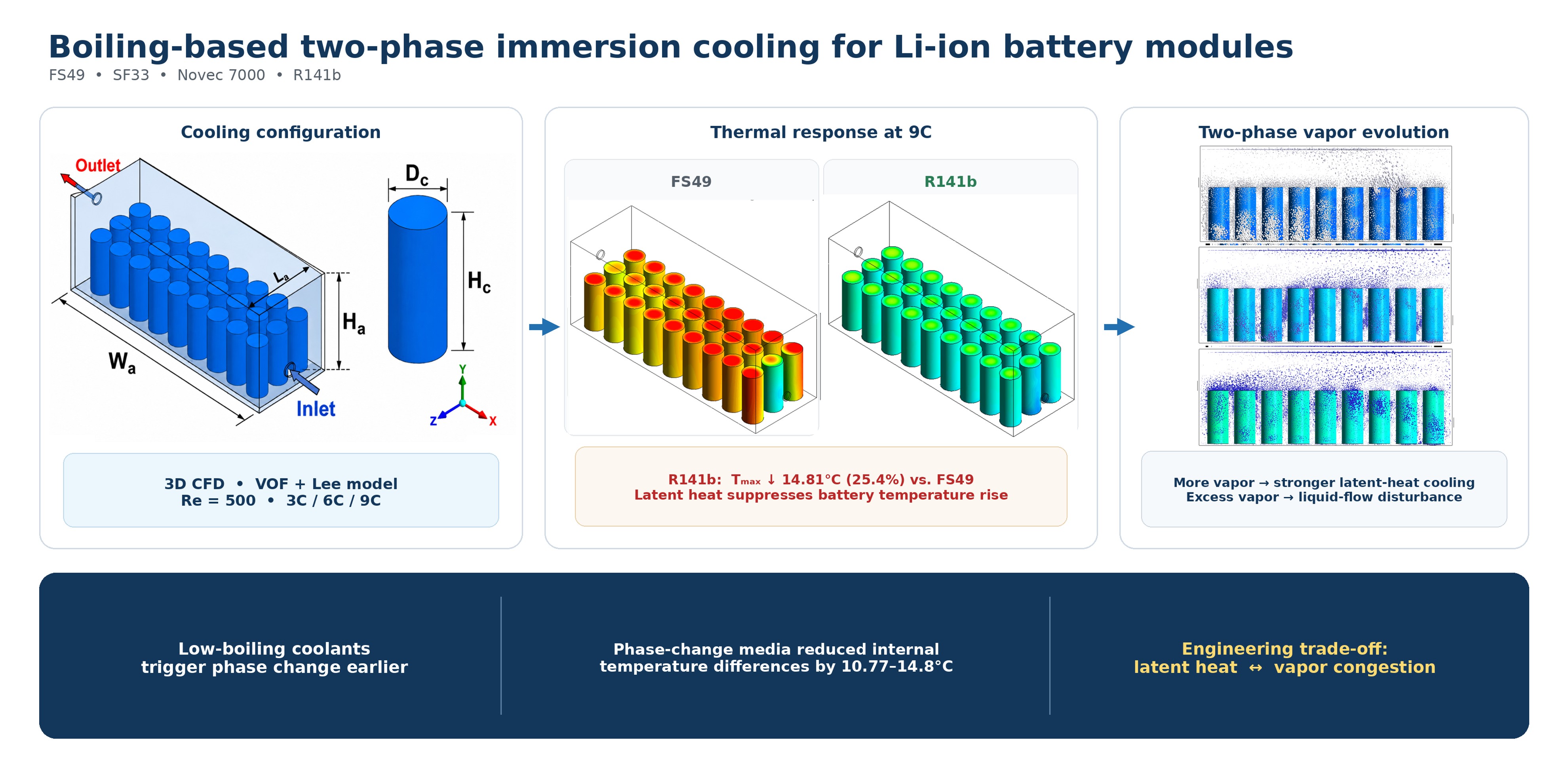
In this numerical study, a boiling-based two-phase immersion cooling system is designed for lithium-ion batteries. However, systematic cross-coolant comparisons linking boiling onset, vapor generation, and module temperature uniformity under a common hydrodynamic condition remain limited. To address this gap, the Volume of Fluid (VOF) method, together with the transient solution method and the Lee model, is used to simulate boiling, evaporation, and two-phase flow of coolants after heating in the lithium-ion battery cooling module. FS49, SF33, Novec 7000, and R141b are considered as the coolants. All coolant cases were evaluated at a fixed Reynolds number, Re = 500, defined using the liquid-phase inlet properties and the inlet diameter, to provide a common hydrodynamic basis for comparison. The module’s temperature distribution, average temperature, maximum temperature difference, temperature standard deviation, and gas-phase volume fraction results are examined at different discharge rates. At 9C, the low-boiling R141b triggered nucleate boiling earlier, reducing the maximum temperature by 14.81 °C (25.4%) compared to single-phase FS49. The coolant boiling point is identified as a critical parameter; phase-change media reduced internal temperature differences by 10.77–14.8 °C relative to single-phase flow by effectively flattening temperature rise curves via latent heat. R141b, with a gas-phase generation of approximately 0.7, has the highest gas-phase volume fraction among the four coolants, exhibiting superior heat-dissipation capabilities, with an average temperature of only 37.3 °C, a 27.1% reduction compared to FS49. The design of a two-phase immersion cooling system must balance the benefits of latent heat of vaporization against the adverse effects of bubble accumulation on the flow field. Ultimately, this work quantifies the roles of latent heat and convection, offering a vital numerical reference for optimizing high-power battery cooling media and flow configurations.
- Open Access
- Article
Performance Evaluation of Boiling-Based Two-Phase Immersion Cooling for Lithium-Ion Battery Modules Using Different Coolants and Discharge Rates
- Wei-Mon Yan 1,
- Wen-Kai Wang 1,
- Chun-Han Li 2,* and
- Saman Rashidi 3,*
Author Information
Received: 30 July 2026 | Revised: 03 October 2026 | Accepted: 20 October 2026 | Published: 29 October 2026
Abstract
Graphical Abstract
Keywords
lithium-ion battery | boiling-based immersion cooling | latent heat | temperature distribution | lee model
References
- 1.
Bai, P.; Xu, R.; Liu, M.; et al. Thermal Runaway Characteristics of LFP Batteries by Immersion Cooling. ACS Appl. Energy Mater. 2023, 6, 7205–7211. https://doi.org/10.1021/acsaem.3c00904.
- 2.
Guo, L.S.; Wang, Z.R.; Wang, J.H.; et al. Effects of the environmental temperature and heat dissipation condition on the thermal runaway of lithium ion batteries during the charge-discharge process. J. Loss Prev. Process Ind. 2017, 49, 953–960. https://doi.org/10.1016/j.jlp.2017.05.029.
- 3.
Yin, C.; Zhang, Y.; Sheng, L.; et al. Assessments of thermal-runaway behaviors in a NCM811-based cylindrical lithium-ion battery. J. Power Sources 2026, 671, 239555. https://doi.org/10.1016/j.jpowsour.2026.239555.
- 4.
Gong, X.; Wong, S.K.; Ye, H.; et al. Traced state of charge for lithium-ion battery thermal runaway accidents. J. Energy Storage 2026, 148, 120133. https://doi.org/10.1016/j.est.2025.120133.
- 5.
Yang, T.F.; Zheng, L.Z.; Lin, C.Y.; et al. A comprehensive parametric study on thermal aspects of vanadium redox flow batteries. J. Therm. Anal. Calorim. 2023, 148, 14081–14096.
- 6.
Yang, T.F.; Zheng, L.Z.; Teng, L.T.; et al. Performance analysis of vanadium redox flow battery with interdigitated flow channel. Therm. Sci. Eng. Prog. 2024, 47, 102360. https://doi.org/10.1016/j.tsep.2023.102360.
- 7.
Yao, J.; Zhang, T.; Han, Z.; et al. Study on the effect of immersion thermal management for high-current rate fast charging of 21700 Li-ion batteries. J. Energy Storage 2024, 85, 111061. https://doi.org/10.1016/j.est.2024.111061.
- 8.
Xin, Z.; Tang, W.; Yao, W.; et al. A review of thermal management of batteries with a focus on immersion cooling. Renew. Sustain. Energy Rev. 2025, 217, 115751. https://doi.org/10.1016/j.rser.2025.115751.
- 9.
Yang, T.F.; Lin, P.Y.; Lin, C.Y.; et al. Study on thermal aspects of lithium-ion battery packs with phase change material and air cooling system. Case Stud. Therm. Eng. 2024, 53, 103809. https://doi.org/10.1016/j.csite.2023.103809.
- 10.
Qi, W.; Liu, Y.; Wang, X.; et al. Performance enhancement of battery thermal management based on liquid cooling plate channels embedded with non-uniform spiral fin structures. Appl. Therm. Eng. 2026, 300, 131501. https://doi.org/10.1016/j.applthermaleng.2026.131501.
- 11.
Sheng, L.; Wang, H.; Zhang, C.; et al. Experimental study on immersion cooling performance of a lithium-ion battery module for commercial/industrial energy storage at different ambient temperatures. Int. J. Therm. Sci. 2026, 221, 110473. https://doi.org/10.1016/j.ijthermalsci.2025.110473.
- 12.
Huang, H.; Li, W.; Xiong, S.; et al. Single-phase static immersion-cooled battery thermal management system with finned heat pipes. Appl. Therm. Eng. 2024, 254, 123931. https://doi.org/10.1016/j.applthermaleng.2024.123931.
- 13.
Liu, Q.; Sun, C.; Zhang, J.; et al. The electro-thermal equalization behaviors of battery modules with immersion cooling. Appl. Energy 2023, 351, 121826. https://doi.org/10.1016/j.apenergy.2023.121826.
- 14.
Chandrasekaran, M.; Jithin, K.V.; Soundarya, T.; et al. Comprehensive experimental study of battery thermal management using single-phase liquid immersion cooling. J. Energy Storage 2025, 111, 115445. https://doi.org/10.1016/j.est.2025.115445.
- 15.
Wahab, A.; Cifterler, N.; Amjady, N.; et al. Enhancing energy and thermal efficiency of single-phase liquid immersion cooling systems for lithium-ion batteries in electric vehicles. J. Energy Storage 2025, 131, 117365. https://doi.org/10.1016/j.est.2025.117365.
- 16.
Hu, J.; Yu, B.; Chen, Z.; et al. Simulation Study on the Single-Phase Immersion Cooling Performance of Lithium-Ion Battery Packs. Appl. Sci. 2025, 15, 9531. https://doi.org/10.3390/app15179531.
- 17.
Choi, H.; Lee, H.; Kim, J.; et al. Hybrid single-phase immersion cooling structure for battery thermal management under fast-charging conditions. Energy Convers. Manag. 2023, 287, 117053. https://doi.org/10.1016/j.enconman.2023.117053.
- 18.
Li, Y.; Bai, M.; Zhou, Z.; et al. Thermal management for the prismatic lithium-ion battery pack by immersion cooling with Fluorinated liquid. Appl. Therm. Eng. 2024, 257, 124453. https://doi.org/10.1016/j.applthermaleng.2024.124453.
- 19.
Li, C.; Wang, Y.; Sun, Z.; et al. Two-phase immersion liquid cooling system for 4680 Li-ion battery thermal management. J. Energy Storage 2024, 97, 112952. https://doi.org/10.1016/j.est.2024.112952.
- 20.
Liu, X.; Zhou, Z.; Wu, W.T.; et al. Numerical simulation for comparison of cold plate cooling and HFE-7000 immersion cooling in lithium-ion battery thermal management. J. Energy Storage 2024, 101, 113938. https://doi.org/10.1016/j.est.2024.113938.
- 21.
Williams, N.P.; Trimble, D.; O’Shaughnessy, S.M. An experimental investigation of liquid immersion cooling of a four cell lithium-ion battery module. J. Energy Storage 2024, 86, 111289. https://doi.org/10.1016/j.est.2024.111289.
- 22.
Zhou, H.; Dai, C.; Liu, Y.; et al. Experimental investigation of battery thermal management and safety with heat pipe and immersion phase change liquid. J. Power Sources 2020, 473, 228545. https://doi.org/10.1016/j.jpowsour.2020.228545.
- 23.
Kureshi, D.A.; Nandan, R.; Das, M.K. Improved temperature uniformity and fast charging of high energy density Li-ion battery module via two-phase immersion cooling. Appl. Therm. Eng. 2026, 290, 130105. https://doi.org/10.1016/j.applthermaleng.2026.130105.
- 24.
Bai, H.; Li, X.; Zhou, Z.; et al. Efficient thermal management of lithium-ion battery modules using a simplified two-phase immersion cooling system. Appl. Therm. Eng. 2026, 290, 129993. https://doi.org/10.1016/j.applthermaleng.2026.129993.
- 25.
Banerjee, R.; Nidhul, K. Immersion cooling performance of nanofluid in a cylindrical cell battery pack using two-phase numerical simulations for varying discharge rates: A comparative study. Results Eng. 2025, 25, 104377. https://doi.org/10.1016/j.rineng.2025.104377.
- 26.
Koucheh, A.B.; Sharbati, P.; Ünlü, C.; et al. Comprehensive evaluation of battery cooling mechanisms including two-phase immersion with 3M™ NOVEC™-7000 and 7100. Energy Convers. Manag. 2026, 348, 120780. https://doi.org/10.1016/j.enconman.2025.120780.
- 27.
Lee, W.H. A Pressure Iteration Scheme for Two-Phase Flow Modeling. In Multiphase Transport: Fundamentals, Reactor Safety, Applications; Hemisphere Publishing Corp.: Washington, DC, USA, 1980; Volume 1, pp. 407–432.
- 28.
Kharangate, C.R.; Mudawar, I. Review of computational studies on boiling and condensation. Int. J. Heat Mass Transf. 2017, 108, 1164–1196. https://doi.org/10.1016/j.ijheatmasstransfer.2016.12.065.
- 29.
Alizadehdakhel, A.; Rahimi, M.; Alsairafi, A.A. CFD modeling of flow and heat transfer in a thermosyphon. Int. Commun. Heat Mass Transf. 2010, 37, 312–318. https://doi.org/10.1016/j.icheatmasstransfer.2009.09.002.
- 30.
Zhou, L.; Yang, W.; Li, C.; et al. Numerical Investigation on Thermal Performance of Two-Phase Immersion Cooling Method for High-Power Electronics. Front. Heat Mass Transf. 2024, 22, 157–173. https://doi.org/10.32604/fhmt.2023.045135.
- 31.
Jiang, W.; Lyu, P.; Liu, X.; et al. Temperature equalization strategy in immersion flow boiling battery thermal management: Optimization of flow regime in boiling heat transfer. Appl. Therm. Eng. 2025, 267, 125825. https://doi.org/10.1016/j.applthermaleng.2025.125825.
- 32.
Jiang, W.; Lyu, P.; Liu, X.; et al. Evaluation of thermal performance of immersion flow boiling thermal management in large-scale battery packs with simplified model. Int. Commun. Heat Mass Transf. 2025, 162, 108656. https://doi.org/10.1016/j.icheatmasstransfer.2025.108656.
- 33.
Bernardi, D.; Pawlikowski, E.; Newman, J. A General Energy Balance for Battery Systems. J. Electrochem. Soc. 1985, 132, 5–12. https://doi.org/10.1149/1.2113792.
- 34.
Wang, Y.; Li, C.; Wen, X.; et al. Experimental studies on two-phase immersion liquid cooling for Li-ion battery thermal management. J. Energy Storage 2023, 72, 108748. https://doi.org/10.1016/j.est.2023.108748.
- 35.
Li, Y.; Bai, M.; Zhou, Z.; et al. Experimental investigations of liquid immersion cooling for 18650 lithium-ion battery pack under fast charging conditions. Appl. Therm. Eng. 2023, 227, 120287. https://doi.org/10.1016/j.applthermaleng.2023.120287.
- 36.
Williams, N.P.; Trimble, D.; O’Shaughnessy, S.M. Liquid immersion thermal management of lithium-ion batteries for electric vehicles: An experimental study. J. Energy Storage 2023, 72, 108636. https://doi.org/10.1016/j.est.2023.108636.
- 37.
Williams, N.P.; Trimble, D.; O’Shaughnessy, S.M. Electrochemical-thermal numerical model of a lithium-ion battery under natural convection liquid immersion cooling conditions. Energy Convers. Manag. X 2025, 27, 101062. https://doi.org/10.1016/j.ecmx.2025.101062.


This work is licensed under a Creative Commons Attribution 4.0 International License.
