
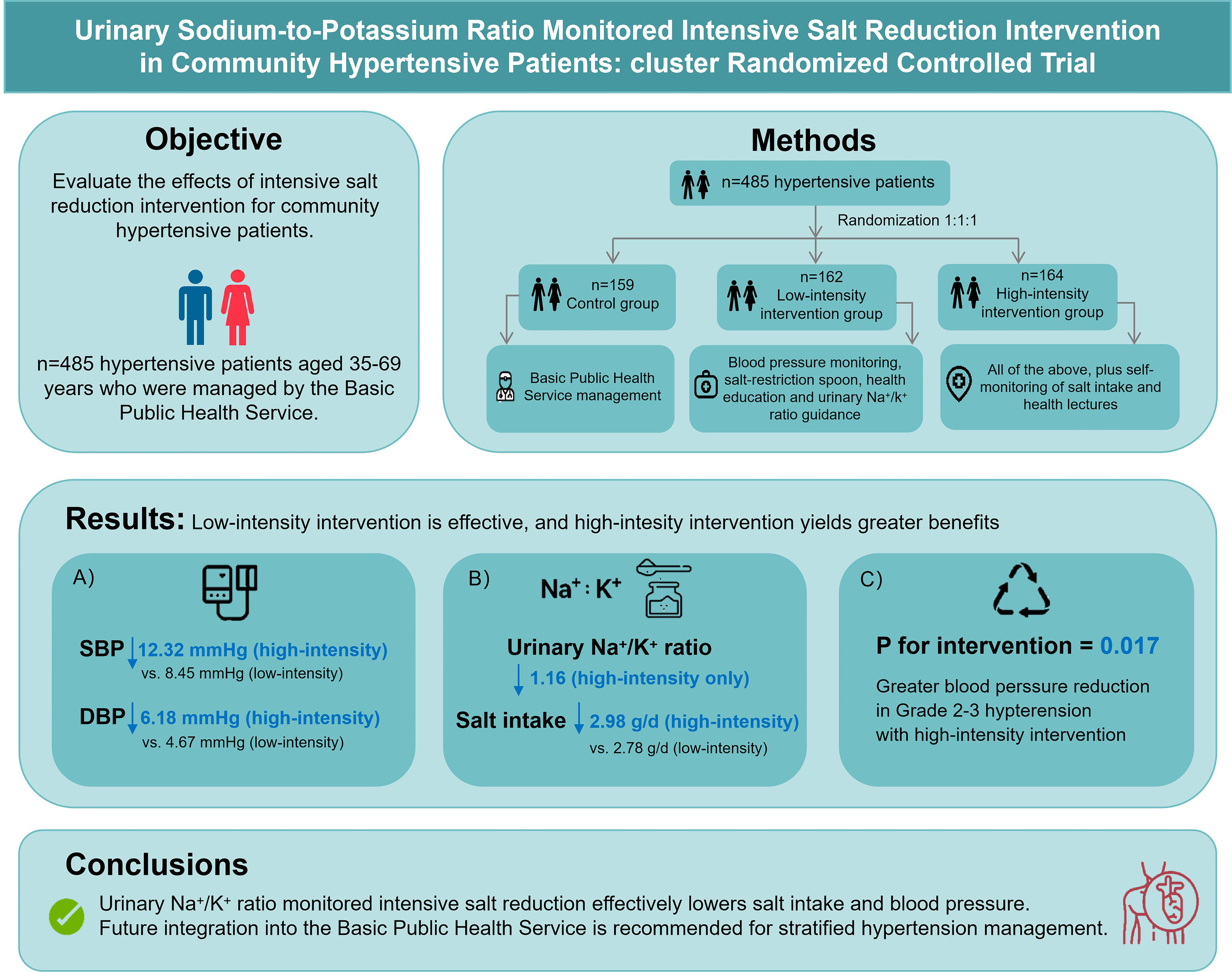
Background: To evaluate the effects of Urinary Sodium-to-Potassium Ratio Monitored Intensive Salt Reduction Intervention for Community Hypertensive Patients. Methods: This cluster randomized controlled trial was carried out between August 2023 and August 2024 in Yishui County, Shandong Province. All participants were asked to complete the blood and urine sample collection, anthropometric measurement, questionnaires at the baseline and one-year post-intervention survey, with dietary surveys conducted in a subset of participants. A total of 485 hypertensive patients aged 35 to 69 years from 15 villages were recruited at the baseline and randomly allocated in a 1:1:1 ratio to the control group, low-intensity intervention group, or high-intensity intervention group. The control group received management according to the Basic Public Health Service. The low-intensity intervention group received blood pressure monitoring, salt-restriction spoons, and health education. The high-intensity intervention group additionally received self-monitoring of salt intake and health lectures. Final survey was conducted after one year. Results: A total of 471 participants completed follow-up assessments. Compared with the control group, adjusted mixed linear model analysis showed that the systolic blood pressure decreased by 8.45 mmHg (95% confidence interval −13.57 to −3.33) in the low-intensity intervention group and 12.32 mmHg (−17.40 to −7.23) in the high-intensity intervention group. The effects of the high-intensity intervention were more pronounced, with salt intake decreasing by 2.98 g/d (−4.56 to −1.41) and spot urinary sodium-to-potassium ratio decreasing by 1.16 (−1.93 to −0.38). The knowledge and behaviors in intervention groups improved significantly. The intervention effect interacted with baseline hypertension grade (p for interaction = 0.017), with high-intensity intervention demonstrating greater blood pressure reductions in patients with grade 2 or 3 hypertension. Conclusions: The urinary sodium-to-potassium ratio monitored intensive salt reduction intervention was effective in lowering salt intake and blood pressure. Future efforts could integrate intensity salt reduction interventions and urinary sodium-to-potassium ratio monitoring into the Basic Public Health Service to improve health outcomes in hypertensive patients.
- Open Access
- Article
Effect of Urinary Sodium-to-Potassium Ratio Monitored Intensive Salt Reduction Intervention in Community Hypertensive Patients: Cluster Randomized Controlled Trial
- Rui Guo 1,†,
- Junli Tang 2,†,
- Danru Liu 2,
- Jie Ren 2,
- Genzhao Yang 3,
- Jing Dong 2,
- Xiaolei Guo 4,*,
- Bingyin Zhang 2,*
Author Information
Received: 17 Mar 2026 | Revised: 27 Apr 2026 | Accepted: 06 May 2026 | Published: 22 Sep 2026
Abstract
Graphical Abstract
Keywords
community hypertension management | Intensive salt reduction intervention | urine sodium-to-potassium ratio
References
- 1.
Meneton, P.; Jeunemaitre, X.; de Wardener, H.E.; et al. Links between Dietary Salt Intake, Renal Salt Handling, Blood Pressure, and Cardiovascular Diseases. Physiol. Rev. 2005, 85, 679–715. https://doi.org/10.1152/physrev.00056.2003.
- 2.
Strazzullo, P.; DʼElia, L.; Kandala, N.-B.; et al. Salt Intake, Stroke, and Cardiovascular Disease: Meta-Analysis of Prospective Studies. BMJ 2009, 339, b4567. https://doi.org/10.1136/bmj.b4567.
- 3.
He, F.J.; Tan, M.; Ma, Y.; et al. Salt Reduction to Prevent Hypertension and Cardiovascular Disease: JACC State-of-the-Art Review. J. Am. Coll. Cardiol. 2020, 75, 632–647. https://doi.org/10.1016/j.jacc.2019.11.055.
- 4.
Global Burden of Cardiovascular Diseases and Risks 2023 Collaborators. Global, Regional, and National Burden of Cardiovascular Diseases and Risk Factors in 204 Countries and Territories, 1990–2023. J. Am. Coll. Cardiol. 2025, 86, 2167–2243. https://doi.org/10.1016/j.jacc.2025.08.015.
- 5.
Chen, X.; Zhong, F.; Li, J. The Burden of Cardiovascular Disease Attributable to Dietary Risk Factors in China, 1990–2021. Sci. Rep. 2025, 15, 25641. https://doi.org/10.1038/s41598-025-11645-z.
- 6.
Song, J.; Tan, M.; Wang, C.; et al. Salt Intake, Blood Pressure and Cardiovascular Disease Mortality in England, 2003–2018. J. Hypertens. 2023, 41, 1713–1720. https://doi.org/10.1097/HJH.0000000000003521.
- 7.
Land, M.-A.; Wu, J.H.Y.; Selwyn, A.; et al. Effects of a Community-Based Salt Reduction Program in a Regional Australian Population. BMC Public Health 2016, 16, 388. https://doi.org/10.1186/s12889-016-3064-3.
- 8.
Moran, A.J.; Wang, J.; Sharkey, A.L.; et al. US Food Industry Progress Toward Salt Reduction, 2009–2018. Am. J. Public Health 2022, 112, 325–333. https://doi.org/10.2105/AJPH.2021.306571.
- 9.
Neal, B.; Wu, Y.; Feng, X.; et al. Effect of Salt Substitution on Cardiovascular Events and Death. N. Engl. J. Med. 2021, 385, 1067–1077. https://doi.org/10.1056/NEJMoa2105675.
- 10.
Hou, L.; Guo, X.; Zhang, J.; et al. Associations Between Salt-Restriction Spoons and Long-Term Changes in Urinary Na+/K+ Ratios and Blood Pressure: Findings from a Population-Based Cohort. J. Am. Heart Assoc. 2020, 9, e014897. https://doi.org/10.1161/JAHA.119.014897.
- 11.
Xu, A.; Ma, J.; Guo, X.; et al. Association of a Province-Wide Intervention with Salt Intake and Hypertension in Shandong Province, China, 2011–2016. JAMA Intern. Med. 2020, 180, 877–886. https://doi.org/10.1001/jamainternmed.2020.0904.
- 12.
Liu, M.; Xu, J.; Li, Y.; et al. A Town-Level Comprehensive Intervention Study to Reduce Salt Intake in China: Cluster Randomized Controlled Trial. Nutrients 2022, 14, 4698. https://doi.org/10.3390/nu14214698.
- 13.
Jackson, S.L.; Cogswell, M.E.; Zhao, L.; et al. Association Between Urinary Sodium and Potassium Excretion and Blood Pressure Among Adults in the United States: National Health and Nutrition Examination Survey, 2014. Circulation 2018, 137, 237–246. https://doi.org/10.1161/CIRCULATIONAHA.117.029193.
- 14.
Yin, L.; Deng, G.; Mente, A.; et al. Association Patterns of Urinary Sodium, Potassium, and Their Ratio with Blood Pressure across Various Levels of Salt‑Diet Regions in China. Sci. Rep. 2018, 8, 6727. https://doi.org/10.1038/s41598-018-25097-1.
- 15.
Bhagavathula, A.S.; Refaat, S.A.; Bentley, B.L.; et al. Association between Intake of Sodium, Potassium, Sodium-to-Potassium Ratio, and Blood Pressure among US Adults. Int. J. Vitam. Nutr. Res. 2023, 93, 392–400. https://doi.org/10.1024/0300-9831/a000740.
- 16.
Xie, Y.; Qi, H.; Peng, W.; et al. Higher Potassium Intake and Lower Sodium Intake May Help in Reducing CVD Risk by Lowering Salt Sensitivity of Blood Pressure in the Han Chinese Population. Nutrients 2022, 14, 4436. https://doi.org/10.3390/nu14204436.
- 17.
Iwahori, T.; Miura, K.; Ueshima, H.; et al. Estimating 24-h Urinary Sodium/Potassium Ratio from Casual (“Spot”) Urinary Sodium/Potassium Ratio: The INTERSALT Study. Int. J. Epidemiol. 2017, 46, 1564–1572. https://doi.org/10.1093/ije/dyw287.
- 18.
Kogure, M.; Hirata, T.; Nakaya, N.; et al. Multiple Measurements of the Urinary Sodium-to-Potassium Ratio Strongly Related Home Hypertension: TMM Cohort Study. Hypertens. Res. 2020, 43, 62–71. https://doi.org/10.1038/s41440-019-0335-2.
- 19.
Zhou, W.; Mao, X.; Dong, Y.; et al. Analysis on Implementation Progress of Basic Public Health Service Projects in Jiangxi Province from 2017 to 2023. Medicine 2025, 104, e46591. https://doi.org/10.1097/MD.0000000000046591.
- 20.
Qin, J.; Zhang, Y.; Fridman, M.; et al. The Role of the Basic Public Health Service Program in the Control of Hypertension in China: Results from a Cross-Sectional Health Service Interview Survey. PLoS ONE 2021, 16, e0217185. https://doi.org/10.1371/journal.pone.0217185.
- 21.
Zhang, J.; Zhang, B.; Tang, J.; et al. Deaths and Life Expectancy Losses Attributed to High-Salt Diet in Shandong Province. Zhonghua Liu Xing Bing Xue Za Zhi 2021, 42, 527–530. https://doi.org/10.3760/cma.j.cn112338-20200306-00268.
- 22.
Anderson, C.A.M.; Appel, L.J.; Okuda, N.; et al. Dietary Sources of Sodium in China, Japan, the United Kingdom, and the United States, Women and Men Aged 40 to 59 Years: The INTERMAP Study. J. Am. Diet. Assoc. 2010, 110, 736–745. https://doi.org/10.1016/j.jada.2010.02.007.
- 23.
Du, X.; Zhu, Y.; Guo, J.; et al. Effect of Salt Reduction Interventions in Lowering Blood Pressure and Salt Intake in Zhejiang Province, China, 2017–2021: A Randomized Controlled Trial. Nutrients 2025, 17, 893. https://doi.org/10.3390/nu17050893.
- 24.
Duus, C.L.; Nielsen, S.F.; Hornstrup, B.G.; et al. Self-Performed Dietary Sodium Reduction and Blood Pressure in Patients with Essential Hypertension: A Randomized Clinical Trial. J. Am. Heart Assoc. 2024, 13, e034632. https://doi.org/10.1161/JAHA.124.034632.
- 25.
Grover, S.; Mishra, H.P.; Gupta, R.; et al. Effect of Telemonitoring and Home Blood Pressure Monitoring on Blood Pressure Reduction in Hypertensive Adults: A Network Meta-Analysis. J. Hypertens. 2025, 43, 1091–1098. https://doi.org/10.1097/HJH.0000000000004008.
- 26.
Jin, A.; Xie, W.; Wu, Y. Effect of Salt Reduction Interventions in Lowering Blood Pressure in Chinese Populations: A Systematic Review and Meta-Analysis of Randomised Controlled Trials. BMJ Open 2020, 10, e032941. https://doi.org/10.1136/bmjopen-2019-032941.
- 27.
Sonuch, P.; Aekplakorn, W.; Pomsanthia, N.; et al. Community-Based Intervention for Monitoring of Salt Intake in Hypertensive Patients: A Cluster Randomized Controlled Trial. PLoS ONE 2024, 19, e0311908. https://doi.org/10.1371/journal.pone.0311908.
- 28.
Takada, T.; Imamoto, M.; Sasaki, S.; et al. Effects of Self-Monitoring of Daily Salt Intake Estimated by a Simple Electrical Device for Salt Reduction: A Cluster Randomized Trial. Hypertens. Res. 2018, 41, 524–530. https://doi.org/10.1038/s41440-018-0046-0.
- 29.
Shimoyama, M.; Kawamoto, S.; Nakatani, Y.; et al. Effects of Salt Intake Reduction by Urinary Sodium to Potassium Ratio Self-Monitoring Method. Hypertens. Res. 2024, 47, 1852–1860. https://doi.org/10.1038/s41440-024-01655-1.
- 30.
Zhang, X.; Zhang, P.; Shen, D.; et al. Effect of Home Cook Interventions for Salt Reduction in China: Cluster Randomised Controlled Trial. BMJ 2023, 382, e074258. https://doi.org/10.1136/bmj-2022-074258.
- 31.
Zhang, W.; Neupane, D.; Zhao, Z.; et al. Knowledge and Practices Related to Salt Consumption in China: Findings from a National Representative Cross-Sectional Survey. J. Hum. Hypertens. 2024, 38, 155–167. https://doi.org/10.1038/s41371-023-00861-7.
- 32.
Mizuta, E.; Kitada, K.; Nagata, S.; et al. Effect of Population-Based Sodium Reduction Interventions on Blood Pressure: A Systematic Review and Meta-Analysis of Randomized Trials. Hypertens. Res. 2025, 48, 1899–1910. https://doi.org/10.1038/s41440-025-02181-4.
- 33.
Sanoff, S.L.; Klemmer, P.J.; Neelon, F.A.; et al. Treating Malignant Hypertension with the Low-Sodium, Low-Protein, and Low-Fat Rice Diet. Hypertension 2026, 83, 26–36. https://doi.org/10.1161/HYPERTENSIONAHA.125.25073.

This work is licensed under a Creative Commons Attribution 4.0 International License.

 Suite 4002 Level 4, 447 Collins Street, Melbourne, Victoria 3000, Australia
 General Inquiries: info@sciltp.com