
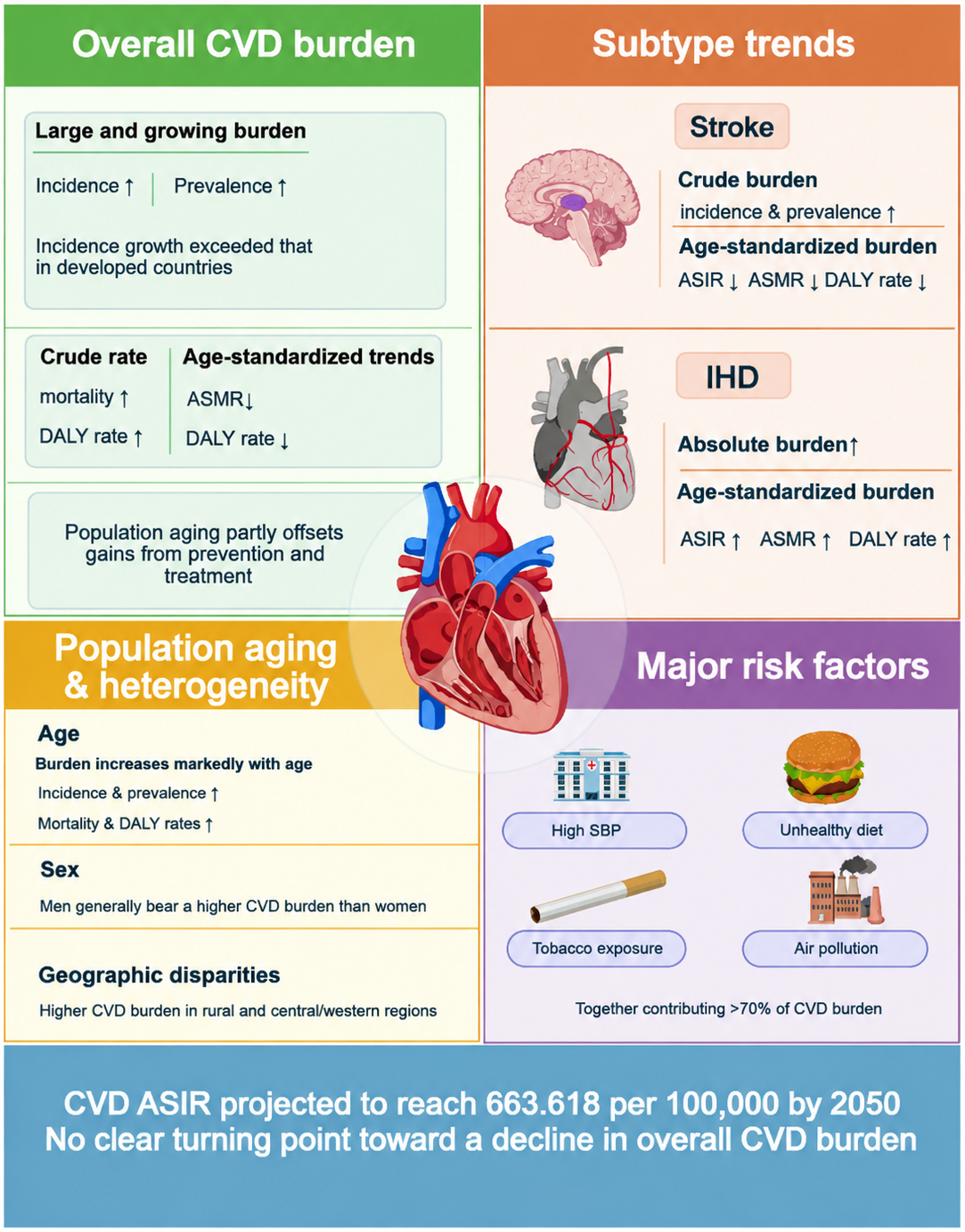
Objective: To describe the current situation and trends of cardiovascular disease burden in China, and the progress and challenges of prevention and control. Methods: The electronic online databases of PubMed, Web of Science, ScienceDirect, China National Knowledge Infrastructure, and Wanfang Data were utilized to systematically search published articles in China, the long-term trends of cardiovascular disease prevalence, incidence rate, mortality and disability adjusted life years were systematically reviewed, and the risk factors, population differences and regional distribution characteristics were discussed. Results: From 1990 to 2019, the prevalence and incidence rate of cardiovascular diseases in China increased by 99.75% and 93.75%, respectively. The age-standardized incidence rate showed an upward trend, in contrast to the global downward trend. The burden of subtypes such as ischemic heart disease and stroke continues to increase, particularly in rural areas, the elderly, and the central and western regions; High systolic blood pressure, unhealthy diet, smoking, and air pollution are the main attributable risk factors, contributing over 70% of the disease burden. Conclusion: Although the age-standardized mortality rate and disability adjusted life year rate have decreased, the aging population has offset the intervention effect, and the inflection point of disease burden has not yet appeared. Precise prevention and control strategies need to be implemented for key populations, subtypes, and regions.
- Open Access
- Review Article
Burden and Trends of Cardiovascular Disease in China over the Past 30 Years
Author Information
Received: 26 Apr 2026 | Revised: 28 Jul 2026 | Accepted: 07 Sep 2026 | Published: 24 Sep 2026
Abstract
Graphical Abstract
Keywords
cardiovascular disease | disease burden | prevalence | incidence rate | mortality rate
References
- 1.
Han, Y. Drive the high-quality development of China’s cardiovascular disease with scientific and technological innovation (in Chinese). Chin. J. Cardiol. 2021, 49, 1–2. https://doi.org/10.3760/cma.j.cn112148-20201204-00962.
- 2.
National Center for Cardiovascular Diseases. Annual Report on Cardiovascular Health and Diseases in China (2024) (in Chinese); Peking Union Medical College Press: Beijing, China, 2025.
- 3.
Yang, J.; Zhang, Y.; Ma, T.; et al. Epidemic status, disease burden and prediction of cardiovascular diseases in China, 1990–2019 (in Chinese). Chin. Gen. Pract. 2024, 27, 233–244. https://doi.org/10.12114/j.issn.1007-9572.2023.0470.
- 4.
Zheng, C.; Wang, X.; Gu, R.; et al. The burden of cardiovascular disease in China: Incidence estimates from national surveillance (2023). J. Am. Coll. Cardiol. 2026, 87, 1453–1465. https://doi.org/10.1016/j.jacc.2025.08.060.
- 5.
Lv, D.; Guo, Y.; Wang, Y.; et al. Burden and medical expenses of cardiovascular disease hospitalizations attributable to non-optimum temperature in China. Environ. Res. 2025, 285, 122671. https://doi.org/10.1016/j.envres.2025.122671.
- 6.
Pei, X.; Tang, H.; Zheng, C.; et al. Incidence and burden of cardiovascular disease attributable to extreme heat in China. Eur. J. Prev. Cardiol. 2026, 33, 1846–1855. https://doi.org/10.1093/eurjpc/zwaf643.
- 7.
Shi, Y.; Xu, X.; Liu, X.; et al. Trends in cardiovascular diseases burden in China, 1990–2023: A global burden of disease analysis. JACC Asia 2026, 6, 1733–1746. https://doi.org/10.1016/j.jacasi.2026.05.005.
- 8.
Zhang, Y.; Du, R.; Zhang, X.; et al. Spatial-temporal characteristics and prediction of ischemic heart disease burden in the working population aged 15 to 59 years in China. Front. Cardiovasc. Med. 2025, 12, 1643717. https://doi.org/10.3389/fcvm.2025.1643717.
- 9.
Zhang, C.; Yang, P.; Yi, Q. The burden of ischemic heart disease among women of childbearing age in China from 1990 to 2021, and projections for the next 15 years. BMC Women’s Health 2025, 25, 220. https://doi.org/10.1186/s12905-025-03773-5.
- 10.
Shi, L.; Bao, C.; Wen, Y.; et al. Analysis and comparison of the trends in burden of rheumatic heart disease in China and worldwide from 1990 to 2019. BMC Cardiovasc. Disord. 2023, 23, 517. https://doi.org/10.1186/s12872-023-03552-w.
- 11.
Chen, W.; Wei, J.; Zheng, X.; et al. Burden of non-rheumatic valvular heart disease globally and in China from 1990 to 2021: A systematic analysis for the global burden of disease study 2021. Front. Cardiovasc. Med. 2025, 12, 1641448.
- 12.
Wang, M.L.; Wei, C.; Xu, Y.; et al. The disease burden of degenerative mitral valve disease in the Chinese population from 1990 to 2019 (in Chinese). Chin. J. Cardiol. 2022, 50, 172–178. https://doi.org/10.3760/cma.j.cn112148-20211029-00933.
- 13.
Wu, R.; Zhong, X. National burden and future projections of hypertensive heart disease in China: A GBD 2021 analysis. Curr. Probl. Cardiol. 2026, 51, 103273. https://doi.org/10.1016/j.cpcardiol.2026.103273.
- 14.
Wu, J.; Wang, Y.; Li, S.; et al. Epidemiological trends, risk factor contributions, and future projections of cardiovascular disease among Chinese adults ≥45 years: Insights from GBD 2021 and CHARLS. Exp. Gerontol. 2026, 216, 113072. https://doi.org/10.1016/j.exger.2026.113072.
- 15.
Fan, W.P.; Yu, X.H.; Qi, J.L.; et al. Analysis of the trend changes in the burden of cardiovascular disease mortality in China from 2010 to 2021 (in Chinese). Chin. J. Epidemiol. 2025, 46, 1562–1569. https://doi.org/10.3760/cma.j.cn112338-20250109-00024.
- 16.
Zhu, M.; Jin, W.; He, W.; et al. The incidence, mortality and disease burden of cardiovascular diseases in China: A comparative study with the United States and Japan based on the GBD 2019 time trend analysis. Front. Cardiovasc. Med. 2024, 11, 1408487. https://doi.org/10.3389/fcvm.2024.1408487.
- 17.
Wang, H.; Zhang, H.; Zou, Z. Changing profiles of cardiovascular disease and risk factors in China: A secondary analysis for the global burden of disease study 2019. Chin. Med. J. 2023, 136, 2431–2441. https://doi.org/10.1097/cm9.0000000000002741.
- 18.
Cao, X.; Zhao, Z.; Kang, Y.; et al. The burden of cardiovascular disease attributable to high systolic blood pressure across China, 2005–18: A population-based study. Lancet Public Health 2022, 7, e1027–e1040. https://doi.org/10.1016/s2468-2667(22)00232-8.
- 19.
Chen, X.; Zhong, F.; Li, J. The burden of cardiovascular disease attributable to dietary risk factors in China, 1990–2021. Sci. Rep. 2025, 15, 25641. https://doi.org/10.1038/s41598-025-11645-z.
- 20.
Tian, Y.; Cao, X.; Wang, X.; et al. LDL-C–related cardiovascular burden in China 2010 to 2030: Spatiotemporal patterns and scenario-based projections. J. Am. Coll. Cardiol. 2026, 87, 1418–1432. https://doi.org/10.1016/j.jacc.2025.09.1592.
- 21.
Cao, X.; Tian, Y.; Zhao, Z.; et al. Disparities in high fasting plasma glucose-related cardiovascular disease burden in China. Nat. Commun. 2024, 15, 8817. https://doi.org/10.1038/s41467-024-53236-y.
- 22.
Liu, Y.R.; Chen, Q.M.; Liu, M.; et al. Cardiovascular diseases burden attributed to low physical activity in China, 1990–2019 (in Chinese). Chin. J. Epidemiol. 2024, 45, 105–111. https://doi.org/10.3760/cma.j.cn112338-20230511-00291.
- 23.
Zhang, T.; Jiang, H.; Xu, X.; et al. Non-communicable disease burden in China, 1990–2023: Evidence from the global burden of disease study 2023. Chin. Med. J. 2026, 139, 48–57. https://doi.org/10.1097/cm9.0000000000003898.
- 24.
Liu, H.; Yin, P.; Qi, J.; et al. Burden of non-communicable diseases in China and its provinces, 1990–2021: Results from the global burden of disease study 2021. Chin. Med. J. 2024, 137, 2325–2333. https://doi.org/10.1097/cm9.0000000000003270.
- 25.
Liu, S.; Li, Y.; Zeng, X.; et al. Burden of cardiovascular diseases in China, 1990–2016: Findings from the 2016 global burden of disease study. JAMA Cardiol. 2019, 4, 342–352. https://doi.org/10.1001/jamacardio.2019.0295.
- 26.
Liang, D.; Yang, C.; Lin, X.; et al. Burden of cardiovascular diseases attributable to diabetes among Chinese adults from 1990 to 2019 (in Chinese). Chin. Gen. Pract. 2024, 27, 1380–1386. https://doi.org/10.12114/j.issn.1007-9572.2023.0627.
- 27.
Lin, Z.; Ren, T.; Wang, Z.; et al. Burden of ischemic heart disease in China from 1990 to 2021: Data from the global disease burden database 2021. Int. J. Cardiol. Cardiovasc. Risk Prev. 2025, 27, 200489. https://doi.org/10.1016/j.ijcrp.2025.200489.
- 28.
Wu, J.; Zhai, J.; Zhu, X.; et al. Epidemiological characteristics of ischemic heart disease: A comparative study between China and the world from 1990 to 2021 and prediction to 2036. PLoS ONE 2025, 20, e0336963. https://doi.org/10.1371/journal.pone.0336963.
- 29.
Zhang, Y.; Li, H.; Chu, J.; et al. Trends and projections of burden of ischemic heart disease in China versus other G20 countries: A comparative study based on the 2021 global burden of disease database. Glob. Heart 2025, 20, 37. https://doi.org/10.5334/gh.1424.
- 30.
Shi, Y.; Zhang, K.; Tang, S.; et al. Ischemic Heart Disease in G20 countries: Forecasted burden and regional disparities based on GBD 2023 estimates. Catheter. Cardiovasc. Interv. 2026. https://doi.org/10.1002/ccd.70783.
- 31.
Sun, W.; Li, P.; Ni, Q.; et al. Global, regional, and national burden of ischemic heart disease in youths and young adults aged 15–39 years in 204 countries/territories, 1990–2021: A systematic analysis of global burden of disease study 2021. Front. Cardiovasc. Med. 2025, 12, 1649408. https://doi.org/10.3389/fcvm.2025.1649408.
- 32.
Hou, X.Z.; Wu, Q.; Yang, Y.T.; et al. The epidemiology and burden of atherosclerotic cardiovascular disease in China from 1990 to 2021: Findings from the global burden of disease 2021. Front. Public Health 2025, 13, 1529506. https://doi.org/10.3389/fpubh.2025.1529506.
- 33.
Guan, C.; Wu, S.; Xu, W.; et al. Global, regional, and national burden of ischaemic heart disease and its trends, 1990–2019. Public Health 2023, 223, 57–66. https://doi.org/10.1016/j.puhe.2023.07.010.
- 34.
Li, C.; Xu, X.; Zhang, H.; et al. The evolving burden of ischemic heart disease in China, 1990–2023: Three decades of trends, risk factors, and future challenges. Am. J. Prev. Cardiol. 2026, 26, 101413. https://doi.org/10.1016/j.ajpc.2026.101413.
- 35.
Xu, S.; Liu, Z.; Tang, M.; et al. Burden, risk factors, and projections of ischemic heart disease in China (1990–2021): Findings from the 2021 GBD study. Front. Cardiovasc. Med. 2025, 12, 1549147. https://doi.org/10.3389/fcvm.2025.1549147.
- 36.
Liang, P.; Kang, J.; Liu, J.; et al. Trends and projections of ischemic heart disease burden in the belt and road countries and China from 1990 to 2021: A study based on the 2021 global burden of disease. Ann. Med. 2025, 57, 2534100. https://doi.org/10.1080/07853890.2025.2534100.
- 37.
Su, W.; Zhang, Y.; Ma, S. Trend and prediction analysis of the changing disease burden of ischemic heart disease in China and worldwide from 1990 to 2019 (in Chinese). Chin. Gen. Pract. 2024, 27, 2375–2381. https://doi.org/10.12114/j.issn.1007-9572.2023.0498.
- 38.
Jing, S.; Chen, A.; Xia, Y.; et al. Global burden of ischemic heart disease from 1990 to 2021: Findings from the global burden of disease study 2021 and predictions to 2030. Chin. Med. J. 2026, 139, 1181–1190. https://doi.org/10.1097/cm9.0000000000004006.
- 39.
Yang, L.; Zheng, B.; Gong, Y. Global, regional and national burden of ischemic heart disease and its attributable risk factors from 1990 to 2021: A systematic analysis of the global burden of disease study 2021. BMC Cardiovasc. Disord. 2025, 25, 625. https://doi.org/10.1186/s12872-025-05022-x.
- 40.
Xu, D.; Yang, Z.; Yao, W.; et al. Smoking-attributable ischemic heart disease burden in China from 1990 to 2021 and projections to 2036: A retrospective analysis and forecasting study. Tob. Induc. Dis. 2026, 24, 41. https://doi.org/10.18332/tid/217625.
- 41.
Zhang, G.; Yu, C.; Zhou, M.; et al. Burden of ischaemic heart disease and attributable risk factors in China from 1990 to 2015: Findings from the global burden of disease 2015 study. BMC Cardiovasc. Disord. 2018, 18, 18. https://doi.org/10.1186/s12872-018-0761-0.
- 42.
Li, Y.; Zhang, J. Disease burden and risk factors of ischemic heart disease in China during 1990–2019 based on the global burden of disease 2019 report: A systematic analysis. Front. Public Health 2022, 10, 973317. https://doi.org/10.3389/fpubh.2022.973317.
- 43.
Safiri, S.; Karamzad, N.; Singh, K.; et al. Burden of ischemic heart disease and its attributable risk factors in 204 countries and territories, 1990–2019. Eur. J. Prev. Cardiol. 2022, 29, 420–431. https://doi.org/10.1093/eurjpc/zwab213.
- 44.
Zhang, M.N.; Li, M.T.; Zhi, X.Y.; et al. Trends of a burden on atherosclerotic cardiovascular disease and its related risk factors in China, 1990 to 2019 (in Chinese). Chin. J. Epidemiol. 2021, 42, 1797–1803. https://doi.org/10.3760/cma.j.cn112338-20201208-01390.
- 45.
Tian, Y.; Zhao, Z.; Cao, X.; et al. Rapid increasing burden of diabetes and cardiovascular disease caused by high body mass index in 1.25 million Chinese adults, 2005–2018. Med 2023, 4, 505–525.e3. https://doi.org/10.1016/j.medj.2023.05.008.
- 46.
Huang, H.; Sun, Q.; Lv, W.; et al. Global, regional, and national burden of ischemic heart disease attributable to environmental risk factors from 1990 to 2021: A systematic analysis based on the 2021 global burden of disease study. Front. Public Health 2025, 13, 1630811. https://doi.org/10.3389/fpubh.2025.1630811.
- 47.
Zhu, Z.; Shi, M.; Yu, Q.; et al. Burden and risk factors of stroke worldwide and in China: An analysis from the global burden of disease study 2021. Chin. Med. J. 2025, 138, 2588–2595. https://doi.org/10.1097/cm9.0000000000003778.
- 48.
Fu, L.; Jiang, W.; Peng, Y.; et al. Burden of stroke in China from 1990 to 2023: Analysis from the global burden of disease study 2023. Online J. Public Health Inf. 2026, 18, e86225. https://doi.org/10.2196/86225.
- 49.
Feigin, V.L.; Volovici, V.; Brainin, M.; et al. The latest global stroke fact sheet 1990–2023: Global burden of disease study. Neuroepidemiology 2026. 1–18. https://doi.org/10.1159/000552065.
- 50.
Lv, B.; Song, G.; Jing, F.; et al. Mortality from cerebrovascular diseases in China: Exploration of recent and future trends. Chin. Med. J. 2024, 137, 588–595.
- 51.
Guo, Y.; Jiang, J.; Cao, F.; et al. Disease burden based on gender and age and risk factors for stroke in China, 2019 (in Chinese). J. Cent. South Univ. Med. Sci. 2023, 48, 1217–1224. https://doi.org/10.11817/j.issn.1672-7347.2023.220561.
- 52.
Xiong, J.; Chen, S.; Wu, X.; et al. Aging China’s cardiac challenge: Projected growth of atrial arrhythmia cases and healthcare preparedness through 2045—A global burden disease analysis. Geriatr. Gerontol. Int. 2025, 25, 1047–1057. https://doi.org/10.1111/ggi.70089.
- 53.
Tian, W.; Zhu, G.; Xiao, W.; et al. Stroke burden and attributable risk factors in China, 1990–2019. Front. Neurol. 2023, 14, 1193056.
- 54.
Wang, J.; Xiao, C.; Cheng, Z.; et al. Analysis and prediction of disease burden of stroke and its subtypes in China from 1990 to 2040. Chin. Med. J. 2025, 138, 2452–2463. https://doi.org/10.1097/cm9.0000000000003725.
- 55.
Wang, H.; Wang, X.; Wang, J.; et al. Temporal trends and epidemiological impact of metabolic risk factors on stroke burden in Chinese individuals aged 65 and older, 1992–2021. Front. Neurol. 2025, 16, 1607823. https://doi.org/10.3389/fneur.2025.1607823.
- 56.
Ma, Q.; Li, R.; Wang, L.; et al. Temporal trend and attributable risk factors of stroke burden in China, 1990–2019: An analysis for the global burden of disease study 2019. Lancet Public Health 2021, 6, e897–e906. https://doi.org/10.1016/s2468-2667(21)00228-0.
- 57.
Peng, R.; Yang, L.; Ye, X.; et al. Burden of disease for stroke attributable to ambient PM (2.5) exposure in China 1990–2019 (in Chinese). J. Hyg. Res. 2022, 51, 604–609. https://doi.org/10.19813/j.cnki.weishengyanjiu.2022.04.018.
- 58.
Yin, P.; Cai, Y.; Liu, J.M.; et al. Disease burden attributable to household air pollution in 1990 and 2013 in China (in Chinese). Chin. J. Prev. Med. 2017, 51, 53–57. https://doi.org/10.3760/cma.j.issn.0253-9624.2017.01.011.
- 59.
Cui, J.; Xu, Z.; Dai, Y.; et al. Temporal trends of ischemic stroke attributable to diet high in sodium in China from the global burden of disease study 2021. Front. Nutr. 2025, 12, 1513981. https://doi.org/10.3389/fnut.2025.1513981.
- 60.
Zhou, X.; Liu, J.; Li, X. Comparative analysis of global and Chinese trends in the burden of ischemic stroke attributable to secondhand smoke from 1990–2021. Tob. Induc. Dis. 2025, 23, 78. https://doi.org/10.18332/tid/204510.
- 61.
Ding, N.; Fan, R.; Zhang, X.; et al. Trend and burden of ischemic stroke attributable to high body mass index in China from 1990 to 2021, with projection to 2044. PLoS ONE 2025, 20, e0335616. https://doi.org/10.1371/journal.pone.0335616.
- 62.
Wang, N.; Wang, Y.; Lv, Q.; et al. Global burden of disease attributable to high fasting plasma glucose from 1990 to 2021: A spatiotemporal analysis of global burden of disease 2021. Front. Cardiovasc. Med. 2026, 13, 1679255. https://doi.org/10.3389/fcvm.2026.1679255.
- 63.
Qi, J.Y.; Wang, C.R.; Liu, M.; et al. Analysis on disease burden of stroke in China and the regions with different sociodemographic index from 1990 to 2017 (in Chinese). Chin. J. Prev. Med. 2021, 55, 958–964. https://doi.org/10.3760/cma.j.cn112150-20201013-01274.
- 64.
Wu, H.; Wang, Y.; Zhang, H.; et al. An investigation into the health status of the elderly population in China and the obstacles to achieving healthy aging. Sci. Rep. 2024, 14, 31123. https://doi.org/10.1038/s41598-024-82443-2.
- 65.
Wang, Y.; Jiang, J.; Zhu, Z. Trends in disease burden of type 2 diabetes, stroke, and hypertensive heart disease attributable to high BMI in China: 1990–2019. Open Med. 2024, 19, 20241087. https://doi.org/10.1515/med-2024-1087.
- 66.
Liu, L.; Yang, Y.; Zhao, Y.; et al. Burden of stroke and its risk factors in Yunnan province of China, 1990–2017. Int. J. Qual. Health Care 2023, 35, mzac101. https://doi.org/10.1093/intqhc/mzac101.
- 67.
Wang, Z.; Pei, W.; Gou, M.; et al. Analysis of diet-related stroke disease burden in China from 1990 to 2021 and projections for 2025–2044. Front. Nutr. 2025, 12, 1571916. https://doi.org/10.3389/fnut.2025.1571916.


This work is licensed under a Creative Commons Attribution 4.0 International License.

 Suite 4002 Level 4, 447 Collins Street, Melbourne, Victoria 3000, Australia
 General Inquiries: info@sciltp.com