
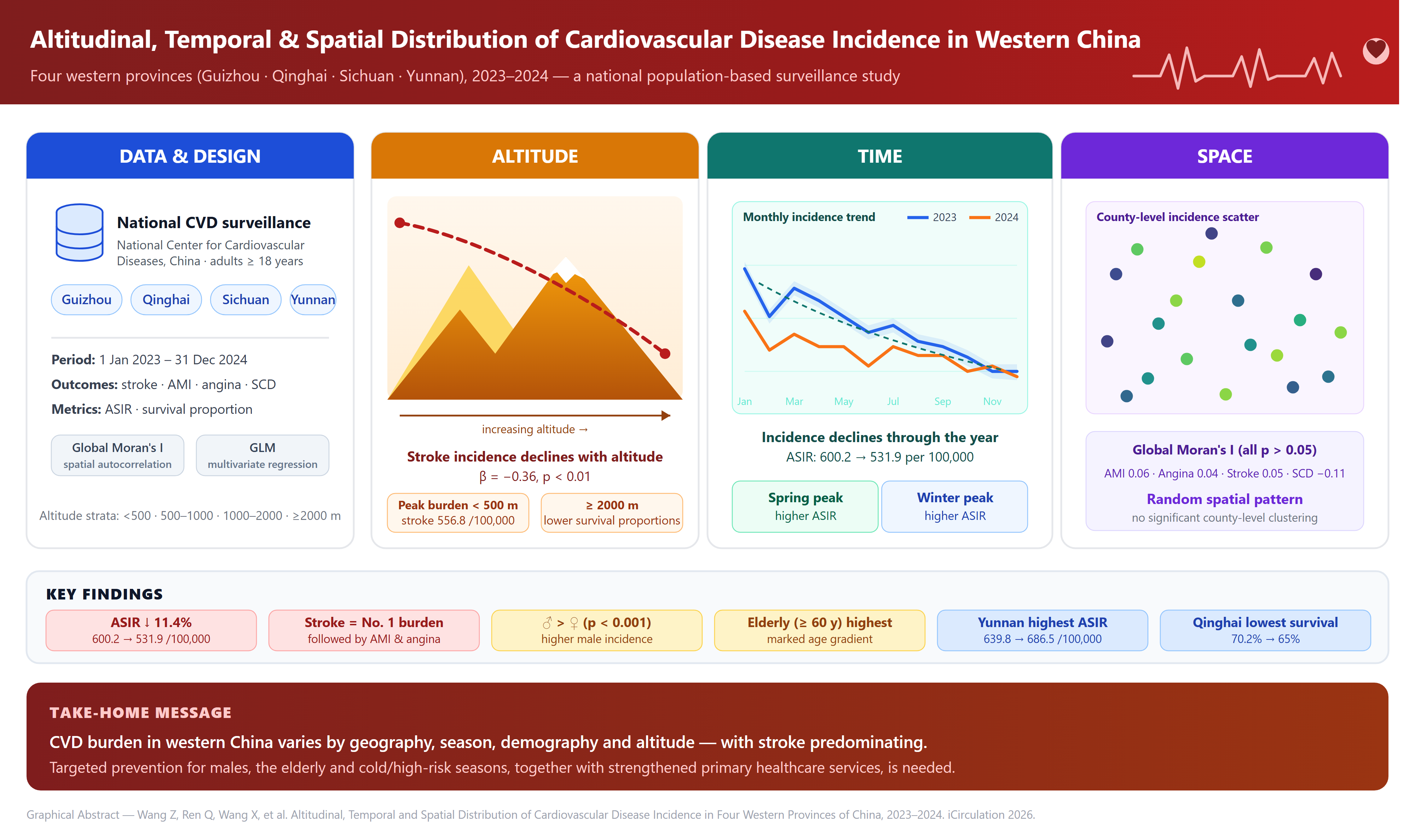
Background: Western China, characterized by high altitude, hypoxia, cold climate, and large seasonal temperature variations, exhibits a high level of cardiovascular disease (CVD) incidence, yet the underlying environmental risk factors remain poorly understood. Methods: CVD data were obtained from the national surveillance database managed by the National Center for Cardiovascular Diseases, China. Disease burden was assessed using incidence rate and age-standardized incidence rate (ASIR). Spatial autocorrelation was evaluated using Global Moran’s I, and a generalized linear model (GLM) was employed for multivariable analysis. Results: The overall ASIR decreased from 600.21 per 100,000 in 2023 to 531.92 per 100,000 in 2024. Regional variation was evident, with Yunnan showing consistently higher incidence and Qinghai exhibiting the lowest survival. Stroke accounted for the largest proportion of CVD burden. Males and older individuals had higher incidence levels, while seasonal peaks occurred in spring and winter. Descriptive analyses suggested differences in incidence across altitude strata, but multivariable regression revealed no independent association between altitude and CVD incidence. Conclusions: CVD incidence in western China varies by region, season, and population, with stroke predominating. Higher rates occur in males and the elderly, highlighting the need for targeted prevention strategies and strengthened primary healthcare services.
- Open Access
- Research Article
Altitudinal, Temporal and Spatial Distribution of Cardiovascular Disease Incidence in Four Western Provinces (Guizhou, Qinghai, Sichuan and Yunnan) of China, 2023–2024
- Zhuo Wang 1,†,
- Qian Ren 1,†,
- Xin Wang 2,†,
- Congyi Zheng 2,
- Xuyan Pei 2,
- Qinglan Jia 2,
- Yujin He 1,
- Yuxin Zha 1,
- Xiaoyun Qin 1,
- Yaqi Liu 1,
- Rui He 1,
- Kui Ji 1,
- Bo Zhong 1,*,
- Zengwu Wang 2,*
Author Information
Received: 30 Apr 2026 | Revised: 07 Sep 2026 | Accepted: 09 Sep 2026 | Published: 23 Sep 2026
Abstract
Graphical Abstract
Keywords
cardiovascular diseases | altitude | temporal distribution | spatial epidemiology | western China
References
- 1.
Global, Regional, and National Burden of Cardiovascular Diseases and Risk Factors in 204 Countries and Territories, 1990–2023. J. Am. Coll. Cardiol. 2025, 86, 2167–2243. https://doi.org/10.1016/j.jacc.2025.08.015.
- 2.
King, S.J.; Wangdak Yuthok, T.Y.; Bacong, A.M.; et al. Heart disease mortality in the United States, 1970 to 2022. J. Am. Heart Assoc. 2025, 14, e038644. https://doi.org/10.1161/jaha.124.038644.
- 3.
Shi, Y.; Xu, X.; Liu, X.; et al. Trends in Cardiovascular Diseases Burden in China, 1990–2023: A Global Burden of Disease Analysis. JACC Asia 2026, 6, 1733–1746. https://doi.org/10.1016/j.jacasi.2026.05.005.
- 4.
National Center for Cardiovascular Diseases The Writing Committee of the Report on Cardiovascular Health and Diseases in China. Report on cardiovascular health and diseases in China 2023: An updated summary. Biomed. Environ. Sci. 2024, 37, 949–992. https://doi.org/10.3967/bes2024.162
- 5.
Zheng, C.; Wang, X.; Gu, R.; et al. The Burden of Cardiovascular Disease in China: Incidence Estimates from National Surveillance (2023). J. Am. Coll. Cardiol. 2026, 87, 1453–1465. https://doi.org/10.1016/j.jacc.2025.08.060
- 6.
Rajendran, A.; Minhas, A.S.; Kazzi, B.; et al. Sex-specific differences in cardiovascular risk factors and implications for cardiovascular disease prevention in women. Atherosclerosis 2023, 384, 117269. https://doi.org/10.1016/j.atherosclerosis.2023.117269.
- 7.
Li, W.; Shen, C.; Kong, W.; et al. Association between the triglyceride glucose-body mass index and future cardiovascular disease risk in a population with Cardiovascular-Kidney-Metabolic syndrome stage 0–3: A nationwide prospective cohort study. Cardiovasc. Diabetol. 2024, 23, 292. https://doi.org/10.1186/s12933-024-02352-6.
- 8.
Yang, K.; Hou, R.; Zhao, J.; et al. Lifestyle effects on aging and CVD: A spotlight on the nutrient-sensing network. Ageing Res. Rev. 2023, 92, 102121. https://doi.org/10.1016/j.arr.2023.102121.
- 9.
Kulkarni, A.; Kulkarni, C.C.; Pradeep, S.R.; et al. Role of Anti-Inflammatory and Antioxidant Properties of Natural Products in Curing Cardiovascular Diseases. Curr. Issues Mol. Biol. 2025, 47, 955. https://doi.org/10.3390/cimb47110955.
- 10.
Tabas, I.; Bornfeldt, K.E. Intracellular and Intercellular Aspects of Macrophage Immunometabolism in Atherosclerosis. Circ. Res. 2020, 126, 1209–1227. https://doi.org/10.1161/circresaha.119.315939.
- 11.
He, Q.; Wang, M.; Liu, K.; et al. GPRChinaTemp1km: A high-resolution monthly air temperature data set for China (1951–2020) based on machine learning. Earth Syst. Sci. Data 2022, 14, 3273–3292. https://doi.org/10.5194/essd-14-3273-2022.
- 12.
The Writing Committee of the Report on Cardiovascular Health and Diseases in China; Hu, S.S. Report on cardiovascular health and diseases in China 2021: An updated summary. J. Geriatr. Cardiol. 2023, 20, 399–430. https://doi.org/10.26599/1671-5411.2023.06.001.
- 13.
Li, Z.; Jiang, Y.; Li, H.; et al. China’s response to the rising stroke burden. BMJ 2019, 364, l879. https://doi.org/10.1136/bmj.l879.
- 14.
Tu, W.J.; Wang, L.D. China stroke surveillance report 2021. Mil. Med. Res. 2023, 10, 33. https://doi.org/10.1186/s40779-023-00463-x.
- 15.
Pan, L.; Yang, Z.; Wu, Y.; et al. The prevalence, awareness, treatment and control of dyslipidemia among adults in China. Atherosclerosis 2016, 248, 2–9. https://doi.org/10.1016/j.atherosclerosis.2016.02.006.
- 16.
He, Y.; Li, Y.; Yang, X.; et al. The dietary transition and its association with cardiometabolic mortality among Chinese adults, 1982–2012: A cross-sectional population-based study. Lancet Diabetes Endocrinol. 2019, 7, 540–548. https://doi.org/10.1016/s2213-8587(19)30152-4.
- 17.
Martin, S.S.; Aday, A.W.; Almarzooq, Z.I.; et al. 2024 Heart Disease and Stroke Statistics: A Report of US and Global Data from the American Heart Association. Circulation 2024, 149, e347–e913. https://doi.org/10.1161/cir.0000000000001209.
- 18.
Timmis, A.; Petersen, S.E.; Van Belle, E.; et al. European Society of Cardiology: Cardiovascular disease statistics 2025. Eur. Heart J. 2026, 47, 3499–3543. https://doi.org/10.1093/eurheartj/ehag345.
- 19.
Prust, M.L.; Forman, R.; Ovbiagele, B. Addressing disparities in the global epidemiology of stroke. Nat. Rev. Neurol. 2024, 20, 207–221. https://doi.org/10.1038/s41582-023-00921-z.
- 20.
Regitz-Zagrosek, V.; Gebhard, C. Gender medicine: Effects of sex and gender on cardiovascular disease manifestation and outcomes. Nat. Rev. Cardiol. 2023, 20, 236–247. https://doi.org/10.1038/s41569-022-00797-4.
- 21.
Tian, F.; Chen, L.; Qian, Z.M.; et al. Ranking age-specific modifiable risk factors for cardiovascular disease and mortality: Evidence from a population-based longitudinal study. EClinicalMedicine 2023, 64, 102230. https://doi.org/10.1016/j.eclinm.2023.102230.
- 22.
Kaneko, H.; Yano, Y.; Okada, A.; et al. Age-Dependent Association Between Modifiable Risk Factors and Incident Cardiovascular Disease. J. Am. Heart Assoc. 2023, 12, e027684. https://doi.org/10.1161/jaha.122.027684.
- 23.
Stewart, S.; Keates, A.K.; Redfern, A.; et al. Seasonal variations in cardiovascular disease. Nat. Rev. Cardiol. 2017, 14, 654–664. https://doi.org/10.1038/nrcardio.2017.76.
- 24.
Chen, J.; Yang, J.; Zhou, M.; et al. Cold spell and mortality in 31 Chinese capital cities: Definitions, vulnerability and implications. Environ. Int. 2019, 128, 271–278. https://doi.org/10.1016/j.envint.2019.04.049.
- 25.
Richalet, J.P.; Hermand, E.; Lhuissier, F.J. Cardiovascular physiology and pathophysiology at high altitude. Nat. Rev. Cardiol. 2024, 21, 75–88. https://doi.org/10.1038/s41569-023-00924-9.
- 26.
Miele, C.H.; Schwartz, A.R.; Gilman, R.H.; et al. Increased Cardiometabolic Risk and Worsening Hypoxemia at High Altitude. High. Alt. Med. Biol. 2016, 17, 93–100.
- 27.
Bhatnagar, A. Environmental Determinants of Cardiovascular Disease. Circ. Res. 2017, 121, 162–180. https://doi.org/10.1161/circresaha.117.306458.
- 28.
Mallet, R.T.; Burtscher, J.; Gatterer, H.; et al. Reduced cardiovascular mortality at moderate altitude: A putative role of physical activity and body mass. J. Physiol. 2025. https://doi.org/10.1113/jp290022.
- 29.
Gerken, J.; Huber, N.; Zapata, D.; et al. Does altitude have an effect on stroke mortality and hospitalization risk? A comprehensive evaluation of United States data. Front. Stroke 2023, 2, 1223255. https://doi.org/10.3389/fstro.2023.1223255.


This work is licensed under a Creative Commons Attribution 4.0 International License.

 Suite 4002 Level 4, 447 Collins Street, Melbourne, Victoria 3000, Australia
 General Inquiries: info@sciltp.com