
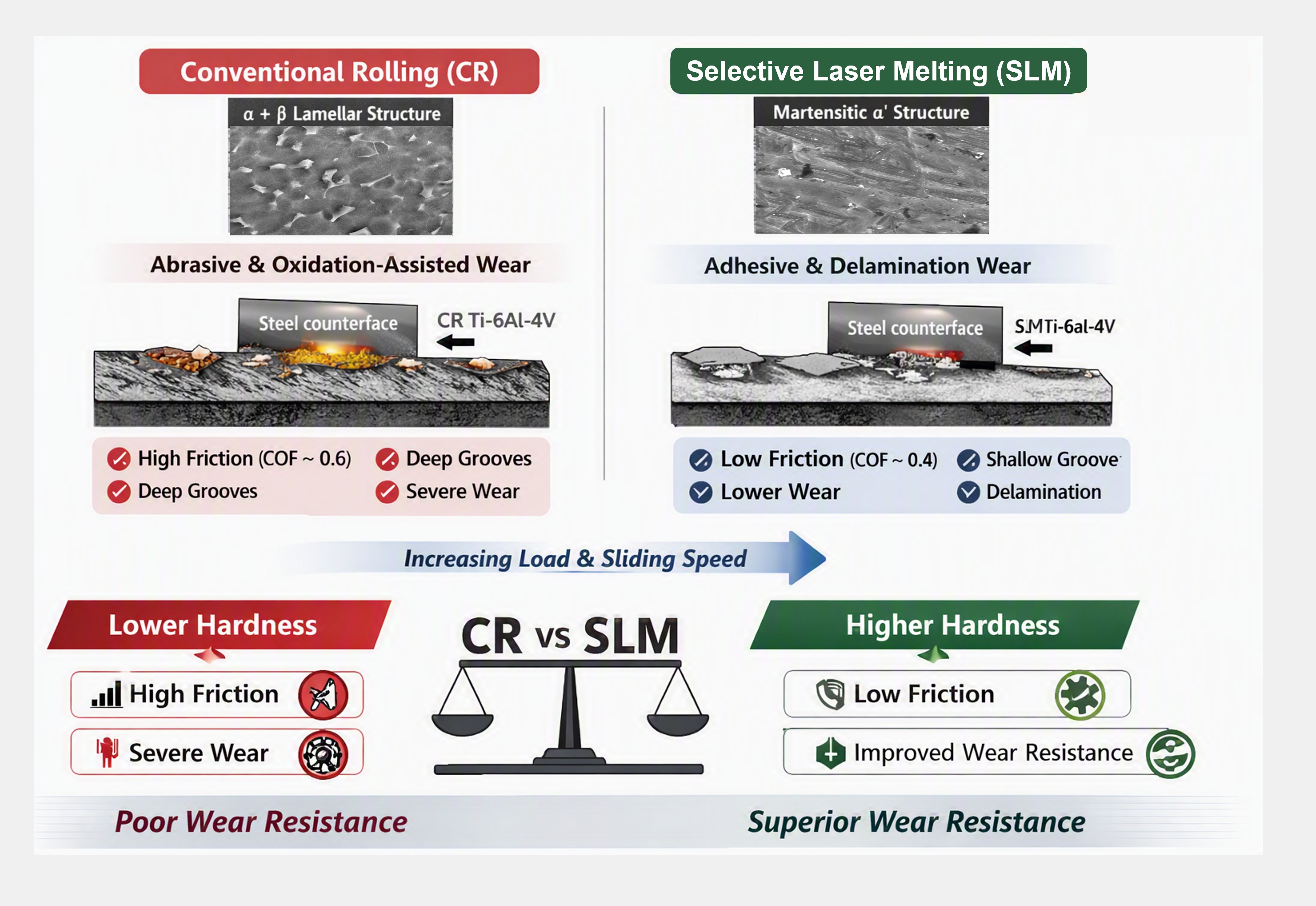
This work presents a detailed assessment of the microstructural features and tribological behaviour of Ti6Al4V alloy produced by conventional casting followed by rolling (CR) and selective laser melting (SLM). The two fabrication routes yield markedly different microstructures: the CR alloy develops a dualphase α + β microstructure, whereas the SLM alloy forms a fine martensitic α′ lath morphology with enhanced hardness. Tribological experiments performed under various loads and sliding speeds reveal clear distinctions in frictional response and wear characteristics. The CR samples exhibit deeper ploughing grooves, stronger oxidation effects, and higher coefficients of friction, indicating that abrasive and oxidationassisted wear dominate their surface degradation. In contrast, the SLM samples show shallower wear tracks, reduced friction, and improved resistance to material removal, with delamination and adhesive wear occurring only under more severe test conditions. The lower COF and diminished wear severity observed in the SLM alloy highlight the advantages of its refined microstructure in stabilizing interfacial contact and reducing frictional energy losses. Overall, the results confirm the superior tribological performance of SLMprocessed Ti6Al4V for applications demanding high wear resistance and structural reliability.
- Open Access
- Article
Tribological Behavior of Ti-6Al-4V Alloys Processed by Selective Laser Melting and Conventional Casting Process
- Anil Kumar Chaubey 1,
- Sameer Sahoo 1 and
- K. G. Prashanth 2,3,4,*
Author Information
Received: 15 September 2026 | Revised: 22 October 2026 | Accepted: 25 October 2026 | Published: 06 November 2026
Abstract
Graphical Abstract
Keywords
additive manufacturing | laser powder bed fusion | Ti-6Al-4V | tribology | wear properties
References
- 1.
Abd-Elaziem, W.; Darwish, M.A.; Hamada, A.; et al. Titanium-Based alloys and composites for orthopedic implants Applications: A comprehensive review. Mater. Des. 2024, 241, 112850. https://doi.org/10.1016/j.matdes.2024.112850.
- 2.
Voisin, T.; Monchoux, J.P.; Couret, A. Near-Net Shaping of Titanium-Aluminum Jet Engine Turbine Blades by SPS. In Spark Plasma Sintering of Materials; Springer International Publishing: Cham, Switzerland, 2019; pp. 713–737. https://doi.org/10.1007/978-3-030-05327-7_25.
- 3.
Singh, N.; Hameed, P.; Ummethala, R.; et al. Selective laser manufacturing of Ti-based alloys and composites: Impact of process parameters, application trends, and future prospects. Mater. Today Adv. 2020, 8, 100097. https://doi.org/10.1016/j.mtadv.2020.100097.
- 4.
Li, Y.; Wang, X.; Yang, S.; et al. Investigation on Wear Behavior of Cryogenically Treated Ti-6Al-4V Titanium Alloy under Dry and Wet Conditions. Materials 2019, 12, 2850. https://doi.org/10.3390/ma12182850.
- 5.
Williams, J.C.; Boyer, R.R. Opportunities and Issues in the Application of Titanium Alloys for Aerospace Components. Metals 2020, 10, 705. https://doi.org/10.3390/met10060705.
- 6.
Arcieri, E.V.; Baragetti, S.; Božić, Ž. Failure analysis of Ti6Al4V titanium alloy under fatigue loading: An experimental and numerical study. Eng. Fail. Anal. 2024, 164, 108715. https://doi.org/10.1016/j.engfailanal.2024.108715.
- 7.
Lalegani Dezaki, M.; Serjouei, A.; Zolfagharian, A.; et al. A review on additive/subtractive hybrid manufacturing of directed energy deposition (DED) process. Adv. Powder Mater. 2022, 1, 100054. https://doi.org/10.1016/j.apmate.2022.100054.
- 8.
Frazier, W.E. Metal Additive Manufacturing: A Review. J. Mater. Eng. Perform. 2014, 23, 1917–1928. https://doi.org/10.1007/s11665-014-0958-z.
- 9.
Khan, P.A.; Raheem, A.; Kalirajan, C.; et al. In Vivo Assessment of a Triple Periodic Minimal Surface Based Biomimmetic Gyroid as an Implant Material in a Rabbit Tibia Model. ACS Mater. Au 2024, 4, 479–488. https://doi.org/10.1021/acsmaterialsau.4c00016.
- 10.
Song, B.; Zhao, X.; Li, S.; et al. Differences in microstructure and properties between selective laser melting and traditional manufacturing for fabrication of metal parts: A review. Front. Mech. Eng. 2015, 10, 111–125. https://doi.org/10.1007/s11465-015-0341-2.
- 11.
Herzog, D.; Seyda, V.; Wycisk, E.; et al. Additive manufacturing of metals. Acta Mater. 2016, 117, 371–392. https://doi.org/10.1016/j.actamat.2016.07.019.
- 12.
Gokuldoss, P.K.; Kolla, S.; Eckert, J. Additive Manufacturing Processes: Selective Laser Melting, Electron Beam Melting and Binder Jetting—Selection Guidelines. Materials 2017, 10, 672. https://doi.org/10.3390/ma10060672.
- 13.
Prashanth, K.G.; Scudino, S.; Klauss, H.J.; et al. Microstructure and mechanical properties of Al–12Si produced by selective laser melting: Effect of heat treatment. Mater. Sci. Eng. A 2014, 590, 153–160. https://doi.org/10.1016/j.msea.2013.10.023.
- 14.
Scudino, S.; Unterdörfer, C.; Prashanth, K.G.; et al. Additive manufacturing of Cu–10Sn bronze. Mater. Lett. 2015, 156, 202–204. https://doi.org/10.1016/j.matlet.2015.05.076.
- 15.
Wang, Z.; Tang, S.Y.; Scudino, S.; et al. Additive manufacturing of a martensitic Co–Cr–Mo alloy: Towards circumventing the strength–ductility trade-off. Addit. Manuf. 2021, 37, 101725. https://doi.org/10.1016/j.addma.2020.101725.
- 16.
Prashanth, K.G.; Debalina, B.; Wang, Z.; et al. Tribological and corrosion properties of Al–12Si produced by selective laser melting. J. Mater. Res. 2014, 29, 2044–2054. https://doi.org/10.1557/jmr.2014.133.
- 17.
Prashanth, K.G.; Scudino, S.; Chaubey, A.K.; et al. Processing of Al–12Si–TNM composites by selective laser melting and evaluation of compressive and wear properties. J. Mater. Res. 2016, 31, 55–65. https://doi.org/10.1557/jmr.2015.326.
- 18.
Bartolomeu, F.; Faria, S.; Carvalho, O.; et al. Predictive models for physical and mechanical properties of Ti6Al4V produced by Selective Laser Melting. Mater. Sci. Eng. A 2016, 663, 181–192. https://doi.org/10.1016/j.msea.2016.03.113.
- 19.
Molinari, A.; Straffelini, G.; Tesi, B.; et al. Dry sliding wear mechanisms of the Ti6Al4V alloy. Wear 1997, 208, 105–112. https://doi.org/10.1016/s0043-1648(96)07454-6.
- 20.
Attar, H.; Prashanth, K.G.; Chaubey, A.K.; et al. Comparison of wear properties of commercially pure titanium prepared by selective laser melting and casting processes. Mater. Lett. 2015, 142, 38–41. https://doi.org/10.1016/j.matlet.2014.11.156.
- 21.
Sieniawski, J.; Ziaja, W.; Kubiak, K.; et al. Microstructure and Mechanical Properties of High Strength Two-Phase Titanium Alloys. In Titanium Alloys—Advances in Properties Control; InTech: Houston, TX, USA, 2013. https://doi.org/10.5772/56197.
- 22.
He, J.; Li, D.; Jiang, W.; et al. The Martensitic Transformation and Mechanical Properties of Ti6Al4V Prepared via Selective Laser Melting. Materials 2019, 12, 321. https://doi.org/10.3390/ma12020321.
- 23.
Karimi, J.; Zhao, C.; Prashanth, K.G. Massive transformation in dual-laser powder bed fusion of Ti6Al4V alloys. J. Manuf. Process. 2024, 119, 282–292. https://doi.org/10.1016/j.jmapro.2024.03.083.
- 24.
Karimi, J.; Suryanarayana, C.; Okulov, I.; et al. Selective laser melting of Ti6Al4V: Effect of laser re-melting. Mater. Sci. Eng. A 2021, 805, 140558. https://doi.org/10.1016/j.msea.2020.140558.
- 25.
Agius, D.; Kourousis, K.I.; Wallbrink, C.; et al. Cyclic plasticity and microstructure of as-built SLM Ti-6Al-4V: The effect of build orientation. Mater. Sci. Eng. A 2017, 701, 85–100. https://doi.org/10.1016/j.msea.2017.06.069.
- 26.
Agius, D.; Kourousis, K.I.; Wallbrink, C. A Review of the As-Built SLM Ti-6Al-4V Mechanical Properties towards Achieving Fatigue Resistant Designs. Metals 2018, 8, 75. https://doi.org/10.3390/met8010075.
- 27.
Zhao, C.; Wang, Z.; Li, D.; et al. Cu-Ni-Sn alloy fabricated by melt spinning and selective laser melting: A comparative study on the microstructure and formation kinetics. J. Mater. Res. Technol. 2020, 9, 13097–13105. https://doi.org/10.1016/j.jmrt.2020.09.047.
- 28.
Jung, H.Y.; Choi, S.J.; Prashanth, K.G.; et al. Fabrication of Fe-based bulk metallic glass by selective laser melting: A parameter study. Mater. Des. 2015, 86, 703–708. https://doi.org/10.1016/j.matdes.2015.07.145.
- 29.
Thijs, L.; Verhaeghe, F.; Craeghs, T.; et al. A study of the microstructural evolution during selective laser melting of Ti–6Al–4V. Acta Mater. 2010, 58, 3303–3312. https://doi.org/10.1016/j.actamat.2010.02.004.
- 30.
Wang, D.; Chen, X.; Li, F.; et al. Influence of normal load, electric current and sliding speed on tribological performance of electrical contact interface. Microelectron. Reliab. 2023, 142, 114929. https://doi.org/10.1016/j.microrel.2023.114929.
- 31.
Grejtak, T.; Gallego, N.C.; Arregui-Mena, J.D.; et al. Sliding friction and wear behavior of nuclear graphite in high temperature inert environment: Influence of contact load, speed and temperature. Wear 2026, 599, 206779. https://doi.org/10.1016/j.wear.2026.206779.
- 32.
Stott, F.H. High-temperature sliding wear of metals. Tribol. Int. 2002, 35, 489–495. https://doi.org/10.1016/s0301-679x(02)00041-5.
- 33.
Du, D.H.; Yu, Z.J.; Tao, F.J.; et al. Effect of softening in near-surface region on wear transition of Ti-6Al-4V alloy at elevated temperatures. IOP Conf. Ser. Mater. Sci. Eng. 2021, 1167, 012014. https://doi.org/10.1088/1757-899x/1167/1/012014.
- 34.
Gowda, H.D.S.; Hemaraju; Kumar, V.G.P.; et al. Optimizing abrasive wear in sustainable MCC reinforced hemp bamboo epoxy composites for tribological applications. Sci. Rep. 2026, 16, 12990. https://doi.org/10.1038/s41598-026-43505-9.
- 35.
Hokkirigawa, K.; Kato, K. An experimental and theoretical investigation of ploughing, cutting and wedge formation during abrasive wear. Tribol. Int. 1988, 21, 51–57. https://doi.org/10.1016/0301-679x(88)90128-4.
- 36.
Pirso, J.; Viljus, M.; Juhani, K.; et al. Three-body abrasive wear of TiC–NiMo cermets. Tribol. Int. 2010, 43, 340–346. https://doi.org/10.1016/j.triboint.2009.06.014.
- 37.
Valizade, N.; Farhat, Z. A Review on Abrasive Wear of Aluminum Composites: Mechanisms and Influencing Factors. J. Compos. Sci. 2024, 8, 149. https://doi.org/10.3390/jcs8040149.
- 38.
So, H. The mechanism of oxidational wear. Wear 1995, 184, 161–167. https://doi.org/10.1016/0043-1648(94)06569-1.
- 39.
Dong, C.; Yuan, C.; Bai, X.; et al. Coupling mechanism between wear and oxidation processes of 304 stainless steel in hydrogen peroxide environments. Sci. Rep. 2017, 7, 2327. https://doi.org/10.1038/s41598-017-02530-5.
- 40.
Liu, Y.; Bai, X.; Cheng, K. A study on the formation of wear debris during abrasion. Tribol. Int. 1985, 18, 107–111. https://doi.org/10.1016/0301-679x(85)90047-7.
- 41.
Jahanmir, S.; Suh, N.P.; Abrahamson, E.P. The delamination theory of wear and the wear of a composite surface. Wear 1975, 32, 33–49. https://doi.org/10.1016/0043-1648(75)90203-3.
- 42.
Söderman, A.; Törnquist, P.L. Galling is a serious issue in many industries that use stainless steel fasteners- but there are solutions. Met. Powder Rep. 2021, 76, 194–195. https://doi.org/10.1016/j.mrpr.2019.07.004.
- 43.
Devenport, T.M.; Griffin, J.M.; Rolfe, B.F.; et al. Friction and Wear in Stages of Galling for Sheet Metal Forming Applications. Lubricants 2023, 11, 288. https://doi.org/10.3390/lubricants11070288.
- 44.
Finkin, E.F. Adhesive wear: A general review of the state of experimental knowledge and theory. Int. J. Mater. Eng. Appl. 1979, 1, 154–161. https://doi.org/10.1016/0141-5530(79)90004-9.
- 45.
Fleming, J.R.; Suh, N.P. Mechanics of crack propagation in delamination wear. Wear 1977, 44, 39–56. https://doi.org/10.1016/0043-1648(77)90083-7.
- 46.
Meng, X.; Lin, Y.; Mi, S.; et al. The Study of Tool Wear Mechanism Considering the Tool–Chip Interface Temperature during Milling of Aluminum Alloy. Lubricants 2023, 11, 471. https://doi.org/10.3390/lubricants11110471.
- 47.
Pan, S.; Li, C.; Zhu, W.; et al. Establishment of an improved wear model for high-temperature contact interfaces and investigation of wear behavior. Wear 2026, 602, 206914. https://doi.org/10.1016/j.wear.2026.206914.
- 48.
Palanikumar, P.; Gnanasekaran, N.; Subrahmanya, K.; et al. Effect of sliding speed and rise in temperature at the contact interface on coefficient of friction during full sliding of SS304. Mater. Today Proc. 2020, 27, 1996–1999. https://doi.org/10.1016/j.matpr.2019.09.046.
- 49.
Waterhouse, R.B.; Taylor, D.E. Fretting debris and the delamination theory of wear. Wear 1974, 29, 337–344. https://doi.org/10.1016/0043-1648(74)90019-2.
- 50.
Han, L.; Qi, H. Dynamic response analysis of helical gear pair considering the interaction between friction and mesh stiffness. Meccanica 2019, 54, 2325–2337. https://doi.org/10.1007/s11012-019-01088-y.
- 51.
Tang, B.; Wu, P.Q.; Fan, A.L.; et al. Improvement of Corrosion-Wear Resistance of Ti-6Al-4V Alloy by Plasma Mo-N Surface Modification. Adv. Eng. Mater. 2005, 7, 232–238. https://doi.org/10.1002/adem.200400207.

This work is licensed under a Creative Commons Attribution 4.0 International License.
