
2605003903
  • Open Access
  • Review

Hard Nanostructured PVD Coatings on Cemented Carbide Cutting Tools for Sustainable Dry High-Speed Milling of Hardened Injection Mould Steels (P20, H13, D2): A Critical Review of Tribological Behaviour, Surface Integrity, Corrosion Resistance, and a Research Roadmap Toward Green Precision Manufacturing

  • Ignatius Ekengwu 1,   
  • Ikechukwu Geoffrey Okoli 2,*

Received: 21 Mar 2026 | Revised: 28 Apr 2026 | Accepted: 12 May 2026 | Published: 02 Jul 2026

Abstract

Cutting-fluid elimination in the finish milling of hardened injection mould steels represents one of the most commercially and environmentally urgent challenges in contemporary precision manufacturing. This review paper presents a unified critical synthesis that simultaneously addresses tribological wear mechanisms, surface integrity outcomes, electrochemical corrosion behaviour, and life-cycle environmental impacts of hard nanostructured physical vapour deposition (PVD) coatings on cemented carbide (WC-Co) end mills across all three industrially dominant mould-steel grades—P20 (32–40 HRC), H13 (44–52 HRC), and D2 (58–62 HRC)—under dry high-speed milling conditions. Drawing on a corpus of 105 primary publications and review articles spanning 2003–2025, we demonstrate that coating architecture, rather than bulk chemical composition alone, is the decisive factor governing tribological stability, and that the AlCrN family—particularly when deposited by high-power impulse magnetron sputtering (HiPIMS)—delivers the most consistent balance of low coefficient of friction (CoF 0.35–0.42 at 500 °C), compressive subsurface residual stress (−600 to −900 MPa in H13 and D2), high oxidation resistance (stable to 1050 °C), and corrosion protection (barrier resistance >10 MΩ·cm2 in 3.5 wt% NaCl). Drawing on evidence consolidated from multiple independent experimental studies, the review highlights the V2O5 tribochemical mechanism as a practically critical constraint on AlCrN performance in H13—A mechanism that prior reviews have acknowledged only in passing. Crucially, this review is the first to quantify the consequent inversion of coating performance rankings (AlCrN vs. TiAlSiN) as a function of cutting speed and workpiece grade in a cross-grade format, providing actionable selection boundaries for each mould-steel grade. A six-theme structured research roadmap is proposed, encompassing vanadium-tolerant graded coating design, toughness engineering in nanocomposites, AI-driven digital-twin process monitoring, standardised surface-integrity reporting, comprehensive life-cycle assessment of HiPIMS and nanocomposite coatings, and finite-element simulation of industrial mould-cavity geometries. These contributions collectively define an actionable path toward certified green precision manufacturing of injection mould cavities.
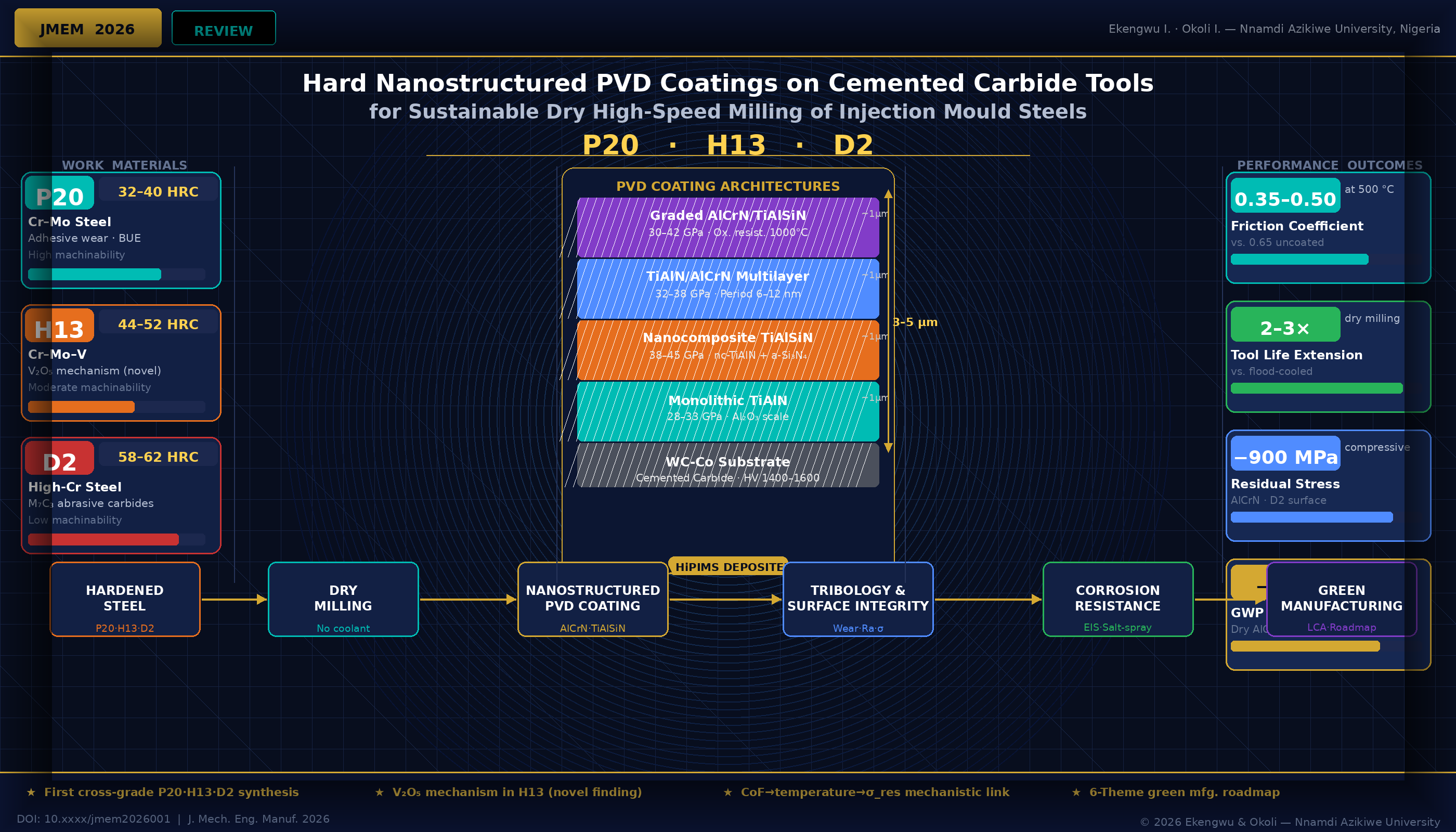
 

Graphical Abstract

References 

  • 1.

    Fallböhmer, P.; Rodríguez, C.A.; Özel, T.; et al. High-Speed Machining of Cast Iron and Alloy Steels for Die and Mold Manufacturing. J. Mater. Process. Technol. 2000, 98, 104–115. https://doi.org/10.1016/S0924-0136(99)00311-8.

  • 2.

    Hu, Y.N.; Wang, C.Y.; Wang, J.L.; et al. Surface Quality Analysis of Milling Hardened Die Steel with Micro-End Mill. In Materials Science Forum; Trans Tech Publications Ltd.: Zurich, Switzerland, 2004; Volume 471–472, pp. 374–379. https://doi.org/10.4028/www.scientific.net/MSF.471-472.374.

  • 3.

    Duflou, J.R.; Sutherland, J.W.; Dornfeld, D.; et al. Towards Energy and Resource Efficient Manufacturing: A Processes and Systems Approach. CIRP Ann. 2012, 61, 587–609. https://doi.org/10.1016/j.cirp.2012.05.002.

  • 4.

    Ren, X.; Liu, Z. Influence of Cutting Parameters on Work Hardening Behavior of Surface Layer during Turning Superalloy Inconel 718. Int. J. Adv. Manuf. Technol. 2016, 86, 2319–2327. https://doi.org/10.1007/s00170-016-8350-9.

  • 5.

    Dandekar, C.R.; Shin, Y.C. Modeling of Machining of Composite Materials: A Review. Int. J. Mach. Tools Manuf. 2012, 57, 102–121. https://doi.org/10.1016/j.ijmachtools.2012.01.006.

  • 6.

    Klocke, F.; Eisenblätter, G. Dry Cutting. CIRP Ann. 1997, 46, 519–526. https://doi.org/10.1016/S0007-8506(07)60877-4.

  • 7.

    Lembke, M.I.; Lewis, D.B.; Münz, W.-D.; et al. Significance of Y and Cr in TiAlN Hard Coatings for Dry High Speed Cutting. Surf. Eng. 2001, 17, 153–158. https://doi.org/10.1179/026708401101517656.

  • 8.

    Veprek, S.; Veprek-Heijman, M.J. Industrial Applications of Superhard Nanocomposite Coatings. Surf. Coat. Technol. 2008, 202, 5063–5073. https://doi.org/10.1016/j.surfcoat.2008.05.038.

  • 9.

    Mayrhofer, P.H.; Mitterer, C.; Hultman, L.; et al. Microstructural Design of Hard Coatings. Prog. Mater. Sci. 2006, 51, 1032–1114. https://doi.org/10.1016/j.pmatsci.2006.02.002.

  • 10.

    Bobzin, K.; Brögelmann, T.; Kalscheuer, C.; et al. (Cr,Al)N and (Cr,Al,Mo)N Hard Coatings for Tribological Applications under Minimum Quantity Lubrication. Tribol. Int. 2019, 140, 105817. https://doi.org/10.1016/j.triboint.2019.06.010.

  • 11.

    Jawahir, I.S.; Brinksmeier, E.; M'Saoubi, R.; et al. Surface Integrity in Material Removal Processes: Recent Advances. CIRP Ann. 2011, 60, 603–626. https://doi.org/10.1016/j.cirp.2011.05.002.

  • 12.

    Benga, G.C.; Abrao, A.M. Turning of Hardened 100Cr6 Bearing Steel with Ceramic and PCBN Cutting Tools. J. Mater. Process. Technol. 2003, 143–144, 237–241. https://doi.org/10.1016/S0924-0136(03)00346-7.

  • 13.

    Chinchanikar, S.; Choudhury, S.K. Machining of Hardened Steel—Experimental Investigations, Performance Modelling and Cooling Techniques: A Review. Int. J. Mach. Tools Manuf. 2015, 89, 95–109. https://doi.org/10.1016/j.ijmachtools.2014.11.002.

  • 14.

    PalDey, S.; Deevi, S.C. Single Layer and Multilayer Wear Resistant Coatings of (Ti,Al)N: A Review. Mater. Sci. Eng. A 2003, 342, 58–79. https://doi.org/10.1016/S0921-5093(02)00259-9.

  • 15.

    Bouzakis, K.-D.; Michailidis, N.; Skordaris, G.; et al. Cutting with Coated Tools: Coating Technologies, Characterisation Methods and Performance Optimisation. CIRP Ann. 2012, 61, 703–723. https://doi.org/10.1016/j.cirp.2012.05.006.

  • 16.

    Bobzin, K. High-Performance Coatings for Cutting Tools. CIRP J. Manuf. Sci. Technol. 2017, 18, 1–9. https://doi.org/10.1016/j.cirpj.2016.11.004.

  • 17.

    Reiter, A.E.; Derflinger, V.H.; Hanselmann, B.; et al. Investigation of the Properties of Al1−xCrxN Coatings Prepared by Cathodic Arc Evaporation. Surf. Coat. Technol. 2005, 200, 2114–2122. https://doi.org/10.1016/j.surfcoat.2005.01.043.

  • 18.

    Fox-Rabinovich, G.S.; Endrino, J.L.; Beake, B.D.; et al. Impact of Annealing on Microstructure, Properties and Cutting Performance of an AlTiN Coating. Surf. Coat. Technol. 2006, 201, 3524–3529. https://doi.org/10.1016/j.surfcoat.2006.08.075.

  • 19.

    Cheng, Y.H.; Browne, T.; Heckerman, B.; et al. Mechanical and Tribological Properties of Nanocomposite TiSiN Coatings. Surf. Coat. Technol. 2010, 204, 2123–2129. https://doi.org/10.1016/j.surfcoat.2009.11.034.

  • 20.

    Rachbauer, R.; Holec, D.; Mayrhofer, P.H. Phase Stability and Decomposition Products of Ti–Al–N Thin Films. Appl. Phys. Lett. 2010, 97, 151901. https://doi.org/10.1063/1.3495783.

  • 21.

    Chinchanikar, S.; Choudhury, S.K. Characteristic of Wear, Force and Their Inter-Relationship: In-Process Monitoring of Tool within Different Phases of the Tool Life. Procedia Mater. Sci. 2014, 5, 1424–1433. https://doi.org/10.1016/j.mspro.2014.07.461.

  • 22.

    Grzesik, W. Influence of Tool Wear on Surface Roughness in Hard Turning Using Differently Shaped Ceramic Tools. Wear 2008, 265, 327–335. https://doi.org/10.1016/j.wear.2007.11.001.

  • 23.

    Marinescu, I.; Axinte, D.A. A Critical Analysis of Effectiveness of Acoustic Emission Signals to Detect Tool and Workpiece Malfunctions in Milling Operations. Int. J. Mach. Tools Manuf. 2008, 48, 1148–1160. https://doi.org/10.1016/j.ijmachtools.2008.01.011.

  • 24.

    Antonov, M.; Hussainova, I.; Veinthal, R.; et al. Effect of Temperature and Load on Three-Body Abrasion of Cermets and Steel. Tribol. Int. 2012, 46, 261–268. https://doi.org/10.1016/j.triboint.2011.06.029.

  • 25.

    Outeiro, J.C.; Umbrello, D.; M'Saoubi, R. Experimental and Numerical Modelling of the Residual Stresses Induced in Orthogonal Cutting of AISI 316L Steel. Int. J. Mach. Tools Manuf. 2006, 46, 1786–1794. https://doi.org/10.1016/j.ijmachtools.2005.11.013.

  • 26.

    Javidi, A.; Rieger, U.; Eichlseder, W. The Effect of Machining on the Surface Integrity and Fatigue Life. Int. J. Fatigue 2008, 30, 2050–2055. https://doi.org/10.1016/j.ijfatigue.2008.01.005.

  • 27.

    Umbrello, D.; Jawahir, I.S. Numerical Modelling of the Influence of Process Parameters and Workpiece Hardness on White Layer Formation in AISI 52100 Steel. Int. J. Adv. Manuf. Technol. 2009, 44, 955–968. https://doi.org/10.1007/s00170-008-1911-9.

  • 28.

    Barry, J.; Byrne, G. TEM Study on the Surface White Layer in Two Turned Hardened Steels. Mater. Sci. Eng. A 2002, 325, 356–364. https://doi.org/10.1016/S0921-5093(01)01447-2.

  • 29.

    Navinsek, B.; Panjan, P.; Milosev, I. Industrial Applications of CrN (PVD) Coatings, Deposited at High and Low Temperatures. Surf. Coat. Technol. 1997, 97, 182–191. https://doi.org/10.1016/S0257-8972(97)00393-9.

  • 30.

    Lukaszkowicz, K.; Sondor, J.; Kriz, A.; et al. Structure, Mechanical Properties and Corrosion Resistance of Nanocomposite Coatings Deposited by PVD Technology onto the X6CrNiMoTi17-12-2 and X40CrMoV5-1 Steel Substrates. J. Mater. Sci. 2010, 45, 1629–1637. https://doi.org/10.1007/s10853-009-4140-1.

  • 31.

    Ding, X.Z.; Tan, A.L.; Zeng, X.T.; et al. Corrosion Resistance of CrAlN and TiAlN Coatings Deposited by Lateral Rotating Cathode Arc. Thin Solid Films 2008, 516, 5716–5720. https://doi.org/10.1016/j.tsf.2007.07.069.

  • 32.

    Araújo, A.G.F.; Naeem, M.; Araújo, L.N.M.; et al. Design, Manufacturing and Plasma Nitriding of AISI-M2 Steel Forming Tool and Its Performance Analysis. J. Mater. Res. Technol. 2020, 9, 14517–14527. https://doi.org/10.1016/j.jmrt.2020.10.048.

  • 33.

    Hovsepian, P.E.; Lewis, D.B.; Münz, W.-D. Recent Progress in Large Scale Manufacturing of Multilayer/Superlattice Hard Coatings. Surf. Coat. Technol. 2000, 133–134, 166–175. https://doi.org/10.1016/S0257-8972(00)00959-2.

  • 34.

    Pusavec, F.; Deshpande, A.; Yang, S.; et al. Sustainable Machining of High Temperature Nickel Alloy—Inconel 718: Part I—Predictive Performance Models. J. Clean. Prod. 2014, 81, 255–269. https://doi.org/10.1016/j.jclepro.2014.06.040.

  • 35.

    Holmberg, K.; Laukkanen, A.; Ronkainen, H.; et al. A Model for Stresses, Crack Generation and Fracture Toughness Calculation in Scratched TiN-Coated Steel Surfaces. Wear 2003, 254, 278–291. https://doi.org/10.1016/S0043-1648(02)00297-1.

  • 36.

    Dureja, J.S.; Gupta, V.K.; Sharma, V.S.; et al. Design Optimization of Cutting Conditions and Analysis of Their Effect on Tool Wear and Surface Roughness during Hard Turning of AISI-H11 Steel with a Coated-Mixed Ceramic Tool. Proc. Inst. Mech. Eng. Part B J. Eng. Manuf. 2009, 223, 1441–1453. https://doi.org/10.1243/09544054jem1498.

  • 37.

    Pfeiler, M.; Kutschej, K.; Penoy, M.; et al. The Influence of Bias Voltage on Structure and Mechanical/Tribological Properties of Arc Evaporated Ti–Al–V–N Coatings. Surf. Coat. Technol. 2007, 202, 1050–1054. https://doi.org/10.1016/j.surfcoat.2007.07.045.

  • 38.

    Carvalho, N.J.M.; De Hosson, J.T.M. Deformation Mechanisms in TiN/(Ti,Al)N Multilayers under Depth-Sensing Indentation. Acta Mater. 2006, 54, 1857–1862. https://doi.org/10.1016/j.actamat.2005.12.010.

  • 39.

    Wan, Z.; Zhang, T.F.; Ding, J.C.; et al. Enhanced Corrosion Resistance of PVD-CrN Coatings by ALD Sealing Layers. Nanoscale Res. Lett. 2017, 12, 244. https://doi.org/10.1186/s11671-017-2020-1.

  • 40.

    Anders, A. A Review Comparing Cathodic Arcs and High Power Impulse Magnetron Sputtering (HiPIMS). Surf. Coat. Technol. 2014, 257, 308–325. https://doi.org/10.1016/j.surfcoat.2014.08.043.

  • 41.

    Lembke, M.I.; Lewis, D.B.; Munz, W.-D. Localised Oxidation Defects in TiAlN/CrN Superlattice Structured Hard Coatings Grown by Cathodic Arc/Unbalanced Magnetron Deposition on Various Substrate Materials. Surf. Coat. Technol. 2000, 125, 263–268. https://doi.org/10.1016/S0257-8972(99)00571-X.

  • 42.

    Gaitonde, V.N.; Karnik, S.R.; Figueira, L.; et al. Analysis of Machinability during Hard Turning of Cold Work Tool Steel (Type: AISI D2). Mater. Manuf. Process. 2009, 24, 1373–1382. https://doi.org/10.1080/10426910902997415.

  • 43.

    García, J.; Ciprés, V.C.; Blomqvist, A.; et al. Cemented Carbide Microstructures: A Review. Int. J. Refract. Met. Hard Mater. 2019, 80, 40–68. https://doi.org/10.1016/j.ijrmhm.2018.12.004.

  • 44.

    Fox-Rabinovich, G.S.; Yamamoto, K.; Veldhuis, S.C.; et al. Tribological Adaptability of TiAlCrN PVD Coatings under High Performance Dry Machining Conditions. Surf. Coat. Technol. 2005, 200, 1804–1813. https://doi.org/10.1016/j.surfcoat.2005.08.057.

  • 45.

    Bagcivan, N.; Bobzin, K.; Theiß, S. (Cr1−xAlx)N: A Comparison of Direct Current, Middle Frequency Pulsed and High Power Pulsed Magnetron Sputtering for Injection Molding Components. Thin Solid Films 2013, 528, 180–186. https://doi.org/10.1016/j.tsf.2012.08.056.

  • 46.

    Bobzin, K.; Bagcivan, N.; Immich, P.; et al. Advantages of Nanocomposite Coatings Deposited by High Power Pulse Magnetron Sputtering Technology. J. Mater. Process. Technol. 2009, 209, 165–170. https://doi.org/10.1016/j.jmatprotec.2008.01.035.

  • 47.

    Karpat, Y.; Özel, T. Predictive Analytical and Thermal Modeling of Orthogonal Cutting Process—Part II: Effect of Tool Flank Wear on Tool Forces, Stresses, and Temperature Distributions. J. Manuf. Sci. Eng. 2006, 128, 445–453. https://doi.org/10.1115/1.2162591.

  • 48.

    Münz, W.-D.; Smith, I.J.; Lewis, D.B.; et al. Droplet Formation on Steel Substrates during Cathodic Steered Arc Metal Ion Etching. Vacuum 1997, 48, 473–481. https://doi.org/10.1016/S0042-207X(96)00307-7.

  • 49.

    Zhang, Y.; Xue, H.; Li, Y.; et al. Effects of Multi-Pass Turning on Stress Corrosion Cracking of AISI 304 Austenitic Stainless Steel. Micromachines 2022, 13, 1745. https://doi.org/10.3390/mi13101745.

  • 50.

    Creasey, S.; Lewis, D.B.; Smith, I.J.; et al. SEM Image Analysis of Droplet Formation during Metal Ion Etching by a Steered Arc Discharge. Surf. Coat. Technol. 1997, 97, 163–175. https://doi.org/10.1016/S0257-8972(97)00137-0.

  • 51.

    Dobrzański, L.A.; Mikuła, J. Structure and Properties of PVD and CVD Coated Al2O3+TiC Mixed Oxide Tool Ceramics for Dry on High Speed Cutting Processes. J. Mater. Process. Technol. 2005, 164–165, 822–831. https://doi.org/10.1016/j.jmatprotec.2005.02.089.

  • 52.

    Vaz, M.; Owen, D.R.J.; Kalhori, V. Modelling and Simulation of Machining Processes. Arch. Comput. Methods Eng. 2007, 14, 173–204. https://doi.org/10.1007/s11831-007-9005-7.

  • 53.

    Brinksmeier, E.; Cammett, J.T.; König, W.; et al. Residual Stresses—Measurement and Causes in Machining Processes. CIRP Ann. 1982, 31, 491–510. https://doi.org/10.1016/S0007-8506(07)60172-3.

  • 54.

    Özel, T.; Altan, T. Process Simulation Using Finite Element Method—Prediction of Cutting Forces, Tool Stresses and Temperatures in High-Speed Flat End Milling. Int. J. Mach. Tools Manuf. 2000, 40, 713–738. https://doi.org/10.1016/S0890-6955(99)00080-2.

  • 55.

    Rech, J.; Kusiak, A.; Battaglia, J.L. Tribological and Thermal Functions of Cutting Tool Coatings. Surf. Coat. Technol. 2004, 186, 364–371. https://doi.org/10.1016/j.surfcoat.2003.11.027.

  • 56.

    Norgren, S.; García, J.; Blomqvist, A.; et al. Trends in the P/M Hard Metal Industry. Int. J. Refract. Met. Hard Mater. 2015, 48, 31–45. https://doi.org/10.1016/j.ijrmhm.2014.07.007.

  • 57.

    Huang, W.; Wan, C.; Wang, G.; et al. Surface Integrity Optimization for Ball-End Hard Milling of AISI D2 Steel Based on Response Surface Methodology. PLoS ONE 2023, 18, e0290760. https://doi.org/10.1371/journal.pone.0290760.

  • 58.

    An, Q.; Wang, C.; Xu, J.; et al. Experimental Investigation on Hard Milling of High Strength Steel Using PVD-AlTiN Coated Cemented Carbide Tool. Int. J. Refract. Met. Hard Mater. 2014, 43, 94–101. https://doi.org/10.1016/j.ijrmhm.2013.11.007.

  • 59.

    Hsu, C.H.; Chen, H.W.; Lin, C.Y.; et al. Effect of N2/Ar Ratio on Wear Behavior of Multi-Element Nitride Coatings on AISI H13 Tool Steel. Materials 2024, 17, 4748. https://doi.org/10.3390/ma17194748.

  • 60.

    Duflou, J.R.; Kellens, K.; Dewulf, W. Unit Process Impact Assessment for Discrete Part Manufacturing: A State of the Art. CIRP J. Manuf. Sci. Technol. 2011, 4, 129–135. https://doi.org/10.1016/j.cirpj.2011.01.008.

  • 61.

    Kellens, K.; Dewulf, W.; Overcash, M.; et al. Methodology for Systematic Analysis and Improvement of Manufacturing Unit Process Life-Cycle Inventory (UPLCI)—CO2PE! Initiative (Cooperative Effort on Process Emissions in Manufacturing). Part 1: Methodology Description. Int. J. Life Cycle Assess. 2012, 17, 69–78. https://doi.org/10.1007/s11367-011-0340-4.

  • 62.

    Linke, B.S.; Corman, G.J.; Dornfeld, D.A.; et al. Sustainability Indicators for Discrete Manufacturing Processes Applied to Grinding Technology. J. Manuf. Syst. 2013, 32, 556–563. https://doi.org/10.1016/j.jmsy.2013.05.005.

  • 63.

    Jeswiet, J.; Hauschild, M. EcoDesign and Future Environmental Impacts. Mater. Des. 2005, 26, 629–634. https://doi.org/10.1016/j.matdes.2004.08.016.

  • 64.

    Denkena, B.; Biermann, D. Cutting Edge Geometries. CIRP Ann. 2014, 63, 631–653. https://doi.org/10.1016/j.cirp.2014.05.009.

  • 65.

    Bhardwaj, B.; Kumar, R.; Singh, P.K. Effect of Machining Parameters on Surface Roughness in End Milling of AISI 1019 Steel. Proc. Inst. Mech. Eng. Part B J. Eng. Manuf. 2014, 228, 704–714. https://doi.org/10.1177/0954405413506417.

  • 66.

    Chinchanikar, S.; Choudhury, S.K. Effect of Work Material Hardness and Cutting Parameters on Performance of Coated Carbide Tool When Turning Hardened Steel: An Optimization Approach. Measurement 2013, 46, 1572–1584. https://doi.org/10.1016/j.measurement.2012.11.032.

  • 67.

    Chang, Y.Y.; Cai, M.C. Mechanical Property and Tribological Performance of AlTiSiN and AlTiBN Hard Coatings Using Ternary Alloy Targets. Surf. Coat. Technol. 2019, 374, 1120–1127. https://doi.org/10.1016/j.surfcoat.2018.01.077.

  • 68.

    Endrino, J.L.; Fox-Rabinovich, G.S.; Reiter, A.; et al. Oxidation Tuning in AlCrN Coatings. Surf. Coat. Technol. 2007, 201, 4505–4511. https://doi.org/10.1016/j.surfcoat.2006.09.089.

  • 69.

    Kutschej, K.; Mayrhofer, P.H.; Kathrein, M.; et al. Structure, Mechanical and Tribological Properties of Sputtered Ti1−xAlxN Coatings with 0.5 ≤ x ≤ 0.75. Surf. Coat. Technol. 2005, 200, 2358–2365. https://doi.org/10.1016/j.surfcoat.2004.12.008.

  • 70.

    Holmberg, K.; Laukkanen, A.; Ronkainen, H.; et al. Tribological Contact Analysis of a Rigid Ball Sliding on a Hard Coated Surface: Part I: Modelling Stresses and Strains. Surf. Coat. Technol. 2006, 200, 3793–3809. https://doi.org/10.1016/j.surfcoat.2005.03.040.

  • 71.

    Koshy, P.; Dewes, R.C.; Aspinwall, D.K. High Speed End Milling of Hardened AISI D2 Tool Steel (~58 HRC). J. Mater. Process. Technol. 2002, 127, 266–273. https://doi.org/10.1016/S0924-0136(02)00155-3.

  • 72.

    Breidenstein, B.; Denkena, B. Significance of Residual Stress in PVD-Coated Carbide Cutting Tools. CIRP Ann. 2013, 62, 67–70. https://doi.org/10.1016/j.cirp.2013.03.101.

  • 73.

    Outeiro, J.C.; Pina, J.C.; M'Saoubi, R.; et al. Analysis of Residual Stresses Induced by Dry Turning of Difficult-to-Machine Materials. CIRP Ann. 2008, 57, 77–80. https://doi.org/10.1016/j.cirp.2008.03.076.

  • 74.

    Ulutan, D.; Ozel, T. Machining Induced Surface Integrity in Titanium and Nickel Alloys: A Review. Int. J. Mach. Tools Manuf. 2011, 51, 250–280. https://doi.org/10.1016/j.ijmachtools.2010.11.003.

  • 75.

    Özel, T.; Zeren, E. Finite Element Method Simulation of Machining of AISI 1045 Steel with a Round Edge Cutting Tool. In Proceedings of the 8th CIRP International Workshop on Modelling of Machining Operations, Chemnitz, Germany, 10–11 May 2005; pp. 533–542.

  • 76.

    Fernández-Abia, A.I.; Barreiro, J.; López de Lacalle, L.N.; et al. Behaviour of Austenitic Stainless Steels at High Speed Turning Using Specific Force Coefficients. Int. J. Adv. Manuf. Technol. 2012, 62, 505–515. https://doi.org/10.1007/s00170-011-3846-9.

  • 77.

    Hovsepian, P.E.; Luo, Q.; Robinson, G.; et al. TiAlN/VN Superlattice Structured PVD Coatings: A New Alternative in Machining of Aluminium Alloys for Aerospace and Automotive Components. Surf. Coat. Technol. 2006, 201, 265–272. https://doi.org/10.1016/j.surfcoat.2005.11.106.

  • 78.

    Münz, W.-D.; Donohue, L.A.; Hovsepian, P.Eh. Properties of Various Large-Scale Fabricated TiAlN- and CrN-Based Superlattice Coatings Grown by Combined Cathodic Arc–Unbalanced Magnetron Sputter Deposition. Surf. Coat. Technol. 2000, 125, 269–277. https://doi.org/10.1016/S0257-8972(99)00572-1.

  • 79.

    Klocke, F.; Brinksmeier, E.; Weinert, K. Capability Profile of Hard Cutting and Grinding Processes. CIRP Ann. 2005, 54, 22–45. https://doi.org/10.1016/S0007-8506(07)60018-3.

  • 80.

    Beatrice, B.A.; Kirubakaran, E.; Thangaiah, P.R.; et al. Surface Roughness Prediction Using Artificial Neural Network in Hard Turning of AISI H13 Steel with Minimal Cutting Fluid Application. Procedia Eng. 2014, 97, 205–211. https://doi.org/10.1016/j.proeng.2014.12.243.

  • 81.

    Bobzin, K.; Brögelmann, T.; Kalscheuer, C. Triboactive CrAlN+X Hybrid dcMS/HPPMS PVD Nitride Hard Coatings for Friction and Wear Reduction on Components. Surf. Coat. Technol. 2017, 332, 452–463. https://doi.org/10.1016/j.surfcoat.2017.06.089.

  • 82.

    Franz, R.; Mitterer, C. Vanadium Containing Self-Adaptive Low-Friction Hard Coatings for High-Temperature Applications: A Review. Surf. Coat. Technol. 2013, 228, 1–13. https://doi.org/10.1016/j.surfcoat.2013.04.034.

  • 83.

    Bobzin, K.; Brögelmann, T.; Kruppe, N.C.; et al. Nanocomposite (Ti,Al,Cr,Si)N HPPMS Coatings for High Performance Cutting Tools. Surf. Coat. Technol. 2019, 378, 124952. https://doi.org/10.1016/j.surfcoat.2019.07.073.

  • 84.

    Baptista, A.; Silva, F.J.G.; Porteiro, J.; et al. Sputtering Physical Vapour Deposition (PVD) Coatings: A Critical Review on Process Improvement and Market Trend Demands. Coatings 2018, 8, 402. https://doi.org/10.3390/coatings8110402.

  • 85.

    Rachbauer, R.; Stergar, E.; Massl, S.; et al. Three-Dimensional Atom Probe Investigations of Ti–Al–N Thin Films. Scr. Mater. 2009, 61, 725–728. https://doi.org/10.1016/j.scriptamat.2009.06.015.

  • 86.

    Musil, J. Hard Nanocomposite Coatings: Thermal Stability, Oxidation Resistance and Toughness. Surf. Coat. Technol. 2012, 207, 50–65. https://doi.org/10.1016/j.surfcoat.2012.05.073.

  • 87.

    Hörling, A.; Hultman, L.; Odén, M.; et al. Mechanical Properties and Machining Performance of Ti1−xAlxN-Coated Cutting Tools. Surf. Coat. Technol. 2005, 191, 384–392. https://doi.org/10.1016/j.surfcoat.2004.04.056.

  • 88.

    Veprek, S.; Veprek-Heijman, M.G.J. The Formation and Role of Interfaces in Superhard nc-MeN/a-Si3N₄ Nanocomposites. Surf. Coat. Technol. 2007, 201, 6064–6070. https://doi.org/10.1016/j.surfcoat.2006.08.112.

  • 89.

    Li, Z.; Munroe, P.; Jiang, Z.T.; et al. Designing Superhard, Self-Toughening CrAlN Coatings through Grain Boundary Engineering. Acta Mater. 2012, 60, 5735–5744. https://doi.org/10.1016/j.actamat.2012.06.049.

  • 90.

    Paulitsch, J.; Schenkel, M.; Zufraß, T.; et al. Structure and Properties of High Power Impulse Magnetron Sputtering and DC Magnetron Sputtering CrN and TiN Films Deposited in an Industrial Scale Unit. Thin Solid Films 2010, 518, 5558–5564. https://doi.org/10.1016/j.tsf.2010.05.062.

  • 91.

    Ahlgren, M.; Blomqvist, H. Influence of Bias Variation on Residual Stress and Texture in TiAlN PVD Coatings. Surf. Coat. Technol. 2005, 200, 157–160. https://doi.org/10.1016/j.surfcoat.2005.02.078.

  • 92.

    Sarakinos, K.; Alami, J.; Konstantinidis, S. High Power Pulsed Magnetron Sputtering: A Review on Scientific and Engineering State of the Art. Surf. Coat. Technol. 2010, 204, 1661–1684. https://doi.org/10.1016/j.surfcoat.2009.11.013.

  • 93.

    Kelly, P.J.; Arnell, R.D. Magnetron Sputtering: A Review of Recent Developments and Applications. Vacuum 2000, 56, 159–172. https://doi.org/10.1016/S0042-207X(99)00189-X.

  • 94.

    Tillmann, W.; Grisales, D.; Stangier, D.; et al. Residual Stresses and Tribomechanical Behaviour of TiAlN and TiAlCN Monolayer and Multilayer Coatings by DCMS and HiPIMS. Surf. Coat. Technol. 2021, 406, 126664. https://doi.org/10.1016/j.surfcoat.2020.126664.

  • 95.

    Abukhshim, N.A.; Mativenga, P.T.; Sheikh, M.A. Heat Generation and Temperature Prediction in Metal Cutting: A Review and Implications for High Speed Machining. Int. J. Mach. Tools Manuf. 2006, 46, 782–800. https://doi.org/10.1016/j.ijmachtools.2005.07.024.

  • 96.

    Wang, J.; Liu, Z.; Wu, Y.; et al. Cutting Performance and Tool Wear of AlCrN- and TiAlN-Coated Carbide Tools during Milling of Tantalum–Tungsten Alloy. Machines 2024, 12, 170. https://doi.org/10.3390/machines12030170.

  • 97.

    Bartkowiak, T.; Brown, C.A. Multiscale 3D Curvature Analysis of Processed Surface Textures of Aluminum Alloy 6061-T6. Materials 2019, 12, 257. https://doi.org/10.3390/ma12020257.

  • 98.

    Wang, F.; Zhao, J.; Li, A.; et al. Effects of Cutting Conditions on Microhardness and Microstructure in High-Speed Milling of H13 Tool Steel. Int. J. Adv. Manuf. Technol. 2014, 73, 137–146. https://doi.org/10.1007/s00170-014-5812-9.

  • 99.

    Bobzin, K.; Brögelmann, T.; Kruppe, N.C.; et al. Influence of HPPMS on Hybrid dcMS/HPPMS (Cr,Al)N Processes. Surf. Coat. Technol. 2019, 358, 57–66. https://doi.org/10.1016/j.surfcoat.2018.11.032.

  • 100.

    Bouzakis, K.D.; Bouzakis, E.; Skordaris, G.; et al. Effect of PVD Films Wet Micro-Blasting by Various Al2O3 Grain Sizes on the Wear Behaviour of Coated Tools. Surf. Coat. Technol. 2011, 205, S128–S132. https://doi.org/10.1016/j.surfcoat.2011.03.046.

  • 101.

    Kadam, G.S.; Pawade, R.S. Surface Integrity and Sustainability Assessment in High-Speed Machining of Inconel 718. J. Clean. Prod. 2017, 147, 273–283. https://doi.org/10.1016/j.jclepro.2017.01.104.

  • 102.

    Beake, B.D.; Smith, J.F.; Gray, A.; et al. Investigating the Correlation between Nano-Impact Fracture Resistance and Hardness/Modulus Ratio from Nanoindentation at 25–500 °C and the Fracture Resistance and Lifetime of Cutting Tools with Ti1−xAlxN (x = 0.5 and 0.67) PVD Coatings in Milling Operations. Surf. Coat. Technol. 2007, 201, 4585–4593. https://doi.org/10.1016/j.surfcoat.2006.09.118.

  • 103.

    Tang, J.F.; Chen, I.H.; Lu, B.R.; et al. Effect of Bias Voltages and Interlayer Design on Microstructure, Mechanical Properties, and Adhesion Performance of AlCrSiN Coatings Deposited Using HiPIMS. Surf. Coat. Technol. 2024, 480, 130618. https://doi.org/10.1016/j.surfcoat.2024.130618.

  • 104.

    Bouzakis, K.-D.; Bouzakis, E.; Kombogiannis, S.; et al. Effect of Cutting Edge Preparation of Coated Tools on Their Performance in Milling Various Materials. CIRP J. Manuf. Sci. Technol. 2014, 7, 264–273. https://doi.org/10.1016/j.cirpj.2014.05.003.

  • 105.

    Bobzin, K.; Brögelmann, T.; Kruppe, N.C.; et al. Plastic Deformation Behavior of Nanostructured CrN/AlN Multilayer Coatings Deposited by Hybrid dcMS/HPPMS. Surf. Coat. Technol. 2017, 332, 253–261. https://doi.org/10.1016/j.surfcoat.2017.06.092.

Share this article:
How to Cite
Ekengwu, I.; Okoli, I. G. Hard Nanostructured PVD Coatings on Cemented Carbide Cutting Tools for Sustainable Dry High-Speed Milling of Hardened Injection Mould Steels (P20, H13, D2): A Critical Review of Tribological Behaviour, Surface Integrity, Corrosion Resistance, and a Research Roadmap Toward Green Precision Manufacturing. Journal of Mechanical Engineering and Manufacturing 2026. https://doi.org/10.53941/jmem.2026.100028.
RIS
BibTex
Copyright & License
article copyright Image
Copyright (c) 2026 by the authors.
