
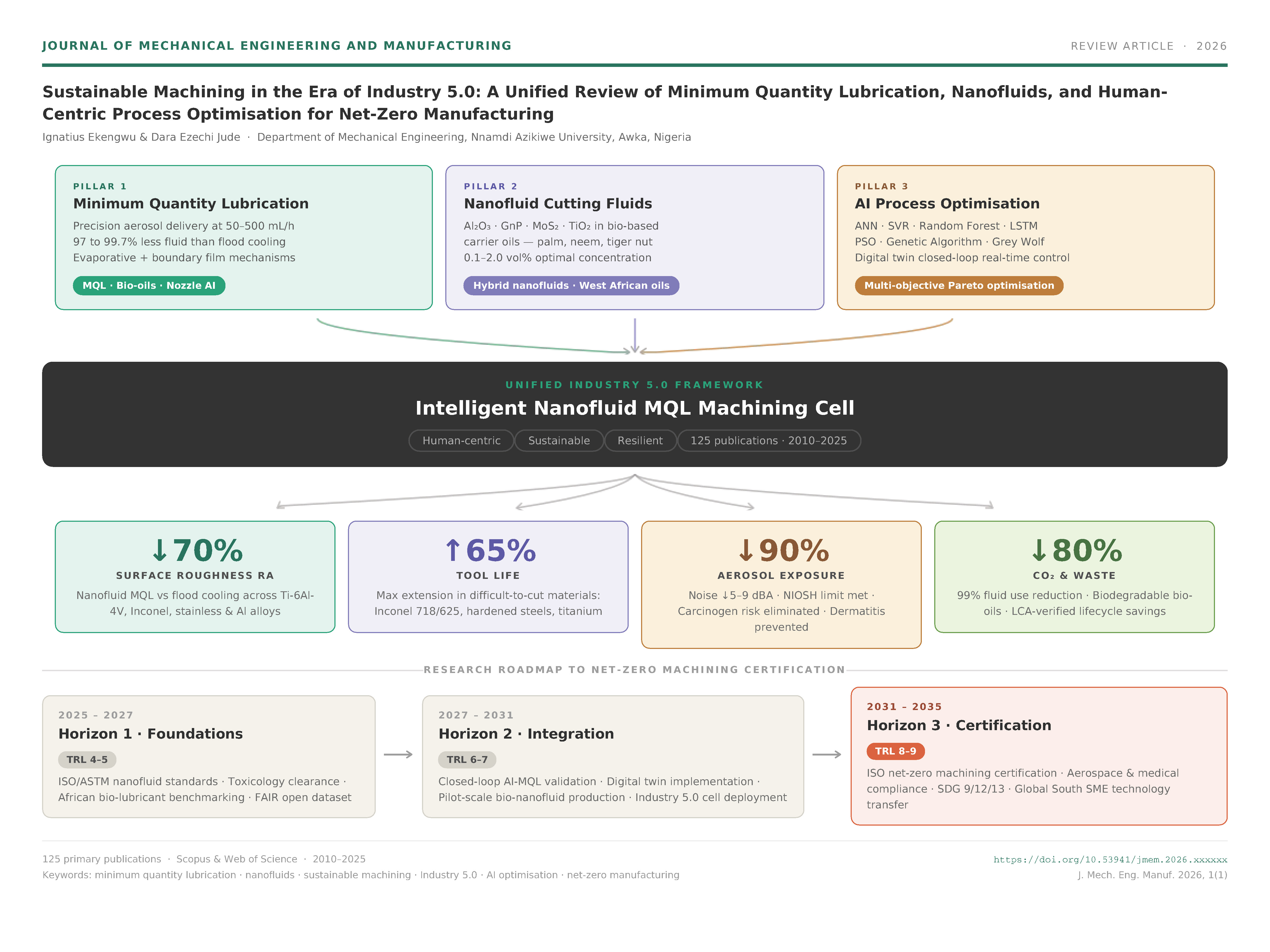
Conventional flood cooling remains the dominant lubrication strategy in machining workshops worldwide, despite more than three decades of documented evidence concerning its environmental and occupational health costs. A single production facility may consume thousands of litres of cutting fluid annually, and the aerosol generated at the work zone carries well-documented associations with respiratory disease, dermatitis, and carcinogen exposure for operators. Over the same period, three categories of technical alternative have each developed substantial evidence bases: minimum quantity lubrication (MQL), nanofluid cutting fluids, and AI-driven process optimisation. No prior review has examined how these three strands fit together, or situated their integration within the Industry 5.0 framework, which holds that manufacturing must serve human well-being and ecological sustainability alongside productivity. This paper addresses that gap. Drawing on 125 primary publications from 2010 to 2025 identified through systematic database searches (methodology described in Section 1.1), the reviewed evidence indicates that nanofluid MQL can reduce cutting fluid consumption by 97 to 99.7 per cent relative to conventional flood cooling while achieving comparable or improved surface finish, tool wear, and cutting force outcomes across titanium alloys, nickel superalloys, stainless steels, and aluminium. This review assesses six nanoparticle classes in bio-based carrier fluids—including locally available West African oils that have received limited attention in the international literature—and examines AI and machine learning approaches for MQL optimisation with explicit attention to worker health outcomes. Eight research gaps are identified and a proposed three-horizon research agenda towards measurably low-impact machining practice by 2035 is presented.
- Open Access
- Review
Sustainable Machining in the Era of Industry 5.0: A Unified Review of Minimum Quantity Lubrication, Nanofluids, and Human-Centric Process Optimisation for Net-Zero Manufacturing
Author Information
Received: 22 Mar 2026 | Revised: 30 Apr 2026 | Accepted: 13 May 2026 | Published: 21 Sep 2026
Abstract
Graphical Abstract
Keywords
minimum quantity lubrication | nanofluids | sustainable machining | Industry 5.0 | bio-based lubricants | artificial intelligence | net-zero manufacturing
References
- 1.
Skerlos, S.J.; Hayes, K.F.; Clarens, A.F.; et al. Current Advances in Sustainable Metalworking Fluids Research. Int. J. Sustain. Manuf. 2008, 1, 180–202. https://doi.org/10.1504/IJSM.2008.019233.
- 2.
Klocke, F.; Eisenblätter, G. Dry Cutting. CIRP Ann. 1997, 46, 519–526. https://doi.org/10.1016/S0007-8506(07)60877-4.
- 3.
European Commission. Industry 5.0: Towards a Sustainable, Human-Centric and Resilient European Industry; Publications Office of the European Union: Luxembourg, 2021. Available online: https://op.europa.eu/en/publication-detail/-/publication/468a892a-5cd9-11eb-b487-01aa75ed71a1 (accessed on 15 December 2024).
- 4.
Khan, M.M.A.; Mithu, M.A.H.; Dhar, N.R. Effects of Minimum Quantity Lubrication on Turning AISI 9310 Alloy Steel Using Vegetable Oil-Based Cutting Fluid. J. Mater. Process. Technol. 2009, 209, 5573–5583. https://doi.org/10.1016/j.jmatprotec.2009.05.014.
- 5.
Eltaggaz, A.; Zawada, P.; Hegab, H.A.; et al. Coolant Strategy Influence on Tool Life and Surface Roughness When Machining ADI. Int. J. Adv. Manuf. Technol. 2018, 94, 3875–3887. https://doi.org/10.1007/s00170-017-1088-1.
- 6.
Singh, G.; Gupta, M.K.; Mia, M.; et al. Modeling and Optimization of Tool Wear in MQL-Assisted Milling of Inconel 718 Superalloy Using Evolutionary Techniques. Int. J. Adv. Manuf. Technol. 2018, 97, 481–494. https://doi.org/10.1007/s00170-018-1911-3.
- 7.
Khan, M.A.; Mia, M.; Dhar, N.R. High-Pressure Coolant on Flank and Rake Surfaces of Tool in Turning of Ti-6Al-4V: Investigations on Forces, Temperature, and Chips. Int. J. Adv. Manuf. Technol. 2017, 90, 1977–1991. https://doi.org/10.1007/s00170-016-9511-6.
- 8.
Sartori, S.; Ghiotti, A.; Bruschi, S. Hybrid Lubricating/Cooling Strategies to Reduce the Tool Wear in Finishing Turning of Difficult-to-Cut Alloys. Wear 2017, 376–377, 107–114. https://doi.org/10.1016/j.wear.2016.12.047.
- 9.
Khan, A.M.; Jamil, M.; Mia, M.; et al. Sustainability-Based Performance Evaluation of Hybrid Nanofluid Assisted Machining. J. Clean. Prod. 2020, 257, 120541. https://doi.org/10.1016/j.jclepro.2020.120541.
- 10.
Duc, T.M.; Long, T.T.; Chien, T.Q. Performance Evaluation of MQL Parameters Using Al2O3 and MoS2 Nanofluids in Hard Turning 90CrSi Steel. Lubricants 2019, 7, 40. https://doi.org/10.3390/lubricants7050040.
- 11.
Liu, M.; Xie, H.; Pan, W.; et al. Prediction of Cutting Force via Machine Learning: State of the Art, Challenges and Potentials. J. Intell. Manuf. 2025, 36, 703–764. https://doi.org/10.1007/s10845-023-02260-8.
- 12.
Manikanta, J.E.; Ambhore, N.; Dhumal, A.; et al. Machine Learning and Artificial Intelligence Supported Machining: A Review and Insights for Future Research. J. Inst. Eng. India Ser. C 2024, 105, 1653–1663. https://doi.org/10.1007/s40032-024-01118-z.
- 13.
Hamıd, M.W.; Özlü, B.; Ulaş, H.B.; et al. Prediction of Cutting Parameters and Reduction of Output Parameters Using Machine Learning in Milling of Inconel 718 Alloy. Sci. Rep. 2025, 15, 33309. https://doi.org/10.1038/s41598-025-04198-8.
- 14.
Tabaszewski, M.; Twardowski, P.; Wiciak-Pikuła, M.; et al. Machine Learning Approaches for Monitoring of Tool Wear during Grey Cast-Iron Turning. Materials 2022, 15, 4359. https://doi.org/10.3390/ma15124359.
- 15.
Shokrani, A.; Dhokia, V.; Newman, S.T. Environmentally Conscious Machining of Difficult-to-Machine Materials with Regard to Cutting Fluids. Int. J. Mach. Tools Manuf. 2012, 57, 83–101. https://doi.org/10.1016/j.ijmachtools.2012.02.002.
- 16.
Pereira, O.; Rodríguez, A.; Fernández-Valdivielso, A.; et al. Cryogenic Hard Turning of ASP23 Steel Using Carbon Dioxide. Procedia Eng. 2015, 132, 486–491. https://doi.org/10.1016/j.proeng.2015.12.523.
- 17.
Kuram, E.; Ozcelik, B.; Demirbas, E.; et al. Optimization of Cutting Fluids and Cutting Parameters during End Milling by Using D-Optimal Design of Experiments. J. Clean. Prod. 2013, 42, 159–166. https://doi.org/10.1016/j.jclepro.2012.11.003.
- 18.
Maruda, R.W.; Krolczyk, G.M.; Wojciechowski, S.; et al. Effects of Extreme Pressure and Anti-Wear Additives on Surface Topography and Tool Wear during MQCL Turning of AISI 1045 Steel. J. Mech. Sci. Technol. 2018, 32, 1585–1591. https://doi.org/10.1007/s12206-018-0313-7.
- 19.
Narutaki, N.; Yamane, Y.; Tashima, S.; et al. A New Advanced Ceramic for Dry Machining. CIRP Ann. 1997, 46, 43–48. https://doi.org/10.1016/S0007-8506(07)60772-0.
- 20.
Grieves, M.; Vickers, J. Digital Twin: Mitigating Unpredictable, Undesirable Emergent Behavior in Complex Systems. In Transdisciplinary Perspectives on Complex Systems; Springer: Cham, Switzerland, 2016; pp. 85–113. https://doi.org/10.1007/978-3-319-38756-7_4.
- 21.
Arrazola, P.J.; Özel, T.; Umbrello, D.; et al. Recent Advances in Modelling of Metal Machining Processes. CIRP Ann. 2013, 62, 695–718. https://doi.org/10.1016/j.cirp.2013.05.006.
- 22.
Debnath, S.; Reddy, M.M.; Yi, Q.S. Environmental Friendly Cutting Fluids and Cooling Techniques in Machining: A Review. J. Clean. Prod. 2014, 83, 33–47. https://doi.org/10.1016/j.jclepro.2014.07.071.
- 23.
Krolczyk, G.M.; Maruda, R.W.; Krolczyk, J.B.; et al. Ecological Trends in Machining as a Key Factor in Sustainable Production. J. Clean. Prod. 2019, 218, 601–615. https://doi.org/10.1016/j.jclepro.2019.02.017.
- 24.
Maruda, R.W.; Krolczyk, G.M.; Feldshtein, E.; et al. A Study on Droplets Sizes, Their Distribution and Heat Exchange for Minimum Quantity Cooling Lubrication (MQCL). Int. J. Mach. Tools Manuf. 2016, 100, 81–92. https://doi.org/10.1016/j.ijmachtools.2015.10.008.
- 25.
Abukhshim, N.A.; Mativenga, P.T.; Sheikh, M.A. Heat Generation and Temperature Prediction in Metal Cutting: A Review and Implications for High Speed Machining. Int. J. Mach. Tools Manuf. 2006, 46, 782–800. https://doi.org/10.1016/j.ijmachtools.2005.07.024.
- 26.
Sarhan, A.A.; Sayuti, M.; Hamdi, M. Reduction of Power and Lubricant Oil Consumption in Milling Process Using a New SiO2 Nano-Lubrication System. Int. J. Adv. Manuf. Technol. 2012, 63, 505–512. https://doi.org/10.1007/s00170-012-3940-7.
- 27.
Duc, T.M.; Long, T.T.; Tuan, N.M. Performance Investigation of MQL Parameters Using Nano Cutting Fluids in Hard Milling. Fluids 2021, 6, 248. https://doi.org/10.3390/fluids6070248.
- 28.
Hadad, M.; Sadeghi, B. Thermal Analysis of Minimum Quantity Lubrication-MQL Grinding Process. Int. J. Mach. Tools Manuf. 2012, 63, 1–15. https://doi.org/10.1016/j.ijmachtools.2012.07.003.
- 29.
Srikant, R.R.; Prasad, M.M.; Amrita, M.; et al. Nanofluids as a Potential Solution for Minimum Quantity Lubrication: A Review. Proc. Inst. Mech. Eng. Part B J. Eng. Manuf. 2014, 228, 3–20. https://doi.org/10.1177/0954405413497939.
- 30.
Lv, T.; Huang, S.; Liu, E.; et al. Tribological and Machining Characteristics of an Electrostatic Minimum Quantity Lubrication (EMQL) Technology Using Graphene Nano-Lubricants as Cutting Fluids. J. Manuf. Process. 2018, 34, 225–237. https://doi.org/10.1016/j.jmapro.2018.06.016.
- 31.
Ali, M.K.; Xianjun, H.; Mai, L.; et al. Improving the Tribological Characteristics of Piston Ring Assembly in Automotive Engines Using Al2O3 and TiO2 Nanomaterials as Nano-Lubricant Additives. Tribol. Int. 2016, 103, 540–554. https://doi.org/10.1016/j.triboint.2016.08.011.
- 32.
Eastman, J.A.; Choi, U.S.; Li, S.; et al. Enhanced Thermal Conductivity through the Development of Nanofluids. MRS Online Proc. Libr. 1996, 457, 3. https://doi.org/10.1557/PROC-457-3.
- 33.
Lee, J.H.; Hwang, K.S.; Jang, S.P.; et al. Effective Viscosities and Thermal Conductivities of Aqueous Nanofluids Containing Low Volume Concentrations of Al2O3 Nanoparticles. Int. J. Heat Mass Transf. 2008, 51, 2651–2656. https://doi.org/10.1016/j.ijheatmasstransfer.2007.10.026.
- 34.
Zhu, H.T.; Lin, Y.S.; Yin, Y.L. A Novel One-Step Chemical Method for Preparation of Copper Nanofluids. J. Colloid Interface Sci. 2004, 277, 100–103. https://doi.org/10.1016/j.jcis.2004.04.026.
- 35.
Ghadimi, A.; Saidur, R.; Metselaar, H.S.C. A Review of Nanofluid Stability Properties and Characterization in Stationary Conditions. Int. J. Heat Mass Transf. 2011, 54, 4051–4068. https://doi.org/10.1016/j.ijheatmasstransfer.2011.04.014.
- 36.
Keblinski, P.; Phillpot, S.R.; Choi, S.U.S.; et al. Mechanisms of Heat Flow in Suspensions of Nano-Sized Particles (Nanofluids). Int. J. Heat Mass Transf. 2002, 45, 855–863. https://doi.org/10.1016/S0017-9310(01)00175-2.
- 37.
Balandin, A.A.; Ghosh, S.; Bao, W.; et al. Superior Thermal Conductivity of Single-Layer Graphene. Nano Lett. 2008, 8, 902–907. https://doi.org/10.1021/nl0731872.
- 38.
Moldoveanu, G.M.; Minea, A.A.; Huminic, G.; et al. Al2O3/TiO2 Hybrid Nanofluids Thermal Conductivity: An Experimental Approach. J. Therm. Anal. Calorim. 2019, 137, 583–592. https://doi.org/10.1007/s10973-018-7974-4.
- 39.
Kim, P.; Shi, L.; Majumdar, A.; et al. Thermal Transport Measurements of Individual Multiwalled Nanotubes. Phys. Rev. Lett. 2001, 87, 215502. https://doi.org/10.1103/PhysRevLett.87.215502.
- 40.
Jamil, M.; Khan, A.M.; Hegab, H.; et al. Effects of Hybrid Al2O3-CNT Nanofluids and Cryogenic Cooling on Machining of Ti–6Al–4V. Int. J. Adv. Manuf. Technol. 2019, 102, 3895–3909. https://doi.org/10.1007/s00170-019-03485-9.
- 41.
Singh, R.K.; Sharma, A.K.; Dixit, A.R.; et al. Performance Evaluation of Alumina-Graphene Hybrid Nano-Cutting Fluid in Hard Turning. J. Clean. Prod. 2017, 162, 830–845. https://doi.org/10.1016/j.jclepro.2017.06.104.
- 42.
Dambatta, Y.S.; Sayuti, M.; Sarhan, A.A.; et al. Tribological Performance of SiO2-Based Nanofluids in Minimum Quantity Lubrication Grinding of Si3N₄ Ceramic. J. Manuf. Process. 2019, 41, 135–147. https://doi.org/10.1016/j.jmapro.2019.03.024.
- 43.
Lawal, S.A.; Choudhury, I.A.; Nukman, Y. Application of Vegetable Oil-Based Metalworking Fluids in Machining Ferrous Metals—A Review. Int. J. Mach. Tools Manuf. 2012, 52, 1–12. https://doi.org/10.1016/j.ijmachtools.2011.09.003.
- 44.
Schulz, H.; Moriwaki, T. High-Speed Machining. CIRP Ann. 1992, 41, 637–643. https://doi.org/10.1016/S0007-8506(07)63250-8.
- 45.
Saidur, R.; Leong, K.Y.; Mohammed, H.A. A Review on Applications and Challenges of Nanofluids. Renew. Sustain. Energy Rev. 2011, 15, 1646–1668. https://doi.org/10.1016/j.rser.2010.11.035.
- 46.
Hegab, H.; Umer, U.; Soliman, M.; et al. Effects of Nano-Cutting Fluids on Tool Performance and Chip Morphology in Machining Inconel 718. Int. J. Adv. Manuf. Technol. 2018, 96, 3449–3458. https://doi.org/10.1007/s00170-018-1825-0.
- 47.
Yıldırım, Ç.V.; Kıvak, T.; Erzincanlı, F. Tool Wear and Surface Roughness Analysis in Milling with Ceramic Tools of Waspaloy: A Comparison of Machining Performance with Different Cooling Methods. J. Braz. Soc. Mech. Sci. Eng. 2019, 41, 83. https://doi.org/10.1007/s40430-019-1582-5.
- 48.
Hwang, Y.; Lee, J.K.; Lee, C.H.; et al. Stability and Thermal Conductivity Characteristics of Nanofluids. Thermochim. Acta 2007, 455, 70–74. https://doi.org/10.1016/j.tca.2006.11.036.
- 49.
Fox, N.J.; Stachowiak, G.W. Vegetable Oil-Based Lubricants—A Review of Oxidation. Tribol. Int. 2007, 40, 1035–1046. https://doi.org/10.1016/j.triboint.2006.10.001.
- 50.
Kazeem, R.A.; Fadare, D.A.; Ikumapayi, O.M.; et al. Advances in the Application of Vegetable-Oil-Based Cutting Fluids to Sustainable Machining Operations—A Review. Lubricants 2022, 10, 69. https://doi.org/10.3390/lubricants10040069.
- 51.
Ozcelik, B.; Kuram, E.; Cetin, M.H.; et al. Experimental Investigations of Vegetable Based Cutting Fluids with Extreme Pressure during Turning of AISI 304L. Tribol. Int. 2011, 44, 1864–1871. https://doi.org/10.1016/j.triboint.2011.07.012.
- 52.
Bankar, N.D.; Shelke, G.D.; Irfan, P.M. Experimental Investigation of Aluminum 7075 Using Dry, Wet and MQL Condition. Int. Res. J. Eng. Technol. 2019, 6, 957–962. Available online: https://www.academia.edu/40773229/ (accessed on 17 June 2026).
- 53.
Pereira, O.; Martín-Alfonso, J.E.; Rodríguez, A.; et al. Sustainability Analysis of Lubricant Oils for Minimum Quantity Lubrication Based on Their Tribo-Rheological Performance. J. Clean. Prod. 2017, 164, 1419–1429. https://doi.org/10.1016/j.jclepro.2017.07.078.
- 54.
Sarma, D.K.; Dixit, U.S. A Comparison of Dry and Air-Cooled Turning of Grey Cast Iron with Mixed Oxide Ceramic Tool. J. Mater. Process. Technol. 2007, 190, 160–172. https://doi.org/10.1016/j.jmatprotec.2007.02.049.
- 55.
Dhar, N.R.; Ahmed, M.T.; Islam, S. An Experimental Investigation on Effect of Minimum Quantity Lubrication in Machining AISI 1040 Steel. Int. J. Mach. Tools Manuf. 2007, 47, 748–753. https://doi.org/10.1016/j.ijmachtools.2006.09.017.
- 56.
Thakur, D.G.; Ramamoorthy, B.; Vijayaraghavan, L. Study on the Machinability Characteristics of Superalloy Inconel 718 during High Speed Turning. Mater. Des. 2009, 30, 1718–1725. https://doi.org/10.1016/j.matdes.2008.07.011.
- 57.
Sadik, M.I.; Isakson, S.; Malakizadi, A.; et al. Influence of Coolant Flow Rate on Tool Life and Wear Development in Cryogenic and Wet Milling of Ti-6Al-4V. Procedia CIRP 2016, 46, 91–94. https://doi.org/10.1016/j.procir.2016.02.014.
- 58.
Yıldırım, Ç.V.; Kıvak, T.; Sarıkaya, M.; et al. Evaluation of Tool Wear, Surface Roughness/Topography and Chip Morphology When Machining of Ni-Based Alloy 625 under MQL, Cryogenic Cooling and CryoMQL. J. Mater. Res. Technol. 2020, 9, 2079–2092. https://doi.org/10.1016/j.jmrt.2019.12.069.
- 59.
Bordin, A.; Sartori, S.; Bruschi, S.; et al. Experimental Investigation on the Feasibility of Dry and Cryogenic Machining as Sustainable Strategies When Turning Ti6Al4V Produced by Direct Metal Laser Sintering. J. Clean. Prod. 2017, 142, 4142–4151. https://doi.org/10.1016/j.jclepro.2016.09.209.
- 60.
Uysal, A.; Demiren, F.; Altan, E. Applying Minimum Quantity Lubrication (MQL) Method on Milling of Martensitic Stainless Steel by Using Nano MoS2 Reinforced Vegetable Cutting Fluid. Procedia Soc. Behav. Sci. 2015, 195, 2742–2747. https://doi.org/10.1016/j.sbspro.2015.06.384.
- 61.
Ekengwu, I.G.; Okoli, O.C.; Okafor, O.N.; et al. Lubricity Potentials of Azadirachta indica (Neem) Oil and Cyperus esculentus (Tiger Nut) Oil Extracts and Their Blends in Machining of Mild Steel. Heliyon 2025, 11, e42059. https://doi.org/10.1016/j.heliyon.2025.e42059.
- 62.
Sharma, A.K.; Singh, R.K.; Dixit, A.R.; et al. Characterization and Experimental Investigation of Al2O3 Nanoparticle Based Cutting Fluid in Turning of AISI 1040 Steel under Minimum Quantity Lubrication (MQL). Mater. Today Proc. 2016, 3, 1899–1906. https://doi.org/10.1016/j.matpr.2016.04.090.
- 63.
Zhang, Y.; Li, C.; Ji, H.; et al. Analysis of Grinding Mechanics and Improved Predictive Force Model Based on Material-Removal and Plastic-Stacking Mechanisms. Int. J. Mach. Tools Manuf. 2017, 122, 81–97. https://doi.org/10.1016/j.ijmachtools.2017.06.002.
- 64.
Dhar, N.R.; Kamruzzaman, M.; Ahmed, M. Effect of Minimum Quantity Lubrication (MQL) on Tool Wear and Surface Roughness in Turning AISI-4340 Steel. J. Mater. Process. Technol. 2006, 172, 299–304. https://doi.org/10.1016/j.jmatprotec.2005.09.022.
- 65.
Ezugwu, E.O.; Bonney, J.; Yamane, Y. An Overview of the Machinability of Aeroengine Alloys. J. Mater. Process. Technol. 2003, 134, 233–253. https://doi.org/10.1016/S0924-0136(02)01042-7.
- 66.
Kaynak, Y. Evaluation of Machining Performance in Cryogenic Machining of Inconel 718 and Comparison with Dry and MQL Machining. Int. J. Adv. Manuf. Technol. 2014, 72, 919–933. https://doi.org/10.1007/s00170-014-5683-0.
- 67.
Adler, D.P.; Hii, W.W.S.; Michalek, D.J.; et al. Examining the Role of Cutting Fluids in Machining and Efforts to Address Associated Environmental/Health Concerns. Mach. Sci. Technol. 2006, 10, 23–58. https://doi.org/10.1080/10910340500534282.
- 68.
Zhu, D.; Zhang, X.; Ding, H. Tool Wear Characteristics in Machining of Nickel-Based Superalloys. Int. J. Mach. Tools Manuf. 2013, 64, 60–77. https://doi.org/10.1016/j.ijmachtools.2012.08.001.
- 69.
Hegab, H.; Umer, U.; Deiab, I.; et al. Performance Evaluation of Ti-6Al-4V Machining Using Nano-Cutting Fluids under Minimum Quantity Lubrication. Int. J. Adv. Manuf. Technol. 2018, 95, 4229–4241. https://doi.org/10.1007/s00170-017-1527-z.
- 70.
Bai, X.; Li, C.; Dong, L.; et al. Experimental Evaluation of the Lubrication Performances of Different Nanofluids for Minimum Quantity Lubrication (MQL) in Milling Ti-6Al-4V. Int. J. Adv. Manuf. Technol. 2019, 101, 2621–2632. https://doi.org/10.1007/s00170-018-3100-9.
- 71.
Zhang, D.; Li, C.; Jia, D.; et al. Specific Grinding Energy and Surface Roughness of Nanoparticle Jet Minimum Quantity Lubrication in Grinding. Chin. J. Aeronaut. 2015, 28, 570–581. https://doi.org/10.1016/j.cja.2014.12.035.
- 72.
Diniz, A.E.; de Oliveira, A.J. Optimizing the Use of Dry Cutting in Rough Turning Steel Operations. Int. J. Mach. Tools Manuf. 2004, 44, 1061–1067. https://doi.org/10.1016/j.ijmachtools.2004.03.001.
- 73.
Sharma, V.S.; Dogra, M.; Suri, N.M. Cooling Techniques for Improved Productivity in Turning. Int. J. Mach. Tools Manuf. 2009, 49, 435–453. https://doi.org/10.1016/j.ijmachtools.2008.12.010.
- 74.
Xu, X.; Lu, Y.; Vogel-Heuser, B.; et al. Industry 4.0 and Industry 5.0—Inception, Conception and Perception. J. Manuf. Syst. 2021, 61, 530–535. https://doi.org/10.1016/j.jmsy.2021.10.006.
- 75.
Longo, F.; Padovano, A.; Umbrello, S. Value-Oriented and Ethical Technology Engineering in Industry 5.0: A Human-Centric Perspective for the Design of the Factory of the Future. Appl. Sci. 2020, 10, 4182. https://doi.org/10.3390/app10124182.
- 76.
Nahavandi, S. Industry 5.0: A Human-Centric Solution. Sustainability 2019, 11, 4371. https://doi.org/10.3390/su11164371.
- 77.
Javaid, M.; Haleem, A.; Singh, R.P.; et al. Enabling Flexible Manufacturing System (FMS) through the Applications of Industry 4.0 Technologies. Internet Things Cyber-Phys. Syst. 2022, 2, 49–62. https://doi.org/10.1016/j.iotcps.2022.05.005.
- 78.
Mia, M.; Dhar, N.R. Prediction of Surface Roughness in Hard Turning under High Pressure Coolant Using Artificial Neural Network. Measurement 2016, 92, 464–474. https://doi.org/10.1016/j.measurement.2016.06.048.
- 79.
Breque, M.; De Nul, L.; Petridis, A. Industry 5.0: Towards a Sustainable, Human-Centric and Resilient European Industry; Publications Office of the European Union: Luxembourg, 2021. https://doi.org/10.2777/308407.
- 80.
Maddikunta, P.K.R.; Pham, Q.V.; Prabadevi, B.; et al. Industry 5.0: A Survey on Enabling Technologies and Potential Applications. J. Ind. Inf. Integr. 2022, 26, 100257. https://doi.org/10.1016/j.jii.2021.100257.
- 81.
Kumar, V.; Vrat, P.; Shankar, R. Factors Influencing the Implementation of Industry 4.0 for Sustainability in Manufacturing. Glob. J. Flex. Syst. Manag. 2022, 23, 453–478. https://doi.org/10.1007/s40171-022-00312-1.
- 82.
Solke, N.S.; Shah, P.; Sekhar, R.; et al. Machine Learning-Based Predictive Modeling and Control of Lean Manufacturing in Automotive Parts Manufacturing Industry. Glob. J. Flex. Syst. Manag. 2022, 23, 89–112. https://doi.org/10.1007/s40171-021-00291-9.
- 83.
Benardos, P.G.; Vosniakos, G.C. Predicting Surface Roughness in Machining: A Review. Int. J. Mach. Tools Manuf. 2003, 43, 833–844. https://doi.org/10.1016/S0890-6955(03)00059-2.
- 84.
Rao, R.V.; Pawar, P.J. Parameter Optimization of a Multi-Pass Milling Process Using Non-Traditional Optimization Algorithms. Appl. Soft Comput. 2010, 10, 445–456. https://doi.org/10.1016/j.asoc.2009.08.007.
- 85.
Yıldız, A.R. Comparison of Evolutionary-Based Optimization Algorithms for Structural Design Optimization. Eng. Appl. Artif. Intell. 2013, 26, 327–333. https://doi.org/10.1016/j.engappai.2012.05.014.
- 86.
Mirjalili, S.; Mirjalili, S.M.; Lewis, A. Grey Wolf Optimizer. Adv. Eng. Softw. 2014, 69, 46–61. https://doi.org/10.1016/j.advengsoft.2013.12.007.
- 87.
Tao, F.; Cheng, J.; Qi, Q.; et al. Digital Twin-Driven Product Design, Manufacturing and Service with Big Data. Int. J. Adv. Manuf. Technol. 2018, 94, 3563–3576. https://doi.org/10.1007/s00170-017-0233-1.
- 88.
Madni, A.M.; Madni, C.C.; Lucero, S.D. Leveraging Digital Twin Technology in Model-Based Systems Engineering. Systems 2019, 7, 7. https://doi.org/10.3390/systems7010007.
- 89.
Friesen, M.C.; Costello, S.; Eisen, E.A. Quantitative Exposure to Metalworking Fluids and Bladder Cancer Incidence in a Cohort of Autoworkers. Am. J. Epidemiol. 2009, 169, 1471–1478. https://doi.org/10.1093/aje/kwp073.
- 90.
Zeka, A.; Eisen, E.A.; Kriebel, D.; et al. Risk of Upper Aerodigestive Tract Cancers in a Case-Cohort Study of Autoworkers Exposed to Metalworking Fluids. Occup. Environ. Med. 2004, 61, 426–431. https://doi.org/10.1136/oem.2003.010157.
- 91.
Deutsche Gesetzliche Unfallversicherung (DGUV). Minimum Quantity Lubrication for Machining Operations; DGUV Information 209-025; DGUV: Berlin, Germany, 2010. Available online: https://publikationen.dguv.de/widgets/pdf/download/article/806 (accessed on 26 June 2026).
- 92.
Maruda, R.W.; Feldshtein, E.; Legutko, S.; et al. Analysis of Contact Phenomena and Heat Exchange in the Cutting Zone under Minimum Quantity Cooling Lubrication Conditions. Arab. J. Sci. Eng. 2016, 41, 661–668. https://doi.org/10.1007/s13369-015-1726-6.
- 93.
Davim, J.P.; Sreejith, P.S.; Gomes, R.; et al. Experimental Studies on Drilling of Aluminum (AA1050) under Dry, Minimum Quantity of Lubricant, and Flood-Lubricated Conditions. Proc. Inst. Mech. Eng. Part B J. Eng. Manuf. 2006, 220, 1605–1611. https://doi.org/10.1243/09544054JEM557.
- 94.
Pušavec, F.; Krajnik, P.; Kopac, J. Transitioning to Sustainable Production—Part I: Application on Machining Technologies. J. Clean. Prod. 2010, 18, 174–184. https://doi.org/10.1016/j.jclepro.2009.08.010.
- 95.
Heitbrink, W.A.; Yacher, J.M.; D’Arcy, J.B. Comparison of Mist Generation Rates for Micro-Lubrication and Flood Application of Cutting Fluids during Milling and Drilling; National Institute for Occupational Safety and Health: Cincinnati, OH, USA, 2001. Available online: https://stacks.cdc.gov/view/cdc/193979 (accessed on 26 June 2026).
- 96.
Revuru, R.S.; Posinasetti, N.R.; VSN, V.R.; et al. Application of Cutting Fluids in Machining of Titanium Alloys—A Review. Int. J. Adv. Manuf. Technol. 2017, 91, 2477–2498. https://doi.org/10.1007/s00170-016-9883-7.
- 97.
Thakur, A.; Gangopadhyay, S. State-of-the-Art in Surface Integrity in Machining of Nickel-Based Super Alloys. Int. J. Mach. Tools Manuf. 2016, 100, 25–54. https://doi.org/10.1016/j.ijmachtools.2015.10.001.
- 98.
Bertolini, R.; Ghiotti, A.; Bruschi, S. Graphene Nanoplatelets as Additives to MQL for Improving Tool Life in Machining Inconel 718 Alloy. Wear 2021, 476, 203656. https://doi.org/10.1016/j.wear.2021.203656.
- 99.
Shokrani, A.; Dhokia, V.; Munoz-Escalona, P.; et al. State-of-the-Art Cryogenic Machining and Processing. Int. J. Comput. Integr. Manuf. 2013, 26, 616–648. https://doi.org/10.1080/0951192X.2012.749531.
- 100.
Ezugwu, E.O.; Wang, Z.M. Titanium Alloys and Their Machinability—A Review. J. Mater. Process. Technol. 1997, 68, 262–274. https://doi.org/10.1016/S0924-0136(96)00030-1.
- 101.
Yıldırım, Ç.V. Experimental Comparison of the Performance of Nanofluids, Cryogenic and Hybrid Cooling in Turning of Inconel 625. Tribol. Int. 2019, 137, 366–378. https://doi.org/10.1016/j.triboint.2019.05.014.
- 102.
Zhang, Y.; Li, C.; Jia, D.; et al. Experimental Evaluation of the Lubrication Performance of MoS2/CNT Nanofluid for Minimal Quantity Lubrication in Ni-Based Alloy Grinding. Int. J. Mach. Tools Manuf. 2015, 99, 19–33. https://doi.org/10.1016/j.ijmachtools.2015.09.003.
- 103.
Kishawy, H.A.; Dumitrescu, M.; Ng, E.G.; et al. Effect of Coolant Strategy on Tool Performance, Chip Morphology and Surface Quality during High-Speed Machining of A356 Aluminum Alloy. Int. J. Mach. Tools Manuf. 2005, 45, 219–227. https://doi.org/10.1016/j.ijmachtools.2004.07.003.
- 104.
Gupta, M.K.; Sood, P.K. Machining Comparison of Aerospace Materials Considering Minimum Quantity Cutting Fluid: A Clean and Green Approach. Proc. Inst. Mech. Eng. Part C J. Mech. Eng. Sci. 2017, 231, 1445–1464. https://doi.org/10.1177/0954406216684158.
- 105.
Sreejith, P.S. Machining of 6061 Aluminium Alloy with MQL, Dry and Flooded Lubricant Conditions. Mater. Lett. 2008, 62, 276–278. https://doi.org/10.1016/j.matlet.2007.05.019.
- 106.
Sarıkaya, M.; Gupta, M.K.; Tomaz, I.; et al. A State-of-the-Art Review on Tool Wear and Surface Integrity Characteristics in Machining of Superalloys. CIRP J. Manuf. Sci. Technol. 2021, 35, 624–658. https://doi.org/10.1016/j.cirpj.2021.08.005.
- 107.
Pecat, O.; Rentsch, R.; Brinksmeier, E. Influence of Milling Process Parameters on the Surface Integrity of CFRP. Procedia CIRP 2012, 1, 466–470. https://doi.org/10.1016/j.procir.2012.04.083.
- 108.
Yu, W.; Xie, H. A Review on Nanofluids: Preparation, Stability Mechanisms, and Applications. J. Nanomater. 2012, 2012, 435873. https://doi.org/10.1155/2012/435873.
- 109.
Boswell, B.; Islam, M.N.; Davies, I.J.; et al. A Review Identifying the Effectiveness of Minimum Quantity Lubrication (MQL) during Conventional Machining. Int. J. Adv. Manuf. Technol. 2017, 92, 321–340. https://doi.org/10.1007/s00170-017-0142-3.
- 110.
Dureja, J.S.; Singh, R.; Singh, T.; et al. Performance Evaluation of Coated Carbide Tool in Machining of Stainless Steel (AISI 202) under Minimum Quantity Lubrication (MQL). Int. J. Precis. Eng. Manuf. Green Technol. 2015, 2, 123–129. https://doi.org/10.1007/s40684-015-0016-9.
- 111.
Shokrani, A.; Al-Samarrai, I.; Newman, S.T. Hybrid Cryogenic MQL for Improving Tool Life in Machining of Ti-6Al-4V Titanium Alloy. J. Manuf. Process. 2019, 43, 229–243. https://doi.org/10.1016/j.jmapro.2019.05.006.
- 112.
Benedicto, E.; Carou, D.; Rubio, E.M. Technical, Economic and Environmental Review of the Lubrication/Cooling Systems Used in Machining Processes. Procedia Eng. 2017, 184, 99–116. https://doi.org/10.1016/j.proeng.2017.04.075.
- 113.
Itoigawa, F.; Childs, T.H.C.; Nakamura, T.; et al. Effects and Mechanisms in Minimal Quantity Lubrication Machining of an Aluminum Alloy. Wear 2006, 260, 339–344. https://doi.org/10.1016/j.wear.2005.03.035.
- 114.
Sangwan, K.S.; Saxena, S.; Kant, G. Optimization of Machining Parameters to Minimize Surface Roughness Using Integrated ANN-GA Approach. Procedia CIRP 2015, 29, 305–310. https://doi.org/10.1016/j.procir.2015.02.002.
- 115.
Jawaid, A.; Che-Haron, C.H.; Abdullah, A. Tool Wear Characteristics in Turning of Titanium Alloy Ti-6246. J. Mater. Process. Technol. 1999, 92–93, 329–334. https://doi.org/10.1016/S0924-0136(99)00246-0.
- 116.
Gupta, M.K.; Mia, M.; Pruncu, C.I.; et al. Parametric Optimization and Process Capability Analysis for Machining of Nickel-Based Superalloy. Int. J. Adv. Manuf. Technol. 2019, 102, 3995–4009. https://doi.org/10.1007/s00170-019-03453-3.
- 117.
Tuan, N.M.; Duc, T.M.; Long, T.T.; et al. Investigation of Machining Performance of MQL and MQCL Hard Turning Using Nano Cutting Fluids. Fluids 2022, 7, 143. https://doi.org/10.3390/fluids7050143.
- 118.
Çakır Şencan, A.; Şirin, Ş.; Saraç, E.N.S.; et al. Evaluation of Machining Characteristics of SiO2 Doped Vegetable Based Nanofluids with Taguchi Approach in Turning of AISI 304 Steel. Tribol. Int. 2024, 191, 109122. https://doi.org/10.1016/j.triboint.2023.109122.
- 119.
Maruda, R.W.; Krolczyk, G.M.; Nieslony, P.; et al. The Influence of the Cooling Conditions on the Cutting Tool Wear and the Chip Formation Mechanism. J. Manuf. Process. 2016, 24, 107–115. https://doi.org/10.1016/j.jmapro.2016.08.006.

This work is licensed under a Creative Commons Attribution 4.0 International License.

 Suite 4002 Level 4, 447 Collins Street, Melbourne, Victoria 3000, Australia
 General Inquiries: info@sciltp.com