
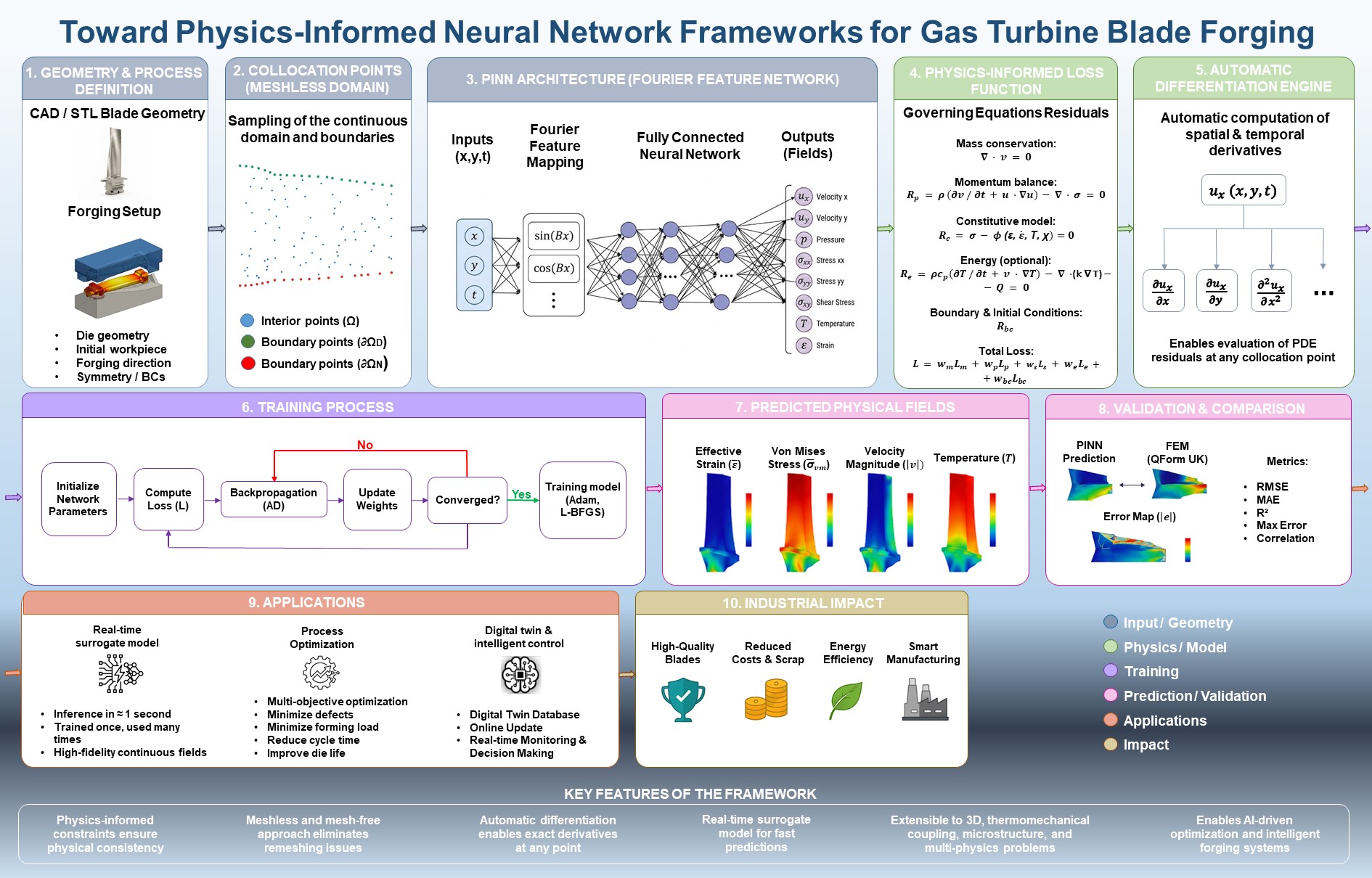
Blades are critical components of gas turbine engines (GTEs). Precision forging of such components remains computationally demanding because conventional finite element method (FEM) simulations require extensive computational resources and prolonged optimization cycles. The quality of forged blades strongly depends on accurate prediction of the stress-strain state (SSS). Consequently, growing research interest is focused on AI-assisted digital manufacturing approaches. This work establishes the methodological foundations for applying Physics-Informed Neural Networks (PINNs) to precision hot forging processes for GTE blades. The scientific novelty lies in integrating continuum-mechanics equations directly into a Fourier Feature Network-based PINN architecture. The proposed framework enables mesh-free approximation of severe plastic deformation during hot forging. Unlike conventional FEM approaches, the methodology avoids repeated remeshing procedures typical of large-deformation FEM simulations. Automatic differentiation and physics-constrained optimization enable continuous approximation of velocity and strain fields within deforming workpiece domains. The methodology is validated under axisymmetric hot-forging conditions using die-surface collocation points extracted from STL geometry files. One-time network training requires approximately 20 h on standard CPU hardware. After training, the PINN performs field inference over 259,200 spatial points in approximately 1.4 s. Quantitative validation against QForm UK FEM simulations yields an RMSE of 0.557 for the normalized plastic strain profile. The proposed framework is classified at Technology Readiness Level 3 (TRL 3) as a computational proof-of-concept demonstrating the feasibility of PINN modeling for precision hot forging. Compared with conventional FEM simulations, the proposed framework provides an approximately 5000-fold reduction in post-training inference time, excluding the one-time network training cost. These results highlight the potential applicability of the approach to accelerated process optimization, AI-assisted digital manufacturing, and near-real-time digital twin systems for metal forming. No experimental forging data were available for this study. Validation is performed exclusively against QForm UK FEM simulations.
- Open Access
- Article
Meshless PINN-Based Modeling of Hot Forging Processes for Gas Turbine Engine Blade Manufacturing
Author Information
Received: 14 May 2026 | Revised: 28 May 2026 | Accepted: 03 Jun 2026 | Published: 21 Sep 2026
Abstract
Graphical Abstract
Keywords
stress-strain state | meshless methods | automatic differentiation | metal forming | surrogate modeling
References
- 1.
Kobayashi, S.; Oh, S.-I.; Altan, T. Metal Forming and the Finite-Element Method; Oxford University Press: New York, NY, USA, 1989; p. 377.
- 2.
Wagoner, R.H.; Chenot, J.L. Fundamentals of Metal Forming; John Wiley & Sons: New York, NY, USA, 1996; p. 405.
- 3.
Wu, S.; Zhou, Z.; Bruce, N.; et al. A simulation of Al-Si coating growth under various hot stamping austenitization parameters: An artificial neural network model. Mater. Today Commun. 2024, 38, 108492. https://doi.org/10.1016/j.mtcomm.2024.108492.
- 4.
Zhao, Y.; Li, H.; Zhou, H.; et al. Rapid prediction of material deformation in hot stamping of battery box geometries using graph neural network. J. Phys. Conf. Ser. 2025, 3104, 012057. https://doi.org/10.1088/1742-6596/3104/1/012057.
- 5.
Liu, S.; Xia, Y.; Liu, Y.; et al. Tool path planning of consecutive free-form sheet metal stamping with deep learning. J. Mater. Process. Technol. 2022, 303, 117530. https://doi.org/10.1016/j.jmatprotec.2022.117530.
- 6.
Raissi, M.; Perdikaris, P.; Karniadakis, G.E. Physics-informed neural networks: A deep learning framework for solving forward and inverse problems involving nonlinear partial differential equations. J. Comput. Phys. 2019, 378, 686–707. https://doi.org/10.1016/j.jcp.2018.10.045.
- 7.
Haghighat, E.; Raissi, M.; Moure, A.; et al. A physics-informed deep learning framework for inversion and surrogate modeling in solid mechanics. Comput. Methods Appl. Mech. Eng. 2021, 379, 113741. https://doi.org/10.1016/j.cma.2021.113741.
- 8.
Niu, S.; Zhang, E.; Bazilevs, Y.; et al. Modeling finite-strain plasticity using physics-informed neural network and assessment of the network performance. J. Mech. Phys. Solids 2023, 172, 105177. https://doi.org/10.1016/j.jmps.2022.105177.
- 9.
Ding, F.; Hong, T.; Dong, F.; et al. Research Advancements in High-Temperature Constitutive Models of Metallic Materials. Crystals 2025, 15, 699. https://doi.org/10.3390/cryst15080699.
- 10.
Dornheim, J.; Morand, L.; Nallani, H.J.; et al. Neural Networks for Constitutive Modeling: From Universal Function Approximators to Advanced Models and the Integration of Physics. Arch. Comput. Methods Eng. 2024, 31, 1097–1127. https://doi.org/10.1007/s11831-023-10009-y.
- 11.
Munzone, F.; Hazrati, J.; Hakvoort, W.; et al. Comparative study of artificial neural network and physics-informed neural network application in sheet metal forming. Mater. Res. Proc. 2024, 41, 2278–2288. https://doi.org/10.21741/9781644903131-251.
- 12.
Bobbili, V.S.R.; Chandrasekhara Sastry, C.; Krishnaiah, J.; et al. Physics-informed neural networks for predicting high-strain-rate energy absorption in additively manufactured lattice materials. Prog. Addit. Manuf. 2026, 11, 2095–2121. https://doi.org/10.1007/s40964-025-01460-3.
- 13.
Sun, Y.; Zhang, Q.; Raffoul, S. Physics-informed neural network for predicting hot-rolled steel temperatures during heating process. J. Eng. Res. 2025, 13, 1496–1504. https://doi.org/10.1016/j.jer.2024.02.011.
- 14.
Almeida, E.F.; Silva, S.; Cunha, A., Jr. Physics-informed neural networks for solving elasticity problems. In Proceedings of the 27th International Congress of Mechanical Engineering (COBEM 2023), Florianópolis, Brazil, 4–8 December 2023.
- 15.
Roy, A.M.; Guha, S. A data-driven physics-constrained deep learning computational framework for solving von Mises plasticity. Eng. Appl. Artif. Intell. 2023, 122, 106049. https://doi.org/10.1016/j.engappai.2023.106049.
- 16.
Roy, A.M.; Guha, S.; Sundararaghavan, V.; et al. Physics-infused deep neural network for solution of non-associative Drucker–Prager elastoplastic constitutive model. J. Mech. Phys. Solids 2024, 185, 105570. https://doi.org/10.1016/j.jmps.2024.105570.
- 17.
Galib, G.; Silva, F.J.G.; Pedroso, A.F.V.; et al. A Comprehensive Review of Additive Manufacturing Technologies for Composite Materials. J. Mech. Eng. Manuf. 2025, 1, 2. https://doi.org/10.53941/jmem.2025.100002.
- 18.
Pinto, G.F.; Almeida, D.; Silva, F.J.G.; et al. Correlating Cutting Performance and Surface Roughness under Different Bias Using TiAlTaN Coated Milling Tools. J. Mech. Eng. Manuf. 2025, 1, 7. https://doi.org/10.53941/jmem.2025.100007.
- 19.
Guimarães, A.; Pereira, R.; Pereira, M.; et al. Business Productivity and the Adoption of Lean and Industry 4.0 Tools: A Regional Study. J. Mech. Eng. Manuf. 2025, 1, 6. https://doi.org/10.53941/jmem.2025.100006.
- 20.
Ren, Z.; Zhou, S.; Liu, D.; et al. Physics-Informed Neural Networks: A Review of Methodological Evolution, Theoretical Foundations, and Interdisciplinary Frontiers Toward Next-Generation Scientific Computing. Appl. Sci. 2025, 15, 8092. https://doi.org/10.3390/app15148092.
- 21.
Yang, S.; Kim, H.; Hong, Y.; et al. Data-driven physics-informed neural networks: A digital twin perspective. Comput. Methods Appl. Mech. Eng. 2024, 428, 117075. https://doi.org/10.1016/j.cma.2024.117075.
- 22.
Paszke, A.; Gross, S.; Massa, F.; et al. PyTorch: An imperative style, high-performance deep learning library. In Advances in Neural Information Processing Systems 32; Curran Associates, Inc.: Red Hook, NY, USA, 2019.
- 23.
Lu, L.; Meng, X.; Mao, Z.; et al. DeepXDE: A deep learning library for solving differential equations. SIAM Rev. 2021, 63, 208–228. https://doi.org/10.1137/19M1274067.
- 24.
Kingma, D.P.; Ba, J.L. Adam: A method for stochastic optimization. In Proceedings of the 3rd International Conference on Learning Representations (ICLR 2015), San Diego, CA, USA, 7–9 May 2015.
- 25.
Liu, D.C.; Nocedal, J. On the limited memory method for large scale optimization. Math. Program. 1989, 45, 503–528. https://doi.org/10.1007/BF01589116.
- 26.
Hoff, N.J. Approximate analysis of structures in the presence of moderately large creep deformations. Q. Appl. Math. 1954, 12, 49–55. https://doi.org/10.1090/qam/61664.
- 27.
Norton, F.H. The Creep of Steel at High Temperatures; McGraw-Hill: New York, NY, USA, 1929.
- 28.
Tancik, M.; Srinivasan, P.P.; Mildenhall, B.; et al. Fourier Features Let Networks Learn High Frequency Functions in Low Dimensional Domains. In Advances in Neural Information Processing Systems 33; Larochelle, H., Ranzato, M., Hadsell, R., Eds.; Curran Associates, Inc.: Red Hook, NY, USA, 2020; pp. 7537–7547.


This work is licensed under a Creative Commons Attribution 4.0 International License.

 Suite 4002 Level 4, 447 Collins Street, Melbourne, Victoria 3000, Australia
 General Inquiries: info@sciltp.com