
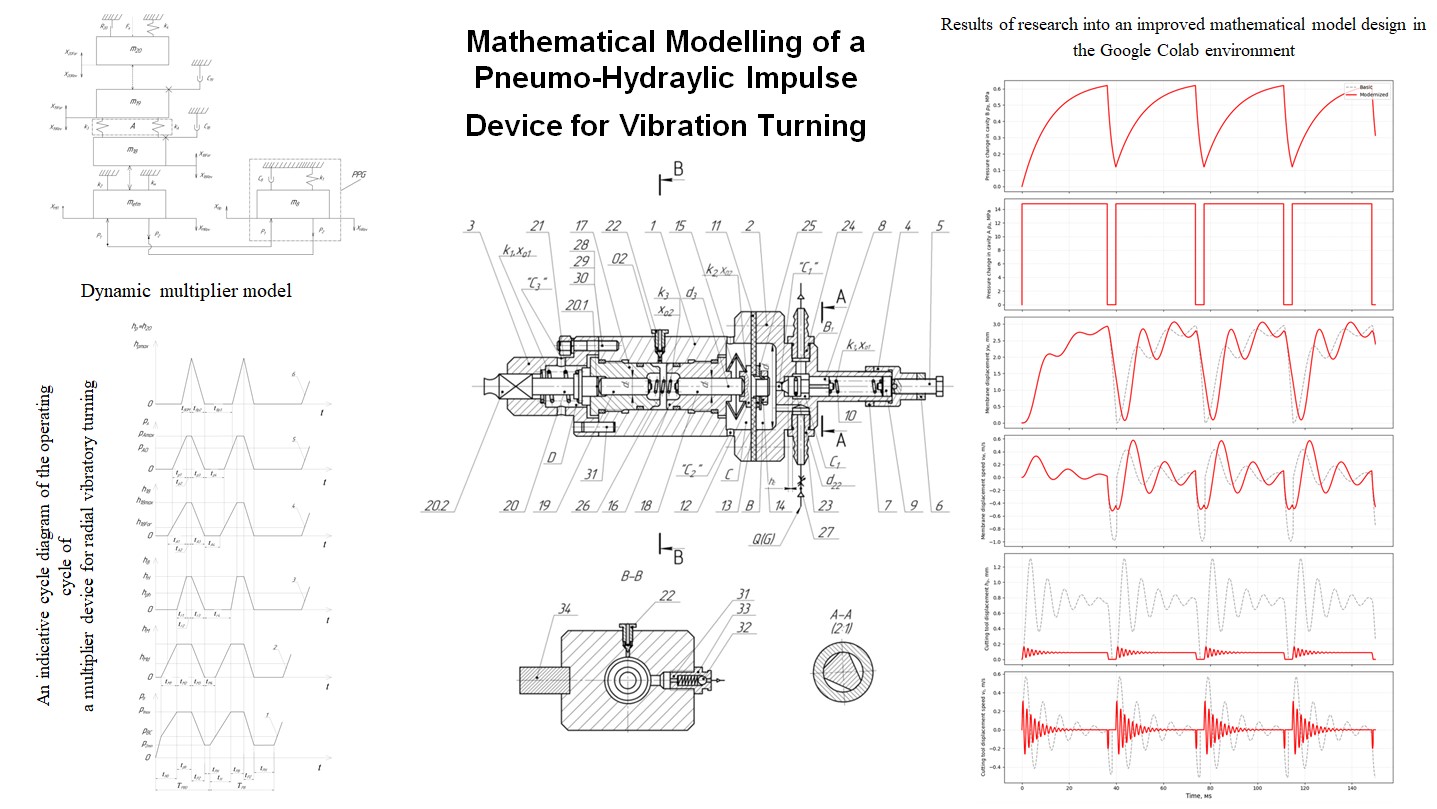
This paper addresses the critical challenge of improving the machinability of difficult-to-cut advanced materials through radial vibration-assisted turning. Traditional piezoelectric or mechanical vibrators suffer from micro-stroke decay or severe inertial limitations under heavy technological cutting loads. To resolve this bottleneck, a compact pneumo-hydraulic impulse multiplier device equipped with a single-stage parametric pressure pulse generator is investigated via a non-linear fluid-structure interaction framework solved through explicit Euler integration. Initial simulations revealed that a conventional high-inertia steel pusher (0.85 kg) paired with standard cylindrical springs induces a destructive “static lock-up” condition due to continuous unrelaxed kinetic energy accumulation. To bring the drive into its optimal operating window, structural modernization was executed by substituting the reciprocating components with a lightweight titanium alloy (Ti-6Al-4V Grade 5) and integrating a high-stiffness slotted spring. The upgraded simulation demonstrates a successful transition into a critically damped aperiodic operating regime. The modernized drive completely eliminates parasitic tool rebound, achieving perfectly repeatable pressure cycles reaching 14.8 MPa and a highly stable cutter vibration amplitude of 0.15–0.18 mm at operating frequencies up to 250 Hz. This provides a predictive, numerically validated foundation for high-frequency vibration turning utilizing standard shop-floor pneumatic supply networks.
- Open Access
- Article
Mathematical Modelling of a Pneumo-Hydraulic Impulse Device for Vibration Turning
- Roman Obertyukh 1,
- Andriiy Slabkyi 1,
- Oleksandr Povstyanoy 2,
- Dmytro Bakalets 1,
- Vladyslav Polishchuk 1
Author Information
Received: 18 May 2026 | Revised: 14 Jun 2026 | Accepted: 17 Jun 2026 | Published: 24 Sep 2026
Abstract
Graphical Abstract
Keywords
vibrations | hydraulic pulse drive | pressure pulse generator | mathematical modelling | oscillation frequency
References
- 1.
Shamoto, E.; Moriwaki, T. Study on Elliptical Vibration Cutting. CIRP Ann. 1994, 43, 35–38. https://doi.org/10.1016/S0007-8506(07)62158-1.
- 2.
Obertyukh, R.R.; Slabkyi, A.V. Vibroturning Devices based on a Hydropulse Drive: Monograph; VNTU: Vinnytsia, Ukraine, 2015. (In Ukrainian)
- 3.
Brehl, D.E.; Dow, T.A. Review of vibration-assisted machining. Precis. Eng. 2008, 32, 153–172. https://doi.org/10.1016/j.precisioneng.2007.08.003.
- 4.
Overcash, J.L. Tunable, Ultrasonic, Vibration Assisted Diamond Turning. Ph.D. Thesis, University of North Carolina at Charlotte, Charlotte, NC, USA, 2006.
- 5.
Zhu, Z.; To, S.; Ehmann, K.F.; et al. Design, analysis, and realization of a novel piezoelectrically actuated rotary spatial vibration system for micro-/nanomachining. IEEE/ASME Trans. Mechatron. 2017, 22, 1227–1237. https://doi.org/10.1109/TMECH.2017.2673832.
- 6.
Zheng, L.; Chen, W.; Huo, D. Review of vibration devices for vibration-assisted machining. Int. J. Adv. Manuf. Technol. 2020, 108, 1631–1651. https://doi.org/10.1007/s00170-020-05483-8.
- 7.
Barycki, J.; Ganczarek, M.; Kollek, W.; et al. Performances of high-speed pneumatic drive with self-acting impulse valve. Mech. Mach. Theory 2004, 39, 657–663. https://doi.org/10.1016/S0094-114X(03)00089-2.
- 8.
Obertyukh, R.R.; Slabkyi, A.V.; Polishchuk, O.V.; et al. Pneumo-Hydraulic Device for Vibration Turning. Patent of Ukraine No. 142770, 25 June 2020. (In Ukrainian)
- 9.
Dindorf, R.; Takosoglu, J.; Wos, P. Review of hydro-pneumatic accumulator models for the study of the energy efficiency of hydraulic systems. Energies 2023, 16, 6472. https://doi.org/10.3390/en16186472.
- 10.
Lin, T.; Wang, Q.; Hu, B.; et al. Development of hybrid powered hydraulic construction machinery. Autom. Constr. 2010, 19, 11–19. https://doi.org/10.1016/j.autcon.2009.09.005.
- 11.
Nisters, C.; Bauer, F.; Brocker, M. Condition Monitoring Systems for Hydraulic Accumulators—Improvements in Efficiency, Productivity and Quality; Technische Universität Dresden: Dresden, Germany, 2020.
- 12.
Obertyukh, R.; Slabkyi, A.; Petrov, O.; et al. Substantiation of the design calculation method for the vibroturning device. In Advances in Design, Simulation and Manufacturing V; Ivanov, V., Trojanowska, J., Pavlenko, I., et al., Eds.; Dragan Lecture Notes in Mechanical Engineering; Springer: Cham, Switzerland, 2022; pp. 185–194. https://doi.org/10.1007/978-3-031-06025-0_19.
- 13.
Obertyukh, R.; Slabkyi, A.; Petrov, O.; et al. Substantiation of the methodology for calculating the design of a small-sized hydraulic pulse vibrator. Vibroengineering Procedia 2024, 56, 22–28. https://doi.org/10.21595/vp.2024.24512.
- 14.
Merritt, H.E. Hydraulic Control Systems; John Wiley & Sons: New York, NY, USA, 1967.
- 15.
Manring, N.D.; Fales, M.C. Hydraulic Control Systems, 2nd ed.; John Wiley & Sons: Hoboken, NJ, USA, 2019. https://doi.org/10.1002/9781119416470.
- 16.
Obertyukh, R.; Slabkyi, A.; Polishchuk, L.; et al. Method of project calculation of hydroimpulsive device for vibroturning with an incorporated cycle spring pressure pulse generator. In Mechatronic Systems 1: Applications in Transport, Logistics, Diagnostics, and Control; CRC Press: Boca Raton, FL, USA, 2021; pp. 45–56. https://doi.org/10.1201/9781003224136-1.
- 17.
Totten, G.E.; De Negri, V.J. (Eds.) Handbook of Hydraulic Fluid Technology, 2nd ed.; CRC Press: Boca Raton, FL, USA, 2011. https://doi.org/10.1201/b11225.
- 18.
Virnyk, M.; Iskovych-Lototskyi, R.; Veselovska, N. Vibration and Vibration-Impact Processes and Machines in the Foundry Industry: Monograph; VNTU: Vinnytsia, Ukraine, 2007.
- 19.
Obertyukh, R.; Slabkyi, A.; Petrov, O.; et al. Mathematical Modeling of the Device for Radial Vibroturning. In Advanced Manufacturing Processes II; Tonkonogyi, V., Ivanov, V., Trojanowska, J., Eds.; Lecture Notes in Mechanical Engineering; Springer: Cham, Switzerland, 2021; pp. 566–576. https://doi.org/10.1007/978-3-030-68014-5_55.
- 20.
Obertyukh, R.; Slabkyi, A.; Povstyanoy, O.; et al. Mathematical modeling of a small-dimension hydropulse vibrator with a valve-driven pressure pulse generator. J. Eng. Sci. 2026, 13, F1–F16. https://doi.org/10.21272/jes.2026.13(1).f1.
- 21.
Beater, P. Pneumatic Drives: System Design, Modelling and Control; Springer: Berlin, Heidelberg, 2007. https://doi.org/10.1007/978-3-540-69471-7.
- 22.
Barber, A. Pneumatic Handbook, 8th ed.; Elsevier Advanced Technology: Oxford, UK, 1997.
- 23.
Zucrow, M.J.; Hoffman, J.D. Gas Dynamics; John Wiley & Sons: New York, NY, USA, 1976; Volume 1.
- 24.
Sebbe, N.P.V.; Silva, F.J.G.; Pinto, A.; et al. Exploring Post-Processing Operations of Ti Alloys Using Hybrid Manufacturing Systems. J. Mech. Eng. Manuf. 2026, 2, 9. https://doi.org/10.53941/jmem.2026.100009.
- 25.
Galib, G.; Silva, F.J.G.; Pedroso, A.F.V.; et al. A Comprehensive Review of Additive Manufacturing Technologies for Composite Materials. J. Mech. Eng. Manuf. 2025, 1, 2. https://doi.org/10.53941/jmem.2025.100002.
- 26.
Pedroso, A.F.V.; Lucas, R.; Teixeira, L.; et al. Electrical Discharge Machining of Composites: A Critical Review of Challenges and Innovations. J. Mech. Eng. Manuf. 2025, 1, 5. https://doi.org/10.53941/jmem.2025.100005.


This work is licensed under a Creative Commons Attribution 4.0 International License.

 Suite 4002 Level 4, 447 Collins Street, Melbourne, Victoria 3000, Australia
 General Inquiries: info@sciltp.com