
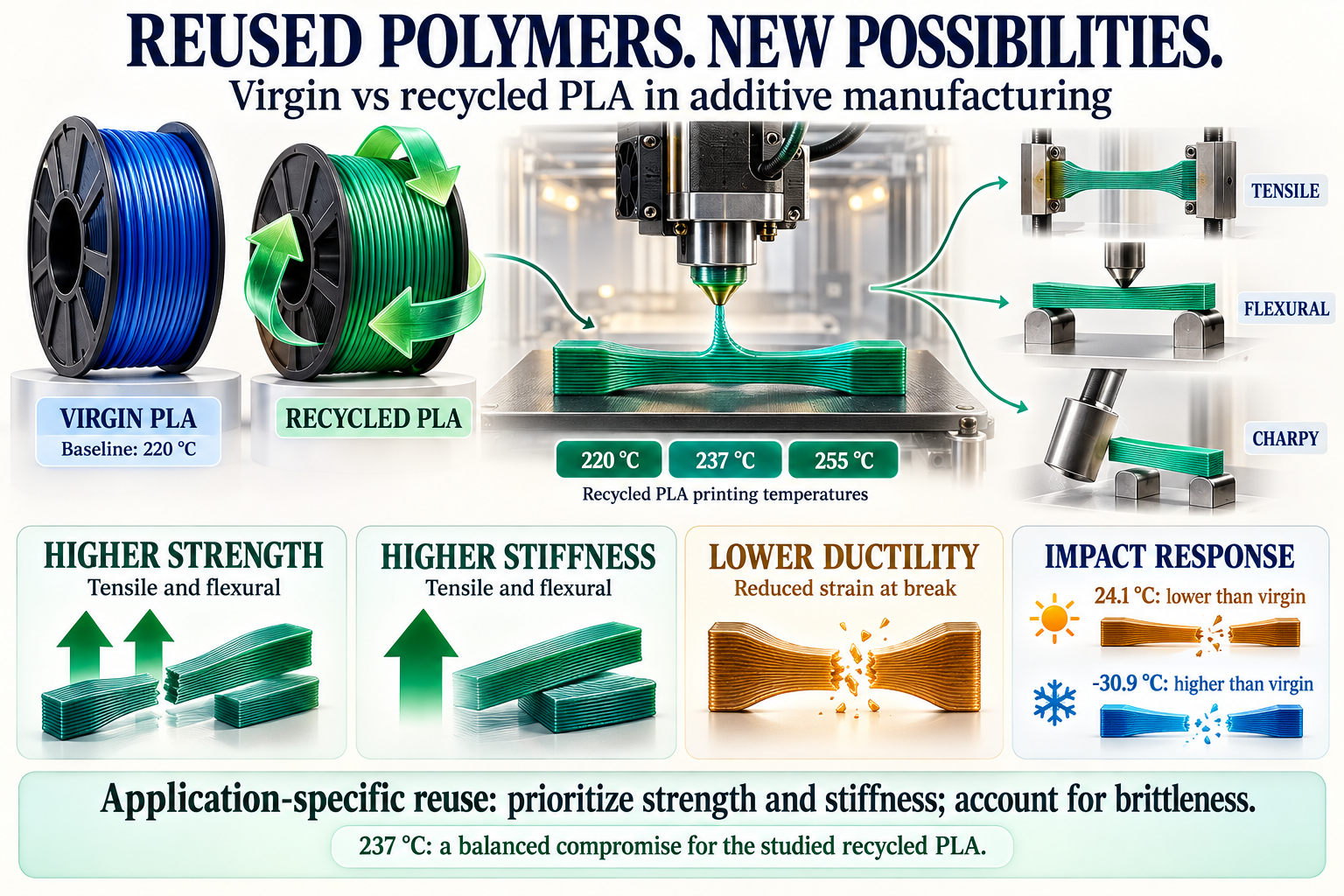
Additive manufacturing (AM) has grown into a widely accessible technology. This shift has been driven largely by advances in low-cost, user-friendly equipment, particularly in fused deposition modelling (FDM) systems. However, material use remains a major cost and sustainability challenge in FDM printing. Polylactic acid (PLA) is the most common and affordable filament, although routine operations such as purging when changing filament color, printing support structures, and discarding failed prints generate significant waste. These drawbacks motivate efforts to recycle waste PLA into new filament, reducing environmental impact and material expense. This study investigates the mechanical performance of recycled PLA, aiming to understand optimal processing parameters. Test specimens were printed for tensile, flexural, and Charpy impact testing. One set of specimens printed from virgin PLA served as the control, while three recycled-PLA sets were printed at different nozzle temperatures: 220 °C (virgin PLA baseline), 237 °C, and 255 °C. All other printing parameters remained constant. Charpy tests, carried out in a manual pendulum system, were also replicated at low temperatures (−30.9 °C). It was concluded that, while recycled PLA demonstrated higher strength and stiffness compared to virgin PLA in both tensile and flexural tests, it showed a substantially lower strain at break. The absorbed energy measurements showed significant reductions for recycled PLA at room temperature over virgin PLA, and major reductions with the testing temperature. Overall, recycled PLA shows promise for specific applications requiring stiffness, but further optimization is needed to improve toughness and ensure consistent manufacturing reliability.
- Open Access
- Article
Viability Analysis of Reusing Polymers in Additive Manufacturing
Author Information
Received: 19 Nov 2025 | Revised: 14 Jun 2026 | Accepted: 18 Jun 2026 | Published: 24 Sep 2026
Abstract
Graphical Abstract
Keywords
additive manufacturing | fused deposition modelling | polymer recycling | polylactic acid | printing temperature
References
- 1.
Galib, G.; Silva, F.J.G.; Pedroso, A.F.V.; et al. A comprehensive review of additive manufacturing technologies for composite materials. J. Mech. Eng. Manuf. 2025, 1, 2. https://doi.org/10.53941/jmem.2025.100002.
- 2.
Schiavone, N.; Verney, V.; Askanian, H. Effect of 3D printing temperature profile on polymer materials behavior. 3D Print. Addit. Manuf. 2020, 7, 311–325.
- 3.
ISO. Plastics—Determination of Tensile Properties; ISO: Geneva, Switzerland, 2019.
- 4.
ASTM. Standard Test Method for Tensile Properties of Plastics; ASTM: West Conshohocken, PA, USA, 2014.
- 5.
Tosto, C.; Saitta, L.; Pergolizzi, E.; et al. Methods for the characterization of polyetherimide based materials processed by fused deposition modelling. Appl. Sci. 2020, 10, 3195.
- 6.
ISO. Plastics—Determination of Flexural Properties; ISO: Geneva, Switzerland, 2019.
- 7.
dos Santos, L.d.C.F.; Verardi, M.; de Araujo Demarchi, A. Polymeric Enclosures Impact Simulaton: Constitutive Model Optimization. In Proceedings of the 2022 International Conference on Electrical Machines (ICEM), Valencia, Spain, 5–8 September 2022; pp. 1267–1273.
- 8.
Bute, I.; Tarasovs, S.; Vidinejevs, S.; et al. Thermal properties of 3D printed products from the most common polymers. Int. J. Adv. Manuf. Technol. 2023, 124, 2739–2753.
- 9.
ISO. Plastics—Differential Scanning Calorimetry (DSC); ISO: Geneva, Switzerland, 2016.
- 10.
Kafle, A.; Luis, E.; Silwal, R.; et al. 3D/4D printing of polymers: Fused deposition modelling (FDM), selective laser sintering (SLS), and stereolithography (SLA). Polymers 2021, 13, 3101.
- 11.
Maideen, N.C.; Nazri, M.H.; Budin, S.; et al. The effect of different slicing software on the manufacturing performance of 3d printed parts. J. Mek. 2023, 46, 72–80. https://doi.org/10.11113/jm.v46.490.
- 12.
Acierno, D.; Patti, A. Fused deposition modelling (FDM) of thermoplastic-based filaments: Process and rheological properties—An overview. Materials 2023, 16, 7664.
- 13.
Fafenrot, S.; Grimmelsmann, N.; Wortmann, M.; et al. Three-dimensional (3D) printing of polymer-metal hybrid materials by fused deposition modeling. Materials 2017, 10, 1199.
- 14.
Almansoori, K.; Pervaiz, S. Effect of layer height, print speed and cell geometry on mechanical properties of marble PLA based 3D printed parts. Smart Mater. Manuf. 2023, 1, 100023.
- 15.
Gordelier, T.J.; Thies, P.R.; Turner, L.; et al. Optimising the FDM additive manufacturing process to achieve maximum tensile strength: A state-of-the-art review. Rapid Prototyping J. 2019, 25, 953–971. https://doi.org/10.1108/RPJ-07-2018-0183.
- 16.
Tanveer, M.Q.; Mishra, G.; Mishra, S.; et al. Effect of infill pattern and infill density on mechanical behaviour of FDM 3D printed Parts-a current review. Mater. Today Proc. 2022, 62, 100–108.
- 17.
Czyżewski, P.; Marciniak, D.; Nowinka, B.; et al. Influence of extruder’s nozzle diameter on the improvement of functional properties of 3D-printed PLA products. Polymers 2022, 14, 356.
- 18.
Ebel, E.; Sinnemann, T. Fabrication of FDM 3D objects with ABS and PLA and determination of their mechanical properties. RTe J. 2014, 11. Available online: https://rtejournal.de/rte/article/view/2014_3 (accessed on 13 February 2026).
- 19.
Ahn, S.H.; Montero, M.; Odell, D.; et al. Anisotropic material properties of fused deposition modeling ABS. Rapid Prototyping J. 2002, 8, 248–257.
- 20.
Letcher, T.; Waytashek, M. Material property testing of 3D-printed specimen in PLA on an entry-level 3D printer. In Proceedings of the ASME International Mechanical Engineering Congress and Exposition, Montreal, QC, Canada, 14–20 November 2014; p. V02AT02A014.
- 21.
Wittbrodt, B.; Pearce, J.M. The effects of PLA color on material properties of 3-D printed components. Addit. Manuf. 2015, 8, 110–116.
- 22.
Natayu, A.; Muhammad, A.A.; Tumada, A.; et al. Effect of annealing on the mechanical properties of fused deposition modeling 3d printed PLA. J. Rekay. Mes. 2024, 15, 1343–1351.
- 23.
Guimarães, A.; Messias, S.; Lopes, J.; et al. Development of a polymer filament extruder: Recycling 3D printer waste. J. Mech. Eng. Manuf. 2026, 2, 1. https://doi.org/10.53941/jmem.2026.100001.
- 24.
Al Rashid, A.; Koç, M. Additive manufacturing for sustainability and circular economy: Needs, challenges, and opportunities for 3D printing of recycled polymeric waste. Mater. Today Sustain. 2023, 24, 100529.
- 25.
Marsavina, L.; Dohan, V.; Galatanu, S.V. Mechanical evaluation of recycled PETG filament for 3D printing. Fracture Struct. Integr. 2024, 18, 310–321.
- 26.
Olawumi, M.A.; Oladapo, B.I.; Olugbade, T.O. Evaluating the impact of recycling on polymer of 3D printing for energy and material sustainability. Resour. Conserv. Recycl. 2024, 209, 107769.
- 27.
Badia, J.; Strömberg, E.; Karlsson, S.; et al. Material valorisation of amorphous polylactide. Influence of thermo-mechanical degradation on the morphology, segmental dynamics, thermal and mechanical performance. Polym. Degrad. Stab. 2012, 97, 670–678.
- 28.
Brüster, B.; Addiego, F.; Hassouna, F.; et al. Thermo-mechanical degradation of plasticized poly (lactide) after multiple reprocessing to simulate recycling: Multi-scale analysis and underlying mechanisms. Polym. Degrad. Stab. 2016, 131, 132–144.
- 29.
Lanzotti, A.; Martorelli, M.; Maietta, S.; et al. A comparison between mechanical properties of specimens 3D printed with virgin and recycled PLA. Procedia CIRP 2019, 79, 143–146, https://doi.org/10.1016/j.procir.2019.02.030.
- 30.
Romani, A.; Perusin, L.; Ciurnelli, M.; et al. Characterization of PLA feedstock after multiple recycling processes for large-format material extrusion additive manufacturing. Mater. Today Sustain. 2024, 25, 100636, https://doi.org/10.1016/j.mtsust.2023.100636.
- 31.
Selvaraj, V.K.; Subramanian, J.; Seenivasan, R.; et al. Sustainable additive manufacturing of recycled Rigid PU/PLA composites via filament extrusion for enhanced mechanical and acoustic properties. Results Eng. 2025, 27, 106365.
- 32.
Simon, Ž.; Stojcevski, F.; Dharmasiri, B.; et al. Circular economy-driven additive manufacturing: A model for recycling PLA/copper composites through multi-extrusion processing. J. Ind. Eng. Chem. 2024, 130, 392–400.
- 33.
BAMBU. Bambu Filament; Technical Data Sheet V3.0. Pla Basic; BAMBU: Guangdong, China, 2025.
- 34.
SAKATA3D. Technical Data Sheet: Sakata 3D Re-Go&Print; SAKATA3D: Andalucía, Spain, 2025.
- 35.
BAMBU. Introduction to Bambu Lab Build Plates. Available from: https://wiki.bambulab.com/en/filament-acc/acc/plates (accessed on 1 May 2026).
- 36.
Hasan, M.R.; Davies, I.J.; Pramanik, A.; et al. Impact of process parameters on improving the performance of 3D printed recycled polylactic acid (rPLA) components. Int. J. Adv. Manuf. Technol. 2024, 131, 3751–3779. https://doi.org/10.1007/s00170-024-13140-7.
- 37.
Pang, R.; Lai, M.K.; Ismail, K.I.; et al. The Effect of Printing Temperature on Bonding Quality and Tensile Properties of Fused Deposition Modelling 3d-Printed Parts. In Proceedings of the IOP Conference Series: Materials Science and Engineering, 33rd Symposium of Malaysian Chemical Engineers (SOMChE 2022), Virtual Event, 8–9 August 2022; Vol. 1257, p. 012031. https://doi.org/10.1088/1757-899X/1257/1/012031.
- 38.
Wei, X.; Bähr, R. A comparative study of 3D printing with virgin and recycled polylactic acid filaments. CIRP J. Manuf. 2024, 54, 75–84. https://doi.org/10.1016/j.cirpj.2024.08.007.
- 39.
Anderson, I. Mechanical Properties of Specimens 3D Printed with Virgin and Recycled Polylactic Acid. 3D Print Addit. Manuf. 2017, 4, 110–115. https://doi.org/10.1089/3dp.2016.0054.
- 40.
Aly, R.; Olalere, O.; Ryder, A.; et al. Mechanical Property Characterization of Virgin and Recycled PLA Blends in Single-Screw Filament Extrusion for 3D Printing. Polymers 2024, 16, 3569.
- 41.
Bergaliyeva, S.; Sales, D.L.; Delgado, F.J.; et al. Manufacture and Characterization of Polylactic Acid Filaments Recycled from Real Waste for 3D Printing. Polymers 2023, 15, 2165.
- 42.
Karayer, Y.; Altınsoy, Ş.; Koç, G.; et al. Effects of Steam Sterilization and Recycling on the Mechanical and Surface Properties of 3D-Printed Biodegradable PLA and Re-PLA Materials. Polymers 2025, 17, 2590.


This work is licensed under a Creative Commons Attribution 4.0 International License.

 Suite 4002 Level 4, 447 Collins Street, Melbourne, Victoria 3000, Australia
 General Inquiries: info@sciltp.com