
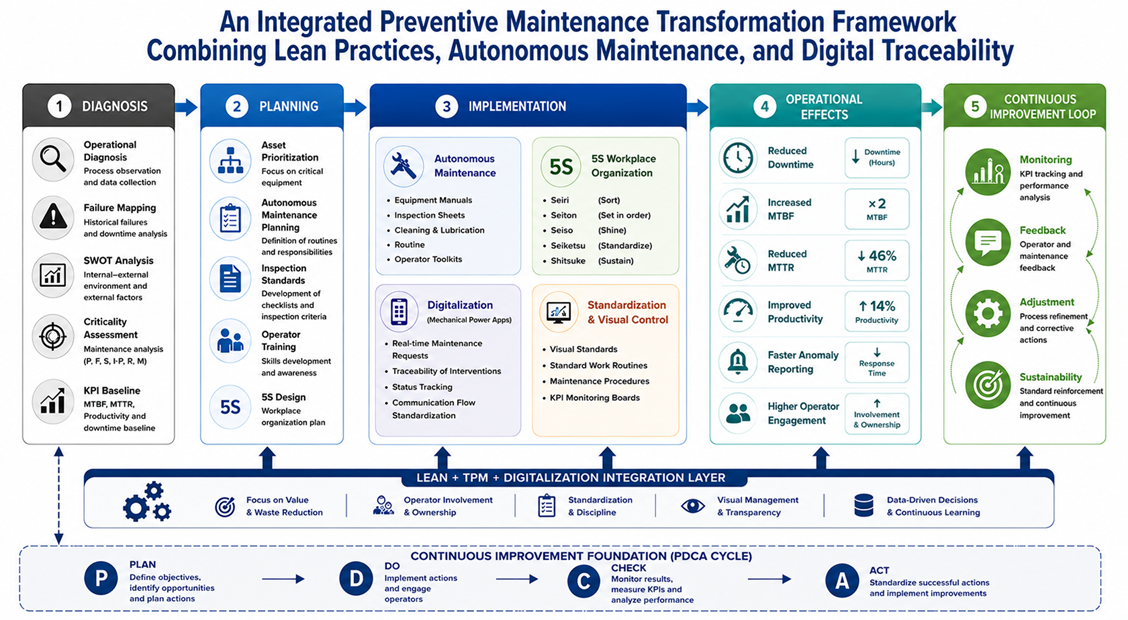
Despite the widespread adoption of Lean and Total Productive Maintenance (TPM) methodologies, many manufacturing companies still struggle to operationally integrate preventive maintenance, workplace organization, autonomous maintenance, and digital traceability into a coherent and measurable maintenance-improvement system. This Action Research study presents an integrated Lean-based preventive maintenance transformation framework implemented in a production unit of a major corrugated cardboard packaging manufacturer. The project focused on the DRO 1628 NT rotary die-cutter, identified as the most critical asset in the converting section through a structured multi-criteria criticality assessment. The proposed framework combined autonomous maintenance routines, standardized inspection procedures, 5S workplace organization, KPI-driven monitoring, and maintenance communication digitalization through a custom Microsoft Power Apps (Microsoft Corporation, Redmond, Washington, DC, USA) solution. The novelty of the study lies in the operational integration of these organizational, technical, and digital elements within a unified preventive maintenance transformation strategy specifically adapted to a high-pressure industrial environment characterized by limited traceability, reactive maintenance practices, and strong dependence on informal operator knowledge. Between the September 2024 baseline and the May 2025 post-intervention assessment, productivity increased by 14.0%, monthly production output increased by 16.8%, Mean Time between Failures (MTBF) increased by 18.0%, and Mean Time to Repair (MTTR) decreased by 43.3%. Beyond these quantitative gains, qualitative observations indicated improvements in operator engagement, routine discipline, workplace organization, anomaly traceability, and production-maintenance communication. The findings further suggest that substantial maintenance-performance improvements can be achieved through the structured integration of Lean routines, operator-centered maintenance practices, and accessible digital support systems, even in industrial environments that do not yet rely on advanced predictive maintenance architectures. The study therefore contributes a preventive maintenance transformation framework empirically evaluated through an industrial Action Research study and provides new insights into how organizational routines, operator involvement, standardized work, and digital traceability interact to strengthen preventive maintenance capability, with potential transferability to other manufacturing environments.
- Open Access
- Article
An Integrated Preventive Maintenance Transformation Framework Combining Lean Practices, Autonomous Maintenance and Digital Traceability
Author Information
Received: 05 Apr 2026 | Revised: 02 Jul 2026 | Accepted: 14 Jul 2026 | Published: 09 Oct 2026
Abstract
Graphical Abstract
Keywords
equipment reliability | autonomous maintenance | maintenance performance indicators | TPM | 5S | maintenance digitalization | asset prioritization | Action Research
References
- 1.
Nakagawa, T. Advanced Reliability Models and Maintenance Policies; Springer: London, UK, 2008. https://doi.org/10.1007/978-1-84800-294-4.
- 2.
Higgins, L.R.; Mobley, R.K.; Smith, R. Maintenance Engineering Handbook, 6th ed.; McGraw-Hill: New York, NY, USA, 2002. https://doi.org/10.1036/0071394524.
- 3.
Ben-Daya, M.; Duffuaa, S.O.; Raouf, A.; et al. (Eds.). Handbook of Maintenance Management and Engineering; Springer: London, UK, 2009. https://doi.org/10.1007/978-1-84882-472-0.
- 4.
Wireman, T. Benchmarking Best Practices in Maintenance Management; Industrial Press: New York, NY, USA, 2004.
- 5.
Smith, R.; Hawkins, B. Lean Maintenance: Reduce Costs, Improve Quality, and Increase Market Share; Butterworth-Heinemann: Oxford, UK, 2004.
- 6.
British Standards Institution. BS EN 15341:2007—Maintenance—Maintenance Key Performance Indicators; BSI: London, UK, 2007.
- 7.
Dowlatshahi, S. The role of industrial maintenance in the maquiladora industry: An empirical analysis. Int. J. Prod. Econ. 2008, 114, 298–307. https://doi.org/10.1016/j.ijpe.2008.02.009.
- 8.
Muchiri, P.; Pintelon, L.; Gelders, L.; et al. Development of maintenance function performance measurement framework and indicators. Int. J. Prod. Econ. 2011, 131, 295–302. https://doi.org/10.1016/j.ijpe.2010.04.039.
- 9.
Oliveira, M.; Lopes, I.; Rodrigues, C. Use of maintenance performance indicators by companies of the industrial hub of Manaus. Procedia CIRP 2016, 52, 157–160. https://doi.org/10.1016/j.procir.2016.07.071.
- 10.
Ferreira, S.; Silva, F.J.G.; Casais, R.B.; et al. KPI development and obsolescence management in industrial maintenance. Procedia Manuf. 2019, 38, 1427–1435. https://doi.org/10.1016/j.promfg.2020.01.145.
- 11.
Komonen, K.; Kunttu, S.; Ahonen, T.; et al. In search of best practices in industrial maintenance: Some underlying factors. IFAC Proc. Vol. 2010, 43, 68–73. https://doi.org/10.3182/20100701-2-PT-4012.00013.
- 12.
Santos, T.; Silva, F.J.G.; Ramos, S.F.; et al. Asset priority setting for maintenance management in the food industry. Procedia Manuf. 2019, 38, 1623–1633. https://doi.org/10.1016/j.promfg.2020.01.122.
- 13.
Antosz, K.; Stadnicka, D.; Ratnayake, R.M.C. Development of a risk matrix for the assessment of maintenance suppliers: A study based on empirical knowledge. IFAC-PapersOnLine 2017, 50, 9026–9031. https://doi.org/10.1016/j.ifacol.2017.08.1586.
- 14.
Mwanza, B.G.; Mbohwa, C. Design of a total productive maintenance model for effective implementation: Case study of a chemical manufacturing company. Procedia Manuf. 2015, 4, 461–470. https://doi.org/10.1016/j.promfg.2015.11.063.
- 15.
Kigsirisin, S.; Pussawiro, S.; Noohawm, O. Approach for total productive maintenance evaluation in water productivity: A case study. Procedia Eng. 2016, 154, 260–267. https://doi.org/10.1016/j.proeng.2016.07.472.
- 16.
Guariente, P.; Antoniolli, I.; Ferreira, L.P.; et al. Implementing autonomous maintenance in an automotive components manufacturer. Procedia Manuf. 2017, 13, 1128–1134. https://doi.org/10.1016/j.promfg.2017.09.174.
- 17.
Pinto, G.F.L.; Silva, F.J.G.; Campilho, R.D.S.G.; et al. Continuous improvement in maintenance: A case study in the automotive industry involving lean tools. Procedia Manuf. 2019, 38, 1582–1591. https://doi.org/10.1016/j.promfg.2020.01.127.
- 18.
Pinto, G.; Silva, F.J.G.; Fernandes, N.O.; et al. Implementing a maintenance strategic plan using TPM methodology. Int. J. Ind. Eng. Manag. 2020, 11, 192–204. https://doi.org/10.24867/IJIEM-2020-3-264.
- 19.
Pinto, G.; Silva, F.J.G.; Baptista, A.; et al. TPM implementation and maintenance strategic plan—A case study. Procedia Manuf. 2020, 51, 1423–1430. https://doi.org/10.1016/j.promfg.2020.10.198.
- 20.
Martins, L.; Silva, F.J.G.; Pimentel, C.; et al. Improving preventive maintenance management in an energy solutions company. Procedia Manuf. 2020, 51, 1551–1558. https://doi.org/10.1016/j.promfg.2020.10.216.
- 21.
Pereira, T.; Neves, A.S.L.; Silva, F.J.G.; et al. Production process analysis and improvement of corrugated cardboard industry. Procedia Manuf. 2020, 51, 1395–1402. https://doi.org/10.1016/j.promfg.2020.10.194.
- 22.
Ferreira, S.; Martins, L.; Silva, F.J.G.; et al. A novel approach to improve maintenance operations. Procedia Manuf. 2020, 51, 1531–1537. https://doi.org/10.1016/j.promfg.2020.10.213.
- 23.
Rashidnejad, M.; Ebrahimnejad, S.; Safari, J. A bi-objective model of preventive maintenance planning in distributed systems considering vehicle routing problem. Comput. Ind. Eng. 2018, 120, 360–381. https://doi.org/10.1016/j.cie.2018.05.001.
- 24.
Al-Thani, N.A.; Ahmed, M.B.; Haouari, M. A model and optimization-based heuristic for the operational aircraft maintenance routing problem. Transp. Res. Part C 2016, 72, 29–44. https://doi.org/10.1016/j.trc.2016.09.004.
- 25.
Eltoukhy, A.E.E.; Chan, F.T.S.; Chung, S.H.; et al. A model with a solution algorithm for the operational aircraft maintenance routing problem. Comput. Ind. Eng. 2018, 120, 346–359. https://doi.org/10.1016/j.cie.2018.05.002.
- 26.
De Bruecker, P.; Beliën, J.; Van den Bergh, J.; et al. A three-stage mixed integer programming approach for optimizing the skill mix and training schedules for aircraft maintenance. Eur. J. Oper. Res. 2018, 267, 439–452. https://doi.org/10.1016/j.ejor.2017.11.047.
- 27.
Callewaert, P.; Verhagen, W.J.C.; Curran, R. Integrating maintenance work progress monitoring into aircraft maintenance planning decision support. Transp. Res. Procedia 2018, 29, 58–69. https://doi.org/10.1016/j.trpro.2018.02.006.
- 28.
Bokrantz, J.; Skoogh, A.; Berlin, C.; et al. Maintenance in digitalized manufacturing: Delphi-based scenarios for 2030. Int. J. Prod. Econ. 2017, 191, 154–169. https://doi.org/10.1016/j.ijpe.2017.06.010.
- 29.
Bumblauskas, D.; Gemmill, D.; Igou, A.; et al. Smart maintenance decision support systems based on corporate big data analytics. Expert Syst. Appl. 2017, 90, 303–317. https://doi.org/10.1016/j.eswa.2017.08.025.
- 30.
Rodríguez-Padial, N.; Marín, M.; Domingo, R. Strategic framework to maintenance decision support systems. Procedia Eng. 2015, 132, 903–910. https://doi.org/10.1016/j.proeng.2015.12.576.
- 31.
Masoni, R.; Ferrise, F.; Bordegoni, M.; et al. Supporting remote maintenance in Industry 4.0 through augmented reality. Procedia Manuf. 2017, 11, 1296–1302. https://doi.org/10.1016/j.promfg.2017.07.257.
- 32.
Scurati, G.W.; Gattullo, M.; Fiorentino, M.; et al. Converting maintenance actions into standard symbols for augmented reality applications in Industry 4.0. Comput. Ind. 2018, 98, 68–79. https://doi.org/10.1016/j.compind.2018.02.001.
- 33.
Tsagkas, V.; Nathanael, D.; Marmaras, N. A pragmatic mapping of factors behind deviating acts in aircraft maintenance. Reliab. Eng. Syst. Saf. 2014, 130, 106–114. https://doi.org/10.1016/j.ress.2014.05.011.
- 34.
Iung, B.; Levrat, E. Advanced maintenance services for promoting sustainability. Procedia CIRP 2014, 22, 15–22. https://doi.org/10.1016/j.procir.2014.07.018.
- 35.
Pires, S.P.; Sénéchal, O.; Loures, E.F.R.; et al. An approach to the prioritization of sustainable maintenance drivers in the TBL framework. IFAC-PapersOnLine 2016, 49, 150–155. https://doi.org/10.1016/j.ifacol.2016.11.026.
- 36.
Susman, G.I.; Evered, R.D. An Assessment of the Scientific Merits of Action Research. Admin. Sci. Q. 1978, 23, 582–603. https://doi.org/10.2307/2392581.
- 37.
Baskerville, R.L. Investigating Information Systems with Action Research. Commun. Assoc. Inf. Syst. 1999, 2, 19. https://doi.org/10.17705/1CAIS.00219.
- 38.
Coughlan, P.; Coghlan, D. Action Research for Operations Management. Int. J. Oper. Prod. Manag. 2002, 22, 220–240. https://doi.org/10.1108/01443570210417515.
- 39.
Kemmis, S.; McTaggart, R.; Nixon, R. The Action Research Planner: Doing Critical Participatory Action Research; Springer: Singapore, 2014. https://doi.org/10.1007/978-981-4560-67-2.


This work is licensed under a Creative Commons Attribution 4.0 International License.

 Suite 4002 Level 4, 447 Collins Street, Melbourne, Victoria 3000, Australia
 General Inquiries: info@sciltp.com