
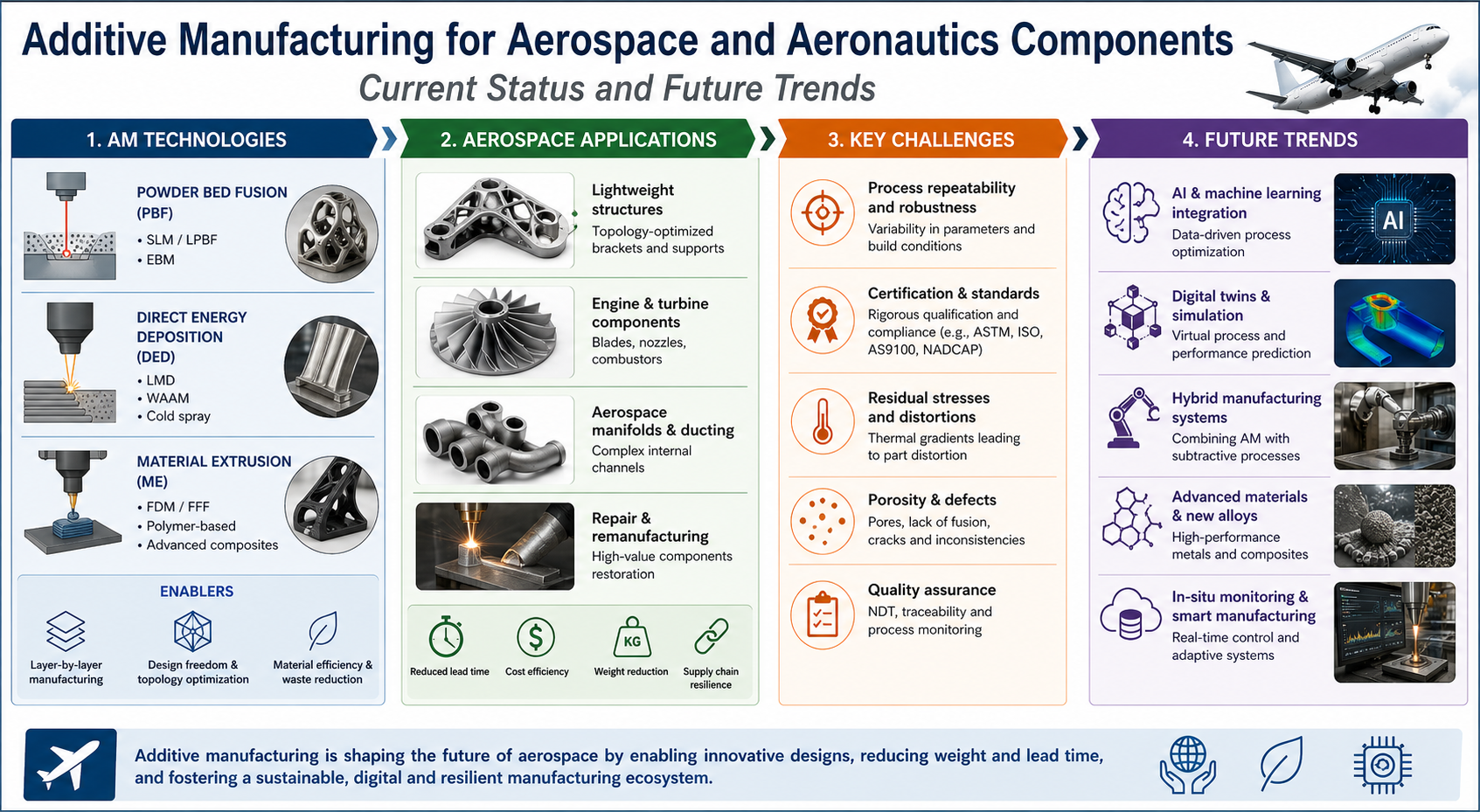
Additive manufacturing (AM), also known globally as three-dimensional (3D) printing, has been gaining traction, since it allows the use of digital models to directly produce components by depositing the required materials one layer at a time. In contrast to conventional subtractive manufacturing processes, the greatest advantage of AM lies in the significant reduction of material waste, while simultaneously enabling much more complex structures, whose topology optimisation may be easily performed, with a wide range of geometric forms. Owing to these outstanding characteristics, AM is now an essential technology in high-value industrial fields, such as aerospace and aeronautics, where performance, weight reduction, and design flexibility are key requirements. Particularly, metal additive manufacturing (MAM) has been growing significantly, with powder bed fusion (PBF) currently being the most widely used process, followed by directed energy deposition (DED) and material extrusion, although the latter is still mostly applied to polymers. The wide range of industrial applications of these technologies includes aircraft ducts, brackets and housings, structurally optimised components, in addition to the repair and manufacture of high-value parts, such as turbine blades and rotor shafts. This review offers a descriptive and updated overview of the state-of-the-art of additive manufacturing technologies applied to the aerospace and aeronautics sectors. It analyses current applications, materials used, and process paths, while critically discussing the key technological and regulatory challenges that continue to limit broader industrial adoption, especially in terms of quality assurance, process repeatability, certification, and compliance with the tight industry standards. Furthermore, emerging trends and future research directions are outlined, providing a forward-looking perspective on this technology’s role in shaping next-generation aerospace components. By consolidating dispersed knowledge and synthesising recent scientific and industrial advances, this article’s objective is to serve as a foundational reference for both established researchers and newcomers to the field, supporting informed research, technology development, and industrial decision-making in metal additive manufacturing for aerospace applications.
- Open Access
- Review
Additive Manufacturing for Aerospace and Aeronautical Components Production: Current Status and Future Trends
Author Information
Received: 30 Apr 2026 | Revised: 08 Sep 2026 | Accepted: 09 Sep 2026 | Published: 15 Oct 2026
Abstract
Graphical Abstract
Keywords
additive manufacturing | powder-bed fusion | directed energy deposition | aerospace | aeronautics
References
- 1.
Kalender, M.; Bozkurt, Y.; Ersoy, S.; et al. Product Development with Additive Manufacturing and 3D Printer Technology in Aerospace Industry. J. Aeronaut. Space Technol. 2020, 13, 129–138.
- 2.
Gao, G.; Wang, Y.; Wang, Y.; et al. Development on Shape and Performance Control of Aeronautical Parts in Additive Manufacturing. J. Manuf. Process. 2025, 141, 351–374. https://doi.org/10.1016/j.jmapro.2025.03.015.
- 3.
Gupta, A. Advantages and Challenges of Additive Manufacturing: A Breakthrough in Aerospace Manufacturing. Int. J. Res. Aeronaut. Mech. Eng. 2024, 12, 1–14. https://doi.org/10.5281/zenodo.10847767.
- 4.
Roucoules, L.; Paredes, M.; Eynard, B.; et al. Advances on Mechanics, Design Engineering and Manufacturing III. In Proceedings of the International Joint Conference on Mechanics, Design Engineering & Advanced Manufacturing, Online, 2–4 June 2020. https://doi.org/10.1007/978-3-030-70566-4.
- 5.
Radhika, C.; Shanmugam, R.; Ramoni, M.; et al. A Review on Additive Manufacturing for Aerospace Application. Mater. Res. Express 2024, 11, 022001. https://doi.org/10.1088/2053-1591/ad21ad.
- 6.
Abdulhameed, O.; Al-Ahmari, A.; Ameen, W.; et al. Additive Manufacturing: Challenges, Trends, and Applications. Adv. Mech. Eng. 2019, 11, 1687814018822880. https://doi.org/10.1177/1687814018822880.
- 7.
Sherekar, R.; Gaddamwar, S. Advanced Applications of Additive Manufacturing in the Design and Fabrication of High-Performance Aerospace Heat Exchangers. Int. J. Sci. Res. Eng. Manag. 2025, 9, 1–9. https://doi.org/10.55041/ijsrem51777.
- 8.
Prater, T.; Tilson, W.; Vickers, J.; et al. Breakthrough Materials for Space Applications Workshop. In Proceedings of the Workshop at Jackson Center, Huntsville, AL, USA, 23–24 April 2019.
- 9.
Mohanavel, V.; Ashraff Ali, K.S.; Ranganathan, K.; et al. The Roles and Applications of Additive Manufacturing in the Aerospace and Automobile Sector. Mater. Today Proc. 2021, 47, 405–409. https://doi.org/10.1016/j.matpr.2021.04.596.
- 10.
Dordlofva, C. A Design for Qualification Framework for the Development of Additive Manufacturing Components—A Case Study from the Space Industry. Aerospace 2020, 7, 25. https://doi.org/10.3390/aerospace7030025.
- 11.
Ceruti, A.; Marzocca, P.; Liverani, A.; et al. Maintenance in Aeronautics in an Industry 4.0 Context: The Role of Augmented Reality and Additive Manufacturing. J. Comput. Des. Eng. 2019, 6, 516–526. https://doi.org/10.1016/j.jcde.2019.02.001.
- 12.
Rossi, S.; Hernandez, M.; Hassan, B. Additive Manufacturing (3D Printing): Applications in Healthcare, Aerospace, and Consumer Products. 2024. Available online: https://www.researchgate.net/publication/384326285 (accessed on 30 April 2026).
- 13.
Scalia, T.; Bonventre, L.; Vecchiarelli, P.; et al. Additive Manufacturing: Scientific & Patent Trends in the Space Sector. In Proceedings of the 72nd International Astronautical Congress (IAC), Dubai, United Arab Emirates, 25–29 October 2021.
- 14.
Khorasani, A.; Ghasemi, A.; Rolfe, B.; et al. Additive Manufacturing a Powerful Tool for the Aerospace Industry. Rapid Prototyp. J. 2022, 28, 87–100. https://doi.org/10.1108/rpj-01-2021-0009.
- 15.
Rietter, L.; Freitas, R.; Carneiro, F.; et al. Study for Implementation of Electronic Circuits into Multifunctional Miniaturized Thermoplastic Enclosures. In Proceedings of the 2023 15th International Congress Mechatronic Integration Discourse (MID), Amberg, Germany, 21–22 June 2023; pp. 1–5. https://doi.org/10.1109/mid59615.2023.10461320.
- 16.
Vlaeyen, M.; Sinico, M.; Witvrouw, A.; et al. End-to-End Additive Manufacturing for a Structural Aerospace Component. In Proceedings of the 23rd International Conference of the European Society for Precision Engineering and Nanotechnology, Copenhagen, Denmark, 12–16 June 2023; pp. 103–106.
- 17.
Getachew, M.T.; Shiferaw, M.Z.; Ayele, B.S. Recent Advances of Additive Manufacturing for Aerospace Industries: Methods, Materials, Challenges, and Future Outlooks. In Sustainable Development Research in Manufacturing, Process Engineering, Green Infrastructure, and Water Resources; Springer Nature Switzerland: Cham, Switzerland, 2025; pp. 47–82. https://doi.org/10.1007/978-3-031-77339-6_4.
- 18.
Heikkinen, T.; Stolt, R.; Elgh, F. Incorporating Design for Additive Manufacturing in Multidisciplinary Design Automation—Challenges Identified. Comput. Aided Des. Appl. 2020, 17, 936–947. https://doi.org/10.14733/cadaps.2020.936-947.
- 19.
Nguyen, D.S. Design of Lattice Structure for Additive Manufacturing in CAD Environment. J. Adv. Mech. Des. Syst. Manuf. 2019, 13, JAMDSM0057. https://doi.org/10.1299/jamdsm.2019jamdsm0057.
- 20.
Zhu, J.H.; Zhang, W.H.; Xia, L. Topology Optimization in Aircraft and Aerospace Structures Design. Arch. Comput. Methods Eng. 2016, 23, 595–622. https://doi.org/10.1007/s11831-015-9151-2.
- 21.
Crespo-Sánchez, J.; Solek, C.; Fuentes del Toro, S.; et al. Retrofitting of a High-Performance Aerospace Component via Topology Optimization and Additive Manufacturing. Machines 2025, 13, 700. https://doi.org/10.3390/machines13080700.
- 22.
Ferreira, B.T.; Monteiro, J.; Borille, A.; et al. Reuse Powder Impacts in Additive Manufacturing for Aeronautical Parts. Int. J. Adv. Manuf. Technol. 2025, 141, 2027–2062. https://doi.org/10.1007/s00170-025-16619-z.
- 23.
Doğru, A.; Seydibeyoğlu, M.Ö. Sustainable Materials Used by Additive Manufacturing for Aerospace Industry. In Research Developments in Sustainable Aviation; Springer International Publishing: Cham, Switzerland, 2021; pp. 99–107.
- 24.
Olabisi, S.A.; Madueke, C.I.; Adediran, A.A.; et al. A Mini Review on Additive Manufacturing in Aerospace: Challenges and Opportunities. NIPES J. Sci. Technol. Res. 2025, 7, 126–138. https://doi.org/10.37933/nipes/7.4.2025.si16.
- 25.
Getachew, M.T.; Shiferaw, M.Z.; Ayele, B.S. The Current State of the Art and Advancements, Challenges, and Future of Additive Manufacturing in Aerospace Applications. Adv. Mater. Sci. Eng. 2023, 2023, 8817006. https://doi.org/10.1155/2023/8817006.
- 26.
Bozkurt, Y.; Avşar, A.; Korgancı, M.; et al. A Comprehensive Review on Friction Stir Additive Manufacturing of Various Structural Alloys for Aerospace Applications. Prog. Addit. Manuf. 2025, 10, 7365–7390. https://doi.org/10.1007/s40964-025-01160-y.
- 27.
Saracyakupoglu, T. The Qualification of the Additively Manufactured Parts in the Aviation Industry. Am. J. Aerosp. Eng. 2019, 6, 1–10. https://doi.org/10.11648/j.ajae.20190601.11.
- 28.
Rahman, M.M.; Ramzan, A. Additive Manufacturing and 3D Printing for Aerospace and Automotive Industries. Spectr. Eng. Sci. 2025, 3, 1241–1259. https://doi.org/10.5281/zenodo.16477032.
- 29.
Zhou, L.; Miller, J.; Vezza, J.; et al. Additive Manufacturing: A Comprehensive Review. Sensors 2024, 24, 2668. https://doi.org/10.3390/s24092668.
- 30.
Wang, T.; Li, N.; Yu, N.; et al. Robot-Assisted Additive Manufacturing for Aerospace Applications: Recent Trends and Its Future Possibilities. Int. J. Comput. Integr. Manuf. 2026, 39, 204–244. https://doi.org/10.1080/0951192x.2025.2478007.
- 31.
Franco, G.; Candura, F. Production Technology and Use of Composite Materials in the Aeronautics Industry, Risks and Pathology in the Manufacturing Workers. G. Ital. Med. Lav. 1985, 7, 45–57.
- 32.
Pant, H.; Arora, A.; Gopakumar, G.S.; et al. Applications of Wire Arc Additive Manufacturing (WAAM) for Aerospace Component Manufacturing. Int. J. Adv. Manuf. Technol. 2023, 127, 4995–5011. https://doi.org/10.1007/s00170-023-11623-7.
- 33.
Tyan, M.; Min, D.; Maw, A. Topology Optimization in Additive Manufacturing for Lightweight Aerospace Components. Int. Innov. Res. J. Eng. Technol. 2025, 11, 44–53. https://doi.org/10.32595/iirjet.org/v11i1.2025.231.
- 34.
Ferreira, C.M.; Reis, L.; Carmezim, M.J.; et al. Additive Manufacturing of Aluminium Alloys in the Aeronautical Sector—A Bibliometric Analysis. Procedia Struct. Integr. 2024, 53, 254–263. https://doi.org/10.1016/j.prostr.2024.01.031.
- 35.
Gradl, P.; Mireles, O.R.; Katsarelis, C.; et al. Advancement of Extreme Environment Additively Manufactured Alloys for next Generation Space Propulsion Applications. Acta Astronaut. 2023, 211, 483–497. https://doi.org/10.1016/j.actaastro.2023.06.035.
- 36.
Waller, J.M.; Burke, E.R.; Wells, D.N.; et al. NDE-Based Quality Assurance of Metal Additively Manufactured Aerospace Parts at NASA, JAXA, and ESA. In Proceedings of the ASTM Special Technical Publication, STP 1620, West Conshohocken, PA, USA, 6–8 November 2018. https://doi.org/10.1520/stp162020180106.
- 37.
Afkhami, S.; Piili, H.; Salminen, A.; et al. Effective Parameters on the Fatigue Life of Metals Processed by Powder Bed Fusion Technique: A Short Review. Procedia Manuf. 2019, 36, 3–10. https://doi.org/10.1016/j.promfg.2019.08.002.
- 38.
Neumann, G.; Schwarz, H.; Groh, W.; et al. A Data-Based Certification Approach for Additively Manufactured Metal Aircraft Components. Prog. Addit. Manuf. 2025, 10, 4061–4071. https://doi.org/10.1007/s40964-025-01107-3.
- 39.
Blachowicz, T.; Ehrmann, G.; Ehrmann, A. Metal Additive Manufacturing for Satellites and Rockets. Appl. Sci. 2021, 11, 12036. https://doi.org/10.3390/app112412036.
- 40.
Stelling, O.; Maywald, K. Influence of Processing Parameters during Hot Isostatic Pressing on Properties and Microstructure of Additive Manufactured TiAl6V4. HTM J. Heat Treat. Mater. 2020, 75, 35–47. https://doi.org/10.3139/105.110403.
- 41.
Di Caprio, F.; Acanfora, V.; Franchitti, S.; et al. Hybrid Metal/Composite Lattice Structures: Design for Additive Manufacturing. Aerospace 2019, 6, 71. https://doi.org/10.3390/aerospace6060071.
- 42.
Chiapperi, J.D.; Bron, J.A.; Gregory, D.C.; et al. An Integrative Course in Turbomachine Design, Manufacturing, and Measurement. In Proceedings of the ASME Turbo Expo 2025: Turbomachinery Technical Conference and Exposition, Memphis, TN, USA, 16–20 June 2025. https://doi.org/10.1115/gt2025-152137.
- 43.
Subeshan, B.; Ali, Z.; Asmatulu, E. Metal Additive Manufacturing in Space and Aerospace Exploration: Current Processes, Material Selection and Challenges. J. Eng. Appl. Sci. 2024, 11, 35. https://doi.org/10.5455/jeas.2024021104.
- 44.
Marketyn, S.; Ellis, B.; Rajab, H. Material Selection Criteria for Additive Manufacturing in Aerospace. 2025. Available online: https://www.researchgate.net/publication/389819194 (accessed on 25 April 2026).
- 45.
Arena, M.; Ambrogiani, P.; Raiola, V.; et al. Design and Qualification of an Additively Manufactured Manifold for Aircraft Landing Gears Applications. Aerospace 2023, 10, 69. https://doi.org/10.3390/aerospace10010069.
- 46.
Valentin, M.; Arnaud, C.; Kling, R. Additive Manufacturing by Wire Based Laser Metal Deposition. In Proceedings of the Laser 3D Manufacturing VI, San Francisco, CA, USA, 5–7 February 2019. https://doi.org/10.1117/12.2510074.
- 47.
Lizarribar Carrillo, B.; Prieto, B.; Martínez-Iturralde, M.; et al. Design and Additive Manufacturing of a Lightweight Aerospace Electric Actuator. Open Res. Eur. 2024, 4, 121. https://doi.org/10.12688/openreseurope.17752.1.
- 48.
Kumar, S.A.; Ahmad, N. Microstructure Analysis of Carbon-Reinforced PEEK in Additive Manufacturing for Aerospace Applications. 2024. https://doi.org/10.13140/rg.2.2.21023.37288.
- 49.
Bagassi, S.; Lucchi, F.; de Crescenzio, F.; et al. Generative Design: Advanced Design Optimization Processes for Aeronautical Applications. In Proceedings of the 30th Congress of the International Council of the Aeronautical Sciences (ICAS 2016), Daejeon, South Korea, 25–30 September 2016.
- 50.
Andries, V.; Zaharia, S.M. Generative Design, Simulation, and 3D Printing of the Quadcopter Drone Frame. Appl. Sci. 2025, 15, 9647. https://doi.org/10.3390/app15179647.
- 51.
Khajavi, S.H.; Partanen, J.; Holmström, J. Additive Manufacturing in the Spare Parts Supply Chain. Comput. Ind. 2014, 65, 50–63. https://doi.org/10.1016/j.compind.2013.07.008.
- 52.
Avşar Aydın, E.; Biçer, M.B.; Mert, M.E.; et al. 3D-Printed Antenna Design Using Graphene Filament and Copper Tape for High-Tech Air Components. SAE Int. J. Aerosp. 2022, 16, 131–140. https://doi.org/10.4271/01-16-02-0008.
- 53.
Gradl, P.; Tinker, D.C.; Park, A.; et al. Robust Metal Additive Manufacturing Process Selection and Development for Aerospace Components. J. Mater. Eng. Perform. 2022, 31, 6013–6044. https://doi.org/10.1007/s11665-022-06850-0.
- 54.
Acosta, C.; Flynn, W.P.; Santillan, L.; et al. The Performance Characterization of a Drop-on-Demand Inkjet-Printed Gold Film Under the Temperature Conditions for Airborne Equipment. J. Compos. Sci. 2025, 9, 231. https://doi.org/10.3390/jcs9050231.
- 55.
León-Becerra, J.; Hidalgo-Salazar, M.Á.; González-Estrada, O.A. Progressive Damage Analysis of Carbon Fiber-Reinforced Additive Manufacturing Composites. Int. J. Adv. Manuf. Technol. 2023, 126, 2617–2631. https://doi.org/10.1007/s00170-023-11256-w.
- 56.
Arévalo, C.M.; Perez-Soriano, E.M.; Ariza, E.; et al. Optimizing Titanium-Boron Carbide Composites for Aerospace Manufacturing via Plasma Metal Deposition. Mater. Sci. Forum 2025, 1146, 49–56. https://doi.org/10.4028/p-4t23q8.
- 57.
Danylenko, V.; Lipovskyi, V. Review of Polymer Fused Deposition Material Additive Manufacturing Technology for Aerospace Application. J. Rocket. Space Technol. 2025, 34, 21–30. https://doi.org/10.15421/452502.
- 58.
Aliberti, F.; Longo, R.; Raimondo, M.; et al. Additive manufacturing of polymers and composites for applications in aerospace and aeronautics. Mater. Horiz. 2025, 13, 532–588. https://doi.org/10.1039/d5mh01403d.
- 59.
Montanari, R.; Palombi, A.; Richetta, M.; et al. Additive Manufacturing of Aluminum Alloys for Aeronautic Applications: Advantages and Problems. Metals 2023, 13, 716. https://doi.org/10.3390/met13040716.
- 60.
Palmero, E.M.; Casaleiz, D.; de Vicente, J.; et al. Composites Based on Metallic Particles and Tuned Filling Factor for 3D-Printing by Fused Deposition Modeling. Compos. Part A Appl. Sci. Manuf. 2019, 124, 105497. https://doi.org/10.1016/j.compositesa.2019.105497.
- 61.
Kafalı, H.; Tunca, E. Investigation of the Mechanical Properties of Polyurethane Foam-Filled FDM-Printed Honeycomb Core Sandwich Composites for Aircraft. Aeronaut. J. 2024, 128, 577–597. https://doi.org/10.1017/aer.2023.85.
- 62.
Wei, S.; Cai, Y.; Wang, Q.; et al. Research Progress and Prospect of Laser Additive Manufacturing of Ultra-High-Strength Steel. J. Mater. Eng. Perform. 2026, 35, 14285–14316. https://doi.org/10.1007/s11665-025-12334-8.
- 63.
Galib, G.; Silva, F.J.G.; Pedroso, A.F.V.; et al. A Comprehensive Review of Additive Manufacturing Technologies for Composite Materials. J. Mech. Eng. Manuf. 2025, 1, 2. https://doi.org/10.53941/jmem.2025.100002.
- 64.
Rastegarzadeh, S.; Wang, J.; Huang, J. High-Performance Aerospace Components Design with Architected Cellular Materials. Integr. Mater. Manuf. Innov. 2025, 14, 606–619. https://doi.org/10.1007/s40192-025-00424-3.
- 65.
Sargent, J.F.; Schwartz, R.X. 3D Printing: Overview, Impacts, and the Federal Role. In Key Congressional Reports for August 2019: Part VII; Nova Science Publishers, Inc.: Hauppauge, NY, USA, 2020.
- 66.
Khan, N.; Riccio, A. A Systematic Review of Design for Additive Manufacturing of Aerospace Lattice Structures: Current Trends and Future Directions. Prog. Aerosp. Sci. 2024, 149, 101021. https://doi.org/10.1016/j.paerosci.2024.101021.
- 67.
Ellis, B.; Marketyn, S.; Alex, C.; et al. The Role of Metal Additive Manufacturing in Modern Aerospace Exploration. 2025. Available online: https://www.researchgate.net/publication/389819643 (accessed on 20 April 2026).
- 68.
Almalki, A.; Downing, D.; Noronha, J.; et al. The Effect of Geometric Design and Materials on Section Properties of Additively Manufactured Lattice Elements. Int. J. Adv. Manuf. Technol. 2023, 126, 3555–3577. https://doi.org/10.1007/s00170-023-11251-1.
- 69.
Shetty, K.; Murthy, H.R. Additive Manufacturing of Threaded Parts for Aerospace Applications. In Proceedings of the AeroCON 2022, Bangalore, India, 2 June 2022. https://doi.org/10.4271/2022-26-0030.
- 70.
Tilvaldyev, S.A.; Caldiño Herrera, U.; Dávalos Ramírez, J.O.; et al. The Importance of Additive Technology and Manufacturing Processes for Laboratory Experiments in Aeronautics. Ing. Investig. y Desarro. 2023, 23, 56–64. https://doi.org/10.19053/1900771x.v23.n2.2023.16703.
- 71.
Wang, L.; Mosher, R.; Duett, P. Additive Manufacturing in the Aerospace Industry. Am. J. Eng. Appl. Sci. 2024, 17, 116–125. https://doi.org/10.3844/ajeassp.2024.116.125.
- 72.
Blakey-Milner, B.; Gradl, P.; Snedden, G.; et al. Metal Additive Manufacturing in Aerospace: A Review. Mater. Des. 2021, 209, 110008. https://doi.org/10.1016/j.matdes.2021.110008.
- 73.
Venkatesan, S.; S, V. Review on Additive Manufacturing Process in Aircraft Industries. Acceleron Aerosp. J. 2024, 2, 204–208. https://doi.org/10.61359/11.2106-2412.
- 74.
Lu, X.; Chiumenti, M.; Cervera, M.; et al. Warpage Analysis and Control of Thin-Walled Structures Manufactured by Laser Powder Bed Fusion. Metals 2021, 11, 686. https://doi.org/10.3390/met11050686.
- 75.
Tabares, I.; Andral, U.; Escudero, M.; et al. Surface Smoothing and Periodic Microstructuring of Additively Manufactured Scalmalloy® by Sequential Continuous-Wave Polishing and Direct Laser Interference Patterning. Surf. Coat. Technol. 2026, 531, 133560. https://doi.org/10.1016/j.surfcoat.2026.133560.
- 76.
Chen, H.; Li, M.; Yin, H.; et al. A Novel Low-Density and High-Strength Al-Mg-Li Based Multicomponent Alloys Manufactured by Laser Powder Bed Fusion. Mater. Charact. 2026, 236, 116444. https://doi.org/10.1016/j.matchar.2026.116444.
- 77.
Yan, Y.; Zhang, C.; Liu, Y.; et al. Laser-Directed Energy Deposition of Y2O3 Nanoparticle-Reinforced GH5188 Superalloy with Enhanced Strength. J. Alloys Compd. 2026, 1080, 190339. https://doi.org/10.1016/j.jallcom.2026.190339.
- 78.
Hu, Z.; Song, R.; Liu, X.; et al. A Review on Additive Manufacturing of CM247LC Nickel-Based Superalloy: Cracking Mechanisms, Suppression Strategies, and Microstructure-Property Control. J. Alloys Compd. 2026, 1061, 187453. https://doi.org/10.1016/j.jallcom.2026.187453.
- 79.
Li, M.X.; Qu, W.Q. Electron Beam Additive Manufacturing and Its Applications in Aerospace Field. Mater. Sci. Forum 2014, 789, 377–383. https://doi.org/10.4028/www.scientific.net/msf.789.377.
- 80.
Estupiñán-López, F.; Orquiz-Muela, C.; Gaona-Tiburcio, C.; et al. Oxidation Kinetics of Ti-6Al-4V Alloys by Conventional and Electron Beam Additive Manufacturing. Materials 2023, 16, 1187. https://doi.org/10.3390/ma16031187.
- 81.
Jiang, J.; An, N.; Yang, G.; et al. Finite Element Simulation of Temperature Field during SEBM Process of Pure Tungsten. Chin. J. Lasers 2022, 49, 0802006. https://doi.org/10.3788/cjl202249.0802006.
- 82.
Gaytan, S.M.; Murr, L.E.; Medina, F.; et al. Fabrication and Characterization of Reticulated, Porous Mesh Arrays and Foams for Aerospace Applications by Additive Manufacturing Using Electron Beam Melting. In Proceedings of the TMS Annual Meeting, Seattle, WA, USA, 14–18 February 2010.
- 83.
Yıldız, A.; Yilmaz, O.; Yamaner, Y.; et al. Digital Twin Manufacturing of Aerospace Tooling in Wire Arc Additive Manufacturing. In Proceedings of the 34th CIRP Design Conference, Cranfield, UK, 3–5 June 2024.
- 84.
Lin, Z.; Song, K.; Yu, X. A Review on Wire and Arc Additive Manufacturing of Titanium Alloy. J. Manuf. Process. 2021, 70, 24–45. https://doi.org/10.1016/j.jmapro.2021.08.018.
- 85.
Guan, S.; Wang, H. Current Status of High-Strength Aluminum Alloy Arc Additive Manufacturing Technology. Acad. J. Sci. Technol. 2025, 17, 13–23. https://doi.org/10.54097/s0k94887.
- 86.
Chakraborty, D.; Tirumala, T.; Chitral, S.; et al. The State of the Art for Wire Arc Additive Manufacturing Process of Titanium Alloys for Aerospace Applications. J. Mater. Eng. Perform. 2022, 31, 6149–6182. https://doi.org/10.1007/s11665-022-07128-1.
- 87.
Pedroso, A.F.V.; Durão, L.M.; Martinho, R.P.; et al. Recent Advances and Future Trends in Extending the Service Life of Injection Moulding Tools: A Comprehensive Review. J. Mech. Eng. Manuf. 2026, 2, 12. https://doi.org/10.53941/jmem.2026.100012.
- 88.
Bester, D. Applying Design for Additive Manufacturing to Existing Aerospace Parts. MATEC Web Conf. 2023, 388, 05002. https://doi.org/10.1051/matecconf/202338805002.
- 89.
Chen, M.; Wang, W.; Dong, K.; et al. Crack Suppression and Directional Grain Growth in M247 Nickel-Based Superalloy via Synchronous Induction-Assisted Laser Directed Energy Deposition. Mater. Des. 2026, 266, 116172. https://doi.org/10.1016/j.matdes.2026.116172.
- 90.
Stehr, C. Accelerating Adoption of Large-Format Additive Manufacturing in Aerospace Tooling. Master’s Thesis, Massachusetts Institute of Technology, 2022.
- 91.
Sebbe, N.P.V.; Silva, F.J.G.; Pinto, A.; et al. Exploring Post-Processing Operations of Ti Alloys Using Hybrid Manufacturing Systems. J. Mech. Eng. Manuf. 2026, 2, 9. https://doi.org/10.53941/jmem.2026.100009.
- 92.
Jack, W.; Sofiyan, U. Microstructure and Crystallographic Texture Evolution in Additive Manufacturing of Nickel-Based Superalloys for Aerospace Applications. ResearchGate 2024. https://doi.org/10.13140/rg.2.2.28573.12008.
- 93.
Veiga, F.; Suárez, A.; Artaza, T.; et al. Effect of the Heat Input on Wire-Arc Additive Manufacturing of Invar 36 Alloy: Microstructure and Mechanical Properties. Weld. World 2022, 66, 1081–1091. https://doi.org/10.1007/s40194-022-01295-4.
- 94.
Aghayar, Y.; Behvar, A.; Antu, M.N.R.; et al. Ambient and High-Temperature Rotating Bending Fatigue of as-Built and Hot Isostatic Pressed Additively Manufactured 316L Stainless Steel. Int. J. Fatigue 2026, 204, 109365. https://doi.org/10.1016/j.ijfatigue.2025.109365.
- 95.
Morshed-Behbahani, K.; Aliyu, A.; Bishop, D.P.; et al. Additive Manufacturing of Copper-Based Alloys for High-Temperature Aerospace Applications: A Review. Mater. Today Commun. 2024, 38, 108395. https://doi.org/10.1016/j.mtcomm.2024.108395.
- 96.
Doğru, Ö.; Seydibeyoğlu, M.; Doğru, A.; et al. Polymer Composite Based Additive Manufacturing for Aerospace Applications. In Havacilik Teknolojisi ve Uygulamalari Kitabi; Ege University: İzmir, Turkey, 2022.
- 97.
Rai, R.S. Applications of Additively Manufactured Functional Polymers and Nanocomposites in Aerospace and Aviation Industry. In Additive Manufacturing of Functional Polymers and Nanocomposites: Recent Progress, Applications, Challenges and Future Opportunities; Woodhead Publishing: Cambridge, MA, USA, 2025; pp. 385–438. https://doi.org/10.1016/b978-0-443-26516-7.00014-6.
- 98.
Boado-Cuartero, B.; Pérez-Álvarez, J.; Roibás-Millán, E. Material Characterization of High-Performance Polymers for Additive Manufacturing (AM) in Aerospace Mechanical Design. Aerospace 2024, 11, 748. https://doi.org/10.3390/aerospace11090748.
- 99.
Guimarães, A.; Messias, S.; Lopes, J.; et al. Development of a Polymer Filament Extruder: Recycling 3D Printer Waste. J. Mech. Eng. Manuf. 2026, 2, 1. https://doi.org/10.53941/jmem.2026.100001.
- 100.
Palmero, E.M.; Bollero, A. 3D and 4D Printing of Functional and Smart Composite Materials. In Encyclopedia of Materials: Composites; Elsevier: Amsterdam, The Netherlands, 2021; Volume 2. https://doi.org/10.1016/b978-0-12-819724-0.00008-2.
- 101.
Acanfora, V.; Sellitto, A.; Russo, A.; et al. Experimental Investigation on 3D Printed Lightweight Sandwich Structures for Energy Absorption Aerospace Applications. Aerosp. Sci. Technol. 2023, 137, 108276. https://doi.org/10.1016/j.ast.2023.108276.
- 102.
Shen, C.; Guo, Y.; Shen, Z.; et al. Additive Manufacturing of Aerospace Composites: A Critical Review of the Material-Process-Design Interplay and Prospects for Application. Materials 2025, 18, 4280. https://doi.org/10.3390/ma18184280.
- 103.
Singh, M.; Halbig, M.C.; Grady, J.E. Additive Manufacturing of Light Weight Ceramic Matrix Composites for Gas Turbine Engine Applications. In Proceedings of the Advanced Processing and Manufacturing Technologies for Nanostructured and Multifunctional Materials, Daytona Beach, FL, USA, 25–30 January 2015. https://doi.org/10.1002/9781119211662.ch16.
- 104.
Goulas, A.; Friel, R.J. Laser Sintering of Ceramic Materials for Aeronautical and Astronautical Applications. In Laser Additive Manufacturing: Materials, Design, Technologies, and Applications; Elsevier Inc.: Amsterdam, The Netherlands, 2017; pp. 373–398.
- 105.
Zhang, B.; Wang, L.; Chen, X.; et al. From Complex Shaping to Mirror Finish: Additive Manufacturing of Aerospace-Grade Cf/SiC Space Optics. Adv. Sci. 2026, 13, e17980. https://doi.org/10.1002/advs.202517980.
- 106.
Shvydyuk, K.O.; Lanceros-Mendez, S.; Silva, A.P. Advanced Ceramics in Aerospace and Defense: The Interrelationship between Traditional and Additive Manufacturing Approaches. Adv. Mater. Technol. 2026, 11, e01012. https://doi.org/10.1002/admt.202501012.
- 107.
Tadjdeh, Y. 3D Printing Promises to Revolutionize Defense, Aerospace Industries. Natl. Def. 2014, 98, 20–23.
- 108.
Balaji, D.; Ranga, J.; Bhuvaneswari, V.; et al. Additive Manufacturing for Aerospace from Inception to Certification. J. Nanomater. 2022, 2022, 7226852. https://doi.org/10.1155/2022/7226852.
- 109.
Chen, Z.K.; Li, X.Y. Numerical Simulations for Microstructure Evolution during Metal Additive Manufacturing. Adv. Mech. 2022, 52, 397–409. https://doi.org/10.6052/1000-0992-22-021.
- 110.
Totuk, O.H.; Özkara, M.; Akar, S. Anisotropic Effects on Topology Optimization for Additive Manufacturing in Aerospace Applications. Kocaeli J. Sci. Eng. 2025, 8, 30–37. https://doi.org/10.34088/kojose.1565969.
- 111.
Onafide, M.; Al Turk, A. Additive Manufacturing Techniques for Reducing Failure Modes and Enhancing Durability in Aerospace Components. J. Manag. Eng. Integr. 2025, 18, 42–52. https://doi.org/10.62704/10057/30204.
- 112.
Özsoy, K.; Duman, B.; Gültekin, D.İ. Metal Part Production with Additive Manufacturing for Aerospace and Defense Industry. Int. J. Technol. Sci. 2020, 11, 201–210.
- 113.
Monteiro, H.; Carmona-Aparicio, G.; Lei, I.; et al. Energy and Material Efficiency Strategies Enabled by Metal Additive Manufacturing—A Review for the Aeronautic and Aerospace Sectors. Energy Rep. 2022, 8, 298–305. https://doi.org/10.1016/j.egyr.2022.01.035.
- 114.
Lesseur, J.; Tranchand, B.; Mancier, T.; et al. On the Use of X-Ray Microtomography to Control Artificial Defect Geometries Produced by Metal Additive Manufacturing. Nondestruct. Test. Eval. 2022, 37, 611–630. https://doi.org/10.1080/10589759.2022.2085701.
- 115.
Seifert, D.; Grzona, P.; Raval, K.; et al. Quality Control Techniques in Additive Manufacturing: Current Trends and Their Prototypical Implementation. Procedia Comput. Sci. 2025, 253, 1206–1215. https://doi.org/10.1016/j.procs.2025.01.182.
- 116.
Kiefel, D.; Scius-Bertrand, M.; Stößel, R. Computed Tomography Inspection of Additive Manufactured Components in Aeronautic Industry. In Proceedings of the 8th Conference on Industrial Computed Tomography, Wels, Austria, 6–9 February 2018.
- 117.
Siddiqui, M.M.U.Z.; Tabassum, A. Condition-Based Monitoring Techniques and Algorithms in 3d Printing and Additive Manufacturing: A State-of-the-Art Review. Prog. Addit. Manuf. 2025, 10, 4257–4304. https://doi.org/10.1007/s40964-024-00816-5.
- 118.
Barros, R.; Silva, F.J.G.; Gouveia, R.M.; et al. Laser Powder Bed Fusion of Inconel 718: Residual Stress Analysis before and after Heat Treatment. Metals 2019, 9, 1290. https://doi.org/10.3390/met9121290.
- 119.
Omede, B.; Festa, S.; Tirelli, M.; et al. Design for Additive Manufacturing: Integrating Structural Optimization and Printability Analysis for Aerospace Components. In Proceedings of the European Rotorcraft Forum 2025, Venice, Italy, 9–12 September 2025.
- 120.
Farzana, R.; Dayal, P.; Peristyy, A.; et al. Effect of Ti-Metal Addition on Hot-Isostatically Pressed (HIPed) Synroc-C. J. Am. Ceram. Soc. 2023, 106, 6971–6986. https://doi.org/10.1111/jace.19313.
- 121.
Sebbe, N.; Lafuente, J.L.; Aibar, C.; et al. Posture Optimization Techniques for Enhanced Robotic Machining Performance: A Review. J. Mech. Eng. Manuf. 2026, 2, 13. https://doi.org/10.53941/jmem.2026.100013.
- 122.
Tian, Z. Adaptive Slicing Algorithm and Path Planning for Additive Manufacturing of Aerospace Parts. Appl. Comput. Eng. 2025, 186, 78–86. https://doi.org/10.54254/2755-2721/2025.gl27145.
- 123.
Acanfora, V.; Garofano, A.; Battaglia, M.; et al. On the Effect of Printing Orientation on the Surface Roughness of an Additive Manufactured Composite Vertical Tail. Int. J. Adv. Manuf. Technol. 2024, 130, 4543–4564. https://doi.org/10.1007/s00170-024-12999-w.
- 124.
Hu, Z.; Huang, C.; Xie, L.; et al. Machine Learning Assisted Quality Control in Metal Additive Manufacturing: A Review. Adv. Powder Mater. 2025, 4, 100342. https://doi.org/10.1016/j.apmate.2025.100342.
- 125.
Ekengwu, I.; Jude, D.; Ilechukwu, A.; et al. Machine Learning for Process Optimization and Defect Detection in Metal Additive Manufacturing: A Critical Review of Algorithms, In-Situ Monitoring Strategies, and Quality Assurance Frameworks. J. Mech. Eng. Manuf. 2026. https://doi.org/10.53941/jmem.2026.100022.
- 126.
Nasir, N.; Röttger, A. Additive Manufacturing of Functionally Graded Materials: Advances, Challenges, and Strategies for Processing and Performance Optimization. Next Mater. 2026, 12, 102285. https://doi.org/10.1016/j.nxmate.2026.102285.
- 127.
Ghanavati, R.; Mosallanejad, M.H.; Behjat, A.; et al. Multi-Material Processing of Metallic Components by Direct Additive Manufacturing Methods: Technologies, Scientific Insights, and Industrial Applications. Int. J. Extrem. Manuf. 2026, 8, 042004. https://doi.org/10.1088/2631-7990/ae5295.
- 128.
Tian, Z.; Zheng, Y.; Liu, Y.; et al. Ultrasonic-Assisted Additive Manufacturing of Crack-Free IN738/CuCrZr Dissimilar Components: Interfacial Evolution and Gradient Microstructure Formation. J. Mater. Process. Technol. 2026, 355, 119401. https://doi.org/10.1016/j.jmatprotec.2026.119401.
- 129.
Crispo, L.; Kim, I.Y. Combined Topology and Build Orientation Optimization for Support Structure Minimization in Additive Manufacturing. Struct. Multidiscip. Optim. 2025, 68, 216. https://doi.org/10.1007/s00158-025-04124-6.
- 130.
Achyut, T.; Patel, M.; Prakash, A.; et al. A Critical Review of Smart Materials in Additive Manufacturing for Sustainable Future. Int. J. Innov. Sci. Res. Technol. 2025, 10, 2066–2071. https://doi.org/10.38124/ijisrt/25jul1381.
- 131.
Pacheco, F.; Sebbe, N.P.V.; Silva, F.J.G.; et al. Challenges and Frontiers in the Circularity of Polymer Additive Manufacturing: A Systematic Review of Recycling Pathways and Material Degradation. J. Mech. Eng. Manuf. 2026, 2, 19. https://doi.org/10.53941/jmem.2026.100019.
- 132.
Uralde, V.; Veiga, F.; Cervera, A.; et al. Comparative Assessment of Design Approaches and Wire Arc Additive Manufacturing Variants Using Life Cycle Assessment: Gas Metal Arc Welding, Gas Tungsten Arc Welding, and Plasma Arc Welding. Results Eng. 2026, 29, 109688. https://doi.org/10.1016/j.rineng.2026.109688.
- 133.
Marudhappan, R.; Chandrasekhar, U. Additive Manufacturing in India Aerospace Manufacturing and MRO Industry: Challenges and Opportunities. J. Inst. Eng. India Ser. C 2022, 103, 1013–1030. https://doi.org/10.1007/s40032-022-00812-0.
- 134.
Rodrigues, J.; Barter, S.; Das, R. Additive Manufacturing towards Sustainable Aerospace Structures. In Sustainable Materials and Manufacturing Techniques in Aviation; Springer: Cham, Switzerland, 2024; pp. 55–71.
- 135.
Satya Hanush, S.; Manjaiah, M. Topology Optimization of Aerospace Part to Enhance the Performance by Additive Manufacturing Process. Mater. Today Proc. 2022, 62, 7373–7378. https://doi.org/10.1016/j.matpr.2022.02.074.
- 136.
Lasagni, F.; Vilanova, J.; Periñán, A.; et al. Getting Confidence for Flying Additive Manufactured Hardware. Prog. Addit. Manuf. 2016, 1, 129–139. https://doi.org/10.1007/s40964-016-0014-7.


This work is licensed under a Creative Commons Attribution 4.0 International License.

 Suite 4002 Level 4, 447 Collins Street, Melbourne, Victoria 3000, Australia
 General Inquiries: info@sciltp.com