
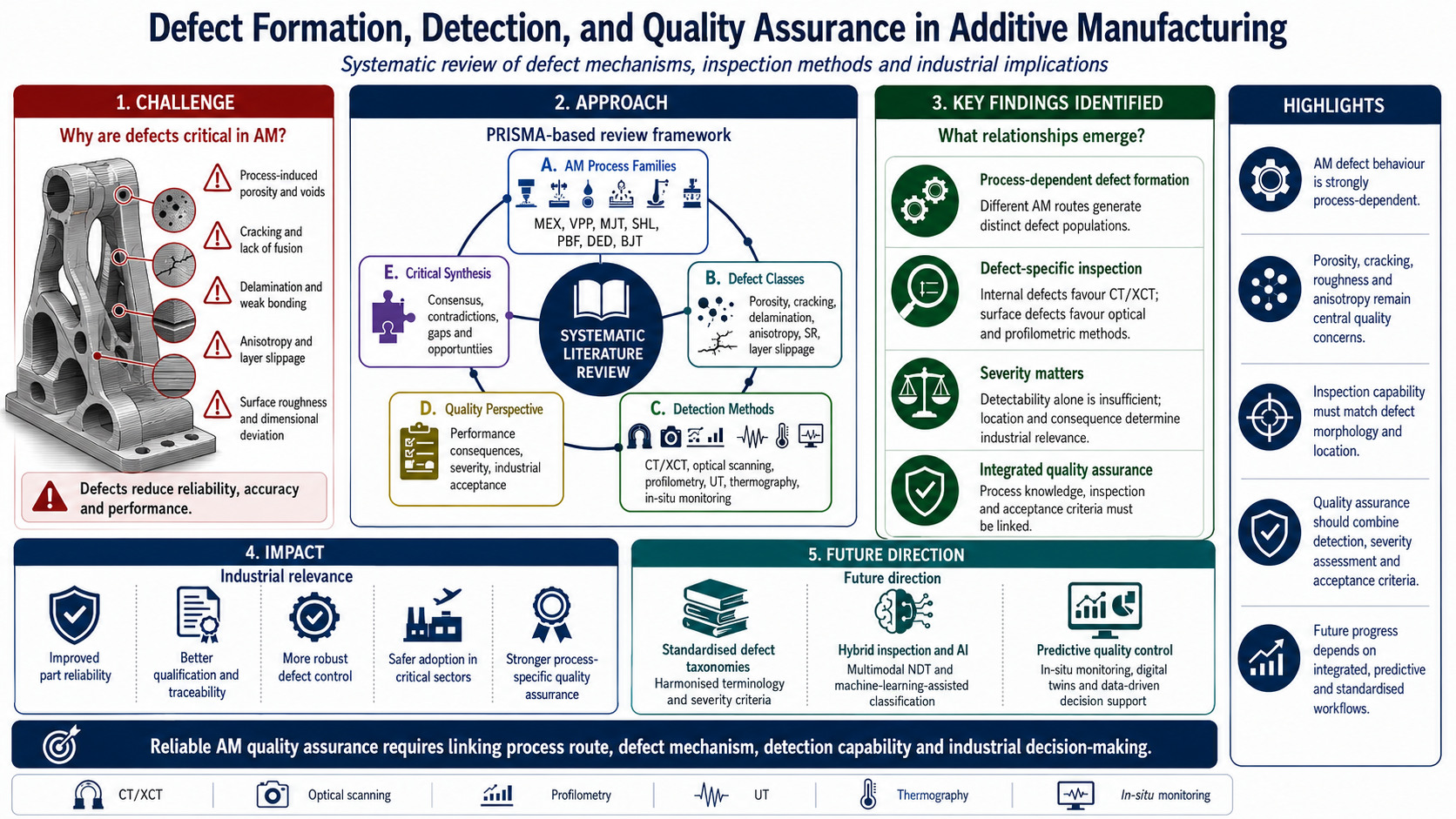
Additive manufacturing (AM) enables the production of geometrically complex components but introduces process-dependent defects that may compromise dimensional accuracy, surface integrity and mechanical reliability. This systematic review examines defect formation, defect-sensitive quality phenomena, detection and quality assurance across the principal AM process categories, distinguishing discrete manufacturing discontinuities from geometrical deviations, surface-quality attributes and process-dependent material responses. Literature published between 2010 and 2025 was retrieved through CrossRef and screened using a Preferred Reporting Items for Systematic Reviews and Meta-Analyses (PRISMA)-informed procedure, resulting in 134 publications included in the final analytical corpus. The synthesis shows that defect formation is governed by interacting material, process and thermal-history variables and that apparently similar defect manifestations can arise from substantially different mechanisms across AM processes. Inspection capability is likewise process- and defect-dependent: X-ray computed tomography (XCT), including micro-computed tomography (µCT), is particularly suited to internal volumetric discontinuities, whereas optical and three-dimensional scanning primarily address external geometry and surface conformity. The principal contribution of the review is an integrated process–material response–quality manifestation–performance–inspection–qualification framework that connects process-dependent defect and quality formation with engineering consequences, inspection capability, quality-assurance decision-making and industrial qualification.
- Open Access
- Systematic Review
Defect Formation, Detection, and Quality Assurance in Additive Manufacturing: A Systematic Review
- André F. V. Pedroso 1,2,*,
- André H. M. Rodrigues 1,
- José P. C. Gonçalves 1,
- Marta L. S. Barbosa 1,2,
- Rúben D. F. S. Costa 2,3,
- Naiara P. V. Sebbe 1,
- Arnaldo G. Pinto 1 and
- Isabel M. Pinto 1,4
Author Information
Received: 19 June 2026 | Revised: 23 September 2026 | Accepted: 27 October 2026 | Published: 10 November 2026
Abstract
Graphical Abstract
Keywords
additive manufacturing | manufacturing defects | quality assurance | defect detection | surface integrity | anisotropy
References
- 1.
Li, Z.; Zhang, Z.; Shi, J.; et al. Prediction of Surface Roughness in Extrusion-Based Additive Manufacturing with Machine Learning. Robot. Comput.-Integr. Manuf. 2019, 57, 488–495. https://doi.org/10.1016/j.rcim.2019.01.004.
- 2.
Meng, G.; Zhang, J.; Li, J.; et al. Impact of Pore Defects on Laser Additive Manufacturing of Inconel 718 Alloy Based on a Novel Finite Element Model: Thermal and Stress Evaluation. Opt. Laser Technol. 2023, 167, 109782. https://doi.org/10.1016/j.optlastec.2023.109782.
- 3.
Zhu, Y.; Wu, Z.; Hartley, W.D.; et al. Unraveling Pore Evolution in Post-Processing of Binder Jetting Materials: X-ray Computed Tomography, Computer Vision, and Machine Learning. Addit. Manuf. 2020, 34, 101183. https://doi.org/10.1016/j.addma.2020.101183.
- 4.
Godec, D.; Pilipović, A.; Breški, T.; et al. Introduction to Additive Manufacturing. In A Guide to Additive Manufacturing; Godec, D., Gonzalez-Gutierrez, J., Nordin, E., et al., Eds.; Springer: Cham, Switzerland, 2022; pp. 1–44. https://doi.org/10.1007/978-3-031-05863-9_1.
- 5.
Zhang, K.; Meng, Q.; Zhang, X.; et al. Quantitative Characterization of Defects in Stereolithographic Additive Manufactured Ceramic Using X-ray Computed Tomography. J. Mater. Sci. Technol. 2022, 118, 144–157. https://doi.org/10.1016/j.jmst.2021.11.060.
- 6.
Kim, H.; Lin, Y.; Tseng, T.L.B. A Review on Quality Control in Additive Manufacturing. Rapid Prototyp. J. 2018, 24, 645–669. https://doi.org/10.1108/rpj-03-2017-0048.
- 7.
du Plessis, A.; Yadroitsava, I.; Yadroitsev, I. Effects of Defects on Mechanical Properties in Metal Additive Manufacturing: A Review Focusing on X-ray Tomography Insights. Mater. Des. 2020, 187, 108385. https://doi.org/10.1016/j.matdes.2019.108385.
- 8.
Huang, C.; Wang, G.; Song, H.; et al. Rapid Surface Defects Detection in Wire and Arc Additive Manufacturing Based on Laser Profilometer. Measurement 2022, 189, 110503. https://doi.org/10.1016/j.measurement.2021.110503.
- 9.
Charalampous, P.; Kostavelis, I.; Tzovaras, D. Non-Destructive Quality Control Methods in Additive Manufacturing: A Survey. Rapid Prototyp. J. 2020, 26, 777–790. https://doi.org/10.1108/rpj-08-2019-0224.
- 10.
Mostafaei, A.; Zhao, C.; He, Y.; et al. Defects and Anomalies in Powder Bed Fusion Metal Additive Manufacturing. Curr. Opin. Solid State Mater. Sci. 2022, 26, 100974. https://doi.org/10.1016/j.cossms.2021.100974.
- 11.
Segovia Ramírez, I.; García Márquez, F.P.; Papaelias, M. Review on Additive Manufacturing and Non-Destructive Testing. J. Manuf. Syst. 2023, 66, 260–286. https://doi.org/10.1016/j.jmsy.2022.12.005.
- 12.
Zhang, K.; Meng, Q.; Qu, Z.; et al. A Review of Defects in Vat Photopolymerization Additive-Manufactured Ceramics: Characterization, Control, and Challenges. J. Eur. Ceram. Soc. 2024, 44, 1361–1384. https://doi.org/10.1016/j.jeurceramsoc.2023.10.067.
- 13.
Ashebir, D.A.; Hendlmeier, A.; Dunn, M.; et al. Detecting Multi-Scale Defects in Material Extrusion Additive Manufacturing of Fiber-Reinforced Thermoplastic Composites: A Review of Challenges and Advanced Non-Destructive Testing Techniques. Polymers 2024, 16, 2986. https://doi.org/10.3390/polym16212986.
- 14.
Yildiz, R.A.; Ozdogan, C.; Malekan, M. On the Surface Roughness of 316L Stainless Steel Fabricated Using L-PBF Additive Manufacturing. Tribol.-Finn. J. Tribol. 2024, 41, 54–56. https://doi.org/10.30678/fjt.149389.
- 15.
Tofail, S.A.M.; Koumoulos, E.P.; Bandyopadhyay, A.; et al. Additive Manufacturing: Scientific and Technological Challenges, Market Uptake and Opportunities. Mater. Today 2018, 21, 22–37. https://doi.org/10.1016/j.mattod.2017.07.001.
- 16.
Kumar, S.A.; Prasad, R.V.S. Basic Principles of Additive Manufacturing: Different Additive Manufacturing Technologies. In Additive Manufacturing: A Tool for Industrial Revolution 4.0; Manjaiah, M., Raghavendra, K., Balashanmugam, N., et al., Eds.; Woodhead Publishing: Cambridge, UK, 2021; pp. 17–35. https://doi.org/10.1016/b978-0-12-822056-6.00012-6.
- 17.
Ngo, T.D.; Kashani, A.; Imbalzano, G.; et al. Additive Manufacturing (3D Printing): A Review of Materials, Methods, Applications and Challenges. Compos. Part B Eng. 2018, 143, 172–196. https://doi.org/10.1016/j.compositesb.2018.02.012.
- 18.
Pedroso, A.F.V.; Sousa, V.F.C.; Sebbe, N.P.V.; et al. A Review of INCONEL® Alloy’s Non-Conventional Machining Processes. In Flexible Automation and Intelligent Manufacturing: Establishing Bridges for More Sustainable Manufacturing Systems, Proceedings of FAIM 2023, Porto, Portugal, 18–22 June 2023; Springer: Cham, Switzerland, 2024; pp. 773–783. https://doi.org/10.1007/978-3-031-38241-3_86.
- 19.
Qin, J.; Hu, F.; Liu, Y.; et al. Research and Application of Machine Learning for Additive Manufacturing. Addit. Manuf. 2022, 52, 102691. https://doi.org/10.1016/j.addma.2022.102691.
- 20.
R, N.J.; Aravind Raj, S. Quality Control in Additive Manufacturing: A Review of Traditional and Advanced Techniques. Eng. Res. Express 2025, 7, 012402. https://doi.org/10.1088/2631-8695/adbc47.
- 21.
Pedroso, A.F.V.; Sebbe, N.P.V.; Silva, F.J.G.; et al. An in-Depth Exploration of Unconventional Machining Techniques for INCONEL® Alloys. Materials 2024, 17, 1197. https://doi.org/10.3390/ma17051197.
- 22.
Akbari, M. Data-Driven Review of Additive Manufacturing on Supply Chains: Regionalization, Key Research Themes and Future Directions. Comput. Ind. Eng. 2023, 184, 109600. https://doi.org/10.1016/j.cie.2023.109600.
- 23.
Hettiarachchi, B.D.; Sudusinghe, J.I.; Seuring, S.; et al. Challenges and Opportunities for Implementing Additive Manufacturing Supply Chains in Circular Economy. IFAC-Pap. 2022, 55, 1153–1158. https://doi.org/10.1016/j.ifacol.2022.09.545.
- 24.
Godec, D.; Breški, T.; Katalenić, M.; et al. Applications of AM. In A Guide to Additive Manufacturing; Godec, D., Gonzalez-Gutierrez, J., Nordin, A., et al., Eds.; Springer: Cham, Switzerland, 2022; pp. 149–229. https://doi.org/10.1007/978-3-031-05863-9_6.
- 25.
Singh, S.; Mohanty, R.P.; Mangla, S.K.; et al. Critical Success Factors of Additive Manufacturing for Higher Sustainable Competitive Advantage in Supply Chains. J. Clean. Prod. 2023, 425, 138908. https://doi.org/10.1016/j.jclepro.2023.138908.
- 26.
de Pastre, M.A.; Quinsat, Y.; Lartigue, C. Effects of Additive Manufacturing Processes on Part Defects and Properties: A Classification Review. Int. J. Interact. Des. Manuf. 2022, 16, 1471–1496. https://doi.org/10.1007/s12008-022-00839-8.
- 27.
Yeshiwas, T.A.; Tiruneh, A.B.; Sisay, M.A. A Review Article on the Assessment of Additive Manufacturing. J. Mater. Sci. Mater. Eng. 2025, 20, 85. https://doi.org/10.1186/s40712-025-00306-8.
- 28.
Poudel, A.; Yasin, M.S.; Ye, J.; et al. Feature-Based Volumetric Defect Classification in Metal Additive Manufacturing. Nat. Commun. 2022, 13, 6369. https://doi.org/10.1038/s41467-022-34122-x.
- 29.
de Pastre, M.A.; Quinsat, Y.; Lartigue, C. Direct Additive Manufactured Beam Shape Defect Identification from Computed Tomography and Modal Decomposition. In Proceedings of the Joint Special Interest Group Meeting between Euspen and ASPE Advancing Precision in Additive Manufacturing, St Gallen, Switzerland, 21 September 2021.
- 30.
Altmann, M.L.; Benthien, T.; Ellendt, N.; et al. Defect Classification for Additive Manufacturing with Machine Learning. Materials 2023, 16, 6242. https://doi.org/10.3390/ma16186242.
- 31.
Dixit, S.; Liu, S.; Smith, P.M.; et al. Effects of Scan Rotation Angle and Build Orientation on Mechanical Anisotropy in Additive Manufacturing 316L Stainless Steel. J. Manuf. Process. 2024, 129, 122–133. https://doi.org/10.1016/j.jmapro.2024.08.043.
- 32.
Kok, Y.; Tan, X.P.; Wang, P.; et al. Anisotropy and Heterogeneity of Microstructure and Mechanical Properties in Metal Additive Manufacturing: A Critical Review. Mater. Des. 2018, 139, 565–586. https://doi.org/10.1016/j.matdes.2017.11.021.
- 33.
Dixit, S.; Smith, P.M.; Li, G.; et al. Crystal Plasticity Modeling of Mechanical Anisotropy in Additive Manufacturing 316L Stainless Steel: Influence of Build Orientation and Scan Rotation Angle. Materialia 2025, 43, 102537. https://doi.org/10.1016/j.mtla.2025.102537.
- 34.
Malej, S.; Godec, M.; Donik, Č.; et al. Hybrid Additive Manufacturing of Ti6Al4V with Powder-Bed Fusion and Direct-Energy Deposition. Mater. Sci. Eng. A 2023, 878, 145229. https://doi.org/10.1016/j.msea.2023.145229.
- 35.
Hossain, U.; Ghouse, S.; Nai, K.; et al. Controlling and Testing Anisotropy in Additively Manufactured Stochastic Structures. Addit. Manuf. 2021, 39, 101849. https://doi.org/10.1016/j.addma.2021.101849.
- 36.
Khalifa, N.B.; Isakovic, J.; Bohlen, J. New Concepts of Extrusion Dies to Reduce the Anisotropy of Extruded Profiles by Means of Additive Manufacturing. CIRP Ann. 2021, 70, 231–234. https://doi.org/10.1016/j.cirp.2021.04.006.
- 37.
Zago, M.; Lecis, N.F.M.; Vedani, M.; et al. Dimensional and Geometrical Precision of Parts Produced by Binder Jetting Process as Affected by the Anisotropic Shrinkage on Sintering. Addit. Manuf. 2021, 43, 102007. https://doi.org/10.1016/j.addma.2021.102007.
- 38.
Kang, J.; Dong, E.; Li, D.; et al. Anisotropy Characteristics of Microstructures for Bone Substitutes and Porous Implants with Application of Additive Manufacturing in Orthopaedic. Mater. Des. 2020, 191, 108608. https://doi.org/10.1016/j.matdes.2020.108608.
- 39.
Kundu, R.D.; Zhang, X.S. Additive Manufacturing of Stiff and Strong Structures by Leveraging Printing-Induced Strength Anisotropy in Topology Optimization. Addit. Manuf. 2023, 75, 103730. https://doi.org/10.1016/j.addma.2023.103730.
- 40.
Li, B.; Xu, K.; Jiang, C. Anisotropy Reduction and Mechanical Property Improvement of Additively Manufactured Stainless Steel Based on Cyclic Phase Transformation. J. Mater. Sci. Technol. 2024, 184, 1–14. https://doi.org/10.1016/j.jmst.2023.09.041.
- 41.
Lizzul, L.; Sorgato, M.; Bertolini, R.; et al. Anisotropy Effect of Additively Manufactured Ti6Al4V Titanium Alloy on Surface Quality after Milling. Precis. Eng. 2021, 67, 301–310. https://doi.org/10.1016/j.precisioneng.2020.10.003.
- 42.
Muhammad, W.; Brahme, A.P.; Ibragimova, O.; et al. A Machine Learning Framework to Predict Local Strain Distribution and the Evolution of Plastic Anisotropy & Fracture in Additively Manufactured Alloys. Int. J. Plast. 2021, 136, 102867. https://doi.org/10.1016/j.ijplas.2020.102867.
- 43.
Wang, Z.; Cao, X.; Yang, H.; et al. Additively-Manufactured 3D Truss-Lattice Materials for Enhanced Mechanical Performance and Tunable Anisotropy: Simulations & Experiments. Thin-Walled Struct. 2023, 183, 110439. https://doi.org/10.1016/j.tws.2022.110439.
- 44.
Bigot, S.; Valentinčič, J.; Blatnik, O.; et al. Micro EDM Parameters Optimisation. In 4M 2006-Second International Conference on Multi-Material Micro Manufacture; Menz, W., Dimov, S., Fillon, B., et al., Eds.; Elsevier: Amsterdam, The Netherlands, 2006; pp. 195–198. https://doi.org/10.1016/b978-008045263-0/50045-3.
- 45.
Giorleo, L.; Ravelli, M. Laser Polishing of Polymer Parts Produced with Material Jetting Technology: Effect of Laser Scan Speed, Overlapping and Loop Cycles. J. Inst. Eng. India Ser. C 2023, 104, 1065–1077. https://doi.org/10.1007/s40032-023-00979-0.
- 46.
Bakhtiari, H.; Nikzad, M.; Tolouei-Rad, M. Influence of Three-Dimensional Printing Parameters on Compressive Properties and Surface Smoothness of Polylactic Acid Specimens. Polymers 2023, 15, 3827. https://doi.org/10.3390/polym15183827.
- 47.
Moura de Souza Soares, F.; Barbosa, D.M.; Reis Corado, H.P.; et al. Surface Morphology, Roughness, and Corrosion Resistance of Dental Implants Produced by Additive Manufacturing. J. Mater. Res. Technol. 2022, 21, 3844–3855. https://doi.org/10.1016/j.jmrt.2022.10.114.
- 48.
Jiang, P.; Rifat, M.; Basu, S. Impact of Surface Roughness and Porosity on Lattice Structures Fabricated by Additive Manufacturing- a Computational Study. Procedia Manuf. 2020, 48, 781–789. https://doi.org/10.1016/j.promfg.2020.05.114.
- 49.
Kamble, P.; Mittal, Y.; Gote, G.; et al. A Mathematical Surface Roughness Model for Objects Made by Material Jetting. Prog. Addit. Manuf. 2024, 9, 2213–2224. https://doi.org/10.1007/s40964-024-00573-5.
- 50.
Afroz, L.; Qian, M.; Forsmark, J.; et al. Fatigue Life of Laser Powder Bed Fusion (L-PBF) AlSi10Mg Alloy: Effects of Surface Roughness and Porosity. Prog. Addit. Manuf. 2025, 10, 2423–2441. https://doi.org/10.1007/s40964-024-00759-x.
- 51.
Caggiano, A.; Teti, R.; Alfieri, V.; et al. Automated Laser Polishing for Surface Finish Enhancement of Additive Manufactured Components for the Automotive Industry. Prod. Eng. 2021, 15, 109–117. https://doi.org/10.1007/s11740-020-01007-1.
- 52.
Grimm, T.; Hantke, N.; Iusupova, A.; et al. Surface Analysis in Additive Manufacturing: A Systematic Literature Review regarding Powder Bed Fusion Processes. Surf. Topogr. Metrol. Prop. 2025, 13, 013002. https://doi.org/10.1088/2051-672x/ad91cd.
- 53.
Fanya, A.; Haruman, E.; Adenan, M.S. Optimization of Multi-Objective Taguchi Method for Hybrid Thermochemical Treatment Applied to AISI 316LVM Biological Grade Stainless Steel. In Reference Module in Materials Science and Materials Engineering; Elsevier: Amsterdam, The Netherlands, 2019. https://doi.org/10.1016/b978-0-12-803581-8.11165-8.
- 54.
Ratnam, M.M. 1.1 Factors Affecting Surface Roughness in Finish Turning. In Comprehensive Materials Finishing; Hashmi, M.S.J., Ed.; Elsevier: Amsterdam, The Netherlands, 2017; pp. 1–25. https://doi.org/10.1016/b978-0-12-803581-8.09147-5.
- 55.
Liu, W.; Chen, X.; Zeng, W.; et al. Comparison of X-ray Computed Tomography and Coordinate-Measuring System Dimensional Measurement for Additive Manufacturing Parts Using Physical and Simulation Methods. Measurement 2024, 229, 114414. https://doi.org/10.1016/j.measurement.2024.114414.
- 56.
Gabbar, H.A.; Chahid, A.; Khan, M.J.A.; et al. CTIMS: Automated Defect Detection Framework Using Computed Tomography. Appl. Sci. 2022, 12, 2175. https://doi.org/10.3390/app12042175.
- 57.
ISO 9712:2021 (E); Non-Destructive Testing—Qualification and Certification of NDT Personnel. International Organization for Standardization: Geneva, Switzerland, 2021.
- 58.
Page, M.J.; McKenzie, J.E.; Bossuyt, P.M.; et al. The PRISMA 2020 Statement: An Updated Guideline for Reporting Systematic Reviews. BMJ 2021, 372, n71. https://doi.org/10.1136/bmj.n71.
- 59.
Page, M.J.; Moher, D.; Bossuyt, P.M.; et al. PRISMA 2020 Explanation and Elaboration: Updated Guidance and Exemplars for Reporting Systematic Reviews. BMJ 2021, 327, n160. https://doi.org/10.1136/bmj.n160.
- 60.
Moher, D.; Liberati, A.; Tetzlaff, J.; et al. Preferred Reporting Items for Systematic Reviews and Meta-Analyses: The PRISMA Statement. Int. J. Surg. 2010, 8, 336–341. https://doi.org/10.1016/j.ijsu.2010.02.007.
- 61.
Hendricks, G.; Tkaczyk, D.; Lin, J.; et al. Crossref: The Sustainable Source of Community-Owned Scholarly Metadata. Quant. Sci. Stud. 2020, 1, 414–427. https://doi.org/10.1162/qss_a_00022.
- 62.
Agarwala, M.K.; Jamalabad, V.R.; Langrana, N.A.; et al. Structural Quality of Parts Processed by Fused Deposition. Rapid Prototyp. J. 1996, 2, 4–19. https://doi.org/10.1108/13552549610732034.
- 63.
Penumakala, P.K.; Santo, J.; Thomas, A. A Critical Review on the Fused Deposition Modeling of Thermoplastic Polymer Composites. Compos. Part B Eng. 2020, 201, 108336. https://doi.org/10.1016/j.compositesb.2020.108336.
- 64.
Papazetis, G.; Vosniakos, G.C. Mapping of Deposition-Stable and Defect-Free Additive Manufacturing via Material Extrusion from Minimal Experiments. Int. J. Adv. Manuf. Technol. 2019, 100, 2207–2219. https://doi.org/10.1007/s00170-018-2820-1.
- 65.
Sells, E.; Bailard, S.; Smith, Z.; et al. RepRap: The Replicating Rapid Prototyper: Maximizing Customizability by Breeding the Means of Production. In Handbook of Research in Mass Customization and Personalization; World Scientific Publishing Company: Singapore, 2009; pp. 568–580. https://doi.org/10.1142/9789814280280_0028.
- 66.
Chen, Y.; Lu, J. RP Part Surface Quality versus Build Orientation: When the Layers Are Getting Thinner. Int. J. Adv. Manuf. Technol. 2013, 67, 377–385. https://doi.org/10.1007/s00170-012-4491-7.
- 67.
Bhatt, P.M.; Kabir, A.M.; Peralta, M.; et al. A Robotic Cell for Performing Sheet Lamination-Based Additive Manufacturing. Addit. Manuf. 2019, 27, 278–289. https://doi.org/10.1016/j.addma.2019.02.002.
- 68.
Rana, A.R.; Fayazbakhsh, K. In-Process Laser Scanning for Defect Detection in Material Extrusion Additive Manufacturing. Int. J. Adv. Manuf. Technol. 2025, 139, 4417–4430. https://doi.org/10.1007/s00170-025-16145-y.
- 69.
De La Rosa, A.; Armani, A.; Golmohamadi, M. Defect Detection and Closed-Loop Feedback Using Machine Learning for Fused Filament Fabrication. Procedia CIRP 2024, 126, 603–608. https://doi.org/10.1016/j.procir.2024.08.247.
- 70.
Gajjar, T.; Yang, R.; Ye, L.; et al. Effects of Key Process Parameters on Tensile Properties and Interlayer Bonding Behavior of 3D Printed PLA Using Fused Filament Fabrication. Prog. Addit. Manuf. 2025, 10, 1261–1280. https://doi.org/10.1007/s40964-024-00704-y.
- 71.
Özel, T.; Malekar, D.; Aniyambeth, S.; et al. Physics-Informed Machine Learning for Defect Identification in Fused Filament Fabrication Additive Manufacturing. Procedia CIRP 2023, 118, 723–728. https://doi.org/10.1016/j.procir.2023.06.124.
- 72.
Al Rashid, A.; Ahmed, W.; Khalid, M.Y.; et al. Vat Photopolymerization of Polymers and Polymer Composites: Processes and Applications. Addit. Manuf. 2021, 47, 102279. https://doi.org/10.1016/j.addma.2021.102279.
- 73.
Salmoria, G.V.; Ahrens, C.H.; Fredel, M.; et al. Stereolithography Somos 7110 Resin: Mechanical Behavior and Fractography of Parts Post-Cured by Different Methods. Polym. Test. 2005, 24, 157–162. https://doi.org/10.1016/j.polymertesting.2004.09.008.
- 74.
Zhou, M.; Liu, W.; Wu, H.; et al. Preparation of a Defect-Free Alumina Cutting Tool via Additive Manufacturing Based on Stereolithography—Optimization of the Drying and Debinding Processes. Ceram. Int. 2016, 42, 11598–11602. https://doi.org/10.1016/j.ceramint.2016.04.050.
- 75.
Jia, X.; Li, S.; Wang, T.; et al. High-Performance Defect Detection Methods for Real-Time Monitoring of Ceramic Additive Manufacturing Process Based on Small-Scale Datasets. Processes 2024, 12, 633. https://doi.org/10.3390/pr12040633.
- 76.
Torres-Alvarez, D.; Celis-Guzman, A.; Aguirre-Soto, A. Resin-Dependent Mechanical Anisotropy in Laser Vat Photopolymerization Correlates to the Initial Rate of Polymerization and Critical Energy. Addit. Manuf. Lett. 2025, 12, 100264. https://doi.org/10.1016/j.addlet.2024.100264.
- 77.
Fernández-Abia, A.I.; Martínez-Sanchez, Á.; Peláez-Peláez, S.; et al. Microstructural Transformation and Defect Analysis in Alumina Ceramics Components Manufactured by Stereolithography Additive Manufacturing Technology. Int. J. Adv. Manuf. Technol. 2025. https://doi.org/10.1007/s00170-025-15946-5.
- 78.
Long, C.; Liu, Z.; Liu, C.; et al. Ceramic Additive Manufacturing via Vat Photopolymerization. Mater. Sci. Addit. Manuf. 2025, 4, 025200031. https://doi.org/10.36922/msam025200031.
- 79.
Korkut, V.; Yavuz, H. Comparison and Evaluation of Various Material Jetting Technologies in Terms of Additive Manufacturing. J. Mater. Electron. Devices 2018, 1, 20–24.
- 80.
Liu, Y.; Sing, S.L. A Review of Advances in Additive Manufacturing and the Integration of High-Performance Polymers, Alloys, and Their Composites. Mater. Sci. Addit. Manuf. 2023, 2, 1587. https://doi.org/10.36922/msam.1587.
- 81.
Elkaseer, A.; Chen, K.J.; Janhsen, J.C.; et al. Material Jetting for Advanced Applications: A State-of-the-Art Review, Gaps and Future Directions. Addit. Manuf. 2022, 60, 103270. https://doi.org/10.1016/j.addma.2022.103270.
- 82.
Shrestha, S.; Manogharan, G. Optimization of Binder Jetting Using Taguchi Method. JOM 2017, 69, 491–497. https://doi.org/10.1007/s11837-016-2231-4.
- 83.
Vu, I.Q.; Bass, L.B.; Williams, C.B.; et al. Characterizing the Effect of Print Orientation on Interface Integrity of Multi-Material Jetting Additive Manufacturing. Addit. Manuf. 2018, 22, 447–461. https://doi.org/10.1016/j.addma.2018.05.036.
- 84.
Beltrán, N.; Álvarez, B.J.; Blanco, D.; et al. A Design for Additive Manufacturing Strategy for Dimensional and Geometrical Quality Improvement of PolyJet-Manufactured Glossy Cylindrical Features. Polymers 2021, 13, 1132. https://doi.org/10.3390/polym13071132.
- 85.
Gülcan, O.; Günaydın, K.; Çelik, A. Investigation on Surface Roughness of PolyJet-Printed Airfoil Geometries for Small UAV Applications. Aerospace 2022, 9, 82. https://doi.org/10.3390/aerospace9020082.
- 86.
Pandey, P.; Nayak, A.; Taufik, M. Evaluation of Mathematical Models for Surface Roughness Prediction of PolyJet 3D Printed Parts. Adv. Mater. Process. Technol. 2024, 10, 89–98. https://doi.org/10.1080/2374068x.2022.2097416.
- 87.
Turek, P.; Bazan, A.; Budzik, G.; et al. Surface Roughness of Photoacrylic Resin Shapes Obtained Using PolyJet Additive Technology. Polimery 2023, 68, 631–639. https://doi.org/10.14314/polimery.2023.11.7.
- 88.
Bezek, L.B.; Williams, C.B. Process-Structure-Property Effects of Ultraviolet Curing in Multi-Material Jetting Additive Manufacturing. Addit. Manuf. 2023, 73, 103640. https://doi.org/10.1016/j.addma.2023.103640.
- 89.
Ahn, D.; Kweon, J.H.; Choi, J.; et al. Quantification of Surface Roughness of Parts Processed by Laminated Object Manufacturing. J. Mater. Process. Technol. 2012, 212, 339–346. https://doi.org/10.1016/j.jmatprotec.2011.08.013.
- 90.
Gujba, A.K.; Medraj, M. Power Ultrasonic Additive Manufacturing: Process Parameters, Microstructure, and Mechanical Properties. Adv. Mater. Sci. Eng. 2020, 2020, 1064870. https://doi.org/10.1155/2020/1064870.
- 91.
Ishfaq, K.; Abas, Z.; Saravana Kumar, M.; et al. Review of Recent Trends in Ultrasonic Additive Manufacturing: Current Challenges and Future Prospects. Rapid Prototyp. J. 2023, 29, 1195–1211. https://doi.org/10.1108/rpj-09-2022-0300.
- 92.
Ali, M.; Headings, L.M.; Srinivas, V.; et al. Laminated Interface Characterization and Cohesive Zone Modeling (CZM) of Fracture for Ultrasonic Additive Manufacturing (UAM) Structures. J. Manuf. Process. 2025, 154, 614–622. https://doi.org/10.1016/j.jmapro.2025.09.085.
- 93.
Poudel, L.; Jha, S.; Meeker, R.; et al. Advanced Predictive Quality Assessment for Ultrasonic Additive Manufacturing with Deep Learning Model. J. Intell. Manuf. 2026, 37, 1033–1047. https://doi.org/10.1007/s10845-025-02582-9.
- 94.
Parry, L.A.; Ashcroft, I.A.; Wildman, R.D. Geometrical Effects on Residual Stress in Selective Laser Melting. Addit. Manuf. 2019, 25, 166–175. https://doi.org/10.1016/j.addma.2018.09.026.
- 95.
Abe, F.; Osakada, K.; Shiomi, M.; et al. The Manufacturing of Hard Tools from Metallic Powders by Selective Laser Melting. J. Mater. Process. Technol. 2001, 111, 210–213. https://doi.org/10.1016/s0924-0136(01)00522-2.
- 96.
Chen, H.; Wei, Q.; Zhang, Y.; et al. Powder-Spreading Mechanisms in Powder-Bed-Based Additive Manufacturing: Experiments and Computational Modeling. Acta Mater. 2019, 179, 158–171. https://doi.org/10.1016/j.actamat.2019.08.030.
- 97.
Zheng, Z.; Peng, L.; Wang, D. Defect Analysis of 316 L Stainless Steel Prepared by LPBF Additive Manufacturing Processes. Coatings 2021, 11, 1562. https://doi.org/10.3390/coatings11121562.
- 98.
Mojumder, S.; Gan, Z.; Li, Y.; et al. Linking Process Parameters with Lack-of-Fusion Porosity for Laser Powder Bed Fusion Metal Additive Manufacturing. Addit. Manuf. 2023, 68, 103500. https://doi.org/10.1016/j.addma.2023.103500.
- 99.
Dwivedi, A.; Khurana, M.K.; Bala, Y.G. A Comparative Study of Porosity Rate Measurement Methods and Influence of Energy Density in Inconel 718 Produced by Laser Powder Bed Fusion Additive Manufacturing Process. Int. J. Interact. Des. Manuf. 2025, 19, 2645–2658. https://doi.org/10.1007/s12008-024-01875-2.
- 100.
Aydogan, B.; Chou, K. Review of in Situ Detection and ex Situ Characterization of Porosity in Laser Powder Bed Fusion Metal Additive Manufacturing. Metals 2024, 14, 669. https://doi.org/10.3390/met14060669.
- 101.
Xi, H.; Wang, X.; Wang, Z.; et al. Laser Ultrasonic Inspection of Internal Porosity Defects in AlSi10Mg Additive Manufacturing Components. Int. J. Lightweight Mater. Manuf. 2024, 7, 546–555. https://doi.org/10.1016/j.ijlmm.2024.03.001.
- 102.
Hocker, S.J.A.; Kitahara, A.R.; Richter, B.; et al. A Novel Additive Manufacturing Process Metric for Predicting Spatter-Related Porosity in Laser Powder Bed Fusion. Integr. Mater. Manuf. Innov. 2025, 14, 53–73. https://doi.org/10.1007/s40192-024-00376-0. Correction to Integr. Mater. Manuf. Innov. 2025, 14, 74. https://doi.org/10.1007/s40192-025-00391-9.
- 103.
Dobson, S.D.; Paz y Puente, A.E. Using Surface Roughness as an Indicator of Laser Powder Bed Fusion Part Quality. Rapid Prototyp. J. 2025, 31, 1489–1498. https://doi.org/10.1108/rpj-08-2024-0367.
- 104.
Bevans, B.D.; Riensche, A.; Carrington, A.; et al. In-Process Monitoring of Part Quality in Laser Powder Bed Fusion Additive Manufacturing Process Using Acoustic Emission Sensors. J. Manuf. Sci. Eng. 2025, 147, 061010. https://doi.org/10.1115/1.4067848.
- 105.
Suárez, A.; Tobar, M.J.; Yáñez, A.; et al. Modeling of Phase Transformations of Ti6Al4V during Laser Metal Deposition. Phys. Procedia 2011, 12, 666–673. https://doi.org/10.1016/j.phpro.2011.03.083.
- 106.
Svetlizky, D.; Das, M.; Zheng, B.; et al. Directed Energy Deposition (DED) Additive Manufacturing: Physical Characteristics, Defects, Challenges and Applications. Mater. Today 2021, 49, 271–295. https://doi.org/10.1016/j.mattod.2021.03.020.
- 107.
Lalegani Dezaki, M.; Serjouei, A.; Zolfagharian, A.; et al. A Review on Additive/Subtractive Hybrid Manufacturing of Directed Energy Deposition (DED) Process. Adv. Powder Mater. 2022, 1, 100054. https://doi.org/10.1016/j.apmate.2022.100054.
- 108.
Zhang, W.; Xu, C.; Li, C.; et al. Advances in Ultrasonic-Assisted Directed Energy Deposition (DED) for Metal Additive Manufacturing, Crystals 2024, 14, 114. https://doi.org/10.3390/cryst14020114.
- 109.
Albannai, A.I. A Brief Review on the Common Defects in Wire Arc Additive Manufacturing. Int. J. Curr. Sci. Res. Rev. 2022, 5, 4556–4576. https://doi.org/10.47191/ijcsrr/v5-i12-19.
- 110.
El Mountassir, M.; Flotte, D.; Yaacoubi, S.; et al. A Novel Approach to Enhance Defect Detection in Wire Arc Additive Manufacturing Parts Using Radiographic Testing without Surface Milling. J. Intell. Manuf. 2025, 36, 1743–1760. https://doi.org/10.1007/s10845-024-02328-z.
- 111.
Omiyale, B.O.; Ogedengbe, I.I.; Ogbeyemi, A.; et al. Defects in Wire Arc Additive Manufacturing of Stainless Steel: A Brief Critical Review. Lasers Manuf. Mater. Process. 2025, 12, 1061–1105. https://doi.org/10.1007/s40516-025-00307-7.
- 112.
Polamuri, S.K.; Chitral, S.; Adapa, M.K.; et al. A Strategic Approach to Minimize Lack of Fusion Defects in Wire Arc Additive Manufacturing. Prog. Addit. Manuf. 2025, 10, 6965–6980. https://doi.org/10.1007/s40964-025-01020-9.
- 113.
Zhao, K.; Su, Z.; Ye, Z.; et al. Review of the Types, Formation Mechanisms, Effects, and Elimination Methods of Binder Jetting 3D-Printing Defects. J. Mater. Res. Technol. 2023, 27, 5449–5469. https://doi.org/10.1016/j.jmrt.2023.11.045.
- 114.
Lee, Y.; Nandwana, P.; Simunovic, S. Powder Spreading, Densification, and Part Deformation in Binder Jetting Additive Manufacturing. Prog. Addit. Manuf. 2022, 7, 111–125. https://doi.org/10.1007/s40964-021-00214-1.
- 115.
Guo, X.; Liu, J.; Li, L.; et al. Polymer-Metal Powders Melt Extrusion Printing to Produce High-Density, High-Conductivity Pure Copper Components. J. Mater. Res. Technol. 2025, 35, 1323–1334. https://doi.org/10.1016/j.jmrt.2025.01.095.
- 116.
Lima, P.; Zocca, A.; Acchar, W.; et al. 3D Printing of Porcelain by Layerwise Slurry Deposition. J. Eur. Ceram. Soc. 2018, 38, 3395–3400. https://doi.org/10.1016/j.jeurceramsoc.2018.03.014.
- 117.
Li, M.; Du, W.; Elwany, A.; et al. Metal Binder Jetting Additive Manufacturing: A Literature Review. J. Manuf. Sci. Eng. 2020, 142, 090801. https://doi.org/10.1115/1.4047430.
- 118.
Li, M.; Wei, X.; Pei, Z.; et al. Binder Jetting Additive Manufacturing: Observations of Compaction-Induced Powder Bed Surface Defects. Manuf. Lett. 2021, 28, 50–53. https://doi.org/10.1016/j.mfglet.2021.04.003.
- 119.
Cook, O.; Huang, N.; Smithson, R.; et al. Ultrasonic Characterization of Porosity in Components Made by Binder Jet Additive Manufacturing. Mater. Eval. 2022, 80, 37–44. https://doi.org/10.32548/2022.me-04266.
- 120.
Pasha, M.M.; Arman, M.S.; Pei, Z.; et al. Effects of Compaction Thickness on Density, Integrity, and Microstructure of Green Parts in Binder Jetting Additive Manufacturing of Silicon Carbide. J. Manuf. Mater. Process. 2025, 9, 136. https://doi.org/10.3390/jmmp9040136.
- 121.
Renzo, D.A.; Crocco, M.C.; Maletta, C.; et al. X-ray Computed μ-Tomography Analysis to Evaluate the Crack Growth in an Additive Manufactured Ti-6Al-4V Alloy Sample Stressed with in-Phase Axial and Torsional Loading. Int. J. Fatigue 2023, 175, 107727. https://doi.org/10.1016/j.ijfatigue.2023.107727.
- 122.
Orenes Balaciart, S.; Pannier, Y.; Gigliotti, M.; et al. Damage Onset Mechanisms in Multi-Axial Tensile Test of 3D Woven Organic Matrix Composite through an in Situ Coupled Micro-Computed Tomography and Acoustic Emission Methodology. Compos. Struct. 2024, 327, 117651. https://doi.org/10.1016/j.compstruct.2023.117651.
- 123.
Zong, Y.; Liang, J.; Pai, W.; et al. A High-Efficiency and High-Precision Automatic 3D Scanning System for Industrial Parts Based on a Scanning Path Planning Algorithm. Opt. Lasers Eng. 2022, 158, 107176. https://doi.org/10.1016/j.optlaseng.2022.107176.
- 124.
Krznar, N.; Pilipović, A.; Šercer, M. Additive Manufacturing of Fixture for Automated 3D Scanning—Case Study. Procedia Eng. 2016, 149, 197–202. https://doi.org/10.1016/j.proeng.2016.06.656.
- 125.
Sun, W.; Symes, D.R.; Brenner, C.M.; et al. Review of High Energy X-ray Computed Tomography for Non-Destructive Dimensional Metrology of Large Metallic Advanced Manufactured Components. Rep. Prog. Phys. 2022, 85, 016102. https://doi.org/10.1088/1361-6633/ac43f6.
- 126.
Wilbig, J.; Wilson-Heid, A.E.; Bernard, L.; et al. Comparison of Porosity Analysis Based on X-ray Computed Tomography on Metal Parts Produced by Additive Manufacturing. Appl. Sci. 2025, 15, 9876. https://doi.org/10.3390/app15189876.
- 127.
Bevans, B.D.; Carrington, A.; Riensche, A.; et al. Digital Twins for Rapid in-Situ Qualification of Part Quality in Laser Powder Bed Fusion Additive Manufacturing. Addit. Manuf. 2024, 93, 104415. https://doi.org/10.1016/j.addma.2024.104415.
- 128.
Mönter, N.; Bliedtner, K.; Herold, F. Towards 4D CT in Additive Manufacturing: Evaluating Algorithmic Limitations and Opportunities for Industrial Non-Destructive Testing. In Proceedings of the 14th Conference on Industrial Computed Tomography (iCT 2025), Antwerp, Belgium, 4–7 February 2025. https://doi.org/10.58286/30715.
- 129.
Kladovasilakis, N.; Charalampous, P.; Kostavelis, I.; et al. Q3D: A Complete Solution for Quality Control and Inspection in Additive Manufacturing Processes. Rapid Prototyp. J. 2024, 30, 1087–1093. https://doi.org/10.1108/rpj-11-2023-0392.
- 130.
Martin, M.; Banijamali, K.; Gilbert, H.; et al. LiDAR-Based Real-Time Geometrical Inspection for Large-Scale Additive Manufacturing. Prog. Addit. Manuf. 2025, 10, 3437–3453. https://doi.org/10.1007/s40964-024-00817-4.
- 131.
Du, L.; Lai, Y.; Luo, C.; et al. E-Quality Control in Dental Metal Additive Manufacturing Inspection Using 3D Scanning and 3D Measurement. Front. Bioeng. Biotechnol. 2020, 8, 1038. https://doi.org/10.3389/fbioe.2020.01038.
- 132.
Suresh, V.; Balasubramaniam, B.; Yeh, L.H.; et al. Recent Advances in in Situ 3D Surface Topographical Monitoring for Additive Manufacturing Processes. J. Manuf. Mater. Process. 2025, 9, 133. https://doi.org/10.3390/jmmp9040133.


This work is licensed under a Creative Commons Attribution 4.0 International License.
