
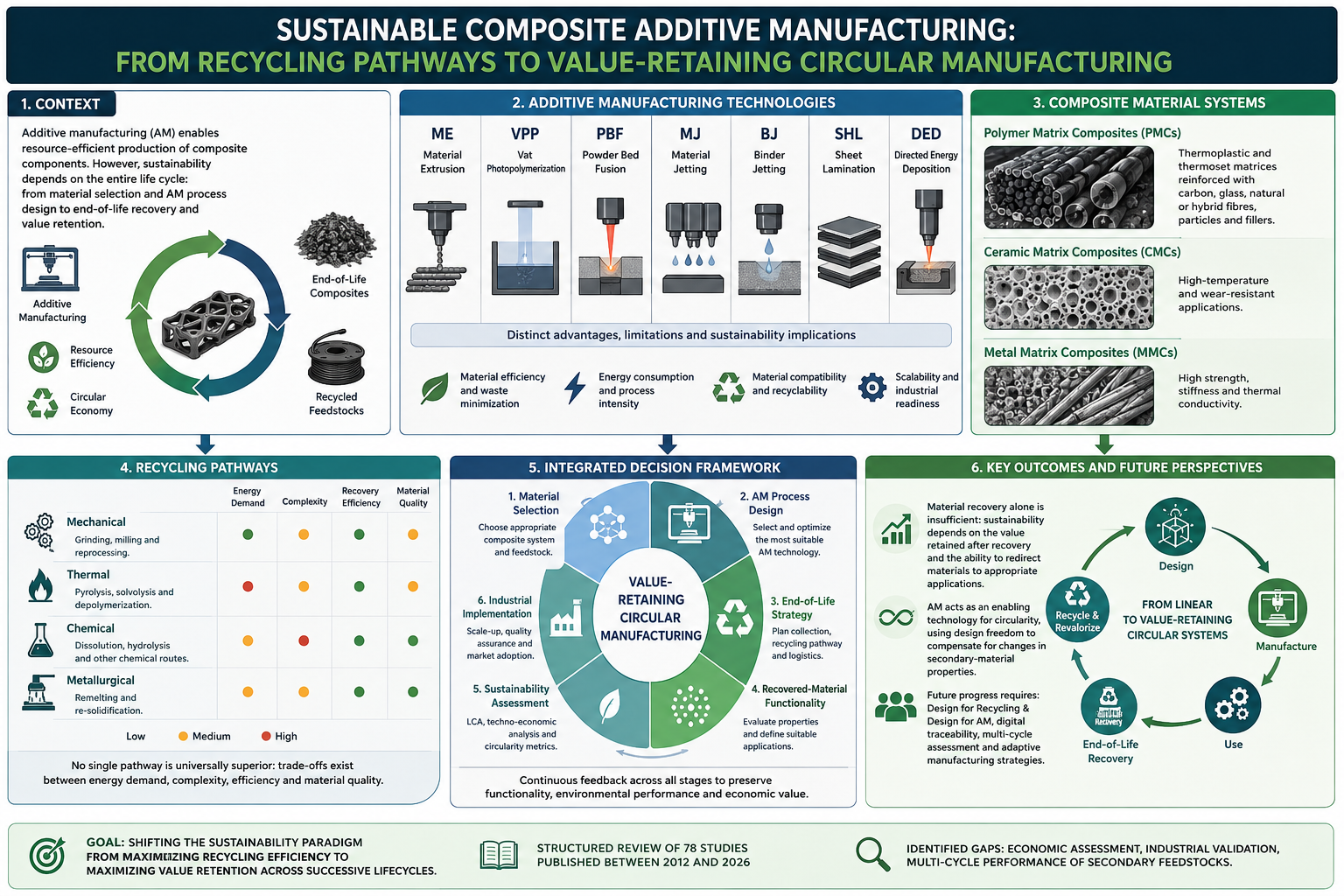
Additive manufacturing (AM) offers significant opportunities for resource-efficient composite manufacturing, yet its sustainability cannot be inferred solely from reduced material waste, design flexibility, or the incorporation of recycled feedstocks. The environmental performance of composite AM emerges from complex interactions among material architecture, manufacturing technology, energy and resource demand, recycling strategy, recovered-material quality, and subsequent functional use. This review critically examines these interactions through a structured analysis of 78 peer-reviewed studies published between 2012 and 2026, covering the principal AM technologies, polymer-, ceramic-, and metal-matrix composites, recycling pathways, environmental assessment, and circular manufacturing strategies. The evidence reveals a markedly heterogeneous sustainability landscape, with research concentrated in selected material–process combinations and substantially less evidence concerning economic assessment, industrial validation, and the behaviour of secondary feedstocks across multiple lifecycles. Mechanical, thermal, chemical, and metallurgical recycling routes exhibit distinct trade-offs between energy demand, process complexity, recovery efficiency, material degradation, scalability, and recovered-material quality, preventing the definition of a universally preferable recycling pathway. A central outcome of the review is that material recovery alone is an insufficient measure of circularity: sustainability depends increasingly on the functional and economic value retained after recovery and on the ability to redirect secondary materials towards technically appropriate applications. In this context, AM can act not only as a consumer of recycled feedstocks but as an enabling technology for circularity, using design freedom and application-specific adaptation to compensate for changes in secondary-material properties. Based on the synthesized evidence, an integrated decision framework is proposed linking material selection, AM process design, end-of-life strategy, recovered-material functionality, environmental and economic assessment, and industrial implementation. Future progress requires multi-cycle evaluation, harmonized lifecycle and techno-economic assessment, Design for Recycling integrated with Design for Additive Manufacturing, digital material traceability, and adaptive manufacturing strategies for variable secondary feedstocks. Overall, the review shifts the sustainability perspective from maximizing recycling efficiency towards value-retaining circular manufacturing, where materials, processes, products, and recovery pathways are co-designed to preserve engineering functionality and resource value across successive lifecycles.
- Open Access
- Review
Sustainable Composite Additive Manufacturing: From Recycling Pathways to Value-Retaining Circular Manufacturing
- Luís Araújo 1,
- Naiara P. V. Sebbe 1,2,*,
- André F. V. Pedroso 1,2,
- Rafaela B. Casais 1,
- Paulo J. Silva 1 and
- Arnaldo G. Pinto 1
Author Information
Received: 26 July 2026 | Revised: 03 November 2026 | Accepted: 06 November 2026 | Published: 17 November 2026
Abstract
Graphical Abstract
Keywords
additive manufacturing | 3D printing | composites | circular economy | sustainability | environmental impact | life cycle assessment
References
- 1.
Ngo, T.D.; Kashani, A.; Imbalzano, G.; et al. Additive manufacturing (3D printing): A review of materials, methods, applications and challenges. Compos. Part B Eng. 2018, 143, 172–196. https://doi.org/10.1016/j.compositesb.2018.02.012.
- 2.
Habiba, R.D.; Malça, C.; Branco, R. Exploring the Potential of Recycled Polymers for 3D Printing Applications: A Review. Materials 2024, 17, 2915. https://doi.org/10.3390/ma17122915.
- 3.
Lee, J.Y.; An, J.; Chua, C.K. Fundamentals and applications of 3D printing for novel materials. Appl. Mater. Today 2017, 7, 120–133. https://doi.org/10.1016/j.apmt.2017.02.004.
- 4.
Saadi, M.A.S.R.; Maguire, A.; Pottackal, N.T.; et al. Direct Ink Writing: A 3D Printing Technology for Diverse Materials. Adv. Mater. 2022, 34, 2108855. https://doi.org/10.1002/adma.202108855.
- 5.
Tadi, S.P.; Maddula, S.S.; Mamilla, R.S. Sustainability aspects of composite filament fabrication for 3D printing applications. Renew. Sustain. Energy Rev. 2024, 189, 113961. https://doi.org/10.1016/j.rser.2023.113961.
- 6.
Ror, C.K.; Negi, S.; Mishra, V. Development and characterization of sustainable 3D printing filaments using post-consumer recycled PET: Processing and characterization. J. Polym. Res. 2023, 30, 350. https://doi.org/10.1007/s10965-023-03742-2.
- 7.
Ibrahim, I.; Ashour, A.G.; Zeiada, W.; et al. A Systematic Review on the Technical Performance and Sustainability of 3D Printing Filaments Using Recycled Plastic. Sustainability 2024, 16, 8247. https://doi.org/10.3390/su16188247.
- 8.
Al Rashid, A.; Koç, M. 3D-Printed recycled polyethylene terephthalate (PET) sandwich structures—Influence of infill design and density on tensile, dynamic mechanical, and creep response. Int. J. Lightweight Mater. Manuf. 2025, 8, 442–452. https://doi.org/10.1016/j.ijlmm.2025.03.001.
- 9.
Zander, N.E.; Gillan, M.; Burckhard, Z.; et al. Recycled polypropylene blends as novel 3D printing materials. Addit. Manuf. 2019, 25, 122–130. https://doi.org/10.1016/j.addma.2018.11.009.
- 10.
Giani, N.; Mazzocchetti, L.; Benelli, T.; et al. Towards sustainability in 3D printing of thermoplastic composites: Evaluation of recycled carbon fibers as reinforcing agent for FDM filament production and 3D printing. Compos. Part A Appl. Sci. Manuf. 2022, 159, 107002. https://doi.org/10.1016/j.compositesa.2022.107002.
- 11.
Garmabi, M.M.; Jalali, A.; Manzoor, A.; et al. Driving sustainability and performance: 3D-printing of lightweight functional components using recycled carbon fiber reinforced polyphenylene sulfide composites for automotive industry. Prog. Addit. Manuf. 2025, 10, 2397–2409. https://doi.org/10.1007/s40964-024-00757-z.
- 12.
Morales, M.A.; Maranon, A.; Hernandez, C.; et al. Development and Characterization of a 3D Printed Cocoa Bean Shell Filled Recycled Polypropylene for Sustainable Composites. Polymers 2021, 13, 3162. https://doi.org/10.3390/polym13183162.
- 13.
Ghabezi, P.; Sam-Daliri, O.; Flanagan, T.; et al. Circular economy innovation: A deep investigation on 3D printing of industrial waste polypropylene and carbon fiber composites. Resour. Conserv. Recycl. 2024, 206, 107667. https://doi.org/10.1016/j.resconrec.2024.107667.
- 14.
Mahmoodi, O.; Siad, H.; Lachemi, M.; et al. Recent advances in CDW-based geopolymers: A review of mechanical performance, structural application, 3D printing, durability and sustainability. J. Environ. Manag. 2025, 391, 126358. https://doi.org/10.1016/j.jenvman.2025.126358.
- 15.
Balina, K.; Gailitis, R.; Sinka, M.; et al. Prospective LCA for 3D-Printed Foamed Geopolymer Composites Using Construction Waste as Additives. Sustainability 2025, 17, 6459. https://doi.org/10.3390/su17146459.
- 16.
Rahman, A.M.; Tan, E.C.D.; Pei, Z. 3D printing of packaging inserts from biomass-fungi composites: Environmental sustainability analysis. Discov. Appl. Sci. 2025, 7, 739. https://doi.org/10.1007/s42452-025-07264-y.
- 17.
Bareen, M.A.; Derossi, A.; Corradini, M.G.; et al. Enhancing 3D Printing Performance and Product Quality Through the Valorization of Food By-Products and Waste. Compr. Rev. Food Sci. Food Saf. 2025, 24, e70267. https://doi.org/10.1111/1541-4337.70267.
- 18.
Laoutid, F.; Lafqir, S.; Toncheva, A.; et al. Valorization of Recycled Tire Rubber for 3D Printing of ABS- and TPO-Based Composites. Materials 2021, 14, 5889. https://doi.org/10.3390/ma14195889.
- 19.
Andreozzi, M.; Bianchi, I.; Di Pompeo, V.; et al. Sustainability assessment of autoclave and 3D printed composites with thermosetting and thermoplastic matrices. Int. J. Adv. Manuf. Technol. 2025, 138, 3221–3237. https://doi.org/10.1007/s00170-025-15689-3.
- 20.
Pezzana, L.; Wolff, R.; Stampfl, J.; et al. High temperature vat photopolymerization 3D printing of fully bio-based composites: Green vegetable oil epoxy matrix & bio-derived filler powder. Addit. Manuf. 2024, 79, 103929. https://doi.org/10.1016/j.addma.2023.103929.
- 21.
British Standards Institution. BS EN ISO/ASTM 52900:2021; Additive Manufacturing—General Principles—Fundamentals and Vocabulary. BSI British Standards: London, UK, 2022. https://doi.org/10.3403/30448424.
- 22.
Singh, G.; Brar, G.S.; Singh, R. On Mechanical Properties of 3D-Printed Secondary Recycled Acrylonitrile Butadiene Styrene Composite for Silencer Application in Short-Range Gun. J. Mater. Eng. Perform. 2024, 33, 10295–10309. https://doi.org/10.1007/s11665-023-08684-w.
- 23.
Coronado, D.R.R.; Chen, W.H.; Ubando, A.T. Advancements in biochar-reinforced 3D printing filaments for material extrusion: A review on material performance, sustainability, and circular economy. Compos. Part C Open Access 2026, 19, 100687. https://doi.org/10.1016/j.jcomc.2025.100687.
- 24.
Ramesh, M.; Niranjana, K.; Bhoopathi, R.; et al. Additive manufacturing (3D printing) technologies for fiber-reinforced polymer composite materials: A review on fabrication methods and process parameters. e-Polym. 2024, 24, 20230114. https://doi.org/10.1515/epoly-2023-0114.
- 25.
Saini, P.; Chatterjee, H.; Choudhari, A.; et al. Circular economy and sustainability innovation: A deep investigation to use recycled propylene with zeolites in 3D printing and injection molding. Prog. Addit. Manuf. 2025, 10, 9475–9490. https://doi.org/10.1007/s40964-025-01176-4.
- 26.
Wang, X.; Jiang, M.; Zhou, Z.; et al. 3D printing of polymer matrix composites: A review and prospective. Compos. Part B Eng. 2017, 110, 442–458. https://doi.org/10.1016/j.compositesb.2016.11.034.
- 27.
Chawla, K.; Singh, R.; Singh, J.; et al. Investigations on mechanical properties of secondary recycled ABS reinforced with Fe powder for 3D printing applications. Mater. Today Proc. 2022, 50, 2450–2454. https://doi.org/10.1016/j.matpr.2021.10.291.
- 28.
Blanzeanu, E.; Marin, M.; Verziu, M.N.; et al. Chitosan-polylactic acid composites: From seafood waste to advanced functional materials for 3D printing. Adv. Compos. Hybrid Mater. 2025, 8, 66. https://doi.org/10.1007/s42114-024-01131-x.
- 29.
Ligon, S.C.; Liska, R.; Stampfl, J.; et al. Polymers for 3D Printing and Customized Additive Manufacturing. Chem. Rev. 2017, 117, 10212–10290. https://doi.org/10.1021/acs.chemrev.7b00074.
- 30.
Ateeq, M.; Akbar, A.; Shafique, M. Advancing circular economy: Comparative analysis of recycled and virgin carbon fiber 3D printed composites on performance and eco-efficiency. Polymer 2025, 317, 127865. https://doi.org/10.1016/j.polymer.2024.127865.
- 31.
Chia, H.N.; Wu, B.M. Recent advances in 3D printing of biomaterials. J. Biol. Eng. 2015, 9, 4. https://doi.org/10.1186/s13036-015-0001-4.
- 32.
Galib, G.; Silva, F.J.G.; Pedroso, A.F.V.; et al. A Comprehensive Review of Additive Manufacturing Technologies for Composite Materials. J. Mech. Eng. Manuf. 2025, 1, 2. https://doi.org/10.53941/jmem.2025.100002.
- 33.
Shahrubudin, N.; Lee, T.C.; Ramlan, R. An Overview on 3D Printing Technology: Technological, Materials, and Applications. Procedia Manuf. 2019, 35, 1286–1296. https://doi.org/10.1016/j.promfg.2019.06.089.
- 34.
Yang, Y.; Boom, R.; Irion, B.; et al. Recycling of composite materials. Chem. Eng. Process. Process Intensif. 2012, 51, 53–68. https://doi.org/10.1016/j.cep.2011.09.007.
- 35.
Cruz Sanchez, F.A.; Boudaoud, H.; Hoppe, S.; et al. Polymer recycling in an open-source additive manufacturing context: Mechanical issues. Addit. Manuf. 2017, 17, 87–105. https://doi.org/10.1016/j.addma.2017.05.013.
- 36.
Bledzki, A.K.; Seidlitz, H.; Goracy, K.; et al. Recycling of Carbon Fiber Reinforced Composite Polymers—Review—Part 1: Volume of Production, Recycling Technologies, Legislative Aspects. Polymers 2021, 13, 300. https://doi.org/10.3390/polym13020300.
- 37.
Mushtaq, R.T.; Wang, Y.; Bao, C.; et al. Multi-objective optimization of laser polishing parameters for enhanced mechanical properties, sustainability, and surface finish of 3D-Printed industrial ABS polymers using response surface methodology (RSM). J. Mater. Res. Technol. 2024, 29, 3168–3184. https://doi.org/10.1016/j.jmrt.2024.02.023.
- 38.
Al-Mazrouei, N.; Al-Marzouqi, A.H.; Ahmed, W. Characterization and Sustainability Potential of Recycling 3D-Printed Nylon Composite Wastes. Sustainability 2022, 14, 10458. https://doi.org/10.3390/su141710458.
- 39.
Mohamed, T.S.; Nassef, E.; Morsy, A.; et al. Enhancing 3D printing sustainability: Reinforcing thermoplastic polyurethane with recycled polyurethane foam for durable applications in orthopedic footwear. J. Vinyl Addit. Technol. 2024, 30, 1153–1163. https://doi.org/10.1002/vnl.22109.
- 40.
Castanon-Jano, L.; Palomera-Obregon, P.; Lázaro, M.; et al. Enhancing sustainability in polymer 3D printing via fusion filament fabrication through integration of by-products in powder form: Mechanical and thermal characterization. Int. J. Adv. Manuf. Technol. 2024, 133, 1251–1269. https://doi.org/10.1007/s00170-024-13635-3.
- 41.
Kennedy, S.M.; Wilson, L.A.; M, J.A.; et al. Natural fiber filaments transforming the future of sustainable 3D printing. MethodsX 2025, 14, 103385. https://doi.org/10.1016/j.mex.2025.103385.
- 42.
Ki, D.; Kang, S.Y.; Park, K.M. Upcycling of Wastewater Sludge Incineration Ash as a 3D Printing Technology Resource. Front. Sustain. 2021, 2, 697265. https://doi.org/10.3389/frsus.2021.697265.
- 43.
Nguyen, H.T.; Crittenden, K.; Weiss, L.; et al. Recycle of waste tire rubber in a 3D printed composite with enhanced damping properties. J. Clean. Prod. 2022, 368, 133085. https://doi.org/10.1016/j.jclepro.2022.133085.
- 44.
Garg, M.; Rani, R.; Meena, V.K.; et al. Significance of 3D printing for a sustainable environment. Mater. Today Sustain. 2023, 23, 100419. https://doi.org/10.1016/j.mtsust.2023.100419.
- 45.
Nekin Joshua, R.; Sakthivel, A.R. Reinforced Polymer Composite Filaments in Fused Deposition Modeling of 3D Printing Technology: A Review. Adv. Eng. Mater. 2025, 27, 2402509. https://doi.org/10.1002/adem.202402509.
- 46.
Agrawal, P.; Lima, P.D.A.; da Cunha, R.B.; et al. Development of acrylonitrile–butadiene–styrene (ABS)/natural fiber composite filaments for innovative 3D and 4D printing. Polym. Eng. Sci. 2024, 64, 6037–6053. https://doi.org/10.1002/pen.26967.
- 47.
Beg, M.D.H.; Pickering, K.L.; Akindoyo, J.O.; et al. Recyclable hemp Hurd fiber-reinforced PLA composites for 3D printing. J. Mater. Res. Technol. 2024, 33, 4439–4447. https://doi.org/10.1016/j.jmrt.2024.10.082.
- 48.
Morales, M.A.; Porras, J.; Maranon, A.; et al. Effect of Polypropylene-Grafted-Maleic Anhydride and Rice Husk Particle Size on 3D -Printing Filament Composites from Recycled Polypropylene. Polym. Compos. 2025, 46, 15125–15141. https://doi.org/10.1002/pc.30118.
- 49.
Fico, D.; Rizzo, D.; De Carolis, V.; et al. Sustainable Polymer Composites Manufacturing through 3D Printing Technologies by Using Recycled Polymer and Filler. Polymers 2022, 14, 3756. https://doi.org/10.3390/polym14183756.
- 50.
Romani, A.; Tralli, P.; Levi, M.; et al. Metallization of Recycled Glass Fiber-Reinforced Polymers Processed by UV-Assisted 3D Printing. Materials 2022, 15, 6242. https://doi.org/10.3390/ma15186242.
- 51.
Mantelli, A.; Romani, A.; Suriano, R.; et al. UV-Assisted 3D Printing of Polymer Composites from Thermally and Mechanically Recycled Carbon Fibers. Polymers 2021, 13, 726. https://doi.org/10.3390/polym13050726.
- 52.
Zhao, P.; Rao, C.; Gu, F.; et al. Close-looped recycling of polylactic acid used in 3D printing: An experimental investigation and life cycle assessment. J. Clean. Prod. 2018, 197, 1046–1055. https://doi.org/10.1016/j.jclepro.2018.06.275.
- 53.
Elessawy, N.A.; El Shakhs, A.; Fahmy El-Saka, M.; et al. Sustainable and eco-friendly 3D printing filament fabricated from different recycled solid wastes and evaluate its impact on interior and furniture design. Results Eng. 2024, 23, 102428. https://doi.org/10.1016/j.rineng.2024.102428.
- 54.
Yadav, K.; Sharma, A.; Siraj, N.; et al. Advanced 3D-Printed Nanocellulose Composites from Cow Dung for UV Shielding and Antibacterial Applications in the Biomedical Sector. BioNanoScience 2025, 15, 564. https://doi.org/10.1007/s12668-025-02181-1.
- 55.
Sonigara, K.K.; Vaghasiya, J.V.; Mayorga-Martinez, C.C.; et al. Point-of-use upcycling of 3D printing waste for developing 3D-printed Zn–I2 batteries. J. Mater. Chem. A 2025, 13, 11804–11816. https://doi.org/10.1039/d5ta00919g.
- 56.
Dananjaya, S.A.V.; Chevali, V.S.; Dear, J.P.; et al. 3D printing of biodegradable polymers and their composites—Current state-of-the-art, properties, applications, and machine learning for potential future applications. Prog. Mater. Sci. 2024, 146, 101336. https://doi.org/10.1016/j.pmatsci.2024.101336.
- 57.
Ashima, R.; Haleem, A.; Bahl, S.; et al. Automation and manufacturing of smart materials in additive manufacturing technologies using Internet of Things towards the adoption of industry 4.0. Mater. Today Proc. 2021, 45, 5081–5088. https://doi.org/10.1016/j.matpr.2021.01.583.
- 58.
Shahpasand, R.; Talebian, A.; Mishra, S.S. Investigating environmental and economic impacts of the 3D printing technology on supply chains: The case of tire production. J. Clean. Prod. 2023, 390, 135917. https://doi.org/10.1016/j.jclepro.2023.135917.
- 59.
Stoof, D.; Pickering, K. Sustainable composite fused deposition modelling filament using recycled pre-consumer polypropylene. Compos. Part B Eng. 2018, 135, 110–118. https://doi.org/10.1016/j.compositesb.2017.10.005.
- 60.
Mishra, V.; Ror, C.K.; Negi, S.; et al. Development of sustainable 3D printing filaments using recycled/virgin ABS blends: Processing and characterization. Polym. Eng. Sci. 2023, 63, 1890–1899. https://doi.org/10.1002/pen.26330.
- 61.
Mantelli, A.; Levi, M.; Turri, S.; et al. Remanufacturing of end-of-life glass-fiber reinforced composites via UV-assisted 3D printing. Rapid Prototyp. J. 2019, 26, 981–992. https://doi.org/10.1108/rpj-01-2019-0011.
- 62.
Pemas, S.; Gkiliopoulos, D.; Samiotaki, C.; et al. Valorization of Tomato Agricultural Waste for 3D-Printed Polymer Composites Based on Poly(lactic acid). Polymers 2024, 16, 1536. https://doi.org/10.3390/polym16111536.
- 63.
Mishra, V.; Negi, S.; Kar, S. FDM-based additive manufacturing of recycled thermoplastics and associated composites. J. Mater. Cycles Waste Manag. 2023, 25, 758–784. https://doi.org/10.1007/s10163-022-01588-2.
- 64.
Palmer, J.; Ghita, O.R.; Savage, L.; et al. Successful closed-loop recycling of thermoset composites. Compos. Part A Appl. Sci. Manuf. 2009, 40, 490–498. https://doi.org/10.1016/j.compositesa.2009.02.002.
- 65.
Pickering, S.J. Recycling technologies for thermoset composite materials—Current status. Compos. Part A Appl. Sci. Manuf. 2006, 37, 1206–1215. https://doi.org/10.1016/j.compositesa.2005.05.030.
- 66.
Palmer, J.A.T. Mechanical Recycling of Automotive Composites for Use as Reinforcement in Thermoset Composites. Ph.D. Thesis, University of Exeter, Exeter, UK, 2009.
- 67.
Pickering, S.J. Thermal methods for recycling waste composites. In Management, Recycling and Reuse of Waste Composites; Elsevier: Amsterdam, The Netherlands, 2010; pp. 65–101. https://doi.org/10.1533/9781845697662.2.65.
- 68.
Kaminsky, W. Fluidized bed pyrolysis of waste polymer composites for oil and gas recovery. In Management, Recycling and Reuse of Waste Composites; Elsevier: Amsterdam, The Netherlands, 2010; pp. 192–213. https://doi.org/10.1533/9781845697662.2.192.
- 69.
Yip, H.L.H.; Pickering, S.J.; Rudd, C.D. Characterization of carbon fibers recycled from scrap composites using fluidized bed process. Plast. Rubber Compos. 2002, 31, 278–282. https://doi.org/10.1179/146580102225003047.
- 70.
Blazsó, M. Pyrolysis for recycling waste composites. In Management, Recycling and Reuse of Waste Composites; Elsevier: Amsterdam, The Netherlands, 2010; pp. 102–121. https://doi.org/10.1533/9781845697662.2.102.
- 71.
Piñero-Hernanz, R.; García-Serna, J.; Dodds, C.; et al. Chemical recycling of carbon fibre composites using alcohols under subcritical and supercritical conditions. J. Supercrit. Fluids 2008, 46, 83–92. https://doi.org/10.1016/j.supflu.2008.02.008.
- 72.
Dang, W.; Kubouchi, M.; Sembokuya, H.; et al. Chemical recycling of glass fiber reinforced epoxy resin cured with amine using nitric acid. Polymer 2005, 46, 1905–1912. https://doi.org/10.1016/j.polymer.2004.12.035.
- 73.
Morici, E.; Dintcheva, N.T. Recycling of Thermoset Materials and Thermoset-Based Composites: Challenge and Opportunity. Polymers 2022, 14, 4153. https://doi.org/10.3390/polym14194153.
- 74.
Kladovasilakis, N.; Pemas, S.; Pechlivani, E.M. Computer-Aided Design of 3D-Printed Clay-Based Composite Mortars Reinforced with Bioinspired Lattice Structures. Biomimetics 2024, 9, 424. https://doi.org/10.3390/biomimetics9070424.
- 75.
Cortés, A.; Bañón-Veracruz, M.; Jiménez-Suárez, A.; et al. Enhancing efficiency and sustainability of digital light processing 3D-Printing by novel two-stage processing of carbon nanotube reinforced nanocomposites. J. Mater. Res. Technol. 2024, 29, 3237–3248. https://doi.org/10.1016/j.jmrt.2024.02.018.
- 76.
Kyriakidis, I.F.; Kladovasilakis, N.; Pechlivani, E.M.; et al. Mechanical Performance of Recycled 3D Printed Sustainable Polymer-Based Composites: A Literature Review. J. Compos. Sci. 2024, 8, 215. https://doi.org/10.3390/jcs8060215.
- 77.
Gauss, C.; Pickering, K.L.; Graupner, N.; et al. 3D-printed polylactide composites reinforced with short lyocell fibers—Enhanced mechanical properties based on bio-inspired fiber fibrillation and post-print annealing. Addit. Manuf. 2023, 77, 103806. https://doi.org/10.1016/j.addma.2023.103806.
- 78.
Hassan, M.; Mohanty, A.K.; Misra, M. 3D printing in upcycling plastic and biomass waste to sustainable polymer blends and composites: A review. Mater. Des. 2024, 237, 112558. https://doi.org/10.1016/j.matdes.2023.112558.


This work is licensed under a Creative Commons Attribution 4.0 International License.
