
Hyperglycemia is a major complication of type 2 diabetes. Medicinal plants could mitigate this complication due to their bioactive phytochemicals. Dalbergiella welwitschii is a plant used traditionally to manage hyperglycemia in Nigeria. This study explores the glucose-lowering potential of different parts of Dalbergiella welwitschii through in vitro glucose uptake and α-amylase inhibitory assays alongside antioxidant and phytochemical screening. The glucose uptake activity was evaluated using yeast cells (Saccharomyces cerevisiae) at glucose concentrations of 25, 10 and 5 mM, and extract concentrations of 1000, 500 and 250 µg/mL, respectively. α-Amylase inhibitory activity was determined using the 3,5-dinitosalicyclic acid (DNSA) method. Antioxidant activity was assessed using the DPPH radical scavenging assay and cytotoxicity was evaluated using the brine shrimp lethality assay. Stem extract of Dalbergiella welwitschii exhibited percentage glucose uptake of 92.20 ± 0.16, 96.70 ± 0.00, 85.40 ± 0.17 comparable to the standard Glimepiride-metformin-HCl (92.23 ± 0.06, 91.30 ± 0.10, 88.47 ± 0.42) at 10 mM glucose concentration. The leaf, stem and root had moderate α-amylase inhibitory activity (289.8 ± 0.03, 150.6 ± 0.03, 263.1 ± 0.03 µg/mL) compared with acarbose (33.2 ± 0.00 µg/mL). Phytochemical screening revealed the presence of alkaloids, flavonoids and phenols across all plant parts with higher concentrations in the leaves. The stem extract (0.403 µg/mL) exhibited strong antioxidant activity comparable to ascorbic acid (0.474 µg/mL) and butylated hydroxyanisole (0.315 µg/mL). Brine shrimp lethality assay indicated relatively low cytotoxicity for the extracts compared with the standard cyclophosphamide. These findings indicate that Dalbergiella welwitschii possesses promising glucose-lowering properties through a mechanism involving enhanced glucose utilization, moderate carbohydrate digestion and antioxidant activity supporting its potential for further pharmacological investigation.
- Open Access
- Article
In Vitro Glucose Uptake, α-Amylase, Antioxidant and Cytotoxic Evaluation of Dalbergiella Welwitschii as a Potential Glucose-Lowering Agent for Type 2 Diabetes
Author Information
Received: 18 Jun 2026 | Revised: 11 Aug 2026 | Accepted: 21 Aug 2026 | Published: 27 Aug 2026
Abstract
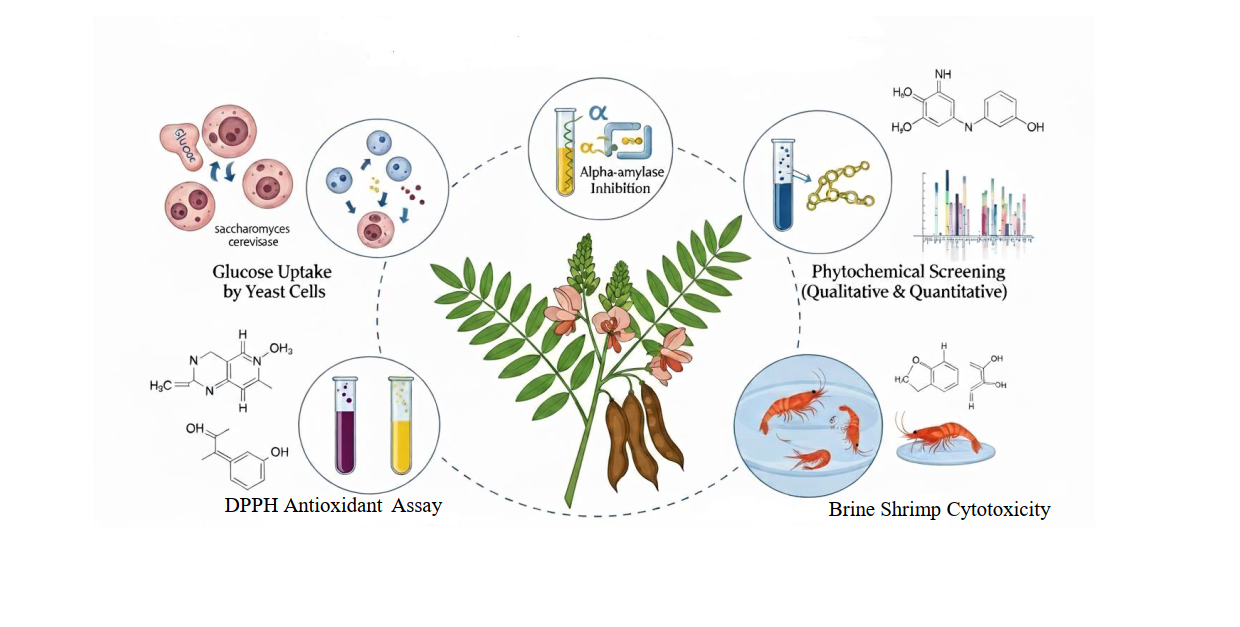
Graphical Abstract
Keywords
Dalbergiella welwitschii | diabetes | antioxidant | herbal medicine
References
- 1.
Sinclair, A.J. Sub-Sahara Africa- The Impact and Challenge of Type 2 Diabetes Mellitus Requiring Urgent and Sustainable Public Health Measures. eClinicalMedicine 2019, 16, 6–7. https://doi.org/10.1016/j.eclinm.2019.10.005.
- 2.
Adeleye, J.O. The Hazardous Terrain of Diabetes Mellitus in Nigeria: The Time for Action Is Now. Res. J. Health Sci. 2021, 9, 69–76. https://doi.org/10.4314/rejhs.v9i7.8.
- 3.
Sriraman, S.; Sreejith, D.; Andrew, E.; et al. Use of Herbal Medicines for the Management of Type 2 Diabetes: A Systematic Review of Qualitative Studies. Complement. Ther. Clin. Pract. 2023, 53, 101808. https://doi.org/10.1016/j.ctcp.2023.101808.
- 4.
Mthiyane, F.T.; Dludla, P.V.; Ziqubu, K.; et al. A Review on the Antidiabetic Properties of Moringa Oleifera Extracts: Focusing on Oxidative Stress and Inflammation as Main Therapeutic Targets. Front. Pharmacol. 2022, 13, 940572. https://doi.org/10.3389/fphar.2022.940572.
- 5.
Talwar, A.; Chakraborty, N.; Zahera, M.; et al. Antidiabetic Potential of Phytochemicals Found in Vernonia Amygdalina. J. Chem. 2024, 2024, 6111603. https://doi.org/10.1155/2024/6111603.
- 6.
Chukwuma, E.; Soladoye, M.O.; Feyisola, R.T.C. Traditional Medicine and the Future of Medicinal Plants in Nigeria. J. Med. Plants Stud. 2015, 3, 23–29.
- 7.
Olowokudejo, J.D.; Kadiri, A.B.; Travih, V.A. An Ethnobotanical Survey of Herbal Markets and Medicinal Plants in Lagos State of Nigeria. Ethnobot. Leafl. 2008, 12, 851–865.
- 8.
Fred-Jaiyesimi, A.; Akinla, O. Phytochemical and Anti-Inflammatory Activities of the Methanol Extract and Fractions of Dalbergiella Welwitschii Baker (Baker. F) Leaves. Res. J. Pharm. Biol. Chem. Sci. 2013, 4, 1191–1200.
- 9.
Boisa, N.; Maduelos, N.J.; Ogbu, A. Application of Dalbergiella Welwitschii Leaves Extract in the Demulsification of Water-in-Oil Emulsions. J. Chem. Soc. Nigeria. 2021, 46, 1106–1113. https://doi.org/10.46602/jcsn.v46i6.688.
- 10.
Ajiboye, B.O.; Oyinloye, B.E.; Ojo, O.A.; et al. Effect of Flavonoid-Rich Extract from Dalbergiella Welwitschii Leaf on Redox, Cholinergic, Monoaminegic, and Purinergic Dysfunction in Oxidative Testicular Injury: Ex-Vivo and in-Silico Studies. Bioinform. Biol. Insights 2022, 16, 11779322221115546. https://doi.org/10.1177/11779322221115546.
- 11.
Fabeku, P.O. Traditional Medicine the Art, Ways and Practice. In Outlines and Pictures of Medicinal plants from Nigeria; Odugbemi, T.O., Ed.; University of Lagos Press: Lagos, Nigeria, 2008; pp. 13–24.
- 12.
Diniso, T.; Adeyemi, J.; Oriola, A.; et al. Polyphenolic Contents, Free Radical Scavenging and Cholinesterase Inhibitory Activities of Dalbergiella Welwitschii Leaf Extracts. Plants 2022, 11, 2066. https://doi.org/10.3390/plants11152066.
- 13.
Odeyemi, O.O.; Onochie, A.U.; Odeyemi, S.O.; et al. Evaluation of Qualitative Phytochemical Constituents of Napoleona Imperialis Stem Bark. GSC. Bio. Pharm. Sci. 2023, 24, 202–208. https://doi.org/10.30574/gscbps.2023.24.1.0246.
- 14.
Kayode, R.M.O.; Chia, C.N.; Kayode, B.I.; et al. Quality Evaluation of Chin-Chin Produced from Aerial Yam (Dioscorea Bulbifera) and Wheat Flour Blends. Food Prod. Process. Nutr. 2023, 5, 54. https://doi.org/10.1186/s43014-023-00159-8.
- 15.
Dessalegn, E.; Mathewos, M.; Gebremeskel, H.; et al. Determination of Total Phenolic and Flavonoid Contents, Antioxidant and Antibacterial Potential of the Bark Extracts of Syzygium Guineense (Wild.) DC. BMC Complement. Med. Ther. 2025, 25, 35. https://doi.org/10.1186/s12906-025-04788-z.
- 16.
Nyero, A.; Anywar, G.U.; Achaye, I.; et al. Phytochemical Composition and Antioxidant Activities of Some Wild Edible Plants Locally Consumed by Rural Communities in Northern Uganda. Front. Nutr. 2023, 10, 1070031. https://doi.org/10.3389/fnut.2023.1070031.
- 17.
Khan, A.M.; Qureshi, R.A.; Ullah, F.; et al. Phytochemical Analysis of Selected Medicinal Plants of Margalla Hills and Surroudings. J. Med. Plants Res. 2011, 5, 6017–6023. https://doi.org/10.5897/jmpr.9000984.
- 18.
Wickramaratne, M.N.; Punchihewa, J.C.; Wickramaratne, D.B.M. In-Vitro Alpha Amylase Inhibitory Activity of the Leaf Extracts of Adenanthera Pavonina. BMC Complement. Altern. Med. 2016, 16, 466. https://doi.org/10.1186/s12906-016-1452-y.
- 19.
Nair, S.S.; Kavrekar, V.; Mishra, A. Evaluation of in-Vitro Antidiabetic Activity of Selected Plant Extracts. Int. J. Pharm. Sci. Invent. 2013, 2, 12–19.
- 20.
Sankar, B.K.; Barman, S.S.; Das, J.; et al. Evaluation of in-Vitro Antidiabetic Activity of Two Mangrove Plant Extracts: Heritera Fomes and Sonneraria Apetala. J. Pharmacogn. Phytochem. 2019, 8, 2376–2380.
- 21.
Baliyan, S.; Mukherjee, R.; Priyadarshini, A.; et al. Determination of Antioxidants by DPPH Radical Scavenging Activity and Quantitative Phytochemical Analysis of Ficus Religiosa. Molecules 2022, 27, 1326. https://doi.org/10.3390/molecules27041326.
- 22.
Apu, A.S.; Muhit, M.A.; Tareq, S.M.; et al. Antimicrobial Activity and Brine Shrimp Lethality Bioassay of the Leaves Extract of Dillenia Indica Linn. J. Young Pharm. 2010, 2, 50–53. https://doi.org/10.4103/0975-1483.62213.
- 23.
Hamidi, M.R.; Jovanova, B.; Kadifkova Panovska, T. Toxicological Evaluation of the Plant Products Using Brine Shrimp (Artemia salina L.) Model. Maced. Pharm. Bull. 2014, 60, 9–18. https://doi.org/10.33320/maced.pharm.bull.2014.60.01.002.
- 24.
Samarakoon, D.N.A.W.; Uluwaduge, D.I.; Siriwardhene, M.A. Mechanisms of Action of Sri Lankan Herbal Medicines Used in the Treatment of Diabetes: A Review. J. Integr. Med. 2020, 18, 14–20. https://doi.org/10.1016/j.joim.2019.11.003.
- 25.
Lima, J.E.B.F.; Moreira, N.C.S.; Sakamoto-Hojo, E.T. Mechanisms Underlying the Pathophysiology of Type 2 Diabetes: From Risk Factor to Oxidative Stress, Metabolic Dysfunction and Hyperglycemia. Mutat. Res. Genet. Toxicol. Environ. Mutagen 2022, 874–875, 503437. https://doi.org/10.1016/j.mrgentox.2021.503437.
- 26.
Wasik, A.A.; Lehtonen, S. Glucose Transporters in Diabetic Kidney Disease—Friends or Foes? Front. Endocrinol. 2018, 9, 155. https://doi.org/10.3389/fendo.2018.00155.
- 27.
McCall, A.L. Glucose Transport. In Stress, Physiology, Biochemistry and Pathology Handbook of Stress Series Volume 3; Fink, G., Ed.; Academic Press: Cambridge, UK, 2019; Volume 3, pp. 563–570. https://doi.org/10.10.b978-0-12-1813146-6-00022-9.
- 28.
Moreira, F.D.; Reis, C.E.G.A.; Gallassi, A.D.; et al. Suppression of the Postprandial Hyperglycemia in Patients with Type 2 Diabetes by a Raw Medicinal Herb Powder Is Weakened when Consumed in Ordinary Hard Gelatin Capsules: A Randomized Crossover Clinical Trial. PLoS ONE 2024, 19, e0311501. https://doi.org/10.1371/journal.pone.0311501.
- 29.
Lui, T.; Gu, Y.; Waleed, A.A.; et al. Challenges and Opportunities in Developing Low Glycemic Index Foods with White Kidney Bean α-Amylase Inhibitor. Trends Food Sci. Technol. 2024, 147, 104397. https://doi.org/10.1016/j.tifs.2024.104397.
- 30.
Adeyemi, J.O.; Onwudiwe, D.C.; Oyedeji, A.O. In-Vitro α-Glucosidase Enzyme Inhibition and Anti-Inflamatory Studies of Mn3O4 Nanoparticles Mediated Using Extracts of Dalbergiella Welwitschia. Results Chem. 2022, 4, 410049. https://doi.org/10.1016/j.rechem.2022.100497.
- 31.
Modupe, O.U.; Olatunde, S.O.; Wassem, M.; et al. Green Hydrothermal Synthesis of Nickel and Zinc-Doped Nickel Ferrite Nanoparticles Using Dalbergiella Welwitschii Extracts and Their Biological Studies. Heliyon 2025, 11, e40759. https://doi.org/10.1016/j.heliyon.2024.e40759.
- 32.
Shafras, M.; Sabaragamuwa, R.; Suwair, M. Role of Dietary Antioxidants in Diabetes: An Overview. Food Chem. Adv. 2024, 4, 100666. https://doi.org/10.10161j.focha.2024.100666.
- 33.
Chetyrkin, S.; Mathis, M.; Pedchenko, V.; et al. Glucose Autooxidation Induces Functional Damage to Proteins via Modifications of Critical Arginine Residues. Biochem 2011, 50, 6102–6112. https://doi.org/10.1021/bi200757d.
- 34.
Fraunberger, E.A.; Scola, G.; Laliberte, V.L.M.; et al. Redox Modulation, Antioxidants and Neuropsychiatric Disorders. Oxid. Med. Cell. Longev. 2016, 2016, 4729192. https://doi.org/10.1155/2016/4729192.
- 35.
Diworth, L.; Stennert, D.; Facey, A.; et al. Diabetes and the Associated Complications. the Role of Antioxidants in Diabetes Therapy and Care. Biomed. Pharmacother. 2024, 181, 117641. https://doi.org/10.1016/j.biopha.2024.117641.
- 36.
Waghulde, S.; Kale, M.K.; Patil, V.R. Brine Shrimp Lethalithy Assay of the Aqueous and Ethanolic Extracts of the Selected Species of Medicinal Plants. Proceedings 2019, 41, 42. https://doi.org/10.3390/ecsoc-23-06703.
- 37.
Fendrych, K.; Gorska-Ratusznik, A.; Smaidor, J. Electrochemical Assays for the Determination of Antidiabetic Drugs—A Review. Micromachines 2024, 15, 10. https://doi.org/10.3390/mi15010010.
- 38.
Oghenejoboh, U.M.; Babatunde, D.D.; Sonibare, O.O.; et al. Free Radical Scavenging Activity and Oxidative Stress Inhibition of Dalbergiella Welwitschii Essential Oils: Evidence from Experimental and Computational Studies. In Silico Pharmacol 2026, 14, 66. https://doi.org/10.1007/s40203-026-00583-x.
- 39.
Bacanli, M.; Dilsiz, S.A.; Başaran, N.; et al. Effects of Phytochemicals against Diabetes. Adv. Food Nutr. Res. 2019, 89, 209–238.
- 40.
Kaurimovic, B.; Vastag, D. Flavonoids and Phenolic Acids as Potential Natural Antioxidants; Shalaby, E., Ed.; IntechOpen: London, UK, 2019. https://doi.org/10.5772/intechopen.83731.
- 41.
Lewandowski, W.; Lewandowska, H.; Golonko, A.; et al. Correlations between Molecular Structure and Biological Activity in Logical Series of Dietary Chromone Derivatives. PLoS ONE 2020, 15, 40229477. https://doi.org/10/371/journal.pone.0229477.

This work is licensed under a Creative Commons Attribution 4.0 International License.

 Suite 4002 Level 4, 447 Collins Street, Melbourne, Victoria 3000, Australia
 General Inquiries: info@sciltp.com