
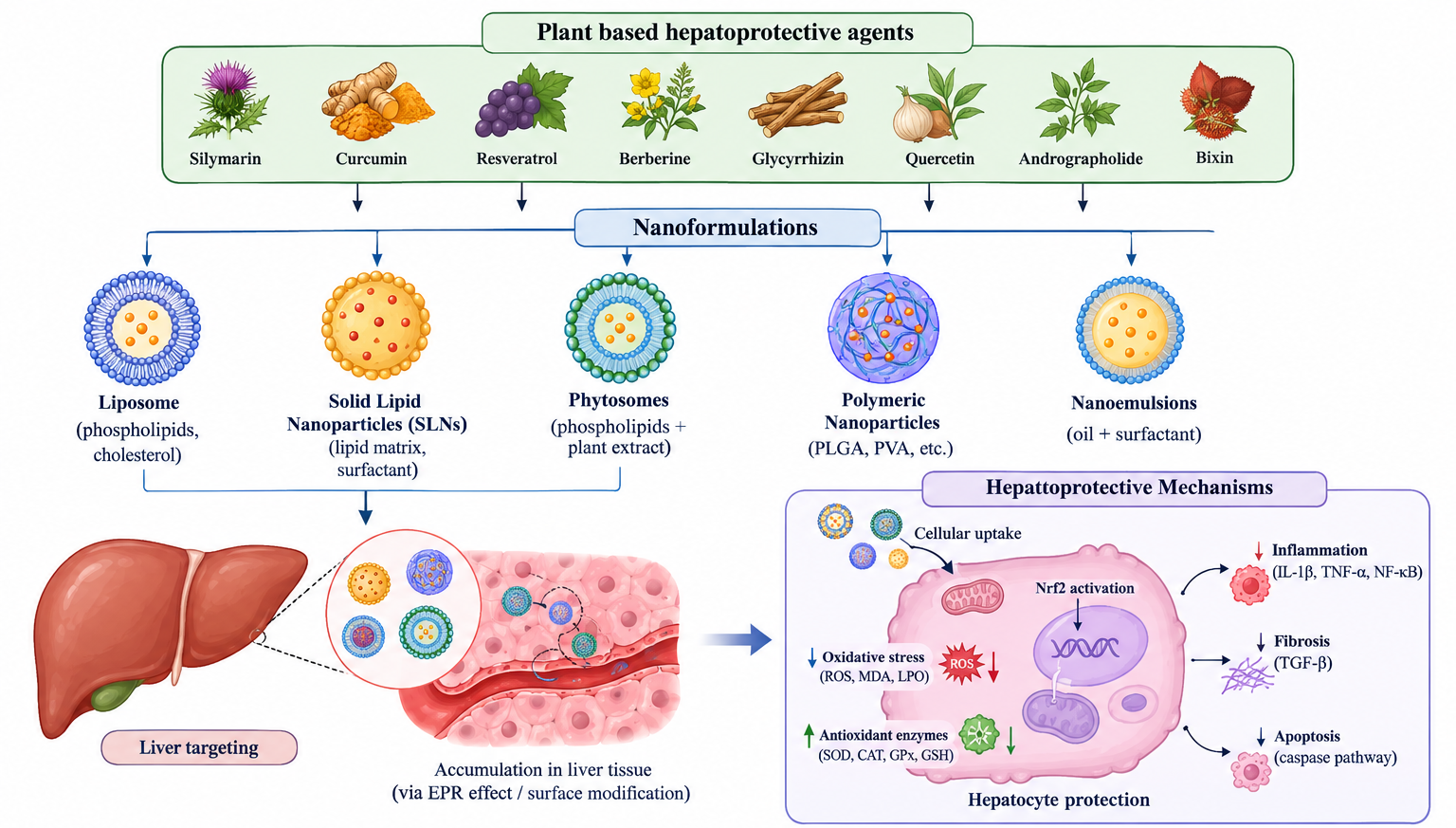
Liver disease poses potential therapeutic challenges, as ongoing hepatic injury is correlated with oxidative stress, inflammation, mitochondrial dysfunction, fibrosis, and impaired hepatocellular function. There are many medicinal plants and their bioactive ingredients with hepatoprotective, antioxidant, and anti-inflammatory properties, but their effectiveness is restricted by problems with water solubility, bioavailability, instability, rapid metabolism, and hepatic delivery. To address this issue, the use of nanocarriers for the delivery of herbal bioactives has become a promising approach to enhance their therapeutic potential. This review focuses on a targeted introduction of the herbal nanocarrier-based treatment approach for liver diseases and the correlation between the various properties of the nanocarrier and the enhancement effect of the plant-derived compounds’ delivery in the liver. Important nanocarrier-based systems such as liposomes, phytosomes, niosomes, solid lipid nanoparticles, nanostructured lipid carriers, polymeric nanoparticles, dendrimers, and other emerging systems are mentioned in relation to their structural features, drug-loading capacity, stability, controlled-release features, bioavailability, and hepatic targeting possibilities. It also highlights some of the herbal bioactives that have been attached to nanocarriers and their uses in hepatotoxicity, fatty liver syndrome, fibrosis, inflammation, and liver cancer. Mainly the nanocarriers help increase the solubility of bioactive molecules, prevent their degradation, extend systemic action, improve their accumulation in the liver, and increase their efficacy in treatment relative to classical herbal formulations. Finally, current state-of-the-art limitations, formulation challenges, safety and standardization aspects, and future possibilities for clinical translation in the context of herbal nanocarrier systems are presented.
- Open Access
- Review
Nanocarrier-Based Herbal Drug Delivery System for the Management of Liver Diseases
Author Information
Received: 17 Jun 2026 | Revised: 06 Sep 2026 | Accepted: 08 Sep 2026 | Published: 15 Sep 2026
Abstract
Graphical Abstract
Keywords
fatty liver | nanostructured lipid carriers | fibrosis | niosomes | phytosomes
References
- 1.
Younossi, Z.M.; Wong, G.; Anstee, Q.M.; et al. The Global Burden of Liver Disease. Clin. Gastroenterol. Hepatol. 2023, 21, 1978–1991. https://doi.org/10.1016/j.cgh.2023.04.015.
- 2.
Devarbhavi, H.; Asrani, S.K.; Arab, J.P.; et al. Global burden of liver disease: 2023 update. J. Hepatol. 2023, 79, 516–537. https://doi.org/10.1016/j.jhep.2023.03.017.
- 3.
Zhang, C.; Cheng, Y.; Zhang, S.; et al. Changing epidemiology of hepatocellular carcinoma in Asia. Liver Int. 2022, 42, 2029–2041. https://doi.org/10.1111/liv.15251.
- 4.
Shanker, N.; Mathur, P.; Das, P.; et al. Cancer scenario in North-East India & need for an appropriate research agenda. Indian J. Med. Res. 2021, 154, 27–35. https://doi.org/10.4103/ijmr.ijmr_347_20.
- 5.
Subramanya, S.B.; Venkataraman, B.; Meeran, M.F.N.; et al. Therapeutic Potential of Plants and Plant Derived Phytochemicals against Acetaminophen-Induced Liver Injury. Int. J. Mol. Sci. 2018, 19, 3776. https://doi.org/10.3390/ijms19123776.
- 6.
Parvin, N.; Aslam, M.; Joo, S.W.; et al. Nano-Phytomedicine: Harnessing Plant-Derived Phytochemicals in Nanocarriers for Targeted Human Health Applications. Molecules 2025, 30, 3177. https://doi.org/10.3390/molecules30153177.
- 7.
Athanasopoulou, F.; Manolakakis, M.; Vernia, S.; et al. Nanodrug Delivery Systems for Metabolic Chronic Liver Diseases: Advances and Perspectives. Nanomedicine 2023, 18, 67–84. https://doi.org/10.2217/nnm-2022-0261.
- 8.
Mintz, K.J.; Leblanc, R.M. The use of nanotechnology to combat liver cancer: Progress and perspectives. Biochim. et Biophys. Acta BBA-Rev. Cancer 2021, 1876, 188621. https://doi.org/10.1016/j.bbcan.2021.188621.
- 9.
Abou Assi, R.; Abdulbaqi, I.M.; Siok Yee, C. The Evaluation of Drug Delivery Nanocarrier Development and Pharmacological Briefing for Metabolic-Associated Fatty Liver Disease (MAFLD): An Update. Pharmaceuticals 2021, 14, 215. https://doi.org/10.3390/ph14030215.
- 10.
Jaeschke, H.; Ramachandran, A. Acetaminophen Hepatotoxicity: Paradigm for Understanding Mechanisms of Drug-Induced Liver Injury. Annu. Rev. Pathol. Mech. Dis. 2024, 19, 453–478. https://doi.org/10.1146/annurev-pathmechdis-051122-094016.
- 11.
Shi, S.; Wang, L.; van der Laan, L.J.W.; et al. Mitochondrial Dysfunction and Oxidative Stress in Liver Transplantation and Underlying Diseases: New Insights and Therapeutics. Transplantation 2021, 105, 2362–2373. https://doi.org/10.1097/tp.0000000000003691.
- 12.
Chen, J.; Zhang, S. The Role of Inflammation in Cholestatic Liver Injury. J. Inflamm. Res. 2023, 16, 4527–4540. https://doi.org/10.2147/jir.s430730.
- 13.
Björnsson, H.K.; Björnsson, E.S. Drug-induced liver injury: Pathogenesis, epidemiology, clinical features, and practical management. Eur. J. Intern. Med. 2022, 97, 26–31. https://doi.org/10.1016/j.ejim.2021.10.035.
- 14.
Priya, S.; Desai, V.M.; Singhvi, G. Surface Modification of Lipid-Based Nanocarriers: A Potential Approach to Enhance Targeted Drug Delivery. ACS Omega 2023, 8, 74–86. https://doi.org/10.1021/acsomega.2c05976.
- 15.
Ng, P.Q.; Ling, L.S.C.; Chellian, J.; et al. Applications of Nanocarriers as Drug Delivery Vehicles for Active Phytoconstituents. Curr. Pharm. Des. 2020, 26, 4580–4590. https://doi.org/10.2174/1381612826666200610111013.
- 16.
Hu, Q.; Luo, Y. Chitosan-based nanocarriers for encapsulation and delivery of curcumin: A review. Int. J. Biol. Macromol. 2021, 179, 125–135. https://doi.org/10.1016/j.ijbiomac.2021.02.216.
- 17.
Has, C.; Sunthar, P. A comprehensive review on recent preparation techniques of liposomes. J. Liposome Res. 2020, 30, 336–365. https://doi.org/10.1080/08982104.2019.1668010.
- 18.
Nsairat, H.; Khater, D.; Sayed, U.; et al. Liposomes: Structure, composition, types, and clinical applications. Heliyon 2022, 8, e09394. https://doi.org/10.1016/j.heliyon.2022.e09394.
- 19.
AbouSamra, M.M. Liposomal nano-carriers mediated targeting of liver disorders: Mechanisms and applications. J. Liposome Res. 2024, 34, 728–743. https://doi.org/10.1080/08982104.2024.2377085.
- 20.
Zielińska, A.; Carreiró, F.; Oliveira, A.M.; et al. Polymeric Nanoparticles: Production, Characterization, Toxicology and Ecotoxicology. Molecules 2020, 25, 3731. https://doi.org/10.3390/molecules25163731.
- 21.
Idrees, H.; Zaidi, S.Z.J.; Sabir, A.; et al. A Review of Biodegradable Natural Polymer-Based Nanoparticles for Drug Delivery Applications. Nanomaterials 2020, 10, 1970. https://doi.org/10.3390/nano10101970.
- 22.
Geszke-Moritz, M.; Moritz, M. Biodegradable Polymeric Nanoparticle-Based Drug Delivery Systems: Comprehensive Overview, Perspectives and Challenges. Polymers 2024, 16, 2536. https://doi.org/10.3390/polym16172536.
- 23.
Luo, F.; Yu, Y.; Li, M.; et al. Polymeric nanomedicines for the treatment of hepatic diseases. J. Nanobiotechnology 2022, 20, 488. https://doi.org/10.1186/s12951-022-01708-y.
- 24.
Hussain, S.; Ashafaq, M.; Alshahrani, S.; et al. Hepatoprotective Effect of Curcumin Nano-Lipid Carrier against Cypermethrin Toxicity by Countering the Oxidative, Inflammatory, and Apoptotic Changes in Wistar Rats. Molecules 2023, 28, 881. https://doi.org/10.3390/molecules28020881.
- 25.
Madkhali, O.A. Perspectives and Prospective on Solid Lipid Nanoparticles as Drug Delivery Systems. Molecules 2022, 27, 1543. https://doi.org/10.3390/molecules27051543.
- 26.
Munir, M.; Zaman, M.; Waqar, M.; et al. Solid lipid nanoparticles: A versatile approach for controlled release and targeted drug delivery. J. Liposome Res. 2024, 34, 335–348. https://doi.org/10.1080/08982104.2023.2268711.
- 27.
Fung, M.; Thornton, A.; Mybeck, K.; et al. Evaluation of the Characteristics of Safety Withdrawal of Prescription Drugs from Worldwide Pharmaceutical Markets-1960 to 1999. Drug Inf. J. 2001, 35, 293–317. https://doi.org/10.1177/009286150103500134.
- 28.
Hussein, R.M.; Kandeil, M.A.; Mohammed, N.A.; et al. Evaluation of the hepatoprotective effect of curcumin-loaded solid lipid nanoparticles against paracetamol overdose toxicity: Role of inducible nitric oxide synthase. J. Liposome Res. 2022, 32, 365–375. https://doi.org/10.1080/08982104.2022.2032737.
- 29.
Mahmoud, K.; Swidan, S.; El-Nabarawi, M.; et al. Lipid based nanoparticles as a novel treatment modality for hepatocellular carcinoma: A comprehensive review on targeting and recent advances. J. Nanobiotechnology 2022, 20, 109. https://doi.org/10.1186/s12951-022-01309-9.
- 30.
Lian, B.; Wu, M.; Feng, Z.; et al. Folate-conjugated human serum albumin-encapsulated resveratrol nanoparticles: Preparation, characterization, bioavailability and targeting of liver tumors. Artif. Cells Nanomed. Biotechnol. 2019, 47, 154–165. https://doi.org/10.1080/21691401.2018.1548468.
- 31.
Nasirizadeh, S.; Malaekeh-Nikouei, B. Solid lipid nanoparticles and nanostructured lipid carriers in oral cancer drug delivery. J. Drug Deliv. Sci. Technol. 2020, 55, 101458. https://doi.org/10.1016/j.jddst.2019.101458.
- 32.
Harish, V.; Mohd, S.; Tewari, D.; et al. Unravelling the role of solid lipid nanoparticles in drug delivery: Journey from laboratory to clinical trial. J. Drug Deliv. Sci. Technol. 2023, 85, 104616. https://doi.org/10.1016/j.jddst.2023.104616.
- 33.
Patel, P.; Garala, K.; Singh, S.; et al. Lipid-Based Nanoparticles in Delivering Bioactive Compounds for Improving Therapeutic Efficacy. Pharmaceuticals 2024, 17, 329. https://doi.org/10.3390/ph17030329.
- 34.
Gaur, P.K.; Singh, R.; Rastogi, S.; et al. Recent Advancements and Applications of Phospholipid Complexes: A Strategy to Enhancing the Bioavailability of Phytopharmaceuticals. Drug Deliv. Lett. 2023, 13, 2–12. https://doi.org/10.2174/2210303112666220929151010.
- 35.
Talebi, M.; Shahbazi, K.; Dakkali, M.S.; et al. Phytosomes: A promising nanocarrier system for enhanced bioavailability and therapeutic efficacy of herbal products. Phytomedicine Plus 2025, 5, 100779. https://doi.org/10.1016/j.phyplu.2025.100779.
- 36.
Barani, M.; Sangiovanni, E.; Angarano, M.; et al. Phytosomes as Innovative Delivery Systems for Phytochemicals: A Comprehensive Review of Literature. Int. J. Nanomed. 2021, 16, 6983–7022. https://doi.org/10.2147/ijn.s318416.
- 37.
Achete de Souza, G.; de Marqui, S.V.; Matias, J.N.; et al. Effects of Ginkgo biloba on Diseases Related to Oxidative Stress. Planta Medica 2020, 86, 376–386. https://doi.org/10.1055/a-1109-3405.
- 38.
Bhargava, S.; Shah, M. Evaluation of efficacy of Bombax ceiba extract and its major constituent, mangiferin in streptozotocin (STZ)-induced diabetic rats. J. Complement. Integr. Med. 2021, 18, 311–318. https://doi.org/10.1515/jcim-2020-0027.
- 39.
Esmaeilzadeh, M.; Heidarian, E.; Shaghaghi, M.; et al. Gallic acid mitigates diclofenac-induced liver toxicity by modulating oxidative stress and suppressing IL-1β gene expression in male rats. Pharm. Biol. 2020, 58, 590–596. https://doi.org/10.1080/13880209.2020.1777169.
- 40.
Sharata, E.E.; Mohyeldin, R.H.; Abdelnaser, M.; et al. Deciphering Gentamicin-Induced Nephrotoxicity and Hepatotoxicity: Pathophysiological Insights and Emerging Protective Approaches. Food Chem. Toxicol. 2026, 217, 116350. https://doi.org/10.1016/j.fct.2026.116350.
- 41.
Liu, X.; Zhang, Y.; Liu, L.; et al. Protective and therapeutic effects of nanoliposomal quercetin on acute liver injury in rats. BMC Pharmacol. Toxicol. 2020, 21, 11. https://doi.org/10.1186/s40360-020-0388-5.
- 42.
Chiu, C.H.; Chang, C.C.; Lin, S.T.; et al. Improved Hepatoprotective Effect of Liposome-Encapsulated Astaxanthin in Lipopolysaccharide-Induced Acute Hepatotoxicity. Int. J. Mol. Sci. 2016, 17, 1128. https://doi.org/10.3390/ijms17071128.
- 43.
Kumar, N.; Rai, A.; Reddy, N.D.; et al. Improved in vitro and in vivo hepatoprotective effects of liposomal silymarin in alcohol-induced hepatotoxicity in Wistar rats. Pharmacol. Rep. 2019, 71, 703–712. https://doi.org/10.1016/j.pharep.2019.03.013.
- 44.
Yousefi-Manesh, H.; Shirooie, S.; Partoazar, A.; et al. Hepatoprotective effects of phosphatidylserine liposomes on carbon tetrachloride-induced hepatotoxicity in rats. J. Cell. Biochem. 2019, 120, 11853–11858. https://doi.org/10.1002/jcb.28464.
- 45.
Kleiner, D.; Hegyi, G.; Urbanics, R.; et al. Hepatoprotective liposomal glycyrrhizin in alcoholic liver injury. Eur. J. Integr. Med. 2016, 8, 23–28. https://doi.org/10.1016/j.eujim.2016.11.005.
- 46.
Marslin, G.; Prakash, J.; Qi, S.; et al. Oral Delivery of Curcumin Polymeric Nanoparticles Ameliorates CCl4-Induced Subacute Hepatotoxicity in Wistar Rats. Polymers 2018, 10, 541. https://doi.org/10.3390/polym10050541.
- 47.
Roy, P.; Das, S.; Auddy, R.; et al. Engineered Andrographolide Nanoparticles Mitigate Paracetamol Hepatotoxicity in Mice. Pharm. Res. 2013, 30, 1252–1262. https://doi.org/10.1007/s11095-012-0964-5.
- 48.
Gupta, M.K.; Sansare, V.A.; Shrivastava, B. Design, fabrication, and characterization of sesamol loaded polymeric nanoparticles: In vivo hepatoprotective potential in Wistar rats. Nanomed. Res. J. 2021, 6, 296–303.
- 49.
Singh, N.; Khullar, N.; Kakkar, V.; et al. Hepatoprotective effects of sesamol loaded solid lipid nanoparticles in carbon tetrachloride induced sub-chronic hepatotoxicity in rats. Environ. Toxicol. 2016, 31, 520–532. https://doi.org/10.1002/tox.22064.
- 50.
Shafique, H.; Ahad, A.; Khan, W.; et al. Ganoderic acid-loaded solid lipid nanoparticles ameliorate d-galactosamine induced hepatotoxicity in Wistar rats. J. Drug Deliv. Sci. Technol. 2019, 50, 48–56. https://doi.org/10.1016/j.jddst.2019.01.005.
- 51.
Rao, M.P.; Manjunath, K.; Bhagawati, S.T.; et al. Bixin loaded solid lipid nanoparticles for enhanced hepatoprotection—Preparation, characterisation and in vivo evaluation. Int. J. Pharm. 2014, 473, 485–492. https://doi.org/10.1016/j.ijpharm.2014.07.027.
- 52.
Xue, M.; Zhang, L.; Yang, M.; et al. Berberine-loaded solid lipid nanoparticles are concentrated in the liver and ameliorate hepatosteatosis in db/db mice. Int. J. Nanomed. 2015, 10, 5049–5057. https://doi.org/10.2147/ijn.s84565.
- 53.
Shriram, R.G.; Moin, A.; Alotaibi, H.F.; et al. Phytosomes as a Plausible Nano-Delivery System for Enhanced Oral Bioavailability and Improved Hepatoprotective Activity of Silymarin. Pharmaceuticals 2022, 15, 790. https://doi.org/10.3390/ph15070790.
- 54.
Al-Kahtani, M.; Abdel-Daim, M.M.; Sayed, A.A.; et al. Curcumin phytosome modulates aluminum-induced hepatotoxicity via regulation of antioxidant, Bcl-2, and caspase-3 in rats. Environ. Sci. Pollut. Res. 2020, 27, 21977–21985. https://doi.org/10.1007/s11356-020-08636-0.
- 55.
Gahandule, M.B.; Jadhav, S.J.; Gadhave, M.V.; et al. Formulation and development of hepato-protective butea monosperma-Phytosome. Int. J. Res. Pharm. Pharm. Sci. 2016, 1, 21–27.
- 56.
Varma, K.; Vishwakarma, G.; Pathak, R. Extraction phytochemical screening and development of phytosomes of hydroalcoholic extract of Terminalia chebula Retz for hepetoprotection. J. Drug Deliv. Ther. 2019, 9, 397–406. https://doi.org/10.22270/jddt.v9i3.2685.
- 57.
Tung, B.T.; Hai, N.T.; Son, P.K. Hepatoprotective effect of Phytosome Curcumin against paracetamol-induced liver toxicity in mice. Braz. J. Pharm. Sci. 2017, 53, e16136. https://doi.org/10.1590/s2175-97902017000116136.
- 58.
Islam, S.; Ahmed, M.M.S.; Islam, M.A.; et al. Advances in nanoparticles in targeted drug delivery–A review. Results Surf. Interfaces 2025, 19, 100529. https://doi.org/10.1016/j.rsurfi.2025.100529.
- 59.
Wadhwa, P.; Sharma, S.; Sahu, S.; et al. A Review of Nanoparticles Characterization Techniques. Curr. Nanomater. 2022, 7, 202–214. https://doi.org/10.2174/2405461507666220405113715.
- 60.
Ezhilarasan, D. Advantages and challenges in nanomedicines for chronic liver diseases: A hepatologist’s perspectives. Eur. J. Pharmacol. 2021, 893, 173832. https://doi.org/10.1016/j.ejphar.2020.173832.
- 61.
Puccetti, M.; Pariano, M.; Schoubben, A.; et al. Biologics, theranostics, and personalized medicine in drug delivery systems. Pharmacol. Res. 2024, 201, 107086. https://doi.org/10.1016/j.phrs.2024.107086.
- 62.
Mi, P. Stimuli-responsive nanocarriers for drug delivery, tumor imaging, therapy and theranostics. Theranostics 2020, 10, 4557–4588. https://doi.org/10.7150/thno.38069.
- 63.
Ruman, U.; Fakurazi, S.; Masarudin, M.J.; et al. Nanocarrier-Based Therapeutics and Theranostics Drug Delivery Systems for Next Generation of Liver Cancer Nanodrug Modalities. Int. J. Nanomed. 2020, 15, 1437–1456. https://doi.org/10.2147/ijn.s236927.

This work is licensed under a Creative Commons Attribution 4.0 International License.

 Suite 4002 Level 4, 447 Collins Street, Melbourne, Victoria 3000, Australia
 General Inquiries: info@sciltp.com