
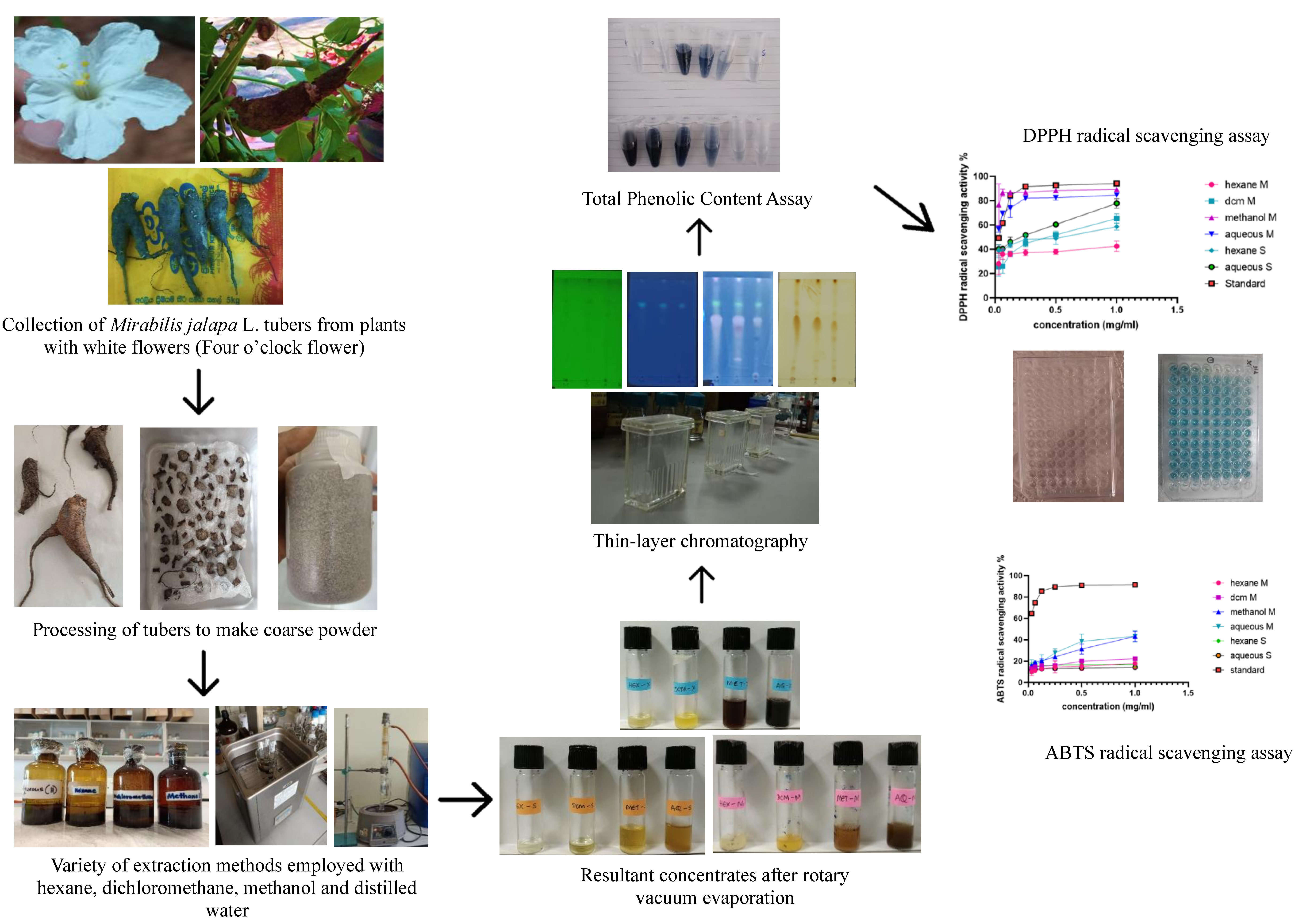
Mirabilis jalapa, or the Four O’clock plant, is an ornamental plant that has medicinal value due to its various phytochemical compositions. This study aims to examine the M. jalapa roots for their phytochemical spectrum and determine their in vitro antioxidant capacity. The plant was collected and authenticated, and then maceration, sonication, and Soxhlet extraction techniques were employed for aqueous, methanol, dichloromethane (DCM), and hexane extracts. Thin-layer chromatography (TLC) coupled with spray reagents was used to screen bioactives. Total Phenolic Content (TPC), DPPH (2,2-diphenyl-1-picrylhydrazyl), and ABTS (2,2′-azino-bis (3-ethylbenzothiazoline-6-sulfonic acid)) radical-scavenging activity assays were performed to investigate the antioxidant potential. TLC screening revealed that maceration and Soxhlet extraction separated most compounds. The TPC values of methanol and aqueous macerates were the highest among all extracts. In the DPPH scavenging assay, these extracts showed a significantly higher activity, with IC50 values (half-maximal inhibitory concentration) below the lowest concentration tested (<0.03125 mg/mL). The ABTS assay identified the same two extracts as the most active, but scavenging remained below 50% (maximum 43.30% at 1 mg/mL); therefore, IC50 could not be determined. Overall, methanol and aqueous extracts of M. jalapa roots showed significantly higher antioxidant activity, perhaps due to their variety of bioactive compounds that justified their incorporation in traditional medicine.
- Open Access
- Article
Comparative Extraction, Preliminary Phytochemical Screening, and Antioxidant Activity of Mirabilis jalapa L. Tuberous Roots Found in Sri Lanka
- Ladhurshika Nadarajah 1,†,
- Luvedika Maheshwaran 1,†,
- Nimesha Senadeera 2,
- Thamara Navarathna 3,
- Amirthasingam Manoraj 3,
- Anchala I. Kuruppu 4,
- Ambalanduwe K. Chandana 5,
- Ranjith N. Pathirana 6 and
- Chathuranga B. Ranaweera 1,*
Author Information
Received: 23 July 2026 | Revised: 15 September 2026 | Accepted: 30 September 2026 | Published: 23 October 2026
Abstract
Graphical Abstract
Keywords
Mirabilis jalapa | phytochemicals | thin layer chromatography | total phenolic content | antioxidant activity
References
- 1.
Kumar, S.; Dobos, G.J.; Rampp, T. The Significance of Ayurvedic Medicinal Plants. J. Evid.-Based Complement. Altern. Med. 2017, 22, 494–501. https://doi.org/10.1177/2156587216671392.
- 2.
Fernando, D.T.K.; Peiris, D.S.H.S.; Senadeera, S.P.N.N.; et al. Evaluation of In Vitro Anti-Inflammatory and Antibacterial Properties of Tuberous Roots of Mirabilis jalapa L. Found in Sri Lanka. Asian J. Res. Bot. 2023, 6, 192–214.
- 3.
Nidavani, R.B.; Mahalakshmi, A.M. An ethanopharmacological review of four o’ clock flower plant (Mirabilis jalapa Linn.). J. Biol. Sci. Opin. 2014, 2, 344–348. https://doi.org/10.7897/2321-6328.02679.
- 4.
Kumar, A.; Chaudhary, P.; Tyagi, P.; et al. Preliminary screening of phytochemicals and antioxidants in ayurvedic medicinal plant Mirabilis jalapa linn. Int. J. Appl. Ayurved Res. 2016, 2, 882–893.
- 5.
Selvakumar, P.; Kaniakumari, D.; Loganathan, V. Phytochemical screening and antioxidant activity of red flowered Mirabilis jalapa leaf in different solvents. Int. J. Pharm. Bio. Sci. 2012, 3, 440–446.
- 6.
Gogoi, J.; Nakhuru, K.S.; Rai, A.K.; et al. Antimicrobial and free radical scavenging activities of crude extract and fractions from the tuberous root of Mirabilis jalapa L. South Asian J. Exp. Biol. 2012, 2, 209–216. https://doi.org/10.38150/sajeb.2(5).p209-216.
- 7.
Rozina, R. Pharmacological and biological activities of Mirabilis jalapa L. Int. J. Pharmacol. Res. 2022, 6, 160–168.
- 8.
Zachariah, S.M.; Aleykutty, N.A.; Viswanad, V.; et al. In-vitro Antioxidant Potential of Methanolic Extracts of Mirabilis jalapa Linn. Free Radic. Antioxid. 2011, 1, 82–86. https://doi.org/10.5530/ax.2011.4.13.
- 9.
Ullah, N. Importance of white flowered Mirabilis jalapa with respect to its phytochemical and antimicrobial screening. Afr. J. Pharm. Pharmacol. 2011, 5, 2694–2697.
- 10.
Nath, L.R.; Manjunath, K.P.; Savadi, R.V.; et al. Anti-inflammatory activity of Mirabilis jalapa Linn. Leaves. J. Basic Clin. Pharm. 2010, 1, 93–96.
- 11.
Hajji, M.; Jarraya, R.; Lassoued, I.; et al. GC/MS and LC/MS analysis, and antioxidant and antimicrobial activities of various solvent extracts from Mirabilis jalapa tubers. Process Biochem. 2010, 45, 1486–1493. https://doi.org/10.1016/j.procbio.2010.05.027.
- 12.
Alshammaa, D.A.; Zalzala, M.; Jaafar, N.S.; et al. Preliminary Phytochemical Screening with Evaluation of Antioxidant Activity of Merabilis jalapa Leaves Cultivated in Iraq. Int. J. Pharm. Res. 2021, 13, 5464–5469. https://doi.org/10.31838/ijpr/2021.13.01.723.
- 13.
Peiris, D.S.H.S.; Fernando, D.T.K.; Senadeera, S.P.N.N.; et al. Phytochemical Screening for Medicinal Plants: Guide for Extraction Methods. Asian Plant Res. J. 2023, 11, 13–34. https://doi.org/10.9734/aprj/2023/v11i4216.
- 14.
Pant, D.; Pant, N.; Saru, D.; et al. Phytochemical screening and study of anti-oxidant, anti-microbial, anti-diabetic, anti-inflammatory and analgesic activities of extracts from stem wood of Pterocarpus marsupium Roxburgh. J. Intercult. Ethnopharmacol. 2017, 6, 170–176. https://doi.org/10.5455/jice.20170403094055.
- 15.
Dubale, S.; Kebebe, D.; Zeynudin, A.; et al. Phytochemical Screening and Antimicrobial Activity Evaluation of Selected Medicinal Plants in Ethiopia. J. Exp. Pharmacol. 2023, 15, 51–62. https://doi.org/10.2147/jep.s379805.
- 16.
Harun-Or-Rashid, M.; Akter, S.; Habiba, U.; et al. Antioxidant, antibacterial, cytotoxic and thrombolytic activities of flowers of Mirabilis jalapa L.: Possible role of phenolics and flavonoids. J. Agric. Food Res. 2023, 14, 100893. https://doi.org/10.1016/j.jafr.2023.100893.
- 17.
Santiago, M.; Strobel, S. Thin Layer Chromatography. In Laboratory Methods in Enzymology: Cell, Lipid and Carbohydrate; Elsevier: Amsterdam, The Netherlands, 2013; pp. 303–324. https://doi.org/10.1016/b978-0-12-420067-8.00024-6.
- 18.
Waldi, D. Spray Reagents for Thin-Layer Chromatography. In Thin-Layer Chromatography; Springer: Berlin/Heidelberg, Germany, 1965; pp. 483–502. https://doi.org/10.1007/978-3-662-01031-0_23.
- 19.
Wagner, H.; Bladt, S. Plant Drug Analysis: A Thin Layer Chromatography Atlas; Springer: Berlin/Heidelberg, Germany, 1996. https://doi.org/10.1007/978-3-642-00574-9.
- 20.
Cai, L. Thin Layer Chromatography. Curr. Protoc. Essent. Lab. Tech. 2014, 8, 6.3.1–6.3.18. https://doi.org/10.1002/9780470089941.et0603s08.
- 21.
Maheshwaran, L.; Nadarajah, L.; Senadeera, S.P.N.N.; et al. Phytochemical Testing Methodologies and Principles for Preliminary Screening/Qualitative Testing. Asian Plant Res. J. 2024, 12, 11–38. https://doi.org/10.9734/aprj/2024/v12i5267.
- 22.
Garcia, E.J.; Oldoni, T.L.C.; Alencar, S.M.D.; et al. Antioxidant activity by DPPH assay of potential solutions to be applied on bleached teeth. Braz. Dent. J. 2012, 23, 22–27. https://doi.org/10.1590/s0103-64402012000100004.
- 23.
Ilyasov, I.R.; Beloborodov, V.L.; Selivanova, I.A.; et al. ABTS/PP Decolorization Assay of Antioxidant Capacity Reaction Pathways. Int. J. Mol. Sci. 2020, 21, 1131. https://doi.org/10.3390/ijms21031131.
- 24.
Prasanth, C.R.S.; Prasanth, M.L.L.; Minnath, T.J.; et al. A review of different extraction methods of saponin glycosides from Sapindus emarginatus. Int. J. Pharmacogn. 2023, 10, 220–223.
- 25.
Olotu, P.N.; Olotu, I.A.; Yahaya, E.A.; et al. Effects of different extraction solvents on phytochemical constituents of the leaf of Moringa oleifera Lamarck (Moringaceae). Int. J. Pharmacogn. Life Sci. 2025, 6, 15–18. https://doi.org/10.33545/27072827.2025.v6.i1a.137.
- 26.
Abegunde, S.M.; Ayodele-Oduola, R.O. Comparison of Efficiency of Different Solvents used for the Extraction of Phytochemicals from the Leaf, Seed and Stem Bark of Calotropis procera. Int. J. Sci. Res. 2015, 4, 835–838.
- 27.
Gogoi, J.; Nakhuru, K.S.; Policegoudra, R.S.; et al. Isolation and characterization of bioactive components from Mirabilis jalapa L. radix. J. Tradit. Complement. Med. 2016, 6, 41–47. https://doi.org/10.1016/j.jtcme.2014.11.028.
- 28.
Rao, A.; Kumari, S.; Laura, J.S.; et al. Qualitative Phytochemical Screening of Medicinal Plants Using Different Solvent Extracts. Orient. J. Chem. 2023, 39, 621–626. https://doi.org/10.13005/ojc/390312.
- 29.
Alara, O.R.; Abdurahman, N.H.; Olalere, O.A. Ethanolic extraction of flavonoids, phenolics and antioxidants from Vernonia amygdalina leaf using two-level factorial design. J. King Saud Univ.-Sci. 2020, 32, 7–16. https://doi.org/10.1016/j.jksus.2017.08.001.
- 30.
Singh, A.; Kumar, V.; Rajendiran, A.; et al. Pharmacognostic, Phytochemical and Hepatoprotective Activity of the Leaves of Mirabilis jalapa. J. Drug Deliv. Ther. 2019, 9, 799–805. https://doi.org/10.22270/jddt.v9i4.3575.
- 31.
Dai, J.; Mumper, R.J. Plant Phenolics: Extraction, Analysis and Their Antioxidant and Anticancer Properties. Molecules 2010, 15, 7313–7352. https://doi.org/10.3390/molecules15107313.
- 32.
Naczk, M.; Shahidi, F. Extraction and analysis of phenolics in food. J. Chromatogr. A 2004, 1054, 95–111. https://doi.org/10.1016/s0021-9673(04)01409-8.
- 33.
Nawaz, H.; Shad, M.A.; Rehman, N.; et al. Effect of solvent polarity on extraction yield and antioxidant properties of phytochemicals from bean (Phaseolus vulgaris) seeds. Braz. J. Pharm. Sci. 2020, 56, e17129. https://doi.org/10.1590/s2175-97902019000417129.
- 34.
Bohm, B.A. (Ed.) The Geography of Phytochemical Races; Springer: Dordrecht, The Netherlands, 2009. https://doi.org/10.1007/978-1-4020-9052-3.
- 35.
Thakur, M.; Singh, K.; Khedkar, R. Phytochemicals: Extraction process, safety assessment, toxicological evaluations, and regulatory issues. In Functional and Preservative Properties of Phytochemicals; Academic Press: Cambridge, MA, USA, 2020; pp. 341–361.
- 36.
Khademi, D.F. Beyond the Present: Future Research Directions on the Extraction and Fractionation of Bioactives, with the Focus on Phytochemicals. Front. Nutr. 2024, 11, 128745.

This work is licensed under a Creative Commons Attribution 4.0 International License.
