
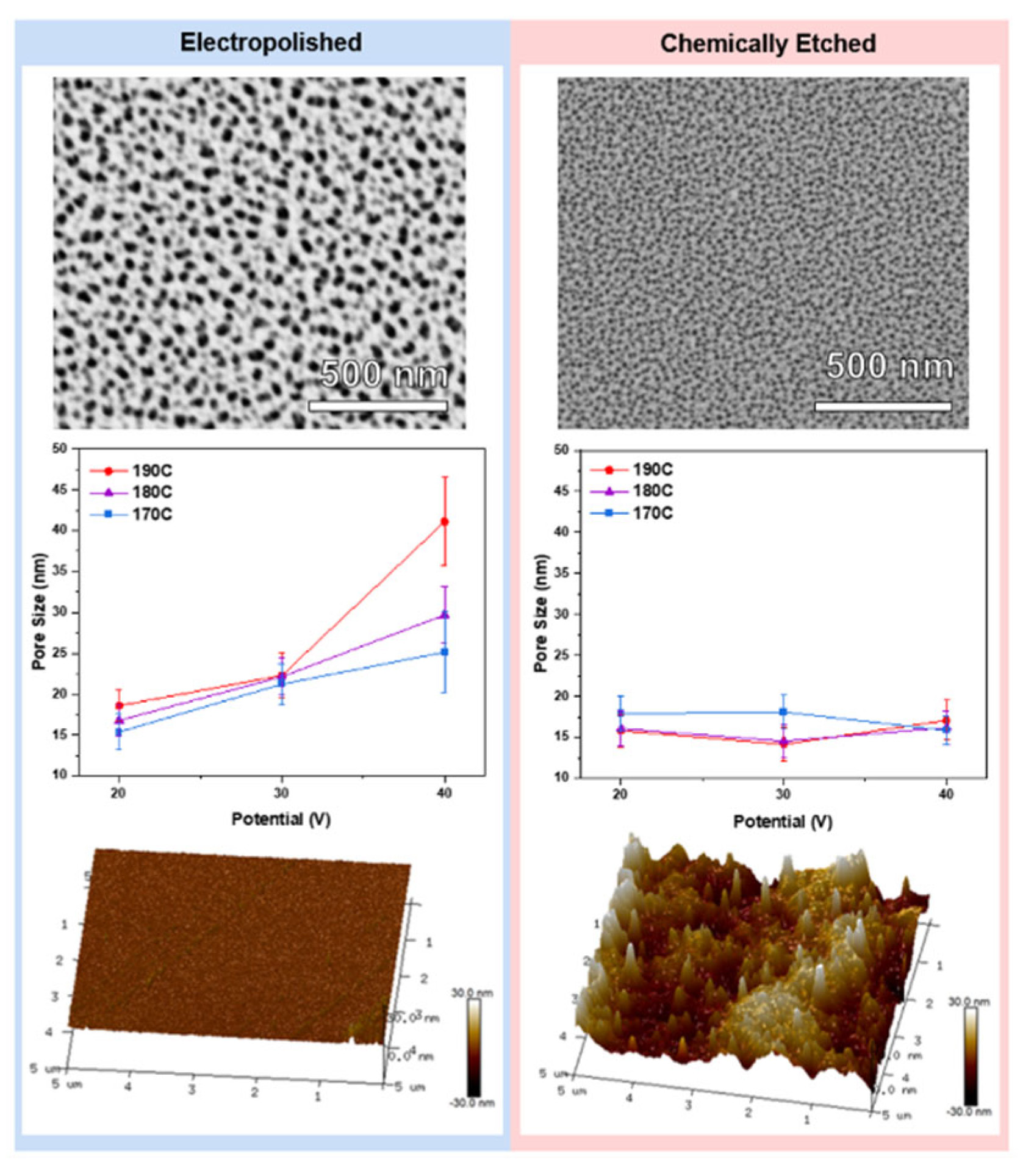
Anodic tantalum oxide films have attracted significant interest due to their highly favorable properties, such as corrosion resistance and biocompatibility, as well as the cost-effective and scalable nature of anodization as a fabrication method. However, the need for morphological control as well as strong adhesion of the resulting films to the substrate pose barriers to their application. In this work, the morphology and adhesion of anodic tantalum oxide films grown on electropolished, chemically etched, and pristine tantalum metal substrates in a fluoride-free electrolyte containing potassium phosphate and glycerol under varying voltage and temperature conditions were systematically investigated. Electropolishing significantly reduced substrate surface roughness and promoted the growth of native suboxide species. Current density-time characteristics during anodization suggest noticeable kinetic effects related to substrate pre-preparation, which were corroborated by significantly increased pore size in oxide films grown on electropolished substrates. Systematic variation in voltage and temperature provided evidence of improved control over size and morphology of the nanoporous anodized oxide films via anodization parameters in electropolished samples. In addition, pull tests demonstrated increased film-substrate adhesion in anodized oxide films on both chemically etched and electropolished substrates. These findings demonstrate that electropolishing is an effective strategy for improving the controllability of nanostructure morphology, film uniformity, and adhesion of anodic tantalum oxide coatings.
- Open Access
- Communication
Effect of Electropolishing on Morphology and Adhesion of Nanostructured Anodic Tantalum Oxide Thin Films
- Sarah E. Pooley 1,
- Cyrus Koroni 1,
- Shinthia Binte Eskender 1,
- Jacob Olson 1,
- Joshua A. Russell 1,
- Max Bork 1,
- Timothy Merrell 1,
- Gage Cook 1,
- Scarlet Fields 1,
- Kaden Kunz 1,
- Kiev Dixon 1,
- Pete Barnes 2,
- Brian Jaques 1,
- Hui Xiong 1,*
Author Information
Received: 17 Jul 2026 | Revised: 13 Aug 2026 | Accepted: 24 Aug 2026 | Published: 03 Sep 2026
Abstract
Graphical Abstract
Keywords
electropolishing | anodization | morphology | adhesion | tantalum oxide
References
- 1.
Momeni, M.M.; Mirhosseini, M.; Chavoshi, M.; Hakimizade, A. The Effect of Anodizing Voltage on Morphology and Photocatalytic Activity of Tantalum Oxide Nanostructure. J. Mater. Sci. Mater. Electron. 2016, 27, 3941–3947. https://doi.org/10.1007/s10854-015-4246-y.
- 2.
Wang, W.; Yin, F.; Niu, H.; Li, Y.; Kim, E.S.; Kim, N.Y. Tantalum Pentoxide (Ta2O5 and Ta2O5-x)-Based Memristor for Photonic in-Memory Computing Application. Nano Energy 2023, 106, 108072. https://doi.org/10.1016/j.nanoen.2022.108072.
- 3.
Li, J.; Jalbert, A.J.; Lee, S.; Simakas, L.S.; Geisler, N.J.; Watkins, V.J.; Cline, L.A.; Fuller, E.J.; Talin, A.A.; Li, Y. Nonvolatile Electrochemical Memory at 600 °C Enabled by Composition Phase Separation. Device 2025, 3, 100623. https://doi.org/10.1016/j.device.2024.100623.
- 4.
Panda, D.; Hui, Y.-F.; Tseng, T.-Y. Diffusion Limiting Layer Induced Tantalum Oxide Based Memristor as Nociceptor. Mater. Today Electron. 2023, 3, 100031. https://doi.org/10.1016/j.mtelec.2023.100031.
- 5.
Talin, A.A.; Li, Y.; Robinson, D.A.; Fuller, E.J.; Kumar, S. ECRAM Materials, Devices, Circuits and Architectures: A Perspective. Adv. Mater. 2023, 35, 2204771. https://doi.org/10.1002/adma.202204771.
- 6.
Fialho, L.; Carvalho, S. Surface Engineering of Nanostructured Ta Surface with Incorporation of Osteoconductive Elements by Anodization. Appl. Surf. Sci. 2019, 495, 143573. https://doi.org/10.1016/j.apsusc.2019.143573.
- 7.
Fialho, L.; Grenho, L.; Fernandes, M.H.; Carvalho, S. Porous Tantalum Oxide with Osteoconductive Elements and Antibacterial Core-Shell Nanoparticles: A New Generation of Materials for Dental Implants. Mater. Sci. Eng. C 2021, 120, 111761. https://doi.org/10.1016/j.msec.2020.111761.
- 8.
Diamanti, M.V.; Pisoni, R.; Cologni, A.; Brenna, A.; Corinto, F.; Pedeferri, M. Anodic Oxidation as a Means to Produce Memristive Films. J. Appl. Biomater. Funct. Mater. 2016, 14, e290–e295. https://doi.org/10.5301/jabfm.5000290.
- 9.
Dang, H.X.; Lin, Y.-M.; Klavetter, K.C.; Cell, T.H.; Heller, A.; Mullins, C.B. Lithium Insertion/Deinsertion Characteristics of Nanostructured Amorphous Tantalum Oxide Thin Films. ChemElectroChem 2014, 1, 158–164. https://doi.org/10.1002/celc.201300139.
- 10.
Gonçalves, R.V.; Migowski, P.; Wender, H.; Eberhardt, D.; Weibel, D.E.; Sonaglio, F.C.; Zapata, M.J.M.; Dupont, J.; Feil, A.F.; Teixeira, S.R. Ta2O5 Nanotubes Obtained by Anodization: Effect of Thermal Treatment on the Photocatalytic Activity for Hydrogen Production. J. Phys. Chem. C 2012, 116, 14022–14030. https://doi.org/10.1021/jp303273q.
- 11.
Su, Z.; Grigorescu, S.; Wang, L.; Lee, K.; Schmuki, P. Fast Fabrication of Ta2O5 Nanotube Arrays and Their Conversion to Ta3N5 for Efficient Solar Driven Water Splitting. Electrochem. Commun. 2015, 50, 15–19. https://doi.org/10.1016/j.elecom.2014.10.017.
- 12.
Han, C.; Wang, T. Tantalum Pentoxide: From Crystal Structures to Applications in Water Splitting. Energy Fuels 2023, 37, 13624–13644. https://doi.org/10.1021/acs.energyfuels.3c02295.
- 13.
Melody, B. The Non-Thickness-Limited Growth of Anodic Oxide Films on Valve Metals. Electrochem. Solid-State Lett. 1999, 1, 126. https://doi.org/10.1149/1.1390659.
- 14.
Zhou, X.; Nguyen, N.T.; Özkan, S.; Schmuki, P. Anodic TiO2 Nanotube Layers: Why Does Self-Organized Growth Occur—A Mini Review. Electrochem. Commun. 2014, 46, 157–162. https://doi.org/10.1016/j.elecom.2014.06.021.
- 15.
Piotrowski, O.; Madore, C.; Landolt, D. Electropolishing of Tantalum in Sulfuric Acid–Methanol Electrolytes. Electrochimica Acta 1999, 44, 3389–3399. https://doi.org/10.1016/S0013-4686(99)00056-0.
- 16.
Barnes, P.; Savva, A.; Dixon, K.; Bull, H.; Rill, L.; Karsann, D.; Croft, S.; Schimpf, J.; Xiong, H. Electropolishing Valve Metals with a Sulfuric Acid-Methanol Electrolyte at Low Temperature. Surf. Coat. Technol. 2018, 347, 150–156. https://doi.org/10.1016/j.surfcoat.2018.04.082.
- 17.
Wu, M.T.; Leu, I.C.; Hon, M.H. Effect of Polishing Pretreatment on the Fabrication of Ordered Nanopore Arrays on Aluminum Foils by Anodization. J. Vac. Sci. Technol. B Microelectron. Nanometer Struct. Process. Meas. Phenom. 2002, 20, 776–782. https://doi.org/10.1116/1.1467657.
- 18.
Rauf, A.; Mehmood, M.; Asim Rasheed, M.; Aslam, M. The Effects of Electropolishing on the Nanochannel Ordering of the Porous Anodic Alumina Prepared in Oxalic Acid. J. Solid State Electrochem. 2009, 13, 321–332. https://doi.org/10.1007/s10008-008-0550-2.
- 19.
Lee, B.G.; Hong, S.-Y.; Yoo, J.E.; Choi, J. Electropolishing for the Formation of Anodic Nanotubular TiO2 with Uniform Length and Density. Appl. Surf. Sci. 2011, 257, 7190–7194. https://doi.org/10.1016/j.apsusc.2011.03.089.
- 20.
Fialho, L.; Almeida Alves, C.F.; Marques, L.S.; Carvalho, S. Development of Stacked Porous Tantalum Oxide Layers by Anodization. Appl. Surf. Sci. 2020, 511, 145542. https://doi.org/10.1016/j.apsusc.2020.145542.
- 21.
Singh, S.; Barden, W.R.T.; Kruse, P. Nanopatterning of Transition Metal Surfaces via Electrochemical Dimple Array Formation. ACS Nano 2008, 2, 2453–2464. https://doi.org/10.1021/nn8003789.
- 22.
Shimizu, K.; Kobayashi, K.; Thompson, G.E.; Skeldon, P.; Wood, G.C. Anodic Oxide Films on Tantalum: Incorporation and Mobilities of Electrolyte-Derived Species. Philos. Mag. B 1996, 73, 461–485. https://doi.org/10.1080/13642819608239129.
- 23.
Mohapatra, B.D.; Sulka, G.D. Review of Anodic Tantalum Oxide Nanostructures: From Morphological Design to Emerging Applications. ACS Appl. Nano Mater. 2024, 7, 13865–13892. https://doi.org/10.1021/acsanm.4c02000.
- 24.
Ngadiman, N.L.S.; Abdul Rani, R.; Makhsin, S.R.; Ayub, M.A.; Aryani, D.; Zoolfakar, A.S. Properties and Application of Electrochemically Anodized Ta2O5 Nanostructures: A Review. J. Mech. Eng. 2022, 11, 1–48. https://doi.org/10.24191/jmeche.v11i1.23580.
- 25.
Horwood, C.A.; El-Sayed, H.A.; Birss, V.I. Precise Electrochemical Prediction of Short Tantalum Oxide Nanotube Length. Electrochimica Acta 2014, 132, 91–97. https://doi.org/10.1016/j.electacta.2014.03.128.
- 26.
Barton, J.E.; Stender, C.L.; Li, P.; Odom, T.W. Structural Control of Anodized Tantalum Oxide Nanotubes. J. Mater. Chem. 2009, 19, 4896–4898. https://doi.org/10.1039/B904964A.
- 27.
El-Sayed, H.A.; Birss, V.I. Controlled Interconversion of Nanoarray of Ta Dimples and High Aspect Ratio Ta Oxide Nanotubes. Nano Lett. 2009, 9, 1350–1355. https://doi.org/10.1021/nl803010v.
- 28.
Singh, S.; Festin, M.; Barden, W.R.T.; Xi, L.; Francis, J.T.; Kruse, P. Universal Method for the Fabrication of Detachable Ultrathin Films of Several Transition Metal Oxides. ACS Nano 2008, 2, 2363–2373
- 29.
Gonçalves, R.V.; Wojcieszak, R.; Uberman, P.M.; Teixeira, S.R.; Rossi, L.M. Insights into the Active Surface Species Formed on Ta2O5 Nanotubes in the Catalytic Oxidation of CO. Phys. Chem. Chem. Phys. 2014, 16, 5755. https://doi.org/10.1039/c3cp54887b.
- 30.
Almeida Alves, C.F.; Calderon, V.S.; Ferreira, P.J.; Marques, L.; Carvalho, S. Passivation and Dissolution Mechanisms in Ordered Anodic Tantalum Oxide Nanostructures. Appl. Surf. Sci. 2020, 513, 145575. https://doi.org/10.1016/j.apsusc.2020.145575.
- 31.
Lee, K.; Schmuki, P. Highly Ordered Nanoporous Ta2O5 Formed by Anodization of Ta at High Temperatures in a Glycerol/Phosphate Electrolyte. Electrochem. Commun. 2011, 13, 542–545. https://doi.org/10.1016/j.elecom.2011.03.005.
- 32.
Uslu, E.; Mimiroglu, D.; Ercan, B. Nanofeature Size and Morphology of Tantalum Oxide Surfaces Control Osteoblast Functions. ACS Appl. Bio Mater. 2021, 4, 780–794. https://doi.org/10.1021/acsabm.0c01354.
- 33.
Sanz, J.M.; Hofmann, S. Auger Electron Spectroscopy and X-Ray Photoelectron Spectroscopy Studies of the Oxidation of Polycrystalline Tantalum and Niobium at Room Temperature and Low Oxygen Pressures. J. Common Met. 1983, 92, 317–327. https://doi.org/10.1016/0022-5088(83)90498-8.
- 34.
NIST X-ray Photoelectron Spectroscopy Database, Version 5.0; NIST X-ray Photoelectron Spectroscopy Database (SRD 20); NIST: Washington, DC, USA, 2023. https://doi.org/10.18434/T4T88K.
- 35.
Chakraborti, P.; Sharma, H.; Pulugurtha, M.R.; Gandhi, S.; Tummala, R.R. Oxide Composition Studies of Electrochemically Grown Tantalum Oxide on Sintered Tantalum Using XPS Depth-Profiling and Co-Relation with Leakage Properties. J. Mater. Sci. Mater. Electron. 2017, 28, 18773–18780. https://doi.org/10.1007/s10854-017-7826-1.
- 36.
Khanuja, M.; Sharma, H.; Mehta, B.R.; Shivaprasad, S.M. XPS Depth-Profile of the Suboxide Distribution at the Native Oxide/Ta Interface. J. Electron Spectrosc. Relat. Phenom. 2009, 169, 41–45. https://doi.org/10.1016/j.elspec.2008.10.004.
- 37.
Díaz, B.; Światowska, J.; Maurice, V.; Seyeux, A.; Härkönen, E.; Ritala, M.; Tervakangas, S.; Kolehmainen, J.; Marcus, P. Tantalum Oxide Nanocoatings Prepared by Atomic Layer and Filtered Cathodic Arc Deposition for Corrosion Protection of Steel: Comparative Surface and Electrochemical Analysis. Electrochimica Acta 2013, 90, 232–245. https://doi.org/10.1016/j.electacta.2012.12.007.
- 38.
Macak, J.M.; Tsuchiya, H.; Ghicov, A.; Yasuda, K.; Hahn, R.; Bauer, S.; Schmuki, P. TiO2 Nanotubes: Self-Organized Electrochemical Formation, Properties and Applications. Curr. Opin. Solid State Mater. Sci. 2007, 11, 3–18. https://doi.org/10.1016/j.cossms.2007.08.004.
- 39.
Mor, G.K.; Varghese, O.K.; Paulose, M.; Shankar, K.; Grimes, C.A. A Review on Highly Ordered, Vertically Oriented TiO2 Nanotube Arrays: Fabrication, Material Properties, and Solar Energy Applications. Sol. Energy Mater. Sol. Cells 2006, 90, 2011–2075. https://doi.org/10.1016/j.solmat.2006.04.007.
- 40.
Ma, J.-W.; Zan, R.; Chen, W.-Z.; Ni, J.-H.; Zhang, X.-N. Cell Behaviors on Surface of Pure Tantalum with Nano-Dimpled Structure. Rare Met. 2019, 38, 543–551. https://doi.org/10.1007/s12598-019-01226-1.
- 41.
Schmuki, P. Self-Organized Oxide Nanotube Layers on Titanium and Other Transition Metals. In Electrochemistry at the Nanoscale; Schmuki, P., Virtanen, S., Eds.; Springer: New York, NY, 2009; pp 435–466. https://doi.org/10.1007/978-0-387-73582-5_12.
- 42.
El-Sayed, H.A.; Molero, H.M.; Birss, V.I. The Impact of Fabrication Conditions on the Quality of Au Nanoparticle Arrays on Dimpled Ta Templates. Nanotechnology 2012, 23, 435602. https://doi.org/10.1088/0957-4484/23/43/435602.
- 43.
Ding, Z.; Tang, Y.; Liu, L.; Ding, Z.; Tan, Y.; He, Q. Improving the Adhesive, Mechanical, Tribological Properties and Corrosion Resistance of Reactive Sputtered Tantalum Oxide Coating on Ti6Al4V Alloy via Introducing Multiple Interlayers. Ceram. Int. 2022, 48, 5983–5994. https://doi.org/10.1016/j.ceramint.2021.11.134.
- 44.
Hogmark, S.; Jacobson, S.; Larsson, M. Design and Evaluation of Tribological Coatings. Wear 2000, 246, 20–33. https://doi.org/10.1016/S0043-1648(00)00505-6.
- 45.
Li, P.; Li, C.; Zhang, Z.; Zhu, X.; Song, Y. Anodic Oxide Films Grown in Dehydrated Phosphate/Glycerol Electrolytes at High Temperatures. Langmuir 2024, 40, 25758–25771. https://doi.org/10.1021/acs.langmuir.4c03777.
- 46.
Tsuji, E.; Matsuura, S.; Aoki, Y.; Habazaki, H. Diffusion-Controlled Growth of TiO2 Mesoporous Anodic Films in Hot Phosphate/Glycerol Electrolytes. Electrochemistry 2018, 86, 184–189. https://doi.org/10.5796/electrochemistry.18-00005.
- 47.
Singh, S.; Greiner, M.T.; Kruse, P. Robust Inorganic Membranes from Detachable Ultrathin Tantalum Oxide Films. Nano Lett. 2007, 7, 2676–2683. https://doi.org/10.1021/nl071061z.
- 48.
ASTM D4541-22; Standard Test Method for Pull-Off Strength of Coatings Using Portable Adhesion Testers. ASTM: West Conshohocken, PA, USA, 2026.
- 49.
Choo, Y.H.; Devereux, O.F. Mechanical Failure of Anodic Films on Aluminum and Tantalum. J. Electrochem. Soc. 1976, 123, 1868. https://doi.org/10.1149/1.2132714.


This work is licensed under a Creative Commons Attribution 4.0 International License.

 Suite 4002 Level 4, 447 Collins Street, Melbourne, Victoria 3000, Australia
 General Inquiries: info@sciltp.com