
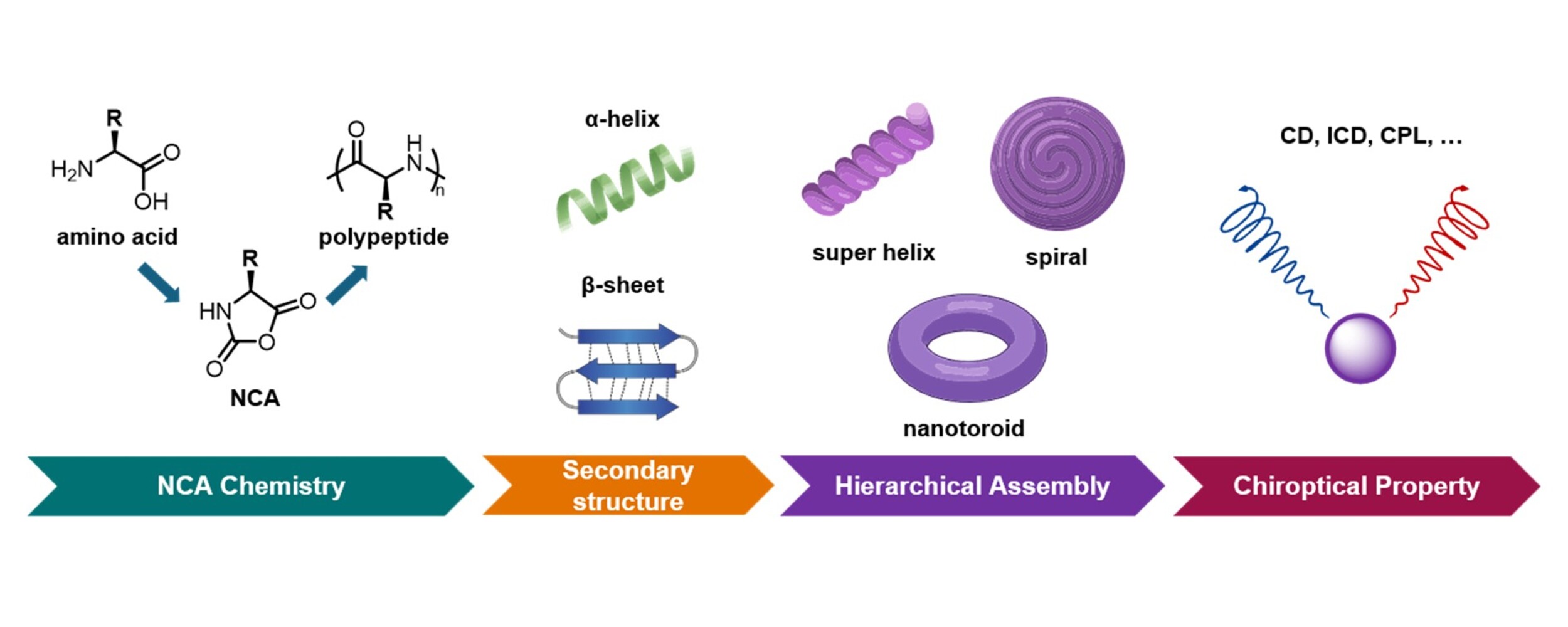
N-carboxyanhydride (NCA)-derived polypeptides are programmable platforms for hierarchical chiral assembly and chiroptical materials. Their controlled stereochemistry, chain length, architecture, and functionality regulate secondary structures such as α-helices and β-sheets, which further guide assembly into nanostructures, liquid-crystalline phases, and bulk ordered materials. This review summarizes how polymer structure and secondary conformation govern chiral assembly, chirality transfer, and chiroptical responses, including circular dichroism, induced circular dichroism, and circularly polarized luminescence. Recent examples of liquid-crystalline polypeptides, homopolypeptide nanotoroids, chromophore co-assemblies, and phosphorescent aggregates are discussed. Challenges and opportunities in structural diversity, performance, and block copolypeptide platforms are also highlighted.
- Open Access
- Review
N-Carboxyanhydride-Derived Polypeptides as Programmable Platforms for Hierarchical Chiral Assembly and Chiroptical Materials
- Shuo Wang,
- Mingyue Zhang,
- Minju Kim,
- Wenxuan Wu,
- Zhiqun Lin *
Author Information
Received: 29 Aug 2026 | Revised: 20 Sep 2026 | Accepted: 22 Sep 2026 | Published: 30 Sep 2026
Abstract
Graphical Abstract
Keywords
NCA polymerization | synthetic polypeptides | chiral assembly | chiroptical materials | chirality transfer | circularly polarized luminescence
References
- 1.
Zhong, H.; Zhao, B.; Deng, J. Polymer‐Based Circularly Polarized Luminescent Materials. Adv. Opt. Mater. 2023, 11, 2202787. https://doi.org/10.1002/adom.202202787.
- 2.
Puneet, P.; Shao, S.W.; Ho, R.M. Induced Circular Dichroism and Circularly Polarized Luminescence for Block Copolymers with Chiral Communications. Macromol. Rapid Commun. 2023, 44, 2200369. https://doi.org/10.1002/marc.202200369.
- 3.
Yang, S.; Zhang, S.; Hu, F.; Han, J.; Li, F. Circularly polarized luminescence polymers: From design to applications. Coord. Chem. Rev. 2023, 485, 215116. https://doi.org/10.1016/j.ccr.2023.215116.
- 4.
Kim, M.; Zhang, M.; Zhu, Y.L.; Yan, Y.; Pu, X.; Choi, W.; Chung, S.; Cho, K.; Kim, J.; Tsukruk, V.; et al. Hierarchical chiral supramolecular assemblies with strong and invertible chiroptical properties. Science 2025, 389, eadu0296. https://doi.org/10.1126/science.adu0296.
- 5.
Zheng, H.; Li, W.; Li, W.; Wang, X.; Tang, Z.; Zhang, S.X.A.; Xu, Y. Uncovering the Circular Polarization Potential of Chiral Photonic Cellulose Films for Photonic Applications. Adv. Mater. 2018, 30, 1705948. https://doi.org/10.1002/adma.201705948.
- 6.
Rasines Mazo, A.; Allison-Logan, S.; Karimi, F.; Chan, N.J.A.; Qiu, W.; Duan, W.; O’Brien-Simpson, N.M.; Qiao, G.G. Ring opening polymerization of α-amino acids: Advances in synthesis, architecture and applications of polypeptides and their hybrids. Chem. Soc. Rev. 2020, 49, 4737–4834. https://doi.org/10.1039/c9cs00738e.
- 7.
Song, Z.; Fu, H.; Wang, R.; Pacheco, L.A.; Wang, X.; Lin, Y.; Cheng, J. Secondary structures in synthetic polypeptides from N-carboxyanhydrides: Design, modulation, association, and material applications. Chem. Soc. Rev. 2018, 47, 7401–7425. https://doi.org/10.1039/c8cs00095f.
- 8.
Bonduelle, C. Secondary structures of synthetic polypeptide polymers. Polym. Chem. 2018, 9, 1517–1529. https://doi.org/10.1039/c7py01725a.
- 9.
Skoulas, D.; Christakopoulos, P.; Stavroulaki, D.; Santorinaios, K.; Athanasiou, V.; Iatrou, H. Micelles Formed by Polypeptide Containing Polymers Synthesized Via N-Carboxy Anhydrides and Their Application for Cancer Treatment. Polymers 2017, 9, 208. https://doi.org/10.3390/polym9060208.
- 10.
Tian, B.; Tao, X.; Ren, T.; Weng, Y.; Lin, X.; Zhang, Y.; Tang, X. Polypeptide-based vesicles: Formation, properties and application for drug delivery. J. Mater. Chem. 2012, 22, 17404–17414. https://doi.org/10.1039/c2jm31806g.
- 11.
Rathore, O.; Sogah, D.Y. Self-Assembly of β-Sheets into Nanostructures by Poly(alanine) Segments Incorporated in Multiblock Copolymers Inspired by Spider Silk. J. Am. Chem. Soc. 2001, 123, 5231–5239. https://doi.org/10.1021/ja004030d.
- 12.
Salas-Ambrosio, P.; Morales-Patlan, E.; Cedillo-Servin, G.; Tronnet, A.; Villavicencio, K.P.; Gómez-Lizárraga, K.; Benítez-Martínez, J.A.; Sanchez-Arevalo, F.M.; Velasquillo, C.; Ceapă, C.D.; et al. Electrospinning Lysine-Polypeptide Copolymers: Creating Microfiber Meshes for Biomedical Applications. ACS Appl. Polym. Mater. 2024, 6, 8733–8744. https://doi.org/10.1021/acsapm.4c00344.
- 13.
Aggeli, A.; Nyrkova, I.A.; Bell, M.; Harding, R.; Carrick, L.; McLeish, T.C.B.; Semenov, A.N.; Boden, N. Hierarchical self-assembly of chiral rod-like molecules as a model for peptide β-sheet tapes, ribbons, fibrils, and fibers. Proc. Natl. Acad. Sci. USA 2001, 98, 11857–11862. https://doi.org/10.1073/pnas.191250198.
- 14.
Guo, Q.; Fang, R.; Lin, J.; Cai, C. Polypeptide Nanotoroids Formed on Substrate via Solvent Evaporation‐Induced Self‐Assembly. Adv. Mater. Interfaces 2025, 12, e00722. https://doi.org/10.1002/admi.202500722.
- 15.
Du, Y.; Li, Y.; Jin, R.; Lin, J.; Cai, C. Triangular Nanotoroids Self‐Assembled from Polypeptide Homopolymers: The Formation Route and Mechanisms. Angew. Chem. Int. Ed. 2025, 64, e202508525. https://doi.org/10.1002/anie.202508525.
- 16.
Gao, W.; Wang, S.; Gao, L.; Lin, J.; Cai, C. Hierarchical Helical Toroids Constructed from One‐pot Controllable Self‐Assembly of Polypeptides. Angew. Chem. Int. Ed. 2026, 65, e24375. https://doi.org/10.1002/anie.202524375.
- 17.
Xu, P.; Gao, L.; Cai, C.; Lin, J.; Wang, L.; Tian, X. Helical Toroids Self‐Assembled from a Binary System of Polypeptide Homopolymer and its Block Copolymer. Angew. Chem. Int. Ed. 2020, 59, 14281–14285. https://doi.org/10.1002/anie.202004102.
- 18.
Ye, Y.; Hu, X.; Yang, D.; Gu, Q.; Liu, S.; Jiang, J.; Liu, G.; Du, J. Aqueously dispersed homopolypeptide nanotoroids with tunable circularly polarized luminescence. Chin. Chem. Lett. 2026, 37, 111844. https://doi.org/10.1016/j.cclet.2025.111844.
- 19.
Jin, R.; Du, Y.; Lin, J.; Cai, C. Homochiral “8”-shaped nanotoroids assembled from polypeptides. Giant 2024, 20, 100343. https://doi.org/10.1016/j.giant.2024.100343.
- 20.
Jin, R.; Liu, J.; Du, Y.; Wang, L.; Lin, J.; Cai, C. Regulating the Topology of Polypeptide Nanotoroids through Solvent-Triggered Nanofiber Twisting. Macromolecules 2026, 59, 7595–7604. https://doi.org/10.1021/acs.macromol.6c00499.
- 21.
Robinson, C. Liquid-crystalline structures in solutions of a polypeptide. Trans. Faraday Soc. 1956, 52, 571–592. https://doi.org/10.1039/tf9565200571.
- 22.
Samulski, E.T.; Tobolsky, A.V. Solid “Liquid Crystal” Films of Poly-γ-benzyl-L-glutamate. Nature 1967, 216, 997. https://doi.org/10.1038/216997a0.
- 23.
Uematsu, I.; Uematsu, Y. Polypeptide liquid crystals. In Liquid Crystal Polymers I; Advances in Polymer Science; Platé, N.A., Ed.; Springer-Verlag: Berlin, Heidelberg, Germany, 1984; vol. 59, pp. 37–73.
- 24.
Lin, J.; Abe, A.; Furuya, H.; Okamoto, S. Liquid Crystal Formation Coupled with the Coil−Helix Transition in the Ternary System Poly(γ-benzyl L-glutamate)/Dichloroacetic Acid/Dichloroethane. Macromolecules 1996, 29, 2584–2589. https://doi.org/10.1021/ma951026r.
- 25.
Chen, Y.; Lu, P.; Yuan, Y.; Zhang, H. Preparation and property manipulation of high efficiency circularly polarized luminescent liquid crystal polypeptides. J. Mater. Chem. C 2020, 8, 13632–13641. https://doi.org/10.1039/d0tc03276j.
- 26.
Song, Z.; Han, Z.; Lv, S.; Chen, C.; Chen, L.; Yin, L.; Cheng, J. Synthetic polypeptides: From polymer design to supramolecular assembly and biomedical application. Chem. Soc. Rev. 2017, 46, 6570–6599. https://doi.org/10.1039/c7cs00460e.
- 27.
Ahn, B.; Kwon, W.; Kim, H.; Ree, M. Cooperative and selective self-assembly behaviors of diblock copolypeptides in nanoscale thin films. Polym. Chem. 2014, 5, 1912–1922. https://doi.org/10.1039/c3py01214j.
- 28.
Ekatan, S.R.; Xue, T.; Song, Z.; Yang, T.; Ndaya, D.; Shaw, M.T.; Cheng, J.; Lin, Y. Thermomechanical Properties of Solid “Liquid Crystalline” Films from Hot-Pressed Synthetic Polypeptides of Various Macromolecular Architectures. Macromolecules 2024, 57, 2008–2018. https://doi.org/10.1021/acs.macromol.3c02005.
- 29.
Cai, C.; Lin, J.; Lu, Y.; Zhang, Q.; Wang, L. Polypeptide self-assemblies: Nanostructures and bioapplications. Chem. Soc. Rev. 2016, 45, 5985–6012. https://doi.org/10.1039/c6cs00013d.
- 30.
Hadjichristidis, N.; Iatrou, H.; Pitsikalis, M.; Sakellariou, G. Synthesis of Well-Defined Polypeptide-Based Materials via the Ring-Opening Polymerization of α-Amino Acid N-Carboxyanhydrides. Chem. Rev. 2009, 109, 5528–5578. https://doi.org/10.1021/cr900049t.
- 31.
Deming, T.J. Synthesis of side-chain modified polypeptides. Chem. Rev. 2016, 116, 786–808. https://doi.org/10.1021/acs.chemrev.5b00292.
- 32.
Song, P.; Lv, J.; Yang, C.; Gu, Q.; Liu, S.; Zhang, Y.; Wang, W.; Zhu, Y.; Du, J. Ring-opening polymerization of N-carboxyanhydrides: An efficient approach toward peptides, peptoids, and functional materials. Prog. Polym. Sci. 2025, 169, 102013. https://doi.org/10.1016/j.progpolymsci.2025.102013.
- 33.
Kricheldorf, H.R. Polypeptides and 100 Years of Chemistry of α‐Amino Acid N‐Carboxyanhydrides. Angew. Chem. Int. Ed. 2006, 45, 5752–5784. https://doi.org/10.1002/anie.200600693.
- 34.
Wu, Y.; Chen, K.; Wang, J.; Chen, M.; Dai, W.; Liu, R. Recent Advances and Future Developments in the Preparation of Polypeptides via N-Carboxyanhydride (NCA) Ring-Opening Polymerization. J. Am. Chem. Soc. 2024, 146, 24189–24208. https://doi.org/10.1021/jacs.4c05382.
- 35.
Lu, H.; Wang, J.; Song, Z.; Yin, L.; Zhang, Y.; Tang, H.; Tu, C.; Lin, Y.; Cheng, J. Recent advances in amino acid N-carboxyanhydrides and synthetic polypeptides: Chemistry, self-assembly and biological applications. Chem. Commun. 2014, 50, 139–155. https://doi.org/10.1039/c3cc46317f.
- 36.
Wang, S.; Lu, H. Unveiling Proton Transfer as the Key Process to Understand and Promote the Ring-Opening Polymerization of N-Carboxyanhydrides. Polym. Sci. Technol. 2025, 1, 76–81. https://doi.org/10.1021/polymscitech.4c00040.
- 37.
Tian, Z.Y.; Zhang, Z.; Wang, S.; Lu, H. A moisture-tolerant route to unprotected α/β-amino acid N-carboxyanhydrides and facile synthesis of hyperbranched polypeptides. Nat. Commun. 2021, 12, 5810. https://doi.org/10.1038/s41467-021-25689-y.
- 38.
Ruggiero, M.T.; Sibik, J.; Orlando, R.; Zeitler, J.A.; Korter, T.M. Measuring the Elasticity of Poly‐l‐Proline Helices with Terahertz Spectroscopy. Angew. Chem. Int. Ed. 2016, 128, 6991–6995. https://doi.org/10.1002/ange.201602268.
- 39.
Tsuji, Y.; Yasunaga, T.; Sano, T.; Ushio, H. Kinetic studies of the helix-coil transition in aqueous solutions of poly(α-L-glutamic acid) using the electric field pulse method. J. Am. Chem. Soc. 1976, 98, 813–818. https://doi.org/10.1021/ja00419a031.
- 40.
Wu, X.; Yang, S.; Njus, J.M.; Nagarajan, R.; Cholli, A.L.; Samuelson, L.A.; Kumar, J. Solvent Specified Conformation in Poly(α-l-glutamic acid) Thin Films. Biomacromolecules 2004, 5, 1214–1218. https://doi.org/10.1021/bm034540a.
- 41.
Tiffany, M.L.; Krimm, S. New chain conformations of poly(glutamic acid) and polylysine. Biopolymers 1968, 6, 1379–1382. https://doi.org/10.1002/bip.1968.360060911.
- 42.
Myer, Y.P. The pH-Induced Helix-Coil Transition of Poly-L-lysine and Poly-L-glutamic Acid and the 238-mμ Dichroic Band. Macromolecules 1969, 2, 624–628. https://doi.org/10.1021/ma60012a012.
- 43.
Bellesia, G.; Shea, J.E. Self-assembly of β-sheet forming peptides into chiral fibrillar aggregates. J. Chem. Phys. 2007, 126, 245104. https://doi.org/10.1063/1.2739547.
- 44.
Fulara, A.; Lakhani, A.; Wójcik, S.; Nieznańska, H.; Keiderling, T.A.; Dzwolak, W. Spiral Superstructures of Amyloid-Like Fibrils of Polyglutamic Acid: An Infrared Absorption and Vibrational Circular Dichroism Study. J. Phys. Chem. B 2011, 115, 11010–11016. https://doi.org/10.1021/jp206271e.
- 45.
Park, S.B.; Sung, M.H.; Uyama, H.; Han, D.K. Poly(glutamic acid): Production, composites, and medical applications of the next-generation biopolymer. Prog. Polym. Sci. 2021, 113, 101341. https://doi.org/10.1016/j.progpolymsci.2020.101341.
- 46.
Carlsen, A.; Lecommandoux, S. Self-assembly of polypeptide-based block copolymer amphiphiles. Curr. Opin. Colloid Interface Sci. 2009, 14, 329–339. https://doi.org/10.1016/j.cocis.2009.04.007.
- 47.
Dongmo Foumthuim, C.J.; Giacometti, A. Solvent quality and solvent polarity in polypeptides. Phys. Chem. Chem. Phys. 2023, 25, 4839–4853. https://doi.org/10.1039/d2cp05214h.
- 48.
Cai, C.; Wang, L.; Lin, J. Self-assembly of polypeptide-based copolymers into diverse aggregates. Chem. Commun. 2011, 47, 11189–11203. https://doi.org/10.1039/c1cc12683k.
- 49.
Chécot, F.; Brûlet, A.; Oberdisse, J.; Gnanou, Y.; Mondain-Monval, O.; Lecommandoux, S. Structure of Polypeptide-Based Diblock Copolymers in Solution: Stimuli-Responsive Vesicles and Micelles. Langmuir 2005, 21, 4308–4315. https://doi.org/10.1021/la0468500.
- 50.
Xu, W.; Ding, J.; Chen, X. Reduction-Responsive Polypeptide Micelles for Intracellular Delivery of Antineoplastic Agent. Biomacromolecules 2017, 18, 3291–3301. https://doi.org/10.1021/acs.biomac.7b00950.
- 51.
Bellomo, E.G.; Wyrsta, M.D.; Pakstis, L.; Pochan, D.J.; Deming, T.J. Stimuli-responsive polypeptide vesicles by conformation-specific assembly. Nat. Mater. 2004, 3, 244–248. https://doi.org/10.1038/nmat1093.
- 52.
Holowka, E.P.; Pochan, D.J.; Deming, T.J. Charged Polypeptide Vesicles with Controllable Diameter. J. Am. Chem. Soc. 2005, 127, 12423–12428. https://doi.org/10.1021/ja053557t.
- 53.
Jiang, J.; Zhang, X.; Fan, Z.; Du, J. Ring-Opening Polymerization of N-Carboxyanhydride-Induced Self-Assembly for Fabricating Biodegradable Polymer Vesicles. ACS Macro Lett. 2019, 8, 1216–1221. https://doi.org/10.1021/acsmacrolett.9b00606.
- 54.
Li, H.; Cornel, E.J.; Fan, Z.; Du, J. Chirality-controlled polymerization-induced self-assembly. Chem. Sci. 2022, 13, 14179–14190. https://doi.org/10.1039/d2sc05695j.
- 55.
Grazon, C.; Salas‐Ambrosio, P.; Ibarboure, E.; Buol, A.; Garanger, E.; Grinstaff, M.W.; Lecommandoux, S.; Bonduelle, C. Aqueous ring‐opening polymerization‐induced self‐assembly (ROPISA) of N‐carboxyanhydrides. Angew. Chem. Int. Ed. 2020, 59, 622–626. https://doi.org/10.1002/anie.201912028.
- 56.
Grazon, C.; Salas-Ambrosio, P.; Antoine, S.; Ibarboure, E.; Sandre, O.; Clulow, A.J.; Boyd, B.J.; Grinstaff, M.W.; Lecommandoux, S.; Bonduelle, C. Aqueous ROPISA of α-amino acid N-carboxyanhydrides: Polypeptide block secondary structure controls nanoparticle shape anisotropy. Polym. Chem. 2021, 12, 6242–6251. https://doi.org/10.1039/d1py00995h.
- 57.
Tinajero-Díaz, E.; Judge, N.; Li, B.; Leigh, T.; Murphy, R.D.; Topham, P.D.; Derry, M.J.; Heise, A. Poly(l-proline)-Stabilized Polypeptide Nanostructures via Ring-Opening Polymerization-Induced Self-Assembly (ROPISA). ACS Macro Lett. 2024, 13, 1031–1036. https://doi.org/10.1021/acsmacrolett.4c00400.
- 58.
Cai, C.; Lin, J.; Chen, T.; Wang, X.S.; Lin, S. Super-helices self-assembled from a binary system of amphiphilic polypeptide block copolymers and polypeptide homopolymers. Chem. Commun. 2009, 45, 2709–2711. https://doi.org/10.1039/b823367e.
- 59.
Cai, C.; Li, Y.; Lin, J.; Wang, L.; Lin, S.; Wang, X.S.; Jiang, T. Simulation-Assisted Self-Assembly of Multicomponent Polymers into Hierarchical Assemblies with Varied Morphologies. Angew. Chem. Int. Ed. 2013, 52, 7732–7736. https://doi.org/10.1002/anie.201210024.
- 60.
Cao, K.; Du, Y.; Lin, J.; Cai, C. Regulating the Chirality of the Superhelices Self-Assembled from Block Copolymer/Homopolymer Binary Systems by the Mixing Ratio of the Polymers. Macromolecules 2024, 57, 6514–6521. https://doi.org/10.1021/acs.macromol.4c00474.
- 61.
Vacogne, C.D.; Wei, C.; Tauer, K.; Schlaad, H. Self-Assembly of α-Helical Polypeptides into Microscopic and Enantiomorphic Spirals. J. Am. Chem. Soc. 2018, 140, 11387–11394. https://doi.org/10.1021/jacs.8b06503.
- 62.
Liu, B.; Fang, R.; Li, W.; Wu, X.; Liu, T.; Lin, M.; Sun, J.; Chen, X. Fast Catalyst-Free Synthesis of Stereoselective Polypeptides via Hierarchical Chiral Assembly. J. Am. Chem. Soc. 2024, 146, 16558–16566. https://doi.org/10.1021/jacs.4c03281.
- 63.
Yang, C.; Gao, L.; Lin, J.; Wang, L.; Cai, C.; Wei, Y.; Li, Z. Toroid Formation through a Supramolecular “Cyclization Reaction” of Rodlike Micelles. Angew. Chem. Int. Ed. 2017, 56, 5546–5550. https://doi.org/10.1002/anie.201701978.
- 64.
Fan, L.; Jiang, J.; Sun, Q.; Hong, K.; Cornel, E.J.; Zhu, Y.; Du, J. Fluorescent homopolypeptide toroids. Polym. Chem. 2022, 13, 1495–1501. https://doi.org/10.1039/d1py01691a.
- 65.
Duke, R.W.; Du Pre, D.B.; Hines, W.A.; Samulski, E.T. Poly(γ-benzyl L-glutamate) helix-coil transition. Pretransition phenomena in the liquid crystal phase. J. Am. Chem. Soc. 1976, 98, 3094–3101. https://doi.org/10.1021/ja00427a006.
- 66.
Miller, W.G.; Wee, E.L. Liquid crystal-isotropic phase equilibriums in the system poly(γ-benzyl α-L-glutamate)-methylformamide. J. Phys. Chem. 1971, 75, 1446–1452. https://doi.org/10.1021/j100680a014.
- 67.
Mori, T. Thermally Induced Cholesteric-to-Nematic-to-Cholesteric Transition of Poly(L-glutamic acid) Liquid Crystals. Polym. J. 1985, 17, 1145–1147. https://doi.org/10.1295/polymj.17.1145.
- 68.
Toriumi, H.; Kusumi, Y.; Uematsu, I.; Uematsu, Y. Thermally Induced Inversion of the Cholesteric Sense in Lyotropic Polypeptide Liquid Crystals. Polym. J. 1979, 11, 863–869. https://doi.org/10.1295/polymj.11.863.
- 69.
Wu, L.; Müller, E.A.; Jackson, G. Understanding and Describing the Liquid-Crystalline States of Polypeptide Solutions: A Coarse-Grained Model of PBLG in DMF. Macromolecules 2014, 47, 1482–1493. https://doi.org/10.1021/ma401230x.
- 70.
Tsuboi, K.; Marcelletti, E.; Matsumoto, H.; Ashizawa, M.; Minagawa, M.; Furuya, H.; Tanioka, A.; Abe, A. Preparation of poly(γ-benzyl-L-glutamate) nanofibers by electrospinning from isotropic and biphasic liquid crystal solutions. Polym. J. 2012, 44, 360–365. https://doi.org/10.1038/pj.2011.137.
- 71.
Mai, Y.; Eisenberg, A. Self-assembly of block copolymers. Chem. Soc. Rev. 2012, 41, 5969–5985. https://doi.org/10.1039/c2cs35115c.
- 72.
Olsen, B.D.; Segalman, R.A. Self-assembly of rod–coil block copolymers. Mater. Sci. Eng. R Rep. 2008, 62, 37–66. https://doi.org/10.1016/j.mser.2008.04.001.
- 73.
Fu, X.; Park, J.M.; Liang, R.; Xue, Y.; Zhong, M. Hierarchically structured materials derived from synthetic polymers: Design and bulk self-assembly strategies. Prog. Polym. Sci. 2025, 170, 102027. https://doi.org/10.1016/j.progpolymsci.2025.102027.
- 74.
Zhou, F.; Ye, T.; Shi, L.; Xie, C.; Chang, S.; Fan, X.; Shen, Z. Synthesis and Self-Assembly of Rod–Rod Block Copolymers with Different Rod Diameters. Macromolecules 2013, 46, 8253–8263. https://doi.org/10.1021/ma4014687.
- 75.
Rubatat, L.; Kong, X.; Jenekhe, S.A.; Ruokolainen, J.; Hojeij, M.; Mezzenga, R. Self-Assembly of Polypeptide/π-Conjugated Polymer/Polypeptide Triblock Copolymers in Rod−Rod−Rod and Coil−Rod−Coil Conformations. Macromolecules 2008, 41, 1846–1852. https://doi.org/10.1021/ma702278a.
- 76.
Ibarboure, E.; Papon, E.; Rodríguez-Hernández, J. Nanostructured thermotropic PBLG–PDMS–PBLG block copolymers. Polymer 2007, 48, 3717–3725. https://doi.org/10.1016/j.polymer.2007.04.046.
- 77.
Ibarboure, E.; Rodríguez-Hernández, J. Supramolecular structures from self-assembled poly(γ-benzyl-l-glutamate)–polydimethylsiloxane–poly(γ-benzyl-l-glutamate) triblock copolypeptides in thin films. Eur. Polym. J. 2010, 46, 891–899. https://doi.org/10.1016/j.eurpolymj.2010.02.006.
- 78.
Bulheller, B.M.; Rodger, A.; Hirst, J.D. Circular and linear dichroism of proteins. Phys. Chem. Chem. Phys. 2007, 9, 2020–2035. https://doi.org/10.1039/b615870f.
- 79.
Tsuchihashi, N.; Nomori, H.; Hatano, M.; Mori, S. Circular Dichroism in Lyotropic Liquid Crystals of Polyglutamate Solutions. Bull. Chem. Soc. Jpn. 1975, 48, 29–32. https://doi.org/10.1246/bcsj.48.29.
- 80.
Keiderling, T.A. Structure of Condensed Phase Peptides: Insights from Vibrational Circular Dichroism and Raman Optical Activity Techniques. Chem. Rev. 2020, 120, 3381–3419. https://doi.org/10.1021/acs.chemrev.9b00636.
- 81.
Singh, R.D.; Keiderling, T.A. Vibrational circular dichroism of poly(γ‐benzyl‐L‐glutamate). Biopolymers 1981, 20, 237–240. https://doi.org/10.1002/bip.1981.360200117.
- 82.
Paterlini, M.G.; Freedman, T.B.; Nafie, L.A. Vibrational circular dichroism spectra of three conformationally distinct states and an unordered state of poly(L‐lysine) in deuterated aqueous solution. Biopolymers 1986, 25, 1751–1765. https://doi.org/10.1002/bip.360250915.
- 83.
Gawroński, J.; Grajewski, J. The Significance of Induced Circular Dichroism. Org. Lett. 2003, 5, 3301–3303. https://doi.org/10.1021/ol0352456.
- 84.
Nomori, H.; Tsuchihashi, N.; Takagi, S.; Hatano, M. Induced Circular Dichroism of Benzyl Chromophores Bound to Helical Polypeptides. Bull. Chem. Soc. Jpn. 1975, 48, 2522–2526. https://doi.org/10.1246/bcsj.48.2522.
- 85.
Goodman, M.; Kossoy, A. Conformational Aspects of Polypeptide Structure. XIX. Azoaromatic Side-Chain Effects. J. Am. Chem. Soc. 1966, 88, 5010–5015. https://doi.org/10.1021/ja00973a042.
- 86.
Sisido, M.; Ishikawa, Y.; Itoh, K.; Tazuke, S. Helically arranged azobenzene chromophores along a polypeptide chain. 1. Synthesis and circular dichroism. Macromolecules 1991, 24, 3993–3998. https://doi.org/10.1021/ma00014a004.
- 87.
Sisido, M.; Ishikawa, Y.; Harada, M.; Itoh, K. Helically arranged azobenzene chromophores along a polypeptide chain. 2. Prediction of conformations and calculation of theoretical circular dichroism. Macromolecules 1991, 24, 3999–4003. https://doi.org/10.1021/ma00014a005.
- 88.
Ueno, A.; Nohara, M.; Toda, F.; Uno, K.; Iwakura, Y. Synthesis of poly‐L‐naphthylalanine and its secondary structure. J. Polym. Sci. Polym. Chem. Ed. 1975, 13, 2751–2762. https://doi.org/10.1002/pol.1975.170131210.
- 89.
Sato, M.; Morikawa, H.; Yoshimoto, M.; Nakahira, T.; Iwaruchi, S. Secondary Structure and Side-Chain Orientation of Poly(L-glutamines) Having Naphthalene Chromophores. Nippon Kagaku Kaishi 1992, 1992, 1368–1373. https://doi.org/10.1246/nikkashi.1992.1368.
- 90.
Shoji, O.; Nakajima, D.; Annaka, M.; Yoshikuni, M.; Nakahira, T. Highly controlled side-chain chromophore orientation in poly[N5-1-(1-pyrenyl)ethyl-l-glutamines]. Polymer 2002, 43, 1711–1714. https://doi.org/10.1016/s0032-3861(01)00740-6.
- 91.
Egusa, S.; Sisido, M.; Imanishi, Y. One-dimensional aromatic crystals in solution. 4. Ground- and excited-state interactions of poly(L-1-pyrenylalanine) studied by chiroptical spectroscopy including circularly polarized fluorescence and fluorescence-detected circular dichroism. Macromolecules 1985, 18, 882–889. https://doi.org/10.1021/ma00147a011.
- 92.
Sisido, M.; Egusa, S.; Imanishi, Y. One-dimensional aromatic crystal in solution. 1. Synthesis, conformation, and spectroscopic properties of poly(L-1-naphthylalanine). J. Am. Chem. Soc. 1983, 105, 1041–1049. https://doi.org/10.1021/ja00342a065.
- 93.
Sisido, M.; Egusa, S.; Okamoto, A.; Imanishi, Y. Circularly polarized fluorescence of aromatic poly(α-amino acids). J. Am. Chem. Soc. 1983, 105, 3351–3352. https://doi.org/10.1021/ja00348a074.
- 94.
Shimizu, T.; Sisido, M.; Imanishi, Y.; Higashimura, T. Local conformations of ends of α‐helical poly[Glu(OBzl)] studied by circular dichroism of terminal chromophores. Biopolymers 1980, 19, 1271–1279. https://doi.org/10.1002/bip.1980.360190703.
- 95.
Stryer, L.; Blout, E.R. Optical Rotatory Dispersion of Dyes Bound to Macromolecules. Cationic Dyes: Polyglutamic Acid Complexes. J. Am. Chem. Soc. 1961, 83, 1411–1418. https://doi.org/10.1021/ja01467a036.
- 96.
Sisido, M.; Akiyama, K.; Imanishi, Y. Poly(α-amino acids) carrying amphiphilic side chains. Synthesis, conformation, hydrophobic binding, and induced circular dichroism. Macromolecules 1984, 17, 1773–1778. https://doi.org/10.1021/ma00139a025.
- 97.
Sisido, M.; Kishi, R. Liquid-crystalline polymer gels. 3. Facile and reversible cholesteric ordering of dye molecules doped in poly(γ-benzyl L-glutamate) gels. Macromolecules 1991, 24, 4110–4114. https://doi.org/10.1021/ma00014a023.
- 98.
Kishi, R.; Sisido, M. Liquid‐crystalline polymer gels, 4. Photocontrol of dye orientation in a polymer gel having a cholesteric liquid‐crystalline order. Makromol. Chem. 1991, 192, 2723–2732. https://doi.org/10.1002/macp.1991.021921117.
- 99.
Sisido, M.; Narisawa, H.; Kishi, R.; Watanabe, J. Induced circular dichroism from cholesteric polypeptide films doped with an azobenzene derivative. Macromolecules 1993, 26, 1424–1428. https://doi.org/10.1021/ma00058a036.
- 100.
Narisawa, H.; Kishi, R.; Sisido, M. Photocontrol of orientation of photochromic dichroic dyes in cholesteric polymer films. Macromol. Chem. Phys. 1995, 196, 1419–1430. https://doi.org/10.1002/macp.1995.021960505.
- 101.
Sang, Y.; Han, J.; Zhao, T.; Duan, P.; Liu, M. Circularly Polarized Luminescence in Nanoassemblies: Generation, Amplification, and Application. Adv. Mater. 2020, 32, 1900110. https://doi.org/10.1002/adma.201900110.
- 102.
Kumar, J.; Nakashima, T.; Kawai, T. Circularly Polarized Luminescence in Chiral Molecules and Supramolecular Assemblies. J. Phys. Chem. Lett. 2015, 6, 3445–3452. https://doi.org/10.1021/acs.jpclett.5b01452.
- 103.
Sisido, M.; Okamoto, A.; Egusa, S.; Imanishi, Y. One-Dimensional Aromatic Crystals in Solution VI. Synthesis and Spectroscopic Characterization of Poly(β-9-anthrylmethyl L-aspartate). Polym. J. 1985, 17, 1253–1261. https://doi.org/10.1295/polymj.17.1253.
- 104.
Jiang, J.; Ma, F.; Dong, R.; Zhang, S.; Zhang, Z.; Tan, H.; Cai, X.; Qiu, Z.; Xiong, Y.; Han, W.; et al. Aqueous Circularly Polarized Luminescence Induced by Homopolypeptide Self-Assembly. J. Am. Chem. Soc. 2023, 145, 27282–27294. https://doi.org/10.1021/jacs.3c06769.
- 105.
Jiang, J.; Ye, Z.; Zhang, S.; Ma, F.; Lu, L.; Qiu, Z.; Sun, J.; Xiong, Y.; Zhao, Z.; Lam, J.W.Y.; et al. α‐Helix‐Driven Regulation of Aqueous Circularly Polarized Luminescence in Homopolypeptide Self‐Assembly. Aggregate 2025, 6, e70123. https://doi.org/10.1002/agt2.70123.
- 106.
Jiang, J.; Pan, Y.; Zhao, J.; Zhang, S.; Ma, F.; Zhang, Z.; Liu, M.; Qiu, Z.; Zhao, Z.; Sun, J.; et al. Poly(vinyl alcohol) induced chirality inversion and amplification of circularly polarized room-temperature phosphorescence in homopolypeptide aggregates. Nat. Commun. 2026, 17, 2915. https://doi.org/10.1038/s41467-026-69707-3.
- 107.
Krupová, M.; Kapitán, J.; Bouř, P. Induced Lanthanide Circularly Polarized Luminescence as a Probe of Protein Fibrils. ACS Omega 2019, 4, 1265–1271. https://doi.org/10.1021/acsomega.8b03175.
- 108.
Yoshida, K.; Kuwahara, Y.; Hano, N.; Horie, Y.; Takafuji, M.; Ryu, N.; Nagaoka, S.; Oda, R.; Ihara, H. Chiral H‐aggregation‐induced large Stokes shift with CPL generation assisted by α‐helical poly(L‐lysine) substructure. Chirality 2023, 35, 411–417. https://doi.org/10.1002/chir.23553.
- 109.
Liao, P.; Zang, S.; Wu, T.; Jin, H.; Wang, W.; Huang, J.; Tang, B.Z.; Yan, Y. Generating circularly polarized luminescence from clusterization‐triggered emission using solid phase molecular self-assembly. Nat. Commun. 2021, 12, 5496. https://doi.org/10.1038/s41467-021-25789-9.
- 110.
Li, D.; Jiang, Z.; Liu, X.; Cheng, Y. Recent Advances in Application of Circularly Polarized Luminescence Probes toward Bioimaging Technology. Chem. Biomed. Imaging 2026, 4, 144–166. https://doi.org/10.1021/cbmi.5c00091.
- 111.
Dai, Y.; Chen, J.; Zhao, C.; Feng, L.; Qu, X. Biomolecule-Based Circularly Polarized Luminescent Materials: Construction, Progress, and Applications. Angew. Chem. Int. Ed. 2022, 61, e202211822. https://doi.org/10.1002/anie.202211822.
- 112.
Stachelek, P.; MacKenzie, L.; Parker, D.; Pal, R. Circularly polarised luminescence laser scanning confocal microscopy to study live cell chiral molecular interactions. Nat. Commun. 2022, 13, 553. https://doi.org/10.1038/s41467-022-28220-z.
- 113.
Chen, P.; Fan, H.; Du, S.; Wen, X.; Zhang, L.; Liu, M. Supramolecular chiroptical sensing of chiral species based on circularly polarized luminescence. Soft Matter 2024, 20, 8937–8946. https://doi.org/10.1039/d4sm00960f.
- 114.
Jhun, B.H.; Park, S.Y.; You, Y. Molecular sensors producing circularly polarized luminescence responses. Dyes Pigm. 2023, 208, 110786. https://doi.org/10.1016/j.dyepig.2022.110786.
- 115.
Bai, W.; Shin, J.; Fu, R.; Kandela, I.; Lu, D.; Ni, X.; Park, Y.; Liu, Z.; Hang, T.; Wu, D.; et al. Bioresorbable photonic devices for the spectroscopic characterization of physiological status and neural activity. Nat. Biomed. Eng. 2019, 3, 644–654. https://doi.org/10.1038/s41551-019-0435-y.

This work is licensed under a Creative Commons Attribution 4.0 International License.
