
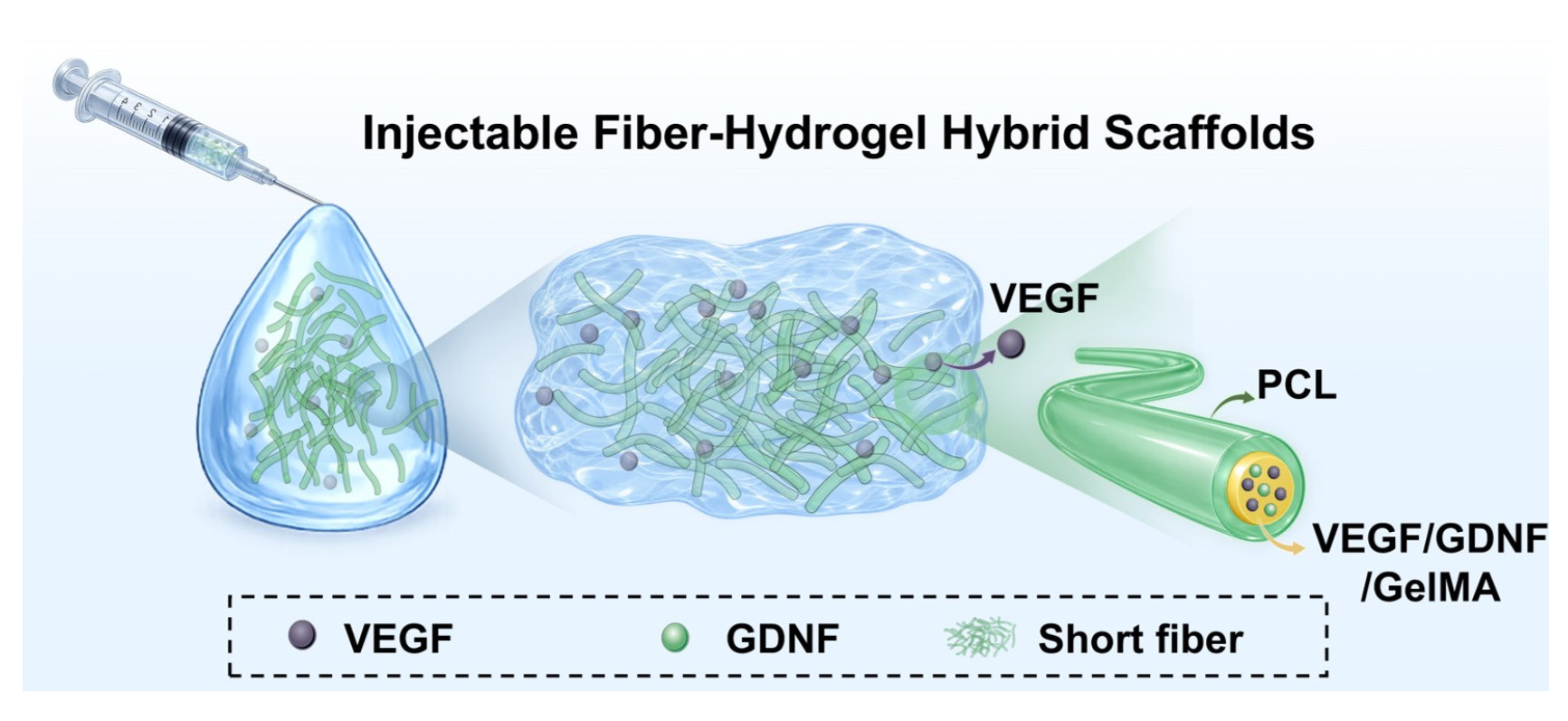
Ischemic stroke is a leading cause of mortality and long-term disability worldwide and is characterized by neuronal loss, vascular impairment, and limited endogenous repair. Recovery after ischemic injury requires coordinated vascular and neural responses. However, the unfavorable post-stroke microenvironment, rapid loss of trophic factors, and poor retention of therapeutic proteins remain major barriers to tissue regeneration. Here, we developed an injectable hierarchical fiber-hydrogel hybrid scaffold for localized delivery of angiogenic and neurotrophic factors. Core-shell gelatin methacryloyl/polycaprolactone (GelMA/PCL) electrospun nanofibers were fabricated by coaxial electrospinning, in which vascular endothelial growth factor (VEGF) and glial cell line-derived neurotrophic factor (GDNF) were encapsulated within the GelMA core, while PCL served as the outer shell. The growth factor-loaded nanofibers were then processed into short fibers and incorporated into a VEGF-containing hydrogel matrix composed of thiol-modified hyaluronic acid/heparin and gelatin. The resulting hybrid scaffold combined an injectable hydrogel network with embedded fibrous components and provided localized release of VEGF and GDNF. In vitro studies showed that the hybrid scaffold promoted endothelial cell migration, supported endothelial cell growth, and maintained angiogenic activity under oxygen-glucose deprivation (OGD) conditions. In addition, the scaffold enhanced SH-SY5Y cell growth and supported PC12 neurite outgrowth. By integrating hydrogel-based injectable support, and localized trophic factor delivery, this scaffold provides a biomaterial platform for modulating vascular and neuronal cell responses under ischemia-mimicking conditions, which is promising for recovery after ischemic injury.
- Open Access
- Article
Injectable Fiber-Hydrogel Hybrid Scaffolds for Localized Growth Factor Delivery and Modulation of Vascular and Neuronal Cell Responses
- Li Ruan 1,
- Kaiqin Mo 1,
- Wenzhe Du 1,
- Kang Huo 2,
- Jianfeng Han 2,
- Jichuan Qiu 3,
- Feng Tian 1,*,
- Jiajia Xue 1,*
Author Information
Received: 03 Jul 2026 | Revised: 23 Sep 2026 | Accepted: 28 Sep 2026 | Published: 30 Sep 2026
Abstract
Graphical Abstract
Keywords
Ischemic stroke | trophic factors | localized release | core-shell short nanofibers | hybrid scaffold
References
- 1.
Campbell, B.C.V.; De Silva, D.A.; Macleod, M.R.; Coutts, S.B.; Schwamm, L.H.; Davis, S.M.; Donnan, G.A. Ischaemic stroke. Nat. Rev. Dis. Primers 2019, 5, 70. https://doi.org/10.1038/s41572-019-0118-8.
- 2.
Tuo, Q.Z.; Zhang, S.T.; Lei, P. Mechanisms of neuronal cell death in ischemic stroke and their therapeutic implications. Med. Res. Rev. 2022, 42, 259–305. https://doi.org/10.1002/med.21817.
- 3.
Candelario-Jalil, E.; Dijkhuizen, R.M.; Magnus, T. Neuroinflammation, Stroke, Blood-Brain Barrier Dysfunction, and Imaging Modalities. Stroke 2022, 53, 1473–1486. https://doi.org/10.1161/strokeaha.122.036946.
- 4.
Guan, X.; Zhu, S.; Song, J.; Liu, K.; Liu, M.; Xie, L.; Wang, Y.; Wu, J.; Xu, X.; Pang, T. Microglial CMPK2 promotes neuroinflammation and brain injury after ischemic stroke. Cell Rep. Med. 2024, 5, 101522. https://doi.org/10.1016/j.xcrm.2024.101522.
- 5.
Xu, A.; Zhang, H.; Zhang, Y.; Wu, J.; Huang, Z. Ischemic stroke and intervention strategies based on the timeline of stroke progression: Review and prospects. Acta Pharm. Sin. B 2025, 15, 4543–4581. https://doi.org/10.1016/j.apsb.2025.07.026.
- 6.
Günkan, A.; Ferreira, M.Y.; Vilardo, M.; Scarcia, L.; Bocanegra-Becerra, J.E.; Cardoso, L.J.C.; Fabrini Paleare, L.F.; de Oliveira Almeida, G.; Semione, G.; Ferreira, C.; et al. Thrombolysis for Ischemic Stroke Beyond the 4.5-Hour Window: A Meta-Analysis of Randomized Clinical Trials. Stroke 2025, 56, 580–590. https://doi.org/10.1161/strokeaha.124.048536.
- 7.
Kanazawa, M.; Hatakeyama, M.; Ninomiya, I. Angiogenesis and neuronal remodeling after ischemic stroke. Neural Regen. Res. 2020, 15, 16–19. https://doi.org/10.4103/1673-5374.264442.
- 8.
Ohab, J.J.; Fleming, S.; Blesch, A.; Carmichael, S.T. A Neurovascular Niche for Neurogenesis after Stroke. J. Neurosci. 2006, 26, 13007–13016. https://doi.org/10.1523/jneurosci.4323-06.2006.
- 9.
Pérez-Gutiérrez, L.; Ferrara, N. Biology and therapeutic targeting of vascular endothelial growth factor A. Nat. Rev. Mol. Cell Biol. 2023, 24, 816–834. https://doi.org/10.1038/s41580-023-00631-w.
- 10.
Lee, C.; Kim, M.J.; Kumar, A.; Lee, H.W.; Yang, Y.; Kim, Y. Vascular endothelial growth factor signaling in health and disease: From molecular mechanisms to therapeutic perspectives. Signal Transduct. Target. Ther. 2025, 10, 170. https://doi.org/10.1038/s41392-025-02249-0.
- 11.
Shahriar, S.; Biswas, S.; Zhao, K.; Akcan, U.; Tuohy, M.C.; Glendinning, M.D.; Kurt, A.; Wayne, C.R.; Prochilo, G.; Price, M.Z.; et al. VEGF-A-mediated venous endothelial cell proliferation results in neoangiogenesis during neuroinflammation. Nat. Neurosci. 2024, 27, 1904–1917. https://doi.org/10.1038/s41593-024-01746-9.
- 12.
Houghton, F.M.; Adams, S.E.; Ríos, A.S.; Masino, L.; Purkiss, A.G.; Briggs, D.C.; Ledda, F.; McDonald, N.Q. Architecture and regulation of a GDNF-GFRα1 synaptic adhesion assembly. Nat. Commun. 2023, 14, 7551. https://doi.org/10.1038/s41467-023-43148-8.
- 13.
Yan, Q.; Matheson, C.; Lopez, O.T. In vivo neurotrophic effects of GDNF on neonatal and adult facial motor neurons. Nature 1995, 373, 341–344. https://doi.org/10.1038/373341a0.
- 14.
Zhang, X.; Gong, B.; Rao, F.; Hu, H.; Tian, F.; Lu, Y.; Zhang, L.; Xia, Y.; Xue, J. Spatiotemporally controlled delivery of biological effectors from nanofiber scaffolds accelerates skin wound healing in porcine models. Sci. Adv. 2025, 11, eadz5302. https://doi.org/10.1126/sciadv.adz5302.
- 15.
Liu, J.; Yao, Z.; Hu, Z.; Zhang, X.; Gong, B.; Dai, Y.; Weng, H.; Xiao, L.; Zhang, B.; Li, T.; et al. Spatiotemporal Delivery of Required Facilitators for Microenvironment Remodeling Propels Neural Regeneration after Spinal Cord Injury. Adv. Mater. 2026, 38, e03479. https://doi.org/10.1002/adma.202503479.
- 16.
Cheah, E.; Wu, Z.; Thakur, S.S.; O’Carroll, S.J.; Svirskis, D. Externally triggered release of growth factors—A tissue regeneration approach. J. Control. Release 2021, 332, 74–95. https://doi.org/10.1016/j.jconrel.2021.02.015.
- 17.
He, S.N.; Liu, S.N.; Zhang, T.T.; Shi, L.Q.; Ma, R.J. The research progress on dynamic covalent bonding-based nanocarriers for protein drug delivery. Acta Polym. Sin. 2025, 56, 1293–1312. (In Chinese)
- 18.
Meng, R.; Lin, Y.T.; Yao, W.Q.; Zhang, S.M.; Chen, W.H.; Zhang, X.Z. Research on smart peptides for drug targeted delivery and immune activation. Acta Polym. Sin. 2025, 56, 1333–1344. (In Chinese)
- 19.
Vermonden, T.; Censi, R.; Hennink, W.E. Hydrogels for Protein Delivery. Chem. Rev. 2012, 112, 2853–2888. https://doi.org/10.1021/cr200157d.
- 20.
Li, J.; Weber, E.; Guth-Gundel, S.; Schuleit, M.; Kuttler, A.; Halleux, C.; Accart, N.; Doelemeyer, A.; Basler, A.; Tigani, B.; et al. Tough Composite Hydrogels with High Loading and Local Release of Biological Drugs. Adv. Healthc. Mater. 2018, 7, 1701393. https://doi.org/10.1002/adhm.201701393.
- 21.
Hong, L.T.A.; Kim, Y.M.; Park, H.H.; Hwang, D.H.; Cui, Y.; Lee, E.M.; Yahn, S.; Lee, J.K.; Song, S.C.; Kim, B.G. An injectable hydrogel enhances tissue repair after spinal cord injury by promoting extracellular matrix remodeling. Nat. Commun. 2017, 8, 533. https://doi.org/10.1038/s41467-017-00583-8.
- 22.
Ma, X.; Gao, F.; Su, W.; Ran, Y.; Bilalijiang, T.; Tuolhen, Y.; Tian, G.; Ye, L.; Feng, Z.; Xi, J.; et al. Multifunctional injectable hydrogel promotes functional recovery after stroke by modulating microglial polarization, angiogenesis and neuroplasticity. Chem. Eng. J. 2023, 464, 142520. https://doi.org/10.1016/j.cej.2023.142520.
- 23.
Fu, X.; Wang, J.; Qian, D.; Chen, Z.; Chen, L.; Cui, W.; Wang, Y. Living Electrospun Short Fibrous Sponge via Engineered Nanofat for Wound Healing. Adv. Fiber Mater. 2023, 5, 979–993. https://doi.org/10.1007/s42765-022-00229-5.
- 24.
Wan, X.; Zhao, Y.; Li, Z.; Li, L. Emerging polymeric electrospun fibers: From structural diversity to application in flexible bioelectronics and tissue engineering. Exploration 2022, 2, 20210029. https://doi.org/10.1002/exp.20210029.
- 25.
Shahriar, S.M.S.; Mondal, B.; Andrabi, S.M.; Xie, J. Polymer Microfibers: Fabrication, Structural Design, Functionalization, and Biomedical Applications. Mater. Interfaces 2026, 3, 85–137. https://doi.org/10.53941/mi.2026.100009.
- 26.
Zhang, X.; Guo, W.; Zhang, J.; Xiong, F.; Yao, Z.; Lin, J.; Hu, S.; Liu, Q.; Tian, F.; Zhao, N.; et al. Nanofibrous Guidance Conduits with Multiple Gradient Cues for Spinal Cord Repair. Adv. Mater. 2025, 37, 2503892. https://doi.org/10.1002/adma.202503892.
- 27.
Gong, B.; Jin, B.; Qin, J.; Sun, Y.; Du, W.; Zhou, X.; Jiang, X.; Liu, W.; Tian, F.; Zhang, L.; et al. Synergistic Integration of Immune Regulation and Bioactive Guidance Cues in Multi-Channel Nanofibrous Nerve Guidance Conduits for Accelerated Peripheral Nerve Regeneration. Adv. Fiber Mater. 2025, 7, 1244–1259. https://doi.org/10.1007/s42765-025-00556-3.
- 28.
Li, L.; Tian, F.; Li, Z.; Xu, M.L.; Fang, L.; Zhang, X.; Ruan, L.; Zhang, T.; Song, J.; Hu, X.; et al. Harnessing exogenous stimuli and functionally 3D aligned fibrous scaffolds for spatiotemporal modulation of bone regeneration. Cell Press Blue 2026, 1, 100006. https://doi.org/10.1016/j.cpblue.2026.100006.
- 29.
Rahmati, M.; Mills, D.K.; Urbanska, A.M.; Saeb, M.R.; Venugopal, J.R.; Ramakrishna, S.; Mozafari, M. Electrospinning for tissue engineering applications. Prog. Mater. Sci. 2021, 117, 100721. https://doi.org/10.1016/j.pmatsci.2020.100721.
- 30.
Chen, J.; Zhang, G.; Zhao, Y.; Zhou, M.; Zhong, A.; Sun, J. Promotion of skin regeneration through co-axial electrospun fibers loaded with basic fibroblast growth factor. Adv. Compos. Hybrid Mater. 2022, 5, 1111–1125. https://doi.org/10.1007/s42114-022-00439-w.
- 31.
Cheng, X.; Xu, N.; Wu, H.; Pan, X.; Zhao, Y.; Chen, X.; Su, Y.; Wei, Y.; Jiang, Q.; Fan, J.; et al. A Coordinated Cascade Therapy-Based Janus Fibrous Membrane Drives Bone Regeneration through Mediating the Transformation of Energy Metabolism Pathway. Adv. Funct. Mater. 2025, 35, 2423212. https://doi.org/10.1002/adfm.202423212.
- 32.
Yang, Q.; Li, J.; Meng, H.; Wang, Y.; Hu, L.; Su, W.; Xu, J.; Hou, J.; Zhao, R.; Wang, Z.; et al. Coaxial Electrospun Nanofibrous Membranes as Dual-Functional Biomimetic Tendon Sheath for Tendon Repair and Anti-Peritendinous Adhesion. Adv. Healthc. Mater. 2025, 14, 2402074. https://doi.org/10.1002/adhm.202402074.
- 33.
Jian, D.; Ye, K.; Wang, L.; Jin, L.; Yang, H.; Ma, L.; Yi, C.; Mao, Z.; Wu, J. Enhance efferocytosis capacity of dendritic cells for diabetic wound healing by nanozyme-loaded nanofiber dressings. Nano Today 2025, 64, 102787. https://doi.org/10.1016/j.nantod.2025.102787.
- 34.
Cheng, G.; Yin, C.; Tu, H.; Jiang, S.; Wang, Q.; Zhou, X.; Xing, X.; Xie, C.; Shi, X.; Du, Y.; et al. Controlled Co-delivery of Growth Factors through Layer-by-Layer Assembly of Core–Shell Nanofibers for Improving Bone Regeneration. ACS Nano 2019, 13, 6372–6382. https://doi.org/10.1021/acsnano.8b06032.
- 35.
Tang, Y.; Wang, J.; Cai, Z.; Sarmento, B.; Du, Y.; Cui, W. Intestine-Settled Electrospun Short-Fibers Modulate Epithelial Transport Proteins to Reduce Purine and Glucose Uptake. Adv. Fiber Mater. 2025, 7, 186–203. https://doi.org/10.1007/s42765-024-00475-9.
- 36.
Wang, H.; Zhang, Y.; Zhang, Y.; Li, C.; Zhang, M.; Wang, J.; Zhang, Y.; Du, Y.; Cui, W.; Chen, W. Activating Macrophage Continual Efferocytosis via Microenvironment Biomimetic Short Fibers for Reversing Inflammation in Bone Repair. Adv. Mater. 2024, 36, 2402968. https://doi.org/10.1002/adma.202402968.
- 37.
Vinikoor, T.; Dzidotor, G.K.; Le, T.T.; Liu, Y.; Kan, H.-M.; Barui, S.; Chorsi, M.T.; Curry, E.J.; Reinhardt, E.; Wang, H.; et al. Injectable and Biodegradable Piezoelectric Hydrogel for Osteoarthritis Treatment. Nat. Commun. 2023, 14, 6257. https://doi.org/10.1038/s41467-023-41594-y.
- 38.
Zhuo, H.; Dong, X.; Liu, Q.; Hong, L.; Zhang, Z.; Long, S.; Zhai, W. Bamboo-inspired ultra-strong nanofiber-reinforced composite hydrogels. Nat. Commun. 2025, 16, 980. https://doi.org/10.1038/s41467-025-56340-9.
- 39.
Han, Z.; Bao, L.; Yu, Y.; Zhao, Y.; Wang, M.; Sun, Y.; Fu, M.; Zhou, Q.; Liu, W.; Cui, W.; et al. Injectable short-fiber hydrogel with fatigue resistance and antibacterial properties for synergistic periodontitis therapy. Chem. Eng. J. 2025, 520, 166298. https://doi.org/10.1016/j.cej.2025.166298.
- 40.
Wang, Q.; Yang, J.; Meng, J.; Yu, J.; Li, X.; Ding, B. Bioinspired hierarchical fiber-hydrogel dressing with dual immunomodulatory and angiogenic functions for diabetic wound healing. J. Control. Release 2025, 386, 114063. https://doi.org/10.1016/j.jconrel.2025.114063.
- 41.
Hu, Y.; Yu, B.; Jia, Y.; Lei, M.; Li, Z.; Liu, H.; Huang, H.; Xu, F.; Li, J.; Wei, Z. Hyaluronate- and gelatin-based hydrogels encapsulating doxycycline as a wound dressing for burn injury therapy. Acta Biomater. 2023, 164, 151–158. https://doi.org/10.1016/j.actbio.2023.04.021.
- 42.
Xu, K.L.; Di Caprio, N.; Fallahi, H.; Dehghany, M.; Davidson, M.D.; Laforest, L.; Cheung, B.C.H.; Zhang, Y.; Wu, M.; Shenoy, V.; et al. Microinterfaces in biopolymer-based bicontinuous hydrogels guide rapid 3D cell migration. Nat. Commun. 2024, 15, 2766. https://doi.org/10.1038/s41467-024-46774-y.
- 43.
Wang, M.; Li, W.; Hao, J.; Gonzales, A.; Zhao, Z.; Flores, R.S.; Kuang, X.; Mu, X.; Ching, T.; Tang, G.; et al. Molecularly cleavable bioinks facilitate high-performance digital light processing-based bioprinting of functional volumetric soft tissues. Nat. Commun. 2022, 13, 3317. https://doi.org/10.1038/s41467-022-31002-2.


This work is licensed under a Creative Commons Attribution 4.0 International License.
