
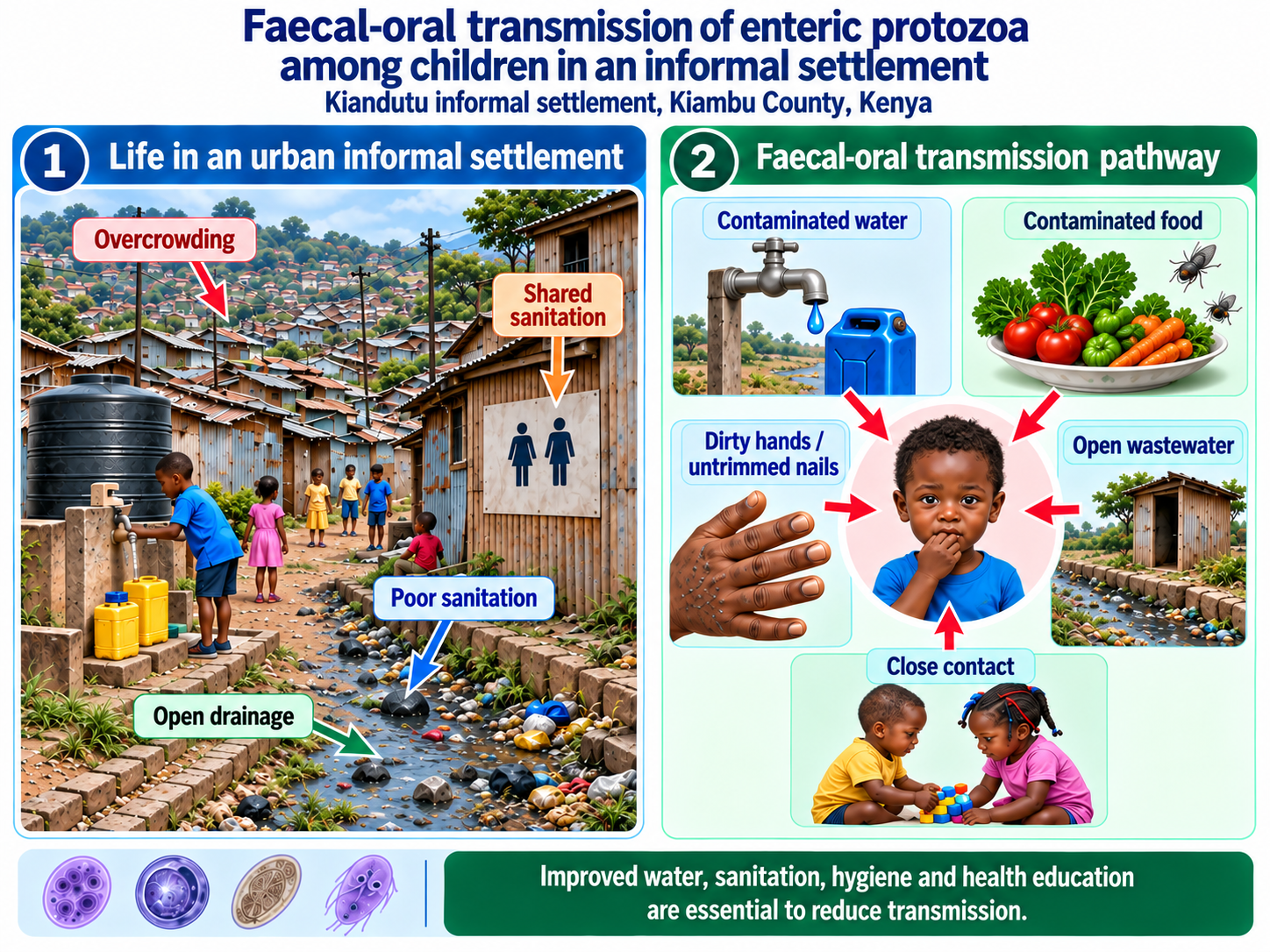
Enteric parasitic infections continue to contribute substantially to childhood morbidity and nutritional problems in Kenya, yet limited information is available on their prevalence and associated risk factors among children living in urban informal settlements. This cross-sectional study assessed the prevalence and risk factors of enteric parasitic infections among children aged 10 years and below in Kiambu County, Kenya. Participants comprised 550 children recruited from Kiandutu Health Centre and Thika Level 5 Hospital. Stool samples underwent direct microscopic examination, formal-ether concentration, and Modified Ziehl-Neelsen staining. Demographic and risk-factor data were collected using structured questionnaires and analyzed in STATA version 14.0 (p ≤ 0.05). The overall prevalence of enteric parasitic infections was 36.7%, and it was significantly higher at Kiandutu Health Centre compared to Thika Level 5 Hospital. Protozoan infections (34.2%) were more common than helminth infections (5.3%). Protozoa detected included Entamoeba histolytica/E. dispar/E. moshkovskii complex, Giardia lamblia, Entamoeba coli, Blastocystis species, Iodamoeba buetschlii, Cryptosporidium species, and Chilomastix mesnili. Helminths identified were Hymenolepis nana, Trichuris trichiura, and Ascaris lumbricoides. Overall enteric parasitic infection was associated with older age (72–131 months: AOR = 2.73, 95% CI: 1.50–4.98, p = 0.001), lower parental income (AOR = 1.24, 95% CI: 1.08–1.43, p = 0.002), lowest income level ≤ Kshs. 5000 (AOR = 3.20, 95% CI: 1.61–6.39, p = 0.001), and untrimmed fingernails (AOR = 1.89, 95% CI: 1.31–2.73, p = 0.001). These findings highlight the need for targeted water, sanitation, hygiene, and health education interventions to reduce enteric parasite transmission among vulnerable Kenyan children.
- Open Access
- Article
Enteric Parasitic Infections and Associated Risk Factors among Symptomatic Children Attending Two Outpatient Health Facilities in Kiambu County, Kenya
- Liza Kiende Mwirigi 1,*,
- Margaret Muturi 1,
- Scholastica Mathenge 1,
- Michael Muraya Mugo 2,
- Tabitha Irungu 2,
- Benjamin Ngugi 2,
- Erastus Mulinge 2,
- Cecilia Mbae 2,*
Author Information
Received: 14 May 2026 | Revised: 16 Aug 2026 | Accepted: 09 Sep 2026 | Published: 16 Sep 2026
Abstract
Graphical Abstract
Keywords
enteric parasites | protozoa | helminths | children | Kiambu county | Kenya
References
- 1.
Kotloff, K.L.; Nataro, J.P.; Blackwelder, W.C.; et al. Burden and aetiology of diarrhoeal disease in infants and young children in developing countries (the Global Enteric Multicenter Study, GEMS): A prospective, case-control study. Lancet 2013, 382, 209–222. https://doi.org/10.1016/s0140-6736(13)60844-2.
- 2.
WHO. Soil-Transmitted Helminth Infections, in Fact Sheet; World Health Organization: Geneva, Switzerland, 2023.
- 3.
Pullan, R.L.; Brooker, S.J. The global limits and population at risk of soil-transmitted helminth infections in 2010. Parasites Vectors 2012, 5, 81. https://doi.org/10.1186/1756-3305-5-81.
- 4.
CDC. Global Diarrhea Burden; Centers for Disease Control and Prevention: Atlanta, GA, USA 2020
- 5.
Fletcher, S.M.; Stark, D.; Harkness, J.; et al. Enteric protozoa in the developed world: A public health perspective. Clin. Microbiol. Rev. 2012, 25, 420–449. https://doi.org/10.1128/cmr.05038-11.
- 6.
Ryan, U.; Paparini, A.; Oskam, C. New technologies for detection of enteric parasites. Trends Parasitol. 2017, 33, 532–546. https://doi.org/10.1016/j.pt.2017.03.005.
- 7.
Hotez, P.J.; Brindley, P.J.; Bethony, J.M.; et al. Helminth infections: The great neglected tropical diseases. J. Clin. Investig. 2008, 118, 1311–1321. https://doi.org/10.1172/jci34261.
- 8.
Thompson, R. Foodborne, enteric, non apicomplexan unicellular parasites. In Foodborne Parasites in the Food Supply Web; Gajadhar, A.A., Ed.; Woodhead Publishing: Oxford, UK, 2015; pp. 149–164.
- 9.
Wierzba, T.F.; Muhib, F. Exploring the broader consequences of diarrhoeal diseases on child health. Lancet Glob. Health 2018, 6, e230–e231. https://doi.org/10.1016/s2214-109x(18)30047-0.
- 10.
Mwandawiro, C.S.; Nikolay, B.; Kihara, J.H.; et al. Monitoring and evaluating the impact of national school-based deworming in Kenya: Study design and baseline results. Parasites Vectors 2013, 6, 198. https://doi.org/10.1186/1756-3305-6-198.
- 11.
Mwandawiro, C.; Okoyo, C.; Kihara, J.; et al. Results of a national school-based deworming programme on soil-transmitted helminths infections and schistosomiasis in Kenya: 2012–2017. Parasites Vectors 2019, 12, 76. https://doi.org/10.1186/s13071-019-3322-1.
- 12.
Strunz, E.C.; Addiss, D.G.; Stocks, M.E.; et al. Water, sanitation, hygiene, and soil-transmitted helminth infection: A systematic review and meta-analysis. PLOS Med. 2014, 11, e1001620. https://doi.org/10.1371/journal.pmed.1001620.
- 13.
Kamande, E.K.; Ng’ang’a, Z.W.; Muthami, L.N.; et al. Prevalence and intensity of intestinal parasitic infections and factors associated with transmission among school going children. East Afr. Med. J. 2015, 92, 264–269.
- 14.
Kimosop, R.J.; Mulambalah, C.S.; Ngeiywa, M.M. Prevalence of enteric parasitic diseases among patients referred at a teaching hospital in Kenya. J. Health Res. Rev. 2018, 5, 78–85. https://doi.org/10.4103/jhrr.jhrr_7_18.
- 15.
Mbae, C.K.; Nokes, D.J.; Mulinge, E.; et al. Intestinal parasitic infections in children presenting with diarrhoea in outpatient and inpatient settings in an informal settlement of Nairobi, Kenya. BMC Infect. Dis. 2013, 13, 243. https://doi.org/10.1186/1471-2334-13-243.
- 16.
Ngonjo, T.; Kihara, J.H.; Gicheru, M.M.; et al. Prevalence and intensity of intestinal parasites in school age children in Thika District, Kenya. Afr. J. Health Sci. 2012, 21, 153–160.
- 17.
Sakari, S.S.W.; Mbugua, A.K.; Mkoji, G.M. Prevalence of soil-transmitted helminthiases and schistosomiasis in preschool age children in Mwea Division, Kirinyaga South District, Kirinyaga County, and their potential effect on physical growth. J. Trop. Med. 2017, 2017, 1–12. https://doi.org/10.1155/2017/1013802.
- 18.
Alum, A.; Rubino, J.R.; Ijaz, M.K. The global war against intestinal parasites—Should we use a holistic approach? Int. J. Infect. Dis. 2010, 14, e732–e738. https://doi.org/10.1016/j.ijid.2009.11.036.
- 19.
Gurmassa, B.K.; Gari, S.R.; Solomon, E.T.; et al. Prevalence and risk factors of soil transmitted helminths among vegetable farmers of Akaki river bank, Addis Ababa, Ethiopia. BMC Infect. Dis. 2024, 24, 961. https://doi.org/10.1186/s12879-024-09704-3.
- 20.
Zenu, S.; Alemayehu, E.; Woldemichael, K. Prevalence of intestinal parasitic infections and associated factors among street children in Jimma town; south West Ethiopia in 2019: A cross sectional study. BMC Public Health 2019, 19, 1731. https://doi.org/10.1186/s12889-019-8083-4.
- 21.
Chin, Y.T.; Lim, Y.A.L.; Chong, C.W.; et al. Prevalence and risk factors of intestinal parasitism among two indigenous sub-ethnic groups in Peninsular Malaysia. Infect. Dis. Poverty 2016, 5, 77. https://doi.org/10.1186/s40249-016-0168-z.
- 22.
Deka, S.; Kalita, D.; Hazarika, N.K. Prevalence and risk factors of intestinal parasitic infection in under-five children with malnutrition: A hospital based cross-sectional study. J. Fam. Med. Prim. Care 2022, 11, 2794–2801. https://doi.org/10.4103/jfmpc.jfmpc_1742_21.
- 23.
Gautam, J.; Parajuli, R.P.; Pandey, K. Prevalence and associated factors of intestinal parasitic infections in the Badi indigenous communities of Western Nepal. J. Health Popul. Nutr. 2024, 43, 211. https://doi.org/10.1186/s41043-024-00694-1.
- 24.
Štrkolcová, G.; Fiľakovská Bobáková, D.; Kaduková, M.; et al. Intestinal parasitic infections in children from marginalised Roma communities: Prevalence and risk factors. BMC Infect. Dis. 2024, 24, 596. https://doi.org/10.1186/s12879-024-09500-z.
- 25.
Njambi, E.; Magu, D.; Masaku, J.; et al. Prevalence of intestinal parasitic infections and associated water, sanitation, and hygiene risk factors among school children in Mwea Irrigation Scheme, Kirinyaga County, Kenya. J. Trop. Med. 2020, 2020, 3974156. https://doi.org/10.1155/2020/3974156.
- 26.
Njenga, D.; Mbugua, A.K.; Okoyo, C.; et al. Intestinal parasite infections and associated risk factors among pre-school aged children in Kibera informal settlement, Nairobi, Kenya. East Afr. Health Res. J. 2022, 6, 86–97. https://doi.org/10.24248/eahrj.v6i1.683.
- 27.
Chege, N.M.; Ondigo, B.N.; Onyambu, F.G.; et al. The prevalence of intestinal parasites and associated risk factors in school-going children from informal settlements in Nakuru town, Kenya. Malawi Med. J. 2020, 32, 80–86. https://doi.org/10.4314/mmj.v32i2.5.
- 28.
Otieno, B.I.A.; Matey, E.J.; Bi, X.; et al. Intestinal parasitic infections and risk factors for infection in Kenyan children with and without HIV infection. Parasitol. Int. 2023, 94, 102717. https://doi.org/10.1016/j.parint.2022.102717.
- 29.
Mulinge, E.; Mbae, C.; Ngugi, B.; et al. Entamoeba species infection in patients seeking treatment for diarrhea and abdominal discomfort in Mukuru informal settlement in Nairobi, Kenya. Food Waterborne Parasitol. 2021, 23, e00122. https://doi.org/10.1016/j.fawpar.2021.e00122.
- 30.
KNBS. 2019 Population and Housing Census, in Kenya’s Population Analytical Report. Government of Kenya. 2019. Available online: https://www.knbs.or.ke/reports/kenya-census-2019/ (accessed on 20 January 2021).
- 31.
Mugenda, O.M.; Mugenda, A.G. Research Methods: Quantitative & Qualitative Apporaches; African Centre for Technology Studies (ACTS) Press: Nairobi, Kenya, 2003.
- 32.
Mengistu, B.; Maddren, R.; Collyer, B.; et al. Trends in the prevalence and intensity of soil-transmitted helminth (STH) infection in Ethiopia 2000 to 2023: A systematic review. Parasit. Vectors 2025, 18, 340. https://doi.org/10.1186/s13071-025-06928-3.
- 33.
Cheesbrough, M. District Laboratory Practice in Tropical Countries, Part 2; Cambridge University Press: Cambridge, UK, 2006.
- 34.
Casemore, D.P. Laboratory methods for diagnosing cryptosporidiosis. J. Clin. Pathol. 1991, 44, 445–451. https://doi.org/10.1136/jcp.44.6.445.
- 35.
Mwirigi, L.K.; Mbae, C.; Muturi, M.; et al. Genotypic characterization of Giardia lamblia, Entamoeba species and Cryptosporidium species among children in Kiambu County, Kenya. Food Waterborne Parasitol. 2025, 39, e00268. https://doi.org/10.1016/j.fawpar.2025.e00268.
- 36.
Obala, A.A.; Simiyu, C.J.; Odhiambo, D.O.; et al. Webuye health and demographic surveillance systems baseline survey of soil-transmitted helminths and intestinal protozoa among children up to five years. J. Trop. Med. 2013, 2013, 1–7. https://doi.org/10.1155/2013/734562.
- 37.
Damtie, D.; Sitotaw, B.; Menkir, S.; et al. Human intestinal parasitic infections: Prevalence and associated risk factors among elementary school children in Merawi Town, Northwest Ethiopia. J. Parasitol. Res. 2021, 2021, 8894089. https://doi.org/10.1155/2021/8894089.
- 38.
Erismann, S.; Diagbouga, S.; Odermatt, P.; et al. Prevalence of intestinal parasitic infections and associated risk factors among schoolchildren in the Plateau Central and Centre-Ouest regions of Burkina Faso. Parasites Vectors 2016, 9, 554. https://doi.org/10.1186/s13071-016-1835-4.
- 39.
Watanabe, K.; Petri, W.A. Molecular biology research to benefit patients with Entamoeba histolytica infection. Mol. Microbiol. 2015, 98, 208–217. https://doi.org/10.1111/mmi.13131.
- 40.
Chifunda, K.; Kelly, P. Parasitic infections of the gut in children. Paediatr. Int. Child Health 2019, 39, 65–72. https://doi.org/10.1080/20469047.2018.1479055.
- 41.
Chunge, R.N.; Nagelkerke, N.; Karumba, P.N.; et al. Longitudinal study of young children in Kenya: Intestinal parasitic infection with special reference to Giardia lamblia, its prevalence, incidence and duration, and its association with diarrhoea and with other parasites. Acta Trop. 1991, 50, 39–49. https://doi.org/10.1016/0001-706x(91)90071-q.
- 42.
Einarsson, E.; Ma’ayeh, S.; Svärd, S.G. An up-date on Giardia and giardiasis. Curr. Opin. Microbiol. 2016, 34, 47–52. https://doi.org/10.1016/j.mib.2016.07.019.
- 43.
Rogawski, E.T.; Bartelt, L.A.; Platts-Mills, J.A.; et al. Determinants and impact of Giardia infection in the first 2 years of life in the MAL-ED birth cohort. J. Pediatr. Infect. Dis. Soc. 2017, 6, 153–160. https://doi.org/10.1093/jpids/piw082.
- 44.
WHO. Water, Sanitation, Hygiene and Health: A Primer for Health Professionals; World Health Organization: Geneva, Switzerland, 2020.
- 45.
Stanley, S.L. Amoebiasis. Lancet 2003, 361, 1025–1034. https://doi.org/10.1016/s0140-6736(03)12830-9.
- 46.
Tanyuksel, M.; Petri, W.A. Laboratory Diagnosis of Amebiasis. Clin. Microbiol. Rev. 2003, 16, 713–729. https://doi.org/10.1128/cmr.16.4.713-729.2003.
- 47.
Wawrzyniak, I.; Poirier, P.; Viscogliosi, E.; et al. Blastocystis, an unrecognized parasite: An overview of pathogenesis and diagnosis. Ther. Adv. Infect. Dis. 2013, 1, 167–178. https://doi.org/10.1177/2049936113504754.
- 48.
Zaman Wahid, B.; Haque, M.A.; Gazi, M.A.; et al. Site-specific incidence rate of Blastocystis hominis and its association with childhood malnutrition: Findings from a multi-country birth cohort study. Am. J. Trop. Med. Hyg. 2023, 108, 887–894. https://doi.org/10.4269/ajtmh.22-0662.
- 49.
Forsell, J.; Granlund, M.; Samuelsson, L.; et al. High occurrence of Blastocystis sp. subtypes 1-3 and Giardia intestinalis assemblage B among patients in Zanzibar, Tanzania. Parasites Vectors 2016, 9, 370. https://doi.org/10.1186/s13071-016-1637-8.
- 50.
Ryan, U.M.; Feng, Y.; Fayer, R.; et al. Taxonomy and molecular epidemiology of Cryptosporidium and Giardia—A 50 year perspective (1971–2021). Int. J. Parasitol. 2021, 51, 1099–1119. https://doi.org/10.1016/j.ijpara.2021.08.007.
- 51.
Osman, M.; El Safadi, D.; Cian, A.; et al. Prevalence and risk factors for intestinal protozoan infections with Cryptosporidium, Giardia, Blastocystis and Dientamoeba among schoolchildren in Tripoli, Lebanon. PLoS Negl. Trop. Dis. 2016, 10, e0004496. https://doi.org/10.1371/journal.pntd.0004496.
- 52.
Sarkar, R.; Kattula, D.; Francis, M.R.; et al. Risk factors for cryptosporidiosis among children in a semi urban slum in southern India: A nested case-control study. Am. J. Trop. Med. Hyg. 2014, 91, 1128–1137. https://doi.org/10.4269/ajtmh.14-0304.
- 53.
Khalil, I.A.; Troeger, C.; Rao, P.C.; et al. Morbidity, mortality, and long-term consequences associated with diarrhoea from Cryptosporidium infection in children younger than 5 years: A meta-analyses study. Lancet Glob. Health 2018, 6, e758–e768. https://doi.org/10.1016/s2214-109x(18)30283-3.
- 54.
Abrar Ul Haq, K.; Gul, N.A.; Hammad, H.M.; et al. Prevalence of Giardia intestinalis and Hymenolepis nana in Afghan refugee population of Mianwali district, Pakistan. Afr. Health Sci. 2015, 15, 394–400. https://doi.org/10.4314/ahs.v15i2.12.
- 55.
Mirdha, B.R.; Samantray, J.C. Hymenolepis nana: A common cause of paediatric diarrhoea in urban slum dwellers in India. J. Trop. Pediatr. 2002, 48, 331–334. https://doi.org/10.1093/tropej/48.6.331.
- 56.
Masaku, J.; Njomo, D.W.; Njoka, A.; et al. Soil-transmitted helminths and schistosomiasis among pre-school age children in a rural setting of Busia County, Western Kenya: A cross-sectional study of prevalence, and associated exposures. BMC Public Health 2020, 20, 356. https://doi.org/10.1186/s12889-020-08485-z.
- 57.
Okoyo, C.; Minnery, M.; Orowe, I.; et al. Model-based geostatistical design and analysis of prevalence for soil-transmitted helminths in Kenya: Results from ten-years of the Kenya national school-based deworming programme. Heliyon 2023, 9, e20695. https://doi.org/10.1016/j.heliyon.2023.e20695.
- 58.
Fischer Walker, C.L.; Aryee, M.J.; Boschi-Pinto, C.; et al. Estimating diarrhea mortality among young children in low and middle income countries. PLoS ONE 2012, 7, e29151. https://doi.org/10.1371/journal.pone.0029151.
- 59.
Mbae, C.; Mulinge, E.; Guleid, F.; et al. Molecular characterization of Giardia duodenalis in children in Kenya. BMC Infect. Dis. 2016, 16, 135. https://doi.org/10.1186/s12879-016-1436-z.
- 60.
Wasihun, A.G.; Teferi, M.; Negash, L.; et al. Intestinal parasitosis, anaemia and risk factors among pre-school children in Tigray region, northern Ethiopia. BMC Infect. Dis. 2020, 20, 379. https://doi.org/10.1186/s12879-020-05101-8.

This work is licensed under a Creative Commons Attribution 4.0 International License.

 Suite 4002 Level 4, 447 Collins Street, Melbourne, Victoria 3000, Australia
 General Inquiries: info@sciltp.com