
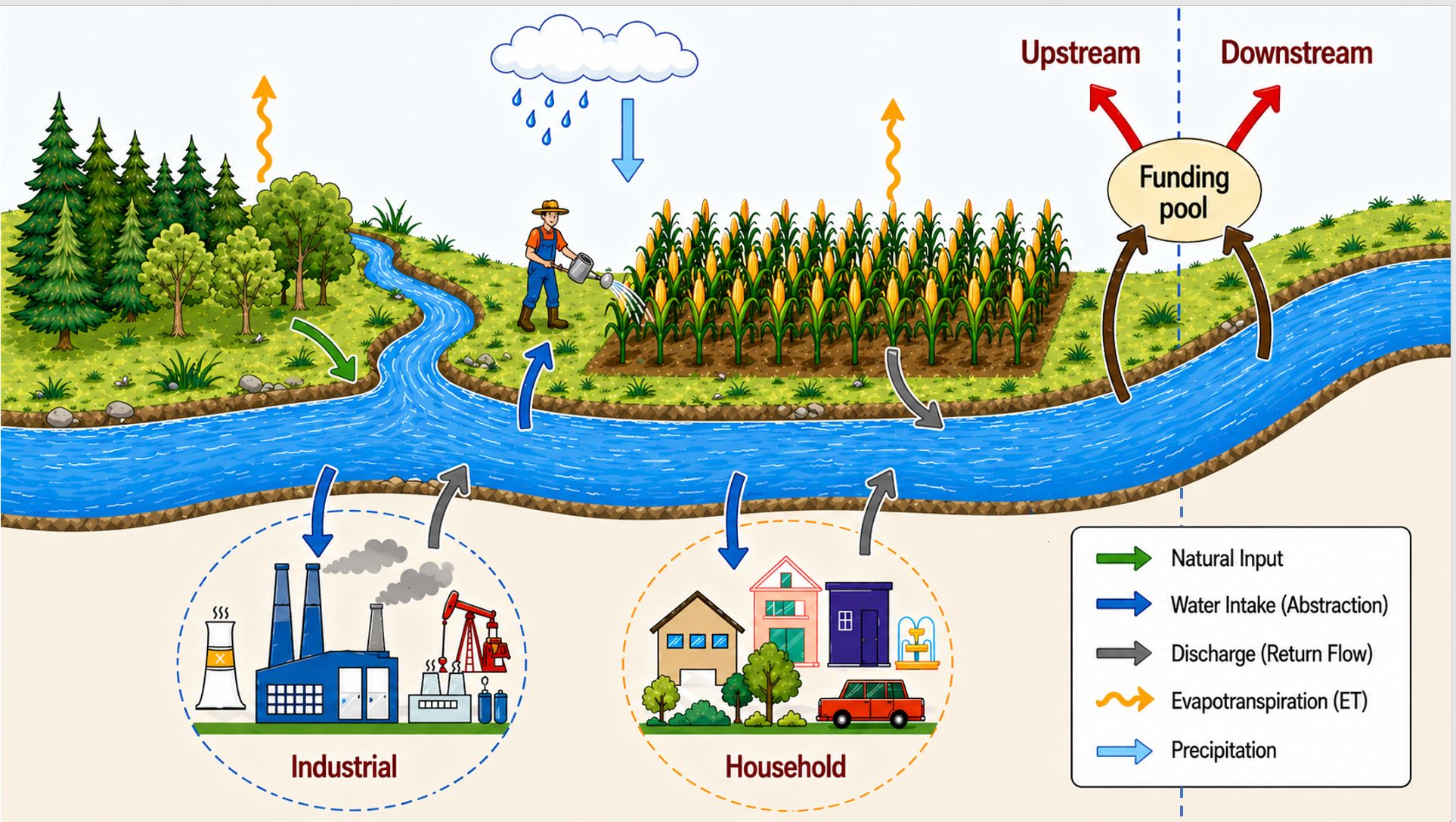
Eco-compensation has become an important policy instrument for integrated watershed management in China. However, quantitative approaches that jointly consider water quantity and quality from both production and consumption perspectives remain limited, constraining the systematic development of eco-compensation standards. This study proposes a funding allocation framework based on Water Yield Equivalent (WYE) and Water Consumption Equivalent (WCE) indicators incorporating both water quality and quantity, and applies it to the upper Miyun Reservoir watershed. Compensation funds were calculated for nine counties in 2000, 2008, and 2013. The results show substantial spatial differences in WYE and WCE, resulting in differentiated compensation responsibilities and receipts. Under the baseline scenario, Miyun County received the highest compensation in 2008 (RMB 198 million), whereas Chicheng County incurred the highest compensation payment in 2000 (RMB 135 million). Further comparison with local fiscal revenue indicates that the ratio of compensation funds to fiscal revenue reflects the potential relative fiscal incentive or constraint of the eco-compensation scheme on local governments. In 2013, Yanqing County had the highest ratio under the baseline scenario, at 12.76%, which increased to 22.59% under the South-to-North Water Diversion Project (SNWDP) water price scenario. Overall, jointly accounting for water quantity, quality, production, and consumption provides a quantitative basis for differentiating compensation responsibilities and benefits across counties. For the Miyun Reservoir watershed, future eco-compensation policies could further integrate water resource protection and pollution reduction requirements to establish differentiated compensation standards, thereby improving the coordination between the compensation mechanism and watershed water resource management objectives.
- Open Access
- Article
Cross-Boundary Watershed Eco-Compensation Based on Water Quantity and Quality from Both Production and Consumption Perspectives
- Qingqing Cheng 1,
- Dongxiao He 1,
- Ayaole Saiken 1,
- Ying Ren 1,
- Xiaoran Cao 1,
- Xiawei Liao 2,* and
- Bo Song 1,3,4,5,*
Author Information
Received: 01 May 2026 | Revised: 31 August 2026 | Accepted: 21 October 2026 | Published: 06 November 2026
Abstract
Graphical Abstract
Keywords
eco-compensation | payment for ecosystem services | water yield equivalent indicator | water consumption equivalent indicator | case study
References
- 1.
Hebei Provincial Department of Finance. Management Measures for the Horizontal Ecological Protection Compensation Funds for the Water Containment Area of the Chaobai River Watershed Upstream of Miyun Reservoir. Available online: http://czt.hebei.gov.cn/root17/zfxx/201906/t20190628_1056132.html (accessed on 30 April 2026).
- 2.
Ministry of Finance of the People’s Republic of China. Ministry of Finance, Ministry of Environmental Protection Launch Implementation of Pilot Project on Water Environment Compensation in Xin’an River Watershed. Available online: https://www.mof.gov.cn/zhengwuxinxi/caizhengxinwen/201103/t20110328_519823.htm (accessed on 29 April 2026).
- 3.
World Bank. Ecological Compensation in China: Trends and Opportunities for Incentive-Based Policies towards a Greener China; World Bank: Washington, DC, USA, 2022. https://documents.worldbank.org/en/publication/documents-reports/documentdetail/099120202112224400 (accessed on 4 November 2026).
- 4.
Ministry of Finance of the People’s Republic of China. A Spokesperson from the Ministry of Finance Answers Journalists’ Questions Regarding Policy Documents on Improving the Mechanism for Cross-Regional Ecological Compensation. Available online: https://www.mof.gov.cn/jrttts/202506/t20250611_3965448.htm (accessed on 29 April 2026).
- 5.
The Central People’s Government of the People’s Republic of China. Outline of the 15th Five-Year Plan for National Economic and Social Development of the People’s Republic of China. Available online: https://www.gov.cn/yaowen/liebiao/202603/content_7062633.htm (accessed on 29 April 2026).
- 6.
Ministry of Finance of the People’s Republic of China. Guidance from the Ministry of Finance on Establishing a Sound Long-Term Mechanism for Eco-Compensation and Protection in the Yangtze River Economic Belt. Available online: https://yss.mof.gov.cn/zhengceguizhang/201802/t20180224_2817575.htm (accessed on 4 November 2026).
- 7.
Wang, Q.; Zhang, M.; Jin, Y. From policy to purity: The impact of China’s watershed ecological compensation on water quality. Environ. Impact Assess. Rev. 2026, 117, 108233. https://doi.org/10.1016/j.eiar.2025.108233.
- 8.
Liu, Y.; Mao, D. Integrated assessment of water quality characteristics and ecological compensation in the Xiangjiang River, south-central China. Ecol. Indic. 2020, 110, 105922. https://doi.org/10.1016/j.ecolind.2019.105922.
- 9.
Liao, X.; Kaczan, D.J.; Zeng, X.; et al. Eco-Compensation in China’s Evolving Environmental Management Regime: Ecological Protection and Water Pollution Control in the Yangtze River Basin; World Bank: Washington, DC, USA, 2021. https://doi.org/10.1596/36270.
- 10.
Sun, F.; Pan, D.; Zhang, D.; et al. Study on Quantitative Model of Water Resource Ecological Compensation in Yangtze River Basin Based on Water Footprint–Decoupling Analysis Methodology. Sustainability 2025, 17, 923. https://doi.org/10.3390/su17030923.
- 11.
Cheng, Y.; Wu, D.; Bian, Y. A systematic approach of determining compensation and allocation for river basin water environment based on total pollutants control. J. Environ. Manag. 2020, 271, 110896. https://doi.org/10.1016/j.jenvman.2020.110896.
- 12.
Zhao, W.; Li, J.; Li, B.; et al. Integrated watershed management under dual ecological compensation for water quantity and water quality. Appl. Geogr. 2026, 186, 103829. https://doi.org/10.1016/j.apgeog.2025.103829.
- 13.
Cheng, P.; Tang, H.; Zhu, S.; et al. Distance to river basin affects residents’ willingness to pay for ecosystem services: Evidence from the Xijiang river basin in China. Ecol. Indic. 2021, 126, 107691. https://doi.org/10.1016/j.ecolind.2021.107691.
- 14.
Ni, Q.; Zhao, M.; Li, C.; et al. Multidimensional trust and its impact on the willingness to pay for ecological compensation in China’s transboundary watersheds—Taking the largest tributary of the Yellow River as an example. J. Environ. Plan. Manag. 2021, 64, 2257–2275. https://doi.org/10.1080/09640568.2020.1866510.
- 15.
Guan, X.; Ruan, T.; Meng, Y.; et al. Ecological compensation mechanism controlled by both river ecological water demand and regional water rights. Sci. Total Environ. 2024, 954, 176137. https://doi.org/10.1016/j.scitotenv.2024.176137.
- 16.
Liu, M.; Guan, X.; Meng, Y.; et al. Ecological compensation mechanism under the double control of water quality and quantity in the Bai River Basin. J. Hydrol. 2023, 626, 130324. https://doi.org/10.1016/j.jhydrol.2023.130324.
- 17.
Lu, S.; Li, J.; Xiao, B.; et al. Analysis of standard accounting method of economic compensation for ecological pollution in watershed. Sci. Total Environ. 2020, 737, 138157. https://doi.org/10.1016/j.scitotenv.2020.138157.
- 18.
Liu, Y.; Wang, J.; Cao, S.; et al. Copula-based framework for integrated evaluation of water quality and quantity: A case study of Yihe River, China. Sci. Total Environ. 2022, 804, 150075. https://doi.org/10.1016/j.scitotenv.2021.150075.
- 19.
Wang, J.; Xiao, W.; Wang, H.; et al. Integrated simulation and assessment of water quantity and quality for a river under changing environmental conditions. Chin. Sci. Bull. 2013, 58, 3340–3347. https://doi.org/10.1007/s11434-012-5622-0.
- 20.
Zhao, Y.; Cao, W.; Wang, X.; et al. Effect of vegetation rehabilitation and construction on runoff of watershed in Beijing Mountain Area (In Chinese). China Environ. Sci. 2015, 35, 3771–3778.
- 21.
Guan, X.; Liu, W.; Chen, M. Study on the ecological compensation standard for river basin water environment based on total pollutants control. Ecol. Indic. 2016, 69, 446–452. https://doi.org/10.1016/j.ecolind.2016.05.011.
- 22.
Guan, X.; Liu, M.; Meng, Y. A comprehensive ecological compensation indicator based on pollution damage–protection bidirectional model for river basin. Ecol. Indic. 2021, 126, 107708. https://doi.org/10.1016/j.ecolind.2021.107708.
- 23.
Xu, J.; Xiao, Y.; Xie, G.; et al. How to coordinate cross-regional water resource relationship by integrating water supply services flow and interregional ecological compensation. Ecol. Indic. 2021, 126, 107595. https://doi.org/10.1016/j.ecolind.2021.107595.
- 24.
Hao, C.; Yan, D.; Gedefaw, M.; et al. Accounting of Transboundary Ecocompensation Standards Based on Water Quantity Allocation and Water Quality Control Targets. Water Resour. Manag. 2021, 35, 1731–1756. https://doi.org/10.1007/s11269-021-02807-5.
- 25.
Hu, H.; Tian, G.; Wu, Z.; et al. Cross-regional ecological compensation under the composite index of water quality and quantity: A case study of the Yellow River Basin. Environ. Res. 2023, 238, 117152. https://doi.org/10.1016/j.envres.2023.117152.
- 26.
Cao, X.; Mukandinda Cyuzuzo, C.; Saiken, A.; et al. A linear additivity water resources assessment indicator by combining water quantity and water quality. Ecol. Indic. 2021, 121, 106990. https://doi.org/10.1016/j.ecolind.2020.106990. Correction in Ecol. Indic. 2021, 121, 107261. https://doi.org/10.1016/j.ecolind.2020.107261.
- 27.
Wu, Z.; Guo, X.; Lv, C.; et al. Study on the quantification method of water pollution ecological compensation standard based on emergy theory. Ecol. Indic. 2018, 92, 189–194. https://doi.org/10.1016/j.ecolind.2017.09.052.
- 28.
Zheng, X.; Huang, G.; Li, J.; et al. Development of a factorial water policy simulation approach from production and consumption perspectives. Water Res. 2021, 193, 116892. https://doi.org/10.1016/j.watres.2021.116892.
- 29.
Pei, S.; Zhang, C.; Liu, C.; et al. Forest ecological compensation standard based on spatial flowing of water services in the upper reaches of Miyun Reservoir, China. Ecosyst. Serv. 2019, 39, 100983. https://doi.org/10.1016/j.ecoser.2019.100983.
- 30.
Schirpke, U.; Candiago, S.; Egarter Vigl, L.; et al. Integrating supply, flow and demand to enhance the understanding of interactions among multiple ecosystem services. Sci. Total Environ. 2019, 651, 928–941. https://doi.org/10.1016/j.scitotenv.2018.09.235.
- 31.
Miyun District People’s Government of Beijing Municipality. Overview of Miyun Reservoir. Available online: https://www.bjmy.gov.cn/stmy/zjmy/mysk/skgk/gkwz/202312/t20231219_97505.html (accessed on 4 November 2026).
- 32.
Qiu, J.; Shen, Z.; Huang, M.; et al. Exploring effective best management practices in the Miyun reservoir watershed, China. Ecol. Eng. 2018, 123, 30–42. https://doi.org/10.1016/j.ecoleng.2018.08.020.
- 33.
Jiang, M. South-to-North Water Diversion Water Transfer and Storage Project at Miyun Reservoir (In Chinese). In Beijing Miyun Almanac; Guo, S., Ed.; Central Party Literature Press: Beijing, China, 2016; pp. 268–269.
- 34.
Sharp, R.; Tallis, H.T.; Ricketts, T.; et al. InVEST 3.2.0 User’s Guide; The Natural Capital Project, Stanford University, University of Minnesota, The Nature Conservancy, and World Wildlife Fund: Stanford, CA, USA, 2015.
- 35.
Sharp, R.; Douglass, J.; Wolny, S.; et al. InVEST 3.10.0.post26+ug.g1087768 User’s Guide; The Natural Capital Project, Stanford University, University of Minnesota, The Nature Conservancy, and World Wildlife Fund: Stanford, CA, USA, 2020.
- 36.
State Environmental Protection Administration of China (SEPA). Environmental Quality Standards for Surface Water (GB 3838-2002). Available online: https://www.mee.gov.cn/ywgz/fgbz/bz/bzwb/shjbh/shjzlbz/200206/t20020601_66497.shtml (accessed on 10 August 2026).
- 37.
Tennant, D.L. Instream Flow Regimens for Fish, Wildlife, Recreation and Related Environmental Resources. Fisheries 1976, 1, 6–10. https://doi.org/10.1577/1548-8446(1976)001%3C0006:IFRFFW%3E2.0.CO;2.
- 38.
Geng, R.; Li, M.; Wang, X.; et al. Effect of land use/landscape changes on diffuse pollution load from watershed based on SWAT model (In Chinese). Trans. Chin. Soc. Agric. Eng. 2015, 31, 241–250. https://doi.org/10.11975/j.issn.1002-6819.2015.16.032.
- 39.
Geng, R.; Zhang, P.; Pang, S.; et al. Impact of Different Climate Change Scenarios on Non-Pointsource Pollution Losses in Miyun Reservoir Watershed (In Chinese). Trans. Chin. Soc. Agric. Eng. 2015, 31, 240–249. https://doi.org/10.11975/j.issn.1002-6819.2015.22.033.
- 40.
Ma, H.; Jia, H.; Wang, J.; et al. Minimum ecological water requirements in urban aquatic eco-systems: A case study in Beijing (In Chinese). J. Tsinghua Univ. 2007, 47, 352–360.
- 41.
Xu, Z.; Dong, Z.; Zhou, J.; et al. The Montana Method for Ecological Water Requirements and Its Application (In Chinese). Water Resour. Hydropower Eng. 2003, 34, 15–17.

This work is licensed under a Creative Commons Attribution 4.0 International License.
