
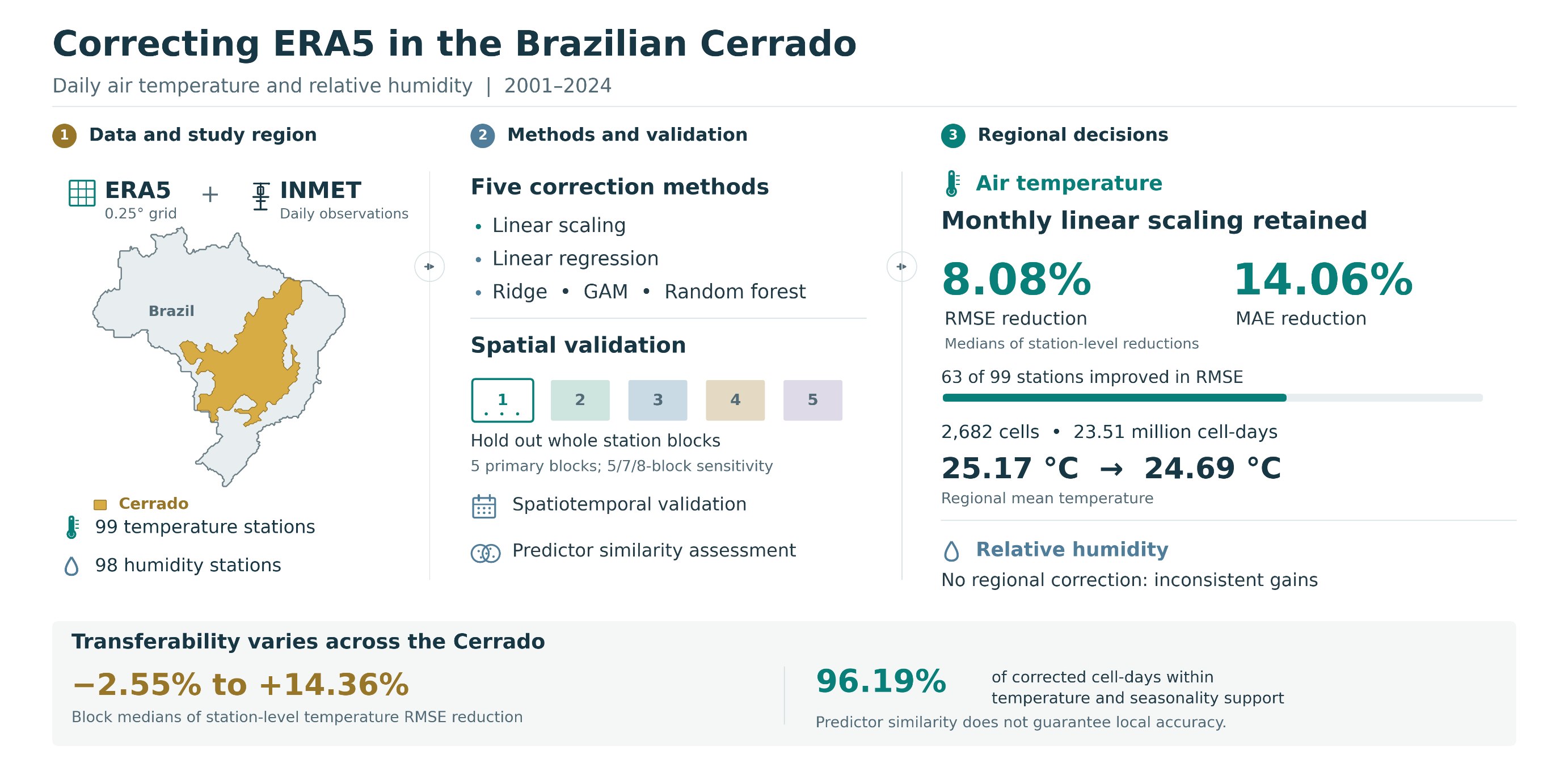
Five methods for correcting daily ERA5 air temperature and relative humidity in the Brazilian Cerrado were evaluated against INMET observations during 2001–2024 using spatial and spatiotemporal validation. The primary assessment included 99 temperature stations and 98 humidity stations. For temperature, monthly linear scaling and linear regression reduced the median station-level root mean square error (RMSE) by 8.08% and 7.77%, respectively. Linear scaling was retained as an interpretable regional monthly adjustment, without a claim of statistical superiority over regression. Performance varied geographically: its median station RMSE changes ranged from a 2.55% deterioration to a 14.36% reduction across five blocks. Spatial-weight sensitivity showed similar positive residual dependence for both methods. Relative humidity gains were small and lacked consistent concordance improvements, so no regional correction was applied. Temperature correction produced 23,510,412 cell-day estimates over 2682 cells, decreasing mean temperature from 25.17 to 24.69 °C. A temperature-and-seasonality similarity screen included 96.19% of these estimates. At held-out stations, median dissimilarity had a near-zero association with RMSE (Spearman ρ = 0.026), limiting its interpretation as a reliability measure. The original constant-width 3.877 °C error interval describes pooled residual dispersion. A separate nested spatial calibration achieved 90.56% overall coverage, but coverage fell to 84.13% in one block and 85.48% in the warmest training-defined temperature stratum. Regional mean improvements therefore coexist with geographic and climatic limits to transferability. Results are based on daily means screened using an 80% hourly-completeness requirement (at least 20 distinct valid hours per station–variable–UTC day).
- Open Access
- Article
Evaluating ERA5 Correction Methods in the Brazilian Cerrado Using Spatial Validation and Predictor Similarity
Author Information
Received: 09 October 2026 | Revised: 16 October 2026 | Accepted: 03 November 2026 | Published: 10 November 2026
Abstract
Graphical Abstract
Keywords
air temperature | relative humidity | atmospheric reanalysis | systematic bias | concordance correlation coefficient
References
- 1.
Ribeiro, J.F.; Walter, B.M.T. As principais fitofisionomias do bioma Cerrado. In Cerrado: Ecologia e Flora; Sano, S.M., Almeida, S.P., Ribeiro, J.F., Eds.; Embrapa Informação Tecnológica: Brasília, DF, Brazil, 2008; pp. 151–212.
- 2.
Alvares, C.A.; Stape, J.L.; Sentelhas, P.C.; et al. Köppen’s climate classification map for Brazil. Meteorol. Z. 2013, 22, 711–728. https://doi.org/10.1127/0941-2948/2013/0507.
- 3.
Projeto MapBiomas. Coleção 10 da Série Anual de Mapas de Cobertura e Uso da Terra do Brasil; MapBiomas: São Paulo, Brazil, 2025.
- 4.
Lawrence, M.G. The Relationship between Relative Humidity and the Dewpoint Temperature in Moist Air: A Simple Conversion and Applications. Bull. Am. Meteorol. Soc. 2005, 86, 225–234. https://doi.org/10.1175/bams-86-2-225.
- 5.
dos Santos Ferreira, L.; Alcantara, C.R.; de Barros Santiago, D.; et al. Validation of ERA5 and ERA5-Land reanalysis data for maximum and minimum temperatures in the Brazilian semiarid region. Theor. Appl. Climatol. 2026, 157, 198. https://doi.org/10.1007/s00704-026-06057-6.
- 6.
Zhang, S.; Pecoraro, G.; Huang, D.; et al. From hydro-meteorological thresholds towards an operational warning model for landslides at regional scale: A real-case application. Eng. Geol. 2026, 362, 108542. https://doi.org/10.1016/j.enggeo.2026.108542.
- 7.
de Araújo, C.S.P.; Silva, J.R.I.; de Almeida, C.D.G.C. Total precipitation and air temperature data obtained from ERA5-Land reanalysis: Validation and accuracy. Rev. Caatinga 2025, 38, e12578. https://doi.org/10.1590/1983-21252025v3812578rc.
- 8.
Brown, J.R.C.; Woods, R.; da Rocha, H.R.; et al. Evaluation of high-resolution meteorological data products using flux tower observations across Brazil. Hydrol. Earth Syst. Sci. 2026, 30, 141–162. https://doi.org/10.5194/hess-30-141-2026.
- 9.
Satyapragyan, S.; Yadav, J.S.; Bhambri, R. Bias corrections of ERA5 and ERA5-Land temperature using automatic weather station data in the Higher Central Himalaya: Implications for hydro-meteorological and glaciological research. J. Hydrol. Reg. Stud. 2026, 63, 103079. https://doi.org/10.1016/j.ejrh.2025.103079.
- 10.
Roberts, D.R.; Bahn, V.; Ciuti, S.; et al. Cross-validation strategies for data with temporal, spatial, hierarchical, or phylogenetic structure. Ecography 2017, 40, 913–929. https://doi.org/10.1111/ecog.02881.
- 11.
Meyer, H.; Pebesma, E. Predicting into unknown space? Estimating the area of applicability of spatial prediction models. Methods Ecol. Evol. 2021, 12, 1620–1633. https://doi.org/10.1111/2041-210x.13650.
- 12.
IBGE. Biomas e Sistema Costeiro-Marinho do Brasil: Compatível Com a Escala 1:250 000; Instituto Brasileiro de Geografia e Estatística: Rio de Janeiro, Brazil, 2025.
- 13.
INMET. Dados Históricos Anuais de Estações Automáticas; Instituto Nacional de Meteorologia: Brasília, Brazil, 2026. Available online: https://portal.inmet.gov.br/dadoshistoricos/ (accessed on 5 November 2026).
- 14.
Hersbach, H.; Bell, B.; Berrisford, P.; et al. The ERA5 global reanalysis. Q. J. R. Meteorol. Soc. 2020, 146, 1999–2049. https://doi.org/10.1002/qj.3803.
- 15.
Open-Meteo. Historical Weather API and Temperature–Dew-Point Humidity Calculation. Available online: https://open-meteo.com/en/docs/historical-weather-api and https://github.com/open-meteo/open-meteo/blob/main/Sources/App/Helper/Meteorology.swift (accessed on 17 October 2026).
- 16.
European Space Agency (ESA). Copernicus Digital Elevation Model; ESA: Paris, France, 2021. https://doi.org/10.5270/ESA-c5d3d65.
- 17.
Open-Meteo. Elevation API. Available online: https://open-meteo.com/en/docs/elevation-api (accessed on 2 September 2026).
- 18.
Teutschbein, C.; Seibert, J. Bias correction of regional climate model simulations for hydrological climate-change impact studies: Review and evaluation of different methods. J. Hydrol. 2012, 456–457, 12–29. https://doi.org/10.1016/j.jhydrol.2012.05.052.
- 19.
Hoerl, A.E.; Kennard, R.W. Ridge Regression: Biased Estimation for Nonorthogonal Problems. Technometrics 1970, 12, 55–67. https://doi.org/10.1080/00401706.1970.10488634.
- 20.
Hastie, T.; Tibshirani, R. Generalized Additive Models. Stat. Sci. 1986, 1, 297–310. https://doi.org/10.1214/ss/1177013604.
- 21.
Wood, S.N. Generalized Additive Models: An Introduction with R, 2nd ed.; Chapman and Hall/CRC: Boca Raton, FL, USA, 2017. https://doi.org/10.1201/9781315370279.
- 22.
Breiman, L. Random Forests. Mach. Learn. 2001, 45, 5–32. https://doi.org/10.1023/a:1010933404324.
- 23.
Lin, L.I. A Concordance Correlation Coefficient to Evaluate Reproducibility. Biometrics 1989, 45, 255–268. https://doi.org/10.2307/2532051.
- 24.
Moran, P.A.P. Notes on continuous stochastic phenomena. Biometrika 1950, 37, 17–23. https://doi.org/10.1093/biomet/37.1-2.17.
- 25.
Benjamini, Y.; Hochberg, Y. Controlling the False Discovery Rate: A Practical and Powerful Approach to Multiple Testing. J. R. Stat. Soc. Ser. B Stat. Methodol. 1995, 57, 289–300. https://doi.org/10.1111/j.2517-6161.1995.tb02031.x.
- 26.
Cressie, N.A.C. Statistics for Spatial Data, revised ed.; Wiley: New York, NY, USA, 1993. https://doi.org/10.1002/9781119115151.


This work is licensed under a Creative Commons Attribution 4.0 International License.
