
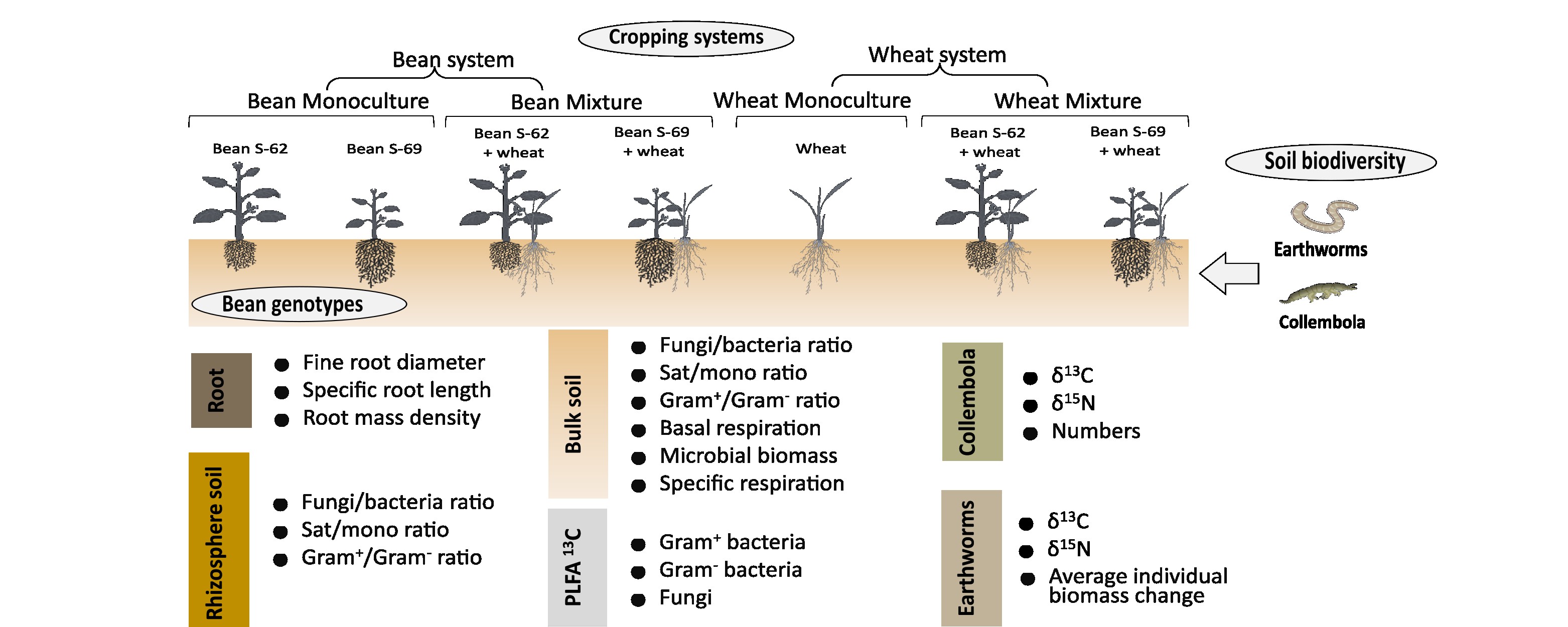
Integrating belowground biodiversity into agricultural systems is key to enhancing agricultural sustainability, yet the role of soil decomposer animals in mediating genotype-specific root and rhizosphere responses remains largely unknown. Using a full-factorial microcosm experiment, we examined how two faba bean genotypes with contrasting root strategies (resource-acquisitive S-62 vs. resource-conservative S-69), mixed cropping with wheat and soil decomposer fauna (earthworms, collembola) jointly shape plant root characteristics and rhizosphere interactions. We quantified root architecture, microbial phospholipid fatty acids (PLFAs), litter carbon incorporation by microorganisms and soil fauna and fauna abundance/biomass. Bean root characteristics differed between genotypes, with higher specific root length and lower root mass density in genotype S-62 than in genotype S-69, reflecting their different resource strategies. Bean genotype S-69 increased fungal/bacterial and Gram+/Gram− PLFA ratios, indicating stronger microbial resource limitation. This was accompanied by reduced earthworm biomass, which shifted their resource use toward litter-derived carbon. Mixed cropping uniformly decreased bean root mass density, but increased microbial basal respiration and biomass in beans while elevating fungal dominance in wheat. Collembola enhanced bean specific root length and increased the fungal/bacterial PLFA ratio and microbial metabolic quotient in the bean rhizosphere, suggesting grazing-induced fungal dominance and stress. Earthworms increased wheat root mass density, while collembola reduced wheat root diameter, and in combination they increased microbial activity and reinforced fungal carbon use in wheat. Further, earthworms reduced the saturated/monoenoic fatty acid ratio in bulk soil and increased the use of litter carbon by Gram− bacteria, indicating microbial stress mitigation. Overall, the results document that plant genotypes with different root strategies fundamentally drive the structure of rhizosphere microbial communities, their interactions with decomposer animals and plant litter dynamics. These findings highlight the importance of considering root phenotypic variation and belowground biodiversity when designing sustainable legume–cereal intercropping systems.
- Open Access
- Article
Faba Bean Genotype, Mixed Cropping and Soil Fauna Jointly Influence Plant Roots and Rhizosphere Microbial Communities
- Zhi-Yuan Wang 1,2,*,
- Shu Li 1,
- Jing-Zhong Lu 2,3,
- Amandine Erktan 2,4,
- Li-Bo Fu 1,
- Wei-Dong Cao 5,
- Pan-Lei Wang 1,*,
- Stefan Scheu 2,6
Author Information
Received: 26 Jan 2026 | Revised: 02 Jun 2026 | Accepted: 22 Jul 2026 | Published: 04 Aug 2026
Abstract
Graphical Abstract
Keywords
earthworm | collembola | genotype | root characteristics | microbial stress | stable isotopes
References
- 1.
Kopittke, P.M.; Menzies, N.W.; Wang, P.; et al. Soil and the Intensification of Agriculture for Global Food Security. Environ. Int. 2019, 132, 105078. https://doi.org/10.1016/j.envint.2019.105078.
- 2.
Wang, M.; Xu, Z. PGPR-Mediated Enhancement of Soil Nutrients, Rhizosphere Microbial Ecology, and Plant Growth: A Review. npj Biofilms Microbiomes 2026, 12, 95. https://doi.org/10.1038/s41522-026-00966-0.
- 3.
Jansson, J.K.; McClure, R.; Egbert, R.G. Soil Microbiome Engineering for Sustainability in a Changing Environment. Nat. Biotechnol. 2023, 41, 1716–1728. https://doi.org/10.1038/s41587-023-01932-3.
- 4.
Jacques, R.G.; Allison, G.; Shaw, P.; et al. Earthworm-Collembola Interactions Affecting Water-Soluble Nutrients, Fauna and Physiochemistry in a Mesocosm Manure-Straw Composting Experiment. Waste Manag. 2021, 134, 57–66. https://doi.org/10.1016/j.wasman.2021.08.008.
- 5.
Hanisch, J.; Engell, I.; Linsler, D.; et al. The Role of Collembola for Litter Decomposition under Minimum and Conventional Tillage. J. Plant Nutr. Soil Sci. 2022, 185, 529–538. https://doi.org/10.1002/jpln.202200077.
- 6.
Vion-Guibert, L.; Capowiez, Y.; Alavoine, G.; et al. The Effects of Earthworm Species on Organic Matter Transformations and Soil Microbial Communities Are Only Partially Related to Their Bioturbation Activity. Soil Biol. Biochem. 2024, 199, 109606. https://doi.org/10.1016/j.soilbio.2024.109606.
- 7.
Wang, Z.; Liu, M.; Ding, W.; et al. Earthworms Enhance Soil Phosphorus Cycling but Plant Responses Differ among Earthworm Ecological Categories: A Meta-Analysis. Soil Biol. Biochem. 2026, 213, 110025. https://doi.org/10.1016/j.soilbio.2025.110025.
- 8.
Eisenhauer, N.; Vogel, A.; Jensen, B.; et al. Decomposer Diversity Increases Biomass Production and Shifts Aboveground-Belowground Biomass Allocation of Common Wheat. Sci. Rep. 2018, 8, 17894. https://doi.org/10.1038/s41598-018-36294-3.
- 9.
Adomako, M.O.; Xue, W.; Roiloa, S.; et al. Earthworms Modulate Impacts of Soil Heterogeneity on Plant Growth at Different Spatial Scales. Front. Plant Sci. 2021, 12, 735495. https://doi.org/10.3389/fpls.2021.735495.
- 10.
Wu, D.; Du, E.; Eisenhauer, N.; et al. Global Engineering Effects of Soil Invertebrates on Ecosystem Functions. Nature 2025, 640, 120–129. https://doi.org/10.1038/s41586-025-08594-y.
- 11.
Liu, Q.; Eisenhauer, N.; Scheu, S.; et al. Climate-Dependent Plant Responses to Earthworms in Two Land-Use Types. Oecologia 2024, 204, 133–146. https://doi.org/10.1007/s00442-023-05493-9.
- 12.
Wang, Z.-Y.; Lu, J.-Z.; Erktan, A.; et al. Crop Productivity, Resource Allocation and Nitrogen Concentration as Affected by Soil Decomposers, Mixed Cropping and Crop Genotype. Soil Biol. Biochem. 2022, 175, 108855. https://doi.org/10.1016/j.soilbio.2022.108855.
- 13.
Wang, P.; Erktan, A.; Fu, L.; et al. Regulation of Agronomic Traits of Bean by Soil Decomposer Animals Depends on Cropping System and Genotype. Plant Soil 2024, 503, 217–229. https://doi.org/10.1007/s11104-023-05909-8.
- 14.
Layek, J.; Das, A.; Mitran, T.; et al. Cereal+Legume Intercropping: An Option for Improving Productivity and Sustaining Soil Health. In Legumes for Soil Health and Sustainable Management; Meena, R.S., Das, A., Yadav, G.S., et al., Eds.; Springer: Singapore, 2018; pp. 347–386. ISBN 978-981-13-0252-7.
- 15.
Picone, R.; Pietramellara, G.; Guggenberger, G.; et al. The Contemporary Plant-Soil Feedback in Legume-Cereal Intercropping Systems: A Review of Carbon, Nutrient, and Microbial Dynamics. Plant Soil 2025. https://doi.org/10.1007/s11104-025-07723-w.
- 16.
Jiang, P.; Wang, Y.; Zhang, Y.; et al. Intercropping Enhances Maize Growth and Nutrient Uptake by Driving the Link between Rhizosphere Metabolites and Microbiomes. New Phytol. 2024, 243, 1506–1521. https://doi.org/10.1111/nph.19906.
- 17.
Homulle, Z.; George, T.S.; Karley, A.J. Root Traits with Team Benefits: Understanding Belowground Interactions in Intercropping Systems. Plant Soil 2022, 471, 1–26. https://doi.org/10.1007/s11104-021-05165-8.
- 18.
Haug, B.; Messmer, M.M.; Enjalbert, J.; et al. New Insights towards Breeding for Mixed Cropping of Spring Pea and Barley to Increase Yield and Yield Stability. Field Crops Res. 2023, 297, 108923. https://doi.org/10.1016/j.fcr.2023.108923.
- 19.
Vidal, A.; Blouin, M.; Lubbers, I.; et al. Chapter One—The Role of Earthworms in Agronomy: Consensus, Novel Insights and Remaining Challenges. In Advances in Agronomy; Sparks, D.L., Ed.; Academic Press: Cambridge, MA, USA, 2023; Volume 181, pp. 1–78. ISBN 0065-2113.
- 20.
Winck, B.R.; Chauvat, M.; Coulibaly, S.F.M.; et al. Functional Collembolan Assemblages Induce Different Plant Responses in Lolium Perenne. Plant Soil 2020, 452, 347–358. https://doi.org/10.1007/s11104-020-04579-0.
- 21.
Partsch, S.; Milcu, A.; Scheu, S. Decomposers (Lumbricidae, Collembola) Affect Plant Performance in Model Grasslands of Different Diversity. Ecology 2006, 87, 2548–2558. https://doi.org/10.1890/0012-9658(2006)87[2548:DLCAPP]2.0.CO;2.
- 22.
Bulgarelli, D.; Rott, M.; Schlaeppi, K.; et al. Revealing Structure and Assembly Cues for Arabidopsis Root-Inhabiting Bacterial Microbiota. Nature 2012, 488, 91–95. https://doi.org/10.1038/nature11336.
- 23.
Bulgarelli, D.; Garrido-Oter, R.; Münch, P.C.; et al. Structure and Function of the Bacterial Root Microbiota in Wild and Domesticated Barley. Cell Host Microbe 2015, 17, 392–403. https://doi.org/10.1016/j.chom.2015.01.011.
- 24.
Scheu, S. Automated Measurement of the Respiratory Response of Soil Microcompartments: Active Microbial Biomass in Earthworm Faeces. Soil Biol. Biochem. 1992, 24, 1113–1118. https://doi.org/10.1016/0038-0717(92)90061-2.
- 25.
Anderson, J.P.E.; Domsch, K.H. A Physiological Method for the Quantitative Measurement of Microbial Biomass in Soils. Soil Biol. Biochem. 1978, 10, 215–221. https://doi.org/10.1016/0038-0717(78)90099-8.
- 26.
Beck, T.; Joergensen, R.G.; Kandeler, E.; et al. An Inter-Laboratory Comparison of Ten Different Ways of Measuring Soil Microbial Biomass C. Soil Biol. Biochem. 1997, 29, 1023–1032. https://doi.org/10.1016/s0038-0717(97)00030-8.
- 27.
Pollierer, M.M.; Ferlian, O.; Scheu, S. Temporal Dynamics and Variation with Forest Type of Phospholipid Fatty Acids in Litter and Soil of Temperate Forests across Regions. Soil Biol. Biochem. 2015, 91, 248–257. https://doi.org/10.1016/j.soilbio.2015.08.035.
- 28.
Lu, J.-Z.; Scheu, S. Response of Soil Microbial Communities to Mixed Beech-Conifer Forests Varies with Site Conditions. Soil Biol. Biochem. 2021, 155, 108155. https://doi.org/10.1016/j.soilbio.2021.108155.
- 29.
Fanin, N.; Kardol, P.; Farrell, M.; et al. The Ratio of Gram-Positive to Gram-Negative Bacterial PLFA Markers as an Indicator of Carbon Availability in Organic Soils. Soil Biol. Biochem. 2019, 128, 111–114. https://doi.org/10.1016/j.soilbio.2018.10.010.
- 30.
Zelles, L. Fatty Acid Patterns of Phospholipids and Lipopolysaccharides in the Characterisation of Microbial Communities in Soil: A Review. Biol. Fertil. Soils 1999, 29, 111–129. https://doi.org/10.1007/s003740050533.
- 31.
Frostegård, Å.; Bååth, E. The Use of Phospholipid Fatty Acid Analysis to Estimate Bacterial and Fungal Biomass in Soil. Biol. Fertil. Soils 1996, 22, 59–65. https://doi.org/10.1007/BF00384433.
- 32.
Kempson, D.; Lloyd, M.; Ghelardi, R. A New Extractor for Woodland Litter. Pedobiologia 1963, 3, 1–21. https://doi.org/10.1016/S0031-4056(22)00112-3.
- 33.
Reineking, A.; Langel, R.; Schikowski, J. 15N,13C-On-Line Measurements with an Elemental Analyser (Carlo Erba, NA 1500), a Modified Trapping Box and a Gas Isotope Mass Spectrometer (Finnigan, MAT 251). Isot. Isot. Environ. Health Stud. 1993, 29, 169–174. https://doi.org/10.1080/10256019308046151.
- 34.
R Core Team R: A Language and Environment for Statistical Computing 2024.
- 35.
Han, M.; Chen, Y.; Li, R.; et al. Root Phosphatase Activity Aligns with the Collaboration Gradient of the Root Economics Space. New Phytol. 2022, 234, 837–849. https://doi.org/10.1111/nph.17906.
- 36.
Lynch, J.P. Root Phenotypes for Improved Nutrient Capture: An Underexploited Opportunity for Global Agriculture. New Phytol. 2019, 223, 548–564. https://doi.org/10.1111/nph.15738.
- 37.
Hou, J.; McCormack, M.L.; Reich, P.B.; et al. Linking Fine Root Lifespan to Root Chemical and Morphological Traits—A Global Analysis. Proc. Natl. Acad. Sci. USA 2024, 121, e2320623121. https://doi.org/10.1073/pnas.2320623121.
- 38.
Freschet, G.T.; Pagès, L.; Iversen, C.M.; et al. A Starting Guide to Root Ecology: Strengthening Ecological Concepts and Standardising Root Classification, Sampling, Processing and Trait Measurements. New Phytol. 2021, 232, 973–1122. https://doi.org/10.1111/nph.17572.
- 39.
Mueller, C.W.; Baumert, V.; Carminati, A.; et al. From Rhizosphere to Detritusphere–Soil Structure Formation Driven by Plant Roots and the Interactions with Soil Biota. Soil Biol. Biochem. 2024, 193, 109396. https://doi.org/10.1016/j.soilbio.2024.109396.
- 40.
Brooker, R.W.; Bennett, A.E.; Cong, W.; et al. Improving Intercropping: A Synthesis of Research in Agronomy, Plant Physiology and Ecology. New Phytol. 2015, 206, 107–117. https://doi.org/10.1111/nph.13132.
- 41.
Demie, D.T.; Döring, T.F.; Finckh, M.R.; et al. Mixture × Genotype Effects in Cereal/Legume Intercropping. Front. Plant Sci. 2022, 13, 846720. https://doi.org/10.3389/fpls.2022.846720.
- 42.
Endlweber, K.; Krome, K.; Welzl, G.; et al. Decomposer Animals Induce Differential Expression of Defence and Auxin-Responsive Genes in Plants. Soil Biol. Biochem. 2011, 43, 1130–1138. https://doi.org/10.1016/j.soilbio.2010.11.013.
- 43.
Meurer, K.; Barron, J.; Chenu, C.; et al. A Framework for Modelling Soil Structure Dynamics Induced by Biological Activity. Glob. Chang. Biol. 2020, 26, 5382–5403. https://doi.org/10.1111/gcb.15289.
- 44.
Wen, T.; Yu, G.-H.; Hong, W.-D.; et al. Root Exudate Chemistry Affects Soil Carbon Mobilization via Microbial Community Reassembly. Fundam. Res. 2022, 2, 697–707. https://doi.org/10.1016/j.fmre.2021.12.016.
- 45.
Zwetsloot, M.J.; Ucros, J.M.; Wickings, K.; et al. Prevalent Root-Derived Phenolics Drive Shifts in Microbial Community Composition and Prime Decomposition in Forest Soil. Soil Biol. Biochem. 2020, 145, 107797. https://doi.org/10.1016/j.soilbio.2020.107797.
- 46.
Cheng, H.; Liu, G.; Shen, Y.; et al. An Assessment of Soil Microbial Community Environmental Stress in Alpine Marginal Ecosystems Using Microbial Indicators. Ecol. Indic. 2024, 158, 111542. https://doi.org/10.1016/j.ecolind.2023.111542.
- 47.
Williams, A.; Langridge, H.; Straathof, A.L.; et al. Root Functional Traits Explain Root Exudation Rate and Composition across a Range of Grassland Species. J. Ecol. 2022, 110, 21–33. https://doi.org/10.1111/1365-2745.13630.
- 48.
Alahmad, A.; Harir, M.; Fochesato, S.; et al. Unraveling the Interplay between Root Exudates, Microbiota, and Rhizosheath Formation in Pearl Millet. Microbiome 2024, 12, 1. https://doi.org/10.1186/s40168-023-01727-3.
- 49.
Chen, W.; Wu, Y.; Fritschi, F.B.; Juenger, T.E. The Genetic Basis of the Root Economics Spectrum in a Perennial Grass. Proc. Natl. Acad. Sci. USA 2021, 118, e2107541118. https://doi.org/10.1073/pnas.2107541118.
- 50.
Dong, Q.; Zhao, X.; Zhou, D.; et al. Maize and Peanut Intercropping Improves the Nitrogen Accumulation and Yield per Plant of Maize by Promoting the Secretion of Flavonoids and Abundance of Bradyrhizobium in Rhizosphere. Front. Plant Sci. 2022, 13, 957336. https://doi.org/10.3389/fpls.2022.957336.
- 51.
Levasseur, A.; Chauvat, M.; Bohm, V.; et al. Experimental Evidence That Soil Fauna Drives Plant Root Exudation Patterns. Soil Biol. Biochem. 2025, 205, 109771. https://doi.org/10.1016/j.soilbio.2025.109771.
- 52.
Drut, B.; Fustec, J.; Oddos, L.; et al. The Combined Effects of Faba Bean and Endogeic Earthworms on Soil Microbial Activity in Intercrops. Eur. J. Soil Biol. 2023, 117, 103510. https://doi.org/10.1016/j.ejsobi.2023.103510.
- 53.
Griffiths, H.M.; Ashton, L.A.; Parr, C.L.; et al. The Impact of Invertebrate Decomposers on Plants and Soil. New Phytol. 2021, 231, 2142–2149. https://doi.org/10.1111/nph.17553.
- 54.
Blume-Werry, G.; Krab, E.J.; Olofsson, J.; et al. Invasive Earthworms Unlock Arctic Plant Nitrogen Limitation. Nat. Commun. 2020, 11, 1766. https://doi.org/10.1038/s41467-020-15568-3.
- 55.
Salazar-Fillippo, A.A.; Emsens, W.; Strybos, S.; et al. Effects of Microarthropod Density on Soil Fungal Community Composition in Nutrient-poor Ecosystems. Funct. Ecol. 2025, 39, 432–445. https://doi.org/10.1111/1365-2435.14733.
- 56.
Li, X.; Mao, N.; Jiang, H.; et al. Synergistic Effects of Straw and Earthworm Addition on Microbial Diversity and Microbial Nutrient Limitation in a Subtropical Conservation Farming System. Soil Tillage Res. 2022, 224, 105500. https://doi.org/10.1016/j.still.2022.105500.
- 57.
Brousseau, P.; Forey, E.; Santonja, M.; et al. Functional Traits of Plant Roots and Collembola Determine Their Tri-trophic Interactions with Soil Microbes. Funct. Ecol. 2025, 39, 462–477. https://doi.org/10.1111/1365-2435.14714.
- 58.
Zheng, H.; Vesterdal, L.; Schmidt, I.K.; et al. Ecoenzymatic Stoichiometry Can Reflect Microbial Resource Limitation, Substrate Quality, or Both in Forest Soils. Soil Biol. Biochem. 2022, 167, 108613. https://doi.org/10.1016/j.soilbio.2022.108613.
- 59.
Pivato, B.; Semblat, A.; Guégan, T.; et al. Rhizosphere Bacterial Networks, but Not Diversity, Are Impacted by Pea-Wheat Intercropping. Front. Microbiol. 2021, 12, 674556. https://doi.org/10.3389/fmicb.2021.674556.
- 60.
Seitz, V.A.; McGivern, B.B.; Daly, R.A.; et al. Variation in Root Exudate Composition Influences Soil Microbiome Membership and Function. Appl. Environ. Microbiol. 2022, 88, e00226-22. https://doi.org/10.1128/aem.00226-22.
- 61.
Hadir, S.; Döring, T.F.; Justes, E.; et al. Root Growth and Belowground Interactions in Spring Wheat /Faba Bean Intercrops. Plant Soil 2025, 506, 57–76. https://doi.org/10.1007/s11104-024-06742-3.
- 62.
Chen, J.; Engbersen, N.; Stefan, L.; et al. Diversity Increases Yield but Reduces Harvest Index in Crop Mixtures. Nat. Plants 2021, 7, 893–898. https://doi.org/10.1038/s41477-021-00948-4.
- 63.
Van Bommel, M.; Arndt, K.; Endress, M.-G.; et al. Under the Lens: Carbon and Energy Channels in the Soil Micro-Food Web. Soil Biol. Biochem. 2024, 199, 109575. https://doi.org/10.1016/j.soilbio.2024.109575.
- 64.
Angst, G.; Potapov, A.; Joly, F.-X.; et al. Conceptualizing Soil Fauna Effects on Labile and Stabilized Soil Organic Matter. Nat. Commun. 2024, 15, 5005. https://doi.org/10.1038/s41467-024-49240-x.
- 65.
Martinović, T.; Mašínová, T.; López-Mondéjar, R.; et al. Microbial Utilization of Simple and Complex Carbon Compounds in a Temperate Forest Soil. Soil Biol. Biochem. 2022, 173, 108786. https://doi.org/10.1016/j.soilbio.2022.108786.
- 66.
Barthod, J.; Dignac, M.F.; Rumpel, C. Effect of Decomposition Products Produced in the Presence or Absence of Epigeic Earthworms and Minerals on Soil Carbon Stabilization. Soil Biol. Biochem. 2021, 160, 108308. https://doi.org/10.1016/j.soilbio.2021.108308.
- 67.
Delory, B.M.; Callaway, R.M.; Semchenko, M. A Trait-based Framework Linking the Soil Metabolome to Plant–Soil Feedbacks. New Phytol. 2024, 241, 1910–1921. https://doi.org/10.1111/nph.19490.
- 68.
Rathore, N.; Hanzelková, V.; Dostálek, T.; et al. Species Phylogeny, Ecology, and Root Traits as Predictors of Root Exudate Composition. New Phytol. 2023, 239, 1212–1224. https://doi.org/10.1111/nph.19060.
- 69.
Liu, T.; Chen, X.; Gong, X.; et al. Earthworms Coordinate Soil Biota to Improve Multiple Ecosystem Functions. Curr. Biol. 2019, 29, 3420-3429.e5. https://doi.org/10.1016/j.cub.2019.08.045.
- 70.
Sun, F.; Chauvat, M.; Blanchard, E.; et al. Fungal-Based Soil Food Webs, Not Local Plant nor Abiotic Properties, Are Most Affected by Rhizome-Derived Secondary Metabolites of Japanese Knotweed (Reynoutria Japonica). Appl. Soil Ecol. 2025, 215, 106416. https://doi.org/10.1016/j.apsoil.2025.106416.
- 71.
Witzgall, K.; Steiner, F.A.; Hesse, B.D.; et al. Living and Decaying Roots as Regulators of Soil Aggregation and Organic Matter Formation—From the Rhizosphere to the Detritusphere. Soil Biol. Biochem. 2024, 197, 109503. https://doi.org/10.1016/j.soilbio.2024.109503.
- 72.
Wang, C.; Kuzyakov, Y. Mechanisms and Implications of Bacterial–Fungal Competition for Soil Resources. ISME J. 2024, 18, wrae073. https://doi.org/10.1093/ismejo/wrae073.
- 73.
Wu, M.; Chen, L.; Chen, S.; et al. Soil Microbial Carbon and Nitrogen Limitation Constraints Soil Organic Carbon Stability in Arid and Semi-Arid Grasslands. J. Environ. Manag. 2025, 373, 123675. https://doi.org/10.1016/j.jenvman.2024.123675.
- 74.
Norris, C.E.; Swallow, M.J.B.; Liptzin, D.; et al. Use of Phospholipid Fatty Acid Analysis as Phenotypic Biomarkers for Soil Health and the Influence of Management Practices. Appl. Soil Ecol. 2023, 185, 104793. https://doi.org/10.1016/j.apsoil.2022.104793.

This work is licensed under a Creative Commons Attribution 4.0 International License.
