
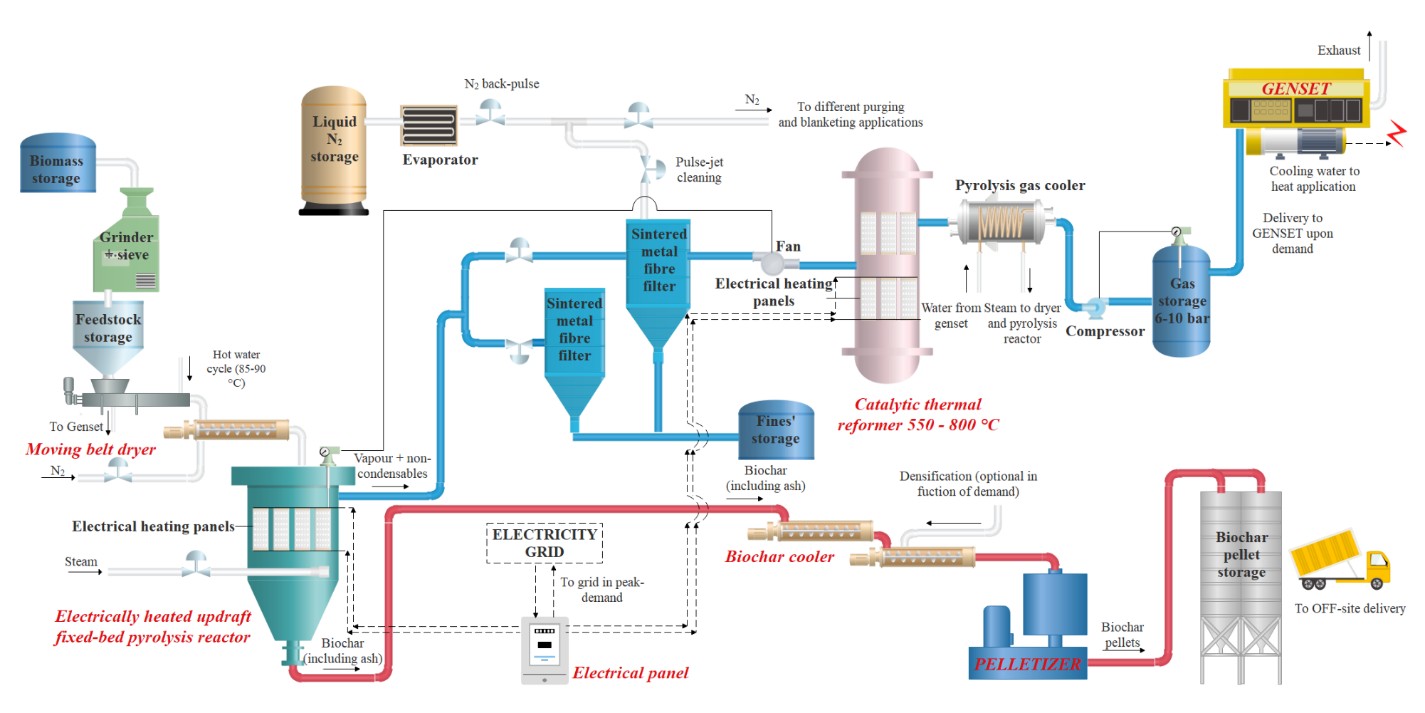
Biomass is recognized as a renewable energy source with high potential. Its pyrolysis produces biogas, a storable bio-oil and char. Although bio-oil also contains a variety of C, H, O components; it also contains value-added chemicals such as levoglucosan. Pyrolysis proceeds at moderate temperatures (300 to 400 °C) temperatures in a slow mode, or at >> 500 °C is a fast mode. At low temperatures and long residence times, slow pyrolysis fosters the production of pyrolysis gas and biochar. At a very fast heating rate and a short residence time in the reactor, the pyrolysis mode changes to the so-called fast mode, where liquid pyrolysis products are higher than in slow pyrolysis mode. After condensation, a brown, acid, and low viscosity bio-oil is obtained. The research will assess the slow pyrolysis system, through its conversions, product distribution and process economics in view of a maximum gas and char production, both considered advantageous toward for energy-carrier storage and peak-time electricity generation.
- Open Access
- Article
Biomass Slow Pyrolysis Produces Stable Gaseous, Liquid and Solid Bio-Energy Carriers
- Yitong Jiang 1,
- Debo Zhang 1,
- Xianfeng Fan 2,
- Tianwei Tan 3,
- Raf Dewil 4,
- Nick Sweygers 4,
- Huili Zhang 3,*
Author Information
Received: 28 Apr 2026 | Revised: 12 May 2026 | Accepted: 15 May 2026 | Published: 25 May 2026
Abstract
Graphical Abstract
Keywords
pyrolysis | biomass | reaction rate | energy storage | peak power generation
References
- 1.
European Court of Auditors. Review No 04/2019: EU Support for Energy Storage. Available online: https://www.eca.europa.eu/en/publications?did=49669 (accessed on 6 April 2026).
- 2.
European Parliament. ENVI—Policy Department for Economic, Scientific and Quality of Life Policies. Available online: https://multimedia.europarl.europa.eu/en/webstreaming/envi-policy-department-for-economic-scientific-and-quality-of-life-policies_20220927-1230-COMMITTEE-ENVI (accessed on 6 April 2026).
- 3.
Mubareka, S.B.; Renner, A.; Acosta Naranjo, R.; et al. EU Biomass Supply, Uses, Governance and Regenerative Actions. Available online: https://publications.jrc.ec.europa.eu/repository/handle/JRC140117 (accessed on 6 May 2026).
- 4.
Pyrum Innovations AG Starts Commissioning of First Large-Scale Industrial Series Plant. Available online: http://www.pyrum.net/en/corporate-news/commissioning-of-the-first-large-scale-industrial-series-plant/ (accessed on 6 May 2026).
- 5.
Andritz Group. Available online: https://www.andritz.com/group-en (accessed on 6 May 2026).
- 6.
Anca-Couce, A. Reaction mechanisms and multi-scale modelling of lignocellulosic biomass pyrolysis. Prog. Energy Combust. Sci. 2016, 53, 41–79. https://doi.org/10.1016/j.pecs.2015.10.002.
- 7.
Abou Rjeily, M.; Gennequin, C.; Randrianalisoa, J.H. Biomass pyrolysis to produce hydrogen, methane, carbon monoxide, carbon dioxide, oil and char: A review. Environ. Chem. Lett. 2025, 23, 1473–1541. https://doi.org/10.1007/s10311-025-01867-y.
- 8.
Khandelwal, K.; Nanda, S.; Dalai, A.K. Machine learning to predict the production of bio-oil, biogas, and biochar by pyrolysis of biomass: a review. Environ. Chem. Lett. 2024, 22, 2669–2698. https://doi.org/10.1007/s10311-024-01767-7.
- 9.
McKendry, P. Energy production from biomass (part 2): conversion technologies. Bioresour. Technol. 2002, 83, 47–54. https://doi.org/10.1016/S0960-8524(01)00119-5.
- 10.
Yao, Z.; Hu, T.; Pan, Y.; et al. Regulating the yield of tar and char during biomass pyrolysis: Insights from lattice Boltzmann simulations of particle shape and flow dynamics. Therm. Sci. Eng. Prog. 2025, 68, 104285. https://doi.org/10.1016/j.tsep.2025.104285.
- 11.
Veksha, A.; Aryal, R.; Low, C.W.; et al. Effect of feedstock on the operation of a combined pyrolysis-reforming prototype using a fluidized Ni/Al2O3 catalyst. Chem. Eng. J 2025, 526, 171033. https://doi.org/10.1016/j.cej.2025.171033.
- 12.
AlOtaibi, B.; Manousiouthakis, V.I. Equilibrium Studies of Biomass Gasification/Pyrolysis for Syngas Generation. Ind. Eng. Chem. Res. 2025, 64, 23685–23699. https://doi.org/10.1021/acs.iecr.5c02300.
- 13.
Shezi, M.; Kiambi, S.L.; Isa, Y.M. Seasonal Harvesting Impact on Biomass Fuel Properties and Pyrolysis-Derived Bio-Oil Organic Phase Composition. GCB Bioenergy 2024, 16, e70011. https://doi.org/10.1111/gcbb.70011.
- 14.
Asaad, S.M.; Inayat, A.; Ghenai, C.; et al. Integration of waste heat recovery with biomass thermal conversion processes: A review. Process Saf. Environ. Prot. 2024, 192, 567–579. https://doi.org/10.1016/j.psep.2024.10.007.
- 15.
del Pozo, C.; Rego, F.; Puy, N.; et al. The effect of reactor scale on biochars and pyrolysis liquids from slow pyrolysis of coffee silverskin, grape pomace and olive mill waste, in auger reactors. Waste Manag. 2022, 148, 106–116. https://doi.org/10.1016/j.wasman.2022.05.023.
- 16.
Di Blasi, C.; Branca, C.; Galgano, A. On the Experimental Evidence of Exothermicity in Wood and Biomass Pyrolysis. Energy Technol. 2017, 5, 19–29. https://doi.org/10.1002/ente.201600091.
- 17.
Nachenius, R.W.; van de Wardt, T.A.; Ronsse, F.; et al. Torrefaction of pine in a bench-scale screw conveyor reactor. Biomass Bioenergy 2015, 79, 96–104. https://doi.org/10.1016/j.biombioe.2015.03.027.
- 18.
Ronsse, F.; Van Hecke, S.; Dickinson, D.; et al. Production and characterization of slow pyrolysis biochar: influence of feedstock type and pyrolysis conditions. Glob. Chang. Biol. Bioenergy 2013, 5, 104–115. https://doi.org/10.1111/gcbb.12018.
- 19.
Mašek, O.; Budarin, V.; Gronnow, M.; et al. Microwave and slow pyrolysis biochar—Comparison of physical and functional properties. J. Anal. Appl. Pyrolysis 2013, 100, 41–48. https://doi.org/10.1016/j.jaap.2012.11.015.
- 20.
Gronnow, M.J.; Budarin, V.L.; Mašek, O.; et al. Torrefaction/biochar production by microwave and conventional slow pyrolysis—comparison of energy properties. GCB Bioenergy 2013, 5, 144–152. https://doi.org/10.1111/gcbb.12021.
- 21.
Rego, F.; Xiang, H.; Yang, Y.; et al. Investigation of the role of feedstock properties and process conditions on the slow pyrolysis of biomass in a continuous auger reactor. J. Anal. Appl. Pyrolysis 2022, 161, 105378. https://doi.org/10.1016/j.jaap.2021.105378.
- 22.
Shi, X.; Ronsse, F.; Roegiers, J.; et al. 3D Eulerian-Eulerian modeling of a screw reactor for biomass thermochemical conversion. Part 1: Solids flow dynamics and back-mixing. Renew. Energy 2019, 143, 1465–1476. https://doi.org/10.1016/j.renene.2019.05.098.
- 23.
Zhang, H.L.; Baeyens, J.; Tan, T.W.; et al. Biomass slow pyrolysis to value-added biochar. Presented at ICB2019, the 7th International Conference on Biorefinery, Johannesburg, South Africa, 18–21 August 2019.
- 24.
Ferreira, C.I.A.; Calisto, V.; Cuerda-Correa, E.M.; et al. Comparative valorisation of agricultural and industrial biowastes by combustion and pyrolysis. Bioresour. Technol. 2016, 218, 918–925. https://doi.org/10.1016/j.biortech.2016.07.047.
- 25.
Tang, Y.; Ford, J.; Cockerill, T.T. Environmental and economic assessment of biochar production systems from agricultural residues. Biochar 2026, 8, 24. http://doi.org/10.1007/s42773-025-00527-2.
- 26.
Manikandan, V.; Elango, D.; Subash, V.; et al. Metal–Organic Frameworks-Cold Plasma Technology for Environmental Sustainability: Challenges and Future Perspectives. Chem. Rec. 2026, 26, e202500190. https://doi.org/10.1002/tcr.202500190.
- 27.
Wang, Y.C.; Wang, C.C.; Lee, C.L.; et al. Exploring PFRs, ROS, PAHs, nitro-PAHs, and health risks of the nonthermal plasma intervention size-segregated smoldering incense and mosquito coils aerosols. Environ. Pollut. 2025, 383, 126820. https://doi.org/10.1016/j.envpol.2025.126820.
- 28.
Mohamed, R.Y.A.; Kumarachari, R.K.; Bukke, S.P.N.; et al. Plasma catalysis for sustainable industry: lab-scale studies and pathways to upscaling. Discov. Appl. Sci. 2025, 7, 271. https://doi.org/10.1007/s42452-025-06718-7.
- 29.
Mohabeer, C.; Boutamine, Z.; Abdelouahed, L.; et al. Time-Dependent Analysis of Catalytic Biomass Pyrolysis in a Continuous Drop Tube Reactor: Evaluating HZSM-5 Stability and Product Evolution. Biomass 2024, 4, 1238–1256. http://doi.org/10.3390/biomass4040069.
- 30.
He, Y.; Li, C.; Chen, X.; et al. Preparation of biofuel from biomass using nanocatalytic-assisted process. Adv. Compos. Hybrid Mater. 2024, 7, 253. https://doi.org/10.1007/s42114-024-01042-x.
- 31.
Confronting the Duck Curve: How to Address Over-Generation of Solar Energy. Available online: https://www.eia.gov/todayinenergy/detail.php?id=56880&utm_source=chatgpt.com (accessed on 6 May 2026).
- 32.
The sustainable investor. Available online: https://www.thesustainableinvestor.org.uk/electricity-ducks-being-seen-in-spain/ (accessed on 6 May 2026).
- 33.
International Energy Agency. Greenhouse Gas Emissions from Energy Data Explorer. Available online: https://www.iea.org/data-and-statistics/data-tools/greenhouse-gas-emissions-from-energy-data-explorer (accessed on 6 May 2026).
- 34.
Mahmoudi, S.; Baeyens, J.; Seville, J.P.K. NOx formation and selective non-catalytic reduction (SNCR) in a fluidized bed combustor of biomass. Biomass Bioenergy 2010, 34, 1393–1409. https://doi.org/10.1016/j.biombioe.2010.04.013.


This work is licensed under a Creative Commons Attribution 4.0 International License.

 Suite 4002 Level 4, 447 Collins Street, Melbourne, Victoria 3000, Australia
 General Inquiries: info@sciltp.com