
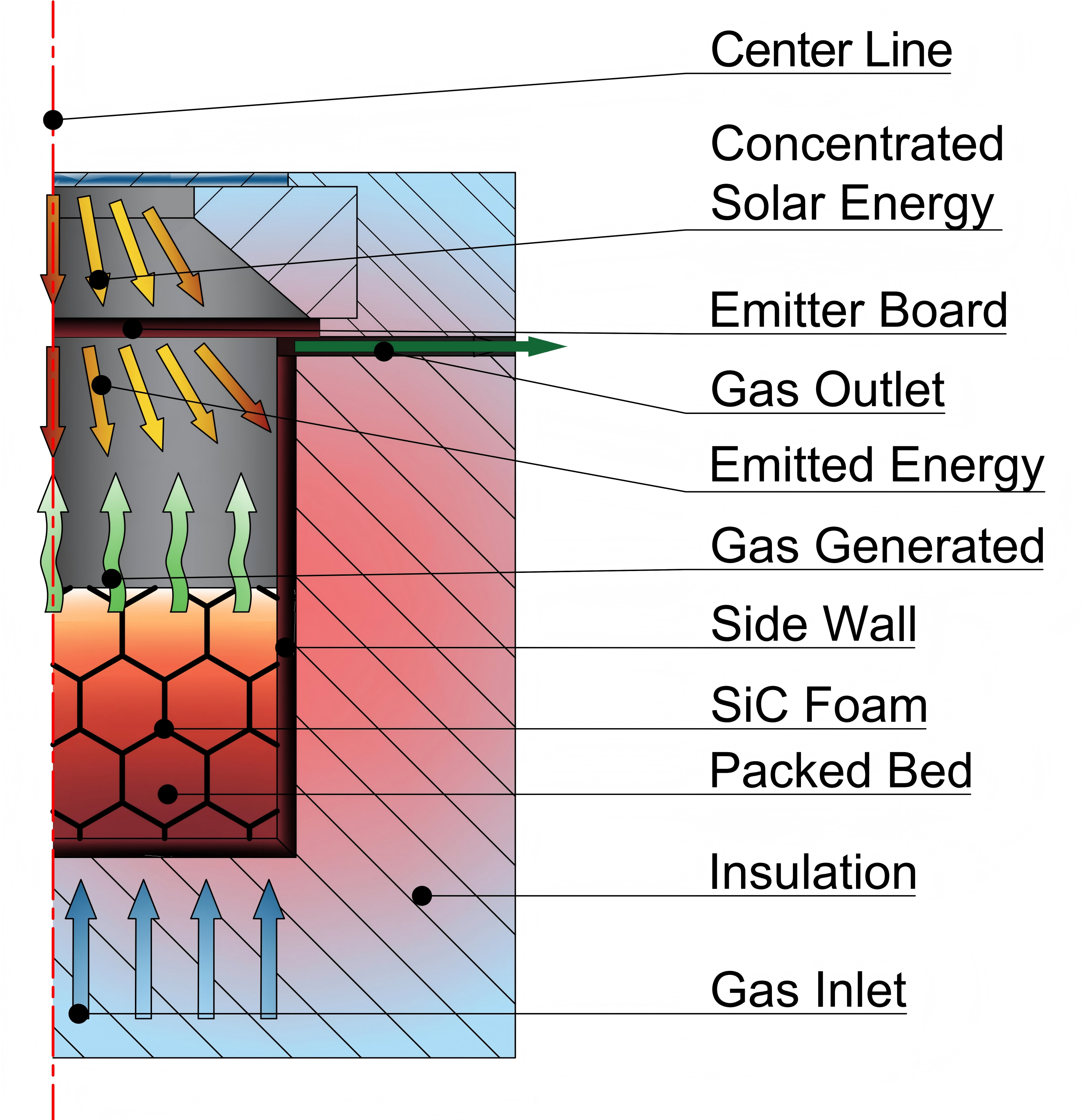
This study performed a CFD-based analysis to assess the reaction-region expansion potential of a solar-driven biomass pyrolysis reactor packed with SiC foam. Reacted volume fraction (RVF), temperature volume fraction (TVF), and the operational conversion front defined by the 700 K isotherm were used to quantify the formation and propagation of the effective reaction region. The results show that the operational conversion front in the SiC foam reactor continued to propagate toward the unreacted region without apparent stagnation. The available time window for further front propagation was approximately five times larger than the time required to cover the remaining unreacted region near the original bed. Moreover, under a conservative assumption for a 12.5% reactor extension, the required finite axial temperature gradient was about two orders of magnitude larger than the local axial temperature gradient at the original bed end. These results indicate that the expanded reaction region can compensate for the feedstock loading capacity loss caused by the SiC foam skeleton, while the reactor still retains further expansion potential.
- Open Access
- Article
Spatiotemporal Evolution and Expansion Potential of the Reaction Zone in a Solar-Driven Biomass Pyrolysis Reactor Packed with SiC Foam
- Yang Liu 1,
- Ruming Pan 2,*,
- Renaud Ansart 3,
- Gérald Debenest 1,*
Author Information
Received: 27 May 2026 | Revised: 23 Jun 2026 | Accepted: 29 Jun 2026 | Published: 01 Jul 2026
Abstract
Graphical Abstract
Keywords
solar-driven pyrolysis | biomass | SiC foam | reaction zone expansion | conversion front | CFD
References
- 1.
El-Fawal, E.M.; El Naggar, A.M.A.; El-Zahhar, A.A.; et al. Biofuel production from waste residuals: Comprehensive insights into biomass conversion technologies and engineered biochar applications. RSC Adv. 2025, 15, 11942–11974. https://doi.org/10.1039/D5RA00857C.
- 2.
Pan, H.; Li, J.; Wang, Y.; et al. Solar-driven biomass reforming for hydrogen generation: Principles, advances, and challenges. Adv. Sci. 2024, 11, 2402651. https://doi.org/10.1002/advs.202402651.
- 3.
Makkawi, Y.; Ibrahim, M.; Yasir, N.; et al. Solar-thermal conversion of biomass: Principles of solar concentrators/reactors, reported studies, and prospects for large-scale implementation. Fuel Process. Technol. 2024, 264, 108139. https://doi.org/10.1016/j.fuproc.2024.108139.
- 4.
Zhao, J.; Korba, D.; Mishra, A.; et al. Particle-based high-temperature thermochemical energy storage reactors. Prog. Energy Combust. Sci. 2024, 102, 101143. https://doi.org/10.1016/j.pecs.2024.101143.
- 5.
Bellan, S.; Kodama, T.; Gokon, N.; et al. A review on high-temperature thermochemical heat storage: Particle reactors and materials based on solid–gas reactions. WIREs Energy Environ. 2022, 11, e440. https://doi.org/10.1002/wene.440.
- 6.
Guo, Y.; Chen, J.; Song, H.; et al. A review of solar thermochemical cycles for fuel production. Appl. Energy 2024, 357, 122499. https://doi.org/10.1016/j.apenergy.2023.122499.
- 7.
Chen, C.; Jiao, F.; Lu, B.; et al. Challenges and perspectives for solar fuel production from water/carbon dioxide with thermochemical cycles. Carbon Neutrality 2023, 2, 9. https://doi.org/10.1007/s43979-023-00048-6.
- 8.
Brendelberger, S.; Rosenstiel, A.; Lopez-Roman, A.; et al. Performance analysis of operational strategies for monolithic receiver-reactor arrays in solar thermochemical hydrogen production plants. Int. J. Hydrogen Energy 2020, 45, 26104–26116. https://doi.org/10.1016/j.ijhydene.2020.06.191.
- 9.
Li, S.; Wheeler, V.M.; Kumar, A.; et al. Thermodynamic guiding principles for designing nonstoichiometric redox materials for solar thermochemical fuel production: Ceria, perovskites, and beyond. Energy Technol. 2022, 10, 2000925. https://doi.org/10.1002/ente.202000925.
- 10.
Li, L.; Rahbari, A.; Taheri, M.; et al. Experimental evaluation of an indirectly-irradiated packed-bed solar thermochemical reactor for calcination-carbonation chemical looping. Chem. Eng. J. 2023, 468, 143543. https://doi.org/10.1016/j.cej.2023.143543.
- 11.
Ullah, F.; Hasrat, K.; Mu, M.; et al. Optimizing solar-biomass pyrolysis: Innovations in reactor design and thermal-solar system efficiency. Energies 2025, 18, 2640. https://doi.org/10.3390/en18102640.
- 12.
Dai, X.; Haussener, S. Non-uniform porous structures and cycling control for optimized fixed-bed solar thermochemical water splitting. J. Sol. Energy Eng. 2022, 144, 030904. https://doi.org/10.1115/1.4052960.
- 13.
Bulfin, B.; Miranda, M.; Steinfeld, A. Performance indicators for benchmarking solar thermochemical fuel processes and reactors. Front. Energy Res. 2021, 9, 677980. https://doi.org/10.3389/fenrg.2021.677980.
- 14.
Khan, M.I.; Mishamandani, A.S.; Asfand, F.; et al. Solar driven calcium-looping for thermochemical energy storage system and carbon capture in power and cement industry: A review. Process Saf. Environ. Prot. 2025, 193, 886–917. https://doi.org/10.1016/j.psep.2024.11.067.
- 15.
Abanades, S.; Rodat, S.; Boujjat, H. Solar thermochemical green fuels production: A review of biomass pyro-gasification, solar reactor concepts and modelling methods. Energies 2021, 14, 1494. https://doi.org/10.3390/en14051494.
- 16.
Liu, Y.; Pan, R.; Ansart, R.; et al. Numerical simulation of solar-driven biomass gasification by using ceramic foam. Process Saf. Environ. Prot. 2024, 184, 300–313. https://doi.org/10.1016/j.psep.2024.02.008.
- 17.
Liu, Y.; Pan, R.; Ansart, R.; et al. Optimization and analysis of solar-driven biomass gasification using a CFD-ANN-GA framework. Energy 2025, 325, 136036. https://doi.org/10.1016/j.energy.2025.136036.
- 18.
Piatkowski, N.; Wieckert, C.; Steinfeld, A. Experimental investigation of a packed-bed solar reactor for the steam-gasification of carbonaceous feedstocks. Fuel Process. Technol. 2009, 90, 360–366. https://doi.org/10.1016/j.fuproc.2008.10.007.
- 19.
Liu, Y.; Pan, R.; Ansart, R.; et al. Efficient Biomass Pyrolysis under Sub-Design Solar Input through SiC Foam Integration and Process Parameter Tuning. 2026. Available online: https://ssrn.com/abstract=5327617 (accessed on 29 June 2026).
- 20.
Debiagi, P.; Gentile, G.; Cuoci, A.; et al. A predictive model of biochar formation and characterization. J. Anal. Appl. Pyrolysis 2018, 134, 326–335. https://doi.org/10.1016/j.jaap.2018.06.022.
- 21.
Lao, Z.; Shao, Y.; Gao, X. Multiscale CFD modeling of high-temperature biomass pyrolysis with an intraparticle particle model and detailed pyrolysis kinetics. Ind. Eng. Chem. Res. 2022, 61, 16843–16856. https://doi.org/10.1021/acs.iecr.2c02992.
- 22.
Brebu, M.; Ioniță, D.; Stoleru, E. Thermal behavior and conversion of agriculture biomass residues by torrefaction and pyrolysis. Sci. Rep. 2025, 15, 11505. https://doi.org/10.1038/s41598-025-88001-8.
- 23.
Rosero Espín, M.V.; Muñoz Borja, M.A.; Narvaez Cueva, R.A.; et al. Identification and comparison of pyrolysis products of different biomasses from agro-industrial using TGA-FTIR and Py-GC/MS. Int. J. Renew. Energy Dev. 2026, 15, 305–321. https://doi.org/10.61435/ijred.2026.61812.


This work is licensed under a Creative Commons Attribution 4.0 International License.

 Suite 4002 Level 4, 447 Collins Street, Melbourne, Victoria 3000, Australia
 General Inquiries: info@sciltp.com