
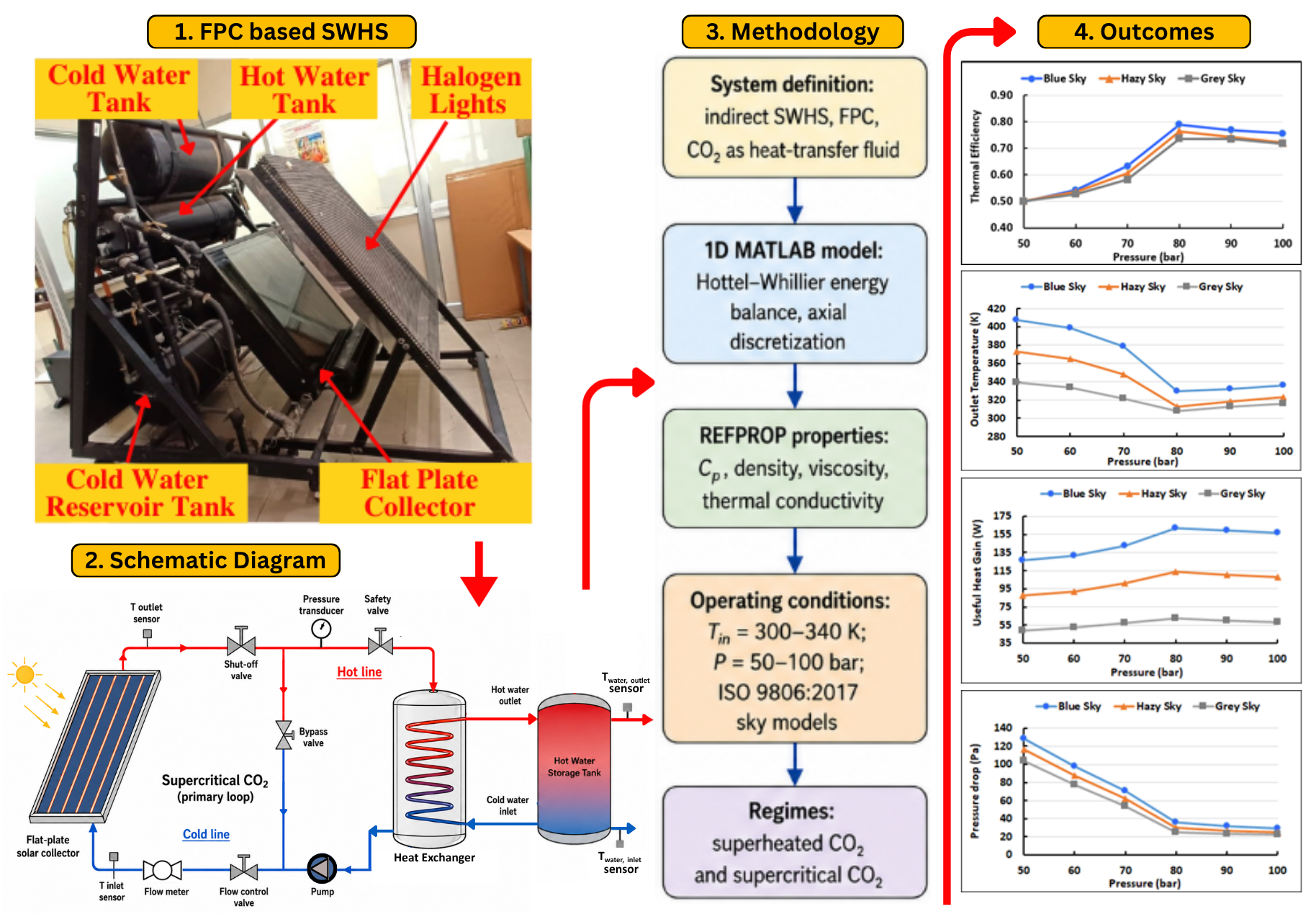
This study presents a thermal-hydraulic assessment of an indirect solar water heating system employing carbon dioxide (CO2) as the heat-transfer fluid in a flat-plate collector. The work compares superheated and supercritical operating regimes under identical geometric, flow, and standardized outdoor conditions. A distributed one-dimensional MATLAB model is formulated by coupling the Hottel-Whillier energy balance with real-gas CO2 thermophysical properties obtained by integrating REFPROP. The collector tube is discretized axially to capture the strong variations in specific heat, density, viscosity, thermal conductivity, Nusselt number, pressure drop, and local heat transfer coefficient near the critical and pseudo-critical regions. The model is evaluated for inlet temperatures of 300–340 K and operating pressures of 50–100 bar under blue-sky, hazy-sky, and grey-sky Standard Reporting Conditions of ISO 9806:2017. The analysis shows that operating near 80 bar provides the most favorable thermal-hydraulic outcomes. The heat transfer improves due to enhanced real-gas properties, while hydraulic loss and pumping power decrease because of the higher density and lower flow velocity of pressurized CO2. Within the investigated range, supercritical operation improves collector efficiency by approximately 15–20% compared with superheated operation at comparable boundary conditions. The results provide design guidance for CO2-based solar thermal collectors and highlight that high-pressure material selection, sealing, safety, and techno-economic assessment are necessary before practical deployment.
- Open Access
- Article
Thermal-Hydraulic Performance of a Solar Flat Plate Collector Using CO2 under Superheated and Supercritical Regimes
- Wasim Ashraf 1,*,
- Maddali Ramgopal 2,
- Mahendra V. Reddy 2
Author Information
Received: 04 Feb 2026 | Revised: 28 Jul 2026 | Accepted: 21 Aug 2026 | Published: 31 Aug 2026
Abstract
Graphical Abstract
Keywords
indirect solar water heating system | flat plate collector | thermophysical properties of CO2 | superheated and supercritical-CO2 | thermal hydraulic model
References
- 1.
World Energy Outlook 2023. Available online: https://www.iea.org/reports/world-energy-outlook-2023 (accessed on 15 December 2025).
- 2.
IMPRI Impact and Policy Research Institute. Available online: https://www.impriindia.com/insights/the-ministry-of-power/ (accessed on 10 January 2026).
- 3.
The Ministry of New and Renewable Energy, India. Available online: https://mnre.gov.in/en/other-report/ (accessed on 12 January 2026).
- 4.
Kalogirou, S.A. Solar Thermal Collectors and Applications. Prog. Energy Combust. Sci. 2004, 30, 231–295. https://doi.org/10.1016/j.pecs.2004.02.001.
- 5.
Pandey, K.M.; Chaurasiya, R. A Review on Analysis and Development of Solar Flat Plate Collector. Renew. Sustain. Energy Rev. 2017, 67, 641–650. https://doi.org/10.1016/j.rser.2016.09.078.
- 6.
Kalogirou, S. Thermal Performance, Economic and Environmental Life Cycle Analysis of Thermosiphon Solar Water Heaters. Sol. Energy 2009, 83, 39–48. https://doi.org/10.1016/j.solener.2008.06.005.
- 7.
Larsen, K. Heating and Cooling Europe with Solar. Renew. Energy Focus 2010, 11, 56–61. https://doi.org/10.1016/s1755-0084(10)70056-9.
- 8.
Sundar, L.S.; Misganaw, A.H.; Singh, M.K.; et al. Efficiency, Energy and Economic Analysis of Twisted Tape Inserts in a Thermosyphon Solar Flat Plate Collector with Cu Nanofluids. Renew. Energy Focus 2020, 35, 10–31. https://doi.org/10.1016/j.ref.2020.06.004.
- 9.
Hottel, H.C.; Whillier, A. Evaluation of Flat-Plate Solar-Collector Performance. In Proceedings of the Conference on the Use of Solar Energy, Tucson, AZ, USA, 31 October–1 November 1955.
- 10.
Ashraf, W.; Ramgopal, M.; Reddy, V.M. Performance Analysis of an S-CO2 Based Solar Flat Plate Collector. In Proceedings of the International Conference on Advances in Energy Research, Singapore, 7–9 July 2022; pp. 385–395.
- 11.
Faizal, M.; Saidur, R.; Mekhilef, S.; et al. Energy, Economic and Environmental Analysis of Metal Oxides Nanofluid for Flat-Plate Solar Collector. Energy Convers. Manag. 2013, 76, 162–168. https://doi.org/10.1016/j.enconman.2013.07.038.
- 12.
Tyagi, H.; Phelan, P.; Prasher, R. Predicted Efficiency of a Low Temperature Nanofluid-Based Direct Absorption Solar Collector. J. Sol. Energy Eng. 2009, 131, 041004. https://doi.org/10.1115/1.3197562.
- 13.
Alfellag, M.A.; Kazi, S.N.; Hasnain, S.U.; et al. Experimental Evaluation of Flat-Plate Solar Collector Performance with Eco-Friendly MWCNTs/hBN Hybrid Nanofluids: Energy, Exergy, Hydrothermal, Economic, and Environmental Analysis. Energy 2025, 339, 139070. https://doi.org/10.1016/j.energy.2025.139070.
- 14.
Wang, X.Q.; Mujumdar, A.S. Heat Transfer Characteristics of Nanofluids: A Review. Int. J. Therm. Sci. 2007, 46, 1–19. https://doi.org/10.1016/j.ijthermalsci.2006.06.010.
- 15.
Said, Z.; Sabiha, M.A.; Saidur, R.; et al. Performance Enhancement of a Flat Plate Solar Collector Using Titanium Dioxide Nanofluid and Polyethylene Glycol Dispersant. J. Clean. Prod. 2015, 92, 343–353. https://doi.org/10.1016/j.jclepro.2015.01.007.
- 16.
Sarkar, J.; Bhattacharyya, S.; Gopal, M.R. Transcritical CO2 Heat Pump Dryer: Part 1. Mathematical Model and Simulation. Dry. Technol. 2006, 24, 1583–1591. https://doi.org/10.1080/07373930601030903.
- 17.
Sarkar, J. Performance of a Flat-Plate Solar Thermal Collector Using Supercritical Carbon Dioxide as Heat Transfer Fluid. Int. J. Sustain. Energy 2013, 32, 531–543. https://doi.org/10.1080/14786451.2013.833205.
- 18.
Yamaguchi, H.; Zhang, X.R.; Fujima, K. Basic Study on New Cryogenic Refrigeration Using CO2 Solid–Gas Two Phase Flow. Int. J. Refrig. 2008, 31, 404–410. https://doi.org/10.1016/j.ijrefrig.2007.08.001.
- 19.
Biradar, M.K.; Parmar, D.N.; Yadav, A.K. CFD and Exergy Analysis of Subcritical/Supercritical CO2 Based Naturally Circulated Solar Thermal Collector. Renew. Energy 2022, 189, 865–880. https://doi.org/10.1016/j.renene.2022.03.056.
- 20.
Sarwar, J.; Khan, M.R.; Rehan, M.; et al. Performance Analysis of a Flat Plate Collector to Achieve a Fixed Outlet Temperature under Semi-Arid Climatic Conditions. Sol. Energy 2020, 207, 503–516. https://doi.org/10.1016/j.solener.2020.06.088.
- 21.
Kiran Kumar, K.; Ram Gopal, M. Steady-State Analysis of CO2 Based Natural Circulation Loops with End Heat Exchangers. Appl. Therm. Eng. 2009, 29, 1893–1903. https://doi.org/10.1016/j.applthermaleng.2008.08.002.
- 22.
Yamaguchi, H.; Sawada, N.; Suzuki, H.; et al. Preliminary Study on a Solar Water Heater Using Supercritical Carbon Dioxide as Working Fluid. J. Sol. Energy Eng. 2010, 132, 011010. https://doi.org/10.1115/1.4000350.
- 23.
Ochsner, K. Carbon Dioxide Heat Pipe in Conjunction with a Ground Source Heat Pump (GSHP). Appl. Therm. Eng. 2008, 28, 2077–2082. https://doi.org/10.1016/j.applthermaleng.2008.04.023.
- 24.
Pitla, S.S.; Robinson, D.M.; Groll, E.A.; et al. Heat Transfer from Supercritical Carbon Dioxide in Tube Flow: A Critical Review. HVAC&R Res. 1998, 4, 281–301. https://doi.org/10.1080/10789669.1998.10391405.
- 25.
Yamaguchi, H.; Zhang, X.R.; Fujima, K.; et al. Solar Energy Powered Rankine Cycle Using Supercritical CO2. Appl. Therm. Eng. 2006, 26, 2345–2354. https://doi.org/10.1016/j.applthermaleng.2006.02.029.
- 26.
Yohanis, Y.G.; Popel, O.S.; Frid, S.E.; et al. Detailed Comparison of the Performance of Flat-Plate and Vacuum Tube Solar Collectors for Domestic Hot Water Heating. Int. J. Sustain. Energy 2012, 31, 347–364. https://doi.org/10.1080/14786451.2012.661733.
- 27.
ISO 9806:2017; Solar Energy—Solar Thermal Collectors—Test Methods. International Organization for Standardization: Geneva, Switzerland, 2017. Available online: https://www.iso.org/standard/67978.html (accessed on 12 February, 2026).
- 28.
Huber, M.L.; Lemmon, E.W.; Bell, I.H.; et al. The NIST REFPROP Database for Highly Accurate Properties of Industrially Important Fluids. Ind. Eng. Chem. Res. 2022, 61, 15449–15472. https://doi.org/10.1021/acs.iecr.2c01427.
- 29.
Jafarkazemi, F.; Ahmadifard, E. Energetic and Exergetic Evaluation of Flat Plate Solar Collectors. Renew. Energy 2013, 56, 55–63. https://doi.org/10.1016/j.renene.2012.10.031.
- 30.
Duffie, J.A.; Beckman, W.A. Solar Engineering of Thermal Processes; Wiley: New York, NY, USA, 2013.
- 31.
Ashraf, W.; Ramgopal, M. Performance of Solar Flat Plate Collectors with S-CO2 as Heat Transfer Fluid. In Proceedings of the 16th International Conference on Applied Energy (ICAE2024), Niigata, Japan, 1–5 September 2024. https://doi.org/10.46855/energy-proceedings-11580.
- 32.
Ashraf, W.; Ramgopal, M. Comparative Evaluation of S-CO2 with Antifreeze Heat Transfer Fluids as an Application in Solar Flat Plate Collectors. In Proceedings of the Fluid Mechanics and Fluid Power (FMFP) 2023, Rajasthan, India, 20–22 December 2023. https://doi.org/10.1007/978-981-96-9600-0_25.
- 33.
Budynas, R.G.; Nisbett, J.K. Shigley’s Mechanical Engineering Design, 10th ed.; McGraw-Hill: New York, NY, USA, 2015.
- 34.
Budynas, R.G.; Nisbett, J.K. Shigley’s Mechanical Engineering Design, 11th ed.; McGraw-Hill: New York, NY, USA, 2020.
- 35.
ASME B31.3-2024; Process Piping. American Society of Mechanical Engineers: New York, NY, USA, 2024.
- 36.
Tubing Data Sheet: Suggested Allowable Working Pressures for Carbon Steel, Stainless Steel, Copper, Aluminium and Additional-Alloy Tubing. Available online: https://www.swagelok.com/downloads/webcatalogs/en/ms-01-107.pdf (accessed on 21 July, 2026).
- 37.
ASTM B210-12; Standard Specification for Aluminum and Aluminum-Alloy Drawn Seamless Tubes. ASTM International: West Conshohocken, PA, USA, 2019.


This work is licensed under a Creative Commons Attribution 4.0 International License.

 Suite 4002 Level 4, 447 Collins Street, Melbourne, Victoria 3000, Australia
 General Inquiries: info@sciltp.com