
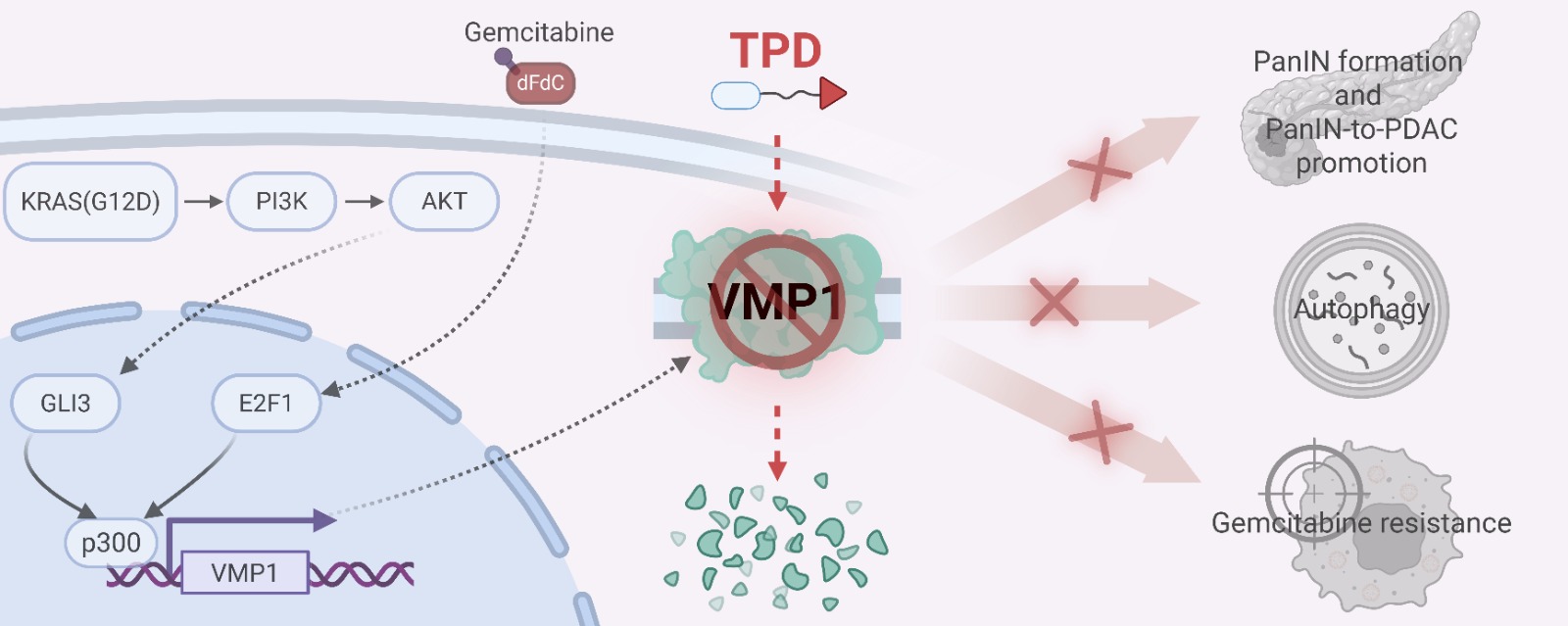
Pancreatic ductal adenocarcinoma (PDAC) remains one of the most lethal malignancies, with a five-year survival rate below 12%. The intrinsic chemoresistance of PDAC underscores the urgent need for novel therapeutic targets. Vacuole Membrane Protein 1 (VMP1) is a transmembrane protein that functions as a master regulator of autophagy, phospholipid scrambling, and membrane contact site dynamics. VMP1 is markedly overexpressed in PDAC downstream of oncogenic KRAS. Recent work from our group demonstrated that VMP1 is regulated by non-degradative polyubiquitination. Here, we review VMP1 biology and its regulation by the ubiquitin system, proposing it as an attractive candidate for Targeted Protein Degradation (TPD). We discuss how emerging TPD platforms could be leveraged to selectively eliminate VMP1, thereby establishing a conceptual framework for next-generation therapeutic approaches in pancreatic cancer.
- Open Access
- Review
VMP1 in Pancreatic Cancer: A Rationale for Targeted Protein Degradation
Author Information
Received: 24 July 2026 | Revised: 14 October 2026 | Accepted: 21 October 2026 | Published: 03 November 2026
Abstract
Graphical Abstract
Keywords
pancreatic ductal adenocarcinoma (PDAC) | VMP1 | targeted protein degradation (TPD) | autophagy | ubiquitination | KRAS
References
- 1.
Stoop, T.F.; Javed, A.A.; Oba, A.; et al. Pancreatic Cancer. Lancet 2025, 405, 1182–1202.
- 2.
Shah, A.; Ganguly, K.; Rauth, S.; et al. Unveiling the resistance to therapies in pancreatic ductal adenocarcinoma. Drug Resist. Updates 2024, 77, 101146. https://doi.org/10.1016/j.drup.2024.101146.
- 3.
Connor, A.A.; Gallinger, S. Pancreatic cancer evolution and heterogeneity: Integrating omics and clinical data. Nat. Rev. Cancer 2022, 22, 131–142. https://doi.org/10.1038/s41568-021-00418-1.
- 4.
Yang, S.; Wang, X.; Contino, G.; et al. Pancreatic cancers require autophagy for tumor growth. Genes Dev. 2011, 25, 717–729. https://doi.org/10.1101/gad.2016111.
- 5.
Guo, J.Y.; Chen, H.Y.; Mathew, R.; et al. Activated Ras requires autophagy to maintain oxidative metabolism and tumorigenesis. Genes Dev. 2011, 25, 460–470. https://doi.org/10.1101/gad.2016311.
- 6.
Guilbaud, E.; Ryan, K.M.; Green, D.R.; et al. Autophagy modulation in cancer. Nat. Rev. Drug Discov. 2026, 25, 701–722. https://doi.org/10.1038/s41573-026-01449-9.
- 7.
Hama, Y.; Morishita, H.; Mizushima, N. Regulation of ER-Derived Membrane Dynamics by the DedA Domain-Containing Proteins VMP1 and TMEM41B. EMBO Rep. 2022, 23, e53894.
- 8.
Grasso, D.; Renna, F.J.; Vaccaro, M.I. Initial Steps in Mammalian Autophagosome Biogenesis. Front. Cell Dev. Biol. 2018, 6, 146. https://doi.org/10.3389/fcell.2018.00146.
- 9.
Renna, F.J.; Gonzalez, C.D.; Vaccaro, M.I. Decoding the Versatile Landscape of Autophagic Protein VMP1 in Cancer: A Comprehensive Review across Tissue Types and Regulatory Mechanisms. Int. J. Mol. Sci. 2024, 25, 3758. https://doi.org/10.3390/ijms25073758.
- 10.
Renna, F.J.; Enriqué Steinberg, J.H.; Gonzalez, C.D.; et al. Ubiquitination Is a Novel Post-Translational Modification of VMP1 in Autophagy of Human Tumor Cells. Int. J. Mol. Sci. 2023, 24, 12981. https://doi.org/10.3390/ijms241612981.
- 11.
Grasso, D.; Ropolo, A.; Lo Ré, A.; et al. Zymophagy, a Novel Selective Autophagy Pathway Mediated by VMP1-USP9x-p62, Prevents Pancreatic Cell Death. J. Biol. Chem. 2011, 286, 8308–8324. https://doi.org/10.1074/jbc.m110.197301.
- 12.
Vargas, J.N.S.; Hamasaki, M.; Kawabata, T.; et al. The mechanisms and roles of selective autophagy in mammals. Nat. Rev. Mol. Cell Biol. 2023, 24, 167–185. https://doi.org/10.1038/s41580-022-00542-2.
- 13.
Zhao, Y.G.; Chen, Y.; Miao, G.; et al. The ER-Localized Transmembrane Protein EPG-3/VMP1 Regulates SERCA Activity to Control ER-Isolation Membrane Contacts for Autophagosome Formation. Mol. Cell 2017, 67, 974–989.e6. https://doi.org/10.1016/j.molcel.2017.08.005.
- 14.
Li, Y.E.; Wang, Y.; Du, X.; et al. TMEM41B and VMP1 are scramblases and regulate the distribution of cholesterol and phosphatidylserine. J. Cell Biol. 2021, 220, e202103105. https://doi.org/10.1083/jcb.202103105.
- 15.
Ghanbarpour, A.; Valverde, D.P.; Melia, T.J.; et al. A model for a partnership of lipid transfer proteins and scramblases in membrane expansion and organelle biogenesis. Proc. Natl. Acad. Sci. USA 2021, 118, e2101562118. https://doi.org/10.1073/pnas.2101562118.
- 16.
Jiang, X.; Fulte, S.; Deng, F.; et al. Lack of VMP1 impairs hepatic lipoprotein secretion and promotes non-alcoholic steatohepatitis. J. Hepatol. 2022, 77, 619–631. https://doi.org/10.1016/j.jhep.2022.04.010.
- 17.
Nascimbeni, A.C.; Giordano, F.; Dupont, N.; et al. ER–plasma membrane contact sites contribute to autophagosome biogenesis by regulation of local PI3P synthesis. EMBO J. 2017, 36, 2018–2033. https://doi.org/10.15252/embj.201797006.
- 18.
Vanasco, V.; Ropolo, A.; Grasso, D.; et al. Mitochondrial Dynamics and VMP1-Related Selective Mitophagy in Experimental Acute Pancreatitis. Front. Cell Dev. Biol. 2021, 9, 640094. https://doi.org/10.3389/fcell.2021.640094.
- 19.
Boggio, V.; Gonzalez, C.D.; Zotta, E.; et al. VMP1 Constitutive Expression in Mice Dampens Pancreatic and Systemic Histopathological Damage in an Experimental Model of Severe Acute Pancreatitis. Int. J. Mol. Sci. 2025, 26, 3196. https://doi.org/10.3390/ijms26073196.
- 20.
Wang, S.; Chao, X.; Jiang, X.; et al. Loss of acinar cell VMP1 triggers spontaneous pancreatitis in mice. Autophagy 2022, 18, 1572–1582. https://doi.org/10.1080/15548627.2021.1990672.
- 21.
Bai, R.; Rebelo, A.; Kleeff, J.; et al. Identification of Prognostic Lipid Droplet-Associated Genes in Pancreatic Cancer Patients via Bioinformatics Analysis. Lipids Health Dis. 2021, 20, 58.
- 22.
Loncle, C.; Molejon, M.I.; Lac, S.; et al. The pancreatitis-associated protein VMP1, a key regulator of inducible autophagy, promotes KrasG12D-mediated pancreatic cancer initiation. Cell Death Dis. 2016, 7, e2295. https://doi.org/10.1038/cddis.2016.202.
- 23.
Li, J.; Chen, X.; Kang, R.; et al. Regulation and function of autophagy in pancreatic cancer. Autophagy 2021, 17, 3275–3296. https://doi.org/10.1080/15548627.2020.1847462.
- 24.
Dikic, I.; Schulman, B.A. An expanded lexicon for the ubiquitin code. Nat. Rev. Mol. Cell Biol. 2023, 24, 273–287. https://doi.org/10.1038/s41580-022-00543-1.
- 25.
Ebadi, P.; Stratton, C.M.; Olsen, S.K. E3 ubiquitin ligases in signaling, disease, and therapeutics. Trends Biochem. Sci. 2025, 50, 960–976. https://doi.org/10.1016/j.tibs.2025.07.009.
- 26.
Müller, M.; Winklhofer, K.F.; Reggiori, F. The role of E3 ubiquitin ligases in selective types of macroautophagy. EMBO Rep. 2026, 27, 4950–4968. https://doi.org/10.1038/s44319-026-00887-1.
- 27.
Yau, R.; Rape, M. The increasing complexity of the ubiquitin code. Nat. Cell Biol. 2016, 18, 579–586. https://doi.org/10.1038/ncb3358.
- 28.
Yang, X.; Lan, T.; Zhang, B.; et al. Targeting Ubiquitination in Disease and Therapy. Signal Transduct. Target. Ther. 2025, 10, 424.
- 29.
Lange, S.M.; Armstrong, L.A.; Kulathu, Y. Deubiquitinases: From mechanisms to their inhibition by small molecules. Mol. Cell 2022, 82, 15–29. https://doi.org/10.1016/j.molcel.2021.10.027.
- 30.
Chen, R.H.; Chen, Y.H.; Huang, T.Y. Ubiquitin-Mediated Regulation of Autophagy. J. Biomed. Sci. 2019, 26, 80.
- 31.
Karanasios, E.; Walker, S.A.; Okkenhaug, H.; et al. Autophagy initiation by ULK complex assembly on ER tubulovesicular regions marked by ATG9 vesicles. Nat. Commun. 2016, 7, 12420. https://doi.org/10.1038/ncomms12420.
- 32.
Mazian, M.A.; Yamanishi, K.; Rahman, M.Z.A.; et al. CRL4Cdt2 Ubiquitin Ligase, A Genome Caretaker Controlled by Cdt2 Binding to PCNA and DNA. Genes 2022, 13, 266. https://doi.org/10.3390/genes13020266.
- 33.
Tavlas, P.; Nikou, S.; Geramoutsou, C.; et al. CUL4A Ubiquitin Ligase Is an Independent Predictor of Overall Survival in Pancreatic Adenocarcinoma. Cancer Genom.-Proteom. 2024, 21, 166–177. https://doi.org/10.21873/cgp.20438.
- 34.
Békés, M.; Langley, D.R.; Crews, C.M. PROTAC targeted protein degraders: The past is prologue. Nat. Rev. Drug Discov. 2022, 21, 181–200. https://doi.org/10.1038/s41573-021-00371-6.
- 35.
Zhong, G.; Chang, X.; Xie, W.; et al. Targeted Protein Degradation: Advances in Drug Discovery and Clinical Practice. Signal Transduct. Target. Ther. 2024, 9, 308.
- 36.
Zhao, L.; Zhao, J.; Zhong, K.; et al. Targeted protein degradation: Mechanisms, strategies and application. Signal Transduct. Target. Ther. 2022, 7, 113. https://doi.org/10.1038/s41392-022-00966-4.
- 37.
Wu, Y.; Lin, B.; Lu, Y.; et al. Aptamer-LYTACs for Targeted Degradation of Extracellular and Membrane Proteins. Angew. Chem. Int. Ed. 2023, 62, e202218106. https://doi.org/10.1002/anie.202218106.
- 38.
Banik, S.M.; Pedram, K.; Wisnovsky, S.; et al. Lysosome-targeting chimaeras for degradation of extracellular proteins. Nature 2020, 584, 291–297. https://doi.org/10.1038/s41586-020-2545-9.
- 39.
Takahashi, D.; Arimoto, H. Targeting selective autophagy by AUTAC degraders. Autophagy 2020, 16, 765–766. https://doi.org/10.1080/15548627.2020.1718362.
- 40.
Pei, J.; Pan, X.; Wang, A.; et al. Developing potent LC3-targeting AUTAC tools for protein degradation with selective autophagy. Chem. Commun. 2021, 57, 13194–13197. https://doi.org/10.1039/d1cc04661f.
- 41.
Bao, J.; Chen, Z.; Li, Y.; et al. Discovery of Novel PDEδ Autophagic Degraders: A Case Study of Autophagy-Tethering Compound (ATTEC). ACS Med. Chem. Lett. 2024, 15, 29–35. https://doi.org/10.1021/acsmedchemlett.3c00161.
- 42.
Shi, S.; Du, Y.; Zou, Y.; et al. Rational Design for Nitroreductase (NTR)-Responsive Proteolysis Targeting Chimeras (PROTACs) Selectively Targeting Tumor Tissues. J. Med. Chem. 2022, 65, 5057–5071. https://doi.org/10.1021/acs.jmedchem.1c02221.
- 43.
Serafini, M.; Twigger, S.A.; Delfas, G.; et al. Indolequinone-Based Hypoxia-Activated Proteolysis Targeting Chimeras Selectively Degrade BRD4 in Hypoxic Cancer Cells. J. Am. Chem. Soc. 2025, 147, 36352–36364. https://doi.org/10.1021/jacs.5c10240.
- 44.
Pillow, T.H.; Adhikari, P.; Blake, R.A.; et al. Antibody Conjugation of a Chimeric BET Degrader Enables in vivo Activity. ChemMedChem 2020, 15, 17–25. https://doi.org/10.1002/cmdc.201900497.
- 45.
Ocaña, A.; Pandiella, A. Proteolysis Targeting Chimeras (PROTACs) in Cancer Therapy. J. Exp. Clin. Cancer Res. 2020, 39, 189.
- 46.
Yang, X.; Wang, D.; Li, C.; et al. Nano-PROTACs for Precision Medicine: Engineering Strategies for Enhanced Targeting and Potency. J. Nanobiotechnology 2026, 24, 120.
- 47.
Zheng, Y.; Singh, A.; Niu, Z.; et al. In-Cell Approach to Evaluate E3 Ligases for Use in Targeted Protein Degradation. J. Am. Chem. Soc. 2025, 147, 21560–21574. https://doi.org/10.1021/jacs.5c02741.

This work is licensed under a Creative Commons Attribution 4.0 International License.
