
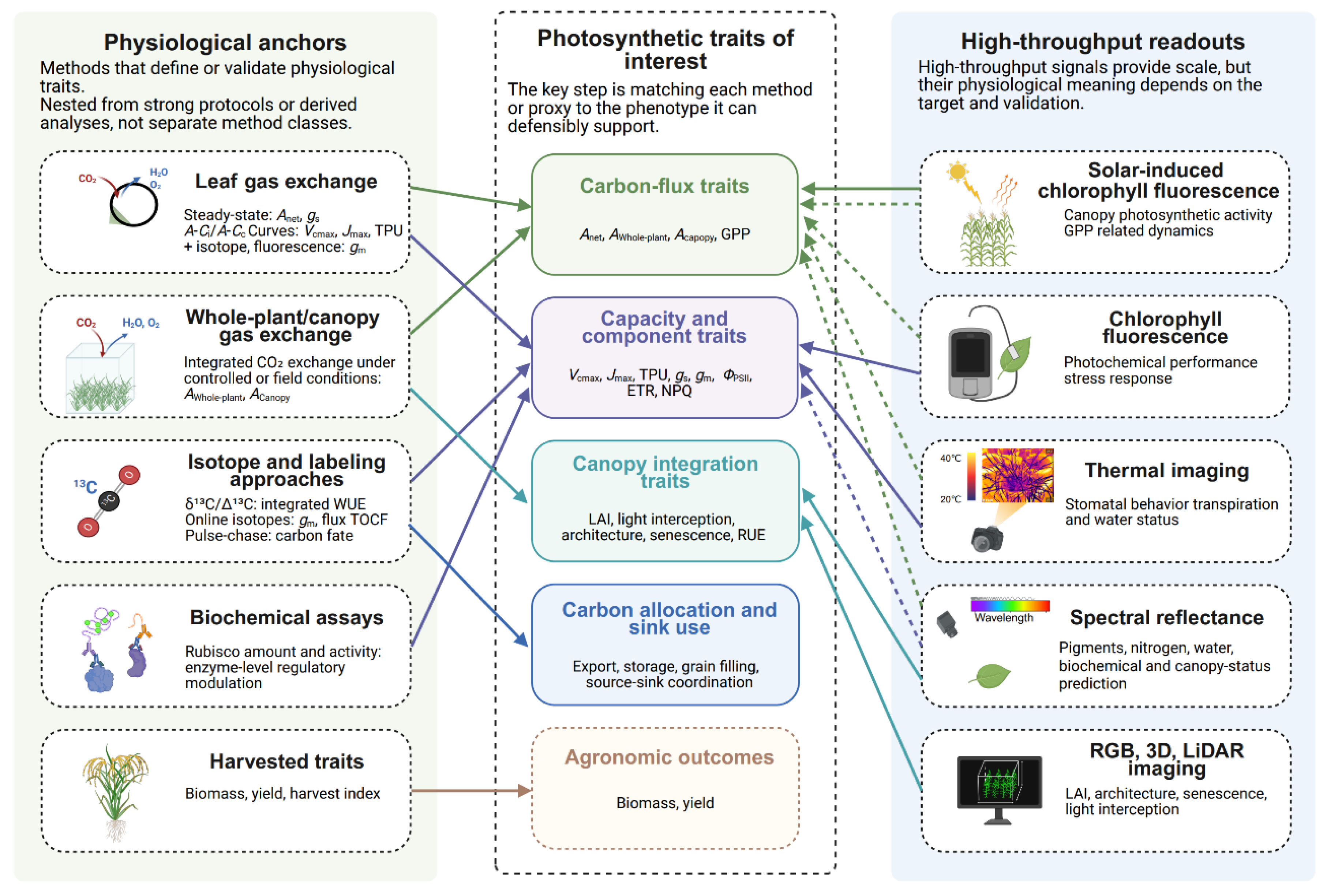
Photosynthesis phenotyping is increasingly important for crop improvement, but its main limitation is not measurement throughput alone. It is the physiological interpretation of scalable signals. Direct methods, including gas exchange, CO2 response analysis, isotope-based approaches, and canopy flux measurements, define photosynthetic carbon assimilation and capacity, but remain difficult to deploy at scale. Optical and imaging approaches provide high-throughput observations of plant function, but they mainly capture indirect, context-dependent signals. We argue that a core challenge in the field is the frequent conflation of proxy measurements with photosynthetic carbon assimilation. Scalable traits often reflect integrated physiological states rather than carbon flux itself, and their relationship to photosynthesis depends on environmental context, biological scale, and the processes limiting carbon gain. Progress will therefore require treating scalable measurements as inferential signals rather than direct physiological quantities. It will also require stronger physiological benchmarks and validation frameworks across genotypes, environments, developmental stages, and spatial scales.
- Open Access
- Review
Photosynthesis Phenotyping: Where Are We and How Should We Move Forward?
Author Information
Received: 09 Jul 2026 | Revised: 22 Sep 2026 | Accepted: 01 Oct 2026 | Published: 15 Oct 2026
Abstract
Graphical Abstract
Keywords
photosynthesis phenotyping | crop improvement | high-throughput phenotyping | optical imaging | physiological validation | carbon assimilation
References
- 1.
Aasen H, Van Wittenberghe S, Sabater Medina N, Damm A, Goulas Y, Wieneke S, Hueni A, Malenovský Z, Alonso L, Pacheco-Labrador J, Cendrero-Mateo MP, Tomelleri E, Burkart A, Cogliati S, & Rascher U, et al. (2019). Sun-induced chlorophyll fluorescence II: Review of passive measurement setups, protocols, and their application at the leaf to canopy level. Remote Sensing, 11(8), 927–959. https://doi.org/10.3390/rs11080927.
- 2.
Al-Tamimi N, Langan P, Bernád V, Walsh J, Mangina E, & Negrão S. (2022). Capturing crop adaptation to abiotic stress using image-based technologies. Open Biology, 12(6), 210353. https://doi.org/10.1098/rsob.210353.
- 3.
Aminizadeh S, Pourseyedi S, Mohammadi-Nejad G, Mohayeji M, Farahbakhsh H, Salarpour M, & Abdolshahi R. (2024). Comprehensive morpho-physiological criteria for screening bread wheat (Triticum aestivum L.) genotypes under drought stress condition. Cereal Research Communications, 52(1), 287–300. https://doi.org/10.1007/s42976-023-00390-6.
- 4.
Anagha PK, Sharma RM, Dubey AK, Goswami AK, Kumar S, Jha S, Kumar A, & Deepak. (2026). High-throughput phenotyping for assessing drought responses of novel citrus rootstock genotypes. Journal of Plant Growth Regulation, 45(5), 3775-3792. https://doi.org/10.1007/s00344-026-12112-3.
- 5.
Araus JL, & Cairns JE. (2014). Field high-throughput phenotyping: The new crop breeding frontier. Trends in Plant Science, 19(1), 52–61. https://doi.org/10.1016/j.tplants.2013.09.008.
- 6.
Araus JL, & Kefauver SC. (2018). Breeding to adapt agriculture to climate change: Affordable phenotyping solutions. Current Opinion in Plant Biology, 45, 237–247. https://doi.org/10.1016/j.pbi.2018.05.003.
- 7.
Araus JL, Kefauver SC, Vergara-Díaz O, Gracia-Romero A, Rezzouk FZ, Segarra J, Buchaillot ML, Chang-Espino M, Vatter T, Sanchez-Bragado R, Fernandez-Gallego JA, Serret MD, & Bort J. (2022). Crop phenotyping in a context of global change: What to measure and how to do it. Journal of Integrative Plant Biology, 64(2), 592–618. https://doi.org/10.1111/jipb.13191.
- 8.
Araus JL, Kefauver SC, Zaman-Allah M, Olsen MS, & Cairns JE. (2018). Translating high-throughput phenotyping into genetic gain. Trends in Plant Science, 23(5), 451–466. https://doi.org/10.1016/j.tplants.2018.02.001.
- 9.
Araus JL, Sanchez-Bragado R, & Vicente R. (2021). Improving crop yield and resilience through optimization of photosynthesis: Panacea or pipe dream? Journal of Experimental Botany, 72(11), 3936–3955. https://doi.org/10.1093/jxb/erab097.
- 10.
Arndt SK, & Wanek W. (2002). Use of decreasing foliar carbon isotope discrimination during water limitation as a carbon tracer to study whole plant carbon allocation. Plant, Cell & Environment, 25(5), 609–616. https://doi.org/10.1046/j.1365-3040.2002.00838.x.
- 11.
Atkins CA, & Canvin DT. (1971). Photosynthesis and CO2 evolution by leaf discs: Gas exchange, extraction, and ion-exchange fractionation of 14C-labeled photosynthetic products. Canadian Journal of Botany, 49(7), 1225–1234. https://doi.org/10.1139/b71-171.
- 12.
Azadbakht M, Ashourloo D, Aghighi H, Radiom S, & Alimohammadi A. (2019). Wheat leaf rust detection at canopy scale under different LAI levels using machine learning techniques. Computers and Electronics in Agriculture, 156, 119–128. https://doi.org/10.1016/j.compag.2018.11.016.
- 13.
Baslam M, Mitsui T, Hodges M, Priesack E, Herritt MT, Aranjuelo I, & Sanz-Sáez Á. (2020). Photosynthesis in a changing global climate: Scaling up and scaling down in crops. Frontiers in Plant Science, 11, 882–910. https://doi.org/10.3389/fpls.2020.00882.
- 14.
Berger B, Parent B, & Tester M. (2010). High-throughput shoot imaging to study drought responses. Journal of Experimental Botany, 61(13), 3519–3528. https://doi.org/10.1093/jxb/erq201.
- 15.
Berghuijs HNC, Yin X, Ho QT, Driever SM, Retta MA, Nicolaï BM, & Struik PC. (2016). Mesophyll conductance and reaction-diffusion models for CO2 transport in C3 leaves; needs, opportunities and challenges. Plant Science, 252, 62–75. https://doi.org/10.1016/j.plantsci.2016.05.016.
- 16.
Bhagooli R, Mattan-Moorgawa S, Kaullysing D, Louis YD, Gopeechund A, Ramah S, Soondur M, Pilly SS, Beesoo R, Wijayanti DP, Bachok ZB, Monrás VC, Casareto BE, Suzuki Y, & Baker AC. (2021). Chlorophyll fluorescence—A tool to assess photosynthetic performance and stress photophysiology in symbiotic marine invertebrates and seaplants. Marine Pollution Bulletin, 165, 112059. https://doi.org/10.1016/j.marpolbul.2021.112059.
- 17.
Blonquist JM, Norman JM, & Bugbee B. (2009). Automated measurement of canopy stomatal conductance based on infrared temperature. Agricultural and Forest Meteorology, 149(12), 2183–2197. https://doi.org/10.1016/j.agrformet.2009.10.003.
- 18.
Busch FA, Ainsworth EA, Amtmann A, Cavanagh AP, Driever SM, Ferguson JN, Kromdijk J, Lawson T, Leakey ADB, Matthews JSA, Meacham-Hensold K, Vath RL, Vialet-Chabrand S, Walker BJ, & Papanatsiou M. (2024). A guide to photosynthetic gas exchange measurements: Fundamental principles, best practice and potential pitfalls. Plant, Cell & Environment, 47(9), 3344–3364. https://doi.org/10.1111/pce.14815.
- 19.
Cabrera-Bosquet L, Crossa J, Von Zitzewitz J, Serret MD, & Araus JL. (2012). High-throughput phenotyping and genomic selection: The frontiers of crop breeding converge. Journal of Integrative Plant Biology, 54(5), 312–320. https://doi.org/10.1111/j.1744-7909.2012.01116.x.
- 20.
Camino C, Gonzalez-Dugo V, Hernandez P, & Zarco-Tejada PJ. (2019). Radiative transfer Vcmax estimation from hyperspectral imagery and SIF retrievals to assess photosynthetic performance in rainfed and irrigated plant phenotyping trials. Remote Sensing of Environment, 231, 111186. https://doi.org/10.1016/j.rse.2019.05.005.
- 21.
Carmo-Silva E, Andralojc PJ, Scales JC, Driever SM, Mead A, Lawson T, Raines CA, & Parry MAJ. (2017). Phenotyping of field-grown wheat in the UK highlights contribution of light response of photosynthesis and flag leaf longevity to grain yield. Journal of Experimental Botany, 68(13), 3473–3486. https://doi.org/10.1093/jxb/erx169.
- 22.
Casari R, Paiva D, Silva V, Ferreira T, Souza, Junior M, Oliveira N, Kobayashi A, Molinari H, Santos T, Gomide R, Magalhães P, & Sousa C. (2019). Using thermography to confirm genotypic variation for drought response in maize. International Journal of Molecular Sciences, 20(9), 2273. https://doi.org/10.3390/ijms20092273.
- 23.
Cernusak LA. (2020). Gas exchange and water-use efficiency in plant canopies. Plant Biology, 22(S1), 52–67. https://doi.org/10.1111/plb.12939.
- 24.
Cernusak LA, Pate JS, & Farquhar GD. (2002). Diurnal variation in the stable isotope composition of water and dry matter in fruiting Lupinus angustifolius under field conditions. Plant, Cell & Environment, 25(7), 893–907. https://doi.org/10.1046/j.1365-3040.2002.00875.x.
- 25.
Chukhutsina VU, Holzwarth AR, & Croce R. (2019). Time-resolved fluorescence measurements on leaves: Principles and recent developments. Photosynthesis Research, 140(3), 355–369. https://doi.org/10.1007/s11120-018-0607-8.
- 26.
Cogliati S, Rossini M, Julitta T, Meroni M, Schickling A, Burkart A, Pinto F, Rascher U, & Colombo R. (2015). Continuous and long-term measurements of reflectance and sun-induced chlorophyll fluorescence by using novel automated field spectroscopy systems. Remote Sensing of Environment, 164, 270–281. https://doi.org/10.1016/j.rse.2015.03.027.
- 27.
Cornwell WK, Wright IJ, Turner J, Maire V, Barbour MM, Cernusak LA, Dawson T, Ellsworth D, Farquhar GD, Griffiths H, Keitel C, Knohl A, Reich PB, Williams DG, & Bhaskar R, et al. (2018). Climate and soils together regulate photosynthetic carbon isotope discrimination within C3 plants worldwide. Global Ecology and Biogeography, 27(9), 1056–1067. https://doi.org/10.1111/geb.12764.
- 28.
Cozzolino D. (2023). Advantages and limitations of using near infrared spectroscopy in plant phenomics applications. Computers and Electronics in Agriculture, 212, 108078. https://doi.org/10.1016/j.compag.2023.108078.
- 29.
De Souza AP, & Long SP. (2018). Toward improving photosynthesis in cassava: Characterizing photosynthetic limitations in four current African cultivars. Food and Energy Security, 7(2), e00130. https://doi.org/10.1002/fes3.130.
- 30.
Deng J, Liu K, Tian N, Su T, Feng X, Tian X, Jin Z, Shi S, Huang L, & Zhang Y. (2026). Improved photosynthesis from leaf to canopy scale drives yield progress in super hybrid rice. European Journal of Agronomy, 175, 128031. https://doi.org/10.1016/j.eja.2026.128031.
- 31.
Diao H, Cernusak LA, Saurer M, Gessler A, Siegwolf RTW, & Lehmann MM. (2024). Uncoupling of stomatal conductance and photosynthesis at high temperatures: Mechanistic insights from online stable isotope techniques. New Phytologist, 241(6), 2366–2378. https://doi.org/10.1111/nph.19558.
- 32.
Du T, Meng P, Huang J, Peng S, & Xiong D. (2020). Fast photosynthesis measurements for phenotyping photosynthetic capacity of rice. Plant Methods, 16(1), 6–15. https://doi.org/10.1186/s13007-020-0553-2.
- 33.
Duursma RA. (2015). Plantecophys—An R Package for Analysing and Modelling Leaf Gas Exchange Data. PLoS ONE, 10(11), e0143346. https://doi.org/10.1371/journal.pone.0143346.
- 34.
Escalona JM, Pou A, Tortosa I, Hernández-Montes E, Tomás M, Martorell S, Bota J, & Medrano H. (2016). Using whole-plant chambers to estimate carbon and water fluxes in field-grown grapevines. Theoretical and Experimental Plant Physiology, 28(2), 241–254. https://doi.org/10.1007/s40626-016-0073-7.
- 35.
Faralli M, Mellers G, Wall S, Vialet-Chabrand S, Forget G, Galle A, Van Rie J, Gardner KA, Ober ES, Cockram J, & Lawson T. (2024). Exploring natural genetic diversity in a bread wheat multi-founder population: Dual imaging of photosynthesis and stomatal kinetics. Journal of Experimental Botany, 75(21), 6733–6747. https://doi.org/10.1093/jxb/erae233.
- 36.
Farquhar GD, von Caemmerer S, & Berry JA. (1980). A biochemical model of photosynthetic CO2 assimilation in leaves of C3 species. Planta, 149(1), 78–90. https://doi.org/10.1007/BF00386231.
- 37.
Feng L, Chen S, Zhang C, Zhang Y, & He Y. (2021). A comprehensive review on recent applications of unmanned aerial vehicle remote sensing with various sensors for high-throughput plant phenotyping. Computers and Electronics in Agriculture, 182, 106033. https://doi.org/10.1016/j.compag.2021.106033.
- 38.
Ferguson JN, Jithesh T, Lawson T, & Kromdijk J. (2023). Excised leaves show limited and species-specific effects on photosynthetic parameters across crop functional types. Journal of Experimental Botany, 74(21), 6662–6676. https://doi.org/10.1093/jxb/erad319.
- 39.
Flood PJ, Harbinson J, & Aarts MGM. (2011). Natural genetic variation in plant photosynthesis. Trends in Plant Science, 16(6), 327–335. https://doi.org/10.1016/j.tplants.2011.02.005.
- 40.
Flood PJ, Kruijer W, Schnabel SK, Van Der Schoor R, Jalink H, Snel JFH, Harbinson J, & Aarts MGM. (2016). Phenomics for photosynthesis, growth and reflectance in Arabidopsis thaliana reveals circadian and long-term fluctuations in heritability. Plant Methods, 12(1), 14–27. https://doi.org/10.1186/s13007-016-0113-y.
- 41.
Fu P, Montes CM, Siebers MH, Gomez-Casanovas N, McGrath JM, Ainsworth EA, & Bernacchi CJ. (2022). Advances in field-based high-throughput photosynthetic phenotyping. Journal of Experimental Botany, 73(10), 3157–3172. https://doi.org/10.1093/jxb/erac077.
- 42.
Furbank RT, Jimenez-Berni JA, George-Jaeggli B, Potgieter AB, & Deery DM. (2019). Field crop phenomics: Enabling breeding for radiation use efficiency and biomass in cereal crops. New Phytologist, 223(4), 1714–1727. https://doi.org/10.1111/nph.15817.
- 43.
Furbank RT, Silva-Perez V, Evans JR, Condon AG, Estavillo GM, He W, Newman S, Poiré R, Hall A, & He Z. (2021). Wheat physiology predictor: Predicting physiological traits in wheat from hyperspectral reflectance measurements using deep learning. Plant Methods, 17(1), 108–122. https://doi.org/10.1186/s13007-021-00806-6.
- 44.
Genty B, Briantais J-M, & Baker NR. (1989). The relationship between the quantum yield of photosynthetic electron transport and quenching of chlorophyll fluorescence. Biochimica et Biophysica Acta (BBA)–General Subjects, 990(1), 87–92. https://doi.org/10.1016/S0304-4165(89)80016-9.
- 45.
Gerhards M, Schlerf M, Mallick K, & Udelhoven T. (2019). Challenges and future perspectives of multi-/hyperspectral thermal infrared remote sensing for crop water-stress detection: A review. Remote Sensing, 11(10), 1240. https://doi.org/10.3390/rs11101240.
- 46.
Gorbe E, & Calatayud A. (2012). Applications of chlorophyll fluorescence imaging technique in horticultural research: A review. Scientia Horticulturae, 138, 24–35. https://doi.org/10.1016/j.scienta.2012.02.002.
- 47.
Großkinsky DK, Svensgaard J, Christensen S, & Roitsch T. (2015). Plant phenomics and the need for physiological phenotyping across scales to narrow the genotype-to-phenotype knowledge gap. Journal of Experimental Botany, 66(18), 5429–5440. https://doi.org/10.1093/jxb/erv345.
- 48.
Gu L, Han J, Wood JD, Chang CY-Y, & Sun Y. (2019). Sun-induced chl fluorescence and its importance for biophysical modeling of photosynthesis based on light reactions. New Phytologist, 223(3), 1179–1191. https://doi.org/10.1111/nph.15796.
- 49.
Heckmann D, Schlüter U, & Weber APM. (2017). Machine learning techniques for predicting crop photosynthetic capacity from leaf reflectance spectra. Molecular Plant, 10(6), 878–890. https://doi.org/10.1016/j.molp.2017.04.009.
- 50.
Hogewoning SW, Trouwborst G, Harbinson J, & Van Ieperen W. (2010). Light distribution in leaf chambers and its consequences for photosynthesis measurements. Photosynthetica, 48(2), 219–226. https://doi.org/10.1007/s11099-010-0027-2.
- 51.
Holland BL, Monk NAM, Clayton RH, & Osborne CP. (2019). A theoretical analysis of how plant growth is limited by carbon allocation strategies and respiration. In Silico Plants, 1(1), diz004. https://doi.org/10.1093/insilicoplants/diz004.
- 52.
Iio A, Fukasawa H, Nose Y, Naramoto M, Mizunaga H, & Kakubari Y. (2009). Within-branch heterogeneity of the light environment and leaf temperature in a Fagus crenata crown and its significance for photosynthesis calculations. Trees, 23(5), 1053–1064. https://doi.org/10.1007/s00468-009-0347-7.
- 53.
Jonard F, De Cannière S, Brüggemann N, Gentine P, Short Gianotti DJ, Lobet G, Miralles DG, Montzka C, Pagán BR, Rascher U, & Vereecken H. (2020). Value of sun-induced chlorophyll fluorescence for quantifying hydrological states and fluxes: Current status and challenges. Agricultural and Forest Meteorology, 291, 108088. https://doi.org/10.1016/j.agrformet.2020.108088.
- 54.
Kaiser E, Correa Galvis V, & Armbruster U. (2019). Efficient photosynthesis in dynamic light environments: A chloroplast’s perspective. Biochemical Journal, 476(19), 2725–2741. https://doi.org/10.1042/BCJ20190134.
- 55.
Kaiser E, Morales A, & Harbinson J. (2018). Fluctuating light takes crop photosynthesis on a rollercoaster ride. Plant Physiology, 176(2), 977–989. https://doi.org/10.1104/pp.17.01250.
- 56.
Kalaji HM, Jajoo A, Oukarroum A, Brestic M, Zivcak M, Samborska IA, Cetner MD, Łukasik I, Goltsev V, & Ladle RJ. (2016). Chlorophyll a fluorescence as a tool to monitor physiological status of plants under abiotic stress conditions. Acta Physiologiae Plantarum, 38(4), 102–112. https://doi.org/10.1007/s11738-016-2113-y.
- 57.
Khadka K, Earl HJ, Raizada MN, & Navabi A. (2020). A physio-morphological trait-based approach for breeding drought tolerant wheat. Frontiers in Plant Science, 11, 715–740. https://doi.org/10.3389/fpls.2020.00715.
- 58.
Kilbane E, Crews T, DeHaan L, Grillo M, Ohsowski B, & Dybzinski R. (2025). Modeling carbon allocation strategies for high-yielding perennial crops. European Journal of Agronomy, 166, 127559. https://doi.org/10.1016/j.eja.2025.127559.
- 59.
Kläring H-P, & Körner O. (2020). Design of a real-time gas-exchange measurement system for crop stands in environmental scenarios. Agronomy, 10(5), 737–756. https://doi.org/10.3390/agronomy10050737.
- 60.
Krause GH, & Weis E. (1991). Chlorophyll fluorescence and photosynthesis: The basics. Annual Review of Plant Physiology and Plant Molecular Biology, 42(1), 313–349. https://doi.org/10.1146/annurev.pp.42.060191.001525.
- 61.
Kumagai E, Burroughs CH, Pederson TL, Montes CM, Peng B, Kimm H, Guan K, Ainsworth EA, & Bernacchi CJ. (2022). Predicting biochemical acclimation of leaf photosynthesis in soybean under in-field canopy warming using hyperspectral reflectance. Plant, Cell & Environment, 45(1), 80–94. https://doi.org/10.1111/pce.14204.
- 62.
Lazarević B, Javornik T, Carović-Stanko K, & Vodnik D. (2026). Spatial stability of photosynthetic and optical traits in common bean leaves under moderate drought revealed by imaging-based phenotyping. BMC Plant Biology, 26(1), 360–376. https://doi.org/10.1186/s12870-026-08233-2.
- 63.
Lenthe J-H, Oerke E-C, & Dehne H-W. (2007). Digital infrared thermography for monitoring canopy health of wheat. Precision Agriculture, 8(1–2), 15–26. https://doi.org/10.1007/s11119-006-9025-6.
- 64.
Li L, Zhang Q, & Huang D. (2014). A review of imaging techniques for plant phenotyping. Sensors, 14(11), 20078–20111. https://doi.org/10.3390/s141120078.
- 65.
Li X, & Xiao J. (2019). A global, 0.05-degree product of solar-induced chlorophyll fluorescence derived from OCO-2, MODIS, and reanalysis data. Remote Sensing, 11(5), 517–540. https://doi.org/10.3390/rs11050517.
- 66.
Li Y, Zhen Y, Zhu J, Liu Q, Yu Z, & Liu D. (2021). Regulation of carbon assimilation in Skeletonema costatum under diel variations. Science of the Total Environment, 786, 147533. https://doi.org/10.1016/j.scitotenv.2021.147533.
- 67.
Li Z, Zhang Q, Li J, Yang X, Wu Y, Zhang Z, Wang S, Wang H, & Zhang Y. (2020). Solar-induced chlorophyll fluorescence and its link to canopy photosynthesis in maize from continuous ground measurements. Remote Sensing of Environment, 236, 111420. https://doi.org/10.1016/j.rse.2019.111420.
- 68.
Liu H, Bruning B, Garnett T, & Berger B. (2020). Hyperspectral imaging and 3D technologies for plant phenotyping: From satellite to close-range sensing. Computers and Electronics in Agriculture, 175, 105621. https://doi.org/10.1016/j.compag.2020.105621.
- 69.
Liu J, Zhao J, Ling X, & Xiong D. (2025). 13C labeling to determine intra-leaf photosynthetic heterogeneity dynamics during drought and rewatering. Journal of Experimental Botany, 76(16), 4640–4653. https://doi.org/10.1093/jxb/eraf215.
- 70.
Liu X, Guanter L, Liu L, Damm A, Malenovský Z, Rascher U, Peng D, Du S, & Gastellu-Etchegorry J-P. (2019). Downscaling of solar-induced chlorophyll fluorescence from canopy level to photosystem level using a random forest model. Remote Sensing of Environment, 231, 110772. https://doi.org/10.1016/j.rse.2018.05.035.
- 71.
Long SP, Taylor SH, Burgess SJ, Carmo-Silva E, Lawson T, De Souza AP, Leonelli L, & Wang Y. (2022). Into the shadows and back into sunlight: Photosynthesis in fluctuating light. Annual Review of Plant Biology, 73(1), 617–648. https://doi.org/10.1146/annurev-arplant-070221-024745.
- 72.
Loreto F, Tricoli D, & Marco G. (1995). On the relationship between electron transport rate and photosynthesis in leaves of the C4 plant Sorghum bicolor exposed to water stress, temperature changes and carbon metabolism inhibition. Australian Journal of Plant Physiology, 22(6), 885–892. https://doi.org/10.1071/PP9950885.
- 73.
Lu J, Qi Q, Zheng G, Eitel JUH, Zhang Q, Zhang J, Chen S, Zhang F, Fang W, Guan Z, & Chen F. (2025). High-throughput field phenotyping using unmanned aerial vehicles (UAVs) for rapid estimation of photosynthetic traits. Plant Phenomics, 7(2), 100045. https://doi.org/10.1016/j.plaphe.2025.100045.
- 74.
Maroco JP, Breia E, Faria T, Pereira JS, & Chaves MM. (2002). Effects of long-term exposure to elevated CO2 and N fertilization on the development of photosynthetic capacity and biomass accumulation in Quercus suber L. Plant, Cell & Environment, 25(1), 105–113. https://doi.org/10.1046/j.0016-8025.2001.00800.x.
- 75.
Medlyn BE, De Kauwe MG, Lin Y-S, Knauer J, Duursma RA, Williams CA, Arneth A, Clement R, Isaac P, Limousin J-M, Linderson M-L, Meir P, Martin-StPaul N, & Wingate L. (2017). How do leaf and ecosystem measures of water-use efficiency compare? New Phytologist, 216(3), 758–770. https://doi.org/10.1111/nph.14626.
- 76.
Miao Z, Xu M, Lathrop RG, & Wang Y. (2009). Comparison of the A–Cc curve fitting methods in determining maximum ribulose 1·5-bisphosphate carboxylase/oxygenase carboxylation rate, potential light saturated electron transport rate and leaf dark respiration. Plant, Cell & Environment, 32(2), 109–122. https://doi.org/10.1111/j.1365-3040.2008.01900.x.
- 77.
Mir RR, Reynolds M, Pinto F, Khan MA, & Bhat MA. (2019). High-throughput phenotyping for crop improvement in the genomics era. Plant Science, 282, 60–72. https://doi.org/10.1016/j.plantsci.2019.01.007.
- 78.
Mishra P, Asaari MSM, Herrero-Langreo A, Lohumi S, Diezma B, & Scheunders P. (2017). Close range hyperspectral imaging of plants: A review. Biosystems Engineering, 164, 49–67. https://doi.org/10.1016/j.biosystemseng.2017.09.009.
- 79.
Molero G, & Reynolds MP. (2020). Spike photosynthesis measured at high throughput indicates genetic variation independent of flag leaf photosynthesis. Field Crops Research, 255, 107866. https://doi.org/10.1016/j.fcr.2020.107866.
- 80.
Momayyezi M, Rippner DA, Duong FV, Raja PV, Brown PJ, Kluepfel DA, Earles JM, Forrestel EJ, Gilbert ME, & McElrone AJ. (2022). Structural and functional leaf diversity lead to variability in photosynthetic capacity across a range of Juglans regia genotypes. Plant, Cell & Environment, 45(8), 2351–2365. https://doi.org/10.1111/pce.14370.
- 81.
Morales F, Ancín M, Fakhet D, González-Torralba J, Gámez AL, Seminario A, Soba D, Ben Mariem S, Garriga M, & Aranjuelo I. (2020). Photosynthetic metabolism under stressful growth conditions as a bases for crop breeding and yield improvement. Plants, 9(1), 88–110. https://doi.org/10.3390/plants9010088.
- 82.
Murchie EH, Kefauver S, Araus JL, Muller O, Rascher U, Flood PJ, & Lawson T. (2018). Measuring the dynamic photosynthome. Annals of Botany, 122(2), 207–220. https://doi.org/10.1093/aob/mcy087.
- 83.
Murchie EH, & Ruban AV. (2020). Dynamic non-photochemical quenching in plants: From molecular mechanism to productivity. The Plant Journal, 101(4), 885–896. https://doi.org/10.1111/tpj.14601.
- 84.
Nogués S, Damesin C, Tcherkez G, Maunoury F, Cornic G, & Ghashghaie J. (2006). 13C/12C isotope labelling to study leaf carbon respiration and allocation in twigs of field-grown beech trees. Rapid Communications in Mass Spectrometry, 20(2), 219–226. https://doi.org/10.1002/rcm.2297.
- 85.
Pandey P, Ge Y, Stoerger V, & Schnable JC. (2017). High throughput in vivo analysis of plant leaf chemical properties using hyperspectral imaging. Frontiers in Plant Science, 8, 1348. https://doi.org/10.3389/fpls.2017.01348.
- 86.
Pappula-Reddy S-P, Kumar S, Pang J, Chellapilla B, Pal M, Millar AH, & Siddique KHM. (2024). High-throughput phenotyping for terminal drought stress in chickpea (Cicer arietinum L.). Plant Stress, 11, 100386. https://doi.org/10.1016/j.stress.2024.100386.
- 87.
Pathare VS, Koteyeva N, & Cousins AB. (2020). Increased adaxial stomatal density is associated with greater mesophyll surface area exposed to intercellular air spaces and mesophyll conductance in diverse C4 grasses. New Phytologist, 225(1), 169–182. https://doi.org/10.1111/nph.16106.
- 88.
Perera-Castro AV, & Flexas J. (2023). The ratio of electron transport to assimilation (ETR/AN): Underutilized but essential for assessing both equipment’s proper performance and plant status. Planta, 257(2), 29–43. https://doi.org/10.1007/s00425-022-04063-2.
- 89.
Pérez-Bueno ML, Pineda M, & Barón M. (2019). Phenotyping plant responses to biotic stress by chlorophyll fluorescence imaging. Frontiers in Plant Science, 10, 1135. https://doi.org/10.3389/fpls.2019.01135.
- 90.
Pineda M, Barón M, & Pérez-Bueno ML. (2020). Thermal imaging for plant stress detection and phenotyping. Remote Sensing, 13(1), 68–88. https://doi.org/10.3390/rs13010068.
- 91.
Porcar-Castell A, Malenovský Z, Magney T, Van Wittenberghe S, Fernández-Marín B, Maignan F, Zhang Y, Maseyk K, Atherton J, Albert LP, Robson TM, Zhao F, Garcia-Plazaola J-I, Ensminger I, & Rajewicz PA, et al. (2021). Chlorophyll a fluorescence illuminates a path connecting plant molecular biology to Earth-system science. Nature Plants, 7(8), 998–1009. https://doi.org/10.1038/s41477-021-00980-4.
- 92.
Rahman S, Duursma RA, Muktadir MdA, Roberts TH, & Atwell BJ. (2018). Leaf canopy architecture determines light interception and carbon gain in wild and domesticated Oryza species. Environmental and Experimental Botany, 155, 672–680. https://doi.org/10.1016/j.envexpbot.2018.08.008.
- 93.
Rapparini F, Neri L, Mihailova G, Petkova S, & Georgieva K. (2015). Growth irradiance affects the photoprotective mechanisms of the resurrection angiosperm Haberlea rhodopensis Friv. in response to desiccation and rehydration at morphological, physiological and biochemical levels. Environmental and Experimental Botany, 113, 67–79. https://doi.org/10.1016/j.envexpbot.2015.01.007.
- 94.
Retta MA, Van Doorselaer L, Driever SM, Yin X, De Ruijter NCA, Verboven P, Nicolaï BM, & Struik PC. (2024). High photosynthesis rates in Brassiceae species are mediated by leaf anatomy enabling high biochemical capacity, rapid CO2 diffusion and efficient light use. New Phytologist, 244(5), 1824–1836. https://doi.org/10.1111/nph.20136.
- 95.
Reynolds M, Chapman S, Crespo-Herrera L, Molero G, Mondal S, Pequeno DNL, Pinto F, Pinera-Chavez FJ, Poland J, Rivera-Amado C, Saint Pierre C, & Sukumaran S. (2020). Breeder friendly phenotyping. Plant Science, 295, 110396. https://doi.org/10.1016/j.plantsci.2019.110396.
- 96.
Reynolds M, Foulkes J, Furbank R, Griffiths S, King J, Murchie E, Parry M, & Slafer G. (2012). Achieving yield gains in wheat. Plant, Cell & Environment, 35(10), 1799–1823. https://doi.org/10.1111/j.1365-3040.2012.02588.x.
- 97.
Robles-Zazueta CA, Pinto F, Molero G, Foulkes MJ, Reynolds MP, & Murchie EH. (2022). Prediction of photosynthetic, biophysical, and biochemical traits in wheat canopies to reduce the phenotyping bottleneck. Frontiers in Plant Science, 13, 828451. https://doi.org/10.3389/fpls.2022.828451.
- 98.
Rühle T, Reiter B, & Leister D. (2018). Chlorophyll fluorescence video imaging: A versatile tool for identifying factors related to photosynthesis. Frontiers in Plant Science, 9, 55–67. https://doi.org/10.3389/fpls.2018.00055.
- 99.
Sales CRG, Molero G, Evans JR, Taylor SH, Joynson R, Furbank RT, Hall A, & Carmo-Silva E. (2022). Phenotypic variation in photosynthetic traits in wheat grown under field versus glasshouse conditions. Journal of Experimental Botany, 73(10), 3221–3237. https://doi.org/10.1093/jxb/erac096.
- 100.
Sales CRG, Wang Y, Evers JB, & Kromdijk J. (2021). Improving C4 photosynthesis to increase productivity under optimal and suboptimal conditions. Journal of Experimental Botany, 72(17), 5942–5960. https://doi.org/10.1093/jxb/erab327.
- 101.
Salter WT, Gilbert ME, & Buckley TN. (2018). A multiplexed gas exchange system for increased throughput of photosynthetic capacity measurements. Plant Methods, 14(1), 80–91. https://doi.org/10.1186/s13007-018-0347-y.
- 102.
Scafaro AP, Posch BC, Evans JR, Farquhar GD, & Atkin OK. (2023). Rubisco deactivation and chloroplast electron transport rates co-limit photosynthesis above optimal leaf temperature in terrestrial plants. Nature Communications, 14(1), 2820. https://doi.org/10.1038/s41467-023-38496-4.
- 103.
Serbin SP, Singh A, Desai AR, Dubois SG, Jablonski AD, Kingdon CC, Kruger EL, & Townsend PA. (2015). Remotely estimating photosynthetic capacity, and its response to temperature, in vegetation canopies using imaging spectroscopy. Remote Sensing of Environment, 167, 78–87. https://doi.org/10.1016/j.rse.2015.05.024.
- 104.
Sharma P, Thilakarathna I, & Fennell A. (2024). Hyperspectral imaging and artificial intelligence enhance remote phenotyping of grapevine rootstock influence on whole vine photosynthesis. Frontiers in Plant Science, 15, 1409821. https://doi.org/10.3389/fpls.2024.1409821.
- 105.
Sharwood RE, Quick WP, Sargent D, Estavillo GM, Silva-Perez V, & Furbank RT. (2022). Mining for allelic gold: Finding genetic variation in photosynthetic traits in crops and wild relatives. Journal of Experimental Botany, 73(10), 3085–3108. https://doi.org/10.1093/jxb/erac081.
- 106.
Siebers MH, Gomez-Casanovas N, Fu P, Meacham-Hensold K, Moore CE, & Bernacchi CJ. (2021). Emerging approaches to measure photosynthesis from the leaf to the ecosystem. Emerging Topics in Life Sciences, 5(2), 261–274. https://doi.org/10.1042/ETLS20200292.
- 107.
Silva-Cancino MC, Esteban R, Artetxe U, & Garcia-Plazaola J-I. (2012). Patterns of spatio-temporal distribution of winter chronic photoinhibition in leaves of three evergreen mediterranean species with contrasting acclimation responses. Physiologia Plantarum, 144(3), 289–301. https://doi.org/10.1111/j.1399-3054.2011.01556.x.
- 108.
Slattery RA, & Ort DR. (2021). Perspectives on improving light distribution and light use efficiency in crop canopies. Plant Physiology, 185(1), 34–48. https://doi.org/10.1093/plphys/kiaa006.
- 109.
Smigaj M, Agarwal A, Bartholomeus H, Decuyper M, Elsherif A, De Jonge A, & Kooistra L. (2023). Thermal infrared remote sensing of stress responses in forest environments: A review of developments, challenges, and opportunities. Current Forestry Reports, 10(1), 56–76. https://doi.org/10.1007/s40725-023-00207-z.
- 110.
Song Q, & Zhu X-G. (2024). Techniques for photosynthesis phenomics: Gas exchange, fluorescence, and reflectance spectrums. Crop and Environment, 3(3), 147–158. https://doi.org/10.1016/j.crope.2024.05.002.
- 111.
Souza A, & Yang Y. (2021). High-throughput corn image segmentation and trait extraction using chlorophyll fluorescence images. Plant Phenomics, 2021, 9792582. https://doi.org/10.34133/2021/9792582.
- 112.
Stirbet A, Lazár D, Kromdijk J, & Govindjee G. (2018). Chlorophyll a fluorescence induction: Can just a one-second measurement be used to quantify abiotic stress responses? Photosynthetica, 56, 86–104. https://doi.org/10.1007/s11099-018-0770-3.
- 113.
Struthers R, Ivanova A, Tits L, Swennen R, & Coppin P. (2015). Thermal infrared imaging of the temporal variability in stomatal conductance for fruit trees. International Journal of Applied Earth Observation and Geoinformation, 39, 9–17. https://doi.org/10.1016/j.jag.2015.02.006.
- 114.
Sukhvibul N, Whiley AW, Smith MK, & Hetherington SE. (2000). Susceptibility of mango (Mangifera indica L.) to cold-induced photoinhibition and recovery at different temperatures. Australian Journal of Agricultural Research, 51(4), 503–513. https://doi.org/10.1071/AR99076.
- 115.
Sun Y, Gu L, Wen J, Van Der Tol C, Porcar-Castell A, Joiner J, Chang CY, Magney T, Wang L, Hu L, Rascher U, Zarco-Tejada P, Barrett CB, Lai J, & Han J, et al. (2023). From remotely sensed solar-induced chlorophyll fluorescence to ecosystem structure, function, and service: Part I—Harnessing theory. Global Change Biology, 29(11), 2926–2952. https://doi.org/10.1111/gcb.16634.
- 116.
Taylor SH. (2024). Phenotyping photosynthesis: Yes we can. Journal of Experimental Botany, 75(3), 659–662. https://doi.org/10.1093/jxb/erad496.
- 117.
Ubierna N, & Farquhar GD. (2014). Advances in measurements and models of photosynthetic carbon isotope discrimination in C3 plants. Plant, Cell & Environment, 37(7), 1494–1498. https://doi.org/10.1111/pce.12346.
- 118.
Van Der Tol C, Verhoef W, Timmermans J, Verhoef A, & Su Z. (2009). An integrated model of soil-canopy spectral radiances, photosynthesis, fluorescence, temperature and energy balance. Biogeosciences, 6(12), 3109–3129. https://doi.org/10.5194/bg-6-3109-2009.
- 119.
Vaz M, Maroco J, Ribeiro N, Gazarini LC, Pereira JS, & Chaves MM. (2011). Leaf-level responses to light in two co-occurring Quercus (Quercus ilex and Quercus suber): Leaf structure, chemical composition and photosynthesis. Agroforestry Systems, 82(2), 173–181. https://doi.org/10.1007/s10457-010-9343-6.
- 120.
Vialet-Chabrand S, Matthews JSA, Simkin AJ, Raines CA, & Lawson T. (2017). Importance of fluctuations in light on plant photosynthetic acclimation. Plant Physiology, 173(4), 2163–2179. https://doi.org/10.1104/pp.16.01767.
- 121.
Vilfan N, Van Der Tol C, Yang P, Wyber R, Malenovský Z, Robinson SA, & Verhoef W. (2018). Extending fluspect to simulate xanthophyll driven leaf reflectance dynamics. Remote Sensing of Environment, 211, 345–356. https://doi.org/10.1016/j.rse.2018.04.012.
- 122.
Wang B, Cai W, Li J, Wan Y, Li Y, Guo C, Wilkes A, You S, Qin X, Gao Q, & Liu K. (2020). Leaf photosynthesis and stomatal conductance acclimate to elevated [CO2] and temperature thus increasing dry matter productivity in a double rice cropping system. Field Crops Research, 248, 107735. https://doi.org/10.1016/j.fcr.2020.107735.
- 123.
Wang J, Wu B, Kohnen MV, Lin D, Yang C, Wang X, Qiang A, Liu W, Kang J, Li H, Shen J, Yao T, Su J, Li B, & Gu L. (2021). Classification of rice yield using UAV-based hyperspectral imagery and lodging feature. Plant Phenomics, 2021, 9765952. https://doi.org/10.34133/2021/9765952.
- 124.
Wang T, Zhang X, & Li C. (2007). Growth, abscisic acid content, and carbon isotope composition in wheat cultivars grown under different soil moisture. Biologia Plantarum, 51(1), 181–184. https://doi.org/10.1007/s10535-007-0036-6.
- 125.
Wohlfahrt G, Hammerle A, Spielmann FM, De Vries A, Hänchen L, Pacheco-Labrador J, & Migliavacca M. (2026). Proximal sensing of drought stress with sun-induced chlorophyll fluorescence: A tale of scaling up and down. Remote Sensing of Environment, 338, 115370. https://doi.org/10.1016/j.rse.2026.115370.
- 126.
Wong S-C, & Woo KC. (1986). Simultaneous measurements of steady state chlorophyll a fluorescence and CO2 assimilation in leaves: The relationship between fluorescence and photosynthesis in C3 and C4 plants. Plant Physiology, 80(4), 877–883. https://doi.org/10.1104/pp.80.4.877.
- 127.
Xie C, & Yang C. (2020). A review on plant high-throughput phenotyping traits using UAV-based sensors. Computers and Electronics in Agriculture, 178, 105731. https://doi.org/10.1016/j.compag.2020.105731.
- 128.
Xiong D. (2024). Perspectives of improving rice photosynthesis for higher grain yield. Crop and Environment, 3(3), 123–137. https://doi.org/10.1016/j.crope.2024.04.001.
- 129.
Xiong D, Flexas J, Yu T, Peng S, & Huang J. (2017). Leaf anatomy mediates coordination of leaf hydraulic conductance and mesophyll conductance to CO2 in Oryza. New Phytologist, 213(2), 572–583. https://doi.org/10.1111/nph.14186.
- 130.
Xiong D, Liu X, Liu L, Douthe C, Li Y, Peng S, & Huang J. (2015a). Rapid responses of mesophyll conductance to changes of CO2 concentration, temperature and irradiance are affected by N supplements in rice. Plant, Cell & Environment, 38(12), 2541–2550. https://doi.org/10.1111/pce.12558.
- 131.
Xiong D, Yu T, Liu X, Li Y, Peng S, & Huang J. (2015b). Heterogeneity of photosynthesis within leaves is associated with alteration of leaf structural features and leaf N content per leaf area in rice. Functional Plant Biology, 42(7), 687–696. https://doi.org/10.1071/FP15057.
- 132.
Xu Y, Koroma AA, Weise SE, Fu X, Sharkey TD, & Shachar-Hill Y. (2023). Daylength variation affects growth, photosynthesis, leaf metabolism, partitioning, and metabolic fluxes. Plant Physiology, 194(1), 475–490. https://doi.org/10.1093/plphys/kiad507.
- 133.
Yan Y, Duan F, Li X, Zhao R, Hou P, Zhao M, Li S, Wang Y, Dai T, & Zhou W. (2024). Photosynthetic capacity and assimilate transport of the lower canopy influence maize yield under high planting density. Plant Physiology, 195(4), 2652–2667. https://doi.org/10.1093/plphys/kiae204.
- 134.
Ye M, Mao Y, Yuan R, Zhang D, & Zhang Z. (2026). Optimized leaf morphology and delayed senescence boost rice yield via enhanced leaf and canopy photosynthesis. Rice Science, 33(2), 245–259. https://doi.org/10.1016/j.rsci.2025.12.005.
- 135.
Yendrek CR, Tomaz T, Montes CM, Cao Y, Morse AM, Brown PJ, McIntyre LM, Leakey ADB, & Ainsworth EA. (2017). High-throughput phenotyping of maize leaf physiological and biochemical traits using hyperspectral reflectance. Plant Physiology, 173(1), 614–626. https://doi.org/10.1104/pp.16.01447.
- 136.
Yi Y, Gong T, Xiong X, Guan Y, Wei C, Lyu T, Du H, Zhang Y, & Wang H. (2025). Nitrogen supply regulates stomatal traits and reduces diurnal transpiration rate in potato under non-limiting water conditions. Food and Energy Security, 14(6), e70150. https://doi.org/10.1002/fes3.70150.
- 137.
Yin X, & Struik PC. (2010). Modelling the crop: From system dynamics to systems biology. Journal of Experimental Botany, 61(8), 2171–2183. https://doi.org/10.1093/jxb/erp375.
- 138.
Zhang H-Y, Ren X-X, Zhou Y, Wu Y-P, He L, Heng Y-R, Feng W, & Wang C-Y. (2018). Remotely assessing photosynthetic nitrogen use efficiency with in situ hyperspectral remote sensing in winter wheat. European Journal of Agronomy, 101, 90–100. https://doi.org/10.1016/j.eja.2018.08.010.
- 139.
Zhang J, Zhang L, Wang Q, Liu J, & Sun Y. (2023). Diurnal regulation of leaf photosynthesis is related to leaf-age-dependent changes in assimilate accumulation in Camellia oleifera. Plants, 12(11), 2161. https://doi.org/10.3390/plants12112161.
- 140.
Zhou J-J, Zhang Y-H, Han Z-M, Liu X-Y, Jian Y-F, Hu C-G, & Dian Y-Y. (2021). Evaluating the performance of hyperspectral leaf reflectance to detect water stress and estimation of photosynthetic capacities. Remote Sensing, 13(11), 2160. https://doi.org/10.3390/rs13112160.
- 141.
Zhu X-G, Long SP, & Ort DR. (2010). Improving photosynthetic efficiency for greater yield. Annual Review of Plant Biology, 61(1), 235–261. https://doi.org/10.1146/annurev-arplant-042809-112206.

This work is licensed under a Creative Commons Attribution 4.0 International License.

 Suite 4002 Level 4, 447 Collins Street, Melbourne, Victoria 3000, Australia
 General Inquiries: info@sciltp.com