
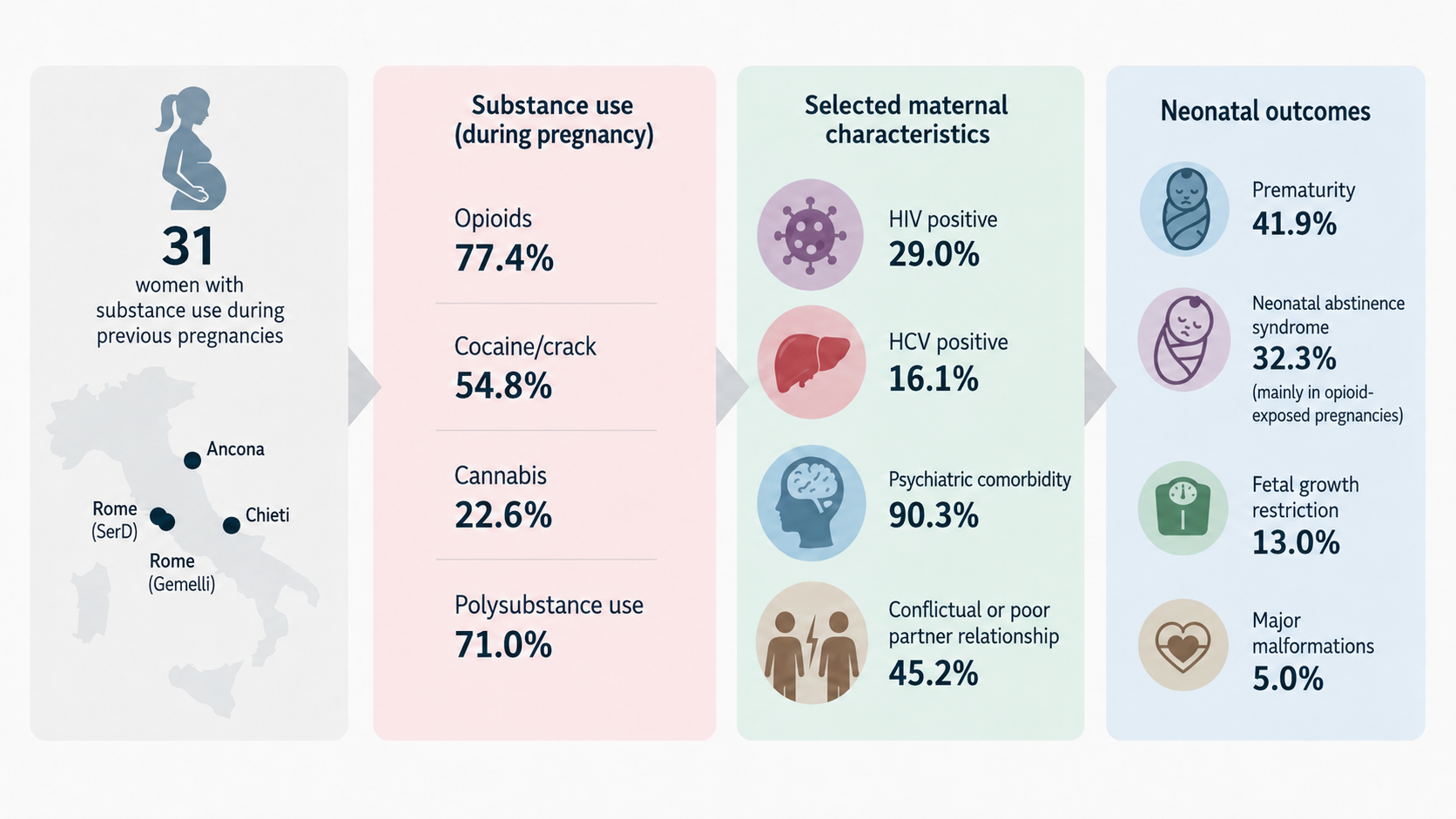
Background: Rising substance use during pregnancy is a major global health concern associated with adverse maternal and neonatal outcomes. Despite growing international literature, Italian real-world multicenter data remain limited. Methods: We conducted a retrospective descriptive analysis of 31 women who reported substance use during a current or previous pregnancy across four Italian clinical centers using data collected between January 2024 and October 2025. Each participant contributed one index pregnancy to the maternal and neonatal outcome analysis. The 54 pregnancies recorded for the overall cohort represented cumulative obstetric history and were not treated as independent observations. Collected variables included type of substance, maintenance therapy, psychiatric diagnosis, infectious serology, neonatal outcomes, obstetric history, and partner relationship quality. Results: Opioid use (alone or in combination) was present in 77.4% of participants, cocaine/crack in 54.8%, and cannabis in 22.6%. Polysubstance use was common. Prematurity occurred in 13 of 31 index pregnancies (41.9%), and neonatal abstinence syndrome was documented in 10 of 31 index pregnancies (32.3%), all of which were opioid-exposed. Human immunodeficiency virus (HIV) positivity was present in 29.0% of participants and Hepatitis C Virus in 16.1%, exclusively among opioid-exposed women. Conflictual or unstable partner relationships were reported in 45.2% of participants. Conclusions: In this small, selected Italian multicenter clinical sample, substance use during pregnancy was heterogeneous and frequently associated with medical, psychiatric, and psychosocial vulnerability. Opioid exposure predominated, and all cases of neonatal abstinence syndrome occurred among opioid-exposed index pregnancies, while cocaine/crack and cannabis use were also frequently documented. Given the descriptive design and small sample size, these findings should not be interpreted as population-level prevalence estimates or as evidence of causal relationships between individual substances and pregnancy outcomes.
- Open Access
- Article
Substance Use during Pregnancy: A Retrospective Multicenter Clinical Report from Four Italian Centers
- Antonio Inserra 1,2,3,*,†,
- Francesco Di Carlo 2,†,
- Vincenzo Micale 4,5,
- Claudio D'Addario 6,7,
- Andrea Di Cesare 8,
- Roberto Mayer 9,
- Giulio Marasca 10,
- Giulia Francesconi 11,
- Rosa Volgare 11,
- Livia Miotti 12,
- Umberto Volpe 13,
- Mauro Pettorruso 2,14,15,
- Giovanni Martinotti 2,14,15,16
Author Information
Received: 10 Mar 2026 | Revised: 24 Jul 2026 | Accepted: 31 Aug 2026 | Published: 10 Sep 2026
Abstract
Graphical Abstract
Keywords
substance use disorder | pregnancy | opioids | cocaine | neonatal abstinence syndrome | prematurity | multidisciplinary care | Italy
References
- 1.
Behnke, M.; Smith, V.C.; Levy, S.; et al. Prenatal Substance Abuse: Short- and Long-term Effects on the Exposed Fetus. Pediatrics 2013, 131, e1009–e1024. https://doi.org/10.1542/peds.2012-3931.
- 2.
Dipartimento Politiche Antidroga. Relazione Annuale al Parlamento sul Fenomeno Delle Tossicodipendenze in Italia; Presidenza del Consiglio dei Ministri: Roma, Italy, 2024.
- 3.
De Santis, M.; De Luca, C.; Mappa, I.; et al. Smoke, alcohol consumption and illicit drug use in an Italian population of pregnant women. Eur. J. Obstet. Gynecol. Reprod. Biol. 2011, 159, 106–110. https://doi.org/10.1016/j.ejogrb.2011.07.042.
- 4.
ISS. Epidemiologia e Prevenzione Dell’uso di Sostanze in Gravidanza; Istituto Superiore di Sanità: Roma, Italy, 2023.
- 5.
Fortinguerra, F.; Belleudi, V.; Poggi, F.R.; et al. Monitoring medicine prescriptions before, during and after pregnancy in Italy. PLoS ONE 2023, 18, e0287111. https://doi.org/10.1371/journal.pone.0287111.
- 6.
Corbett, G.A.; Carmody, D.; Rochford, M.; et al. Drug use in pregnancy in Ireland’s capital city: A decade of trends and outcomes. Eur. J. Obstet. Gynecol. Reprod. Biol. 2023, 282, 24–30. https://doi.org/10.1016/j.ejogrb.2022.12.021.
- 7.
Lenie, S.; Sillis, L.; Allegaert, K.; et al. Alcohol, Tobacco and Illicit Drug Use During Pregnancy in the Longitudinal BELpREG Cohort in Belgium between 2022 and 2024. J Clin Med 2025, 14, 613. https://doi.org/10.3390/jcm14020613.
- 8.
Committee Opinion No. 711: Opioid Use and Opioid Use Disorder in Pregnancy. Obstet. Gynecol. 2017, 130, e81–e94. https://doi.org/10.1097/AOG.0000000000002235.
- 9.
Logue, T.C.; Wen, T.; Friedman, A.M. Demographic trends associated with substance use disorder and risk for adverse obstetric outcomes with cannabis and opioid use disorders. J. Matern.-Fetal Neonatal Med. 2022, 35, 2128658. https://doi.org/10.1080/14767058.2022.2128658.
- 10.
Cook, J.L. Epidemiology of opioid use in pregnancy. Best. Pract. Res. Clin. Obstet. Gynaecol. 2022, 85, 12–17. https://doi.org/10.1016/j.bpobgyn.2022.07.008.
- 11.
Patrick, S.W.; Schumacher, R.E.; Benneyworth, B.D.; et al. Neonatal abstinence syndrome and associated health care expenditures: United States, 2000–2009. JAMA 2012, 307, 1934–1940. https://doi.org/10.1001/jama.2012.3951.
- 12.
Suarez, E.A.; Huybrechts, K.F.; Straub, L.; et al. Buprenorphine versus Methadone for Opioid Use Disorder in Pregnancy. N. Engl. J. Med. 2022, 387, 2033–2044. https://doi.org/10.1056/nejmoa2203318.
- 13.
Brett, J.; Bruno, C.; Varney, B.; et al. Analgesic opioids in pregnancy and placental malperfusion-related disorders: A population-based cohort study. Int. J. Epidemiol. 2025, 54, dyaf137. https://doi.org/10.1093/ije/dyaf137.
- 14.
ElHassan, N.O.; Hayes, C.J.; Mahashabde, R.V.; et al. Novel approaches in linkage of data sources to explore the associations between purchase of opioid prescriptions during pregnancy and adverse neonatal outcomes. PLoS ONE 2026, 21, e0340816. https://doi.org/10.1371/journal.pone.0340816.
- 15.
Ecker, J.; Abuhamad, A.; Hill, W.; et al. Substance use disorders in pregnancy: Clinical, ethical, and research imperatives of the opioid epidemic: A report of a joint workshop of the Society for Maternal-Fetal Medicine, American College of Obstetricians and Gynecologists, and American Society of Addiction Medicine. Am. J. Obstet. Gynecol. 2019, 221, B5–B28. https://doi.org/10.1016/j.ajog.2019.03.022.
- 16.
Lappen, J.R.; Pettker, C.M.; Louis, J.M. Society for Maternal-Fetal Medicine Consult Series #54: Assessing the risk of maternal morbidity and mortality. Am. J. Obstet. Gynecol. 2021, 224, B2–B15. https://doi.org/10.1016/j.ajog.2020.12.006.
- 17.
Gouin, K.; Murphy, K.; Shah, P.S. Effects of cocaine use during pregnancy on low birthweight and preterm birth: Systematic review and metaanalyses. Am. J. Obstet. Gynecol. 2011, 204, 340.e1–340.e12. https://doi.org/10.1016/j.ajog.2010.11.013.
- 18.
Wouldes, T.A.; Lester, B.M. Stimulants: How big is the problem and what are the effects of prenatal exposure? Semin. Fetal Neonatal Med. 2019, 24, 155–160. https://doi.org/10.1016/j.siny.2019.01.011.
- 19.
Volpe, J.J. Effect of Cocaine Use on the Fetus. N. Engl. J. Med. 1992, 327, 399–407. https://doi.org/10.1056/nejm199208063270607.
- 20.
Peltier, M.R.; Roberts, W.; Verplaetse, T.L.; et al. Licit and illicit drug use across trimesters in pregnant women endorsing past-year substance use: Results from National Survey on Drug Use and Health (2009–2019). Arch. Womens Ment. Health 2022, 25, 819–827. https://doi.org/10.1007/s00737-022-01244-6.
- 21.
Committee Opinion Summary No. 722: Marijuana Use During Pregnancy and Lactation. Obstet. Gynecol. 2017, 130, 931–932. https://doi.org/10.1097/AOG.0000000000002349.
- 22.
Gunn, J.K.L.; Rosales, C.B.; Center, K.E.; et al. Prenatal exposure to cannabis and maternal and child health outcomes: A systematic review and meta-analysis. BMJ Open 2016, 6, e009986. https://doi.org/10.1136/bmjopen-2015-009986.
- 23.
Bassalov, H.; Yakirevich-Amir, N.; Reuveni, I.; et al. Prenatal cannabis exposure and the risk for neuropsychiatric anomalies in the offspring: A systematic review and meta-analysis. Am. J. Obstet. Gynecol. 2024, 231, 574–588.e8. https://doi.org/10.1016/j.ajog.2024.06.014.
- 24.
Paul, S.E.; Hatoum, A.S.; Fine, J.D.; et al. Associations Between Prenatal Cannabis Exposure and Childhood Outcomes: Results from the ABCD Study. JAMA Psychiatry 2021, 78, 64–76. https://doi.org/10.1001/jamapsychiatry.2020.2902.
- 25.
Corsi, D.J.; Donelle, J.; Sucha, E.; et al. Maternal cannabis use in pregnancy and child neurodevelopmental outcomes. Nat. Med. 2020, 26, 1536–1540. https://doi.org/10.1038/s41591-020-1002-5.
- 26.
Andrade, C. Maternal Cannabis Use During Pregnancy and Neuropsychiatric Adverse Outcomes during Childhood and Early Adult Life. J. Clin. Psychiatry 2025, 86, 24f15753. https://doi.org/10.4088/jcp.24f15753.
- 27.
Valdes, V.; Sacks, D.D.; Nelson, C.A. Latent profiles of maternal psychopathology and risk for lifetime/perinatal substance use: Findings from the HBCD study. J. Affect. Disord. 2026, 398, 121043. https://doi.org/10.1016/j.jad.2025.121043.
- 28.
Wohrer, F.; Ngo, H.; DiDomenico, J.; et al. Potentially modifiable risk and protective factors affecting mental and emotional wellness in pregnancy. Front. Hum. Neurosci. 2024, 18, 1323297. https://doi.org/10.3389/fnhum.2024.1323297.
- 29.
Kruger, E.S.; Rodriguez, A.; Leeman, L.; et al. Prenatal substance use and mental health comorbidities predict continued use. Psychol. Addict. Behav. 2025, 39, 301–310. https://doi.org/10.1037/adb0001017.
- 30.
Pfeifer, L.R.; Haile, Z.T. Unmet Mental Health Care Needs and Illicit Drug Use During Pregnancy. J. Addict. Med. 2021, 15, 233–240. https://doi.org/10.1097/adm.0000000000000752.
- 31.
Kock, L.S.; Melbostad, H.S.; Heil, S.H. Prevalence of psychosocial issues among pregnant women who do and do not use illicit substances. Psychol. Addict. Behav. 2024, 38, 205–210. https://doi.org/10.1037/adb0000952.
- 32.
Qato, D.M.; Zhang, C.; Gandhi, A.B.; et al. Co-use of alcohol, tobacco, and licit and illicit controlled substances among pregnant and non-pregnant women in the United States: Findings from 2006 to 2014 National Survey on Drug Use and Health (NSDUH) data. Drug Alcohol Depend. 2020, 206, 107729. https://doi.org/10.1016/j.drugalcdep.2019.107729.
- 33.
Board, A.; D’Angelo, D.V.; Salvesen von Essen, B.; et al. Polysubstance use during pregnancy: The importance of screening, patient education, and integrating a harm reduction perspective. Drug Alcohol Depend. 2023, 247, 109872. https://doi.org/10.1016/j.drugalcdep.2023.109872.
- 34.
Habersham, L.L.; Townsel, C.; Terplan, M.; et al. Substance use and use disorders during pregnancy and the postpartum period. Am. J. Obstet. Gynecol. 2025, 232, 337–353.e1. https://doi.org/10.1016/j.ajog.2025.01.007.
- 35.
Hand, D.J.; Fischer, A.C.; Gannon, M.L.; et al. Comprehensive and compassionate responses for opioid use disorder among pregnant and parenting women. Int. Rev. Psychiatry 2021, 33, 514–527. https://doi.org/10.1080/09540261.2021.1908966.
- 36.
McQueen, K.; Murphy-Oikonen, J. Neonatal Abstinence Syndrome. N. Engl. J. Med. 2016, 375, 2468–2479. https://doi.org/10.1056/nejmra1600879.
- 37.
Wachman, E.M.; Schiff, D.M.; Silverstein, M. Neonatal Abstinence Syndrome: Advances in Diagnosis and Treatment. JAMA 2018, 319, 1362–1374. https://doi.org/10.1001/jama.2018.2640.
- 38.
dos Santos, J.F.; de Melo Bastos Cavalcante, C.; Barbosa, F.T.; et al. Maternal, fetal and neonatal consequences associated with the use of crack cocaine during the gestational period: A systematic review and meta-analysis. Arch. Gynecol. Obstet. 2018, 298, 487–503. https://doi.org/10.1007/s00404-018-4833-2.
- 39.
Jarlenski, M.P.; Paul, N.C.; Krans, E.E. Polysubstance Use Among Pregnant Women with Opioid Use Disorder in the United States, 2007–2016. Obstet. Gynecol. 2020, 136, 556–564. https://doi.org/10.1097/aog.0000000000003907.
- 40.
Tran, E.L.; England, L.J.; Park, Y.; et al. Systematic Review: Polysubstance Prevalence Estimates Reported during Pregnancy, US, 2009–2020. Matern. Child Health J. 2023, 27, 426–458. https://doi.org/10.1007/s10995-023-03592-w.
- 41.
Ko, J.Y.; Haight, S.C.; Schillie, S.F.; et al. National Trends in Hepatitis C Infection by Opioid Use Disorder Status Among Pregnant Women at Delivery Hospitalization—United States, 2000–2015. Morb. Mortal. Wkly. Rep. 2019, 68, 833–838. https://doi.org/10.15585/mmwr.mm6839a1.
- 42.
Krans, E.E.; Zickmund, S.L.; Rustgi, V.K.; et al. Screening and evaluation of hepatitis C virus infection in pregnant women on opioid maintenance therapy: A retrospective cohort study. Subst. Abus. 2016, 37, 88–95. https://doi.org/10.1080/08897077.2015.1118720.
- 43.
Koponen, A.M.; et al. Adverse childhood experiences and neurodevelopmental disorders among youth with and without prenatal substance exposure: A longitudinal matched register-based cohort study. Nord. Stud. Alcohol. Drugs 2023, 40, 176–198. https://doi.org/10.1177/14550725221110190.
- 44.
Fitzgerald, R.M. Substance Use Disorder in Pregnancy. Am. Fam. Physician 2023, 107, 547–550.
- 45.
Austin, A.E.; Naumann, R.B.; Simmons, E. Association of State Child Abuse Policies and Mandated Reporting Policies with Prenatal and Postpartum Care Among Women Who Engaged in Substance Use During Pregnancy. JAMA Pediatr. 2022, 176, 1123–1130. https://doi.org/10.1001/jamapediatrics.2022.3396.
- 46.
Smith, V.C.; Wilson, C.R.; Ryan, S.A.; et al. Families Affected by Parental Substance Use. Pediatrics 2016, 138, e20161575. https://doi.org/10.1542/peds.2016-1575.
- 47.
Guille, C.; Aujla, R. Developmental Consequences of Prenatal Substance Use in Children and Adolescents. J. Child. Adolesc. Psychopharmacol. 2019, 29, 479–486. https://doi.org/10.1089/cap.2018.0177.
- 48.
Shah, L.; Yoon, C.D.; LaJeunesse, A.M.; et al. Prenatal substance exposure and infant neurodevelopment: A review of magnetic resonance imaging studies. Front. Hum. Neurosci. 2025, 19, 1613084. https://doi.org/10.3389/fnhum.2025.1613084.
- 49.
Lowe, J.R.; DiDomenico, J.; Stephen, J.M.; et al. Early developmental trajectory of children with prenatal alcohol and opioid exposure. Pediatr. Res. 2024, 96, 471–479. https://doi.org/10.1038/s41390-022-02252-z.
- 50.
Lowell, A.F.; Morie, K.; Potenza, M.N.; et al. An intergenerational lifespan perspective on the neuroscience of prenatal substance exposure. Pharmacol. Biochem. Behav. 2022, 219, 173445. https://doi.org/10.1016/j.pbb.2022.173445.
- 51.
Ross, E.J.; Graham, D.L.; Money, K.M.; et al. Developmental consequences of fetal exposure to drugs: What we know and what we still must learn. Neuropsychopharmacology 2015, 40, 61–87. https://doi.org/10.1038/npp.2014.147.

This work is licensed under a Creative Commons Attribution 4.0 International License.
