
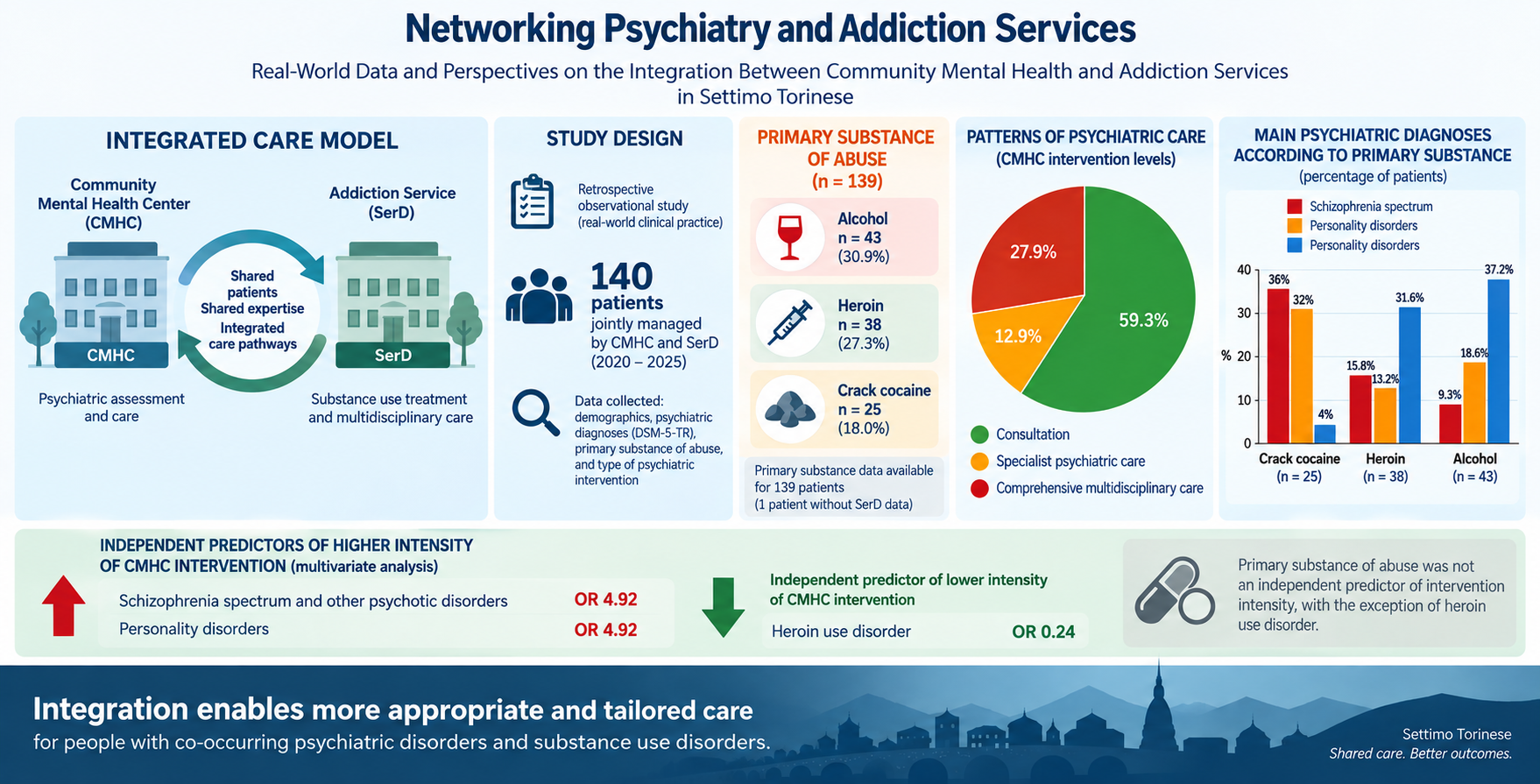
This observational study describes the collaborative model between a Community Mental Health Center (CMHC) and an Addiction Service (Servizio per le Dipendenze, SerD) within a local healthcare setting in the Piedmont Region of Italy. The study aimed to explore the clinical characteristics of patients jointly managed by the two services and to identify the factors underlying different levels of psychiatric intervention. Clinical records were retrospectively reviewed, collecting demographic data, psychiatric diagnoses, primary substance of abuse, and type of intervention provided by the CMHC. The findings highlight a clinically heterogeneous population with distinct profiles according to the primary substance of abuse. Patients with crack cocaine use disorder were younger, more frequently affected by psychotic disorders and personality disorders, and were more often managed through intensive multidisciplinary care. Patients with heroin use disorder showed more chronic clinical trajectories and were predominantly managed through psychiatric consultation. Patients with alcohol use disorder were generally older and commonly presented with depressive disorders. However, multivariate analysis suggested that the intensity of psychiatric intervention was more strongly associated with psychiatric diagnosis than with the primary substance of abuse itself. These findings suggest that close collaboration between Community Mental Health Centers and Addiction Services may promote a more appropriate allocation of healthcare resources, reduce overlap between services, and tailor interventions according to patients’ psychiatric and care needs. The proposed model may provide a useful framework for future research and for the development of more structured and transferable models of integrated care.
- Open Access
- Article
Networking Psychiatry and Addiction Services: Real-World Data and Perspectives on the Integration between Community Mental Health and Addiction Services in Settimo Torinese
- Giovanni Francesco Asinari
Author Information
Received: 08 Jul 2026 | Revised: 13 Sep 2026 | Accepted: 15 Sep 2026 | Published: 24 Sep 2026
Abstract
Graphical Abstract
References
- 1.
Sweileh, W.M. Research Landscape Analysis on Dual Diagnosis of Substance Use and Mental Health Disorders: Key Contributors, Research Hotspots, and Emerging Research Topics. Ann. Gen. Psychiatry 2024, 23, 32. https://doi.org/10.1186/s12991-024-00517-x.
- 2.
Coulter, D.J.; Pearce, L.A.; Legge, M.; et al. Prevalence of Mental Illness, Substance Use Disorder, and Dual Diagnosis among Adults in Custody. Popul. Health Metr. 2025, 23, 45. https://doi.org/10.1186/s12963-025-00408-7.
- 3.
Nizzoli, U. Comorbidity Among Substance Use Disorders, Addiction, Eating Disorders, and Other Mental Disorders: A Challenge for Clinical Practice. Link Riv. Sci. Psicol. 2018, 1–2, 69–79. (In Italian)
- 4.
Available online: https://www.quotidianosanita.it/allegati/create_pdf.php?all=1759327334.pdf (accessed on 12 January 2026). (In Italian)
- 5.
Unified Conference. Programmatic Guidelines: Designing the Health Budget with the Individual—Proposal of Key Elements; Agreement (Ref. No. 104/CU) of 6 July 2022. Presidency of the Council of Ministers: Rome, Italy; 2022. (In Italian)
- 6.
American Psychiatric Association. Diagnostic and Statistical Manual of Mental Disorders, 5th ed; American Psychiatric Association: Washington, DC, USA, 2022.
- 7.
Ministry of Health; State-Regions Conference. National Action Plan for Mental Health; Ministry of Health: Rome, Italy; 2013. (In Italian)
- 8.
McHugh, R.K.; Votaw, V.R.; Sugarman, D.E.; et al. Sex and Gender Differences in Substance Use Disorders. Clin. Psychol. Rev. 2018, 66, 12–23. https://doi.org/10.1016/j.cpr.2017.10.012.
- 9.
Kieling, C.; Buchweitz, C.; Caye, A.; et al. Worldwide Prevalence and Disability from Mental Disorders Across Childhood and Adolescence. JAMA Psychiatry 2024, 81, 347–356. https://doi.org/10.1001/jamapsychiatry.2023.5051.
- 10.
Blanco, C.; Iza, M.; Rodríguez-Fernández, J.M.; et al. Probability and Predictors of Treatment-Seeking for Substance Use Disorders in the U.S. Drug Alcohol Depend. 2015, 149, 136–144. https://doi.org/10.1016/j.drugalcdep.2015.01.031.
- 11.
Vasilenko, S.A.; Evans-Polce, R.J.; Lanza, S.T. Age Trends in Rates of Substance Use Disorders Across Ages 18–90: Differences by Gender and Race/Ethnicity. Drug Alcohol Depend. 2017, 180, 260–264. https://doi.org/10.1016/j.drugalcdep.2017.08.027.
- 12.
Sajwani, H.S. The Dilemma of New Psychoactive Substances: A Growing Threat. Saudi Pharm. J. 2023, 31, 348–350. https://doi.org/10.1016/j.jsps.2023.01.002.
- 13.
Viña, S.M. Religion, Psychedelics, Risky Behavior, and Violence. J. Psychoact. Drugs 2025, 57, 285–296.
- 14.
Yao, Y.; Guo, D.; Lu, T.S.; et al. Efficacy and Safety of Psychedelics for the Treatment of Mental Disorders: A Systematic Review and Meta-Analysis. Psychiatry Res. 2024, 335, 115886. https://doi.org/10.1016/j.psychres.2024.115886.
- 15.
Le, G.H.; Wong, S.; Badulescu, S.; et al. Spectral Signatures of Psilocybin, Lysergic Acid Diethylamide (LSD) and Ketamine in Healthy Volunteers and Persons with Major Depressive Disorder and Treatment-Resistant Depression: A Systematic Review. J. Affect. Disord. 2024, 355, 342–354. https://doi.org/10.1016/j.jad.2024.03.165.
- 16.
Bhalla, I.P.; Stefanovics, E.A.; Rosenheck, R.A. Clinical Epidemiology of Single versus Multiple Substance Use Disorders. Med. Care 2017, 55, S24–S32. https://doi.org/10.1097/mlr.0000000000000731.
- 17.
Guimarães, R.A.; de Oliveira Landgraf de Castro, V.; do Valle Leone de Oliveira, S.M.; et al. Gender Differences in Patterns of Drug Use and Sexual Risky Behaviour among Crack Cocaine Users in Central Brazil. BMC Psychiatry 2017, 17, 412. https://doi.org/10.1186/s12888-017-1569-7.
- 18.
Sanvicente-Vieira, B.; Rovaris, D.L.; Ornell, F.; et al. Sex-Based Differences in Multidimensional Clinical Assessments of Early-Abstinence Crack Cocaine Users. PLoS ONE 2019, 14, e0218334. https://doi.org/10.1371/journal.pone.0218334.
- 19.
Niglio, C.; Gabetta, F.; Gennari, N.; et al. Youth and Substance Addiction: Developmental Vulnerability and Clinical Severity. A Descriptive and Psychopathological Analysis of a Sample of Subjects under 26 Undergoing Treatment at the “Nuove Dipendenze ONDA1” Unit (Integrated Addiction Department—Local Health Authority, City of Turin). FederSerD Inf. 2025. 62–67. https://doi.org/10.3280/mis72-2025oa21723. (In Italian)
- 20.
Bozzatello, P.; Blua, C.; Brandellero, D.; et al. Gender Differences in Borderline Personality Disorder: A Narrative Review. Front. Psychiatry 2024, 15, 1320546. https://doi.org/10.3389/fpsyt.2024.1320546.
- 21.
Moniem, I.; Kafetzopoulos, V. Sex Differences in Schizophrenia: Symptomatology, Treatment Efficacy and Adverse Effects. Front. Psychiatry 2025, 16, 1594334. https://doi.org/10.3389/fpsyt.2025.1594334.
- 22.
Kessler, F.H.P.; Terra, M.B.; Faller, S.; et al. Crack Users Show High Rates of Antisocial Personality Disorder, Engagement in Illegal Activities and Other Psychosocial Problems. Am. J. Addict. 2012, 21, 370–380. https://doi.org/10.1111/j.1521-0391.2012.00245.x.
- 23.
Duailibi, L.B.; Ribeiro, M.; Laranjeira, R. Profile of Cocaine and Crack Users in Brazil. Cad. Saúde Pública 2008, 24, s545–s557. https://doi.org/10.1590/s0102-311x2008001600007.
- 24.
Miguel, A.; Madruga, C.; Cogo-Moreira, H.; et al. Sociodemographic Characteristics, Patterns of Crack Use, Concomitant Substance Use Disorders, and Psychiatric Symptomatology in Treatment-Seeking Crack-Dependent Individuals in Brazil. J. Psychoact. Drugs 2018, 50, 367–372.
- 25.
Areal, L.B.; Herlinger, A.L.; Pelição, F.S.; et al. Crack Cocaine Inhalation Induces Schizophrenia-like Symptoms and Molecular Alterations in Mice Prefrontal Cortex. J. Psychiatr. Res. 2017, 91, 57–63. https://doi.org/10.1016/j.jpsychires.2017.03.005.
- 26.
Giordano, F. The Mental Suffering of Cocaine-Addicted Patients. Psychiatr. Danub. 2024, 36, S45–S52.
- 27.
Tull, M.T.; Gratz, K.L.; Weiss, N.H. Exploring Associations between Borderline Personality Disorder, Crack/Cocaine Dependence, Gender, and Risky Sexual Behavior among Substance-Dependent Inpatients. Personal. Disord. Theory Res. Treat. 2011, 2, 209–219. https://doi.org/10.1037/a0023009.
- 28.
Rosário, B.; Nazaré, M.; Estadella, D.; et al. Behavioral and Neurobiological Alterations Induced by Chronic Use of Crack Cocaine. Rev. Neurosci. 2020, 31, 59–75.
- 29.
Paiva, C.B.; Ferreira, I.B.; Bosa, V.L.; et al. Depression, Anxiety, Hopelessness and Quality of Life in Users of Cocaine/Crack in Outpatient Treatment. Trends Psychiatry Psychother. 2017, 39, 34–42. https://doi.org/10.1590/2237-6089-2015-0065.
- 30.
Fischer, B.; Blanken, P.; Da Silveira, D.X.; et al. Effectiveness of Secondary Prevention and Treatment Interventions for Crack-Cocaine Abuse: A Comprehensive Narrative Overview of English-Language Studies. Int. J. Drug Policy 2015, 26, 352–363. https://doi.org/10.1016/j.drugpo.2015.01.002.
- 31.
Ellis, R.A.; Bailey, A.J.; Jordan, C.; et al. Gender Differences in Illicit Drug Access, Use and Use Disorder: Analysis of National Survey on Drug Use and Health Data. J. Psychiatr. Res. 2024, 175, 118–122. https://doi.org/10.1016/j.jpsychires.2024.05.017.
- 32.
Marsh, J.C.; Park, K.; Lin, Y.A.; et al. Gender Differences in Trends for Heroin Use and Nonmedical Prescription Opioid Use, 2007–2014. J. Subst. Abuse Treat. 2018, 87, 79–85. https://doi.org/10.1016/j.jsat.2018.01.001.
- 33.
Lynch, A.; Arndt, S.; Acion, L. Late- and Typical-Onset Heroin Use among Older Adults Seeking Treatment for Opioid Use Disorder. Am. J. Geriatr. Psychiatry 2021, 29, 417–425. https://doi.org/10.1016/j.jagp.2020.12.005.
- 34.
Department for Anti-Drug Policies. Latency Period Between Onset of Use and First Treatment and Substance Use: Multicenter Study on Users of Drug Addiction Services. In 2010 Report to Parliament on Drug Addiction; Presidency of the Council of Ministers, Department for Anti-Drug Policies: Rome, Italy, 2010. (In Italian)
- 35.
Mattick, R.P.; Breen, C.; Kimber, J.; et al. Methadone Maintenance Therapy versus No Opioid Replacement Therapy for Opioid Dependence. Cochrane Database Syst. Rev. 2009, 2009, CD002209. https://doi.org/10.1002/14651858.cd002209.pub2.
- 36.
Mattick, R.P.; Breen, C.; Kimber, J.; et al. Buprenorphine Maintenance versus Placebo or Methadone Maintenance for Opioid Dependence. Cochrane Database Syst. Rev. 2014, 2014, CD002207. https://doi.org/10.1002/14651858.cd002207.pub4.
- 37.
Sordo, L.; Barrio, G.; Bravo, M.J.; et al. Mortality Risk during and after Opioid Substitution Treatment: Systematic Review and Meta-Analysis of Cohort Studies. BMJ 2017, 357, j1550. https://doi.org/10.1136/bmj.j1550.
- 38.
Al-Shemali, H.K.A.; Hill, D.; Luz, T.C.B.; et al. Prevalence of Psychiatric and Physical Comorbidities in Patients Diagnosed with Opioid Use Disorder (OUD) in Lanarkshire, Scotland, 2018–2019: Cross-Sectional Study. Heroin Addict. Relat. Clin. Probl. 2024, 26, 32. https://doi.org/10.62401/2531-4122-2024-32.
- 39.
Tormohlen, K.N.; Mojtabai, R.; Seiwell, A.; et al. Co-Occurring Opioid Use and Depressive Disorders: Clinical Characteristics and Outcomes in a Treatment-Seeking Sample. J. Dual Diagn. 2021, 17, 123–134.
- 40.
Namchuk, A.B.; Lucki, I.; Browne, C.A. Buprenorphine as a Treatment for Major Depression and Opioid Use Disorder. Adv. Drug Alcohol Res. 2022, 2, 10254. https://doi.org/10.3389/adar.2022.10254.
- 41.
Kosten, T.; Baxter, L. Effective Management of Opioid Withdrawal Symptoms. Am. J. Addict. 2019, 28, 55–62.
- 42.
Verplaetse, T.L.; Carretta, R.F.; Struble, C.A.; et al. Gender Differences in Alcohol Use Disorder Trends from 2009–2019: An Intersectional Analysis. Alcohol 2025, 123, 101–107. https://doi.org/10.1016/j.alcohol.2024.11.003.
- 43.
Høiland, K.; Hagen, E.; Landheim, A.; et al. Gender Differences in Alcohol Use Disorder Treatment. Alcohol. Clin. Exp. Res. 2025, 49, 215–225. https://doi.org/10.1111/acer.15314.
- 44.
Kirsch, D.E.; Belnap, M.A.; Kady, A.; et al. A Narrative Review on Alcohol Use in Women: Insight into the Telescoping Hypothesis from a Biopsychosocial Perspective. Am. J. Drug Alcohol Abuse 2025, 51, 14–30. https://doi.org/10.1080/00952990.2024.2419540.
- 45.
Grant, B.F.; Goldstein, R.B.; Saha, T.D.; et al. Epidemiology of DSM-5 Alcohol Use Disorder: Results from the National Epidemiologic Survey on Alcohol and Related Conditions III. JAMA Psychiatry 2015, 72, 757–766. https://doi.org/10.1001/jamapsychiatry.2015.0584.
- 46.
Rapsey, C.M.; Wells, J.E.; Bharat, C.; et al. Transitions through Stages of Alcohol Use, Use Disorder and Remission: Findings from Te Rau Hinengaro, the New Zealand Mental Health Survey. Alcohol Alcohol. 2019, 54, 87–96. https://doi.org/10.1093/alcalc/agy072.
- 47.
Chapman, C.; Slade, T.; Hunt, C.; et al. Delay to First Treatment Contact for Alcohol Use Disorder. Drug Alcohol Depend. 2015, 147, 116–121. https://doi.org/10.1016/j.drugalcdep.2014.11.029.
- 48.
Venegas, A.; Donato, S.; Meredith, L.R.; et al. Understanding Low Treatment Seeking Rates for Alcohol Use Disorder: A Narrative Review of the Literature and Opportunities for Improvement. Am. J. Drug Alcohol Abuse 2021, 47, 664–679. https://doi.org/10.1080/00952990.2021.1969658.
- 49.
Solmi, M.; Radua, J.; Olivola, M.; et al. Age at Onset of Mental Disorders Worldwide: Large-Scale Meta-Analysis of 192 Epidemiological Studies. Mol. Psychiatry 2022, 27, 281–295. https://doi.org/10.1038/s41380-021-01161-7.
- 50.
Gilman, S.E.; Abraham, H.D. A Longitudinal Study of the Order of Onset of Alcohol Dependence and Major Depression. Alcohol Alcohol. 2001, 36, 595–602. https://doi.org/10.1093/alcalc/36.6.595.
- 51.
McHugh, R.K.; Votaw, V.R.; Sugarman, D.E.; et al. Alcohol Use Disorder and Depressive Disorders: Comorbidity, Etiology, and Treatment. Clin. Psychol. Rev. 2019, 68, 79–90. https://doi.org/10.1016/j.cpr.2018.12.006.
- 52.
Hunt, G.E.; Large, M.M.; Cleary, M.; et al. Prevalence of Comorbid Substance Use in Schizophrenia Spectrum Disorders in Community and Clinical Settings, 1990–2017: Systematic Review and Meta-Analysis. Drug Alcohol Depend. 2018, 191, 234–258. https://doi.org/10.1016/j.drugalcdep.2018.07.011.
- 53.
Koskinen, J.; Löhönen, J.; Koponen, H.; et al. Prevalence of Alcohol Use Disorders in Schizophrenia—A Systematic Review and Meta-Analysis. Acta Psychiatr. Scand. 2009, 120, 85–96. https://doi.org/10.1111/j.1600-0447.2009.01385.x.
- 54.
Addy, P.H.; Radhakrishnan, R.; Cortes, J.A.; et al. Comorbid Alcohol, Cannabis, and Cocaine Use Disorders in Schizophrenia: Epidemiology, Consequences, Mechanisms, and Treatment. Focus 2012, 10, 140–153. https://doi.org/10.1176/appi.focus.10.2.140.
- 55.
Hunt, G.E.; Malhi, G.S.; Lai, H.M.X.; et al. Prevalence of Comorbid Substance Use in Major Depressive Disorder in Community and Clinical Settings, 1990–2019: Systematic Review and Meta-Analysis. J. Affect. Disord. 2020, 266, 288–304. https://doi.org/10.1016/j.jad.2020.01.141.

This work is licensed under a Creative Commons Attribution 4.0 International License.
