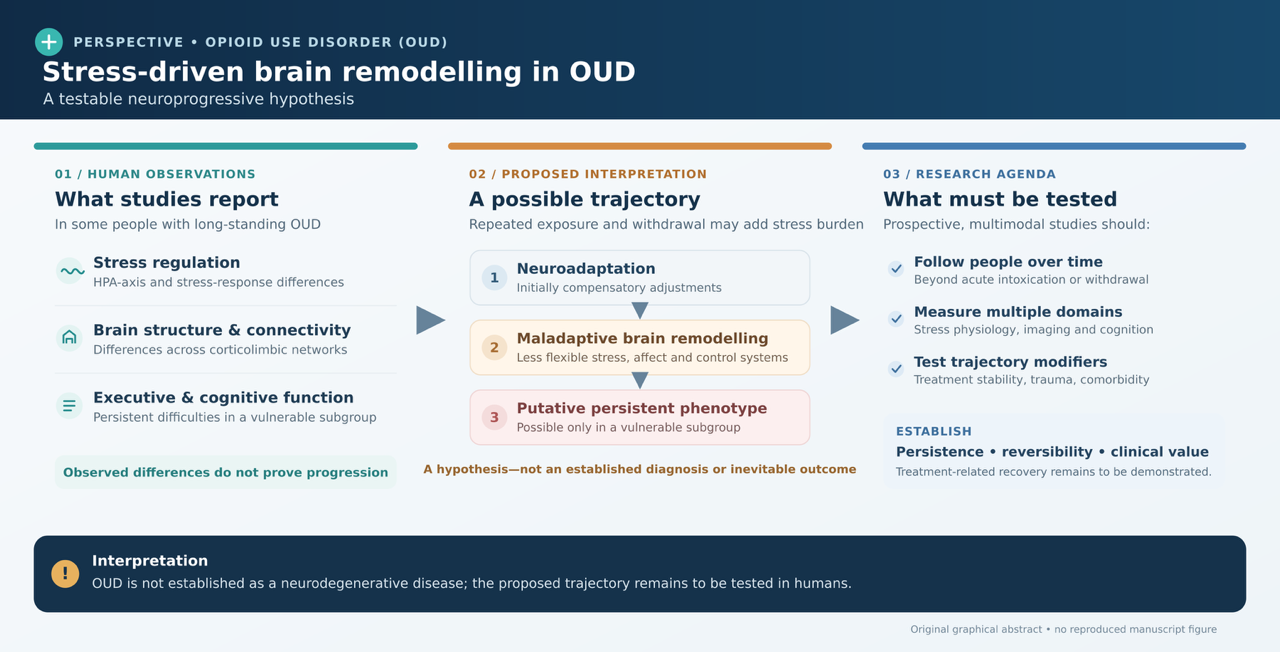
Background: Opioid use disorder (OUD) is classically understood through reward dysregulation, opponent processes, and allostatic adaptation, but these models only partly account for the persistent cognitive, affective, and stress-regulatory abnormalities observed in some individuals with long-standing OUD. Methods: This Perspective integrates human evidence from neuroendocrinology, neuroimaging, and neurocognitive research with mechanistic findings from preclinical opioid-exposure and withdrawal models. Throughout the revised framework, direct evidence in humans is distinguished from cross-species mechanistic inference. Results: Repeated opioid exposure induces neuroadaptations that initially compensate for persistent pharmacological perturbation. When exposure is prolonged and accompanied by recurrent intoxication-withdrawal cycling, these adaptations may become increasingly maladaptive and interact with repeated stress-system destabilization. Human studies document abnormalities in hypothalamic-pituitary-adrenal (HPA) axis regulation, brain structure and connectivity, and executive-cognitive functioning in OUD, whereas preclinical studies provide plausible mechanisms involving glucocorticoid and extrahypothalamic corticotropin-releasing factor (CRF) signaling, noradrenergic and dynorphin systems, synaptic plasticity, neuroimmune activation, and cellular stress. We propose a staged continuum from neuroadaptation to maladaptive brain remodeling and, potentially, neuroprogression. At the advanced end of this continuum, we describe a provisional neuroprogressive phenotype characterized by persistent multidomain dysfunction in stress regulation, cognitive-executive processing, affective regulation, and behavioral control beyond acute intoxication or withdrawal in a vulnerable subset of individuals with OUD. Conclusions: The proposed neuroprogressive model defines a testable hypothesis in which cumulative opioid exposure and recurrent withdrawal-related stress burden may contribute to persistent loss of adaptive capacity. Treatment-related stabilization and partial recovery are incorporated into the model, but disease-modifying effects of opioid agonist treatment remain to be demonstrated prospectively. Longitudinal multimodal studies are required to establish the existence, boundaries, prevalence, reversibility, and clinical utility of the proposed phenotype.
- Open Access
- Review
Stress-Driven Brain Remodeling in Opioid Use Disorder: Toward a Neuroprogressive Model
- Filippo Della Rocca 1,2,
- Icro Maremmani 1,3,*,
- Manuel Glauco Carbone 1,4 and
- Angelo Giovanni Icro Maremmani 1,3
Author Information
Received: 15 June 2026 | Revised: 15 September 2026 | Accepted: 30 September 2026 | Published: 26 October 2026
Abstract
Graphical Abstract
Keywords
opioid use disorder | stress-system dysregulation | neuroadaptation | neuroprogression | brain remodeling | allostatic load
References
- 1.
Di Chiara, G.; Imperato, A. Drugs abused by humans preferentially increase synaptic dopamine concentrations in the mesolimbic system of freely moving rats. Proc. Natl. Acad. Sci. USA 1988, 85, 5274–5278. https://doi.org/10.1073/pnas.85.14.5274.
- 2.
Burns, J.A.; Kroll, D.S.; Feldman, D.E.; et al. Molecular Imaging of Opioid and Dopamine Systems: Insights Into the Pharmacogenetics of Opioid Use Disorders. Front. Psychiatry 2019, 10, 626. https://doi.org/10.3389/fpsyt.2019.00626.
- 3.
Koob, G.F.; Volkow, N.D. Neurobiology of addiction: A neurocircuitry analysis. Lancet Psychiatry 2016, 3, 760–773. https://doi.org/10.1016/s2215-0366(16)00104-8.
- 4.
Koob, G.F.; Le Moal, M. Drug Addiction, Dysregulation of Reward, and Allostasis. Neuropsychopharmacology 2001, 24, 97–129. https://doi.org/10.1016/s0893-133x(00)00195-0.
- 5.
Koob, G.F. A Role for Brain Stress Systems in Addiction. Neuron 2008, 59, 11–34. https://doi.org/10.1016/j.neuron.2008.06.012.
- 6.
Zorrilla, E.P.; Logrip, M.L.; Koob, G.F. Corticotropin releasing factor: A key role in the neurobiology of addiction. Front. Neuroendocrinol. 2014, 35, 234–244. https://doi.org/10.1016/j.yfrne.2014.01.001.
- 7.
Goldstein, R.Z.; Volkow, N.D. Dysfunction of the prefrontal cortex in addiction: Neuroimaging findings and clinical implications. Nat. Rev. Neurosci. 2011, 12, 652–669. https://doi.org/10.1038/nrn3119.
- 8.
Högberg, J.H.; Philips, B.; Nielsen, J.; et al. Executive function at baseline and follow-up in opioid maintenance patients and its relation to psychiatric comorbidity and substance use patterns. BMC Psychiatry 2025, 25, 396. https://doi.org/10.1186/s12888-025-06524-w.
- 9.
Regier, P.S.; Macedo de Arruda, T.C.; Sinko, L.; et al. Factors associated with cognitive flexibility in people with opioid-use disorder: A pilot study. Front. Psychiatry 2024, 15, 1505391. https://doi.org/10.3389/fpsyt.2024.1505391.
- 10.
VanDerNagel, J.E.L. Prevalence of cognitive impairment in patients with substance use disorder. Drug Alcohol Rev. 2019, 38, 435–442. https://doi.org/10.1111/dar.12922.
- 11.
Jin, L.; Yuan, M.; Zhang, W.; et al. Regional cerebral metabolism alterations and functional connectivity in individuals with opioid use disorder: An integrated resting-state PET/fMRI study. J. Psychiatr. Res. 2024, 169, 126–133. https://doi.org/10.1016/j.jpsychires.2023.11.015.
- 12.
Ceceli, A.O.; Huang, Y.; Kronberg, G.; et al. Common and distinct fronto-striatal volumetric changes in heroin and cocaine use disorders. Brain 2023, 146, 1662–1671. https://doi.org/10.1093/brain/awac366.
- 13.
Wollman, S.C.; Hauson, A.O.; Hall, M.G.; et al. Neuropsychological functioning in opioid use disorder: A research synthesis and meta-analysis. Am. J. Drug Alcohol Abus. 2019, 45, 11–25. https://doi.org/10.1080/00952990.2018.1517262.
- 14.
Gerber, H.; Borgwardt, S.J.; Schmid, O.; et al. The Impact of Diacetylmorphine on Hypothalamic-Pituitary-Adrenal Axis Activity and Heroin Craving in Heroin Dependence. Eur. Addict. Res. 2012, 18, 116–123. https://doi.org/10.1159/000334411.
- 15.
Shi, J.; Li, S.X.; Zhang, X.L.; et al. Time-Dependent Neuroendocrine Alterations and Drug Craving during the First Month of Abstinence in Heroin Addicts. Am. J. Drug Alcohol Abus. 2009, 35, 267–272. https://doi.org/10.1080/00952990902933878.
- 16.
Kaplan, G.B.; Thompson, B.L. Neuroplasticity of the extended amygdala in opioid withdrawal and prolonged opioid abstinence. Front. Pharmacol. 2023, 14, 1253736. https://doi.org/10.3389/fphar.2023.1253736.
- 17.
Kieffer, B.L.; Evans, C.J. Opioid Tolerance–In Search of the Holy Grail. Cell 2002, 108, 587–590. https://doi.org/10.1016/s0092-8674(02)00666-9.
- 18.
Christie, M.J. Cellular neuroadaptations to chronic opioids: Tolerance, withdrawal and addiction. Br. J. Pharmacol. 2008, 154, 384–396. https://doi.org/10.1038/bjp.2008.100.
- 19.
McEwen, B.S.; Bowles, N.P.; Gray, J.D.; et al. Mechanisms of stress in the brain. Nat. Neurosci. 2015, 18, 1353–1363. https://doi.org/10.1038/nn.4086.
- 20.
Seco, M.J.; Waisman Campos, M.; Marzan, N.; et al. Neuroprogression in substance use disorders: Integrating molecular mechanisms, brain circuitry, biomarkers, and implications for clinical staging and service design. Int. Rev. Psychiatry 2026, 1–14. https://doi.org/10.1080/09540261.2026.2683081.
- 21.
Bachi, K.; Hurd, Y.L.; Salsitz, E.A. Substance use disorders: A call for a staging paradigm. Transl. Psychiatry 2025, 15, 261. https://doi.org/10.1038/s41398-025-03484-3.
- 22.
Kapczinski, F.; Vieta, E.; Andreazza, A.C.; et al. Allostatic load in bipolar disorder: Implications for pathophysiology and treatment. Neurosci. Biobehav. Rev. 2008, 32, 675–692. https://doi.org/10.1016/j.neubiorev.2007.10.005.
- 23.
Carbone, M.G.; Maremmani, I.; Della Rocca, F.; et al. From Neuroadaptation to Neuroprogression: Rethinking Chronic Cocaine Exposure Through a Model of Cocaine-Related Cerebropathy. J. Clin. Med. 2026, 15, 2222. https://doi.org/10.3390/jcm15062222.
- 24.
Warner, N.S.; Hanson, A.C.; Schulte, P.J.; et al. Prescription Opioids and Longitudinal Changes in Cognitive Function in Older Adults: A Population-Based Observational Study. J. Am. Geriatr. Soc. 2022, 70, 3526–3537. https://doi.org/10.1111/jgs.18030.
- 25.
Lu, L.; Yang, W.; Zhang, X.; et al. Potential brain recovery of frontostriatal circuits in heroin users after prolonged abstinence: A preliminary study. J. Psychiatr. Res. 2022, 152, 326–334. https://doi.org/10.1016/j.jpsychires.2022.06.036.
- 26.
Butelman, E.R.; Huang, Y.; King, S.G.; et al. Peripheral Blood Cytokines as Markers of Longitudinal Change in White Matter Microstructure Following Inpatient Treatment for Opioid Use Disorders. Biol. Psychiatry Glob. Open Sci. 2025, 5, 100480. https://doi.org/10.1016/j.bpsgos.2025.100480.
- 27.
Herman, J.P.; McKlveen, J.M.; Ghosal, S.; et al. Regulation of the Hypothalamic-Pituitary-Adrenocortical Stress Response. Compr. Physiol. 2016, 6, 603–621. https://doi.org/10.1002/j.2040-4603.2016.tb00694.x.
- 28.
Lightman, S.L.; Birnie, M.T.; Conway-Campbell, B.L. Dynamics of ACTH and Cortisol Secretion and Implications for Disease. Endocr. Rev. 2020, 41, bnaa002. https://doi.org/10.1210/endrev/bnaa002.
- 29.
de Kloet, E.R.; Joëls, M.; Holsboer, F. Stress and the brain: From adaptation to disease. Nat. Rev. Neurosci. 2005, 6, 463–475. https://doi.org/10.1038/nrn1683.
- 30.
Androulakis, I.P. Circadian rhythms and the HPA axis: A systems view. WIREs Mech. Dis. 2021, 13, e1518. https://doi.org/10.1002/wsbm.1518.
- 31.
Reyes, B.A.S. The Locus Coeruleus: Anatomy, Physiology, and Stress-Related Neuropsychiatric Disorders. Eur. J. Neurosci. 2025, 61, e70111. https://doi.org/10.1111/ejn.70111.
- 32.
Arnsten, A.F.T. Stress signalling pathways that impair prefrontal cortex structure and function. Nat. Rev. Neurosci. 2009, 10, 410–422. https://doi.org/10.1038/nrn2648.
- 33.
Schwabe, L.; Tegenthoff, M.; Höffken, O.; et al. Simultaneous Glucocorticoid and Noradrenergic Activity Disrupts the Neural Basis of Goal-Directed Action in the Human Brain. J. Neurosci. 2012, 32, 10146–10155. https://doi.org/10.1523/jneurosci.1304-12.2012.
- 34.
Koob, G.F.; Buck, C.L.; Cohen, A.; et al. Addiction as a Stress Surfeit Disorder. Neuropharmacology 2014, 76, 370–382. https://doi.org/10.1016/j.neuropharm.2013.05.024.
- 35.
Chavkin, C.; Koob, G.F. Dynorphin, Dysphoria, and Dependence: The Stress of Addiction. Neuropsychopharmacology 2016, 41, 373–374. https://doi.org/10.1038/npp.2015.258.
- 36.
Bruchas, M.R.; Land, B.B.; Chavkin, C. The dynorphin/kappa opioid system as a modulator of stress-induced and pro-addictive behaviors. Brain Res. 2010, 1314, 44–55. https://doi.org/10.1016/j.brainres.2009.08.062.
- 37.
Heilig, M. The NPY system in stress, anxiety and depression. Neuropeptides 2004, 38, 213–224. https://doi.org/10.1016/j.npep.2004.05.002.
- 38.
Parsons, L.H.; Hurd, Y.L. Endocannabinoid signalling in reward and addiction. Nat. Rev. Neurosci. 2015, 16, 579–594. https://doi.org/10.1038/nrn4004.
- 39.
McEwen, B.S.; Wingfield, J.C. The concept of allostasis in biology and biomedicine. Horm. Behav. 2003, 43, 2–15. https://doi.org/10.1016/s0018-506x(02)00024-7.
- 40.
McEwen, B.S.; Gianaros, P.J. Stress- and Allostasis-Induced Brain Plasticity. Annu. Rev. Med. 2011, 62, 431–445. https://doi.org/10.1146/annurev-med-052209-100430.
- 41.
Sinha, R. Stress and substance use disorders: Risk, relapse, and treatment outcomes. J. Clin. Investig. 2024, 134, e172883. https://doi.org/10.1172/jci172883.
- 42.
Juliano, V.A.L.; Albernaz-Mariano, K.A.; Covre, L.H.H.; et al. Neurobiological intersections of stress and substance use disorders. Front. Neurosci. 2025, 19, 1548372. https://doi.org/10.3389/fnins.2025.1548372.
- 43.
Robinson, T.E.; Berridge, K.C. The psychology and neurobiology of addiction: An incentive–sensitization view. Addiction 2000, 95, 91–117. https://doi.org/10.1080/09652140050111681.
- 44.
Wand, G.S. The influence of stress on the transition from drug use to addiction. Alcohol Res. Health 2008, 31, 119–136.
- 45.
Piazza, P.V.; Le Moal, M. Glucocorticoids as a biological substrate of reward: Physiological and pathophysiological implications. Brain Res. Rev. 1997, 25, 359–372. https://doi.org/10.1016/s0165-0173(97)00025-8.
- 46.
Koob, G.F. Drug Addiction: Hyperkatifeia/Negative Reinforcement as a Framework for Medications Development. Pharmacol. Rev. 2021, 73, 163–201. https://doi.org/10.1124/pharmrev.120.000083.
- 47.
Preston, K.L.; Epstein, D.H. Stress in the daily lives of cocaine and heroin users: Relationship to mood, craving, relapse triggers, and cocaine use. Psychopharmacology 2011, 218, 29–37. https://doi.org/10.1007/s00213-011-2183-x.
- 48.
Mantsch, J.R.; Baker, D.A.; Funk, D.; et al. Stress-Induced Reinstatement of Drug Seeking: 20 Years of Progress. Neuropsychopharmacology 2016, 41, 335–356. https://doi.org/10.1038/npp.2015.142.
- 49.
Everitt, B.J.; Robbins, T.W. Drug Addiction: Updating Actions to Habits to Compulsions Ten Years On. Annu. Rev. Psychol. 2016, 67, 23–50. https://doi.org/10.1146/annurev-psych-122414-033457.
- 50.
Schwabe, L.; Dickinson, A.; Wolf, O.T. Stress, habits, and drug addiction: A psychoneuroendocrinological perspective. Exp. Clin. Psychopharmacol. 2011, 19, 53–63. https://doi.org/10.1037/a0022212.
- 51.
Hogarth, L. Addiction is driven by excessive goal-directed drug choice under negative affect: Translational critique of habit and compulsion theory. Neuropsychopharmacology 2020, 45, 720–735. https://doi.org/10.1038/s41386-020-0600-8.
- 52.
Johnson, S.W.; North, R.A. Opioids excite dopamine neurons by hyperpolarization of local interneurons. J. Neurosci. 1992, 12, 483–488. https://doi.org/10.1523/jneurosci.12-02-00483.1992.
- 53.
Kosten, T.; George, T. The Neurobiology of Opioid Dependence: Implications for Treatment. Sci. Pract. Perspect. 2002, 1, 13–20. https://doi.org/10.1151/spp021113.
- 54.
Paniccia, J.E.; Vollmer, K.M.; Green, L.M.; et al. Restoration of a paraventricular thalamo-accumbal behavioral suppression circuit prevents reinstatement of heroin seeking. Neuron 2024, 112, 772–785.e9. https://doi.org/10.1016/j.neuron.2023.11.024.
- 55.
Liu, Q.M.; Lucas, M.; Badami, F.; et al. Cortical plasticity differences in substance use disorders. Fundam. Res. 2024, 4, 1351–1356. https://doi.org/10.1016/j.fmre.2023.02.015.
- 56.
Vuong, C.; Van Uum, S.H.M.; O’Dell, L.E.; et al. The Effects of Opioids and Opioid Analogs on Animal and Human Endocrine Systems. Endocr. Rev. 2010, 31, 98–132. https://doi.org/10.1210/er.2009-0009.
- 57.
Fountas, A.; Chai, S.T.; Kourkouti, C.; et al. Mechanisms of Endocrinology: Endocrinology of Opioids. Eur. J. Endocrinol. 2018, 179, R183–R196. https://doi.org/10.1530/eje-18-0270.
- 58.
Karavitaki, N.; Bettinger, J.J.; Biermasz, N.; et al. Exogenous Opioids and the Human Endocrine System: An Endocrine Society Scientific Statement. Endocr. Rev. 2024, 45, 773–794. https://doi.org/10.1210/endrev/bnae023.
- 59.
Facchinetti, F.; Volpe, A.; Farci, G.; et al. Hypothalamus-pituitary-adrenal axis of heroin addicts. Drug Alcohol Depend. 1985, 15, 361–366. https://doi.org/10.1016/0376-8716(85)90014-6.
- 60.
Camí, J.; Gilabert, M.; San, L.; et al. Hypercortisolism after opioid discontinuation in rapid detoxification of heroin addicts. Br. J. Addict. 1992, 87, 1145–1151. https://doi.org/10.1111/j.1360-0443.1992.tb02001.x.
- 61.
Zhang, G.F.; Ren, Y.P.; Sheng, L.X.; et al. Dysfunction of the Hypothalamic-Pituitary-Adrenal Axis in Opioid Dependent Subjects: Effects of Acute and Protracted Abstinence. Am. J. Drug Alcohol Abus. 2008, 34, 760–768. https://doi.org/10.1080/00952990802385781.
- 62.
Schmidt, A.; Borgwardt, S.; Gerber, H.; et al. Acute Effects of Heroin on Negative Emotional Processing: Relation of Amygdala Activity and Stress-Related Responses. Biol. Psychiatry 2014, 76, 289–296. https://doi.org/10.1016/j.biopsych.2013.10.019.
- 63.
Patel, E.; Ben-Shlomo, A. Opioid-induced adrenal insufficiency: Diagnostic and management considerations. Front. Endocrinol. 2024, 14, 1280603. https://doi.org/10.3389/fendo.2023.1280603.
- 64.
Kreek, M.J.; Wardlaw, S.L.; Hartman, N.; et al. Circadian rhythms and levels of β-endorphin, ACTH, and cortisol during chronic methadone maintenance treatment in humans. Life Sci. 1983, 33 (Suppl. S1), 409–411. https://doi.org/10.1016/0024-3205(83)90529-5.
- 65.
Schluger, J.H.; Bart, G.; Green, M.; et al. Corticotropin-Releasing Factor Testing Reveals a Dose-Dependent Difference in Methadone Maintained vs. Control Subjects. Neuropsychopharmacology 2003, 28, 985–994. https://doi.org/10.1038/sj.npp.1300156.
- 66.
Mehranfard, N.; Ghasemi, M.; Saboory, E. Disrupted circadian rhythms and opioid-mediated adverse effects: Bidirectional relationship and putative mechanisms. J. Neuroendocrinol. 2025, 37, e70065. https://doi.org/10.1111/jne.70065.
- 67.
Culpepper-Morgan, J.A.; Kreek, M.J. Hypothalamic-pituitary-adrenal axis hypersensitivity to naloxone in opioid dependence: A case of naloxone-induced withdrawal. Metabolism 1997, 46, 130–134. https://doi.org/10.1016/s0026-0495(97)90289-4.
- 68.
Gerra, G.; Ceresini, S.; Esposito, A.; et al. Neuroendocrine and behavioural responses to opioid receptor-antagonist during heroin detoxification: Relationship with personality traits. Int. Clin. Psychopharmacol. 2003, 18, 261–269. https://doi.org/10.1097/00004850-200309000-00002.
- 69.
Glahn, A.; Heberlein, A.; Dürsteler-MacFarland, K.M.; et al. Atrial Natriuretic Peptide, Arginine Vasopressin Peptide and Cortisol Serum Levels in Opiate-Dependent Patients. Neuropsychobiology 2013, 67, 111–115. https://doi.org/10.1159/000346110.
- 70.
McKendrick, G.; Clapham, C.; Zipunnikov, V.; et al. Effects of suvorexant on diurnal cortisol and patient-reported stress during opioid withdrawal in a randomized trial. Psychoneuroendocrinology 2025, 180, 107570. https://doi.org/10.1016/j.psyneuen.2025.107570.
- 71.
McNally, G.P.; Akil, H. Role of Corticotropin-Releasing Hormone in the Amygdala and Bed Nucleus of the Stria Terminalis in the Behavioral, Pain Modulatory, and Endocrine Consequences of Opiate Withdrawal. Neuroscience 2002, 112, 605–617. https://doi.org/10.1016/s0306-4522(02)00105-7.
- 72.
Watanabe, T.; Nakagawa, T.; Yamamoto, R.; et al. Involvement of noradrenergic system within the central nucleus of the amygdala in naloxone-precipitated morphine withdrawal-induced conditioned place aversion in rats. Psychopharmacology 2003, 170, 80–88. https://doi.org/10.1007/s00213-003-1504-0.
- 73.
Smith, R.J.; Aston-Jones, G. Noradrenergic transmission in the extended amygdala: Role in increased drug-seeking and relapse during protracted drug abstinence. Brain Struct. Funct. 2008, 213, 43–61. https://doi.org/10.1007/s00429-008-0191-3.
- 74.
Kash, T.L.; Winder, D.G. Neuropeptide Y and corticotropin-releasing factor bi-directionally modulate inhibitory synaptic transmission in the bed nucleus of the stria terminalis. Neuropharmacology 2006, 51, 1013–1022. https://doi.org/10.1016/j.neuropharm.2006.06.011.
- 75.
Avegno, E.M.; Middleton, J.W.; Gilpin, N.W. Synaptic GABAergic transmission in the central amygdala (CeA) of rats depends on slice preparation and recording conditions. Physiol. Rep. 2019, 7, e14245. https://doi.org/10.14814/phy2.14245.
- 76.
Chartoff, E.; Sawyer, A.; Rachlin, A.; et al. Blockade of kappa opioid receptors attenuates the development of depressive-like behaviors induced by cocaine withdrawal in rats. Neuropharmacology 2012, 62, 167–176. https://doi.org/10.1016/j.neuropharm.2011.06.014.
- 77.
Houshyar, H.; Cooper, Z.D.; Woods, J.H. Paradoxical Effects of Chronic Morphine Treatment on the Temperature and Pituitary-Adrenal Responses to Acute Restraint Stress: A Chronic Stress Paradigm. J. Neuroendocrinol. 2001, 13, 862–874. https://doi.org/10.1046/j.1365-2826.2001.00713.x.
- 78.
Houshyar, H.; Galigniana, M.D.; Pratt, W.B.; et al. Differential Responsivity of the Hypothalamic-Pituitary-Adrenal Axis to Glucocorticoid Negative-Feedback and Corticotropin Releasing Hormone in Rats Undergoing Morphine Withdrawal: Possible Mechanisms Involved in Facilitated and Attenuated Stress Responses. J. Neuroendocrinol. 2001, 13, 875–886. https://doi.org/10.1046/j.1365-2826.2001.00714.x.
- 79.
Houshyar, H.; Gomez, F.; Manalo, S.; et al. Intermittent Morphine Administration Induces Dependence and is a Chronic Stressor in Rats. Neuropsychopharmacology 2003, 28, 1960–1972. https://doi.org/10.1038/sj.npp.1300271.
- 80.
Goeldner, C.; Lutz, P.E.; Darcq, E.; et al. Impaired Emotional-Like Behavior and Serotonergic Function During Protracted Abstinence from Chronic Morphine. Biol. Psychiatry 2011, 69, 236–244. https://doi.org/10.1016/j.biopsych.2010.08.021.
- 81.
Lutz, P.E.; Reiss, D.; Ouagazzal, A.M.; et al. A history of chronic morphine exposure during adolescence increases despair-like behaviour and strain-dependently promotes sociability in abstinent adult mice. Behav. Brain Res. 2013, 243, 44–52. https://doi.org/10.1016/j.bbr.2012.12.049.
- 82.
Carmack, S.A.; Vendruscolo, J.C.M.; McGinn, M.A.; et al. Corticosteroid sensitization drives opioid addiction. Mol. Psychiatry 2022, 27, 2492–2501. https://doi.org/10.1038/s41380-022-01501-1.
- 83.
Wang, L.; Shen, M.; Jiang, C.; et al. Parvalbumin Interneurons of Central Amygdala Regulate the Negative Affective States and the Expression of Corticotrophin-Releasing Hormone During Morphine Withdrawal. Int. J. Neuropsychopharmacol. 2016, 19, pyw060. https://doi.org/10.1093/ijnp/pyw060.
- 84.
Gregoriou, G.C.; Patel, S.D.; Pyne, S.; et al. Opioid Withdrawal Abruptly Disrupts Amygdala Circuit Function by Reducing Peptide Actions. J. Neurosci. 2023, 43, 1668–1681. https://doi.org/10.1523/jneurosci.1317-22.2022.
- 85.
Joëls, M.; Karst, H.; DeRijk, R.; et al. The coming out of the brain mineralocorticoid receptor. Trends Neurosci. 2008, 31, 1–7. https://doi.org/10.1016/j.tins.2007.10.005.
- 86.
Datson, N.A.; van den Oever, J.M.E.; Korobko, O.B.; et al. Previous History of Chronic Stress Changes the Transcriptional Response to Glucocorticoid Challenge in the Dentate Gyrus Region of the Male Rat Hippocampus. Endocrinology 2013, 154, 3261–3272. https://doi.org/10.1210/en.2012-2233.
- 87.
Navarro-Zaragoza, J.; Hidalgo, J.M.; Laorden, M.L.; et al. Glucocorticoid receptors participate in the opiate withdrawal-induced stimulation of rats NTS noradrenergic activity and in the somatic signs of morphine withdrawal. Br. J. Pharmacol. 2012, 166, 2136–2147. https://doi.org/10.1111/j.1476-5381.2012.01918.x.
- 88.
McNally, G.P.; Akil, H. Selective down-regulation of hippocampal glucocorticoid receptors during opiate withdrawal. Mol. Brain Res. 2003, 118, 152–155. https://doi.org/10.1016/s0169-328x(03)00333-4.
- 89.
Jaferi, A.; Lane, D.A.; Pickel, V.M. Subcellular plasticity of the corticotropin-releasing factor receptor in dendrites of the mouse bed nucleus of the stria terminalis following chronic opiate exposure. Neuroscience 2009, 163, 143–154. https://doi.org/10.1016/j.neuroscience.2009.06.029.
- 90.
García-Carmona, J.A.; Milanés, M.V.; Laorden, M.L. Brain stress system response after morphine-conditioned place preference. Int. J. Neuropsychopharmacol. 2013, 16, 1999–2011. https://doi.org/10.1017/s1461145713000588.
- 91.
Lunden, J.W.; Kirby, L.G. Opiate exposure and withdrawal dynamically regulate mRNA expression in the serotonergic dorsal raphe nucleus. Neuroscience 2013, 254, 160–172. https://doi.org/10.1016/j.neuroscience.2013.08.071.
- 92.
Schulkin, J.; McEwen, B.S.; Gold, P.W. Allostasis, amygdala, and anticipatory angst. Neurosci. Biobehav. Rev. 1994, 18, 385–396. https://doi.org/10.1016/0149-7634(94)90051-5.
- 93.
Keen-Rhinehart, E.; Michopoulos, V.; Toufexis, D.J.; et al. Continuous expression of corticotropin-releasing factor in the central nucleus of the amygdala emulates the dysregulation of the stress and reproductive axes. Mol. Psychiatry 2009, 14, 37–50. https://doi.org/10.1038/mp.2008.91.
- 94.
Volavka, J.; Cho, D.; Mallya, A.; et al. Naloxone Increases ACTH and Cortisol Levels in Man. N. Engl. J. Med. 1979, 300, 1056–1057. https://doi.org/10.1056/nejm197905033001817.
- 95.
Wand, G.S.; Schumann, H. Relationship between Plasma Adrenocorticotropin, Hypothalamic Opioid Tone, and Plasma Leptin. J. Clin. Endocrinol. Metab. 1998, 83, 2138–2142. https://doi.org/10.1210/jcem.83.6.4900.
- 96.
al’Absi, M.; Nakajima, M.; DeAngelis, B.; et al. Blunted opioid regulation of the HPA stress response during nicotine withdrawal: Therapeutic implications. Stress 2021, 24, 529–540. https://doi.org/10.1080/10253890.2020.1823367.
- 97.
Koob, G.; Kreek, M.J. Stress, Dysregulation of Drug Reward Pathways, and the Transition to Drug Dependence. Am. J. Psychiatry 2007, 164, 1149–1159. https://doi.org/10.1176/appi.ajp.2007.05030503.
- 98.
Fosnocht, A.Q.; Briand, L.A. Substance use modulates stress reactivity: Behavioral and physiological outcomes. Physiol. Behav. 2016, 166, 32–42. https://doi.org/10.1016/j.physbeh.2016.02.024.
- 99.
Greenwald, M.K.; Woodcock, E.A.; Moses, T.E.H.; et al. Basal cortisol level modulates stress-induced opioid-seeking behavior. Neurobiol. Stress 2024, 33, 100684. https://doi.org/10.1016/j.ynstr.2024.100684.
- 100.
Blaine, S.K.; Sinha, R. Alcohol, stress, and glucocorticoids: From risk to dependence and relapse in alcohol use disorders. Neuropharmacology 2017, 122, 136–147. https://doi.org/10.1016/j.neuropharm.2017.01.037.
- 101.
Wemm, S.E.; Sinha, R. Drug-induced stress responses and addiction risk and relapse. Neurobiol. Stress 2019, 10, 100148. https://doi.org/10.1016/j.ynstr.2019.100148.
- 102.
Walter, M.; Wiesbeck, G.A.; Degen, B.; et al. Heroin reduces startle and cortisol response in opioid-maintained heroin-dependent patients. Addict. Biol. 2011, 16, 145–151. https://doi.org/10.1111/j.1369-1600.2010.00205.x.
- 103.
Xie, P.; Wang, T.J.; Yin, G.; et al. Metabonomic Study of Biochemical Changes in Human Hair of Heroin Abusers by Liquid Chromatography Coupled with Ion Trap-Time of Flight Mass Spectrometry. J. Mol. Neurosci. 2016, 58, 93–101. https://doi.org/10.1007/s12031-015-0655-x.
- 104.
Schluger, J.H.; Borg, L.; Ho, A.; et al. Altered HPA Axis Responsivity to Metyrapone Testing in Methadone Maintained Former Heroin Addicts with Ongoing Cocaine Addiction. Neuropsychopharmacology 2001, 24, 568–575. https://doi.org/10.1016/s0893-133x(00)00222-0.
- 105.
Walter, M.; Wiesbeck, G.A.; Bloch, N.; et al. Psychobiological responses to drug cues before and after methadone intake in heroin-dependent patients: A pilot study. Eur. Neuropsychopharmacol. 2008, 18, 390–393. https://doi.org/10.1016/j.euroneuro.2008.01.005.
- 106.
Yang, J.; Li, J.; Xu, G.; et al. Elevated Hair Cortisol Levels among Heroin Addicts on Current Methadone Maintenance Compared to Controls. PLoS ONE 2016, 11, e0150729. https://doi.org/10.1371/journal.pone.0150729.
- 107.
McEwen, B.S. Protection and Damage from Acute and Chronic Stress: Allostasis and Allostatic Overload and Relevance to the Pathophysiology of Psychiatric Disorders. Ann. N. Y. Acad. Sci. 2004, 1032, 1–7. https://doi.org/10.1196/annals.1314.001.
- 108.
McEwen, B.S.; Morrison, J.H. The Brain on Stress: Vulnerability and Plasticity of the Prefrontal Cortex over the Life Course. Neuron 2013, 79, 16–29. https://doi.org/10.1016/j.neuron.2013.06.028.
- 109.
Cook, S.C.; Wellman, C.L. Chronic stress alters dendritic morphology in rat medial prefrontal cortex. J. Neurobiol. 2004, 60, 236–248. https://doi.org/10.1002/neu.20025.
- 110.
Liston, C.M.; Miller, M.M.; Goldwater, D.S.; et al. Stress-Induced Alterations in Prefrontal Cortical Dendritic Morphology Predict Selective Impairments in Perceptual Attentional Set-Shifting. J. Neurosci. 2006, 26, 7870–7874. https://doi.org/10.1523/jneurosci.1184-06.2006.
- 111.
Hains, A.B.; Vu, M.A.T.; Maciejewski, P.K.; et al. Inhibition of protein kinase C signaling protects prefrontal cortex dendritic spines and cognition from the effects of chronic stress. Proc. Natl. Acad. Sci. USA 2009, 106, 17957–17962. https://doi.org/10.1073/pnas.0908563106.
- 112.
Radley, J.; Rocher, A.; Janssen, W.; et al. Reversibility of apical dendritic retraction in the rat medial prefrontal cortex following repeated stress. Exp. Neurol. 2005, 196, 199–203. https://doi.org/10.1016/j.expneurol.2005.07.008.
- 113.
Kalivas, P.W.; Lalumiere, R.T.; Knackstedt, L.; et al. Glutamate transmission in addiction. Neuropharmacology 2009, 56, 169–173. https://doi.org/10.1016/j.neuropharm.2008.07.011.
- 114.
Siemsen, B.M.; Denton, A.R.; Parrila-Carrero, J.; et al. Heroin Self-Administration and Extinction Increase Prelimbic Cortical Astrocyte-Synapse Proximity and Alter Dendritic Spine Morphometrics That Are Reversed by N-Acetylcysteine. Cells 2023, 12, 1812. https://doi.org/10.3390/cells12141812.
- 115.
Butelman, E.R.; Huang, Y.; Cathomas, F.; et al. Serum cytokines and inflammatory proteins in individuals with heroin use disorder: Potential mechanistically based biomarkers for diagnosis. Transl. Psychiatry 2024, 14, 414. https://doi.org/10.1038/s41398-024-03119-z.
- 116.
Green, J.M.; Sundman, M.H.; Chou, Y.H. Opioid-induced microglia reactivity modulates opioid reward, analgesia, and behavior. Neurosci. Biobehav. Rev. 2022, 135, 104544. https://doi.org/10.1016/j.neubiorev.2022.104544.
- 117.
Wang, Y.; Singh, A.; Li, G.; et al. Opioid induces increased DNA damage in prefrontal cortex and nucleus accumbens. Pharmacol. Biochem. Behav. 2023, 224, 173535. https://doi.org/10.1016/j.pbb.2023.173535.
- 118.
Murlanova, K.; Jouroukhin, Y.; Novototskaya-Vlasova, K.; et al. Loss of Astrocytic µ Opioid Receptors Exacerbates Aversion Associated with Morphine Withdrawal in Mice: Role of Mitochondrial Respiration. Cells 2023, 12, 1412. https://doi.org/10.3390/cells12101412.
- 119.
Hejnova, L.; Hronova, A.; Drastichova, Z.; et al. Long-term administration of morphine specifically alters the level of protein expression in different brain regions and affects the redox state. Open Life Sci. 2024, 19, 20220858. https://doi.org/10.1515/biol-2022-0858.
- 120.
Klengel, T.; Mehta, D.; Anacker, C.; et al. Allele-specific FKBP5 DNA demethylation mediates gene-childhood trauma interactions. Nat. Neurosci. 2013, 16, 33–41. https://doi.org/10.1038/nn.3275.
- 121.
Corradin, O.; Sallari, R.; Hoang, A.T.; et al. Convergence of case-specific epigenetic alterations identify a confluence of genetic vulnerabilities tied to opioid overdose. Mol. Psychiatry 2022, 27, 2158–2170. https://doi.org/10.1038/s41380-022-01477-y.
- 122.
Anand, A.; Agarwal, Y.; Gupta, T.; et al. EnsembleAge clock: A reliable and robust epigenetic age clock service reveals epigenetic age acceleration in opioid-overdosed brains. BMC Genom. 2025, 26, 1088. https://doi.org/10.1186/s12864-025-12271-9.
- 123.
Shelton, M.A.; Horan, N.; Xue, X.; et al. Sex-Specific Concordance of Striatal Transcriptional Signatures of Opioid Addiction in Human and Rodent Brains. Biol. Psychiatry Glob. Open Sci. 2025, 5, 100476. https://doi.org/10.1016/j.bpsgos.2025.100476.
- 124.
McEwen, B.S.; Akil, H. Revisiting the Stress Concept: Implications for Affective Disorders. J. Neurosci. 2020, 40, 12–21. https://doi.org/10.1523/jneurosci.0733-19.2019.
- 125.
Hansson, A.C.; Sommer, W.H.; Metsis, M.; et al. Corticosterone Actions on the Hippocampal Brain-Derived Neurotrophic Factor Expression are Mediated by Exon IV Promoter. J. Neuroendocrinol. 2006, 18, 104–114. https://doi.org/10.1111/j.1365-2826.2005.01390.x.
- 126.
Lyoo, I.K.; Pollack, M.H.; Silveri, M.M.; et al. Prefrontal and temporal gray matter density decreases in opiate dependence. Psychopharmacology 2006, 184, 139–144. https://doi.org/10.1007/s00213-005-0198-x.
- 127.
Liu, H.; Hao, Y.; Kaneko, Y.; et al. Frontal and cingulate gray matter volume reduction in heroin dependence: Optimized voxel-based morphometry. Psychiatry Clin. Neurosci. 2009, 63, 563–568. https://doi.org/10.1111/j.1440-1819.2009.01989.x.
- 128.
Yuan, Y.; Zhu, Z.; Shi, J.; et al. Gray matter density negatively correlates with duration of heroin use in young lifetime heroin-dependent individuals. Brain Cogn. 2009, 71, 223–228. https://doi.org/10.1016/j.bandc.2009.08.014.
- 129.
Upadhyay, J.; Maleki, N.; Potter, J.; et al. Alterations in brain structure and functional connectivity in prescription opioid-dependent patients. Brain 2010, 133, 2098–2114. https://doi.org/10.1093/brain/awq138.
- 130.
King, S.G.; Gaudreault, P.O.; Malaker, P.; et al. Prefrontal-habenular microstructural impairments in human cocaine and heroin addiction. Neuron 2022, 110, 3820–3832.e4. https://doi.org/10.1016/j.neuron.2022.09.011.
- 131.
Gaudreault, P.O.; King, S.G.; Huang, Y.; et al. Frontal White Matter Changes and Craving Recovery in Inpatients with Heroin Use Disorder. JAMA Netw. Open 2024, 7, e2451678. https://doi.org/10.1001/jamanetworkopen.2024.51678.
- 132.
Yang, W.; Zhang, M.; Tang, F.; et al. Recovery of superior frontal gyrus cortical thickness and resting-state functional connectivity in abstinent heroin users after 8 months of follow-up. Hum. Brain Mapp. 2022, 43, 3164–3175. https://doi.org/10.1002/hbm.25841.
- 133.
Savic, I.; Perski, A.; Osika, W. MRI Shows that Exhaustion Syndrome Due to Chronic Occupational Stress is Associated with Partially Reversible Cerebral Changes. Cereb. Cortex 2018, 28, 894–906. https://doi.org/10.1093/cercor/bhw413.
- 134.
Henze, G.I.; Konzok, J.; Kudielka, B.M.; et al. Associations between cortisol stress responses and limbic volume and thickness in young adults: An exploratory study. Eur. J. Neurosci. 2023, 58, 3962–3980. https://doi.org/10.1111/ejn.16161.
- 135.
Moreno, G.L.; Bruss, J.; Denburg, N.L. Increased perceived stress is related to decreased prefrontal cortex volumes among older adults. J. Clin. Exp. Neuropsychol. 2017, 39, 313–325. https://doi.org/10.1080/13803395.2016.1225006.
- 136.
Huang, Y.; Ceceli, A.O.; Kronberg, G.; et al. Association of Cortico-Striatal Engagement During Cue Reactivity, Reappraisal, and Savoring of Drug and Non-Drug Stimuli With Craving in Heroin Addiction. Am. J. Psychiatry 2024, 181, 153–165. https://doi.org/10.1176/appi.ajp.20220759.
- 137.
Shi, Z.; Jagannathan, K.; Padley, J.H.; et al. The role of withdrawal in mesocorticolimbic drug cue reactivity in opioid use disorder. Addict. Biol. 2021, 26, e12977. https://doi.org/10.1111/adb.12977.
- 138.
Li, Q.; Li, Z.; Li, W.; et al. Disrupted Default Mode Network and Basal Craving in Male Heroin-Dependent Individuals. J. Clin. Psychiatry 2016, 77, e1211–e1217. https://doi.org/10.4088/jcp.15m09965.
- 139.
Wen, X.; Yang, W.; Du, Z.; et al. Multimodal frontal neuroimaging markers predict longitudinal craving reduction in abstinent individuals with heroin use disorder. J. Psychiatr. Res. 2024, 177, 1–10. https://doi.org/10.1016/j.jpsychires.2024.06.035.
- 140.
Kronberg, G.; Ceceli, A.O.; Huang, Y.; et al. Shared orbitofrontal dynamics to a drug-themed movie track craving and recovery in heroin addiction. Brain 2025, 148, 1778–1788. https://doi.org/10.1093/brain/awae369.
- 141.
Moeller, S.J.; Abeykoon, S.; Dhayagude, P.; et al. Neural Correlates of Metacognition Impairment in Opioid Addiction. Biol. Psychiatry Cogn. Neurosci. Neuroimaging 2024, 9, 1211–1221. https://doi.org/10.1016/j.bpsc.2024.07.014.
- 142.
Zhao, W.; Duan, F.; Li, X.; et al. Cognitive control in individuals with heroin use disorder after prolonged methadone maintenance treatment. BMC Psychiatry 2025, 25, 78. https://doi.org/10.1186/s12888-025-06523-x.
- 143.
Kosten, T.R. Stress and Addiction. Am. J. Psychiatry 2011, 168, 566–568. https://doi.org/10.1176/appi.ajp.2011.11020180.
- 144.
Tolomeo, S.; Steele, J.D.; Ekhtiari, H.; et al. Chronic heroin use disorder and the brain: Current evidence and future implications. Prog. Neuro-Psychopharmacol. Biol. Psychiatry 2021, 111, 110148. https://doi.org/10.1016/j.pnpbp.2020.110148.
- 145.
Lin, T.; Barash, J.A.; Wang, S.; et al. Regular use of opioids and dementia, cognitive measures, and neuroimaging outcomes among UK Biobank participants with chronic non-cancer pain. Alzheimer’s Dement. 2025, 21, e70177. https://doi.org/10.1002/alz.70177.
- 146.
Kreek, M.J. Methadone-Related Opioid Agonist Pharmacotherapy for Heroin Addiction: History, Recent Molecular and Neurochemical Research and Future in Mainstream Medicine. Ann. N. Y. Acad. Sci. 2000, 909, 186–216. https://doi.org/10.1111/j.1749-6632.2000.tb06683.x.
- 147.
Nava, F.; Caldiroli, E.; Premi, S.; et al. Relationship Between Plasma Cortisol Levels, Withdrawal Symptoms and Craving in Abstinent and Treated Heroin Addicts. J. Addict. Dis. 2006, 25, 9–16. https://doi.org/10.1300/j069v25n02_02.
- 148.
Zojaji, F.; Khalesi, A.; Bahrami, A.; et al. Evaluation of Serum Cortisol Levels and Response to Cosyntropin Test in Methadone-treated Opium Addicts. Anesthesiol. Pain Med. 2023, 13, e135206. https://doi.org/10.5812/aapm-135206.
- 149.
Nava, F.; Manzato, E.; Lucchini, A. Chronic cannabis use does not affect the normalization of hypothalamic-pituitary-adrenal (HPA) axis induced by methadone in heroin addicts. Prog. Neuro-Psychopharmacol. Biol. Psychiatry 2007, 31, 1089–1094. https://doi.org/10.1016/j.pnpbp.2007.03.013.
- 150.
Oesterle, T.S.; Xiao, Y.; Bormann, N.L.; et al. Wearable-derived measures of stress physiology in patients with opioid use disorder treated with methadone: A stress-task study in a real-world clinic with healthy controls. Drug Alcohol Depend. Rep. 2026, 20, 100457. https://doi.org/10.1016/j.dadr.2026.100457.
- 151.
Bershad, A.K.; Jaffe, J.H.; Childs, E.; et al. Opioid partial agonist buprenorphine dampens responses to psychosocial stress in humans. Psychoneuroendocrinology 2015, 52, 281–288. https://doi.org/10.1016/j.psyneuen.2014.12.004.
- 152.
Brar, M.K.; Jain, R.; Bhad, R.; et al. Cortisol/DHEA-S Ratio Normalization by Buprenorphine: Associations with Stress, Coping, and Social Support in Youth with Opioid Use Disorder. J. Psychoact. Drugs 2025, 1–12. https://doi.org/10.1080/02791072.2025.2550288.
- 153.
Schwarz, T.; Akartuna, D.; Busch, M.; et al. Challenges for the implementation of injectable opioid agonist treatment: A scoping review. Harm Reduct. J. 2024, 21, 217. https://doi.org/10.1186/s12954-024-01102-x.
- 154.
Jaremko, K.M.; Sterling, R.C.; Van Bockstaele, E.J. Psychological and physiological stress negatively impacts early engagement and retention of opioid-dependent individuals on methadone maintenance. J. Subst. Abus. Treat. 2015, 48, 117–127. https://doi.org/10.1016/j.jsat.2014.08.006.
- 155.
Sauvé, B.; Koren, G.; Walsh, G.; et al. Measurement of Cortisol in Human Hair as a Biomarker of Systemic Exposure. Clin. Investig. Med. 2007, 30, E183–E191. https://doi.org/10.25011/cim.v30i5.2894.
- 156.
Martins-Silva, T.; Martins, R.C.; Murray, J.; et al. Hair cortisol measurement: A systematic review of current practices and a proposed checklist for reporting standards. Psychoneuroendocrinology 2025, 171, 107185. https://doi.org/10.1016/j.psyneuen.2024.107185.
- 157.
Luciano, M.T.; Acuff, S.F.; Olin, C.C.; et al. Posttraumatic stress disorder, drinking to cope, and harmful alcohol use: A multivariate meta-analysis of the self-medication hypothesis. J. Psychopathol. Clin. Sci. 2022, 131, 447–456. https://doi.org/10.1037/abn0000764.
- 158.
Luo, S.X.; Feaster, D.J.; Liu, Y.; et al. Individual-Level Risk Prediction of Return to Use During Opioid Use Disorder Treatment. JAMA Psychiatry 2024, 81, 45–56. https://doi.org/10.1001/jamapsychiatry.2023.3596.
- 159.
Rush, A.J.; Gore-Langton, R.E.; Bart, G.; et al. Tools to implement measurement-based care (MBC) in the treatment of opioid use disorder (OUD): Toward a consensus. Addict. Sci. Clin. Pract. 2024, 19, 14. https://doi.org/10.1186/s13722-024-00446-w.

This work is licensed under a Creative Commons Attribution 4.0 International License.