
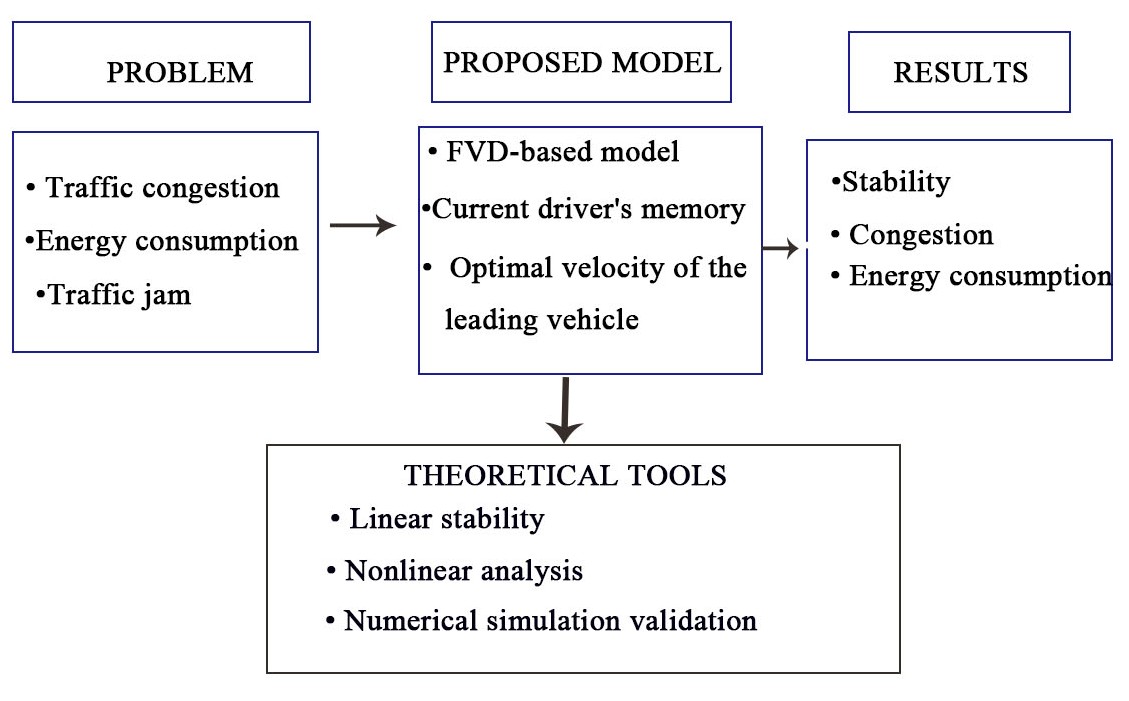
This work proposes an innovative car-following model that incorporates driver’s sensory memory and the preceding vehicle’s optimal velocity within the framework of the full velocity difference (FVD) model. First, the traffic stability criterion is calculated through the use of the theory of linear stability. Using a reductive perturbation technique, we construct the mKdV (modified Korteweg-de Vries) equation. Second, as the system approaches the critical point, the soliton of kink-antikink type obtained from the mKdV equation describes the traveling-wave behavior of jammed traffic. An analysis is also performed on the congestion magnitude and the energy expended. Finally, computational modeling is used to validate the theoretical findings, and the results show that the revised model is useful. According to numerical experiments and analytical derivations, the proposed model increases the optimal velocity coefficient, reduces memory requirements, mitigates traffic jam, strengthens traffic flow stability, and reduces kinetic energy fluctuations.
- Open Access
- Article
Modeling Following Behavior Using Driver Memory and Leader’s Optimal Speed
- Limei Liu *,
- Xia Li,
- Yang Chen
Author Information
Received: 05 May 2026 | Revised: 07 Jul 2026 | Accepted: 14 Aug 2026 | Published: 20 Oct 2026
Abstract
Graphical Abstract
Keywords
FVD model | driver’s sensory memory | mKdV equation | numerical simulations
References
- 1.
Cao, Z.; Jiang, S.; Zhang, J.; et al. A unified framework for vehicle rerouting and traffic light control to reduce traffic congestion. IEEE Trans. Intell. Transp. Syst. 2017, 18, 1958–1973. https://doi.org/10.1109/tits.2016.2613997.
- 2.
Ma, G.; Ma, M.; Liang, S.; et al. Nonlinear analysis of the car-following model considering headway changes with memory and backward looking effect. Phys. A 2021, 562, 125303. https://doi.org/10.1016/j.physa.2020.125303.
- 3.
Liu, L.; Li, W. Modeling and stability analysis of an extended car-following model behavior of the currents vehicle based on delay of response and signal interruption probability. Proc. Inst. Mech. Eng. Part D J. Automob. Eng. 2025, 239, 1355–1366. https://doi.org/10.1177/09544070231214829.
- 4.
Moussa, N. Car accidents in cellular automata models for one-lane traffic flow. Phys. Rev. E 2003, 68, 036127. https://doi.org/10.1103/physreve.68.036127.
- 5.
Wang, Z.; Chen, T.; Wang, Y.; et al. A cellular automaton model for mixed traffic flow considering the size of CAV platoon. Phys. A 2024, 643, 129822. https://doi.org/10.1016/j.physa.2024.129822.
- 6.
Chen, T.; Wang, Z.; Xiang, J.; et al. Analysis of mixed traffic flow characteristics based on cellular automata model under lane management measures. Phys. A 2024, 654, 130177. https://doi.org/10.1016/j.physa.2024.130177.
- 7.
Peng, G.; Liu, Y.; Tan, H.; et al. Phase transition in lattice hydrodynamic model integrating random anomalous information under connected autonomous vehicles surroundings. Chaos Solitons Fractals 2025, 201, 117274. https://doi.org/10.1016/j.chaos.2025.117274.
- 8.
Liu, L.; Li, W.; Wang, X.; et al. Modeling and smooth driving feedback control for an extended lattice hydrodynamic model incorporating cyber-attacks. Phys. Scr. 2026, 101, 145212. https://doi.org/10.1088/1402-4896/ae5769.
- 9.
Mehta, S.; Redhu, P.; Siwach, V. Stability analysis in multi-lane traffic flow model with density delay and lane-changing dynamics: A spatiotemporal and Lyapunov analysis. Chaos Solitons Fractals 2026, 204, 117793. https://doi.org/10.1016/j.chaos.2025.117793.
- 10.
Jiang, R.; Wu, Q.S.; Zhu, Z.J. A new continuum model for traffic flow and numerical tests. Transp. Res. B 2002, 36, 405–419. https://doi.org/10.1016/s0191-2615(01)00010-8.
- 11.
Jafaripournimchahi, A.; Cai, Y.F.; Wang, H.; et al. Stability analysis of delayed-feedback control effect in the continuum traffic flow of autonomous vehicles without V2I communication. Phys. A 2022, 605, 127975. https://doi.org/10.1016/j.physa.2022.127975.
- 12.
Zhai, C.; Wu, W.; Xiao, Y.; et al. A novel throttle-based self-stabilizing control scheme integrated into an anisotropic continuum model to mitigate cyber-attacks in connected vehicle scenarios. Chaos Solitons Fractals 2025, 201, 117319. https://doi.org/10.1016/j.chaos.2025.117319.
- 13.
Tang, T.Q.; Li, C.Y.; Huang, H.J. A new car-following model with the consideration of the driver’s forecast effect. Phys. Lett. A 2010, 374, 3951–3956. https://doi.org/10.1016/j.physleta.2010.07.062.
- 14.
Li, Z.; Qin, Q.; Li, W.; et al. Stabilization analysis and modified KdV equation of a car-following model with consideration of self-stabilizing control in historical traffic data. Nonlinear Dyn. 2018, 91, 1113–1125. https://doi.org/10.1007/s11071-017-3934-y.
- 15.
Fu, Y.; Hu, W.; Shang, J.; et al. A fractional-order car-following model with random delay optimized by an enhanced whale optimization algorithm. Nonlinear Dyn. 2025, 113, 21277–21303. https://doi.org/10.1007/s11071-025-11271-4.
- 16.
Tian, C.; Kang, Y. Modeling of flow-difference influences on dynamic phase transition and stability in curved road traffic systems. Symmetry 2025, 17, 1299. https://doi.org/10.3390/sym17081299.
- 17.
Wu, Y.; Ma, Z.; Wang, Y.; et al. Nonlinear dynamics of traffic flow stability: A review from car-following to mixed-autonomy. Chaos Solitons Fractals 2026, 208, 118340. https://doi.org/10.1016/j.chaos.2026.118340.
- 18.
Pipes, L.A. An operational analysis of traffic dynamics. J. Appl. Phys. 1953, 24, 274–281. https://doi.org/10.1063/1.1721265.
- 19.
Newell, G.F. Nonlinear effects in the dynamics of car following. Oper. Res. 1961, 9, 209–229. https://doi.org/10.1287/opre.9.2.209.
- 20.
Bando, M.; Hasebe, K.; Nakayama, A.; et al. Dynamical model of traffic congestion and numerical simulation. Phys. Rev. E 1995, 51, 1035–1042. https://doi.org/10.1103/physreve.51.1035.
- 21.
Helbing, D.; Tilch, B. Generalized force model of traffic dynamics. Phys. Rev. E 1998, 58, 133–138. https://doi.org/10.1103/physreve.58.133.
- 22.
Jiang, R.; Wu, Q.; Zhu, Z. Full velocity difference model for a car-following theory. Phys. Rev. E 2001, 64, 017101. https://doi.org/10.1103/physreve.64.017101.
- 23.
Ge, H.X.; Cheng, R.J.; Li, Z.P. Two velocity difference model for a car following theory. Phys. A 2008, 387, 5239–5245. https://doi.org/10.1016/j.physa.2008.02.081.
- 24.
Peng, G.H.; Cai, X.H.; Liu, C.Q.; et al. Optimal velocity difference model for a car-following theory. Phys. Lett. A 2011, 375, 3973–3977. https://doi.org/10.1016/j.physleta.2011.09.037.
- 25.
Ma, G.; Li, K. Phase transitions of car following model considering driver characteristics and honk effect. Chaos Solitons Fractals 2025, 201, 117186. https://doi.org/10.1016/j.chaos.2025.117186.
- 26.
Peng, G.; Li, X.; Wang, H.; et al. Bifurcation and phase transitions in car-following model integrating driver’s characteristic and speed limit on spiral slope roads. Chaos Solitons Fractals 2024, 186, 115200. https://doi.org/10.1016/j.chaos.2024.115200.
- 27.
Wang, W.J.; Ma, M.H.; Liang, S.D.; et al. Density waves in an improved car-following model under intelligent transportation system environment. Mod. Phys. Lett. B 2022, 36, 2250014. https://doi.org/10.1142/s0217984922500142.
- 28.
Zhou, T.; Tian, Y.; Zhu, M.; et al. Phase transitions in mixed traffic streams comprising HDVs and CAVs through the implementation of delayed control mechanisms to mitigate traffic jerk. Chaos Solitons Fractals 2025, 199, 116679. https://doi.org/10.1016/j.chaos.2025.116679.
- 29.
Shakeel, M.; Liu, X.G. Solitary wave solutions, bifurcation theory, and sensitivity analysis in the modified unstable nonlinear Schrödinger equation. Mod. Phys. Lett. B 2025, 39, 2550082. https://doi.org/10.1142/s0217984925500824.
- 30.
Hosseini, K.; Hinçal, E.; Ilie, M. Bifurcation analysis, chaotic behaviours, sensitivity analysis, and soliton solutions of a generalized Schrödinger equation. Nonlinear Dyn. 2023, 111, 17455–17462. https://doi.org/10.1007/s11071-023-08759-2.
- 31.
Cao, B.G. A new car-following model considering driver’s sensory memory. Phys. A 2015, 427, 218–225. https://doi.org/10.1016/j.physa.2015.01.078.
- 32.
Ai, W.H.; Lei, Z.Q.; Li, D.Y.; et al. Bifurcation analysis and control study of improved full-speed differential model in connected vehicle environment. Chin. Phys. B 2024, 33, 070503. https://doi.org/10.1088/1674-1056/ad3b80.
- 33.
Guan, X.; Qin, J.; Cheng, R.; et al. Bifurcation and linear analysis of connected heterogeneous traffic flow model under cyberattacks. Chaos Solitons Fractals 2025, 200, 117018. https://doi.org/10.1016/j.chaos.2025.117018.
- 34.
Wang, Y.J.; Song, H.; Cheng, R.J. TDGL and mKdV equations for an extended car-following model with the consideration of driver’s memory. Phys. A 2019, 515, 440–449. https://doi.org/10.1016/j.physa.2018.09.171.
- 35.
Sun, D.H.; Tan, P.; Chen, D.; et al. Burgers and mKdV equation for car-following model considering drivers’ characteristics on a gradient highway. Mod. Phys. Lett. B 2018, 32, 1850314. https://doi.org/10.1142/s0217984918503141.
- 36.
Yao, R.; Qiao, Y.; Xue, Y.; et al. Phase transitions and chaotic jam in multi-lane lattice hydrodynamic model considering driver anticipation and passing behavior. Nonlinear Dyn. 2026, 114, 398. https://doi.org/10.1007/s11071-026-12244-x.
- 37.
Tang, T.Q.; Huang, H.J.; Shang, H.Y. Influences of the driver’s bounded rationality on micro driving behavior, fuel consumption and emissions. Transp. Res. Part D Transp. Environ. 2015, 41, 423–432. https://doi.org/10.1016/j.trd.2015.10.016.
- 38.
Xue, Y.; Kang, S.J.; Lu, W.Z.; et al. Energy dissipation of traffic flow at an on-ramp. Phys. A 2014, 398, 172–178. https://doi.org/10.1016/j.physa.2013.12.032.
- 39.
Peng, G.H.; Lu, W.Z.; He, H.H. Nonlinear analysis of a new car-following model accounting for the global average optimal velocity difference. Mod. Phys. Lett. B 2016, 30, 1650327. https://doi.org/10.1142/s0217984916503279.


This work is licensed under a Creative Commons Attribution 4.0 International License.
