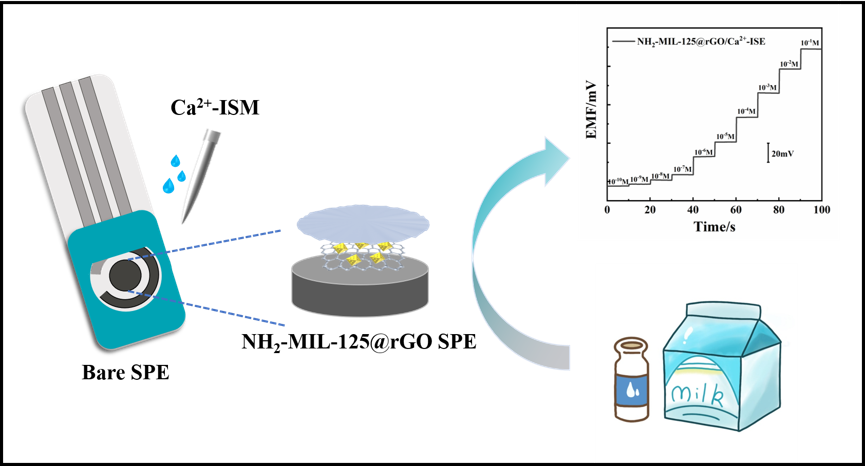
Solid-contact ion-selective electrodes have been extensively utilized for calcium ion detection, particularly in applications involving milk samples. In this study, a solid-contact was developed using a composite material of Ti8O8(OH)4(H2bdc-NH2)6 (NH2-MIL-125) and reduced graphene oxide (rGO) to prepare calcium SC-ISE (NH2-MIL-125@rGO/Ca2+-ISE). The NH2-MIL-125@rGO/Ca2+-ISE demonstrated high double-layer capacitance (222 μF) and rapid electron transfer capabilities. Within the calcium ion concentration range of 10−7~10−1 M, the electrode exhibited an excellent Nernstian response, with a rapid response time (2~3 s) and a low detection limit of 10−7.2 M. Additionally, the electrode performed exceptionally in water layer and anti-interference tests, showing enhanced potential stability and response speed while being unaffected by environmental factors such as light, CO2, and O2. These results confirm the superior performance of the NH2-MIL-125@rGO composite as a solid-contact layer, therefore constructed disposable screen-printed calcium potentiometric sensor. In particular, it demonstrated the capability for rapid and accurate analysis of calcium content in untreated milk samples, highlighting the significant practical potential for development of calibration-free SC-ISEs.
- Open Access
- Article
Disposable Screen-Printed Ca2+ Sensor Using NH2-MIL-125@rGO as Solid-Contact Layer for Raw Milk Analysis
- Wanting Zhang 1,
- Yunrui Fang 1,
- Qingbo An 1,*,
- Zhongqian Song 2,
- Bin Cai 3,
- Jing Sun 1,* and
- Li Niu 4,*
Author Information
Received: 30 June 2026 | Revised: 03 September 2026 | Accepted: 08 October 2026 | Published: 26 October 2026
Abstract
Graphical Abstract
References
- 1.
Ratajczak, A.E.; Zawada, A.; Rychter, A.M.; et al. Milk and Dairy Products: Good or Bad for Human Bone? Practical Dietary Recommendations for the Prevention and Management of Osteoporosis. Nutrients 2021, 13, 1329. https://doi.org/10.3390/nu13041329.
- 2.
Béni, Á.; Nagy, D.; Kapitány, S.; et al. Separation/Preconcentration of Chromium Species with Continuous Liquid-Liquid Extraction Device and Its Determination by AAS. Microchem. J. 2019, 150, 104077. https://doi.org/10.1016/j.microc.2019.104077.
- 3.
Qin, L.M.; Yang, X.A.; Leng, D.; et al. Dual-Frequency Ultrasound Assisted-Enzyme Digestion Coupled with Atomic Fluorescence Spectrometry as a Green and Efficient Tool for Cadmium Detection in Rice Flour Samples. Talanta 2018, 188, 308–315. https://doi.org/10.1016/j.talanta.2018.06.007.
- 4.
Tang, T.; Landis, W.; Blouin, S.; et al. Subcanalicular Nanochannel Volume Is Inversely Correlated with Calcium Content in Human Cortical Bone. J. Bone Miner. Res. 2023, 38, 313–325. https://doi.org/10.1002/jbmr.4753.
- 5.
Zdrachek, E.A.; Bakker, E. Potentiometric Sensing. Anal. Chem. 2021, 93, 72–102. https://doi.org/10.1021/acs.analchem.0c04249.
- 6.
Lyu, Y.; Gan, S.; Bao, Y.; et al. Solid-Contact Ion-Selective Electrodes: Response Mechanisms, Transducer Materials and Wearable Sensors. Membranes 2020, 10, 128. https://doi.org/10.3390/membranes10060128.
- 7.
Kałuża, D.; Jaworska, E.; Mazur, M.; et al. Multiwalled Carbon Nanotubes–Poly(3-Octylthiophene-2,5-Diyl) Nanocomposite Transducer for Ion-Selective Electrodes: Raman Spectroscopy Insight into the Transducer/Membrane Interface. Anal. Chem. 2019, 91, 9010–9017. https://doi.org/10.1021/acs.analchem.9b01286.
- 8.
Papp, S.; Bojtár, M.; Gyurcsányi, R.E.; et al. Potential Reproducibility of Potassium-Selective Electrodes Having Perfluorinated Alkanoate Side Chain Functionalized Poly(3,4-Ethylenedioxytiophene) as a Hydrophobic Solid Contact. Anal. Chem. 2019, 91, 9111–9118. https://doi.org/10.1021/acs.analchem.9b01587.
- 9.
Jiang, C.; Li, X.; Yao, Y.; et al. Fully Written Flexible Potentiometric Sensor Using Two-Dimensional Nanomaterial-Based Conductive Ink. Anal. Chem. 2018, 90, 13088–13095. https://doi.org/10.1021/acs.analchem.8b04334.
- 10.
Li, J.; Qin, W. A Freestanding All-Solid-State Polymeric Membrane Cu2+-Selective Electrode Based on Three-Dimensional Graphene Sponge. Anal. Chim. Acta 2019, 1068, 11–17. https://doi.org/10.1016/j.aca.2019.04.003.
- 11.
Li, J.; Qin, W. An Integrated All-Solid-State Screen-Printed Potentiometric Sensor Based on a Three-Dimensional Self-Assembled Graphene Aerogel. Microchem. J. 2020, 159, 105453. https://doi.org/10.1016/j.microc.2020.105453.
- 12.
Zhang, Y.; Tang, Y.; Liang, R.; et al. Carbon-Based Transducers for Solid-Contact Calcium Ion-Selective Electrodes: Mesopore and Nitrogen-Doping Effects. Membranes 2022, 12, 903. https://doi.org/10.3390/membranes12090903.
- 13.
Zhen, X.V.; Rousseau, C.R.; Bühlmann, P. Redox Buffer Capacity of Ion-Selective Electrode Solid Contacts Doped with Organometallic Complexes. Anal. Chem. 2018, 90, 11000–11007. https://doi.org/10.1021/acs.analchem.8b02595.
- 14.
Jaworska, E.; Naitana, M.L.; Stelmach, E.; et al. Introducing Cobalt(II) Porphyrin/Cobalt(III) Corrole Containing Transducers for Improved Potential Reproducibility and Performance of All-Solid-State Ion-Selective Electrodes. Anal. Chem. 2017, 89, 7107–7114. https://doi.org/10.1021/acs.analchem.7b01027.
- 15.
Jaworska, E.; Wójcik, M.; Kisiel, A.; et al. Gold Nanoparticles Solid Contact for Ion-Selective Electrodes of Highly Stable Potential Readings. Talanta 2011, 85, 1986–1989. https://doi.org/10.1016/j.talanta.2011.07.049.
- 16.
Xu, J.; Sun, Z.; Li, F.; et al. Nitrogen-Doped Porous Carbon Derived from Zeolitic Imidazolate Framework-67 Strung into Necklace with Carbon Nanotubes for the Detection of Calcium at Ultralow Level. J. Electrochem. Soc. 2020, 167, 087512. https://doi.org/10.1149/1945-7111/ab91cb.
- 17.
Mendecki, L.; Mirica, K.A. Conductive Metal–Organic Frameworks as Ion-to-Electron Transducers in Potentiometric Sensors. ACS Appl. Mater. Interfaces 2018, 10, 19248–19257. https://doi.org/10.1021/acsami.8b03956.
- 18.
Shao, Y.; Yao, Y.; Jiang, C.; et al. Two-Dimensional MXene Nanosheets (Types Ti3C2Tx and Ti2CTx) as New Ion-to-Electron Transducers in Solid-Contact Calcium Ion-Selective Electrodes. Microchim. Acta 2019, 186, 750. https://doi.org/10.1007/s00604-019-3878-7.
- 19.
Bagheri, M.; Masoomi, M.Y. Quasi-Metal Organic Frameworks: Preparation, Applications and Future Perspectives. Coord. Chem. Rev. 2022, 468, 214643. https://doi.org/10.1016/j.ccr.2022.214643.
- 20.
Meng, J.; Ashry, A.G.; Abou-Elyazed, A.S.; et al. Highly Efficient Visible-Light Photocatalysts: Bi2O3@TiO2 Derived from Ti-MOFs for Eriochrome Black T Degradation: A Joint Experimental and Computational Study. Catalysts 2024, 14, 829. https://doi.org/10.3390/catal14110829.
- 21.
Mokhtar, N.A.I.M.; Zawawi, R.M.; Khairul, W.M.; et al. Electrochemical and Optical Sensors Made of Composites of Metal–Organic Frameworks and Carbon-Based Materials. A Review. Environ. Chem. Lett. 2022, 20, 3099–3131. https://doi.org/10.1007/s10311-022-01403-2.
- 22.
Shao, D.; Shi, J.; Zhang, J.; et al. Solvent Impedes CO2 Cycloaddition on Metal–Organic Frameworks. Chem. Asian J. 2018, 13, 386–389. https://doi.org/10.1002/asia.201701706.
- 23.
Li, Y.; Li, J.; Qin, W. Solid-Contact Polymeric Membrane Ion-Selective Electrodes Based on Electrodeposited NiCo2S4 Nanosheet Arrays. Talanta 2023, 251, 123797. https://doi.org/10.1016/j.talanta.2022.123797.
- 24.
Jin, J.; Kim, J.P.; Wan, S.; et al. Hierarchical Pore Enhanced Adsorption and Photocatalytic Performance of Graphene Oxide/Ti-Based Metal-Organic Framework Hybrid for Toluene Removal. Appl. Catal. B Environ. 2022, 317, 121751. https://doi.org/10.1016/j.apcatb.2022.121751.
- 25.
Wang, J.; Yu, Z.; Zhu, X.; et al. A Super-Hydrophilic NH2-MIL-125 Composite Film with Dopamine-Modified Graphene Oxide Is Used for Water Treatment. New J. Chem. 2022, 46, 13303–13314. https://doi.org/10.1039/d2nj02181a.
- 26.
Shu, Z.; Zou, Y.; Wu, X.; et al. NH2-MIL-125(Ti)/Reduced Graphene Oxide Enhanced Electrochemical Detection of Fenitrothion in Agricultural Products. Foods 2023, 12, 1534. https://doi.org/10.3390/foods12071534.
- 27.
Li, X.; Le, Z.; Chen, X.; et al. Graphene Oxide Enhanced Amine-Functionalized Titanium Metal Organic Framework for Visible-Light-Driven Photocatalytic Oxidation of Gaseous Pollutants. Appl. Catal. B Environ. 2018, 236, 501–508. https://doi.org/10.1016/j.apcatb.2018.05.052.
- 28.
Yuan, X.; Wang, H.; Wu, Y.; et al. One-Pot Self-Assembly and Photoreduction Synthesis of Silver Nanoparticle-Decorated Reduced Graphene Oxide/MIL-125(Ti) Photocatalyst with Improved Visible Light Photocatalytic Activity. Appl. Organomet. Chem. 2016, 30, 289–296. https://doi.org/10.1002/aoc.3430.
- 29.
Pimenta, M.A.; Dresselhaus, G.; Dresselhaus, M.S.; et al. Studying Disorder in Graphite-Based Systems by Raman Spectroscopy. Phys. Chem. Chem. Phys. 2007, 9, 1276–1290. https://doi.org/10.1039/b613962k.
- 30.
Bagri, A.; Mattevi, C.; Acik, M.; et al. Structural Evolution during the Reduction of Chemically Derived Graphene Oxide. Nat. Chem. 2010, 2, 581–587. https://doi.org/10.1038/nchem.686.
- 31.
Wang, Q.; Wang, G.; Liang, X.; et al. Supporting Carbon Quantum Dots on NH2-MIL-125 for Enhanced Photocatalytic Degradation of Organic Pollutants under a Broad Spectrum Irradiation. Appl. Surf. Sci. 2019, 467–468, 320–327. https://doi.org/10.1016/j.apsusc.2018.10.165.
- 32.
Wang, H.; Yuan, X.; Wu, Y.; et al. Facile Synthesis of Amino-Functionalized Titanium Metal-Organic Frameworks and Their Superior Visible-Light Photocatalytic Activity for Cr(VI) Reduction. J. Hazard. Mater. 2015, 286, 187–194. https://doi.org/10.1016/j.jhazmat.2014.11.039.
- 33.
Paczosa-Bator, B. Ion-Selective Electrodes with Superhydrophobic Polymer/Carbon Nanocomposites as Solid Contact. Carbon 2015, 95, 879–887. https://doi.org/10.1016/j.carbon.2015.09.006.
- 34.
Lai, C.Z.; Joyer, M.M.; Fierke, M.A.; et al. Subnanomolar Detection Limit Application of Ion-Selective Electrodes with Three-Dimensionally Ordered Macroporous (3DOM) Carbon Solid Contacts. J. Solid State Electrochem. 2009, 13, 123–128. https://doi.org/10.1007/s10008-008-0579-2.
- 35.
Xu, J.; Jia, F.; Li, F.; et al. Simple and Efficient Synthesis of Gold Nanoclusters and Their Performance as Solid Contact of Ion Selective Electrode. Electrochim. Acta 2016, 222, 1007–1012. https://doi.org/10.1016/j.electacta.2016.11.069.
- 36.
Hu, J.; Zou, X.U.; Stein, A.; et al. Ion-Selective Electrodes with Colloid-Imprinted Mesoporous Carbon as Solid Contact. Anal. Chem. 2014, 86, 7111–7118. https://doi.org/10.1021/ac501633r.
- 37.
Fibbioli, M.; Morf, W.E.; Badertscher, M.; et al. Potential Drifts of Solid-Contacted Ion-Selective Electrodes Due to Zero-Current Ion Fluxes through the Sensor Membrane. Electroanalysis 2000, 12, 1286–1292.
- 38.
Bobacka, J. Potential Stability of All-Solid-State Ion-Selective Electrodes Using Conducting Polymers as Ion-to-Electron Transducers. Anal. Chem. 1999, 71, 4932–4937. https://doi.org/10.1021/ac990497z.
- 39.
Chai, D.; Sun, Y.; Li, Z.; et al. A Novel Inorganic Redox Buffer of R-GO/Ag@AgCl/TMMCl Utilized as an Effective Ion-to-Electron Transducer for a Solid Contact Calcium Ion-Selective Electrode. Sens. Actuators B Chem. 2022, 367, 132055. https://doi.org/10.1016/j.snb.2022.132055.
- 40.
Bakker, E. Determination of Improved Selectivity Coefficients of Polymer Membrane Ion-Selective Electrodes by Conditioning with a Discriminated Ion. J. Electrochem. Soc. 1996, 143, L83–L85. https://doi.org/10.1149/1.1836608.
- 41.
Li, Y.; Li, J.; Qin, W. All-Solid-State Polymeric Membrane Ion-Selective Electrodes Based on NiCo2S4 as a Solid Contact. Anal. Chem. 2022, 94, 3574–3580. https://doi.org/10.1021/acs.analchem.1c04748.
- 42.
Sundfors, F.; Bobacka, J. EIS Study of the Redox Reaction of Fe(CN)63−/4− at Poly(3,4-Ethylenedioxythiophene) Electrodes: Influence of DC Potential and cOx:cRed Ratio. J. Electroanal. Chem. 2004, 572, 309–316. https://doi.org/10.1016/j.jelechem.2003.12.013.
- 43.
Yin, T.; Li, J.; Qin, W. An All-Solid-State Polymeric Membrane Ca2+-Selective Electrode Based on Hydrophobic Alkyl-Chain-Functionalized Graphene Oxide. Electroanalysis 2017, 29, 821–827. https://doi.org/10.1002/elan.201600383.
- 44.
Jiang, C.; Yao, Y.; Cai, Y.; et al. All-Solid-State Potentiometric Sensor Using Single-Walled Carbon Nanohorns as Transducer. Sens. Actuators B Chem. 2019, 283, 284–289. https://doi.org/10.1016/j.snb.2018.12.040.
- 45.
Zeng, X.; Qin, W. A Solid-Contact Ca2+-Selective Electrode Based on an Inorganic Redox Buffer of Ag@AgCl/1-Tetradecyl-3-Methylimidazolium Chloride as Ion-to-Electron Transducer. Talanta 2020, 209, 120570. https://doi.org/10.1016/j.talanta.2019.120570.
- 46.
Kaur, N.; Kaur, J.; Badru, R.; et al. BGO/AlFu MOF Core Shell Nano-Composite Based Bromide Ion-Selective Electrode. J. Environ. Chem. Eng. 2020, 8, 104375. https://doi.org/10.1016/j.jece.2020.104375.

This work is licensed under a Creative Commons Attribution 4.0 International License.