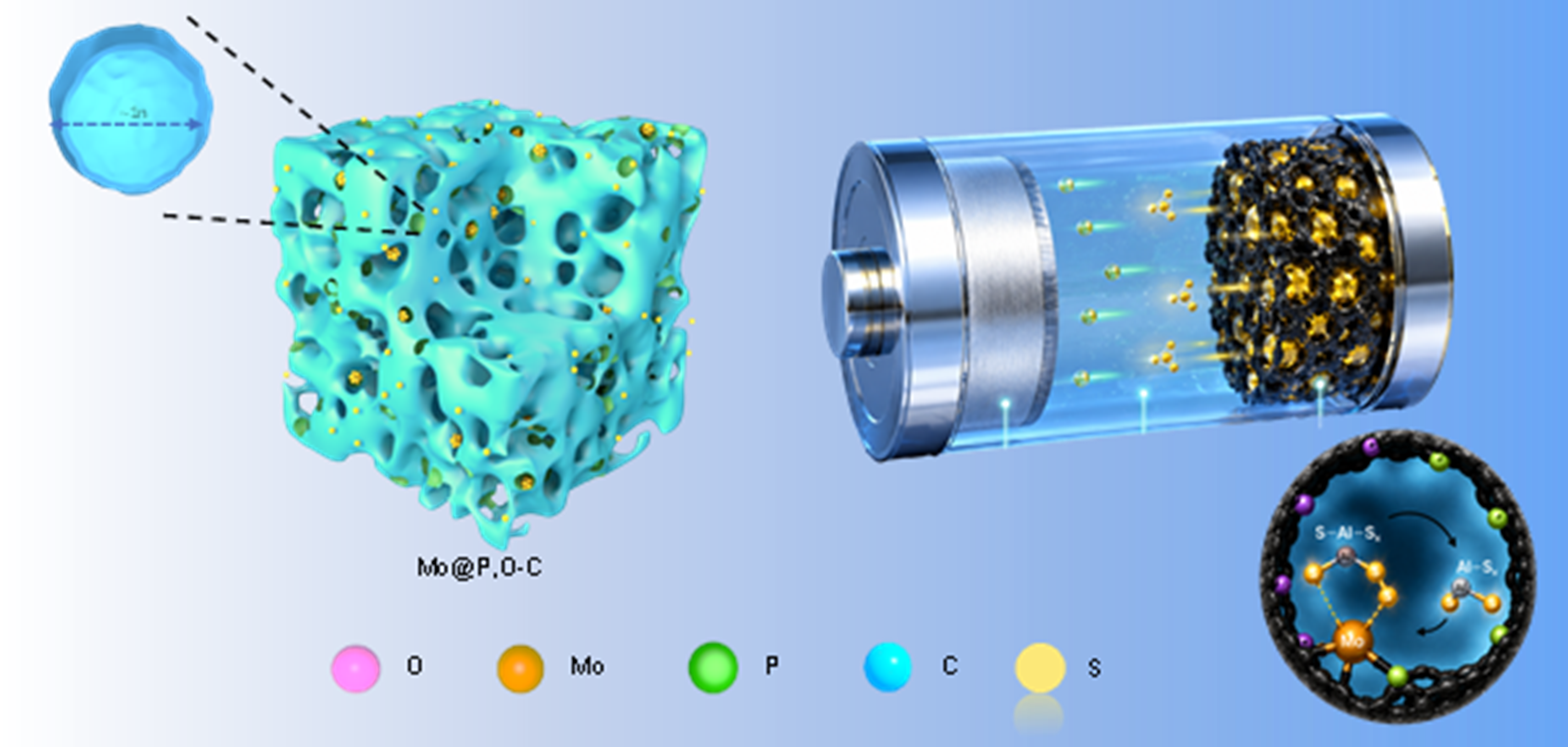
Rechargeable aluminum–sulfur (Al–S) batteries combine earth-abundant electrodes with high theoretical energy density, but room-temperature operation remains constrained by slow sulfur conversion, migration of soluble aluminum polysulfides, and interfacial passivation by insulating discharge products. Here we construct a P/O-codoped microporous carbon cage that stabilizes atomically dispersed molybdenum sites (Mo-SA@P,O-PC) through a pore-matched confinement strategy. The microporous host is designed to retain the polyoxometalate precursor and to bring sulfur species into contact with P/O functionalities and Mo centers after pyrolysis. Electron microscopy, O 1s XPS, soft X-ray absorption spectroscopy, and Mo K-edge XAFS identify positively polarized, light-element-coordinated Mo single atoms without detectable Mo–Mo aggregation. In room-temperature [AlCl3]1.3[EMIM]Cl, the Mo-SA@P,O-PC/S cathode delivers approximately 550 mAh g−1 at 100 mA g−1, whereas the metal-free control provides about 200 mAh g−1. The electrode also maintains reversible operation as the current density is stepped from 200 to 500 mA g−1, followed by substantial capacity recovery when the current is lowered. Cycling profiles remain similar through the 130th cycle at 500 mA g−1, and the discharge capacity stabilizes near 130 mAh g−1 up to 180 cycles at 100 mA g−1 with high Coulombic efficiency. Operando Mo K-edge XAFS shows that the isolated Mo centers retain their first-shell coordination with small state-dependent changes in their electronic environment. These results support a proposed cooperative confinement, coordination, and catalysis mechanism for durable multistep sulfur conversion.
- Open Access
- Article
Micropore-Confined P/O-Codoped Carbon Cages Stabilize Molybdenum Single-Atom Sites for Sulfur Conversion in Aluminum-Sulfur Batteries
- Su Yang 1,2,†,
- Xiaolu Ma 2,†,
- Qian Bai 2,
- Runmin Li 2,
- Rui Yang 2,
- Jilin Li 2,
- Zhengbang Zhu 2,
- Weng-Chon (Max) Cheong 3,
- Wenxing Chen 2,*,
- Handong Jiao 1,* and
- Shuqiang Jiao 4,*
Author Information
Received: 25 July 2026 | Revised: 26 October 2026 | Accepted: 11 November 2026 | Published: 23 November 2026
Abstract
Graphical Abstract
Keywords
Al-S battery | Mo single-atom sites | P,O-co-doped porous carbon | confinement
References
- 1.
Dunn, B.; Kamath, H.; Tarascon, J.M. Electrical Energy Storage for the Grid: A Battery of Choices. Science 2011, 334, 928–935. https://doi.org/10.1126/science.1212741.
- 2.
Elia, G.A.; Marquardt, K.; Hoeppner, K.; et al. An Overview and Future Perspectives of Aluminum Batteries. Adv. Mater. 2016, 28, 7564–7579. https://doi.org/10.1002/adma.201601357.
- 3.
Lin, M.C.; Gong, M.; Lu, B.; et al. An ultrafast rechargeable aluminium-ion battery. Nature 2015, 520, 324–328. https://doi.org/10.1038/nature14340.
- 4.
Yang, H.; Li, H.; Li, J.; et al. The Rechargeable Aluminum Battery: Opportunities and Challenges. Angew. Chem. Int. Ed. 2019, 58, 11978–11996. https://doi.org/10.1002/anie.201814031.
- 5.
Faegh, E.; Ng, B.; Hayman, D.; et al. Practical assessment of the performance of aluminium battery technologies. Nat. Energy 2021, 6,21–29. https://doi.org/10.1038/s41560-020-00728-y. Correction in Nat. Energy 2021, 6, 450.
- 6.
Cohn, G.; Ma, L.; Archer, L.A. A novel non-aqueous aluminum sulfur battery. J. Power Sources 2015, 283, 416–422. https://doi.org/10.1016/j.jpowsour.2015.02.131.
- 7.
Gao, T.; Li, X.; Wang, X.; et al. A Rechargeable Al/S Battery with an Ionic-Liquid Electrolyte. Angew. Chem. Int. Ed. 2016, 55, 9898–9901. https://doi.org/10.1002/anie.201603531.
- 8.
Yu, X.; Manthiram, A. Electrochemical Energy Storage with a Reversible Nonaqueous Room-Temperature Aluminum–Sulfur Chemistry. Adv. Energy Mater. 2017, 7, 1700561. https://doi.org/10.1002/aenm.201700561.
- 9.
Yang, H.; Yin, L.; Liang, J.; et al. An Aluminum–Sulfur Battery with a Fast Kinetic Response. Angew. Chem. Int. Ed. 2018, 57, 1898–1902. https://doi.org/10.1002/anie.201711328.
- 10.
Wang, W.; Cao, Z.; Elia, G.A.; et al. Recognizing the Mechanism of Sulfurized Polyacrylonitrile Cathode Materials for Li–S Batteries and beyond in Al–S Batteries. ACS Energy Lett. 2018, 3, 2899–2907. https://doi.org/10.1021/acsenergylett.8b01945.
- 11.
Guo, Y.; Hu, Z.; Cui, Y.; et al. Al2S3 Cathode for Rechargeable Aluminum-Sulfur Batteries with Improved Cycling Reversibility. Batter. Supercaps 2022, 5, e202100355. https://doi.org/10.1002/batt.202100355.
- 12.
Klimpel, M.; Kovalenko, M.V.; Kravchyk, K.V. Advances and challenges of aluminum–sulfur batteries. Commun. Chem. 2022, 5, 77. https://doi.org/10.1038/s42004-022-00693-5.
- 13.
Deka, N.; Dutta, G.K. Recent advancement in carbon-based materials as sulfur hosts for rechargeable aluminum–sulfur (Al–S) batteries. Curr. Opin. Electrochem. 2023, 38, 101222. https://doi.org/10.1016/j.coelec.2023.101222.
- 14.
Faheem, M.; Hussain, A.; Ali, M.; et al. Recent Theoretical and Experimental Advancements of Aluminum-Sulfur Batteries. Chem. Rec. 2024, 24, e202300268. https://doi.org/10.1002/tcr.202300268.
- 15.
Zhang, Y.; Ma, L.; Tang, R.; et al. The host hollow carbon nanospheres as cathode material for nonaqueous room-temperature Al–S batteries. Int. J. Hydrogen Energy 2021, 46, 4936–4946. https://doi.org/10.1016/j.ijhydene.2020.11.076.
- 16.
Smajic, J.; Wee, S.; Simoes, F.R.F.; et al. Capacity Retention Analysis in Aluminum-Sulfur Batteries. ACS Appl. Energy Mater. 2020, 3, 6805–6814. https://doi.org/10.1021/acsaem.0c00921.
- 17.
Zheng, X.; Tang, R.; Zhang, Y.; et al. Design of a composite cathode and a graphene coated separator for a stable room-temperature aluminum–sulfur battery. Sustain. Energy Fuels 2020, 4, 1630–1641. https://doi.org/10.1039/c9se00762h.
- 18.
Guo, Y.; Jin, H.; Qi, Z.; et al. Carbonized-MOF as a Sulfur Host for Aluminum–Sulfur Batteries with Enhanced Capacity and Cycling Life. Adv. Funct. Mater. 2019, 29, 1807676. https://doi.org/10.1002/adfm.201807676.
- 19.
Guo, Y.; Hu, Z.; Wang, J.; et al. Rechargeable Aluminium–Sulfur Battery with Improved Electrochemical Performance by Cobalt-Containing Electrocatalyst. Angew. Chem. Int. Ed. 2020, 59, 22963–22967. https://doi.org/10.1002/anie.202008481.
- 20.
Zhang, K.; Lee, T.H.; Cha, J.H.; et al. Two-dimensional boron nitride as a sulfur fixer for high performance rechargeable aluminum-sulfur batteries. Sci. Rep. 2019, 9, 13573. https://doi.org/10.1038/s41598-019-50080-9.
- 21.
Xiao, X.; Tu, J.; Huang, Z.; et al. A cobalt-based metal–organic framework and its derived material as sulfur hosts for aluminum–sulfur batteries with the chemical anchoring effect. Phys. Chem. Chem. Phys. 2021, 23, 10326–10334. https://doi.org/10.1039/d1cp01232k.
- 22.
Zheng, X.; Wang, Z.; Li, J.; et al. Binder-free S@Ti3C2Tx sandwich structure film as a high-capacity cathode for a stable aluminum-sulfur battery. Sci. China Mater. 2022, 65, 1463–1475. https://doi.org/10.1007/s40843-021-1913-4.
- 23.
Ai, Y.; Wu, S.C.; Zhang, F.; et al. Bifunctional TiN@N-doped-graphene catalyst based high sulfur content cathode for reversible Aluminum-Sulfur batteries. Energy Storage Mater. 2022, 48, 297–305. https://doi.org/10.1016/j.ensm.2022.03.019.
- 24.
Hu, Z.; Xie, S.; Guo, Y.; et al. Isolated Co single atoms in nitrogen-doped graphene for aluminum-sulfur batteries with enhanced kinetic response. J. Energy Chem. 2022, 67, 354–360. https://doi.org/10.1016/j.jechem.2021.10.010.
- 25.
Wang, F.; Jiang, M.; Zhao, T.; et al. Atomically Dispersed Iron Active Sites Promoting Reversible Redox Kinetics and Suppressing Shuttle Effect in Aluminum–Sulfur Batteries. Nano-Micro Lett. 2022, 14, 169. https://doi.org/10.1007/s40820-022-00915-4.
- 26.
Ju, S.; Ye, J.; Zhang, H.; et al. Recognizing the contrasting role of N, O dual-coordinated single-atom iron catalyst in Li−S and Al−S batteries. Energy Storage Mater. 2023, 56, 1–12. https://doi.org/10.1016/j.ensm.2023.01.002.
- 27.
Ju, S.; Yuan, C.; Zheng, J.; et al. Identifying single-atom catalysts for boosted Al–S conversion reactions. Energy Storage Mater. 2022, 52, 524–533. https://doi.org/10.1016/j.ensm.2022.08.030.
- 28.
Lv, J.; Lai, G.; Yang, T.; et al. Enabling long cycle aluminum-sulfur batteries via structurally stable Co, N-doped graphene-CNTs covalently bonded hybrid. Chem. Eng. J. 2024, 494, 152811. https://doi.org/10.1016/j.cej.2024.152811.
- 29.
Sun, Q.; Chai, L.; Yang, X.; et al. Hollow tubular sea-urchin structure with high catalytic activity of NiCo2Se4@CS2 cathodes for high-performance Al/S batteries. J. Colloid Interface Sci. 2025, 677, 284–292. https://doi.org/10.1016/j.jcis.2024.08.071.
- 30.
Gorle, M.; Jetti, V.R. Enhanced reliability of aluminum–sulfur batteries with cost-effective ionic liquid electrolyte and sulfur/graphite cathode. New J. Chem. 2024, 48, 4020–4029. https://doi.org/10.1039/d3nj05853k.
- 31.
Zhang, X.; Tong, Y.; An, J.; et al. Local electronic regulation of single-atom catalysts to accelerate aluminum-sulfur conversion kinetics. J. Energy Storage 2025, 129, 117320. https://doi.org/10.1016/j.est.2025.117320.
- 32.
Yu, G.; Liu, X.; Huang, W.; et al. Ferromagnetic Atomic d-p Orbital Hybridization for Promoting Al-S Batteries. Adv. Mater. 2025, 37, 2418784. https://doi.org/10.1002/adma.202418784.
- 33.
Zhou, Q.; Zhang, X.; Wu, Y.; et al. Polyoxometalates@Metal-Organic Frameworks Derived Bimetallic Co/Mo2C Nanoparticles Embedded in Carbon Nanotube-Interwoven Hierarchically Porous Carbon Polyhedron Composite as a High-Efficiency Electrocatalyst for Al–S Batteries. Small 2023, 19, 2304515. https://doi.org/10.1002/smll.202304515.
- 34.
Lin, Z.; Mao, M.; Lv, T.; et al. Electroactive-catalytic conductive framework for aluminum-sulfur batteries. Energy Storage Mater. 2022, 51, 266–272. https://doi.org/10.1016/j.ensm.2022.06.055.
- 35.
Liang, J.; Yin, L.; Tang, X.; et al. Kinetically Enhanced Electrochemical Redox of Polysulfides on Polymeric Carbon Nitrides for Improved Lithium–Sulfur Batteries. ACS Appl. Mater. Interfaces 2016, 8, 25193–25201. https://doi.org/10.1021/acsami.6b05647.
- 36.
Tao, X.; Wang, J.; Liu, C.; et al. Balancing surface adsorption and diffusion of lithium-polysulfides on nonconductive oxides for lithium–sulfur battery design. Nat. Commun. 2016, 7, 11203. https://doi.org/10.1038/ncomms11203.
- 37.
He, J.; Hartmann, G.; Lee, M.; et al. Freestanding 1T MoS2/graphene heterostructures as a highly efficient electrocatalyst for lithium polysulfides in Li–S batteries. Energy Environ. Sci. 2019, 12, 344–350. https://doi.org/10.1039/c8ee03252a.
- 38.
Al Salem, H.; Babu, G.; Rao, C.V.; et al. Electrocatalytic Polysulfide Traps for Controlling Redox Shuttle Process of Li–S Batteries. J. Am. Chem. Soc. 2015, 137, 11542–11545. https://doi.org/10.1021/jacs.5b04472.
- 39.
Wang, H.; Shu, Q.; Zhou, Z.; et al. Engineering NiCo single atom alloy on MXene as cascade catalyst for high-performance Li–S batteries. Nano Res. 2025, 18, 94907557. https://doi.org/10.26599/nr.2025.94907557.
- 40.
Liu, J. Catalysis by Supported Single Metal Atoms. ACS Catal. 2017, 7, 34–59. https://doi.org/10.1021/acscatal.6b01534.
- 41.
Hu, P.; Wu, Y.F.; Gao, X.P.; et al. N/O dual coordination of cobalt single atom for fast kinetics sodium-sulfur batteries. Rare Met. 2025, 44, 288–299. https://doi.org/10.1007/s12598-024-02975-4.
- 42.
Du, Z.; Chen, X.; Hu, W.; et al. Cobalt in Nitrogen-Doped Graphene as Single-Atom Catalyst for High-Sulfur Content Lithium–Sulfur Batteries. J. Am. Chem. Soc. 2019, 141, 3977–3985. https://doi.org/10.1021/jacs.8b12973.
- 43.
Zhang, L.; Liu, D.; Muhammad, Z.; et al. Single Nickel Atoms on Nitrogen-Doped Graphene Enabling Enhanced Kinetics of Lithium–Sulfur Batteries. Adv. Mater. 2019, 31, 1903955. https://doi.org/10.1002/adma.201903955.
- 44.
Liu, H.H.; Xu, Q.; Liu, H.; et al. P doping adjusts the coordination structure of single atoms to accelerate the catalytic bidirectional redox reaction in Li–S batteries. Rare Met. 2025, 44, 5428–5438. https://doi.org/10.1007/s12598-025-03233-x.
- 45.
Liu, K.; Wang, L.; Chen, W.; et al. The roadmap of carbon-based single-atom catalysts: Rational design and electrochemical applications. Rare Met. 2025, 44, 7987–8132. https://doi.org/10.1007/s12598-025-03477-7.
- 46.
Yang, S.; Wang, M.; Zhang, Y.; et al. Single-Molecule Confinement Induced Intrinsic Multi-Electron Redox-Activity to Enhance Supercapacitor Performance. Energy Environ. Mater. 2023, 6, e12396. https://doi.org/10.1002/eem2.12396.
- 47.
Jones, J.; Xiong, H.; DeLaRiva, A.T.; et al. Thermally stable single-atom platinum-on-ceria catalysts via atom trapping. Science 2016, 353, 150–154. https://doi.org/10.1126/science.aaf8800.
- 48.
Ferrari, A.C.; Robertson, J. Interpretation of Raman spectra of disordered and amorphous carbon. Phys. Rev. B 2000, 61, 14095–14107. https://doi.org/10.1103/physrevb.61.14095.
- 49.
Fei, H.; Dong, J.; Feng, Y.; et al. General synthesis and definitive structural identification of MN4C4 single-atom catalysts with tunable electrocatalytic activities. Nat. Catal. 2018, 1, 63–72. https://doi.org/10.1038/s41929-017-0008-y.
- 50.
Li, H.; Meng, R.; Guo, Y.; et al. Reversible electrochemical oxidation of sulfur in ionic liquid for high-voltage Al−S batteries. Nat. Commun. 2021, 12, 5714. https://doi.org/10.1038/s41467-021-26056-7.
- 51.
Wang, S.; Yu, Z.; Tu, J.; et al. A Novel Aluminum-Ion Battery: Al/AlCl3-[EMIm]Cl/Ni3S2@Graphene. Adv. Energy Mater. 2016, 6, 1600137. https://doi.org/10.1002/aenm.201600137.
- 52.
Yu, Z.; Kang, Z.; Hu, Z.; et al. Hexagonal NiS nanobelts as advanced cathode materials for rechargeable Al-ion batteries. Chem. Commun. 2016, 52, 10427–10430. https://doi.org/10.1039/c6cc05974k.
- 53.
Li, H.; Yang, H.; Sun, Z.; et al. A highly reversible Co3S4 microsphere cathode material for aluminum-ion batteries. Nano Energy 2019, 56, 100–108. https://doi.org/10.1016/j.nanoen.2018.11.045.
- 54.
Yang, J.; Jia, X.; Li, B.; et al. Precision-Engineered Nanocatalysts via Lattice Tailoring and d-Band Center Modulation for High-Performance Lithium-Sulfur Batteries. Carbon Energy 2025, 7, e70043. https://doi.org/10.1002/cey2.70043.
- 55.
Jiang, B.; Tian, D.; Qiu, Y.; et al. High-Index Faceted Nanocrystals as Highly Efficient Bifunctional Electrocatalysts for High-Performance Lithium–Sulfur Batteries. Nano-Micro Lett. 2022, 14, 40. https://doi.org/10.1007/s40820-021-00769-2.
- 56.
Guo, J.; Liang, H.; Yang, Q.; et al. Steric-Hindrance Effect Induced Fabrication of Lightweight, Bi-Functional, and Easy-to-Infiltrate Hosts for 502 Wh kg−1 Lithium-Sulfur Batteries. Adv. Mater. 2026, 38, e18154. https://doi.org/10.1002/adma.202518154.

This work is licensed under a Creative Commons Attribution 4.0 International License.