
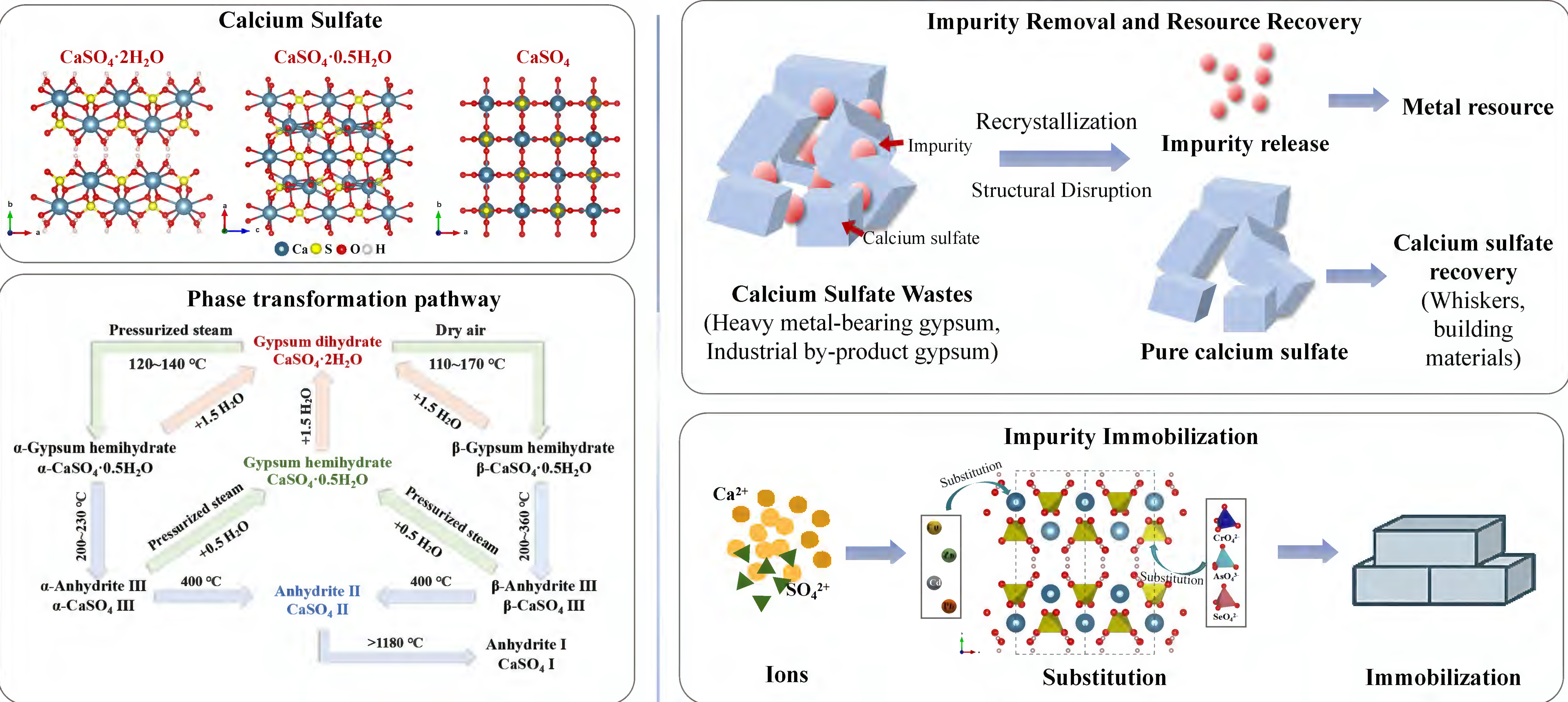
Calcium sulfate is a widely occurring inorganic salt in natural environments and industrial systems. It mainly occurs as dihydrate gypsum, hemihydrate gypsum, and anhydrite. During the nucleation and growth of calcium sulfate, impurity elements can bind to the calcium sulfate matrix through surface adsorption, coprecipitation, physical encapsulation, or lattice incorporation. Industrial processes generate large amounts of impurity-bearing calcium sulfate wastes, in which impurities are associated with the calcium sulfate matrix. The growing annual production and stockpiling of this waste pose challenges for environmental management and resource recovery. On the other hand, phase transformation in the calcium sulfate system provides possibilities for controlling impurity behavior. During dissolution-recrystallization, thermal dehydration and physical enhancement, the reconstruction of the calcium sulfate matrix can promote the release of impurities. Conversely, under specific crystallization conditions, foreign ions can also be immobilized in the calcium sulfate phase. This review summarizes the nucleation and phase transformation behavior of calcium sulfate and discusses the distribution of impurity ions in calcium sulfate. It then discusses different treatment methods based on calcium sulfate phase transformation. For calcium sulfate wastes, phase transformation can be used to promote impurity release and calcium sulfate purification through wet recrystallization, thermal dehydration–rehydration, or physical enhancement. the dissolution-recrystallization process of calcium sulfate is promoted to achieve deep extraction of impurities. Typical examples include gypsum containing heavy metals, as well as industrial by-product gypsum such as phosphogypsum and red gypsum. Then, immobilization applications based on calcium sulfate crystallization are discussed. Finally, the practical limitations and remaining challenges of these approaches are discussed. This review aims to guide the treatment of calcium sulfate waste from a microstructural perspective and promote the sustainable recycling of resources.
- Open Access
- Review
Impurity Regulation during Calcium Sulfate Crystallization and Phase Transformation: Purification, Resource Recovery, and Immobilization
- Jie Li 1,2,
- Li Li 1,2,
- Changzhou Weng 3,
- Jiemin Qin 1,2,
- Zhulin Xue 1,2,
- Lijuan Jia 4,
- Changyong Yu 5,
- Xiaoqin Li 1,2,
- Weizhen Liu 1,2,*,
- Zhang Lin 3
Author Information
Received: 09 May 2026 | Revised: 26 Jun 2026 | Accepted: 21 Jul 2026 | Published: 03 Aug 2026
Abstract
Graphical Abstract
Keywords
gypsum waste | phase transformation | heavy metal | resource recovery
References
- 1.
Van Driessche, A.; Benning, L.G.; Rodriguez-Blanco, J.D.; et al. The Role and Implications of Bassanite as a Stable Precursor Phase to Gypsum Precipitation. Science 2012, 336, 69–72.
- 2.
Langevin, Y.; Poulet, F.; Bibring, J.P.; et al. Sulfates in the North Polar Region of Mars Detected by OMEGA/Mars Express. Science 2005, 307, 1584–1586.
- 3.
Escavy, J.I.; Herrero, M.J.; Arribas, M.E. Gypsum Resources of Spain: Temporal and Spatial Distribution. Ore Geol. Rev. 2012, 49, 72–84.
- 4.
Orti, F.; Rosell, L.; Gibert, L.; et al. Evaporite Sedimentation in a Tectonically Active Basin: The Lacustrine Las Minas Gypsum Unit (Late Tortonian, SE Spain). Sediment. Geol. 2014, 311, 17–42.
- 5.
Peng, X.Q.; Zheng, J.Y.; Liu, Q.; et al. Efficient Removal of Iron from Red Gypsum Via Synergistic Regulation of Gypsum Phase Transformation and Iron Speciation. Sci. Total Environ. 2021, 791, 148319.
- 6.
Li, J.; Peng, X.Q.; Zheng, J.Y.; et al. Simultaneous Removal of Phosphorus and Organic Contaminants from Phosphogypsum Using Hydrothermal Method for Gypsum Resource Regeneration. J. Environ. Chem. Eng. 2022, 10, 108441.
- 7.
Shi, T.; Wan, T.M.; Zhang, Z.Y.; et al. Effect of SiO2 on the Melting Characteristics of Reaction between Phosphogypsum and Calcium Sulfide. J. Therm. Anal. Calorim. 2016, 123, 1601–1609.
- 8.
Beaugnon, F.; Preturlan, J.; Fusseis, F.; et al. from Atom Level to Macroscopic Scale: Structural Mechanism of Gypsum Dehydration. Solid State Sci. 2022, 126, 106845.
- 9.
Iwasaki, S.; Zushi, Y.; Koga, N. An Advanced Kinetic Approach to the Multistep Thermal Dehydration of Calcium Sulfate Dihydrate Under Different Heating and Water Vapor Conditions: Kinetic Deconvolution and Universal Isoconversional Analyses. Phys. Chem. Chem. Phys. 2022, 24, 9492–9508.
- 10.
Jun, Y.S.; Zhu, Y.G.; Wang, Y.; et al. Classical and Nonclassical Nucleation and Growth Mechanisms for Nanoparticle Formation. Annu. Rev. Phys. Chem. 2022, 73, 453–477.
- 11.
Lin, J.R.; Chen, N.; Feng, R.F.; et al. Sequestration of Selenite and Selenate in Gypsum (CaSO4·2H2O): Insights from the Single-Crystal Electron Paramagnetic Resonance Spectroscopy and Synchrotron X-ray Absorption Spectroscopy Study. Environ. Sci. Technol. 2020, 54, 3169–3180.
- 12.
Reigl, S.; Van Driessche, A.; Stawski, T.M.; et al. Sustainable Pathways for the Synthesis of Calcium Sulfate Hemihydrate. Angew. Chem. Int. Ed. 2025, 64, e202415161.
- 13.
Chen, Q.; Wang, S.J.; Li, Y.; et al. Influence of Flue Gas Desulfurization Gypsum Amendments on Heavy Metal Distribution in Reclaimed Sodic Soils. Environ. Eng. Sci. 2015, 32, 470–478.
- 14.
Wei, Z.M.; Chen, B.; Gu, K.; et al. Study of Untreated Phosphogypsum as a Fine Aggregate for Magnesium Oxysulfate Cement. Constr. Build. Mater. 2023, 365, 130040.
- 15.
Wang, C.; Xia, H.; Xu, Y.; et al. Resource Utilization of Waste Acid Neutralization Residue Generated in Nonferrous Metal Smelting Processes: A Review. Sep. Purif. Technol. 2025, 379, 135164.
- 16.
Cesniene, J. Influence of Phosphatic Impurities on the Anhydrite Binding Material of Phosphogypsum. Ceram. Silik. 2007, 51, 153–159.
- 17.
Chen, Q.J.; Ding, W.J.; Sun, H.J.; et al. Synthesis of Anhydrite from Red Gypsum and Acidic Wastewater Treatment. J. Clean. Prod. 2021, 278, 124026.
- 18.
Guan, Q.J.; Sun, N.; Bu, Y.J.; et al. Efficient Extraction of Impurities from Phosphogypsum during Crystal Regulation of Α-Hemihydrate Gypsum. J. Am. Ceram. Soc. 2023, 106, 7360–7374.
- 19.
Lu, S.B.; Warmadewanthi Liu, J.C. Recovery of Rare Earth Elements from Phosphogypsum Using Subcritical Water Extraction. Chem. Eng. Process. Process Intensif. 2023, 190, 109433.
- 20.
Rychkov, V.N.; Kirillov, E.V.; Kirillov, S.V.; et al. Recovery of Rare Earth Elements from Phosphogypsum. J. Clean. Prod. 2018, 196, 674–681.
- 21.
Wang, B.Q.; Yang, L.; Luo, T.; et al. Study on the Kinetics of Hydration Transformation from Hemihydrate Phosphogypsum to Dihydrate Phosphogypsum in Simulated Wet Process Phosphoric Acid. Acs Omega 2021, 6, 7342–7350.
- 22.
Zhong, R.; Xu, Z.X.; Liang, S.J.; et al. Phase Transformation and Crystal Growth of Gypsum Via Hydrothermal Treatment with High Pressure CO2 for Cr(VI) Extraction. Surf. Interfaces 2022, 29, 101768.
- 23.
Wang, S.F.; Zhang, D.N.; Ma, X.; et al. Spectroscopic and DFT Study on the Species and Local Structure of Arsenate Incorporated in Gypsum Lattice. Chem. Geol. 2017, 460, 46–53.
- 24.
Chrysochoou, M.; Dermatas, D.; Grubb, D.G.; et al. Importance of Mineralogy in the Geoenvironmental Characterization and Treatment of Chromite Ore Processing Residue. J. Geotech. Geoenvironmental Eng. 2010, 136, 510–521.
- 25.
Hillier, S.; Lumsdon, D.G.; Brydson, R.; et al. Hydrogarnet: A Host Phase for Cr(VI) in Chromite Ore Processing Residue (COPR) and Other High pH Wastes. Environ. Sci. Technol. 2007, 41, 1921–1927.
- 26.
Liu, W.Z.; Huang, F.; Liao, Y.Q.; et al. Treatment of CrVI-containing Mg(OH)2 Nanowaste. Angew. Chem. Int. Ed. 2008, 120, 5701–5704.
- 27.
Liu, W.Z.; Huang, F.; Wang, Y.J.; et al. Recycling Mg(OH)2 Nanoadsorbent during Treating the Low Concentration of CrVI. Environ. Sci. Technol. 2011, 45, 1955–1961.
- 28.
Liu, W.Z.; Zheng, J.Y.; Ou, X.W.; et al. Effective Extraction of Cr(VI) from Hazardous Gypsum Sludge Via Controlling the Phase Transformation and Chromium Species. Environ. Sci. Technol. 2018, 52, 13336–13342.
- 29.
Singh, B.; Sherman, D.M.; Gilkes, R.J.; et al. Incorporation of Cr, Mn and Ni into Goethite (α-FeOOH): Mechanism from Extended X-ray Absorption Fine Structure Spectroscopy. Clay Miner. 2002, 37, 639–649.
- 30.
Khalil, F.; Pagnanelli, F.; Moscardini, E. Phosphogypsum as the Secondary Source of Rare Earth Elements. Sustainability 2025, 17, 8828.
- 31.
Li, X.; Zhu, X.; Qi, X.J.; et al. Pyrolysis of Arsenic-Bearing Gypsum Sludge Being Substituted for Calcium Flux in Smelting Process. J. Anal. Appl. Pyrolysis 2018, 130, 19–28.
- 32.
Yong, Y.; Yongkui, L.; Jianhang, H.; et al. An All-In-One Strategy for Resource Recovery and Immobilization of Arsenic from Arsenic-Bearing Gypsum Sludge. Chemosphere 2022, 296, 134078.
- 33.
Zhang, T.F.; Han, J.W.; Liu, W.; et al. Recovery of Zinc and Extraction of Calcium and Sulfur from Zinc-Rich Gypsum Residue by Selective Reduction Roasting Combined with Hydrolysis. J. Environ. Manag. 2023, 331, 117256.
- 34.
Wu, C.; Xu, W.T.; Song, Z.Z.; et al. Purification of Synthetic Gypsum: Techniques and Mechanisms. Molecules 2026, 31, 484.
- 35.
Christensen, A.N.; Olesen, M.; Cerenius, Y.; et al. Formation and Transformation of Five Different Phases in the CaSO4·H2O System: Crystal Structure of the Subhydrate beta-CaSO4·0.5H2O and Soluble Anhydrite CaSO4. Chem. Mater. 2008, 20, 2124–2132.
- 36.
Christensen, A.N.; Jensen, T.R.; Nonat, A. A New Calcium Sulfate Hemi-Hydrate. Dalton Trans. 2010, 39, 2044–2048.
- 37.
Pedersen, B.F.; Semmingsen, D. Neutron Diffraction Refinement of the Structure of Gypsum, CaSO4·2H2O. Acta Crystallogr. 1982, 38, 1074–1077.
- 38.
Prieto-Taboada, N.; Larranaga, A.; Gomez-Laserna, O.; et al. The Relevance of the Combination of XRD and Raman Spectroscopy for the Characterization of the CaSO4·H2O System Compounds. Microchem. J. 2015, 122, 102–109.
- 39.
Carbone, M.; Ballirano, P.; Caminiti, R. Kinetics of Gypsum Dehydration at Reduced Pressure: An Energy Dispersive X-ray Diffraction Study. Eur. J. Mineral. 2008, 20, 621–627.
- 40.
Jones, F. Infrared Investigation of Barite and Gypsum Crystallization: Evidence for an Amorphous to Crystalline Transition. Crystengcomm 2012, 14, 8374–8381.
- 41.
Jia, C.Y.; Wu, L.C.; Chen, Q.S.; et al. Structural Evolution of Amorphous Calcium Sulfate Nanoparticles into Crystalline Gypsum Phase. Crystengcomm 2020, 22, 6805–6810.
- 42.
Wang, Y.W.; Kim, Y.Y.; Christenson, H.K.; et al. A New Precipitation Pathway for Calcium Sulfate Dihydrate (Gypsum) Via Amorphous and Hemihydrate Intermediates. Chem. Commun. 2012, 48, 504–506.
- 43.
Stawski, T.M.; van Driessche, A.; Ossorio, M.; et al. Formation of Calcium Sulfate through the Aggregation of Sub-3 Nanometre Primary Species. Nat. Commun. 2016, 7, 11177.
- 44.
Liao, Z.Y.; Wynne, K. A Metastable Amorphous Intermediate is Responsible for Laser-Induced Nucleation of Glycine. J. Am. Chem. Soc. 2022, 144, 6727–6733.
- 45.
Finney, E.E.; Finke, R.G. Nanocluster Nucleation and Growth Kinetic and Mechanistic Studies: A Review Emphasizing Transition-Metal Nanoclusters. J. Colloid Interface Sci. 2008, 317, 351–374.
- 46.
Sun, Y.X.; Kakinen, A.; Xing, Y.T.; et al. Nucleation of Beta-Rich Oligomers and Beta-Barrels in the Early Aggregation of Human Islet Amyloid Polypeptide. Biochim. Biophys. Acta Mol. Basis Dis. 2019, 1865, 434–444.
- 47.
Nguyent, P.; Derreumaux, P. Understanding Amyloid Fibril Nucleation and a Beta Oligomer/Drug Interactions from Computer Simulations. Acc. Chem. Res. 2014, 47, 603–611.
- 48.
Vekilov, P.G. Dense Liquid Precursor for the Nucleation of Ordered Solid Phases from Solution. Cryst. Growth Des. 2004, 4, 671–685.
- 49.
Li, H.J.; Wang, C.C.; Wang, M.; et al. Structures and Dynamic Hydration of CaSO4 Clusters in Supersaturated Solutions: A Molecular Dynamics Simulation Study. J. Mol. Liq. 2021, 324, 115104.
- 50.
Saha, A.; Lee, J.; Pancera, S.M.; et al. New Insights into the Transformation of Calcium Sulfate Hemihydrate to Gypsum Using Time-Resolved Cryogenic Transmission Electron Microscopy. Langmuir 2012, 28, 11182–11187.
- 51.
Van Driessche, A.; Stawski, T.M.; Kellermeier, M. Calcium Sulfate Precipitation Pathways in Natural and Engineered Environments. Chem. Geol. 2019, 530, 119274.
- 52.
Singh, N.B. The Activation Effect of K2SO4 on the Hydration of Gypsum Anhydrite, CaSO4(II). J. Am. Ceram. Soc. 2005, 88, 196–201.
- 53.
Abriel, W.; Reisdorf, K.; Pannetier, J. Dehydration Reactions of Gypsum: A Neutron and X-ray Diffraction Study. J. Solid State Chem. 1990, 85, 23–30.
- 54.
Chang, H.; Huang, P.J.; Hou, S.C. Application of thermo-Raman Spectroscopy to Study Dehydration of CaSO4·2H2O and CaSO4·0.5H2O. Mater. Chem. Phys. 1999, 58, 12–19.
- 55.
Chen, W.; Wu, Y.N.; Zhang, B.R.; et al. Retardation Behavior of Hydration of Calcium Sulfate Hemihydrate (Bassanite) Induced by Sodium Trimetaphosphate (STMP). Crystengcomm 2018, 20, 1662–1668.
- 56.
Comodi, P.; Kurnosov, A.; Nazzareni, S.; et al. The Dehydration Process of Gypsum Under High Pressure. Phys. Chem. Miner. 2012, 39, 65–71.
- 57.
Gurgul, S.J.; Seng, G.; Williams, G.R. A Kinetic and Mechanistic Study into the Transformation of Calcium Sulfate Hemihydrate to Dihydrate. J. Synchrotron Radiat. 2019, 26, 774–784.
- 58.
Li, X.B.; Zhang, Q. Hydration Mechanism and Hardening Property of Alpha-Hemihydrate Phosphogypsum. Minerals 2019, 9, 733.
- 59.
Schmid, T.; Jungnickel, R.; Dariz, P. Insights into the CaSO4·H2O System: A Raman-Spectroscopic Study. Minerals 2020, 10, 115.
- 60.
Sedighi-Gilani, M.; Ghazi Wakili, K.; Koebel, M.; et al. Visualizing Moisture Release and Migration in Gypsum Plaster Board during and Beyond Dehydration by Neutron Radiography. Int. J. Heat Mass Transf. 2013, 60, 284–290.
- 61.
Singh, N.B.; Middendorf, B. Calcium Sulphate Hemihydrate Hydration Leading to Gypsum Crystallization. Prog. Cryst. Growth Charact. Mater. 2007, 53, 57–77.
- 62.
Van der Heijden, G.; Pel, L.; Huinink, H.P.; et al. Moisture Transport and Dehydration in Heated Gypsum, an NMR Study. Chem. Eng. Sci. 2011, 66, 4241–4250.
- 63.
Kontrec, J.; Kralj, D.; Brecevic, L. Transformation of Anhydrous Calcium Sulphate into Calcium Sulphate Dihydrate in Aqueous Solutions. J. Cryst. Growth 2002, 240, 203–211.
- 64.
Ossorio, M.; Van Driessche, A.; Perez, P.; et al. The Gypsum-Anhydrite Paradox Revisited. Chem. Geol. 2014, 386, 16–21.
- 65.
Li, H.J.; Yan, D.; Cai, H.Q.; et al. Insights into Water-Mediated Ion Clustering in Aqueous CaSO4 Solutions: Pre-Nucleation Cluster Characteristics Studied by Ab Initio Calculations and Molecular Dynamics Simulations. Phys. Chem. Chem. Phys. 2017, 19, 11390–11403.
- 66.
Fu, H.L.; Jia, C.Y.; Chen, Q.S.; et al. Calcium Sulfate Polymorph Evolution Dominated by Competitive Nucleation in Gypsum Metastable Zone. J. Cryst. Growth 2017, 470, 143–148.
- 67.
Azimi, G.; Papangelakis, V.G. Mechanism and Kinetics of Gypsum-Anhydrite Transformation in Aqueous Electrolyte Solutions. Hydrometallurgy 2011, 108, 122–129.
- 68.
Ravenhill, E.R.; Kirkman, P.M.; Unwin, P.R. Microscopic Studies of Calcium Sulfate Crystallization and Transformation at Aqueous-Organic Interfaces. Cryst. Growth Des. 2016, 16, 5887–5895.
- 69.
Zhang, Q.W.; Wang, C.C.; Wang, M.; et al. Effects of Methanol on CaSO4 Ion Associated Species in Mixed Solutions: Solvation Dynamics and Hydrogen Bond Bridging Structure. J. Mol. Liq. 2020, 307, 112985.
- 70.
Jones, F.; Piana, S.; Gale, J.D. Understanding the Kinetics of Barium Sulfate Precipitation from Water and Water-Methanol Solutions. Cryst. Growth Des. 2008, 8, 817–822.
- 71.
Yan, C.; Nishida, J.; Yuan, R.F.; et al. Water of Hydration Dynamics in Minerals Gypsum and Bassanite: Ultrafast 2D IR Spectroscopy of Rocks. J. Am. Chem. Soc. 2016, 138, 9694–9703.
- 72.
Schmidt, H.; Paschke, I.; Freyer, D.; et al. Water Channel Structure of Bassanite at High Air Humidity: Crystal Structure of CaSO4·0.625H2O. Acta Crystallogr. Sect. B 2011, 67, 467–475.
- 73.
Skarbek, R.M.; Savage, H.M.; Kelemen, P.B.; et al. Competition Between Crystallization-Induced Expansion and Creep Compaction during Gypsum Formation, and Implications for Serpentinization. J. Geophys. Res. -Solid Earth 2018, 123, 5372–5393.
- 74.
Weber, B. Heat Transfer Mechanisms and Models for a Gypsum Board Exposed to Fire. Int. J. Heat Mass Transf. 2012, 55, 1661–1678.
- 75.
Tang, Y.B.; Gao, J.M.; Liu, C.B.; et al. Dehydration Pathways of Gypsum and the Rehydration Mechanism of Soluble Anhydrite gamma-CaSO4. Acs Omega 2019, 4, 7636–7642.
- 76.
Iwasaki, S.; Koga, N. Thermal Dehydration of Calcium Sulfate Dihydrate: Physico-Geometrical Kinetic Modeling and the Influence of Self-Generated Water Vapor. Phys. Chem. Chem. Phys. 2020, 22, 22436–22450.
- 77.
Yang, L.F.; Dai, L.D.; Li, H.P.; et al. Pressure-Induced Structural Phase Transition and Dehydration for Gypsum Investigated by Raman Spectroscopy and Electrical Conductivity. Chem. Phys. Lett. 2018, 706, 151–157.
- 78.
Dantas, H.F.; Mendes, R.; Pinho, R.D.; et al. Characterization of Gypsum Using TMDSC. J. Therm. Anal. Calorim. 2007, 87, 691–695.
- 79.
Yang, L.F.; Dai, L.D.; Li, H.P.; et al. The Phase Transition and Dehydration in Epsomite Under High Temperature and High Pressure. Crystals 2020, 10, 75.
- 80.
Walawalkar, M.; Nichol, C.K.; Azimi, G. Process Investigation of the Acid Leaching of Rare Earth Elements from Phosphogypsum Using HCl, HNO3, and H2SO4. Hydrometallurgy 2016, 166, 195–204.
- 81.
Ke, B.L.; Zhang, Q.; Li, X.H.; et al. Adsorption and Solidification of Cadmium by Calcium Sulfate Dihydrate (Gypsum) in an Aqueous Environment: A Dispersion-Corrected DFT and Ab Initio Molecular Dynamics Study. Phys. Chem. Chem. Phys. 2022, 24, 9521–9533.
- 82.
Ma, X.; Yao, S.H.; Yuan, Z.D.; et al. Detoxification and Reclamation of Hydrometallurgical Arsenic- and Trace Metals-Bearing Gypsum Via Hydrothermal Recrystallization in Acid Solution. Chemosphere 2020, 250, 126290.
- 83.
Li, W.J.; Wang, C.L.; Che, G.Q.; et al. Enhanced Extraction of Heavy Metals from Gypsum-Based Hazardous Waste by Nanoscale Sulfuric Acid Film at Ambient Conditions. J. Hazard. Mater. 2024, 469, 134027.
- 84.
Zhang, Q.Y.; Ye, J.R.; Hu, X.; et al. In-Situ Passivation of Cr/Cr (VI) in the Co-Combustion Ash of Dyeing Sludge and Biomass Via Controlling the Phase Transformation of Sulfate. J. Hazard. Mater. 2025, 492, 138137.
- 85.
Jia, R.Q.; Wang, Q.; Luo, T. Reuse of Phosphogypsum as Hemihydrate Gypsum: The Negative Effect and Content Control of H3PO4. Resour. Conserv. Recycl. 2021, 174, 105830.
- 86.
Chen, G.L.; Mao, T.; Guan, Q.J.; et al. Deep Removal of Arsenic from Arsenic-Bearing Gypsum Using a Seed-Induced Crystal Control Technique and its Mechanisms. Sep. Purif. Technol. 2025, 352, 128178.
- 87.
Sun, X.; Mao, M.; Lu, K.; et al. One-Step Removal of High-Concentration Arsenic from Wastewater to Form Johnbaumite Using Arsenic-Bearing Gypsum. J. Hazard. Mater. 2022, 424, 127585.
- 88.
Che, J.Y.; Zhang, W.J.; Deen, K.M.; et al. Eco-Friendly Treatment of Copper Smelting Flue Dust for Recovering Multiple Heavy Metals with Economic and Environmental Benefits. J. Hazard. Mater. 2024, 465, 133039.
- 89.
Li, J.; Qin, J.; Kang, Z.; et al. Thallium in Pb-Zn Smelting Waste: Speciation, Stability, and Environmental Risks. J. Environ. Sci. 2025, 162, 91–101.
- 90.
Li, Y.K.; Qi, X.J.; Li, G.H.; et al. Removal of Arsenic in Acidic Wastewater Using Lead-Zinc Smelting Slag: From Waste Solid to As-stabilized Mineral. Chemosphere 2022, 301, 134736.
- 91.
Li, Y.; Min, X.; Chai, L.; et al. Co-Treatment of Gypsum Sludge and Pb/Zn Smelting Slag for the Solidification of Sludge Containing Arsenic and Heavy Metals. J. Environ. Manag. 2016, 181, 756–761.
- 92.
Liu, J.; Wang, J.; Chen, Y.H.; et al. Thallium Transformation and Partitioning during Pb-Zn Smelting and Environmental Implications. Environ. Pollut. 2016, 212, 77–89.
- 93.
Zhang, W.J.; Che, J.Y.; Wen, P.C.; et al. Co-Treatment of Copper Smelting Flue Dust and Arsenic Sulfide Residue by a Pyrometallurgical Approach for Simultaneous Removal and Recovery of Arsenic. J. Hazard. Mater. 2021, 416, 126149.
- 94.
Yang, D.Z.; Sasaki, A.; Endo, M. Reclamation of a Waste Arsenic-Bearing Gypsum as a Soil Conditioner Via Acid Treatment and Subsequent Fe(II)-As Stabilization. J. Clean. Prod. 2019, 217, 22–31.
- 95.
Zheng, J.Y.; Lv, J.X.; Liu, W.Z.; et al. Selective Recovery of Cr from Electroplating Nanosludge Via Crystal Modification and Dilute Acid Leaching. Environ. Sci. Nano 2020, 7, 1593–1601.
- 96.
Liao, C.Z.; Li, X.Q.; Li, J.; et al. Chromium Removal from Chromium Gypsum through Microwave Hydrothermal Crystal Phase Regulation. Environ. Sci. Pollut. Res. 2023, 30, 104544–104553.
- 97.
Akfas, F.; Elghali, A.; Aboulaich, A.; et al. Exploring the Potential Reuse of Phosphogypsum: A Waste or a Resource? Sci. Total Environ. 2024, 908, 168196.
- 98.
Dai, Y.; Dong, H.J.; Sun, L.X.; et al. Life Cycle Environmental Impact Assessment of Titanium Dioxide Production in China. Environ. Impact Assess. Rev. 2024, 105, 107412.
- 99.
Jacques, S.; Gonzalez-Saborido, A.; Leynaud, O.; et al. Structural Evolution during the Dehydration of Gypsum Materials. Mineral. Mag. 2009, 73, 421–432.
- 100.
Preturlan, J.; Vieille, L.; Quiligotti, S.; et al. Kinetics and Mechanism of the Dehydration of Calcium Sulfate Dihydrate: A Comprehensive Approach for Studying the Dehydration of Ionic Hydrates under Controlled Temperature and Water Vapor Pressure. J. Phys. Chem. C 2020, 124, 26352–26367.
- 101.
Vimmrova, A.; Krejsova, J.; Scheinherrova, L.; et al. Changes in Structure and Composition of Gypsum Paste at Elevated Temperatures. J. Therm. Anal. Calorim. 2020, 142, 19–28.
- 102.
Sipple, E.M.; Bracconi, P.; Dufour, P.; et al. Microstructural Modifications Resulting from the Dehydration of Gypsum. Solid State Ion. 2001, 141–142, 447–454.
- 103.
Zheng, J.Y.; Li, J.; Ling, L.; et al. Crystal Regulation of Gypsum Via Hydrothermal Treatment with Hydrogen Ion for Cr(VI) Extraction. J. Hazard. Mater. 2020, 390, 120614.
- 104.
Zheng, J.; Weng, C.; Tian, C.; et al. Ingenious Approach for Retrieving Valuable Metals from Gypsum Via Dehydration–Rehydration Two-Step Phase Transition. Chem. Eng. J. 2024, 491, 152122.
- 105.
Jia, C.Y.; Wu, L.C.; Chen, Q.S.; et al. Distribution Behavior of Arsenate into Α-Calcium Sulfate Hemihydrate Transformed from Gypsum in Solution. Chemosphere 2020, 255, 126936.
- 106.
Li, L.; Gao, H.Q.; Li, J.; et al. A New Insight into Beryllium Extraction Mechanism from Beryllium-Containing Sludge through Key Host Phase Reconstruction and Binding Energy Regulation. J. Clean. Prod. 2025, 489, 144667.
- 107.
Weng, C.Z.; Zheng, Z.Q.; Tian, C.; et al. Effective Separation of Metal Impurities from Gypsum Nanosludge: Synergism of Mechanical Force and Metal Species Regulation. Environ. Sci. Nano 2025, 12, 340–352.
- 108.
Chai, L.Y.; Ke, Y.; Min, X.B.; et al. Separation and Recovery of ZnS from Sulfidized Neutralization Sludge Via the Hydration Conversion of CaSO4 into Bulk CaSO4·2H2O Crystals. Sep. Purif. Technol. 2015, 154, 76–81.
- 109.
Guan, Q.J.; Xu, W.T.; Zhou, F.J.; et al. Phase-Controlled Settling Separation: A Dual-Function Strategy for Purification and Valorization of Synthetic Gypsum. Sep. Purif. Technol. 2026, 387, 136731.
- 110.
Sadri, F.; Kim, R.; Yang, Z.; et al. The Effect of Calcium Sulfate Crystallization and the Crystal Modification on Aqueous REE Stability in Ca Saturated REE-Ca-SO4-H2O Systems. Hydrometallurgy 2018, 182, 82–96.
- 111.
Guan, Q.J.; Sui, Y.; Yu, W.J.; et al. Moderately Efficient Leaching of Rare Earth Elements from Phosphogypsum Via Crystal Regulation with EDTA-2Na during Gypsum Phase Transformation and Recovery by Precipitation. Hydrometallurgy 2022, 214, 105963.
- 112.
Widjaja, L.N.; Lie, J.; Soetaredjo, F.E.; et al. Microwave-Assisted Extraction of Rare Earth Elements from Phosphogypsum—Effect of Hydrogen Peroxide Addition. Chem. Eng. Process. Process Intensif. 2024, 200, 109800.
- 113.
Lambert, A.; Anawati, J.; Walawalkar, M.; et al. Innovative Application of Microwave Treatment for Recovering of Rare Earth Elements from Phosphogypsum. Acs Sustain. Chem. Eng. 2018, 6, 16471–16481.
- 114.
Cao, W.; Yi, W.; Peng, J.; et al. Upcycling of Phosphogypsum as Anhydrite Plaster: The Positive Effect of Soluble Phosphorus Impurities. Constr. Build. Mater. 2023, 372, 130824.
- 115.
Zhou, Z.; Chen, Y.; Fan, H.; et al. Effect of pH and Sodium Citrate on the Preparation of α-CaSO4·0.5 H2O and the Leaching of Impurity Phosphorus from Phosphogypsum. Constr. Build. Mater. 2025, 483, 141796.
- 116.
He, S.K.; Yang, L.; Hu, G.T.; et al. Deep Removal of Phosphate Impurities in Phosphogypsum by Two-Step Crystal Transformation for Use as Portland Cement Retarder. J. Build. Eng. 2023, 79, 107831.
- 117.
Guan, Q.; Sui, Y.; Yu, W.; et al. Deep Removal of Phosphorus and Synchronous Preparation of High-Strength Gypsum from Phosphogypsum by Crystal Modification in NaCl-HCl Solutions. Sep. Purif. Technol. 2022, 298, 121592.
- 118.
Ma, B.G.; Lu, W.D.; Su, Y.; et al. Synthesis of Alpha-Hemihydrate Gypsum from Cleaner Phosphogypsum. J. Clean. Prod. 2018, 195, 396–405.
- 119.
Hou, S.C.; Wang, J.; Wang, X.X.; et al. Effect of Mg2+ on Hydrothermal Formation of alpha-CaSO4·0.5H2O Whiskers with High Aspect Ratios. Langmuir 2014, 30, 9804–9810.
- 120.
Guan, Q.J.; Sun, W.; Hu, Y.H.; et al. A Facile Method of Transforming FGD Gypsum to alpha-CaSO4·0.5H2O Whiskers with Cetyltrimethylammonium Bromide (CTAB) and KCl in Glycerol-Water Solution. Sci. Rep. 2017, 7, 7085.
- 121.
Pan, Z.Y.; Lou, Y.; Yang, G.Y.; et al. Preparation of Calcium Sulfate Dihydrate and Calcium Sulfate Hemihydrate with Controllable Crystal Morphology by Using Ethanol Additive. Ceram. Int. 2013, 39, 5495–5502.
- 122.
Dong, W.Q.; Sun, N.J.; Deng, X.Y.; et al. Study on the Occurrence State of Main Components of Phosphogypsum Dihydrate and its Impurity Distribution. Rsc Adv. 2024, 14, 22280–22291.
- 123.
Xu, P.Y.; Li, Y.Q.; Zhang, T.; et al. Fluorine Speciation and Partitioning in Gas-Liquid-Solid Phases during Phosphoric Acid Production Via a Novel Clean Gypsum Route. J. Environ. Chem. Eng. 2026, 14, 121958.
- 124.
Dong, W.Q.; Deng, X.Y.; Chai, L.Q.; et al. Leaching Characteristics and Mechanisms of Fluorine and Phosphorus from Phosphogypsum. Molecules 2025, 30, 5.
- 125.
Chen, X.Y.; Shi, T.Y.; Zhao, W.D.; et al. Effect of Fluorine and Phosphorus Impurities in Phosphogypsum on Microstructure and Mechanism of α-Type Hemihydrate Gypsum Crystals. Cryst. Res. Technol. 2024, 59, 2300326.
- 126.
Li, J.Q.; Li, Y.L.; Yang, L.; et al. Effect of Phosphorus and Fluorine Impurities on the Properties and Hydration Mechanism of Α-Hemihydrate Gypsum Composite Cementitious Materials. Front. Mater. 2026, 13, 1746766.
- 127.
Yi, J.; Li, S.; Yang, W.; et al. Study on Strengthening the Crystallization Process of Removing F and P from Phosphogypsum Produced by Dihydrate–Hemihydrate Wet Process. Metall. Mater. Trans. B 2024, 55, 3018–3026.
- 128.
Li, X.B.; Zhang, Q. Dehydration Behaviour and Impurity Change of Phosphogypsum during Calcination. Constr. Build. Mater. 2021, 311, 125328.
- 129.
Cao, W.X.; Yi, W.; Peng, J.H.; et al. Recycling of Phosphogypsum to Prepare Gypsum Plaster: Effect of Calcination Temperature. J. Build. Eng. 2022, 45, 103511.
- 130.
Cao, W.X.; Yi, W.; Peng, J.H.; et al. Preparation of Anhydrite from Phosphogypsum: Influence of Phosphorus and Fluorine Impurities on the Performances. Constr. Build. Mater. 2022, 318, 126021.
- 131.
Du, J.W.; Tian, L.; Qi, M.F.; et al. Revealing Maleic Acid Role in the Preparation of A-Hemihydrate Gypsum from Titanium Gypsum through Experiments and DFT Calculations. Sci. Total Environ. 2023, 897, 166405.
- 132.
Koopman, C.; Witkamp, G.J. Ion Exchange Extraction during Continuous Recrystallization of CaSO4 in the Phosphoric Acid Production Process: Lanthanide Extraction Efficiency and CaSO4 Particle Shape. Hydrometallurgy 2002, 63, 137–147.
- 133.
Gou, C.L.; Li, W.J.; Gou, C.L.; et al. Dehydration of Gypsum Waste to Recyclable Anhydrite Using a Nano-Film Reservoir Under Ambient Conditions. Green Chem. 2023, 25, 8748–8758.
- 134.
Chen, D.; Song, J.; Xia, J.; et al. Investigation on the Mechanism of Efficient Removal of Phosphorus and Fluorine Impurities from Phosphogypsum by an in situ Recrystallization Purification Method. Ind. Eng. Chem. Res. 2024, 63, 22369–22379.
- 135.
Wang, Y.R.; Xiang, M.Q.; Yi, J.M.; et al. Sustainable Treatment of Solid Titanium-Gypsum-Waste Using Acidic Titanium-White-Wastewater to Produce High-Value Α-Hemihydrate Gypsum. Hydrometallurgy 2025, 235, 106489.
- 136.
Du, B.C.; He, Y.T.; Zhang, Q.Y.; et al. In-Situ Passivation of Cu and Zn in Dyeing Sludge Incineration Ash: Neglected Role of the Sulfur Cycle. J. Environ. Chem. Eng. 2025, 13, 119715.
- 137.
Dai, C.; Wan, S.; Shi, X.A.; et al. Passivation Mechanism to Cu and Zn in Co-Incineration Bottom Ash of Dyeing Sludge and Rice Husk Via in-situ Mineral Regulation. J. Clean. Prod. 2025, 486, 144419.
- 138.
Li, W.J.; Che, G.Q.; Wang, C.L.; et al. Phase Transformation of Calcium Sulfate at Mineral-Solution Interface: An Overlooked Pathway for Selective Enrichment of Cadmium. J. Hazard. Mater. 2025, 487, 137244.
- 139.
Wang, H.B.; Jiang, R.N.; Wang, B.Y.; et al. The Effect of Gypsum on the Fixation of Selenium in the Iron/Calcium-Selenium Coprecipitation Process. Bull. Environ. Contam. Toxicol. 2021, 106, 121–125.
- 140.
Das, S.; Hendry, M.J. An Assessment of Selenate coprecipitation with Gypsum. Geochemistry 2021, 81, 125743.
- 141.
Follner, S.; Wolter, A.; Preusser, A.; et al. The Setting Behaviour of Α- and β-CaSO4·0.5H2O as a Function of Crystal Structure and Morphology. Cryst. Res. Technol. 2003, 37, 1075–1087.
- 142.
Liu, D.; Min, X.; Ke, Y.; et al. Co-Treatment of Flotation Waste, Neutralization Sludge, and Arsenic-Containing Gypsum Sludge from Copper Smelting: Solidification/Stabilization of Arsenic and Heavy Metals with Minimal Cement Clinker. Environ. Sci. Pollut. Res. 2018, 25, 7600–7607.
- 143.
Ruan, B.; Jiao, F.; Liu, W.; et al. Utilization and Detoxification of Gypsum Sludge by Replacing Limestone in Reduction Smelting of High Lead Slag. J. Cent. South Univ. 2023, 30, 1145–1157.
- 144.
Peng, B.; Lei, J.; Min, X.; et al. Physicochemical Properties of Arsenic-Bearing Lime–Ferrate Sludge and its Leaching Behaviors. Trans. Nonferrous Met. Soc. China 2017, 27, 1188–1198.
- 145.
Zhang, T.; Han, J.; Dong, L.; et al. Innovative Methodology for Comprehensive Utilization of Arsenic-Bearing Neutralization Sludge. J. Environ. Manag. 2024, 353, 120148.
- 146.
Pan, Z.; Ruan, B.; Jiao, F.; et al. Resource Utilization of Hazardous Gypsum Sludge in Oxidation Smelting of Lead Concentrate. J. Cent. South Univ. 2024, 31, 3103–3118.
- 147.
Shibayama, A.; Takasaki, Y.; William, T.; et al. Treatment of Smelting Residue for Arsenic Removal and Recovery of Copper Using Pyro–Hydrometallurgical Process. J. Hazard. Mater. 2010, 181, 1016–1023.
- 148.
Yang, J.; Zhu, P.; Long, W.; et al. Enhanced Zinc Removal from Zinc-Rich Gypsum Residue in the Reduction Process through Red Mud Addition. J. Environ. Chem. Eng. 2025, 13, 117992.
- 149.
Ke, Y.; Chai, L.; Min, X.; et al. Sulfidation of Heavy-Metal-Containing Neutralization Sludge Using Zinc Leaching Residue as the Sulfur Source for Metal Recovery and Stabilization. Miner. Eng. 2014, 61, 105–112.
- 150.
Zhang, T.; Liu, W.; Han, J.; et al. Selective Separation of Calcium from Zinc-Rich Neutralization Sludge by Sulfidation Roasting and HCl Leaching. Sep. Purif. Technol. 2021, 259, 118064.
- 151.
Kordloo, M.; Noeparast, H.; Ashani, A.R.; et al. Using Waste to Treat Waste: Utilizing Pickling Liquor for Detoxification and Extraction of Valuable Elements from Electroplating Sludge. Environ. Technol. Innov. 2024, 36, 103826.
- 152.
Wang, Y.; Liu, P.; Kong, D.; et al. Investigation of the Properties and Microscopic Mechanism of Red Mud-Phosphogypsum-Based Composite Cementitious Materials. J. Build. Eng. 2025, 101, 111962.
- 153.
Ren, J.; Yang, H.; Du, S.; et al. Fabrication of Bulk Hydrophobic Building Gypsum Using Modified Phosphogypsum Additives: Preparation, Performance, and Mechanism. Constr. Build. Mater. 2025, 463, 140064.
- 154.
Zeng, L.; Bian, X.; Weng, J.; et al. Wetting-Drying Effect on the Strength and Microstructure of Cement-Phosphogypsum Stabilized Soils. J. Rock Mech. Geotech. Eng. 2024, 16, 1049–1058.
- 155.
Zhou, X.; Zhao, Y.; Zhu, H.; et al. Performance Activation and Strength Evolution Mechanism of Carbide Slag on Anhydrous Phosphogypsum Backfill Material. Constr. Build. Mater. 2024, 419, 135503.
- 156.
Zhao, L.; Wan, T.; Yang, X.; et al. Effects of Kaolinite Addition on the Melting Characteristics of the Reaction Between Phosphogypsum and CaS. J. Therm. Anal. Calorim. 2015, 119, 2119–2126.
- 157.
Zhou, Y.; Fang, K.; Chen, Y.; et al. Reverse Flotation Purification of Phosphogypsum and Preparation of High Whiteness CaSO4. Colloids Surf. A Physicochem. Eng. Asp. 2025, 716, 136763.
- 158.
Zhang, J.; Qi, Z.; He, Z.; et al. Study on the Extraction of Rare Earth Elements (REEs) from Phosphogypsum Using Gluconobacter Oxydans Culture Solution: Molecules 2025, 30, 674.
- 159.
Bao, H.; Zheng, Z.; Xu, G.; et al. Performance and Mechanism of Sand Stabilization Via Microbial-Induced CaCO3 Precipitation Using Phosphogypsum. J. Clean. Prod. 2024, 468, 142999.
- 160.
Lin, R.; Huang, G.; Ma, F.; et al. Investigation of Phosphogypsum-Based Cementitious Materials: The Effect of Lime Modification. Dev. Built Environ. 2024, 18, 100477.
- 161.
Wang, C.; Ying, Y.; Wang, T.; et al. Highly Efficient Modified Phosphogypsum Building Gypsum Powder and Environmentally Friendly Utilisation in Self-Levelling Mortar. Arch. Civ. Mech. Eng. 2024, 24, 118.
- 162.
Ren, Z.; Wang, L.; Wang, H.; et al. Stabilization and Solidification Mechanism of Pb in Phosphogypsum Slag-Based Cementitious Materials. Constr. Build. Mater. 2023, 368, 130427.
- 163.
Lin, X.; Liu, H.W.; Zhou, Z.X.; et al. Killing Three Birds with One Stone: A Novel Valorization Strategy for Comprehensive Utilization of Waste Titanium Gypsum. Constr. Build. Mater. 2024, 442, 137680.
- 164.
Xie, L.G.; Zhou, T.; Sun, M.Y.; et al. Titanium Gypsum-Assisted Lignite Gasification for H2-rich Syngas: Coupled Phase Reconstruction and Kinetic Switching. Chem. Eng. J. 2026, 537, 176422.
- 165.
Wang, L.F.; Su, X.B.; Zhao, W.Z.; et al. Kill Two Birds with One Stone: Production of Nanoscale CaCO3 and FeS2 from Red Gypsum Via Microbial Degradation. J. Clean. Prod. 2025, 490, 144783.
- 166.
Wang, S.J.; Lin, X.; Wang, C.Q. Dual Benefits of Indirect Mineral Carbonation of Titanium Gypsum: Waste Gypsum Recycling and Carbon Sequestration. Environ. Res. 2025, 285, 122393.
- 167.
Lin, Y.; Sun, H.J.; Zhao, Q.; et al. Titanium White Waste Acid for Efficient Iron Removal from Gypsum: A Study on Leaching Kinetics and a Sustainable “Utilizing Waste to Treat Waste” Strategy. J. Environ. Chem. Eng. 2026, 14, 122430.


This work is licensed under a Creative Commons Attribution 4.0 International License.
