
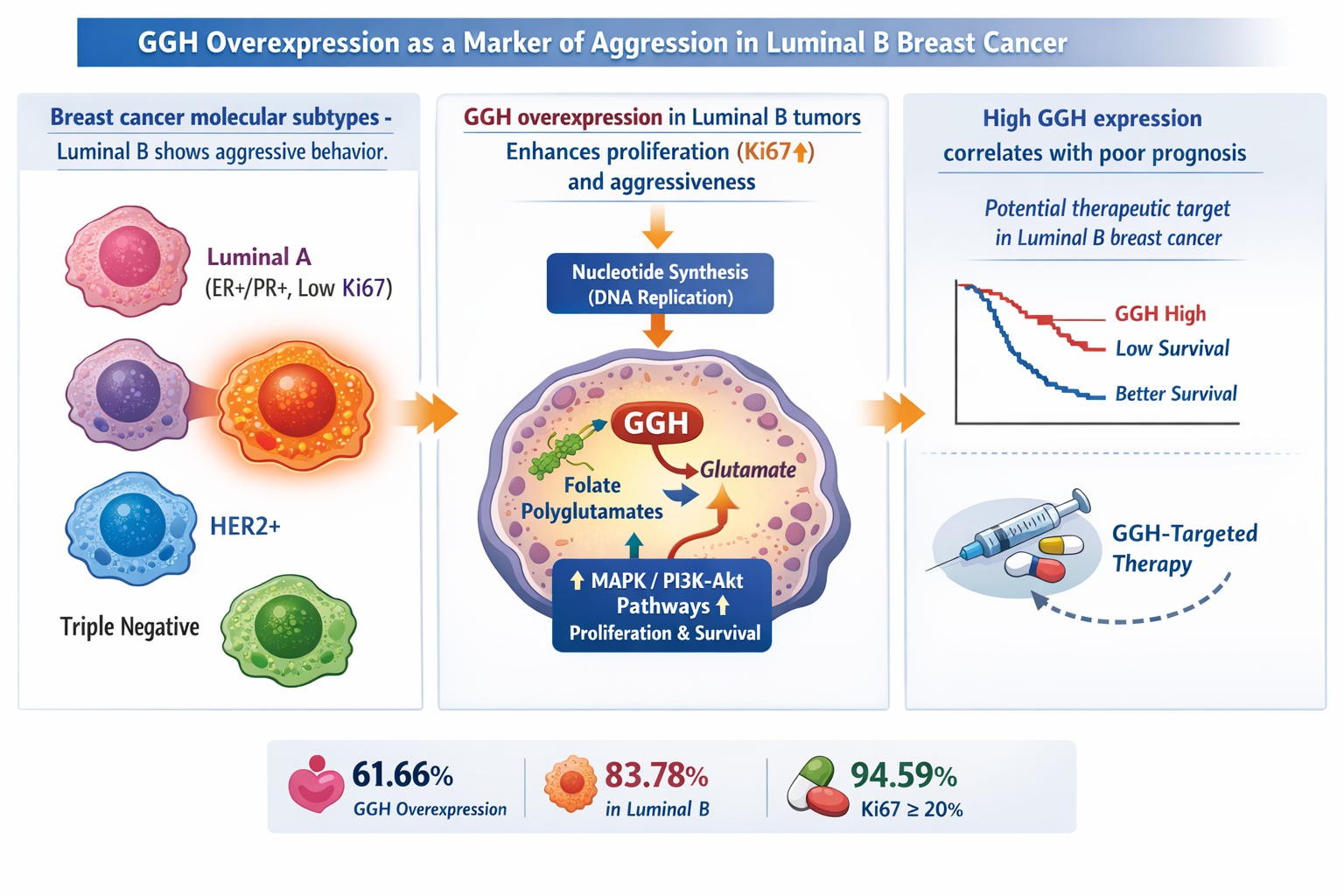
Introduction. Breast cancer is the most common malignant tumor in women, particularly in Algeria, where it ranks first in terms of incidence. It is classified into molecular subtypes (Luminal A, Luminal B, HER2, and Triple-Negative), which guide therapeutic decisions. Gamma-glutamyl hydrolase (GGH), an enzyme involved in folate metabolism, has been proposed as a biomarker in certain hormone-dependent cancers, but its role in breast cancer, especially the Luminal B subtype, remains poorly understood. This first Algerian study aims to evaluate the immunohistochemical expression of GGH in invasive breast cancer tissues and to analyze its correlation with clinicopathological features, particularly molecular subtypes. Materials and Methods. GGH expression was analyzed by immunohistochemistry on paraffin-embedded tissue samples, and the H-score was calculated based on the intensity and proportion of stained tumor cells. Results were correlated with clinicopathological parameters using the Chi-square test. Results. GGH overexpression was observed in 61.66% of cases, while 38.33% showed no expression. A significant association was found between GGH overexpression and estrogen receptor-positive tumors (89.18%, p = 0.011), high proliferation index (94.59%, p < 0.001) and the Luminal B molecular subtype (83.78%, p < 0.001). Conclusion. GGH expression is significantly increased in Luminal B breast cancers, suggesting its involvement in tumor progression. These findings highlight the potential of GGH as a prognostic biomarker and a promising therapeutic target, particularly for patients with the Luminal B subtype. Further studies are needed to validate these results on a larger scale and to explore the underlying molecular mechanisms.
- Open Access
- Article
Gamma-Glutamyl Hydrolase (GGH) Overexpression in Luminal B Breast Cancer: A New Marker of Aggression and a Therapeutic Target
- Radjaa Regad 1,*,
- Amina Belhadj 1,
- Sonia Amel Sedikki 1,
- Sabrina Khelifa 1,
- Zakaria Merad 2,
- Sarah Hayat Bouasaba 3,
- Tewfik Sahraoui 1
Author Information
Received: 17 Sep 2025 | Revised: 09 Dec 2025 | Accepted: 24 Dec 2025 | Published: 23 Jun 2026
Abstract
Graphical Abstract
Keywords
breast cancer | luminal B | GGH | overexpression | H score
References
- 1.
Sung, H.; Ferlay, J.; Siegel, R.L.; Laversanne, M.; Soerjomataram, I.; Jemal, A.; Bray, F. Global Cancer Statistics 2020: GLOBOCAN Estimates of Incidence and Mortality Worldwide for 36 Cancers in 185 Countries. CA Cancer J. Clin. 2021, 71, 209–249. https://doi.org/10.3322/caac.21660.
- 2.
International Agency for Research on Cancer (IARC). Available online: https://gco.iarc.who.int/media/globocan/factsheets/populations/12-algeria-fact-sheet.pdf (accessed on 22 June 2025).
- 3.
Perou, C.M.; Sørlie, T.; Eisen, M.B.; van de Rijn, M.; Jeffrey, S.S.; Rees, C.A.; Pollack, J.R.; Ross, D.T.; Johnsen, H.; Akslen, L.A.; et al. Molecular Portraits of Human Breast Tumours. Nature 2000, 406, 747–752. https://doi.org/10.1038/35021093.
- 4.
Galivan, J.; Ryan, T.J.; Chave, K.; Rhee, M.; Yao, R.; Yin, D. Gamma-glutamyl hydrolase: Pharmacological role and enzymatic characterization. Pharmacol. Ther. 2000, 85, 207–215.
- 5.
Zhao, R.; Goldman, I.D. Resistance to antifolates. Oncogene 2003, 22, 7431–7457.
- 6.
Cole, P.D.; Kamen, B.A.; Gorlick, R.; Banerjee, D.; Smith, A.K.; Magill, E.; Bertino, J.R. Effects of overexpression of γ-glutamyl hydrolase on methotrexate metabolism and resistance. Cancer Res. 2001, 61, 4599–4604.
- 7.
Liang, J.; Lu, T.; Chen, Z.; Zhan, C.; Wang, Q. Mechanisms of resistance to pemetrexed in non-small cell lung cancer. Transl. Lung Cancer Res. 2019, 8, 1107–1118.
- 8.
Kim, S.E.; Cole, P.D.; Cho, R.C.; Ly, A.; Ishiguro, L.; Sohn, K.J.; Croxford, R.; Kamen, B.A. γ-Glutamyl hydrolase modulation and folate influence chemosensitivity of cancer cells to 5-fluorouracil and methotrexate. Br. J. Cancer 2013, 109, 2175–2188.
- 9.
Cheng, Q.; Cheng, C.; Crews, K.R.; Ribeiro, R.C.; Pui, C.H.; Relling, M.V.; Evans, W.E. Epigenetic regulation of human gamma-glutamyl hydrolase activity in acute lymphoblastic leukemia cells. Am. J. Hum. Genet. 2006, 79, 264–274.
- 10.
Prickett, T.D.; Samuels, Y. Molecular pathways: Dysregulated glutamatergic signaling pathways in cancer. Clin. Cancer Res. 2012, 18, 4240–4246.
- 11.
Graham, R.C., Jr.; Karnovsky, M.J. The early stages of absorption of injected horseradish peroxidase in the proximal tubules of mouse kidney: Ultrastructural cytochemistry by a new technique. J. Histochem. Cytochem. 1966, 14, 291–302.
- 12.
McCarty, K.S., Jr.; Miller, L.S.; Cox, E.B.; Konrath, J.; McCarty, K.S., Sr. Estrogen receptor analyses: Correlation of biochemical and immunohistochemical methods using monoclonal antireceptor antibodies. Arch. Pathol. Lab. Med. 1985, 109, 716–721.
- 13.
Dowsett, M.; Nielsen, T.O.; A’Hern, R.; Bartlett, J.; Coombes, R.C.; Cuzick, J.; Ellis, M.; Henry, N.L.; Hugh, J.C.; Lively, T.; et al. Assessment of Ki67 in breast cancer: Recommendations from the International Ki67 in Breast Cancer Working Group. J. Natl. Cancer Inst. 2011, 103, 1656–1664.
- 14.
Guerin, S.; Doyon, F.; Hill, C. The frequency of cancer in France in 2006, mortality trends since 1950, incidence trends since 1980 and analysis of the discrepancies between these trends. Bull. Cancer 2009, 96, 51–57. https://doi.org/10.1684/bdc.2008.0795.
- 15.
Carter, C.L.; Allen, C.; Henson, D.E. Relation of tumor size, lymph node status, and survival in 24,740 breast cancer cases. Cancer 1989, 63, 181–187.
- 16.
Guinebretière, J.M.; Menet, E.; Tardivon, A.; Cherel, P.; Vanel, D. Normal and pathological breast: Histological basis. Eur. J. Radiol. 2005, 54, 6–14.
- 17.
Chen, D.-T.; Nasir, A.; Venkataramu, C.; Fulp, W.J.; Gruidl, M.; Yeatman, T.J. Evaluation of Malignancy-Risk Gene Signature in Breast Cancer Patients. Breast Cancer Res. Treat. 2010, 120, 25–34. https://doi.org/10.1007/s10549-009-0357-6.
- 18.
Pollard, C.; Nitz, M.; Baras, A.; Williams, P.; Moskaluk, C.; Theodorescu, D. Genoproteomic Mining of Urothelial Cancer Suggests γ-Glutamyl Hydrolase and Diazepam-Binding Inhibitor as Putative Urinary Markers of Outcome after Chemotherapy. Am. J. Pathol. 2009, 175, 1824–1830.
- 19.
He, P.; Varticovski, L.; Bowman, E.D.; Fukuoka, J.; Welsh, J.A.; Kovatich, A.; De Togni, P.; Kemp, C.; Cuttitta, F.; Harris, C.C. Identification of carboxypeptidase E and γ-glutamyl hydrolase as biomarkers for pulmonary neuroendocrine tumors. Hum. Pathol. 2004, 35, 1196–1209. https://doi.org/10.1016/j.humpath.2004.06.014.
- 20.
van’t Veer, L.J.; Dai, H.; van de Vijver, M.J.; He, Y.D.; Hart, A.A.; Mao, M.; Peterse, H.L.; van der Kooy, K.; Marton, M.J.; Witteveen, A.T.; et al. Gene expression profiling predicts clinical outcome of breast cancer. Nature 2002, 415, 530–536.
- 21.
Andersen, J.N.; Sathyanarayanan, S.; Di Bacco, A.; et al. Pathway-Based Identification of Biomarkers for Targeted Therapeutics: Personalized Oncology with PI3K Pathway Inhibitors. Sci. Transl. Med. 2010, 2, 43ra55. https://doi.org/10.1126/scitranslmed.3001065.
- 22.
Shubbar, E.; Hélou, K.; Kovács, A.; Nemes, S.; Hajizadeh, S.; Enerbäck, C.; Borg, Å. High levels of γ-glutamyl hydrolase (GGH) are associated with poor prognosis and unfavorable clinical outcomes in invasive breast cancer. BMC Cancer 2013, 13, 47. https://doi.org/10.1186/1471-2407-13-47.
- 23.
Longley, D.B.; Harkin, D.P.; Johnston, P.G. 5-fluorouracil: Mechanisms of action and clinical strategies. Nat. Rev. Cancer 2003, 3, 330–338.
- 24.
Trihia, H.; Murray, S.; Price, K.; Gelber, R.D.; Golouh, R.; Goldhirsch, A.; Coates, A.S.; Collins, J.; Castiglione-Gertsch, M.; Gusterson, B.A. Ki-67 expression in breast carcinoma. Cancer 2003, 97, 1321–1331. https://doi.org/10.1002/cncr.11188.
- 25.
Karlsson, E.; Delle, U.; Danielsson, A.; Olsson, B.; Karlsson, P.; Helou, K. Gene expression variation to predict 10-year survival in lymph-node-negative breast cancer. BMC Cancer 2008, 8, 254. https://doi.org/10.1186/1471-2407-8-254.
- 26.
Matherly, L.H.; Hou, Z.; Deng, Y. Human reduced folate carrier: Translation of basic biology to cancer therapy. Cancer Metastasis Rev. 2007, 26, 111–128.
- 27.
Schneider, E.; Ryan, T.J. Gamma-glutamyl hydrolase and drug resistance. Clin. Chim. Acta 2006, 374, 25–32. https://doi.org/10.1016/j.cca.2006.05.044.
- 28.
Yi, H.; Talmon, G.; Wang, J. Glutamate in Cancers: From Metabolism to Signaling. J. Biomed. Res. 2020, 34, 260–270. https://doi.org/10.7555/JBR.34.20190037.
- 29.
Ducker, G.S.; Rabinowitz, J.D. One-carbon metabolism in health and disease. Cell Metab. 2017, 25, 27–42.
- 30.
Yu, C.; Qi, H.; Zhang, Y.; Zhao, W.; Wu, G. Elevated Expression of Gamma-Glutamyl Hydrolase Is Associated with Poor Prognosis and Altered Immune Signature in Uterine Corpus Endometrial Carcinoma. Front. Genet. 2021, 12, 764194. https://doi.org/10.3389/fgene.2021.764194.
- 31.
Maezawa, Y.; Sakamaki, K.; Oue, N.; Kimura, Y.; Hashimoto, I.; Hara, K.; Kano, K.; Aoyama, T.; Hiroshima, Y.; Yamada, T.; et al. High gamma-glutamyl hydrolase and low folylpolyglutamate synthetase expression as prognostic biomarkers in patients with locally advanced gastric cancer who were administrated postoperative adjuvant chemotherapy with S-1. J. Cancer Res. Clin. Oncol. 2020, 146, 75–86. https://doi.org/10.1007/s00432-019-03087-8.
- 32.
Melling, N.; Rashed, M.; Schroeder, C.; Hube-Magg, C.; Kluth, M.; Lang, D.; Simon, R.; Möller-Koop, C.; Steurer, S.; Sauter, G.; et al. High-Level γ-Glutamyl-Hydrolase (GGH) Expression is Linked to Poor Prognosis in ERG Negative Prostate Cancer. Int. J. Mol. Sci. 2017, 18, 286. https://doi.org/10.3390/ijms18020286.

This work is licensed under a Creative Commons Attribution 4.0 International License.

 Suite 4002 Level 4, 447 Collins Street, Melbourne, Victoria 3000, Australia
 General Inquiries: info@sciltp.com