
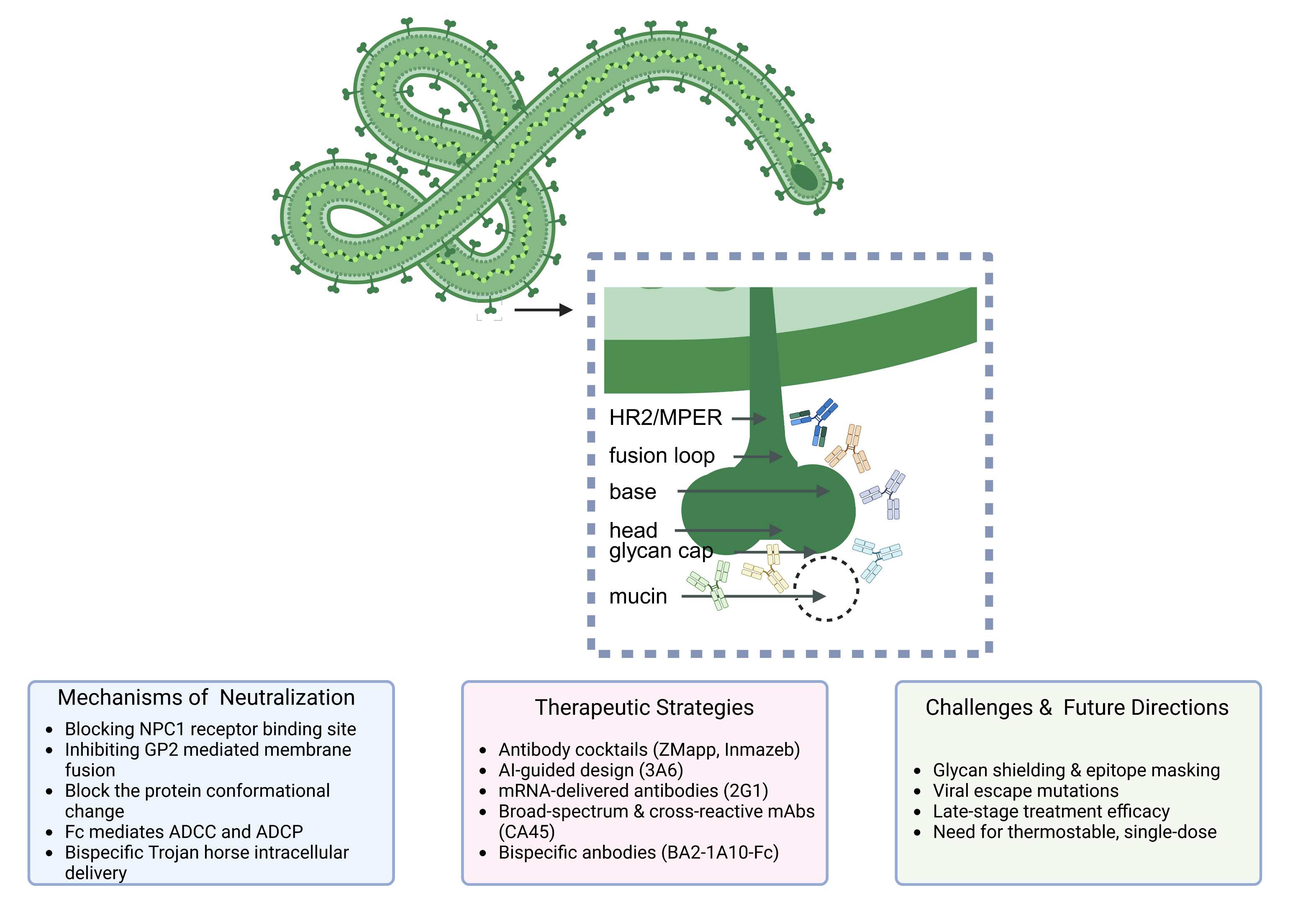
Ebola Virus Disease (EVD) is a severe and acute fatal disease caused by the Orthoebolavirus zairense (Ebola virus, EBOV), first identified in 1976. From 1976 to 2025, multiple Ebola virus disease outbreaks were documented, predominantly attributable to the Zaire ebolavirus (ZEBOV) species, followed by Orthoebolavirus sudanense (Sudan ebolavirus, SUDV), with a limited number of outbreaks associated with Orthoebolavirus bundibugyoense (Bundibugyo ebolavirus, BDBV). As of 2025, numerous outbreaks caused by the EBOV have severely impacted public health and the global economy, particularly in West Africa. One of the response strategies has been the development of broad-spectrum neutralizing antibodies for prevention and treatment. ZMapp was the first antibody cocktail authorized for the emergency treatment of patients infected with ZEBOV. To date, two antibody-based therapeutics—Inmazeb and Ebanga—have been officially approved by the FDA in 2020 for the treatment of ZEBOV infection. Following the discovery of these ZEBOV-specific antibodies, numerous antibodies with broader antiviral spectra have been identified and are currently under development. This review summarizes neutralizing antibodies targeting seven key domains of the EBOV glycoprotein (GP), specifically: the glycan cap, GP1/head, base, fusion loop, GP1/core, GP1/2, and HR2/MPER (Heptad Repeat 2/Membrane-Proximal External Region). A deeper understanding of the characteristics of these neutralizing antibodies will accelerate the development of novel antibody therapies and provide guidance for the rational design of next-generation drugs against EBOV infection.
- Open Access
- Review
Antibody Therapy Targeting GP in Treatment of Ebola Virus Infection
- Jiazhao Gao 1,2,
- Sandra Chiu 3,4,5,*,
- Rui Gong 1,2,*
Author Information
Received: 15 Nov 2025 | Revised: 22 Mar 2026 | Accepted: 27 Apr 2026 | Published: 21 Jul 2026
Abstract
Graphical Abstract
Keywords
References
- 1.
Dhama, K.; Malik, Y.S.; Malik, S.V.S.; Singh, R.K. Ebola from emergence to epidemic: The virus and the disease, global preparedness and perspectives. J. Infect. Dev. Ctries. 2015, 9, 441–455. https://doi.org/10.3855/jidc.6197.
- 2.
Jacob, S.T.; Crozier, I.; Fischer, W.A.; Hewlett, A.; Kraft, C.S.; Vega, M.-A.D.L.; Soka, M.J.; Wahl, V.; Griffiths, A.; Bollinger, L.; et al. Ebola virus disease. Nat. Rev. Dis. Primers 2020, 6, 13. https://doi.org/10.1038/s41572-020-0147-3.
- 3.
Kofman, A.; Linderman, S.; Su, K.; Purpura, L.J.; Ervin, E.; Brown, S.; Morales-Betoulle, M.; Graziano, J.; Cannon, D.L.; Klena, J.D.; et al. Characteristics of Ebola Virus Disease Survivor Blood and Semen in Liberia: Serology and Reverse Transcription Polymerase Chain Reaction (RT-PCR). Clin. Infect. Dis. 2021, 73, e3641–e3646. https://doi.org/10.1093/cid/ciaa1331.
- 4.
Letafati, A.; Salahi Ardekani, O.; Karami, H.; Soleimani, M. Ebola virus disease: A narrative review. Microb. Pathog. 2023, 181, 106213. https://doi.org/10.1016/j.micpath.2023.106213.
- 5.
Kiley, M.P.; Bowen, E.T.W.; Eddy, G.A.; Isaäcson, M.; Johnson, K.M.; McCormick, J.B.; Murphy, F.A.; Pattyn, S.R.; Peters, D.; Prozesky, O.W.; et al. Filoviridae: A Taxonomic Home for Marburg and Ebola Viruses? Intervirology 1982, 18, 24–32. https://doi.org/10.1159/000149300.
- 6.
Camacho, A.; Kucharski, A.J.; Funk, S.; Breman, J.; Piot, P.; Edmunds, W.J. Potential for large outbreaks of Ebola virus disease. Epidemics 2014, 9, 70–78. https://doi.org/10.1016/j.epidem.2014.09.003.
- 7.
Cross, R.W.; Woolsey, C.; Chu, V.C.; Babusis, D.; Bannister, R.; Vermillion, M.S.; Geleziunas, R.; Barrett, K.T.; Bunyan, E.; Nguyen, A.-Q.; et al. Oral administration of obeldesivir protects nonhuman primates against Sudan ebolavirus. Science 2024, 383, eadk6176. https://doi.org/10.1126/science.adk6176.
- 8.
Mwamba, D.K.; Angendu, K.B.; Diouf, W.; Mikobi, M.-C.; Leonard, O.; Kalala, D.; Ntumba, N.; Kakule, D.; Kayembe, D.K.; Sana, E.; et al. Seven Strategies Implemented in Response to the 16th Ebola Virus Disease Outbreak in the Democratic Republic of Congo: Lessons Learned over a Three-Month Period. Viruses 2025, 18, 28. https://doi.org/10.3390/v18010028.
- 9.
Beeching, N.J.; Fenech, M.; Houlihan, C.F. Ebola virus disease. BMJ 2014, 349, g7348. https://doi.org/10.1136/bmj.g7348.
- 10.
Campion, E.W.; Feldmann, H.; Sprecher, A.; Geisbert, T.W. Ebola. N. Engl. J. Med. 2020, 382, 1832–1842. https://doi.org/10.1056/NEJMra1901594.
- 11.
Muwonge, H.; Nasimiyu, C.; Bakamutumaho, B.; Elyanu, P.; Joloba, M.L.; Situma, S.; Schieffelin, J.; Gunn, B.; Bai, S.; Breiman, R.F.; et al. Severe long-term clinical sequelae among Sudan ebolavirus disease survivors 2 years post-infection. BMC Med. 2025, 23, 432.
- 12.
Lee, J.E.; Saphire, E.O. Ebolavirus Glycoprotein Structure and Mechanism of Entry. Future Virol. 2009, 4, 621–635. https://doi.org/10.2217/fvl.09.56.
- 13.
Takada, A.; Watanabe, S.; Ito, H.; Okazaki, K.; Kida, H.; Kawaoka, Y. Downregulation of β1 Integrins by Ebola Virus Glycoprotein: Implication for Virus Entry. Virology 2000, 278, 20–26. https://doi.org/10.1006/viro.2000.0601.
- 14.
Alvarez, C.P.; Lasala, F.; Carrillo, J.; Muñiz, O.; Corbí, A.L.; Delgado, R. C-Type Lectins DC-SIGN and L-SIGN Mediate Cellular Entry by Ebola Virus in cis and in trans. J. Virol. 2002, 76, 6841–6844. https://doi.org/10.1128/JVI.76.13.6841-6844.2002.
- 15.
Usami, K.; Matsuno, K.; Igarashi, M.; Denda-Nagai, K.; Takada, A.; Irimura, T. Involvement of viral envelope GP2 in Ebola virus entry into cells expressing the macrophage galactose-type C-type lectin. Biochem. Biophys. Res. Commun. 2011, 407, 74–78. https://doi.org/10.1016/j.bbrc.2011.02.110.
- 16.
Kondratowicz, A.S.; Lennemann, N.J.; Sinn, P.L.; Davey, R.A.; Hunt, C.L.; Moller-Tank, S.; Meyerholz, D.K.; Rennert, P.; Mullins, R.F.; Brindley, M.; et al. T-cell immunoglobulin and mucin domain 1 (TIM-1) is a receptor for Zaire Ebolavirus and Lake Victoria Marburgvirus. Proc. Natl. Acad. Sci. USA 2011, 108, 8426–8431. https://doi.org/10.1073/pnas.1019030108.
- 17.
Brudner, M.; Karpel, M.; Lear, C.; Chen, L.; Yantosca, L.M.; Scully, C.; Sarraju, A.; Sokolovska, A.; Zariffard, M.R.; Eisen, D.P.; et al. Lectin-Dependent Enhancement of Ebola Virus Infection via Soluble and Transmembrane C-type Lectin Receptors. PLoS ONE 2013, 8, e60838. https://doi.org/10.1371/journal.pone.0060838.
- 18.
Simmons, G.; Reeves, J.D.; Grogan, C.C.; Vandenberghe, L.H.; Baribaud, F.; Whitbeck, J.C.; Burke, E.; Buchmeier, M.J.; Soilleux, E.J.; Riley, J.L.; et al. DC-SIGN and DC-SIGNR Bind Ebola Glycoproteins and Enhance Infection of Macrophages and Endothelial Cells. Virology 2003, 305, 115–123. https://doi.org/10.1006/viro.2002.1730.
- 19.
Takada, A.; Fujioka, K.; Tsuiji, M.; Morikawa, A.; Higashi, N.; Ebihara, H.; Kobasa, D.; Feldmann, H.; Irimura, T.; Kawaoka, Y. Human Macrophage C-Type Lectin Specific for Galactose and N-Acetylgalactosamine Promotes Filovirus Entry. J. Virol. 2004, 78, 2943–2947. https://doi.org/10.1128/JVI.78.6.2943-2947.2004.
- 20.
Lee, J.E.; Fusco, M.L.; Hessell, A.J.; Oswald, W.B.; Burton, D.R.; Saphire, E.O. Structure of the Ebola virus glycoprotein bound to an antibody from a human survivor. Nature 2008, 454, 177–182. https://doi.org/10.1038/nature07082.
- 21.
Dube, D.; Brecher, M.B.; Delos, S.E.; Rose, S.C.; Park, E.W.; Schornberg, K.L.; Kuhn, J.H.; White, J.M. The Primed Ebolavirus Glycoprotein (19-Kilodalton GP1,2): Sequence and Residues Critical for Host Cell Binding. J. Virol. 2009, 83, 2883–2891. https://doi.org/10.1128/JVI.01956-08.
- 22.
Schornberg, K.L.; Shoemaker, C.J.; Dube, D.; Abshire, M.Y.; Delos, S.E.; Bouton, A.H.; White, J.M. α5 β1-Integrin controls ebolavirus entry by regulating endosomal cathepsins. Proc. Natl. Acad. Sci. USA 2009, 106, 8003–8008. https://doi.org/10.1073/pnas.0807578106.
- 23.
Brindley, M.A.; Hunt, C.L.; Kondratowicz, A.S.; Bowman, J.; Sinn, P.L.; McCray, P.B.; Quinn, K.; Weller, M.L.; Chiorini, J.A.; Maury, W. Tyrosine kinase receptor Axl enhances entry of Zaire ebolavirus without direct interactions with the viral glycoprotein. Virology 2011, 415, 83–94. https://doi.org/10.1016/j.virol.2011.04.002.
- 24.
Hunt, C.L.; Kolokoltsov, A.A.; Davey, R.A.; Maury, W. The Tyro3 Receptor Kinase Axl Enhances Macropinocytosis of Zaire Ebolavirus. J. Virol. 2011, 85, 334–347. https://doi.org/10.1128/JVI.01278-09.
- 25.
Nanbo, A.; Imai, M.; Watanabe, S.; Noda, T.; Takahashi, K.; Neumann, G.; Halfmann, P.; Kawaoka, Y. Ebolavirus Is Internalized into Host Cells via Macropinocytosis in a Viral Glycoprotein-Dependent Manner. PLoS Pathog. 2010, 6, e1001121. https://doi.org/10.1371/journal.ppat.1001121.
- 26.
Aleksandrowicz, P.; Marzi, A.; Biedenkopf, N.; Beimforde, N.; Becker, S.; Hoenen, T.; Feldmann, H.; Schnittler, H.-J. Ebola Virus Enters Host Cells by Macropinocytosis and Clathrin-Mediated Endocytosis. J. Infect. Dis. 2011, 204, S957–S967. https://doi.org/10.1093/infdis/jir326.
- 27.
Zhang, Q.; Tian, F.; Wang, F.; Guo, Z.; Cai, M.; Xu, H.; Wang, H.; Yang, G.; Shi, X.; Shan, Y.; et al. Entry Dynamics of Single Ebola Virus Revealed by Force Tracing. ACS Nano 2020, 14, 7046–7054. https://doi.org/10.1021/acsnano.0c01739.
- 28.
Sanchez, A. Analysis of Filovirus Entry into Vero E6 Cells, Using Inhibitors of Endocytosis, Endosomal Acidification, Structural Integrity, and Cathepsin (B and L) Activity. J. Infect. Dis. 2007, 196, S251–S258. https://doi.org/10.1086/520597.
- 29.
Kaletsky, R.L.; Simmons, G.; Bates, P. Proteolysis of the Ebola Virus Glycoproteins Enhances Virus Binding and Infectivity. J. Virol. 2007, 81, 13378–13384. https://doi.org/10.1128/JVI.01170-07.
- 30.
Schornberg, K.; Matsuyama, S.; Kabsch, K.; Delos, S.; Bouton, A.; White, J. Role of Endosomal Cathepsins in Entry Mediated by the Ebola Virus Glycoprotein. J. Virol. 2006, 80, 4174–4178. https://doi.org/10.1128/JVI.80.8.4174-4178.2006.
- 31.
Chandran, K.; Sullivan, N.J.; Felbor, U.; Whelan, S.P.; Cunningham, J.M. Endosomal Proteolysis of the Ebola Virus Glycoprotein Is Necessary for Infection. Science 2005, 308, 1643–1645. https://doi.org/10.1126/science.1110656.
- 32.
Saeed, M.F.; Kolokoltsov, A.A.; Albrecht, T.; Davey, R.A. Cellular Entry of Ebola Virus Involves Uptake by a Macropinocytosis-Like Mechanism and Subsequent Trafficking through Early and Late Endosomes. PLoS Pathog. 2010, 6, e1001110. https://doi.org/10.1371/journal.ppat.1001110.
- 33.
Carette, J.E.; Raaben, M.; Wong, A.C.; Herbert, A.S.; Obernosterer, G.; Mulherkar, N.; Kuehne, A.I.; Kranzusch, P.J.; Griffin, A.M.; Ruthel, G.; et al. Ebola virus entry requires the cholesterol transporter Niemann–Pick C1. Nature 2011, 477, 340–343. https://doi.org/10.1038/nature10348.
- 34.
Côté, M.; Misasi, J.; Ren, T.; Bruchez, A.; Lee, K.; Filone, C.M.; Hensley, L.; Li, Q.; Ory, D.; Chandran, K.; et al. Small molecule inhibitors reveal Niemann–Pick C1 is essential for Ebola virus infection. Nature 2011, 477, 344–348. https://doi.org/10.1038/nature10380.
- 35.
Miller, E.H.; Obernosterer, G.; Raaben, M.; Herbert, A.S.; Deffieu, M.S.; Krishnan, A.; Ndungo, E.; Sandesara, R.G.; Carette, J.E.; Kuehne, A.I.; et al. Ebola virus entry requires the host-programmed recognition of an intracellular receptor: Niemann-Pick C1 is a critical filovirus receptor. EMBO J. 2012, 31, 1947–1960. https://doi.org/10.1038/emboj.2012.53.
- 36.
Wang, H.; Shi, Y.; Song, J.; Qi, J.; Lu, G.; Yan, J.; Gao, G.F. Ebola Viral Glycoprotein Bound to Its Endosomal Receptor Niemann-Pick C1. Cell 2016, 164, 258–268. https://doi.org/10.1016/j.cell.2015.12.044.
- 37.
Jun, S.-R.; Leuze, M.R.; Nookaew, I.; Uberbacher, E.C.; Land, M.; Zhang, Q.; Wanchai, V.; Chai, J.; Nielsen, M.; Trolle, T.; et al. Ebolavirus comparative genomics. FEMS Microbiol. Rev. 2015, 39, 764–778. https://doi.org/10.1093/femsre/fuv031.
- 38.
Saphire, E.O.; Schendel, S.L.; Fusco, M.L.; Gangavarapu, K.; Gunn, B.M.; Wec, A.Z.; Halfmann, P.J.; Brannan, J.M.; Herbert, A.S.; Qiu, X.; et al. Systematic Analysis of Monoclonal Antibodies against Ebola Virus GP Defines Features that Contribute to Protection. Cell 2018, 174, 938–952.e13. https://doi.org/10.1016/j.cell.2018.07.033.
- 39.
Qiu, X.; Wong, G.; Audet, J.; Bello, A.; Fernando, L.; Alimonti, J.B.; Fausther-Bovendo, H.; Wei, H.; Aviles, J.; Hiatt, E.; et al. Reversion of advanced Ebola virus disease in nonhuman primates with ZMapp. Nature 2014, 514, 47–53. https://doi.org/10.1038/nature13777.
- 40.
Corti, D.; Misasi, J.; Mulangu, S.; Stanley, D.A.; Kanekiyo, M.; Wollen, S.; Ploquin, A.; Doria-Rose, N.A.; Staupe, R.P.; Bailey, M.; et al. Protective monotherapy against lethal Ebola virus infection by a potently neutralizing antibody. Science 2016, 351, 1339–1342. https://doi.org/10.1126/science.aad5224.
- 41.
Zhao, X.; Howell, K.A.; He, S.; Brannan, J.M.; Wec, A.Z.; Davidson, E.; Turner, H.L.; Chiang, C.-I.; Lei, L.; Fels, J.M.; et al. Immunization-Elicited Broadly Protective Antibody Reveals Ebolavirus Fusion Loop as a Site of Vulnerability. Cell 2017, 169, 891–904.e15. https://doi.org/10.1016/j.cell.2017.04.038.
- 42.
Pascal, K.E.; Dudgeon, D.; Trefry, J.C.; Anantpadma, M.; Sakurai, Y.; Murin, C.D.; Turner, H.L.; Fairhurst, J.; Torres, M.; Rafique, A.; et al. Development of Clinical-Stage Human Monoclonal Antibodies That Treat Advanced Ebola Virus Disease in Nonhuman Primates. J. Infect. Dis. 2018, 218, S612–S626. https://doi.org/10.1093/infdis/jiy285.
- 43.
Flyak, A.I.; Kuzmina, N.; Murin, C.D.; Bryan, C.; Davidson, E.; Gilchuk, P.; Gulka, C.P.; Ilinykh, P.A.; Shen, X.; Huang, K.; et al. Broadly neutralizing antibodies from human survivors target a conserved site in the Ebola virus glycoprotein HR2–MPER region. Nat. Microbiol. 2018, 3, 670–677. https://doi.org/10.1038/s41564-018-0157-z.
- 44.
Gilchuk, P.; Murin, C.D.; Cross, R.W.; Ilinykh, P.A.; Huang, K.; Kuzmina, N.; Borisevich, V.; Agans, K.N.; Geisbert, J.B.; Zost, S.J.; et al. Pan-ebolavirus protective therapy by two multifunctional human antibodies. Cell 2021, 184, 5593–5607.e18. https://doi.org/10.1016/j.cell.2021.09.035.
- 45.
Milligan, J.C.; Davis, C.W.; Yu, X.; Ilinykh, P.A.; Huang, K.; Halfmann, P.J.; Cross, R.W.; Borisevich, V.; Agans, K.N.; Geisbert, J.B.; et al. Asymmetric and non-stoichiometric glycoprotein recognition by two distinct antibodies results in broad protection against ebolaviruses. Cell 2022, 185, 995–1007.e18. https://doi.org/10.1016/j.cell.2022.02.023.
- 46.
Zhang, Q.; Gui, M.; Niu, X.; He, S.; Wang, R.; Feng, Y.; Kroeker, A.; Zuo, Y.; Wang, H.; Wang, Y.; et al. Potent neutralizing monoclonal antibodies against Ebola virus infection. Sci. Rep. 2016, 6, 25856. https://doi.org/10.1038/srep25856.
- 47.
Shedlock, D.J.; Bailey, M.A.; Popernack, P.M.; Cunningham, J.M.; Burton, D.R.; Sullivan, N.J. Antibody-mediated neutralization of Ebola virus can occur by two distinct mechanisms. Virology 2010, 401, 228–235. https://doi.org/10.1016/j.virol.2010.02.029.
- 48.
Murin, C.D.; Fusco, M.L.; Bornholdt, Z.A.; Qiu, X.; Olinger, G.G.; Zeitlin, L.; Kobinger, G.P.; Ward, A.B.; Saphire, E.O. Structures of protective antibodies reveal sites of vulnerability on Ebola virus. Proc. Natl. Acad. Sci. USA 2014, 111, 17182–17187. https://doi.org/10.1073/pnas.1414164111.
- 49.
Davidson, E.; Bryan, C.; Fong, R.H.; Barnes, T.; Pfaff, J.M.; Mabila, M.; Rucker, J.B.; Doranz, B.J. Mechanism of Binding to Ebola Virus Glycoprotein by the ZMapp, ZMAb, and MB-003 Cocktail Antibodies. J. Virol. 2015, 89, 10982–10992. https://doi.org/10.1128/JVI.01490-15.
- 50.
West, B.R.; Wec, A.Z.; Moyer, C.L.; Fusco, M.L.; Ilinykh, P.A.; Huang, K.; Wirchnianski, A.S.; James, R.M.; Herbert, A.S.; Hui, S.; et al. Structural basis of broad ebolavirus neutralization by a human survivor antibody. Nat. Struct. Mol. Biol. 2019, 26, 204–212. https://doi.org/10.1038/s41594-019-0191-4.
- 51.
Bornholdt, Z.A.; Ndungo, E.; Fusco, M.L.; Bale, S.; Flyak, A.I.; Crowe, J.E.; Chandran, K.; Saphire, E.O. Host-Primed Ebola Virus GP Exposes a Hydrophobic NPC1 Receptor-Binding Pocket, Revealing a Target for Broadly Neutralizing Antibodies. mBio 2016, 7, e02154-15. https://doi.org/10.1128/mBio.02154-15.
- 52.
Audet, J.; Wong, G.; Wang, H.; Lu, G.; Gao, G.F.; Kobinger, G.; Qiu, X. Molecular Characterization of the Monoclonal Antibodies Composing ZMAb: A Protective Cocktail Against Ebola Virus. Sci. Rep. 2014, 4, 6881. https://doi.org/10.1038/srep06881.
- 53.
Oswald, W.B.; Geisbert, T.W.; Davis, K.J.; Geisbert, J.B.; Sullivan, N.J.; Jahrling, P.B.; Parren, P.W.H.I.; Burton, D.R. Neutralizing Antibody Fails to Impact the Course of Ebola Virus Infection in Monkeys. PLoS Pathog. 2007, 3, e9. https://doi.org/10.1371/journal.ppat.0030009.
- 54.
Misasi, J.; Gilman, M.S.A.; Kanekiyo, M.; Gui, M.; Cagigi, A.; Mulangu, S.; Corti, D.; Ledgerwood, J.E.; Lanzavecchia, A.; Cunningham, J.; et al. Structural and molecular basis for Ebola virus neutralization by protective human antibodies. Science 2016, 351, 1343–1346. https://doi.org/10.1126/science.aad6117.
- 55.
Rayaprolu, V.; Fulton, B.O.; Rafique, A.; Arturo, E.; Williams, D.; Hariharan, C.; Callaway, H.; Parvate, A.; Schendel, S.L.; Parekh, D.; et al. Structure of the Inmazeb cocktail and resistance to Ebola virus escape. Cell Host Microbe 2023, 31, 260–272.e7. https://doi.org/10.1016/j.chom.2023.01.002.
- 56.
Mulangu, S.; Dodd, L.E.; Davey, R.T.; Tshiani Mbaya, O.; Proschan, M.; Mukadi, D.; Lusakibanza Manzo, M.; Nzolo, D.; Tshomba Oloma, A.; Ibanda, A.; et al. A Randomized, Controlled Trial of Ebola Virus Disease Therapeutics. N. Engl. J. Med. 2019, 381, 2293–2303. https://doi.org/10.1056/NEJMoa1910993.
- 57.
Peng, W.; Rayaprolu, V.; Parvate, A.D.; Pronker, M.F.; Hui, S.; Parekh, D.; Shaffer, K.; Yu, X.; Saphire, E.O.; Snijder, J. Glycan shield of the ebolavirus envelope glycoprotein GP. Commun. Biol. 2022, 5, 785. https://doi.org/10.1038/s42003-022-03767-1.
- 58.
Lin, G.; Simmons, G.; Pöhlmann, S.; Baribaud, F.; Ni, H.; Leslie, G.J.; Haggarty, B.S.; Bates, P.; Weissman, D.; Hoxie, J.A.; et al. Differential N-Linked Glycosylation of Human Immunodeficiency Virus and Ebola Virus Envelope Glycoproteins Modulates Interactions with DC-SIGN and DC-SIGNR. J. Virol. 2003, 77, 1337–1346. https://doi.org/10.1128/JVI.77.2.1337-1346.2003.
- 59.
Collar, A.L.; Clarke, E.C.; Anaya, E.; Merrill, D.; Yarborough, S.; Anthony, S.M.; Kuhn, J.H.; Merle, C.; Theisen, M.; Bradfute, S.B. Comparison of N- and O-linked glycosylation patterns of ebolavirus glycoproteins. Virology 2017, 502, 39–47. https://doi.org/10.1016/j.virol.2016.12.010.
- 60.
Dowling, W.; Thompson, E.; Badger, C.; Mellquist, J.L.; Garrison, A.R.; Smith, J.M.; Paragas, J.; Hogan, R.J.; Schmaljohn, C. Influences of Glycosylation on Antigenicity, Immunogenicity, and Protective Efficacy of Ebola Virus GP DNA Vaccines. J. Virol. 2007, 81, 1821–1837. https://doi.org/10.1128/JVI.02098-06.
- 61.
Iraqi, M.; Edri, A.; Greenshpan, Y.; Kundu, K.; Bolel, P.; Cahana, A.; Ottolenghi, A.; Gazit, R.; Lobel, L.; Braiman, A.; et al. N-Glycans Mediate the Ebola Virus-GP1 Shielding of Ligands to Immune Receptors and Immune Evasion. Front. Cell. Infect. Microbiol. 2020, 10, 48. https://doi.org/10.3389/fcimb.2020.00048.
- 62.
Jeffers, S.A.; Sanders, D.A.; Sanchez, A. Covalent Modifications of the Ebola Virus Glycoprotein. J. Virol. 2002, 76, 12463–12472. https://doi.org/10.1128/JVI.76.24.12463-12472.2002.
- 63.
Lennemann, N.J.; Rhein, B.A.; Ndungo, E.; Chandran, K.; Qiu, X.; Maury, W. Comprehensive Functional Analysis of N-Linked Glycans on Ebola Virus GP1. mBio 2014, 5, e00862-13. https://doi.org/10.1128/mBio.00862-13.
- 64.
Ritchie, G.; Harvey, D.J.; Stroeher, U.; Feldmann, F.; Feldmann, H.; Wahl‐Jensen, V.; Royle, L.; Dwek, R.A.; Rudd, P.M. Identification of N‐glycans from Ebola virus glycoproteins by matrix‐assisted laser desorption/ionisation time‐of‐flight and negative ion electrospray tandem mass spectrometry. Rapid Commun. Mass Spectrom. 2010, 24, 571–585. https://doi.org/10.1002/rcm.4410.
- 65.
Wang, B.; Wang, Y.; Frabutt, D.A.; Zhang, X.; Yao, X.; Hu, D.; Zhang, Z.; Liu, C.; Zheng, S.; Xiang, S.-H.; et al. Mechanistic understanding of N-glycosylation in Ebola virus glycoprotein maturation and function. J. Biol. Chem. 2017, 292, 5860–5870. https://doi.org/10.1074/jbc.M116.768168.
- 66.
Gunn, B.M.; Yu, W.-H.; Karim, M.M.; Brannan, J.M.; Herbert, A.S.; Wec, A.Z.; Halfmann, P.J.; Fusco, M.L.; Schendel, S.L.; Gangavarapu, K.; et al. A Role for Fc Function in Therapeutic Monoclonal Antibody-Mediated Protection against Ebola Virus. Cell Host Microbe 2018, 24, 221–233.e5. https://doi.org/10.1016/j.chom.2018.07.009.
- 67.
Ilinykh, P.A.; Huang, K.; Gunn, B.M.; Kuzmina, N.A.; Kedarinath, K.; Jurado-Cobena, E.; Zhou, F.; Subramani, C.; Hyde, M.A.; Velazquez, J.V.; et al. Antibodies targeting the glycan cap of Ebola virus glycoprotein are potent inducers of the complement system. Commun. Biol. 2024, 7, 871. https://doi.org/10.1038/s42003-024-06556-0.
- 68.
Olal, D.; Kuehne, A.I.; Bale, S.; Halfmann, P.; Hashiguchi, T.; Fusco, M.L.; Lee, J.E.; King, L.B.; Kawaoka, Y.; Dye, J.M.; et al. Structure of an Antibody in Complex with Its Mucin Domain Linear Epitope That Is Protective against Ebola Virus. J. Virol. 2012, 86, 2809–2816. https://doi.org/10.1128/JVI.05549-11.
- 69.
Gilchuk, P.; Murin, C.D.; Milligan, J.C.; Cross, R.W.; Mire, C.E.; Ilinykh, P.A.; Huang, K.; Kuzmina, N.; Altman, P.X.; Hui, S.; et al. Analysis of a Therapeutic Antibody Cocktail Reveals Determinants for Cooperative and Broad Ebolavirus Neutralization. Immunity 2020, 52, 388–403.e12. https://doi.org/10.1016/j.immuni.2020.01.001.
- 70.
Wilson, J.A.; Hevey, M.; Bakken, R.; Guest, S.; Bray, M.; Schmaljohn, A.L.; Hart, M.K. Epitopes Involved in Antibody-Mediated Protection from Ebola Virus. Science 2000, 287, 1664–1666. https://doi.org/10.1126/science.287.5458.1664.
- 71.
Wec, A.Z.; Bornholdt, Z.A.; He, S.; Herbert, A.S.; Goodwin, E.; Wirchnianski, A.S.; Gunn, B.M.; Zhang, Z.; Zhu, W.; Liu, G.; et al. Development of a Human Antibody Cocktail that Deploys Multiple Functions to Confer Pan-Ebolavirus Protection. Cell Host Microbe 2019, 25, 39–48.e5. https://doi.org/10.1016/j.chom.2018.12.004.
- 72.
Lee, J.; Nyenhuis, D.A.; Nelson, E.A.; Cafiso, D.S.; White, J.M.; Tamm, L.K. Structure of the Ebola virus envelope protein MPER/TM domain and its interaction with the fusion loop explains their fusion activity. Biophys. J. 2017, 112, 78a. https://doi.org/10.1016/j.bpj.2016.11.468.
- 73.
Wec, A.Z.; Herbert, A.S.; Murin, C.D.; Nyakatura, E.K.; Abelson, D.M.; Fels, J.M.; He, S.; James, R.M.; De La Vega, M.-A.; Zhu, W.; et al. Antibodies from a Human Survivor Define Sites of Vulnerability for Broad Protection against Ebolaviruses. Cell 2017, 169, 878–890.e15. https://doi.org/10.1016/j.cell.2017.04.037.
- 74.
Flyak, A.I.; Shen, X.; Murin, C.D.; Turner, H.L.; David, J.A.; Fusco, M.L.; Lampley, R.; Kose, N.; Ilinykh, P.A.; Kuzmina, N.; et al. Cross-Reactive and Potent Neutralizing Antibody Responses in Human Survivors of Natural Ebolavirus Infection. Cell 2016, 164, 392–405. https://doi.org/10.1016/j.cell.2015.12.022.
- 75.
Gilchuk, P.; Mire, C.E.; Geisbert, J.B.; Agans, K.N.; Deer, D.J.; Cross, R.W.; Slaughter, J.C.; Flyak, A.I.; Mani, J.; Pauly, M.H.; et al. Efficacy of Human Monoclonal Antibody Monotherapy Against Bundibugyo Virus Infection in Nonhuman Primates. J. Infect. Dis. 2018, 218, S565–S573. https://doi.org/10.1093/infdis/jiy295.
- 76.
Hastie, K.M.; Salie, Z.L.; Ke, Z.; Halfmann, P.J.; DeWald, L.E.; McArdle, S.; Grinyó, A.; Davidson, E.; Schendel, S.L.; Hariharan, C.; et al. Anti-Ebola virus mAb 3A6 protects highly viremic animals from fatal outcome via binding GP(1,2) in a position elevated from the virion membrane. Nat. Commun. 2025, 16, 1293. https://doi.org/10.1038/s41467-025-56452-2.
- 77.
Wec, A.Z.; Nyakatura, E.K.; Herbert, A.S.; Howell, K.A.; Holtsberg, F.W.; Bakken, R.R.; Mittler, E.; Christin, J.R.; Shulenin, S.; Jangra, R.K.; et al. A “Trojan horse” bispecific-antibody strategy for broad protection against ebolaviruses. Science 2016, 354, 350–354. https://doi.org/10.1126/science.aag3267.
- 78.
Fan, P.; Sun, B.; Liu, Z.; Fang, T.; Ren, Y.; Zhao, X.; Song, Z.; Yang, Y.; Li, J.; Yu, C.; et al. A pan-orthoebolavirus neutralizing antibody encoded by mRNA effectively prevents virus infection. Emerg. Microbes Infect. 2024, 13, 2432366. https://doi.org/10.1080/22221751.2024.2432366.
- 79.
Batista-Duharte, A.; Martínez, D.T.; Carlos, I.Z. Efficacy and safety of immunological adjuvants. Where is the cut-off? Biomed. Pharmacother. 2018, 105, 616–624. https://doi.org/10.1016/j.biopha.2018.06.026.
- 80.
Furuyama, W.; Shifflett, K.; Feldmann, H.; Marzi, A. The Ebola virus soluble glycoprotein contributes to viral pathogenesis by activating the MAP kinase signaling pathway. PLoS Pathog. 2021, 17, e1009937. https://doi.org/10.1371/journal.ppat.1009937.
- 81.
Pallesen, J.; Murin, C.D.; De Val, N.; Cottrell, C.A.; Hastie, K.M.; Turner, H.L.; Fusco, M.L.; Flyak, A.I.; Zeitlin, L.; Crowe, J.E.; et al. Structures of Ebola virus GP and sGP in complex with therapeutic antibodies. Nat. Microbiol. 2016, 1, 16128. https://doi.org/10.1038/nmicrobiol.2016.128.
- 82.
Mohan, G.S.; Li, W.; Ye, L.; Compans, R.W.; Yang, C. Antigenic Subversion: A Novel Mechanism of Host Immune Evasion by Ebola Virus. PLoS Pathog. 2012, 8, e1003065. https://doi.org/10.1371/journal.ppat.1003065.
- 83.
Liu, Y.; Ye, L.; Lin, F.; Gomaa, Y.; Flyer, D.; Carrion, R.; Patterson, J.L.; Prausnitz, M.R.; Smith, G.; Glenn, G.; et al. Intradermal Vaccination with Adjuvanted Ebola Virus Soluble Glycoprotein Subunit Vaccine by Microneedle Patches Protects Mice Against Lethal Ebola Virus Challenge. J. Infect. Dis. 2018, 218, S545–S552. https://doi.org/10.1093/infdis/jiy267.
- 84.
Wahl-Jensen, V.M.; Afanasieva, T.A.; Seebach, J.; Ströher, U.; Feldmann, H.; Schnittler, H.-J. Effects of Ebola Virus Glycoproteins on Endothelial Cell Activation and Barrier Function. J. Virol. 2005, 79, 10442–10450. https://doi.org/10.1128/jvi.79.16.10442-10450.2005.
- 85.
Lubaki, N.M.; Younan, P.; Santos, R.I.; Meyer, M.; Iampietro, M.; Koup, R.A.; Bukreyev, A. The Ebola Interferon Inhibiting Domains Attenuate and Dysregulate Cell-Mediated Immune Responses. PLoS Pathog. 2016, 12, e1006031. https://doi.org/10.1371/journal.ppat.1006031.
- 86.
Kindzelskii, A.L.; Yang, Z.Y.; Nabel, G.J.; Todd, R.F.; Petty, H.R. Ebola Virus Secretory Glycoprotein (sGP) Diminishes FcγRIIIB-to-CR3 Proximity on Neutrophils. J. Immunol. 2000, 164, 953–958. https://doi.org/10.4049/jimmunol.164.2.953.
- 87.
Bradley, J.H.; Harrison, A.; Corey, A.; Gentry, N.; Gregg, R.K. Ebola virus secreted glycoprotein decreases the anti-viral immunity of macrophages in early inflammatory responses. Cell. Immunol. 2018, 324, 24–32. https://doi.org/10.1016/j.cellimm.2017.11.009.
- 88.
Taniguchi, C.M.; Emanuelli, B.; Kahn, C.R. Critical nodes in signalling pathways: Insights into insulin action. Nat. Rev. Mol. Cell Biol. 2006, 7, 85–96. https://doi.org/10.1038/nrm1837.
- 89.
Bost, F.; Aouadi, M.; Caron, L.; Binétruy, B. The role of MAPKs in adipocyte differentiation and obesity. Biochimie 2005, 87, 51–56. https://doi.org/10.1016/j.biochi.2004.10.018.
- 90.
Kjaldgaard, L.; Claude, K.M.; Mukadi-Bamuleka, D.; Kitenge-Omasumbu, R.; Dixit, D.; Edidi-Atani, F.; Kuamfumu, M.M.; Bulabula-Penge, J.; Mambu-Mbika, F.; Tshiani-Mbaya, O.; et al. Virus kinetics and biochemical derangements among children with Ebolavirus disease. eClinicalMedicine 2022, 53, 101638. https://doi.org/10.1016/j.eclinm.2022.101638.
- 91.
Houweling, M.; Vaartjes, W.J.; Van Golde, L.M.G. Metabolic responsiveness to phorbol ester and activity of protein kinase C in isolated hepatocytes from partially hepatectomized rats. Biochem. Biophys. Res. Commun. 1989, 158, 294–301. https://doi.org/10.1016/S0006-291X(89)80211-6.
- 92.
Volchkova, V.A.; Dolnik, O.; Martinez, M.J.; Reynard, O.; Volchkov, V.E. RNA Editing of the GP Gene of Ebola Virus is an Important Pathogenicity Factor. J. Infect. Dis. 2015, 212, S226–S233. https://doi.org/10.1093/infdis/jiv309.
- 93.
Hoenen, T.; Marzi, A.; Scott, D.P.; Feldmann, F.; Callison, J.; Safronetz, D.; Ebihara, H.; Feldmann, H. Soluble Glycoprotein Is Not Required for Ebola Virus Virulence in Guinea Pigs. J. Infect. Dis. 2015, 212, S242–S246. https://doi.org/10.1093/infdis/jiv111.
- 94.
Warfield, K.L.; Swenson, D.L.; Olinger, G.G.; Kalina, W.V.; Aman, M.J.; Bavari, S. Ebola Virus‐like Particle–based Vaccine Protects Nonhuman Primates against Lethal Ebola Virus Challenge. J. Infect. Dis. 2007, 196, S430–S437. https://doi.org/10.1086/520583.
- 95.
McElroy, A.K.; Akondy, R.S.; Davis, C.W.; Ellebedy, A.H.; Mehta, A.K.; Kraft, C.S.; Lyon, G.M.; Ribner, B.S.; Varkey, J.; Sidney, J.; et al. Human Ebola virus infection results in substantial immune activation. Proc. Natl. Acad. Sci. USA 2015, 112, 4719–4724. https://doi.org/10.1073/pnas.1502619112.
- 96.
Paquin-Proulx, D.; Gunn, B.M.; Alrubayyi, A.; Clark, D.V.; Creegan, M.; Kim, D.; Kibuuka, H.; Millard, M.; Wakabi, S.; Eller, L.A.; et al. Associations between Antibody Fc-Mediated Effector Functions and Long-Term Sequelae in Ebola Virus Survivors. Front. Immunol. 2021, 12, 682120. https://doi.org/10.3389/fimmu.2021.682120.
- 97.
Liu, Q.; Fan, C.; Li, Q.; Zhou, S.; Huang, W.; Wang, L.; Sun, C.; Wang, M.; Wu, X.; Ma, J.; et al. Antibody-dependent-cellular-cytotoxicity-inducing antibodies significantly affect the post-exposure treatment of Ebola virus infection. Sci. Rep. 2017, 7, 45552. https://doi.org/10.1038/srep45552.
- 98.
Gong, R.; Xiao, G. Engineered Antibody Variable and Constant Domains as Therapeutic Candidates. Pharm. Pat. Analyst 2013, 2, 637–646. https://doi.org/10.4155/ppa.13.44.
- 99.
Wang, R.; Zhang, H.; Peng, C.; Shi, J.; Zhang, H.; Gong, R. Identification and Characterization of a Novel Single Domain Antibody Against Ebola Virus. Virol. Sin. 2021, 36, 1600–1610. https://doi.org/10.1007/s12250-021-00454-z.
- 100.
Bu, F.; Ye, G.; Morsheimer, K.; Mendoza, A.; Turner-Hubbard, H.; Herbst, M.; Spiller, B.; Wadzinski, B.E.; Eaton, B.; Anantpadma, M.; et al. Discovery of Nanosota-EB1 and -EB2 as Novel Nanobody Inhibitors Against Ebola Virus Infection. PLoS Pathog. 2024, 20, e1012817. https://doi.org/10.1371/journal.ppat.1012817.
- 101.
Wang, M.; Zhang, X.; Li, W.; Yao, Y.; Li, E.; Zhang, B.; Zhou, J.; Liu, S.; Gao, Y.; Zhu, Z.; et al. A highly potent nanobody-based bispecific therapeutic provides broad-spectrum protection against ebolavirus. Nat. Commun. 2026, 17, 4040. https://doi.org/10.1038/s41467-026-70464-6.
- 102.
Lee, J.H.; Andrabi, R.; Su, C.-Y.; Yasmeen, A.; Julien, J.-P.; Kong, L.; Wu, N.C.; McBride, R.; Sok, D.; Pauthner, M.; et al. A Broadly Neutralizing Antibody Targets the Dynamic HIV Envelope Trimer Apex via a Long, Rigidified, and Anionic β-Hairpin Structure. Immunity 2017, 46, 690–702. https://doi.org/10.1016/j.immuni.2017.03.017.
- 103.
Thadani, N.N.; Gurev, S.; Notin, P.; Youssef, N.; Rollins, N.J.; Ritter, D.; Sander, C.; Gal, Y.; Marks, D.S. Learning from prepandemic data to forecast viral escape. Nature 2023, 622, 818–825. https://doi.org/10.1038/s41586-023-06617-0.
- 104.
Brannan, J.M.; He, S.; Howell, K.A.; Prugar, L.I.; Zhu, W.; Vu, H.; Shulenin, S.; Kailasan, S.; Raina, H.; Wong, G.; et al. Post-exposure immunotherapy for two ebolaviruses and Marburg virus in nonhuman primates. Nat. Commun. 2019, 10, 105. https://doi.org/10.1038/s41467-018-08040-w.
- 105.
Bornholdt, Z.A.; Herbert, A.S.; Mire, C.E.; He, S.; Cross, R.W.; Wec, A.Z.; Abelson, D.M.; Geisbert, J.B.; James, R.M.; Rahim, M.N.; et al. A Two-Antibody Pan-Ebolavirus Cocktail Confers Broad Therapeutic Protection in Ferrets and Nonhuman Primates. Cell Host Microbe 2019, 25, 49–58.e5. https://doi.org/10.1016/j.chom.2018.12.005.
- 106.
Kugelman, J.R.; Kugelman-Tonos, J.; Ladner, J.T.; Pettit, J.; Keeton, C.M.; Nagle, E.R.; Garcia, K.Y.; Froude, J.W.; Kuehne, A.I.; Kuhn, J.H.; et al. Emergence of Ebola Virus Escape Variants in Infected Nonhuman Primates Treated with the MB-003 Antibody Cocktail. Cell Rep. 2015, 12, 2111–2120. https://doi.org/10.1016/j.celrep.2015.08.038.
- 107.
Bornholdt, Z.A.; Turner, H.L.; Murin, C.D.; Li, W.; Sok, D.; Souders, C.A.; Piper, A.E.; Goff, A.; Shamblin, J.D.; Wollen, S.E.; et al. Isolation of potent neutralizing antibodies from a survivor of the 2014 Ebola virus outbreak. Science 2016, 351, 1078–1083. https://doi.org/10.1126/science.aad5788.


This work is licensed under a Creative Commons Attribution 4.0 International License.

 Suite 4002 Level 4, 447 Collins Street, Melbourne, Victoria 3000, Australia
 General Inquiries: info@sciltp.com