
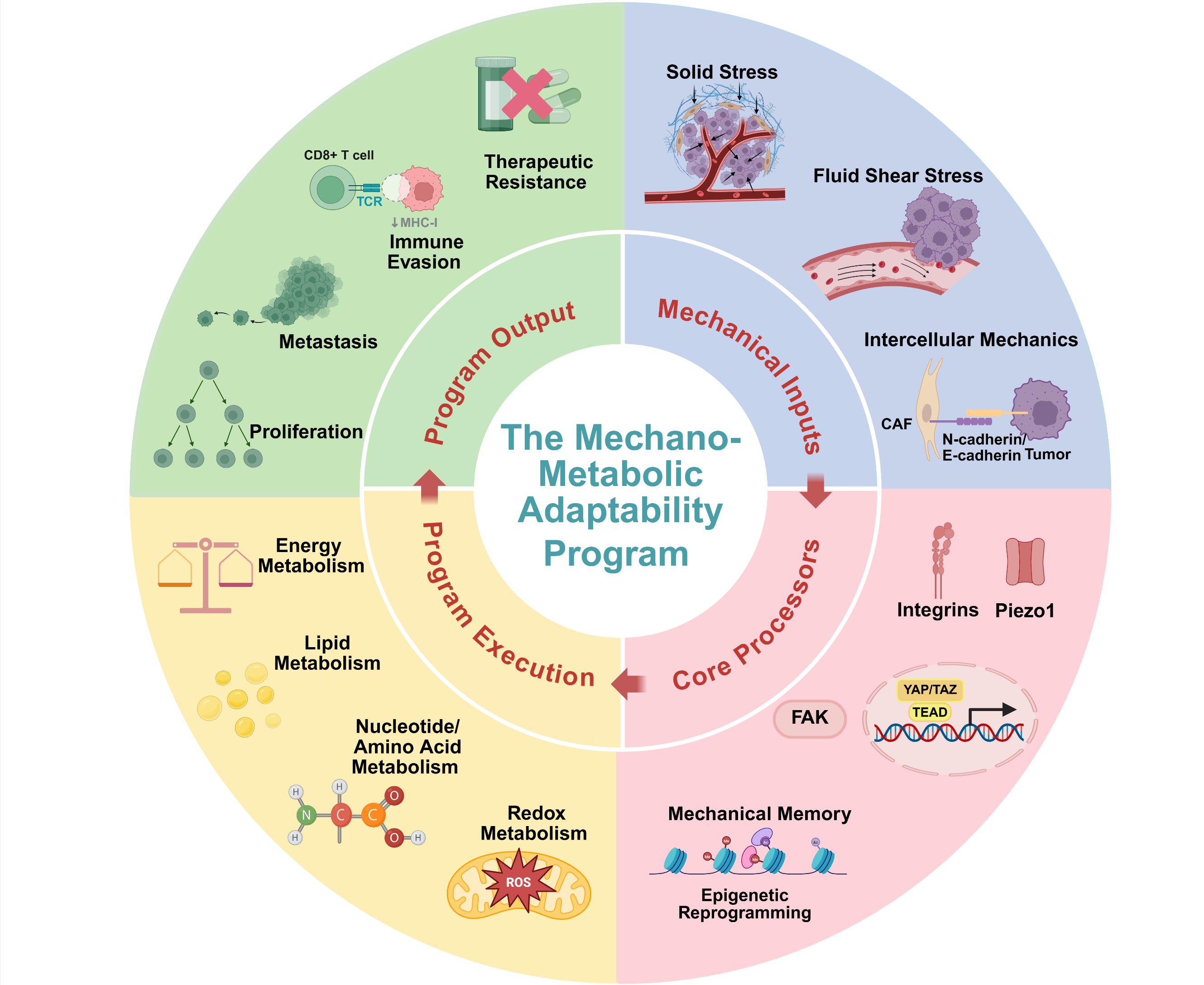
The abnormal mechanical properties of the tumor microenvironment (TME) are not merely passive hallmarks but represent an important upstream regulatory dimension influencing malignant progression. Despite increasing evidence linking mechanical cues and metabolic remodeling, their coordinated roles in cancer progression remain incompletely understood. This review proposes the “Mechano-Metabolic Adaptability Program” (MMAP) as a conceptual framework that integrates emerging evidence connecting mechanotransduction, metabolic reprogramming, and cancer progression. Here, the term “program” does not refer to a formally established biological program but rather to a conceptual and hypothesis-generating framework synthesized from existing evidence. Within this framework, mechanical cues sensed by mechanosensitive molecules such as Piezo channels and integrins are integrated through signaling hubs including YAP/TAZ, leading to coordinated metabolic reprogramming involving glycolysis, lipid metabolism, nucleotide and amino acid metabolism, redox homeostasis, and sorbitol-mediated biomolecular condensation, which may contribute to metastasis, immune evasion, and therapeutic resistance. By integrating mechanobiology and cancer metabolism, this review provides a conceptual basis for understanding tumor adaptability and for developing future mechano-metabolic therapeutic strategies, while emphasizing unresolved questions regarding tumor heterogeneity, context-dependent regulation, mechanistic validation, and clinical translation.
- Open Access
- Review
The Mechano-Metabolic Adaptability Program in Cancer: From Physical Forces to Malignant Progression
- Yuan-Yuan Xin 1,
- Wen Li 1,
- Ming-Zhu Jin 2, 3, *,
- Wei-Lin Jin 1, *
Author Information
Received: 07 Apr 2026 | Revised: 30 May 2026 | Accepted: 16 Jun 2026 | Published: 28 Jul 2026
Abstract
Graphical Abstract
Keywords
mechano-metabolic adaptability | mechanotransduction | metabolic reprogramming | tumor microenvironment | Piezo1 | extracellular matrix
References
- 1.
Hanahan, D. Hallmarks of Cancer: New Dimensions. Cancer Discov. 2022, 12, 31–46. https://doi.org/10.1158/2159-8290.Cd-21-1059.
- 2.
Linke, J.A.; Munn, L.L.; Jain, R.K. Compressive stresses in cancer: Characterization and implications for tumour progression and treatment. Nat. Rev. Cancer 2024, 24, 768–791. https://doi.org/10.1038/s41568-024-00745-z.
- 3.
Romani, P.; Valcarcel-Jimenez, L.; Frezza, C.; Dupont, S. Crosstalk between mechanotransduction and metabolism. Nat. Rev. Mol. Cell Biol. 2021, 22, 22–38. https://doi.org/10.1038/s41580-020-00306-w.
- 4.
Panciera, T.; Azzolin, L.; Cordenonsi, M.; Piccolo, S. Mechanobiology of YAP and TAZ in physiology and disease. Nat. Rev. Mol. Cell Biol. 2017, 18, 758–770. https://doi.org/10.1038/nrm.2017.87.
- 5.
Dupont, S.; Morsut, L.; Aragona, M.; Enzo, E.; Giulitti, S.; Cordenonsi, M.; Zanconato, F.; Le Digabel, J.; Forcato, M.; Bicciato, S.; et al. Role of YAP/TAZ in mechanotransduction. Nature 2011, 474, 179–183. https://doi.org/10.1038/nature10137.
- 6.
Cox, A.G.; Tsomides, A.; Yimlamai, D.; Hwang, K.L.; Miesfeld, J.; Galli, G.G.; Fowl, B.H.; Fort, M.; Ma, K.Y.; Sullivan, M.R.; et al. Yap regulates glucose utilization and sustains nucleotide synthesis to enable organ growth. EMBO J. 2018, 37, EMBJ2018100294. https://doi.org/10.15252/embj.2018100294.
- 7.
Pascual, G.; Domínguez, D.; Elosúa-Bayes, M.; Beckedorff, F.; Laudanna, C.; Bigas, C.; Douillet, D.; Greco, C.; Symeonidi, A.; Hernández, I.; et al. Dietary palmitic acid promotes a prometastatic memory via Schwann cells. Nature 2021, 599, 485–490. https://doi.org/10.1038/s41586-021-04075-0.
- 8.
Fang, F.; Li, G.; Li, X.; Wu, J.; Liu, Y.; Xin, H.; Wang, Z.; Fang, J.; Jiang, Y.; Qian, W.; et al. Piezo1 regulates colon stem cells to maintain epithelial homeostasis through SCD1-Wnt-β-catenin and programming fatty acid metabolism. Cell Rep. 2025, 44, 115400. https://doi.org/10.1016/j.celrep.2025.115400.
- 9.
Torrino, S.; Oldham, W.M.; Tejedor, A.R.; Burgos, I.S.; Nasr, L.; Rachedi, N.; Fraissard, K.; Chauvet, C.; Sbai, C.; O’Hara, B.P.; et al. Mechano-dependent sorbitol accumulation supports biomolecular condensate. Cell 2025, 188, 447–464.e420. https://doi.org/10.1016/j.cell.2024.10.048.
- 10.
Liu, Y.; Yao, X.; Zhao, Y.; Fang, D.; Shi, L.; Yang, L.; Song, G.; Cai, K.; Li, L.; Deng, Q.; et al. Mechanotransduction in response to ECM stiffening impairs cGAS immune signaling in tumor cells. Cell Rep. 2023, 42, 113213. https://doi.org/10.1016/j.celrep.2023.113213.
- 11.
Elosegui-Artola, A.; Andreu, I.; Beedle, A.E.M.; Lezamiz, A.; Uroz, M.; Kosmalska, A.J.; Oria, R.; Kechagia, J.Z.; Rico-Lastres, P.; Le Roux, A.L.; et al. Force Triggers YAP Nuclear Entry by Regulating Transport across Nuclear Pores. Cell 2017, 171, 1397–1410.e1314. https://doi.org/10.1016/j.cell.2017.10.008.
- 12.
Zhu, Y.; Chen, J.; Chen, C.; Tang, R.; Xu, J.; Shi, S.; Yu, X. Deciphering mechanical cues in the microenvironment: From non-malignant settings to tumor progression. Biomark. Res. 2025, 13, 11. https://doi.org/10.1186/s40364-025-00727-9.
- 13.
Chitty, J.L.; Cox, T.R. The extracellular matrix in cancer: From understanding to targeting. Trends Cancer 2025, 11, 839–849. https://doi.org/10.1016/j.trecan.2025.05.003.
- 14.
Levental, K.R.; Yu, H.; Kass, L.; Lakins, J.N.; Egeblad, M.; Erler, J.T.; Fong, S.F.; Csiszar, K.; Giaccia, A.; Weninger, W.; et al. Matrix crosslinking forces tumor progression by enhancing integrin signaling. Cell 2009, 139, 891–906. https://doi.org/10.1016/j.cell.2009.10.027.
- 15.
Yuan, Z.; Li, Y.; Zhang, S.; Wang, X.; Dou, H.; Yu, X.; Zhang, Z.; Yang, S.; Xiao, M. Extracellular matrix remodeling in tumor progression and immune escape: From mechanisms to treatments. Mol. Cancer 2023, 22, 48. https://doi.org/10.1186/s12943-023-01744-8.
- 16.
Winkler, J.; Abisoye-Ogunniyan, A.; Metcalf, K.J.; Werb, Z. Concepts of extracellular matrix remodelling in tumour progression and metastasis. Nat. Commun. 2020, 11, 5120. https://doi.org/10.1038/s41467-020-18794-x.
- 17.
Belhabib, I.; Zaghdoudi, S.; Lac, C.; Bousquet, C.; Jean, C. Extracellular Matrices and Cancer-Associated Fibroblasts: Targets for Cancer Diagnosis and Therapy? Cancers 2021, 13, 3466. https://doi.org/10.3390/cancers13143466.
- 18.
Mai, Z.; Lin, Y.; Lin, P.; Zhao, X.; Cui, L. Modulating extracellular matrix stiffness: A strategic approach to boost cancer immunotherapy. Cell Death Dis. 2024, 15, 307. https://doi.org/10.1038/s41419-024-06697-4.
- 19.
Jiang, Y.; Zhang, H.; Wang, J.; Liu, Y.; Luo, T.; Hua, H. Targeting extracellular matrix stiffness and mechanotransducers to improve cancer therapy. J. Hematol. Oncol. 2022, 15, 34. https://doi.org/10.1186/s13045-022-01252-0.
- 20.
Sun, Z.; Guo, S.S.; Fässler, R. Integrin-mediated mechanotransduction. J. Cell Biol. 2016, 215, 445–456. https://doi.org/10.1083/jcb.201609037.
- 21.
Qu, P.; Zhang, H. The dual role of Piezo1 in tumor cells and immune cells: A new target for cancer therapy. Front. Immunol. 2025, 16, 1635388. https://doi.org/10.3389/fimmu.2025.1635388.
- 22.
Nava, M.M.; Miroshnikova, Y.A.; Biggs, L.C.; Whitefield, D.B.; Metge, F.; Boucas, J.; Vihinen, H.; Jokitalo, E.; Li, X.; García Arcos, J.M.; et al. Heterochromatin-Driven Nuclear Softening Protects the Genome against Mechanical Stress-Induced Damage. Cell 2020, 181, 800–817.e822. https://doi.org/10.1016/j.cell.2020.03.052.
- 23.
Cambria, E.; Coughlin, M.F.; Floryan, M.A.; Offeddu, G.S.; Shelton, S.E.; Kamm, R.D. Linking cell mechanical memory and cancer metastasis. Nat. Rev. Cancer 2024, 24, 216–228. https://doi.org/10.1038/s41568-023-00656-5.
- 24.
Xu, Z.; Li, K.; Xin, Y.; Tang, K.; Yang, M.; Wang, G.; Tan, Y. Fluid shear stress regulates the survival of circulating tumor cells via nuclear expansion. J. Cell Sci. 2022, 135, jcs259586. https://doi.org/10.1242/jcs.259586.
- 25.
Li, J.; Hou, B.; Tumova, S.; Muraki, K.; Bruns, A.; Ludlow, M.J.; Sedo, A.; Hyman, A.J.; McKeown, L.; Young, R.S.; et al. Piezo1 integration of vascular architecture with physiological force. Nature 2014, 515, 279–282. https://doi.org/10.1038/nature13701.
- 26.
Dombroski, J.A.; Hope, J.M.; Sarna, N.S.; King, M.R. Channeling the Force: Piezo1 Mechanotransduction in Cancer Metastasis. Cells 2021, 10, 2815. https://doi.org/10.3390/cells10112815.
- 27.
Sang, L.J.; Ju, H.Q.; Liu, G.P.; Tian, T.; Ma, G.L.; Lu, Y.X.; Liu, Z.X.; Pan, R.L.; Li, R.H.; Piao, H.L.; et al. LncRNA CamK-A Regulates Ca2+-Signaling-Mediated Tumor Microenvironment Remodeling. Mol. Cell 2018, 72, 71–83.e77. https://doi.org/10.1016/j.molcel.2018.08.014.
- 28.
Liu, J.; Tao, M.; Zhao, W.; Song, Q.; Yang, X.; Li, M.; Zhang, Y.; Xiu, D.; Zhang, Z. Calcium Channel α2δ1 is Essential for Pancreatic Tumor-Initiating Cells through Sequential Phosphorylation of PKM2. Cell. Mol. Gastroenterol. Hepatol. 2023, 15, 373–392. https://doi.org/10.1016/j.jcmgh.2022.10.006.
- 29.
Fan, J.; Hitosugi, T.; Chung, T.W.; Xie, J.; Ge, Q.; Gu, T.L.; Polakiewicz, R.D.; Chen, G.Z.; Boggon, T.J.; Lonial, S.; et al. Tyrosine phosphorylation of lactate dehydrogenase A is important for NADH/NAD+ redox homeostasis in cancer cells. Mol. Cell Biol. 2011, 31, 4938–4950. https://doi.org/10.1128/mcb.06120-11.
- 30.
Huang, Q.; Li, S.; Hu, X.; Sun, M.; Wu, Q.; Dai, H.; Tan, Y.; Sun, F.; Wang, C.; Rong, X.; et al. Shear stress activates ATOH8 via autocrine VEGF promoting glycolysis dependent-survival of colorectal cancer cells in the circulation. J. Exp. Clin. Cancer Res. 2020, 39, 25. https://doi.org/10.1186/s13046-020-1533-0.
- 31.
Bera, K.; Kiepas, A.; Godet, I.; Li, Y.; Mehta, P.; Ifemembi, B.; Paul, C.D.; Sen, A.; Serra, S.A.; Stoletov, K.; et al. Extracellular fluid viscosity enhances cell migration and cancer dissemination. Nature 2022, 611, 365–373. https://doi.org/10.1038/s41586-022-05394-6.
- 32.
Zhang, Y.; Li, Y.; Thompson, K.N.; Stoletov, K.; Yuan, Q.; Bera, K.; Lee, S.J.; Zhao, R.; Kiepas, A.; Wang, Y.; et al. Polarized NHE1 and SWELL1 regulate migration direction, efficiency and metastasis. Nat. Commun. 2022, 13, 6128. https://doi.org/10.1038/s41467-022-33683-1.
- 33.
Matamoro-Vidal, A.; Levayer, R. Multiple Influences of Mechanical Forces on Cell Competition. Curr. Biol. 2019, 29, R762–R774. https://doi.org/10.1016/j.cub.2019.06.030.
- 34.
Labernadie, A.; Kato, T.; Brugués, A.; Serra-Picamal, X.; Derzsi, S.; Arwert, E.; Weston, A.; González-Tarragó, V.; Elosegui-Artola, A.; Albertazzi, L.; et al. A mechanically active heterotypic E-cadherin/N-cadherin adhesion enables fibroblasts to drive cancer cell invasion. Nat. Cell Biol. 2017, 19, 224–237. https://doi.org/10.1038/ncb3478.
- 35.
Li, M.; Zhang, X.; Wang, M.; Wang, Y.; Qian, J.; Xing, X.; Wang, Z.; You, Y.; Guo, K.; Chen, J.; et al. Activation of Piezo1 contributes to matrix stiffness-induced angiogenesis in hepatocellular carcinoma. Cancer Commun. 2022, 42, 1162–1184. https://doi.org/10.1002/cac2.12364.
- 36.
Ata, R.; Antonescu, C.N. Integrins and Cell Metabolism: An Intimate Relationship Impacting Cancer. Int. J. Mol. Sci. 2017, 18, 189. https://doi.org/10.3390/ijms18010189.
- 37.
Nam, H.; Yu, G.; Ahn, S.I.; Nam, S. Mechanical regulation of metabolism, epigenetics, and their interplay. NPJ Biomed. Innov. 2026, 3, 5. https://doi.org/10.1038/s44385-025-00059-1.
- 38.
Mayor, R.; Etienne-Manneville, S. The front and rear of collective cell migration. Nat. Rev. Mol. Cell Biol. 2016, 17, 97–109. https://doi.org/10.1038/nrm.2015.14.
- 39.
Melwani, P.K.; Pandey, B.N. Tunneling nanotubes: The intercellular conduits contributing to cancer pathogenesis and its therapy. Biochim. Biophys. Acta Rev. Cancer 2023, 1878, 189028. https://doi.org/10.1016/j.bbcan.2023.189028.
- 40.
Barbazan, J.; Pérez-González, C.; Gómez-González, M.; Dedenon, M.; Richon, S.; Latorre, E.; Serra, M.; Mariani, P.; Descroix, S.; Sens, P.; et al. Cancer-associated fibroblasts actively compress cancer cells and modulate mechanotransduction. Nat. Commun. 2023, 14, 6966. https://doi.org/10.1038/s41467-023-42382-4.
- 41.
Calvo, F.; Ege, N.; Grande-Garcia, A.; Hooper, S.; Jenkins, R.P.; Chaudhry, S.I.; Harrington, K.; Williamson, P.; Moeendarbary, E.; Charras, G.; et al. Mechanotransduction and YAP-dependent matrix remodelling is required for the generation and maintenance of cancer-associated fibroblasts. Nat. Cell Biol. 2013, 15, 637–646. https://doi.org/10.1038/ncb2756.
- 42.
Zhang, X.; Zhao, H.; Li, Y.; Xia, D.; Yang, L.; Ma, Y.; Li, H. The role of YAP/TAZ activity in cancer metabolic reprogramming. Mol. Cancer 2018, 17, 134. https://doi.org/10.1186/s12943-018-0882-1.
- 43.
Koo, J.H.; Guan, K.-L. Interplay between YAP/TAZ and Metabolism. Cell Metab. 2018, 28, 196–206. https://doi.org/10.1016/j.cmet.2018.07.010.
- 44.
Wang, N. Review of Cellular Mechanotransduction. J. Phys. D Appl. Phys. 2017, 50, 23. https://doi.org/10.1088/1361-6463/aa6e18.
- 45.
Karska, J.; Kowalski, S.; Saczko, J.; Moisescu, M.G.; Kulbacka, J. Mechanosensitive Ion Channels and Their Role in Cancer Cells. Membranes 2023, 13, 167. https://doi.org/10.3390/membranes13020167.
- 46.
Cheng, D.; Wang, J.; Yao, M.; Cox, C.D. Joining forces: Crosstalk between mechanosensitive PIEZO1 ion channels and integrin-mediated focal adhesions. Biochem. Soc. Trans. 2023, 51, 1897–1906. https://doi.org/10.1042/bst20230042.
- 47.
Piccolo, S.; Panciera, T.; Contessotto, P.; Cordenonsi, M. YAP/TAZ as master regulators in cancer: Modulation, function and therapeutic approaches. Nat. Cancer 2023, 4, 9–26. https://doi.org/10.1038/s43018-022-00473-z.
- 48.
Mierke, C.T. Impact of the ECM on the Mechanical Memory of Cancer Cells. Cells 2025, 14, 1707. https://doi.org/10.3390/cells14211707.
- 49.
Zhu, B.; Li, F.; Yu, J.; Liang, Z.; Ke, X.; Wang, Y.; Song, Z.; Li, Z.; Li, G.; Guo, Y. PIEZO1 mediates matrix stiffness-induced tumor progression in kidney renal clear cell carcinoma by activating the Ca2+/Calpain/YAP pathway. Biochim. Biophys. Acta Mol. Cell Res. 2025, 1872, 119871. https://doi.org/10.1016/j.bbamcr.2024.119871.
- 50.
Luo, M.; Cai, G.; Ho, K.K.Y.; Wen, K.; Tong, Z.; Deng, L.; Liu, A.P. Compression enhances invasive phenotype and matrix degradation of breast Cancer cells via Piezo1 activation. BMC Mol. Cell Biol. 2022, 23, 1. https://doi.org/10.1186/s12860-021-00401-6.
- 51.
Michalick, L.; Kuebler, W.M. TRPV4-A Missing Link Between Mechanosensation and Immunity. Front. Immunol. 2020, 11, 413. https://doi.org/10.3389/fimmu.2020.00413.
- 52.
Canales, J.; Morales, D.; Blanco, C.; Rivas, J.; Díaz, N.; Angelopoulos, I.; Cerda, O. A TR(i)P to Cell Migration: New Roles of TRP Channels in Mechanotransduction and Cancer. Front. Physiol. 2019, 10, 757. https://doi.org/10.3389/fphys.2019.00757.
- 53.
Tapia-Rojo, R.; Garcia-Manyes, S. Nanomechanics at the extracellular matrix-focal adhesion interface. Curr. Opin. Biomed. Eng. 2025, 35, 100599. https://doi.org/10.1016/j.cobme.2025.100599.
- 54.
Horton, E.R.; Humphries, J.D.; James, J.; Jones, M.C.; Askari, J.A.; Humphries, M.J. The integrin adhesome network at a glance. J. Cell Sci. 2016, 129, 4159–4163. https://doi.org/10.1242/jcs.192054.
- 55.
Katoh, K. Signal Transduction Mechanisms of Focal Adhesions: Src and FAK-Mediated Cell Response. Front. Biosci. 2024, 29, 392. https://doi.org/10.31083/j.fbl2911392.
- 56.
Kuo, J.C. Mechanotransduction at focal adhesions: Integrating cytoskeletal mechanics in migrating cells. J. Cell. Mol. Med. 2013, 17, 704–712. https://doi.org/10.1111/jcmm.12054.
- 57.
Hałas-Wiśniewska, M.; Zawadka, P.; Arendt, W.; Izdebska, M. From Adhesion to Invasion: Integrins, Focal Adhesion Signaling, and Actin Binding Proteins in Cervical Cancer Progression-A Scoping Review. Cells 2025, 14, 1640. https://doi.org/10.3390/cells14201640.
- 58.
Scott, K.E.; Fraley, S.I.; Rangamani, P. A spatial model of YAP/TAZ signaling reveals how stiffness, dimensionality, and shape contribute to emergent outcomes. Proc. Natl. Acad. Sci. USA 2021, 118, e2021571118. https://doi.org/10.1073/pnas.2021571118.
- 59.
Mierke, C.T. The matrix environmental and cell mechanical properties regulate cell migration and contribute to the invasive phenotype of cancer cells. Rep. Prog. Phys. 2019, 82, 064602. https://doi.org/10.1088/1361-6633/ab1628.
- 60.
Cooper, J.; Giancotti, F.G. Integrin Signaling in Cancer: Mechanotransduction, Stemness, Epithelial Plasticity, and Therapeutic Resistance. Cancer Cell 2019, 35, 347–367. https://doi.org/10.1016/j.ccell.2019.01.007.
- 61.
Pan, Z.; Tian, Y.; Cao, C.; Niu, G. The Emerging Role of YAP/TAZ in Tumor Immunity. Mol. Cancer Res. 2019, 17, 1777–1786. https://doi.org/10.1158/1541-7786.Mcr-19-0375.
- 62.
Cai, X.; Wang, K.C.; Meng, Z. Mechanoregulation of YAP and TAZ in Cellular Homeostasis and Disease Progression. Front. Cell Dev. Biol. 2021, 9, 673599. https://doi.org/10.3389/fcell.2021.673599.
- 63.
Totaro, A.; Panciera, T.; Piccolo, S. YAP/TAZ upstream signals and downstream responses. Nat. Cell Biol. 2018, 20, 888–899. https://doi.org/10.1038/s41556-018-0142-z.
- 64.
Battilana, G.; Zanconato, F.; Piccolo, S. Mechanisms of YAP/TAZ transcriptional control. Cell Stress 2021, 5, 167–172. https://doi.org/10.15698/cst2021.11.258.
- 65.
Aragona, M.; Panciera, T.; Manfrin, A.; Giulitti, S.; Michielin, F.; Elvassore, N.; Dupont, S.; Piccolo, S. A mechanical checkpoint controls multicellular growth through YAP/TAZ regulation by actin-processing factors. Cell 2013, 154, 1047–1059. https://doi.org/10.1016/j.cell.2013.07.042.
- 66.
Khalil, A.A.; Smits, D.; Haughton, P.D.; Koorman, T.; Jansen, K.A.; Verhagen, M.P.; van der Net, M.; van Zwieten, K.; Enserink, L.; Jansen, L.; et al. A YAP-centered mechanotransduction loop drives collective breast cancer cell invasion. Nat. Commun. 2024, 15, 4866. https://doi.org/10.1038/s41467-024-49230-z.
- 67.
Melcher, M.L.; Block, I.; Kropf, K.; Singh, A.K.; Posern, G. Interplay of the transcription factor MRTF-A and matrix stiffness controls mammary acinar structure and protrusion formation. Cell Commun. Signal. 2022, 20, 158. https://doi.org/10.1186/s12964-022-00977-2.
- 68.
Miralles, F.; Posern, G.; Zaromytidou, A.I.; Treisman, R. Actin dynamics control SRF activity by regulation of its coactivator MAL. Cell 2003, 113, 329–342. https://doi.org/10.1016/s0092-8674(03)00278-2.
- 69.
Foster, C.T.; Gualdrini, F.; Treisman, R. Mutual dependence of the MRTF-SRF and YAP-TEAD pathways in cancer-associated fibroblasts is indirect and mediated by cytoskeletal dynamics. Genes Dev. 2017, 31, 2361–2375. https://doi.org/10.1101/gad.304501.117.
- 70.
Tan, X.; Yan, Y.; Song, B.; Zhu, S.; Mei, Q.; Wu, K. Focal adhesion kinase: From biological functions to therapeutic strategies. Exp. Hematol. Oncol. 2023, 12, 83. https://doi.org/10.1186/s40164-023-00446-7.
- 71.
Bolós, V.; Gasent, J.M.; López-Tarruella, S.; Grande, E. The dual kinase complex FAK-Src as a promising therapeutic target in cancer. Onco Targets Ther. 2010, 3, 83–97. https://doi.org/10.2147/ott.s6909.
- 72.
Scott, A.K.; Casas, E.; Schneider, S.E.; Swearingen, A.R.; Van Den Elzen, C.L.; Seelbinder, B.; Barthold, J.E.; Kugel, J.F.; Stern, J.L.; Foster, K.J.; et al. Mechanical memory stored through epigenetic remodeling reduces cell therapeutic potential. Biophys. J. 2023, 122, 1428–1444. https://doi.org/10.1016/j.bpj.2023.03.004.
- 73.
Stowers, R.S.; Shcherbina, A.; Israeli, J.; Gruber, J.J.; Chang, J.; Nam, S.; Rabiee, A.; Teruel, M.N.; Snyder, M.P.; Kundaje, A.; et al. Matrix stiffness induces a tumorigenic phenotype in mammary epithelium through changes in chromatin accessibility. Nat. Biomed. Eng. 2019, 3, 1009–1019. https://doi.org/10.1038/s41551-019-0420-5.
- 74.
Cho, S.; Irianto, J.; Discher, D.E. Mechanosensing by the nucleus: From pathways to scaling relationships. J. Cell Biol. 2017, 216, 305–315. https://doi.org/10.1083/jcb.201610042.
- 75.
Swift, J.; Ivanovska, I.L.; Buxboim, A.; Harada, T.; Dingal, P.C.; Pinter, J.; Pajerowski, J.D.; Spinler, K.R.; Shin, J.W.; Tewari, M.; et al. Nuclear lamin-A scales with tissue stiffness and enhances matrix-directed differentiation. Science 2013, 341, 1240104. https://doi.org/10.1126/science.1240104.
- 76.
Bell, E.S.; Shah, P.; Zuela-Sopilniak, N.; Kim, D.; Varlet, A.A.; Morival, J.L.P.; McGregor, A.L.; Isermann, P.; Davidson, P.M.; Elacqua, J.J.; et al. Low lamin A levels enhance confined cell migration and metastatic capacity in breast cancer. Oncogene 2022, 41, 4211–4230. https://doi.org/10.1038/s41388-022-02420-9.
- 77.
Crosas-Molist, E.; Graziani, V.; Maiques, O.; Pandya, P.; Monger, J.; Samain, R.; George, S.L.; Malik, S.; Salise, J.; Morales, V.; et al. AMPK is a mechano-metabolic sensor linking cell adhesion and mitochondrial dynamics to Myosin-dependent cell migration. Nat. Commun. 2023, 14, 2740. https://doi.org/10.1038/s41467-023-38292-0.
- 78.
Liu, T.; Yu, S.; Zhang, L.; Ji, W.; Wang, G.; Wang, N.; Li, M.; Hu, T.; Shi, Z. Yes-associated protein 1 in cancer: Bridging mechanical transduction and epigenetic regulation. Cancer Biol. Ther. 2025, 26, 2562726. https://doi.org/10.1080/15384047.2025.2562726.
- 79.
Chuang, H.H.; Zhen, Y.Y.; Tsai, Y.C.; Chuang, C.H.; Hsiao, M.; Huang, M.S.; Yang, C.J. FAK in Cancer: From Mechanisms to Therapeutic Strategies. Int. J. Mol. Sci. 2022, 23, 1726. https://doi.org/10.3390/ijms23031726.
- 80.
Feng, X.; Cao, F.; Wu, X.; Xie, W.; Wang, P.; Jiang, H. Targeting extracellular matrix stiffness for cancer therapy. Front. Immunol. 2024, 15, 1467602. https://doi.org/10.3389/fimmu.2024.1467602.
- 81.
Northcott, J.M.; Dean, I.S.; Mouw, J.K.; Weaver, V.M. Feeling Stress: The Mechanics of Cancer Progression and Aggression. Front. Cell Dev. Biol. 2018, 6, 17. https://doi.org/10.3389/fcell.2018.00017.
- 82.
Zanotelli, M.R.; Zhang, J.; Reinhart-King, C.A. Mechanoresponsive metabolism in cancer cell migration and metastasis. Cell Metab. 2021, 33, 1307–1321. https://doi.org/10.1016/j.cmet.2021.04.002.
- 83.
Ge, H.; Tian, M.; Pei, Q.; Tan, F.; Pei, H. Extracellular Matrix Stiffness: New Areas Affecting Cell Metabolism. Front. Oncol. 2021, 11, 631991. https://doi.org/10.3389/fonc.2021.631991.
- 84.
Park, J.S.; Burckhardt, C.J.; Lazcano, R.; Solis, L.M.; Isogai, T.; Li, L.; Chen, C.S.; Gao, B.; Minna, J.D.; Bachoo, R.; et al. Mechanical regulation of glycolysis via cytoskeleton architecture. Nature 2020, 578, 621–626. https://doi.org/10.1038/s41586-020-1998-1.
- 85.
Andreucci, E.; Fioretto, B.S.; Rosa, I.; Matucci-Cerinic, M.; Biagioni, A.; Romano, E.; Calorini, L.; Manetti, M. Extracellular Lactic Acidosis of the Tumor Microenvironment Drives Adipocyte-to-Myofibroblast Transition Fueling the Generation of Cancer-Associated Fibroblasts. Cells 2023, 12, 939. https://doi.org/10.3390/cells12060939.
- 86.
Yu, Y.; Kim, H.; Choi, S.; Yu, J.; Lee, J.Y.; Lee, H.; Yoon, S.; Kim, W.Y. Targeting a Lipid Desaturation Enzyme, SCD1, Selectively Eliminates Colon Cancer Stem Cells through the Suppression of Wnt and NOTCH Signaling. Cells 2021, 10, 106. https://doi.org/10.3390/cells10010106.
- 87.
Zhang, X.; Zhu, B.; Yan, J.; Chen, X.; Wu, D.; Wang, Z.; Guan, X.; Huang, Y.; Zhao, Y.; Yang, Y.; et al. Matrix stiffness boosts PDAC chemoresistance via SCD1-dependent lipid metabolic reprogramming. Regen. Biomater. 2025, 12, rbaf056. https://doi.org/10.1093/rb/rbaf056.
- 88.
Shin, Y.; Brangwynne, C.P. Liquid phase condensation in cell physiology and disease. Science 2017, 357, 6357. https://doi.org/10.1126/science.aaf4382.
- 89.
Alberti, S.; Hyman, A.A. Biomolecular condensates at the nexus of cellular stress, protein aggregation disease and ageing. Nat. Rev. Mol. Cell Biol. 2021, 22, 196–213. https://doi.org/10.1038/s41580-020-00326-6.
- 90.
Yan, X.; Liu, C. The ATF4-glutamine axis: A central node in cancer metabolism, stress adaptation, and therapeutic targeting. Cell Death Discov. 2025, 11, 390. https://doi.org/10.1038/s41420-025-02683-7.
- 91.
Nakamura, H.; Takada, K. Reactive oxygen species in cancer: Current findings and future directions. Cancer Sci. 2021, 112, 3945–3952. https://doi.org/10.1111/cas.15068.
- 92.
Aydin, H.B.; Ozcelikkale, A.; Acar, A. Exploiting Matrix Stiffness to Overcome Drug Resistance. ACS Biomater. Sci. Eng. 2024, 10, 4682–4700. https://doi.org/10.1021/acsbiomaterials.4c00445.
- 93.
Urra, F.A.; Fuentes-Retamal, S.; Palominos, C.; Rodríguez-Lucart, Y.A.; López-Torres, C.; Araya-Maturana, R. Extracellular Matrix Signals as Drivers of Mitochondrial Bioenergetics and Metabolic Plasticity of Cancer Cells During Metastasis. Front. Cell Dev. Biol. 2021, 9, 751301. https://doi.org/10.3389/fcell.2021.751301.
- 94.
Wang, Y.; Dai, X.; Li, H.; Jiang, H.; Zhou, J.; Zhang, S.; Guo, J.; Shen, L.; Yang, H.; Lin, J.; et al. The role of mitochondrial dynamics in disease. MedComm 2023, 4, e462. https://doi.org/10.1002/mco2.462.
- 95.
Romani, P.; Nirchio, N.; Arboit, M.; Barbieri, V.; Tosi, A.; Michielin, F.; Shibuya, S.; Benoist, T.; Wu, D.; Hindmarch, C.C.T.; et al. Mitochondrial fission links ECM mechanotransduction to metabolic redox homeostasis and metastatic chemotherapy resistance. Nat. Cell Biol. 2022, 24, 168–180. https://doi.org/10.1038/s41556-022-00843-w.
- 96.
Yu, J.; Huang, Y.; Qin, Y.; Zhu, J.; Zhao, T.; Wu, H.; Ye, X.; Qin, X.; Li, S.; Chen, Y.; et al. Deciphering Mitochondria: Unveiling Their Roles in Mechanosensing and Mechanotransduction. Research 2025, 8, 0816. https://doi.org/10.34133/research.0816.
- 97.
Triner, D.; Shah, Y.M. Hypoxia-inducible factors: A central link between inflammation and cancer. J. Clin. Invest. 2016, 126, 3689–3698. https://doi.org/10.1172/jci84430.
- 98.
Li, B.; Ming, H.; Qin, S.; Nice, E.C.; Dong, J.; Du, Z.; Huang, C. Redox regulation: Mechanisms, biology and therapeutic targets in diseases. Signal Transduct. Target. Ther. 2025, 10, 72. https://doi.org/10.1038/s41392-024-02095-6.
- 99.
Xu, Y.; Hu, S.; Chen, R.; Xu, S.; Yu, G.; Ji, L. Interplay between Nrf2 and ROS in regulating epithelial-mesenchymal transition: Implications for cancer metastasis and therapy. Mol. Biol. Rep. 2025, 52, 628. https://doi.org/10.1007/s11033-025-10731-9.
- 100.
Wang, Y.; Jia, J.; Wang, F.; Fang, Y.; Yang, Y.; Zhou, Q.; Yuan, W.; Gu, X.; Hu, J.; Yang, S. Pre-metastatic niche: Formation, characteristics and therapeutic implication. Signal Transduct. Target. Ther. 2024, 9, 236. https://doi.org/10.1038/s41392-024-01937-7.
- 101.
Sleeboom, J.J.F.; van Tienderen, G.S.; Schenke-Layland, K.; van der Laan, L.J.W.; Khalil, A.A.; Verstegen, M.M.A. The extracellular matrix as hallmark of cancer and metastasis: From biomechanics to therapeutic targets. Sci. Transl. Med. 2024, 16, eadg3840. https://doi.org/10.1126/scitranslmed.adg3840.
- 102.
Wu, Y.; Zanotelli, M.R.; Zhang, J.; Reinhart-King, C.A. Matrix-driven changes in metabolism support cytoskeletal activity to promote cell migration. Biophys. J. 2021, 120, 1705–1717. https://doi.org/10.1016/j.bpj.2021.02.044.
- 103.
Bera, K.; Kiepas, A.; Zhang, Y.; Sun, S.X.; Konstantopoulos, K. The interplay between physical cues and mechanosensitive ion channels in cancer metastasis. Front. Cell Dev. Biol. 2022, 10, 954099. https://doi.org/10.3389/fcell.2022.954099.
- 104.
Bastianello, G.; Kidiyoor, G.R.; Lowndes, C.; Li, Q.; Bonnal, R.; Godwin, J.; Iannelli, F.; Drufuca, L.; Bason, R.; Orsenigo, F.; et al. Mechanical stress during confined migration causes aberrant mitoses and c-MYC amplification. Proc. Natl. Acad. Sci. USA 2024, 121, e2404551121. https://doi.org/10.1073/pnas.2404551121.
- 105.
Massagué, J.; Obenauf, A.C. Metastatic colonization by circulating tumour cells. Nature 2016, 529, 298–306. https://doi.org/10.1038/nature17038.
- 106.
Liang, L.; Song, X.; Zhao, H.; Lim, C.T. Insights into the mechanobiology of cancer metastasis via microfluidic technologies. APL Bioeng. 2024, 8, 021506. https://doi.org/10.1063/5.0195389.
- 107.
Maiques, O.; Sallan, M.C.; Laddach, R.; Pandya, P.; Varela, A.; Crosas-Molist, E.; Barcelo, J.; Courbot, O.; Liu, Y.; Graziani, V.; et al. Matrix mechano-sensing at the invasive front induces a cytoskeletal and transcriptional memory supporting metastasis. Nat. Commun. 2025, 16, 1394. https://doi.org/10.1038/s41467-025-56299-7.
- 108.
Hyun, J.; Kim, S.J.; Cho, S.D.; Kim, H.W. Mechano-modulation of T cells for cancer immunotherapy. Biomaterials 2023, 297, 122101. https://doi.org/10.1016/j.biomaterials.2023.122101.
- 109.
Hu, Q.; Zhu, Y.; Mei, J.; Liu, Y.; Zhou, G. Extracellular matrix dynamics in tumor immunoregulation: From tumor microenvironment to immunotherapy. J. Hematol. Oncol. 2025, 18, 65. https://doi.org/10.1186/s13045-025-01717-y.
- 110.
Park, Y.; Lee, D.; Lee, J.E.; Park, H.S.; Jung, S.S.; Park, D.; Kang, D.H.; Lee, S.-I.; Woo, S.-D.; Chung, C. The Matrix Stiffness Coordinates the Cell Proliferation and PD-L1 Expression via YAP in Lung Adenocarcinoma. Cancers 2024, 16, 598.
- 111.
Wang, K.; Zhang, Y.; Chen, Z.-N. Metabolic interaction: Tumor-derived lactate inhibiting CD8+ T cell cytotoxicity in a novel route. Signal Transduct. Target. Ther. 2023, 8, 52. https://doi.org/10.1038/s41392-023-01320-y.
- 112.
Pang, R.; Sun, W.; Yang, Y.; Wen, D.; Lin, F.; Wang, D.; Li, K.; Zhang, N.; Liang, J.; Xiong, C.; et al. PIEZO1 mechanically regulates the antitumour cytotoxicity of T lymphocytes. Nat. Biomed. Eng. 2024, 8, 1162–1176. https://doi.org/10.1038/s41551-024-01188-5.
- 113.
Meli, V.S.; Veerasubramanian, P.K.; Downing, T.L.; Wang, W.; Liu, W.F. Mechanosensation to inflammation: Roles for YAP/TAZ in innate immune cells. Sci. Signal. 2023, 16, eadc9656. https://doi.org/10.1126/scisignal.adc9656.
- 114.
Kalli, M.; Poskus, M.D.; Stylianopoulos, T.; Zervantonakis, I.K. Beyond matrix stiffness: Targeting force-induced cancer drug resistance. Trends Cancer 2023, 9, 937–954. https://doi.org/10.1016/j.trecan.2023.07.006.
- 115.
LeSavage, B.L.; Zhang, D.; Huerta-López, C.; Gilchrist, A.E.; Krajina, B.A.; Karlsson, K.; Smith, A.R.; Karagyozova, K.; Klett, K.C.; Huang, M.S.; et al. Engineered matrices reveal stiffness-mediated chemoresistance in patient-derived pancreatic cancer organoids. Nat. Mater. 2024, 23, 1138–1149. https://doi.org/10.1038/s41563-024-01908-x.
- 116.
Dupont, S. Mechano-metabolism on the rise. Curr. Opin. Cell Biol. 2025, 95, 102529. https://doi.org/10.1016/j.ceb.2025.102529.
- 117.
Liu, T.; Liang, H.; Li, Y.; Liao, W.; Deng, J.; Zhang, L.; Shen, F. The increased matrix stiffness caused by LOXL2 activates Piezo1 channels to promote the migration and invasion of cervical cancer cells. Discov. Oncol. 2025, 16, 644. https://doi.org/10.1007/s12672-025-02456-9.
- 118.
Jain, R.K. Normalizing tumor microenvironment to treat cancer: Bench to bedside to biomarkers. J. Clin. Oncol. 2013, 31, 2205–2218. https://doi.org/10.1200/jco.2012.46.3653.
- 119.
Chauhan, V.P.; Martin, J.D.; Liu, H.; Lacorre, D.A.; Jain, S.R.; Kozin, S.V.; Stylianopoulos, T.; Mousa, A.S.; Han, X.; Adstamongkonkul, P.; et al. Angiotensin inhibition enhances drug delivery and potentiates chemotherapy by decompressing tumour blood vessels. Nat. Commun. 2013, 4, 2516. https://doi.org/10.1038/ncomms3516.
- 120.
Hou, X.; Shen, Y.; Huang, B.; Li, Q.; Li, S.; Jiang, T.; Shan, X.; Xu, W.; Liu, S.; Wu, S.; et al. Losartan-based nanocomposite hydrogel overcomes chemo-immunotherapy resistance by remodeling tumor mechanical microenvironment. J. Nanobiotechnology 2024, 22, 667. https://doi.org/10.1186/s12951-024-02871-0.
- 121.
Liu-Chittenden, Y.; Huang, B.; Shim, J.S.; Chen, Q.; Lee, S.J.; Anders, R.A.; Liu, J.O.; Pan, D. Genetic and pharmacological disruption of the TEAD-YAP complex suppresses the oncogenic activity of YAP. Genes Dev. 2012, 26, 1300–1305. https://doi.org/10.1101/gad.192856.112.
- 122.
Chen, X.; Wanggou, S.; Bodalia, A.; Zhu, M.; Dong, W.; Fan, J.J.; Yin, W.C.; Min, H.-K.; Hu, M.; Draghici, D.; et al. A Feedforward Mechanism Mediated by Mechanosensitive Ion Channel PIEZO1 and Tissue Mechanics Promotes Glioma Aggression. Neuron 2018, 100, 799–815.e797. https://doi.org/10.1016/j.neuron.2018.09.046.
- 123.
Botello-Smith, W.M.; Jiang, W.; Zhang, H.; Ozkan, A.D.; Lin, Y.C.; Pham, C.N.; Lacroix, J.J.; Luo, Y. A mechanism for the activation of the mechanosensitive Piezo1 channel by the small molecule Yoda1. Nat. Commun. 2019, 10, 4503. https://doi.org/10.1038/s41467-019-12501-1.
- 124.
Bae, C.; Sachs, F.; Gottlieb, P.A. The Mechanosensitive Ion Channel Piezo1 Is Inhibited by the Peptide GsMTx4. Biochemistry 2011, 50, 6295–6300. https://doi.org/10.1021/bi200770q.
- 125.
Katoh, Y.; Yaguchi, T.; Kubo, A.; Iwata, T.; Morii, K.; Kato, D.; Ohta, S.; Satomi, R.; Yamamoto, Y.; Oyamada, Y.; et al. Inhibition of stearoyl-CoA desaturase 1 (SCD1) enhances the antitumor T cell response through regulating β-catenin signaling in cancer cells and ER stress in T cells and synergizes with anti-PD-1 antibody. J. Immunother. Cancer 2022, 10, e004616. https://doi.org/10.1136/jitc-2022-004616.
- 126.
Le, A.; Cooper, C.R.; Gouw, A.M.; Dinavahi, R.; Maitra, A.; Deck, L.M.; Royer, R.E.; Vander Jagt, D.L.; Semenza, G.L.; Dang, C.V. Inhibition of lactate dehydrogenase A induces oxidative stress and inhibits tumor progression. Proc. Natl. Acad. Sci. USA 2010, 107, 2037–2042. https://doi.org/10.1073/pnas.0914433107.
- 127.
Wang, Z.; Liu, F.; Fan, N.; Zhou, C.; Li, D.; Macvicar, T.; Dong, Q.; Bruns, C.J.; Zhao, Y. Targeting Glutaminolysis: New Perspectives to Understand Cancer Development and Novel Strategies for Potential Target Therapies. Front. Oncol. 2020, 10, 589508. https://doi.org/10.3389/fonc.2020.589508.
- 128.
Bertero, T.; Oldham, W.M.; Cottrill, K.A.; Pisano, S.; Vanderpool, R.R.; Yu, Q.; Zhao, J.; Tai, Y.; Tang, Y.; Zhang, Y.Y.; et al. Vascular stiffness mechanoactivates YAP/TAZ-dependent glutaminolysis to drive pulmonary hypertension. J. Clin. Invest. 2016, 126, 3313–3335. https://doi.org/10.1172/jci86387.
- 129.
Edwards, D.N.; Ngwa, V.M.; Wang, S.; Shiuan, E.; Brantley-Sieders, D.M.; Kim, L.C.; Reynolds, A.B.; Chen, J. The receptor tyrosine kinase EphA2 promotes glutamine metabolism in tumors by activating the transcriptional coactivators YAP and TAZ. Sci. Signal. 2017, 10, eaan4667. https://doi.org/10.1126/scisignal.aan4667.
- 130.
Milano, S.K.; Huang, Q.; Nguyen, T.T.; Ramachandran, S.; Finke, A.; Kriksunov, I.; Schuller, D.J.; Szebenyi, D.M.; Arenholz, E.; McDermott, L.A.; et al. New insights into the molecular mechanisms of glutaminase C inhibitors in cancer cells using serial room temperature crystallography. J. Biol. Chem. 2022, 298, 101535. https://doi.org/10.1016/j.jbc.2021.101535.
- 131.
Wicker, C.A.; Hunt, B.G.; Krishnan, S.; Aziz, K.; Parajuli, S.; Palackdharry, S.; Elaban, W.R.; Wise-Draper, T.M.; Mills, G.B.; Waltz, S.E.; et al. Glutaminase inhibition with telaglenastat (CB-839) improves treatment response in combination with ionizing radiation in head and neck squamous cell carcinoma models. Cancer Lett. 2021, 502, 180–188. https://doi.org/10.1016/j.canlet.2020.12.038.
- 132.
Gouda, M.A.; Voss, M.H.; Tawbi, H.; Gordon, M.; Tykodi, S.S.; Lam, E.T.; Vaishampayan, U.; Tannir, N.M.; Chaves, J.; Nikolinakos, P.; et al. A phase I/II study of the safety and efficacy of telaglenastat (CB-839) in combination with nivolumab in patients with metastatic melanoma, renal cell carcinoma, and non-small-cell lung cancer. ESMO Open 2025, 10, 104536. https://doi.org/10.1016/j.esmoop.2025.104536.
- 133.
Sorrentino, G.; Ruggeri, N.; Specchia, V.; Cordenonsi, M.; Mano, M.; Dupont, S.; Manfrin, A.; Ingallina, E.; Sommaggio, R.; Piazza, S.; et al. Metabolic control of YAP and TAZ by the mevalonate pathway. Nat. Cell Biol. 2014, 16, 357–366. https://doi.org/10.1038/ncb2936.
- 134.
Dorsch, M.; Kowalczyk, M.; Planque, M.; Heilmann, G.; Urban, S.; Dujardin, P.; Forster, J.; Ueffing, K.; Nothdurft, S.; Oeck, S.; et al. Statins affect cancer cell plasticity with distinct consequences for tumor progression and metastasis. Cell Rep. 2021, 37, 110056. https://doi.org/10.1016/j.celrep.2021.110056.
- 135.
Hua, Y.; Zheng, Y.; Yao, Y.; Jia, R.; Ge, S.; Zhuang, A. Metformin and cancer hallmarks: Shedding new lights on therapeutic repurposing. J. Transl. Med. 2023, 21, 403. https://doi.org/10.1186/s12967-023-04263-8.
- 136.
Bays, J.L.; Campbell, H.K.; Heidema, C.; Sebbagh, M.; DeMali, K.A. Linking E-cadherin mechanotransduction to cell metabolism through force-mediated activation of AMPK. Nat. Cell Biol. 2017, 19, 724–731. https://doi.org/10.1038/ncb3537.
- 137.
Wheaton, W.W.; Weinberg, S.E.; Hamanaka, R.B.; Soberanes, S.; Sullivan, L.B.; Anso, E.; Glasauer, A.; Dufour, E.; Mutlu, G.M.; Budigner, G.S.; et al. Metformin inhibits mitochondrial complex I of cancer cells to reduce tumorigenesis. eLife 2014, 3, e02242. https://doi.org/10.7554/eLife.02242.
- 138.
Fontaine, E. Metformin-Induced Mitochondrial Complex I Inhibition: Facts, Uncertainties, and Consequences. Front. Endocrinol. 2018, 9, 753. https://doi.org/10.3389/fendo.2018.00753.
- 139.
Prevarskaya, N.; Skryma, R.; Shuba, Y. Ion Channels in Cancer: Are Cancer Hallmarks Oncochannelopathies? Physiol. Rev. 2018, 98, 559–621. https://doi.org/10.1152/physrev.00044.2016.
- 140.
Yang, Z.; Zhao, Y.; Zhang, X.; Huang, L.; Wang, K.; Sun, J.; Chen, N.; Yin, W.; Chen, S.; Zhi, H.; et al. Nano-mechanical Immunoengineering: Nanoparticle Elasticity Reprograms Tumor-Associated Macrophages via Piezo1. ACS Nano 2024, 18, 21221–21235. https://doi.org/10.1021/acsnano.4c04614.
- 141.
Grashoff, C.; Hoffman, B.D.; Brenner, M.D.; Zhou, R.; Parsons, M.; Yang, M.T.; McLean, M.A.; Sligar, S.G.; Chen, C.S.; Ha, T.; et al. Measuring mechanical tension across vinculin reveals regulation of focal adhesion dynamics. Nature 2010, 466, 263–266. https://doi.org/10.1038/nature09198.
- 142.
Wang, W.; Chen, W.; Wu, C.; Zhang, C.; Feng, J.; Liu, P.; Hu, Y.; Li, H.; Sun, F.; Jiang, K.; et al. Hydrogel-based molecular tension fluorescence microscopy for investigating receptor-mediated rigidity sensing. Nat. Methods 2023, 20, 1780–1789. https://doi.org/10.1038/s41592-023-02037-0.
- 143.
Lima, E.; Faghihi, D.; Philley, R.; Yang, J.; Virostko, J.; Phillips, C.M.; Yankeelov, T.E. Bayesian calibration of a stochastic, multiscale agent-based model for predicting in vitro tumor growth. PLoS Comput. Biol. 2021, 17, e1008845. https://doi.org/10.1371/journal.pcbi.1008845.
- 144.
de Anda-Jáuregui, G.; Hernández-Lemus, E. Computational Oncology in the Multi-Omics Era: State of the Art. Front. Oncol. 2020, 10, 423. https://doi.org/10.3389/fonc.2020.00423.
- 145.
Park, J.H.; Pyun, W.Y.; Park, H.W. Cancer Metabolism: Phenotype, Signaling and Therapeutic Targets. Cells 2020, 9, 2308. https://doi.org/10.3390/cells9102308.
- 146.
Zanconato, F.; Cordenonsi, M.; Piccolo, S. YAP/TAZ at the Roots of Cancer. Cancer Cell 2016, 29, 783–803. https://doi.org/10.1016/j.ccell.2016.05.005.
- 147.
Santinon, G.; Pocaterra, A.; Dupont, S. Control of YAP/TAZ Activity by Metabolic and Nutrient-Sensing Pathways. Trends Cell Biol. 2016, 26, 289–299. https://doi.org/10.1016/j.tcb.2015.11.004.
- 148.
Ingallina, E.; Sorrentino, G.; Bertolio, R.; Lisek, K.; Zannini, A.; Azzolin, L.; Severino, L.U.; Scaini, D.; Mano, M.; Mantovani, F.; et al. Mechanical cues control mutant p53 stability through a mevalonate-RhoA axis. Nat. Cell Biol. 2018, 20, 28–35. https://doi.org/10.1038/s41556-017-0009-8.
- 149.
Winkler, F.; Venkatesh, H.S.; Amit, M.; Batchelor, T.; Demir, I.E.; Deneen, B.; Gutmann, D.H.; Hervey-Jumper, S.; Kuner, T.; Mabbott, D.; et al. Cancer neuroscience: State of the field, emerging directions. Cell 2023, 186, 1689–1707. https://doi.org/10.1016/j.cell.2023.02.002.
- 150.
Restaino, A.C.; Vermeer, P.D. Neural regulations of the tumor microenvironment. FASEB Bioadv. 2022, 4, 29–42. https://doi.org/10.1096/fba.2021-00066.
- 151.
Sun, C.; Shen, Y.; Wang, F.; Lu, T.; Zhang, J. Sympathetic nervous system in tumor progression and metabolic regulation: Mechanisms and clinical potential. J. Transl. Med. 2025, 23, 836. https://doi.org/10.1186/s12967-025-06657-2.
- 152.
Nobels, A.; van Marcke, C.; Jordan, B.F.; Van Hul, M.; Cani, P.D. The gut microbiome and cancer: From tumorigenesis to therapy. Nat. Metab. 2025, 7, 895–917. https://doi.org/10.1038/s42255-025-01287-w.
- 153.
Wang, X.; Huang, Y.; Shi, J.; Cao, Y.; Chen, H.; Li, L.; Wang, L.; Tang, S.; Gong, X.; Huang, H.; et al. Biomechanical parameters quantified by MR elastography for predicting response to neoadjuvant chemotherapy and disease-free survival in breast cancer: A prospective longitudinal study. Breast Cancer Res. 2025, 27, 72. https://doi.org/10.1186/s13058-025-02035-4.
- 154.
Cano, A.; Eraso, P.; Mazón, M.J.; Portillo, F. LOXL2 in Cancer: A Two-Decade Perspective. Int. J. Mol. Sci. 2023, 24, 14405. https://doi.org/10.3390/ijms241814405.
- 155.
Ye, C.; Jiang, S.; Zeng, T.; He, S.; Cao, J.; Xiao, J. The role of LOXL2 in tumor progression, immune response and cellular senescence: A comprehensive analysis. Discov. Oncol. 2024, 15, 245. https://doi.org/10.1007/s12672-024-01107-9.
- 156.
Xu, Q.; Ma, L.; Streuer, A.; Altrock, E.; Schmitt, N.; Rapp, F.; Klär, A.; Nowak, V.; Obländer, J.; Weimer, N.; et al. Machine learning-based in-silico analysis identifies signatures of lysyl oxidases for prognostic and therapeutic response prediction in cancer. Cell Commun. Signal. 2025, 23, 169. https://doi.org/10.1186/s12964-025-02176-1.
- 157.
Li, J.; Wang, X.; Liu, R.; Zi, J.; Li, Y.; Li, Z.; Xiong, W. Lysyl Oxidase (LOX) Family Proteins: Key Players in Breast Cancer Occurrence and Progression. J. Cancer 2024, 15, 5230–5243. https://doi.org/10.7150/jca.98688.
- 158.
Demir, Z.E.F.; Sheybani, N.D. Therapeutic Ultrasound for Multimodal Cancer Treatment: A Spotlight on Breast Cancer. Annu. Rev. Biomed. Eng. 2025, 27, 371–402. https://doi.org/10.1146/annurev-bioeng-103023-111151.

This work is licensed under a Creative Commons Attribution 4.0 International License.

 Suite 4002 Level 4, 447 Collins Street, Melbourne, Victoria 3000, Australia
 General Inquiries: info@sciltp.com