
The Dharwar Craton of southern India hosts one of the most significant Neoarchean gold provinces in the world and contains numerous economically important gold deposits distributed across the Eastern and Western Dharwar Cratons. This review synthesizes geological, structural, metamorphic, geochronological, fluid inclusion, stable isotope, and accessory mineral geochemical data to develop a comprehensive understanding of the genesis of these gold systems and their implications for mineral exploration. Gold mineralization is predominantly localized within brittle–ductile shear zones, higher-order structural splays, and lithological contacts, highlighting the critical role of transcrustal deformation in focusing hydrothermal fluids. Hydrothermal alteration is characterized by pervasive carbonatization, sericitization, chloritization, silicification, sulfidation, and locally tourmalinization, forming consistent alteration halos around mineralized zones. Available geochronological constraints indicate that the principal mineralization event occurred between ca. 2547 and 2510 Ma, broadly synchronous with regional metamorphism, juvenile granitoid magmatism, and late Neoarchean tectonic reworking. Fluid inclusion studies reveal predominantly lowto moderately saline H2O–CO2–NaCl ± CH4 fluids formed under mesothermal conditions, whereas stable isotope compositions (O–H–C–S and Sr) indicate a dominant metamorphic signature with localized magmatic/ juvenile contributions. Gold deposition was primarily facilitated by pressure fluctuations, fluid immiscibility, sulfidation of reactive host rocks, and fluid–rock interaction within active shear systems. Geochemical signatures preserved in accessory minerals, particularly tourmaline, pyrite, and arsenopyrite, further document episodic fluid flow and evolving hydrothermal conditions during ore formation. The temporal overlap between bimodal volcanism, greenstone metamorphism, juvenile granitoid emplacement, and gold mineralization, together with the remarkable consistency of orefluid compositions and isotopic signatures across the craton, supports a mixed fluid-source model in which metamorphic devolatilization supplied the dominant ore fluids while juvenile magmatism contributed heat and locally volatile-rich components. This integrated synthesis reinforces the classification of Dharwar gold deposits as classic Archean orogenic systems and provides a robust mineral systems framework for future exploration targeting and genetic investigations. The combined approach of host/altered rock minerology, geochemistry, and fluid inclusion and stable/radiogenic isotopic studies are useful to propose a holistic model for formation of orogenic gold mineralization in Dharwar Craton and beyond.
- Open Access
- Review
Orogenic Gold Mineralization in the Dharwar Craton: Current Understanding and the Enigma of Auriferous Fluid Sources
- Sakthi Saravanan Chinnasamy 1, *,
- Manash Jyoti Saikia 1, #,
- Debasis Pal 2,
- Manju Sati 3, $
Author Information
Received: 28 Apr 2026 | Revised: 18 May 2026 | Accepted: 30 Jun 2026 | Published: 08 Jul 2026
Abstract
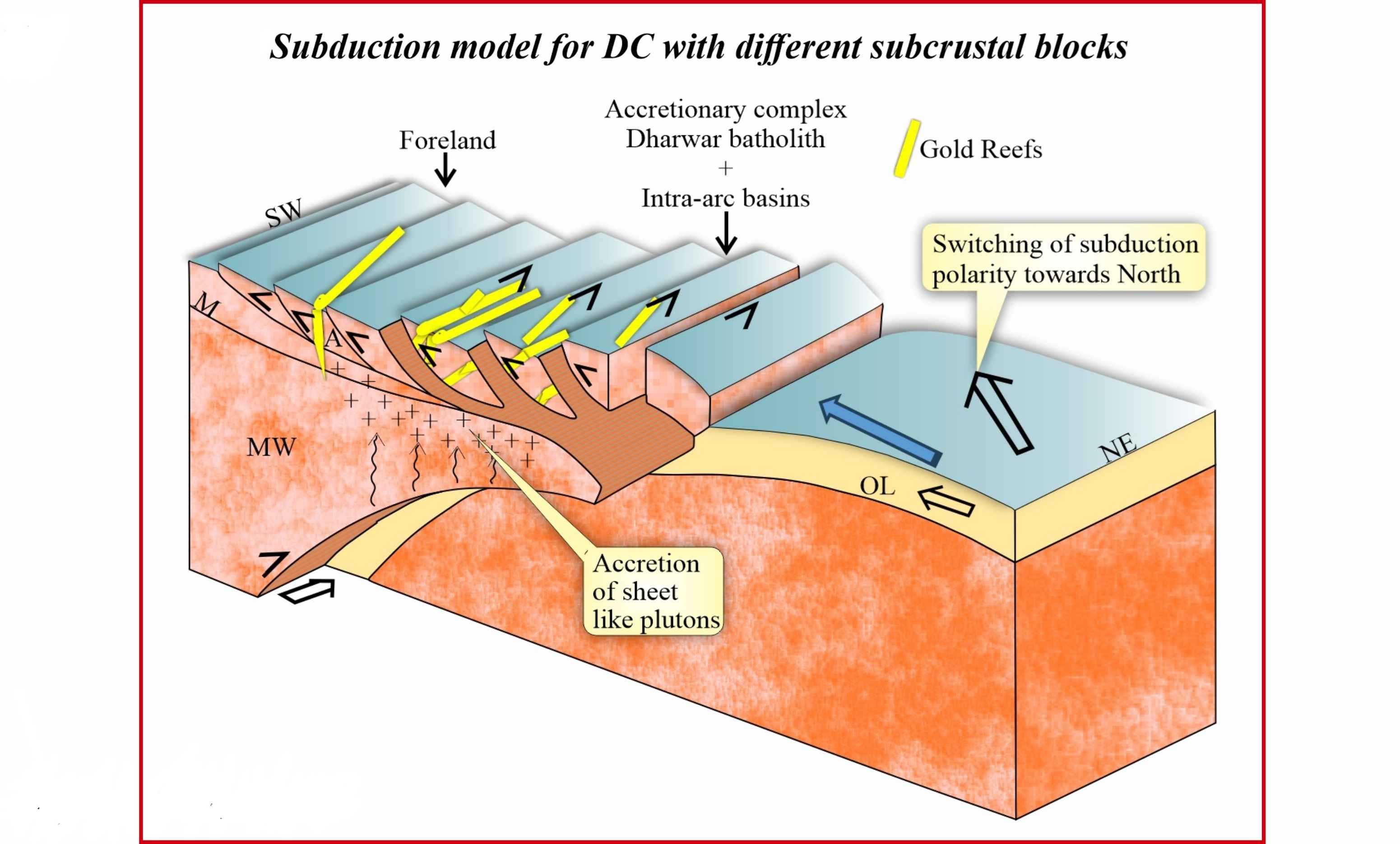
Graphical Abstract
Keywords
Dharwar Craton | greenstone belts | orogenic gold | fluid source
References
- 1.
Tomkins, A.G. On the source of orogenic gold. Geology 2013, 41, 1255–1256. https://doi.org/10.1130/focus122013.1
- 2.
Frimmel, H.E.; Hennigh, Q. First whiffs of atmospheric oxygen triggered onset of crustal gold cycle. Miner. Depos. 2015, 50, 5–23. https://doi.org/10.1007/s00126-014-0574-8
- 3.
Bhlke, J.K. Orogenic (metamorphic-hosted) gold-quartz veins. U.S. Geol. Surv. Open-File Rep. 1982, 795, 70–76.
- 4.
Groves, D.I. The crustal continuum model for late Archean lode gold deposits of the Yilgarn Block, Western Australia. Miner. Depos. 1993, 28, 366–374. https://doi.org/10.1007/BF02431596
- 5.
Goldfarb, R.J.; Groves, D.I. Orogenic gold: Common or evolving fluid and metal sources through time. Lithos 2015, 233, 2–26. https://doi.org/10.1016/j.lithos.2015.07.011
- 6.
Phillips, G.N.; Powell, R. Formation of gold deposits: Review and evaluation of the continuum model. Earth-Sci. Rev. 2009, 94, 1–21. https://doi.org/10.1016/j.earscirev.2009.02.002
- 7.
Phillips, G.N.; Powell, R. Formation of gold deposits: A metamorphic devolatilization model. J. Metam. Geol. 2010, 28, 689–718. https://doi.org/10.1111/j.1525-1314.2010.00887.x
- 8.
Tomkins, A.G.; Grundy, C. Upper temperature limits of orogenic gold deposit formation: Constraints from the granulite-hosted Griffin’s Find deposit, Yilgarn Craton. Econ. Geol. 2009, 104, 669–685. https://doi.org/10.2113/gsecongeo.104.5.669
- 9.
Tomkins, A.G. Windows of metamorphic sulphur liberation in the crust: Implications for gold deposit genesis. Geochim. Cosmochim. Acta 2010, 74, 3246–3259. https://doi.org/10.1016/j.gca.2010.03.003
- 10.
Gaboury, D. Parameters for the formation of orogenic gold deposits. Appl. Earth Sci. 2019, 128, 124–133. https://doi.org/10.1080/ 25726838.2019.1583310
- 11.
Jayananda, M.; Peucat, J.J.; Chardon, D.; Krishna Rao, B.; Fanning, C.M. Neoarchean 788 greenstone volcanism and continental growth, Dharwar Craton, southern India: 789 Constraints from SIMS U–Pb zircon geochronology and Nd isotopes. Precambrian 790 Res. 2013, 227, 55–76.
- 12.
Mishra, B. ; Pal, N. ; Basu Sarbadhikari, A. Fluid inclusion characteristics in barren and auriferous quartz veins in the Uti gold deposit, Hutti-Maski greenstone belt, southern India. Ore Geol. Rev. 2005, 16, 1–16. https://doi.org/10.1016/j.oregeorev.2004.10.002
- 13.
Kolb, J.; Rogers, A.; Meyer, F.M. Relative timing of deformation and two-stage gold mineralization at Hutti Mine, Dharwar Craton, India. Miner. Depos. 2004, 40, 156–174. https://doi.org/10.1007/s00126-005-0475-y
- 14.
Ramakrishnan, M.; Vaidyanadhan, R. Cratons. In Geology of India; Geological Society of India: Bangalore, India, 2008; Volume 1, pp. 99–180.
- 15.
Rogers, A.J.; Kolb, J.; Meyer, F.M.; et al. Two stages of gold mineralization at Hutti Mine, India. Miner. Depos. 2013, 48, 99–114. https://doi.org/10.1007/s00126-012-0416-5
- 16.
Rogers, A.J.; Kolb, J.; Meyer, F.M.; et al. Tectono-magmatic evolution of the Hutti-Maski greenstone belt, India: Constrained using geochemical and geochronological data. J. Asian Earth Sci. 2007, 31, 55–70. https://doi.org/10.1016/j.jseaes.2007.04.003
- 17.
Manikyamba, C.; Kerrich, R.; Khanna, T.C.; et al. Enriched and depleted arc basalts, with Mg-andesites and adakites: A potential paired arc-back arc of the 2.6 Ga Hutti greenstone terrane, India. Geochim. Cosmochim. Acta 2009, 73, 1711–1736. https://doi.org/10.1016/j.gca.2008.12.020
- 18.
Kolb, J.; Rogers, A.; Meyer, F.M.; et al. Development of fluid conduits in the auriferous shear zones of the Hutti Gold Mine, India: Evidence for spatially and temporally heterogeneous fluid flow. Tectonophysics 2004, 378, 65–84. https://doi.org/10.1016/j.tecto.2003.10.009
- 19.
Roy, A. Polyphase folding deformation in the Hutti-Maski schist belt, Karnataka. J. Geol. Soc. India 1979, 20, 598–607.
- 20.
Roy, A. The geology of gold mineralization at Hutti in Hutti-Maski schist belt, Karnataka, India. Indian Miner. 1991, 45, 229–250.
- 21.
Sangurmath, P. Uti gold deposit—evolving scene, Hutti-Maski greenstone belt, Karnataka, India. Geol. Surv. India Spec. Publ. 2001, 58, 289–292.
- 22.
Curtis, L.C. ; Radhakrishna, B.P. Hutti Gold Mine into the 21st Century; Geological Society of India: Bangalore, India, 1995; p. 176.
- 23.
Mishra, B.; Pal, N. Metamorphism, fluid flux, and fluid evolution relative to gold mineralization in the Hutti-Maski greenstone belt, Eastern Dharwar Craton, India. Econ. Geol. 2008, 103, 801–827. https://doi.org/10.2113/gsecongeo.103.4.801
- 24.
Robert, F. ; Poulsen, K.H. Vein formation and deformation in greenstone gold deposits. Rev. Econ. Geol. 2001, 14, 111–155. https://doi.org/10.5382/Rev.14.05
- 25.
Narayanswami, S.; Ziauddin, M.; Ramachandra Rao, A. Structural control and localization of gold-bearing lode, Kolar Gold Field, India. Econ. Geol. 1960, 55, 1429–1459.
- 26.
Hamilton, J.V.; Hodgson, C.J. Mineralization and structure of the Kolar Gold Field, India. In Gold ’86; MacDonald, A.J., Ed. ; Konsult Int. Inc.: Willowdale, ON, Canada, 1986; pp. 270–283.
- 27.
Mukhopadhyay, D.K. Significance of small-scale structures in the Kolar schist belt, South India. J. Geol. Soc. India 1989, 33, 291– 308.
- 28.
Sheshadri, C.R. Indian gold production. Min. Ann. Rev. Min. Mag. 1988, 435–445.
- 29.
Radhakrishna, B.P.; Curtis L.C. Gold: The Indian scene; Geological Society of India: Bangalore, India, 1991; p. 163.
- 30.
Radhakrishna, B.P. ; Curtis, L.C. Gold in India. J. Geol. Soc. India 1999, 53, 308.
- 31.
Pal, D. Genesis of Gold Mineralization in the South Kolar and Gadag Greenstone Belts, Dharwar Craton: Constraints from Hydrothermal Alteration, Tourmaline Chemistry, Fluid Inclusion and Stable Isotope Studies. Ph.D. Thesis, NIT Rourkela, Rourkela, Odisha, India, 2022.
- 32.
Pal, D.; Chinnasamy, S.S.; Goon, S.; et al. Alteration mineralogy, fluid inclusions and stable isotope studies from Chigargunta and Bisanatham gold deposits, South Kolar Greenstone Belt, Dharwar Craton, India: Implications on genesis of gold mineralization. Ore Geol. Rev. 2019, 111, 102946. https://doi.org/10.1016/j.oregeorev.2019.102946
- 33.
Pal, D.; Chinnasamy, S.S.; Goon, S. Characterization of hydrothermal alteration at Chigargunta and Bisanatham gold deposits, South Kolar Greenstone Belt, Dharwar Craton, India. J. Geol. Soc. India, Spec. Publ. 2021, 11, 40–45.
- 34.
Jairam, M.S.; Roop Kumar, D.; Srinivasan, K.N. Classification of greenstone and associated granitoids of Jonnagiri schist belt, Kurnool district, Andhra Pradesh. Geol. Surv. India Spec. Publ. 2001, 55, 59–66.
- 35.
Saravanan, C.S. ; Mishra, B. ; Jairam, M.S. P–T conditions of mineralization in the Jonnagiri granitoid-hosted gold deposit, Eastern Dharwar Craton, southern India: Constraints from fluid inclusions and chlorite thermometry. Ore Geol. Rev. 2009, 36, 333–349. https://doi.org/10.1016/j.oregeorev.2009.07.004
- 36.
Chinnasamy, S.S.; Mishra, B. Greenstone metamorphism, hydrothermal alteration, and gold mineralization in the genetic context of the granodiorite-hosted gold deposit at Jonnagiri, Eastern Dharwar Craton, India. Econ. Geol. 2013, 108, 1015–1036. https://doi.org/10.1016/j.oregeorev.2009.07.004
- 37.
Rao, K.S.; Kumar, D.R.; Jairam, M.S.; et al. Interpretation of geological characteristics of Dona gold prospect, Jonnagiri schist belt, Kurnool district, Andhra Pradesh. Geol. Surv. India Spec. Publ. 2001, 58, 217–231.
- 38.
Vasudev, V.N. Field Guide to Selected Gold Prospects in Karnataka and Andhra Pradesh; Geological Society of India: Bangalore, India, 2009.
- 39.
Bhattacharya, S.; Panigrahi, M.K.; Sachan, H.K.; et al. Oxygen isotope ratio of quartz veins from the auriferous RamagiriPenakacherla schist belt and surrounding granitoids in the Eastern Dharwar Craton: A case for possible link between gold mineralization and granite magmatism. Ore Geol. Rev. 2014, 63, 201–208. https://doi.org/10.1016/j.oregeorev.2014.04.023
- 40.
Ugarkar, A.G.; Malapur, M.A.; Kumar, B.C. Archean turbiditehosted orogenic gold mineralization in the Gadag greenstone belt, Western Dharwar Craton, Peninsular India. Ore Geol. Rev. 2016, 72, 1224–1242. https://doi.org/10.1016/j.oregeorev.2014.04.023
- 41.
Chadwick, B.; Vasudev, V.N.; Hegde, G.V. The Chitradurga schist belt and its adjacent plutonic rocks, NW of Tungabhadra, Karnataka: A duplex in the Late Archaean convergent setting of the Dharwar Craton. J. Geol. Soc. India 2003, 61, 645–663.
- 42.
Pal, D.; Saikia M.J.; Chinnasamy, S.S.; et al. Fluid inclusion, stable isotope and tourmaline chemistry at Gadag Gold Field, Dharwar Craton, India: Implications for metamorphic origin of auriferous fluid, Ore Geol. Rev. 2025, 186, 106876. https://doi.org/10.1016/j.oregeorev.2025.106876
- 43.
Mukhopadhyay, D.; Baral, M.C. Structural geometry of Dharwar rocks near Chitradurga in the Chitradurga schist belt. J. Geol. Soc. India 1985, 26, 547–566.
- 44.
Pal, N.; Mishra, B. Epigenetic nature of BIF-hosted gold mineralization at Ajjanahalli, southern India: Evidence from ore petrography and fluid inclusion studies. Gondwana Res. 2003, 6, 531–540. https://doi.org/10.1016/S1342-937X(05)70836-2
- 45.
Dharuman, R. Final Report on the Preliminary Exploration for Gold in Paramanahalli Block, Chitradurga Schist Belt, Chitradurga District, Karnataka (Part A and B); Geological Survey of India Report; Geological Survey of India (GSI): Kolkata, India, 2004.
- 46.
Sati, M.; Krishnamurthi, R.; Chinnasamy, S.S.; et al. Gold mineralization at Paramanahalli prospect, Chitradurga Greenstone Belt, Western Dharwar Craton, Karnataka, India. J. Geol. Soc. India 2025, 101, 397–405. https://doi.org/10.17491/jgsi/2025/174104
- 47.
Sati, M. ; Krishnamurthi, R. ; Saravanan, S. ; et al. Mineralogy, hydrothermal alteration and paragenesis of gold mineralization at Paramanahalli prospect, Chitradurga Greenstone Belt. Ore Geol. Rev. 2025, 176, 106398. https://doi.org/10.1016/j.oregeorev.2024.106398
- 48.
Gopalakrishna, G.; Shareef, M.; Nagesh, P.C. Shear-controlled gold mineralization of GR Halli area of Chitradurga Schist Belt, Dharwar Craton: Insights from fluid inclusion study. Open J. Geol. 2018, 8, 662–673. https://doi.org/10.4236/ojg.2018.88041
- 49.
Khan, S.A. Gold mineralization along Gonur-Jagalur shear corridor in the central part of the Chitradurga schist belt, Karnataka. In National Seminar on Exploration and Survey for Noble Metals and Precious Stones; Geol. Surv. India Spec. Publ. 58; Geological Survey of India (GSI): Kolkata, India, 2001; pp.251–261.
- 50.
Gupta, S.; Jayananda, M. Tourmaline from Archean G.R. Halli gold deposit, Chitradurga greenstone belt, Dharwar Craton (India): Implications for the gold metallogeny. Geosci. Front. 2014, 5, 877–892. https://doi.org/10.1016/j.gsf.2013.12.002
- 51.
Pandalai, H.S. ; Jadhav, G.N. ; Mathew, B. ; et al. Dissolution channels in quartz and the role of pressure changes in gold and sulfide deposition in the Archean greenstone-hosted Hutti gold deposit, Karnataka, India: Petrography and fluid inclusion studies. Miner. Depos. 2003, 38, 597–624. https://doi.org/10.1007/s00126-003-0357-1
- 52.
Badhe, K.V; Pandalai, H.S.; Pande, K. 40Ar-39Ar age constraints on timing of a late hydrothermal event in the Hutti greenstone belt, Karnataka, India. J. Asian Earth Sci. 2019, 172, 115–125. https://doi.org/10.1016/j.jseaes.2018.12.026
- 53.
Hazarika, P.; Pruseth, K.L.; Mishra, B. Neoarchean greenstone metamorphism in the Eastern Dharwar Craton, India: Constraints from monazite U–Th–Pb total ages and P– T pseudosection calculations. J. Geol. 2015, 123, 429–461. https://doi.org/10.1086/681719
- 54.
Rajamani V; Shivkumar K; Hanson G.N.; Granath J.W. Petrogenesis of Amphibolites in the Kolar Schist Belt, India-A Preliminary Report. Jour. Geol. Soc. India 1981, 22 911, 470–487.
- 55.
Sarma, D.S.; McNaughton, N.J.; Fletcher, I.R.; et al. Timing of gold mineralization in the Hutti gold deposit, Dharwar Craton, South India. Econ. Geol. 2008, 103, 1715–1727. https://doi.org/10.2113/gsecongeo.103.8.1715
- 56.
Sarangi, S.; Sarkar, A.; Srinivasan, S.; et al. Carbon isotope studies of auriferous quartz-carbonate veins from two orogenic gold deposits from the Neoarchean Chitradurga schist belt, Dharwar Craton, India: Evidence for mantle/magmatic source of auriferous fluid. J. Asian Earth Sci. 2012, 52, 1–11. https://doi.org/10.1016/j.jseaes.2011.12.004
- 57.
Kolb, J.; Hellmann, A.; Rogers, A.; et al. The role of a transcrustal shear zone in orogenic gold mineralization at the Ajjanahalli Mine, Dharwar Craton, South India. Econ. Geol. 2004, 99, 743–759. https://doi.org/10.2113/gsecongeo.99.4.743
- 58.
Saikia, M.J. Genesis of Gold Mineralization in the Gadag Greenstone Belt, Western Dharwar Craton: Insights from Greenstone Metamorphism, Alteration Geochemistry and Ore Mineralogy. Ph.D. Thesis, Indian Institute of Technology Bombay, Mumbai, India, 2025.
- 59.
Mishra, B. ; Pruseth, K.L. ; Hazarika, P. ; et al. Nature and source of the ore-forming fluids associated with orogenic gold deposits in the Dharwar Craton. Geosci. Front. 2018, 9, 715–726. https://doi.org/10.1016/j.gsf.2017.09.005
- 60.
Sahoo, A.K.; Krishnamurthi, R.; Sangurmath, P. Nature of ore-forming fluids, wall rock alteration and P–T conditions of gold mineralization at Hira-Buddini, Hutti-Maski Greenstone Belt, Dharwar Craton, India. Ore Geol. Rev. 2018, 99, 195–216. https://doi.org/10.1016/j.oregeorev.2018.06.008
- 61.
Santosh, M. Ore fluids in the auriferous Champion Reef of Kolar, South India. Econ. Geol. 1986, 81, 1546–1552. https://doi.org/10.2113/gsecongeo.81.6.1546
- 62.
Gupta, S.; Fareeduddin. Occurrence of paragonite in the hydrothermal wall rock alteration zone of G.R. Halli gold deposit, Chitradurga Schist Belt, Western Dharwar Craton, southern India. J. Geol. Soc. India 2013, 82, 461–473.
- 63.
Sarma, D.S.; Fletcher, I.R.; Rasmussen, B.; et al. Archaean gold mineralization synchronous with late cratonization of the Western Dharwar Craton, India: Evidence from SHRIMP U–Pb geochronology of xenotime in gold deposits. Miner. Depos. 2011, 46, 273–288. https://doi.org/10.1007/s00126-010-0326-3
- 64.
Deb, M. Precambrian geodynamics and metallogeny of the Indian Shield. Ore Geol. Rev. 2014, 57, 1–28. https://doi.org/10.1016/j.oregeorev.2013.08.022
- 65.
Anand, R.; Balakrishnan, S. Pb, Sr and Nd isotope systematics of metavolcanic rocks of the Hutti greenstone belt, Eastern Dharwar Craton: Constraints on age, duration of volcanism and evolution of mantle sources during the Late Archean. J. Asian Earth Sci. 2010, 39, 1–11. https://doi.org/10.1016/j.jseaes.2010.02.010
- 66.
Anand, R.; Balakrishnan, S.; Mezger, K. Geochemical and geochronological studies on titanites from the granitoid rocks of the Eastern Dharwar Craton, South India. Geophys. Res. Abstr. 2005, 7, 1607-7962/gra/EGU1605-A-01565.
- 67.
Vasudev, V.N.; Chadwick, B.; Nutman, A.P.; et al. Rapid development of the Late Archean Hutti schist belt, northern Karnataka: Implications of new field data and SHRIMP U/Pb zircon ages. J. Geol. Soc. India 2000, 55, 529–540.
- 68.
Balakrishnan, S.; Rajamani, V.; Hanson, G.N. U–Pb ages for zircon and titanite from the Ramagiri area, southern India: Evidence for the accretionary origin of the Eastern Dharwar Craton during the Late Archean. J. Geol. 1999, 107, 69–86. https://doi.org/10.1086/314331
- 69.
Krogstad, E.J.; Hanson, G.N.; Rajamani, V. U–Pb ages of zircon and sphene for two gneiss terranes adjacent to the Kolar schist belt, South India: Evidence for separate crustal evolution histories. J. Geol. 1991, 99, 421–434. https://doi.org/10.1086/629553
- 70.
Balakrishnan, S.; Hanson, G.N.; Rajamani, V. Pb and Nd isotope constraints on the origin of high-Mg and tholeiitic amphibolites, Kolar schist belt, South India. Contrib. Mineral. Petrol. 1990, 107, 279–292. https://doi.org/10.1007/BF00325099
- 71.
Das, S.; Chinnasamy, S.S. Granitoids of the Jonnagiri greenstone belt of eastern Dharwar craton: Constraints from geochemistry and U-Pb zircon geochronology [Conference presentation]. In EGU General Assembly 2024; European Geosciences Union (EGU) / Copernicus Publications (EGUsphere platform): Vienna, Austria, 2024. https://doi.org/10.5194/egusphere-egu24-6082
- 72.
Ram Mohan, M. ; Sarma, D.S. ; Neal, J.M. ; et al. SHRIMP zircon and titanite U–Pb ages, Lu–Hf isotope signatures and geochemical constraints for ∼2.56 Ga granitic magma in the Western Dharwar Craton, southern India: Evidence for short-lived Neoarchean episodic crustal growth? Precambrian Res. 2014, 243, 197–220. https://doi.org/10.1016/j.precamres.2013.12.017
- 73.
Sarma, D.S.; McNaughton, N.J.; Belousova, E.; et al. Detrital zircon U–Pb ages and Hf-isotope systematics from the Gadag greenstone belt: Archean crustal growth in the Western Dharwar Craton, India. Gondwana Res. 2012, 22, 843–854. https://doi.org/10.1016/j.gr.2012.04.001
- 74.
Sati, M. ; Krishnamurthi, R. ; Saravanan, S. Monazite chemistry and timing of mineralization at Paramanahalli, Chitradurga Greenstone Belt, Dharwar Craton, India: Implications for gold exploration. J. Geochem. Explor. 2025, 271, 107688. https://doi.org/10.1016/j.gexplo.2025.107688
- 75.
Pal, N.; Mishra, B. Alteration geochemistry and fluid inclusion characteristics of the greenstone-hosted gold deposit at Hutti, Eastern Dharwar Craton, India. Miner. Depos. 2002, 37, 722–736. https://doi.org/10.1007/s00126-002-0257-8
- 76.
Hazarika, P.; Mishra, B.; Pruseth, K.L. Scheelite, apatite, calcite and tourmaline compositions from the Late Archean Hutti orogenic gold deposit: Implications for analogous twostage ore fluids. Ore Geol. Rev. 2016, 72, 989–1003. https://doi.org/10.1016/j.oregeorev.2015.09.004
- 77.
Krienitz, M.S.; Trumbull, R.B.; Hellmann, A.; et al. Hydrothermal gold mineralisation at the Hira-Buddini gold mine, India: Constraints on fluid evolution and fluid sources from boron isotopic compositions of tourmaline. Miner. Depos. 2008, 43, 421–434. https://doi.org/10.1007/s00126-007-0172-0
- 78.
Saravanan, C.S.; Mishra, B. Uniformity in sulphur isotope compositions in the orogenic gold deposit from the Dharwar Craton, southern India. Miner. Depos. 2009, 44, 597–605. https://doi.org/10.1007/s00126-009-0241-7
- 79.
Sinha, M. Gold Mineralization in the Western Ramagiri Block, Anantapur District, Andhra Pradesh, with Special Reference to Fluid Inclusion Characteristics. Master’s Thesis, Indian Institute of Technology Kharagpur, Kharagpur, India, 1997, unpublished.
- 80.
Hazarika, P. ; Mishra, B. ; Pruseth, K.L. Diverse tourmaline compositions from orogenic gold deposits in the HuttiMaski greenstone belt, India: Implications for sources of ore-forming fluids. Econ. Geol. 2015, 110, 337–353. https://doi.org/10.2113/econgeo.110.2.337
- 81.
Giritharan, T.S., Rajamani, V. REE geochemistry of ore zones in the archean auriferous schist belts of the eastern Dharwar Craton, south India. J. Earth Syst. Sci. 2001, 110, 143–159. https://doi.org/10.1007/BF02702214
- 82.
Bhattacharya, S.; Panigrahi, M.K. Heterogeneity in fluid characteristics in the Ramagiri–Penakacherla sector of the Eastern Dharwar Craton: Implications to gold metallogeny. Russ. Geol. Geophys. 2011, 52, 1436–1447. https://doi.org/10.1016/j.rgg.2011.10.012
- 83.
Mishra, B.; Panigrahi, M.K. Fluid evolution in Kolar Gold Field: Evidence from fluid inclusion studies. Miner. Depos. 1999, 34, 173–181. https://doi.org/10.1007/s001260050194
- 84.
Swain, S.K.; Sarangi, S.; Srinivasan, R.; et al. Isotope (C and O) composition of auriferous quartz-carbonate veins, central lode system, Gadag Gold Field, Dharwar Craton, India: Implications to source of ore fluids. Ore Geol. Rev. 2015, 70, 305–320. https://doi.org/10.1016/j.oregeorev.2015.03.020
- 85.
Malapur, M.A.; Manjunatha, S.; Chandan Kumar, B.; et al. Ore fluids associated with the metasediment-hosted Central Auriferous Zones of Gadag Gold Field, Karnataka. Int. J. Earth Sci. Eng. 2012, 5, 1545–1551.
- 86.
Naden, J.; Shepherd, T.J. Role of methane and carbon dioxide in gold deposition. Nature 1989, 342, 793–795. https://doi.org/10.1038/342793a0
- 87.
Wilkinson, J.J. Fluid inclusions in hydrothermal ore deposits. Lithos 2001, 55, 229–272. https://doi.org/10.1016/S0024-4937(00)00047-5
- 88.
McCuaig, T.C.; Kerrich, R. P–T–t deformation fluid characteristics of lode gold deposits: Evidence from alteration systematics. Ore Geol. Rev. 1998, 12, 381–453. https://doi.org/10.1016/S0169-1368(98)80002-4
- 89.
Sillitoe, R.H.; Thompson, J.F.H. Intrusion-related vein gold deposits: Types, tectono-magmatic settings and difficulties of distinction from orogenic gold deposits. Res. Geol. 1998, 48, 237–250. https://doi.org/10.1111/j.1751-3928.1998.tb00021.x
- 90.
Thompson, J.F.H.; Sillitoe, R.H.; Baker, T.; et al. Intrusion-related gold deposits associated with tungsten-tin provinces. Miner. Depos. 1999, 34, 323–334. https://doi.org/10.1007/s001260050207
- 91.
Groves, D.I.; Goldfarb, R.J.; Robert, F.; et al. Gold deposits in metamorphic belts: Overview of current understanding, outstanding problems, future research, and exploration significance. Econ. Geol. 2003, 98, 1–29. https://doi.org/10.2113/gsecongeo.98.1.1
- 92.
Menon, A.G. ; Venkatasubramanian, V.S. ; Vasudev, V.N. ; et al. Sulfur isotope abundance variations in sulfides of the Dharwar Craton—Part III: Hutti. J. Geol. Soc. India 1981, 22, 448–450.
- 93.
Lambert, I.B.; Phillips, G.N.; Groves, D.I. Sulfur isotope compositions and genesis of Archean gold mineralisation, Australia and Zimbabwe. Geol. Soc. Zimbabwe Spec. Publ. 1984, 1, 373–387.
- 94.
Selvaraja, V.; Caruso, S.; Fiorentini, M.L.; et al. Atmospheric sulfur in the orogenic gold deposits of the Archean Yilgarn Craton, Australia. Geology 2017, 45, 691–694. https://doi.org/10.1130/G39018.1
- 95.
Shieh, Y.; Taylor, H.P. Oxygen and carbon isotope studies of contact metamorphism of carbonate rocks. J. Petrol. 1969, 10, 307–331. https://doi.org/10.1093/petrology/10.2.307
- 96.
Ohmoto, H.; Goldhaber, M.B. Geochemistry of hydrothermal ore deposits. In Geochemistry of Hydrothermal Ore Deposits, 3rd ed.; John Wiley & Sons: New York, NY, USA, 1997; pp. 517–611.
- 97.
Jiang, S.Y.; Yu, J.M.; Lu, J.J. Trace and rare-earth element geochemistry in tourmaline and cassiterite from the Yunlong tin deposit, Yunnan, China: Implications for magmatic-hydrothermal fluid evolution and ore genesis. Chem. Geol. 2004, 209, 193–213. https://doi.org/10.1016/j.chemgeo.2004.04.021
- 98.
Slack, J.F. ; Trumbull, R.B. Tourmaline as a recorder of ore-forming processes. Elements 2011, 7, 321–326. https://doi.org/10.2113/gselements.7.5.321
- 99.
Cabral, A.R.; Wiedenbeck, M.; Koglin, N.; et al. Boron-isotopic constraints on the petrogenesis of hematitic phyllite in the southern Serra do Espinhac¸o, Minas Gerais, Brazil. Lithos 2012, 140, 224–233. https://doi.org/10.1016/j.lithos.2012.01.011
- 100.
Craig, J.R.; Vokes, F.M.; Solberg, T.N. Pyrite: Physical and chemical textures. Miner. Depos. 1998, 34, 82–101. http://dx.doi.org/10.1007/s001260050187
- 101.
Large, R.R.; Maslennikov, V.V.; Robert, F.; et al. Multistage sedimentary and metamorphic origin of pyrite and gold in the giant Sukhoi Log deposit, Lena gold province, Russia. Econ. Geol. 2007, 102, 1233–1267. https://doi.org/10.2113/gsecongeo.102.7.1233
- 102.
Cook, N.J.; Ciobanu, C.I.; Meria, D.; et al. Arsenopyrite-pyrite association in an orogenic gold ore: Tracing mineralization history from textures and trace elements. Econ. Geol. 2013, 108, 1273–1283. https://doi.org/10.2113/econgeo.108.6.1273
- 103.
Jayananda, M.; Santosh, M.; Aadhiseshan, K.R. Formation of Archean (3600–2500 Ma) continental crust in the Dharwar Craton, southern India. Earth-Sci. Rev. 2018, 181, 12–42. https://doi.org/10.1016/j.earscirev.2018.03.013
- 104.
Chinnasamy, S.S. Orogenic gold deposits in the Dharwar Craton: Current insights and future prospects. J. Geol. Soc. India 2025 101, 1290–1292. https://doi.org/10.17491/jgsi/2025/174236
- 105.
Vasudev, V.N; Chinnasamy, S.S. Orogenic gold deposits of the Archaean Dharwar Craton: Development of Neoarchaean greenstone belts in a Phanerozoic-style plate-tectonic framework: A synthesis. J. Geol. Soc. India 2026, 102, 891–904.
- 106.
Hazarika, P.; Mishra, B.; Pruseth, K.L. Trace element geochemistry of pyrite and arsenopyrite: Ore genetic applications for Late Archean orogenic gold deposits in southern India. Mineral. Mag. 2017, 81, 661–678. https://doi.org/10.1180/minmag.2016.080.128
- 107.
Chinnasamy, S.S.; Hazarika, P.; Pal, D.; et al. Pyrite textures and trace element compositions from the granodiorite-hosted gold deposit at Jonnagiri, Eastern Dharwar Craton, India: Implications for gold mineralization processes. Econ. Geol. 2021, 116, 559–579. https://doi.org/10.5382/econgeo.4787
- 108.
Garofalo, P.S.; Fricker, M.B.; Gnther, D.; et al. Physical-chemical properties and metal budget of Au gold-transporting hydrothermal fluids in orogenic deposits. Geological Society, London, Special Publications: London, UK, 2014. https://api.semanticscholar.org/CorpusID:129619918.
- 109.
Ridley, J.R.; Diamond, L.W. Fluid chemistry of orogenic lode gold deposits and implications for genetic models. In Gold in 2000. Reviews in Economic Geology; Hagemann S.G., Brown P. , Eds.; Society of Economic Geologists, Inc.: Littleton, CO, USA, 200; Volume 13, pp. 141–162.
- 110.
Eggler, D.H.; Kadik, A.A. The system NaAlSi3O8-H2O-CO2 to 20 kbar pressure: Compositional and thermodynamic relations of liquids and vapors coexisting with albite. Am. Mineral. 1979, 64, 1036–1048.
- 111.
Cameron, E.N.; Rowe, R.B.; Weis, P.L. Fluid inclusions in beryl and quartz from pegmatites of the Middletown district, Connecticut. Am. Mineral. 1953, 38, 218–262.
- 112.
Goldfarb, R.J.; Hart, C.J.R.; Marsh, E.E. Orogenic gold and evolution of the Cordilleran orogen. In Circum-Pacific Tectonics, Geologic Evolution and Ore Deposits; Spencer, J.E., Titley, S.R., Eds.; Arizona Geological Society Digest 22; Arizona Geological Society: Tucson, AZ, USA, 2008; pp. 311–323.
- 113.
Bierlein, F.P.; Arne, D.C.; Foster, D.A.; et al. A geochronological framework for orogenic gold mineralization in Central Victoria, Australia. Miner. Depos. 2001, 36, 741–767. https://doi.org/10.1007/s001260100203
- 114.
Kesarwani, M.; Sarangi, S.; Srinivasan, R.; et al. Origin of granodiorite-hosted Neoarchean orogenic gold ore deposits: Stable isotopic and geochemical constraints with example from the Dharwar Craton, southern India. Ore Geol. Rev. 2019, 107, 754–779. https://doi.org/10.1016/j.oregeorev.2019.03.001
- 115.
Champion, D.C.; Cassidy, K.F. Granites of the Northern Murchison Province: Their Distribution, Age, Geochemistry, Petrogenesis, Relationship with Mineralisation, and Implications for Tectonic Environment; AMIRA P482/MERIWA M281—Yilgarn Granitoids; AMIRA International (AMIRA P482 project consortium) and Minerals and Energy Research Institute of Western Australia (MERIWA): Perth, Western Australia, Australia, 2002; pp. 5.1–5.54.
- 116.
Pitcairn, I.K.; Craw, D.; Teagle, D.A.H. The gold conveyor belt: Large-scale gold mobility in an active orogen. Ore Geol. Rev. 2014, 62, 129–142. https://doi.org/10.1016/j.oregeorev.2014.03.006
- 117.
Connolly, J.A.D. The mechanics of metamorphic fluid expulsion. Elements 2010, 6, 165–172. https://doi.org/10.2113/gselements.6.3.165
- 118.
Benning, L.G.; Seward, T.M. Hydrosulfide complexing of gold(I) in hydrothermal solutions from 150 to 500 ◦ C and 500 to 1500 bars. Geochim. Cosmochim. Acta 1996, 60, 1849–1871. https://doi.org/10.1016/0016-7037(96)00061-0
- 119.
Mikucki, E.J. Hydrothermal transport and depositional processes in Archean lode gold systems: A review. Ore Geol. Rev. 1998, 13, 307–321. https://doi.org/10.1016/S0169-1368(97)00025-5

This work is licensed under a Creative Commons Attribution 4.0 International License.

 Suite 4002 Level 4, 447 Collins Street, Melbourne, Victoria 3000, Australia
 General Inquiries: info@sciltp.com