
- Generalized framework quantifies archive-specific temporal filtering.
- Effective temporal resolution governs climate-signal preservation.
- Representative archives demonstrate practical framework application.
- Temporal bandwidth enables quantitative proxy comparison.
- Framework improves proxy synthesis and model-data integration
- Open Access
- Article
Temporal Resolution Controls on Climate-Signal Preservation in Quaternary Palaeoclimate Records
- Monmohan Gogoi *,
- Diganta Bhuyan
Author Information
Received: 15 May 2026 | Revised: 28 Jun 2026 | Accepted: 27 Jul 2026 | Published: 31 Jul 2026
Highlights
Abstract
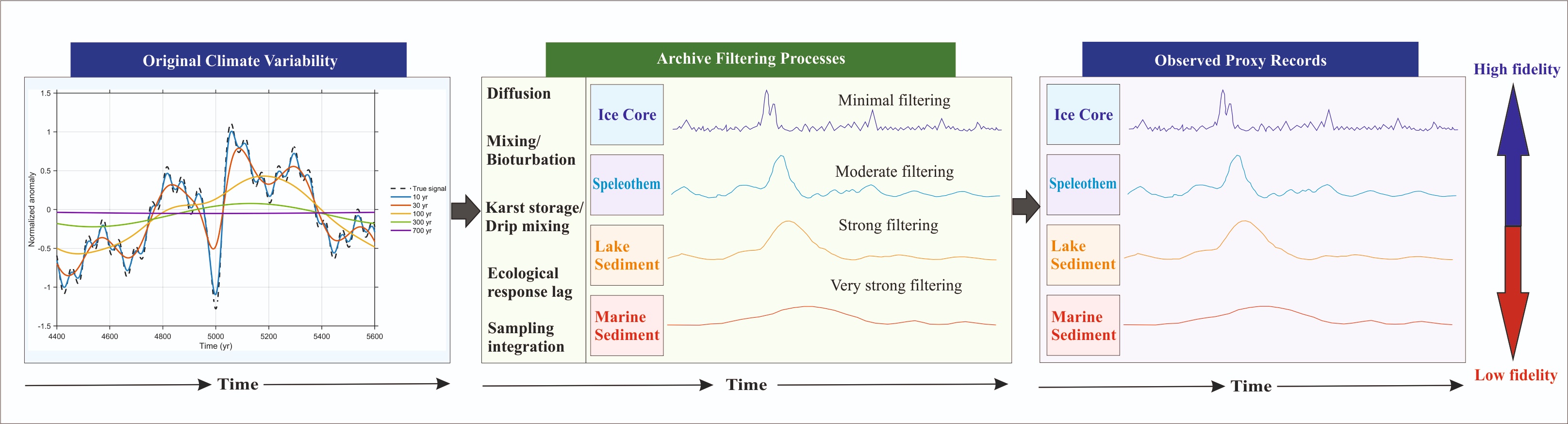
Geological archives provide the primary evidence for reconstructing Quaternary climate variability, yet differences among proxy records are commonly interpreted using broad archive categories. Such classifications can obscure the measurable controls governing the recording and preservation of climate signals. Here, a generalized quantitative framework is developed in which temporal resolution and signal fidelity depend primarily on accumulation rate, sampling integration scale, post-depositional mixing, diffusive smoothing, and ecological response time. Analytical formulations and numerical forward experiments show that increasing effective temporal integration attenuates abrupt events, broadens transition durations, suppresses high-frequency variability, redistributes variance toward longer timescales, and can generate apparent timing offsets between records responding to the same forcing. The framework further shows that uncertainty reduction in multi-record composites is limited when errors are correlated. Representative applications to Greenland ice cores, Chinese speleothems, and North Atlantic marine sediments show how readily available archive metadata can be translated into first-order estimates of effective temporal resolution, climate-signal attenuation, duration inflation, and preserved climatic bandwidth. These results indicate that Quaternary proxy records should be interpreted as filtered representations of climate variability whose characteristics depend on archive-response processes. Explicit integration of effective temporal resolution is essential for cross-archive comparison, proxy synthesis, and model-data evaluation.
Graphical Abstract
Keywords
quaternary palaeoclimate | temporal resolution | proxy archives | signal preservation | proxy system models
References
- 1.
Bradley, R. S. Paleoclimatology, Reconstructing climates of the Quaternary, 2nd ed.; Elsevier Academic Press: San Diego, CA, USA, 1999; Volume 68.
- 2.
Cronin, T. M. Paleoclimates, Understanding Climate Change Past and Present. Columbia University Press: New York, NY, USA, 2009.
- 3.
Tierney, J. E.; Pausata, F. S. R.; deMenocal, P. B. Rainfall regimes of the Green Sahara. Sci. Adv., 2017, 3, e1601503. https://doi.org/10.1126/sciadv.1601503
- 4.
Marcott, S. A.; Shakun, J. D.; Clark, P. U.; et al. A reconstruction of regional and global temperature for the past 11,300 years. Science, 2013, 339, 1198–1201. https://doi.org/10.1126/science.1228026
- 5.
Kaufman, D.; McKay, N.; Routson, C.; et al. Holocene global mean surface temperature, a multi-method reconstruction approach. Sci. Data, 2020, 7, 201. https://doi.org/10.1038/s41597-020-0530-7
- 6.
Konecky, B. L.; McKay, N. P.; Churakova (Sidorova), O. V.; et al. The Iso2k database, A global compilation of paleo-δ¹⁸O and δ²H records. Earth Syst. Sci. Data, 2020, 12, 2261–2288. https://doi.org/10.5194/essd-12-2261-2020
- 7.
Evans, M. N.; Lücke, L. J.; Fan, K. J.; et al. A database of databases for Common Era paleoclimate applications. Earth Syst. Sci. Data, 2026, 18, 1185–1202. https://doi.org/10.5194/essd-18-1185-2026
- 8.
Luecke, L.; Evans, M.; Zhu, F.; et al. lluecke/dod2k, DoD2k Version 2.0. Zenodo, 2026, Geneva, Switzerland. https://doi.org/10.5281/zenodo.18152672
- 9.
Reschke, M.; Rehfeld, K.; Laepple, T. Empirical estimate of the signal content of Holocene temperature proxy records. Clim. Past, 2019, 15, 521–537. https://doi.org/10.5194/cp-15-521-2019
- 10.
Dolman, A. M.; Kunz, T.; Groeneveld, J.; et al. A spectral approach to estimating the timescale-dependent uncertainty of paleoclimate records – Part 2, Application and interpretation. Clim. Past, 2021, 17, 825–841. https://doi.org/10.5194/cp-17-825-2021
- 11.
Evans, M. N.; Tolwinski-Ward, S. E.; Thompson, D. M.; et al. Applications of proxy system modeling in high resolution paleoclimatology. Quat. Sci. Rev., 2013, 76, 16–28. https://doi.org/10.1016/j.quascirev.2013.05.024
- 12.
Dee, S. G.; Steiger, N. J.; Emile-Geay, J.; et al. On the utility of proxy system models for estimating climate states over the common era. J. Adv. Model. Earth Syst., 2016, 8, 1164–1179. https://doi.org/10.1002/2016ms000677
- 13.
Dolman, A. M.; Laepple, T. Sedproxy, A forward model for sediment-archived climate proxies. Clim. Past, 2018, 14, 1851–1868. https://doi.org/10.5194/cp-14-1851-2018
- 14.
Johnsen, S. J.; Clausen, H. B.; Dansgaard, W.; et al. The δ¹⁸O record along the Greenland Ice Core Project deep ice core and the problem of possible Eemian climatic instability. J. Geophys. Res. Oceans, 1997, 102, 26397–26410. https://doi.org/10.1029/97jc00167
- 15.
Fairchild, I. J.; Baker, A. Speleothem Science. Wiley-Blackwell: Chichester, UK, 2012. https://doi.org/10.1002/9781444361094
- 16.
Amrhein, D. E. How large are temporal representativeness errors in paleoclimatology. Clim. Past, 2020, 16, 325–340. https://doi.org/10.5194/cp-16-325-2020
- 17.
Zuhr, A. M.; Wahl, S.; Steen-Larsen, H. C.; et al. Spatial and temporal stable water isotope data from the EastGRIP camp site, NE Greenland, sampled in summer 2018. Earth Syst. Sci. Data, 2024, 16, 1861–1874. https://doi.org/10.5194/essd16-1861-2024
- 18.
Kunz, T.; Laepple, T. Effective spatial degrees of freedom of natural temperature variability as a function of frequency. J. Climate, 2024, 37, 2505–2518. https://doi.org/10.1175/jcli-d-23-0040.1
- 19.
Andersen, K. K.; Azuma, N.; Barnola, J.-M.; et al. High-resolution record of Northern Hemisphere climate extending into the last interglacial period. Nature, 2004, 431, 147–151. https://doi.org/10.1038/nature02805
- 20.
Rasmussen, S. O.; Andersen, K. K.; Svensson, A. M.; et al. A new Greenland ice core chronology for the last glacial termination. J. Geophys. Res. Atmos., 2006, 111, D6. https://doi.org/10.1029/2005jd006079
- 21.
Steffensen, J. P.; Andersen, K. K.; Bigler, M.; et al. High-resolution greenland ice core data show abrupt climate change happens in few years. Science, 2008, 321, 680–684. https://doi.org/10.1126/science.1157707
- 22.
Bond, G.; Broecker, W.; Johnsen, S.; et al. Correlations between climate records from North Atlantic sediments and Greenland ice. Nature, 1993, 365, 143–147. https://doi.org/10.1038/365143a0
- 23.
Denton, G.; Alley, R.; Comer, G.; et al. The role of seasonality in abrupt climate change. Quat. Sci. Rev., 2005, 24, 1159–1182. https://doi.org/10.1016/j.quascirev.2004.12.003
- 24.
Cheng, H.; Edwards, R. L.; Sinha, A.; et al. The Asian monsoon over the past 640,000 years and ice age terminations. Nature, 2016, 534, 640–646. https://doi.org/10.1038/nature18591
- 25.
Dee, S. G.; Russell, J. M.; Morrill, C.; et al. PRYSM v2.0, A proxy system model for lacustrine archives. Paleoceanogr. Paleoclimatol., 2018, 33, 1250–1269. https://doi.org/10.1029/2018pa003413
- 26.
Fischer, M. J. The measurement error proxy system model, MEPSM v0.2. Geosci. Model Dev., 2024, 17, 6745–6760. https://doi.org/10.5194/gmd-17-6745-2024
- 27.
Harper, D.; Polissar, P.; Zhang, Y.; et al. Forward modeling the alkenone paleo-CO₂ Proxy, Combining traditional approaches in a Bayesian framework. In Goldschmidt2023 Abstracts, 2023, Lyon, France, The Geochemical Society & European Association of Geochemistry. https://doi.org/10.7185/gold2023.18606
- 28.
Hathorne, E.; Dolman, A. M.; Laepple, T. Assessing seasonal and inter-annual marine sediment climate proxy data. Paleoceanogr. Paleoclimatol., 2023, 38, e2023PA004649. https://doi.org/10.1029/2023pa004649
- 29.
Wallace, E. J.; Dee, S.; Bregy, J.; et al. A proxy system modeling approach to combining tree-ring and sediment-based paleotempestological records. Paleoceanogr. Paleoclimatol., 2024, 39, e2024PA004870. https://doi.org/10.1029/2024pa004870
- 30.
Fang, M.; Li, X. Paleoclimate data assimilation, Its motivation, progress and prospects. Sci. China Earth Sci., 2016, 59, 1817–1826. https://doi.org/10.1007/s11430-015-5432-6
- 31.
Tierney, J. E.; King, J.; Osman, M. B.; et al. Pliocene warmth and patterns of climate change inferred from paleoclimate data assimilation. AGU Adv., 2025, 6, e2024AV001356. https://doi.org/10.1029/2024av001356
- 32.
Zhang, H.; Li, M.; Hu, Y. Paleoclimate data assimilation, Principles and prospects. Sci. China Earth Sci., 2025, 68, 407–424. https://doi.org/10.1007/s11430-024-1439-y
- 33.
Ning, L.; Liu, J.; Liu, Z.; et al. Progress and prospects of paleoclimate data assimilation. Sci. China Earth Sci., 2026, 69, 1605–1617. https://doi.org/10.1007/s11430-025-1810-2
- 34.
Fang, M.; Wang, J.; Chang, H. Reconstruction of Holocene Northern Hemisphere precipitation fields using paleoclimate data assimilation. Sci. Data, 2026, 13, 235. https://doi.org/10.1038/s41597-026-06551-6
- 35.
Marshall, C.; Morrill, C.; Dee, S.; et al. Proxy System Biases partially resolve long-standing paleoclimate data-model discrepancies in Tropical East Africa. Quat. Sci. Rev., 2025, 366, 109426. https://doi.org/10.1016/j.quascirev.2025.109426
- 36.
McPartland, M. Y.; Münch, T.; Dolman, A. M.; et al. The colors of proxy noise. Clim. Past, 2025, 21, 1917–1931. https://doi.org/10.5194/cp-21-1917-2025
- 37.
Cosentino, N. J.; Torre, G.; Lambert, F.; et al. Paleo±Dust, Quantifying uncertainty in paleo-dust deposition across archive types. Earth Syst. Sci. Data, 2024, 16, 941–959. https://doi.org/10.5194/essd-16-941-2024
- 38.
Govin, A.; Braconnot, P.; Capron, E.; et al. Persistent influence of ice sheet melting on high northern latitude climate during the early Last Interglacial. Clim. Past, 2012, 8, 483–507. https://doi.org/10.5194/cp-8-483-2012
- 39.
Trauth, M. H.; Sarnthein, M.; Arnold, M. Bioturbational mixing depth and carbon flux at the seafloor. Paleoceanography, 1997, 12, 517–526. https://doi.org/10.1029/97pa00722

How to Cite
Gogoi, M., & Bhuyan, D. (2026). Temporal Resolution Controls on Climate-Signal Preservation in Quaternary Palaeoclimate Records. Habitable Planet, 2(2), 413–431. https://doi.org/10.63335/j.hp.2026.0046
RIS
BibTex
Copyright & License

Copyright (c) 2026 by the authors.
This work is licensed under a Creative Commons Attribution 4.0 International License.
Article Metrics
132
Article Views
0
Citations
Contents
References

 Suite 4002 Level 4, 447 Collins Street, Melbourne, Victoria 3000, Australia
 General Inquiries: info@sciltp.com