
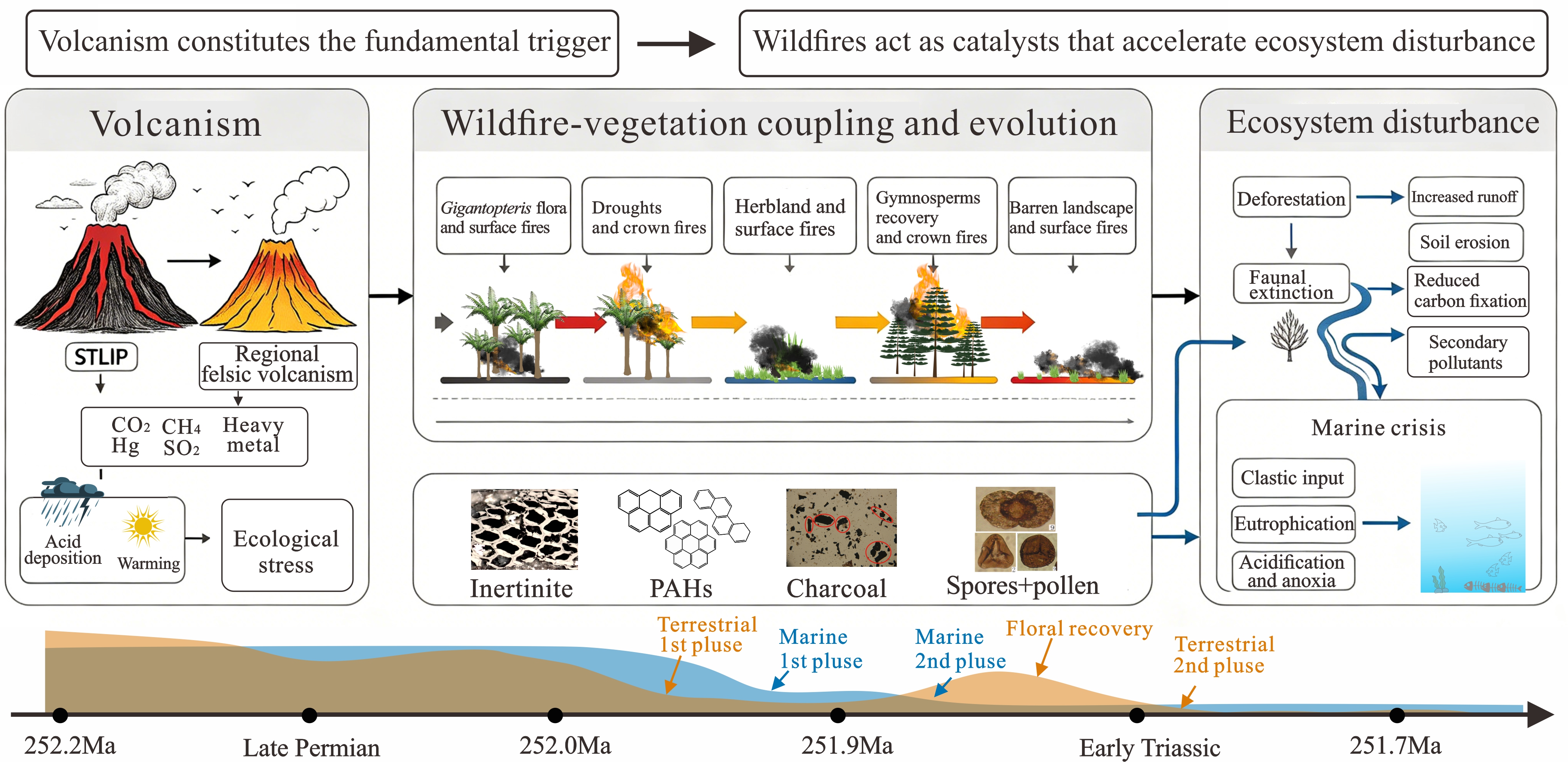
- Multi-stage and long-duration terrestrial ecological disturbance during the Permian–Triassic transition.
- Wildfire played an important role in the terrestrial mass extinction.
- Wildfires destroyed vegetation but were also an agent for renewal and change.
- Open Access
- Review
Terrestrial Ecological Disturbances and Responses to Palaeowildfires at the Permian–Triassic Transition, A Review of Current Research
- Longyi Shao 1,*,
- Fanghui Hua 1,2,*,
- Timothy P. Jones 3,
- Tianchang Zhang 1,
- Xuetian Wang 1,
- Zhiming Yan 4,
- Jing Lu 1,
- Jason Hilton 5
Author Information
Received: 06 Jul 2026 | Revised: 12 Aug 2026 | Accepted: 21 Aug 2026 | Published: 09 Sep 2026
Highlights
Abstract
At the end of the Paleozoic Era, the Earth experienced an extreme ecosystem disturbance event, which was the Permian–Triassic Mass Extinction (PTME); causing an irreversible global catastrophe for animals and plants. Fossil evidence from marine strata correlated by zircon U–Pb dating of volcanic ash supports the view of a rapid and short-lived extinction. In contrast, the associated disturbance processes of terrestrial ecosystems were relatively prolonged and complex, leading different scholars to propose various extinction mechanisms and models for these ecosystem disturbances. Evidence of wildfires in late Permian–Early Triassic transitional strata have been reported globally, and many scholars believe that wildfires during the PTME were a significant contributing factor to terrestrial ecosystem disturbance. Globally, palaeowildfires may have served as an important driver for terrestrial ecosystem disturbance during the Permian–Triassic transition, promoting and accelerating the processes of environmental degradation. Palaeowildfires during the Permian–Triassic transition played a crucial role in the changing of terrestrial ecosystems with potential implications for the evolution of larger ecosystems. This study systematically reviews progress in recent research on the terrestrial PTME and wildfires. It summarizes and considers the mechanisms of terrestrial ecosystem disturbance during the P–T transition and responses to palaeowildfires, considering the palaeoenvironmental background and plant evolution processes.
Graphical Abstract
Keywords
Permian–Triassic Mass Extinction (PTME) | terrestrial ecological disturbance | floral change | palaeowildfire
References
- 1.
Barnosky, A.D.; Matzke, N.; Tomiya, S.; et al. Has the Earth's sixth mass extinction already arrived? Nature 2011, 471, 51–57. https://doi.org/10.1038/nature09678
- 2.
Plumptre, A.J.; Baisero, D.; Belote, R.T.; et al. Where might we find ecologically intact communities? Front. For. Glob. Change 2021, 4, 626635. https://doi.org/10.3389/ffgc.2021.626635
- 3.
Algeo, T.J.; Shen, J. Theory and classification of mass extinction causation. Natl. Sci. Rev. 2024, 11, 237. https://doi.org/10.1093/nsr/nwad237
- 4.
Benton, M.J.; Newell, A.J. Impacts of global warming on Permo-Triassic terrestrial ecosystems. Gondwana Res. 2014, 25, 1308–1337. https://doi.org/10.1016/j.gr.2012.12.010
- 5.
Shen, S.Z.; Crowley, J.L.; Wang, Y.; et al. Calibrating the end-Permian mass extinction. Science 2011, 334, 1367–1372. https://doi.org/10.1126/science.1213454
- 6.
Retallack, G.J. Permian and Triassic greenhouse crises. Gondwana Res. 2013, 24, 90–103. https://doi.org/10.1016/j.gr.2012.03.003
- 7.
Burgess, S.D.; Muirhead, J.D.; Bowring, S.A. Initial pulse of Siberian Traps sills as the trigger of the end-Permian mass extinction. Nat. Commun. 2017, 8, 164. https://doi.org/10.1038/s41467-017-00083-9
- 8.
Wignall, P.B. Large igneous provinces and mass extinctions. Earth-Sci. Rev. 2001, 53, 1–33. https://doi.org/10.1016/S0012-8252(00)00037-4
- 9.
Zhang, H.; Zhang, F.; Chen, J.B.; et al. Felsic volcanism as a factor driving the end-Permian mass extinction. Sci. Adv. 2021, 7, eabh1390. https://doi.org/10.1126/sciadv.abf8142
- 10.
Shen, S.Z.; Ramezani, J.; Chen, J.; et al. A sudden end-Permian mass extinction in south China. Geol. Soc. Am. 2019, 131, 205–223. https://doi.org/10.1130/B31909.1
- 11.
Wignall, P.B.; Chu, D.L.; Hilton, J.M.; et al. Death in the shallows: the record of Permo-Triassic mass extinction in paralic settings, southwest China. Glob. Planet. Change 2020, 189, 103176. https://doi.org/10.1016/j.gloplacha.2020.103176
- 12.
Davydov, V.I.; Karasev, E.V.; Nurgalieva, N.G.; et al. Climate and biotic evolution during the Permian-Triassic transition in the temperate Northern Hemisphere, Kuznetsk Basin, Siberia, Russia. Palaeogeogr. Palaeoclimatol. Palaeoecol. 2021, 573, 110432. https://doi.org/10.1016/j.palaeo.2021.110432
- 13.
Fielding, C.R.; Frank, T.D.; McLoughlin, S.; et al. Age and pattern of the southern high-latitude continental end-Permian extinction constrained by multiproxy analysis. Nat. Commun. 2019, 10, 385. https://doi.org/10.1038/s41467-018-07934-z
- 14.
Wu, Q.; Zhang, H.; Ramezani, J.; et al. The terrestrial end-Permian mass extinction in the paleotropics postdates the marine extinction. Sci. Adv. 2024, 10, 7284. https://doi.org/10.1126/sciadv.adi7284
- 15.
Yang, J.H.; Cawood, P.A.; Condon, D.J.; et al. Anomalous weathering trends indicate accelerated erosion of tropical basaltic landscapes during the Permo-Triassic warming. Earth Planet. Sci. Lett. 2022, 577, 117256. https://doi.org/10.1016/j.epsl.2021.117256
- 16.
Shen, S.Z.; Zhang, F.F.; Wang, W.Q.; et al. Deep-time major biological and climatic events versus global changes: Progresses and challenges. Chin. Sci. Bull. 2023, 69, 268–285. https://doi.org/10.1360/tb-2023-0218
- 17.
Chu, D.L.; Grasby, S.E.; Song, H.J.; et al. Ecological disturbance in tropical peatlands prior to marine Permian-Triassic mass extinction. Geology 2020, 48, 288–292. https://doi.org/10.1130/G46631.1
- 18.
Shen, J.; Yin, R.; Algeo, T.J.; et al. Mercury evidence for combustion of organic-rich sediments during the end-Triassic crisis. Nat. Commun. 2022, 13, 1307. https://doi.org/10.1038/s41467-022-28891-8
- 19.
Hua, F.H.; Shao, L.Y.; Zhang, T.C.; et al. An astronomical timescale for the Permian-Triassic mass extinction reveals a two-step, million-year-long terrestrial crisis in South China. Earth Planet. Sci. Lett. 2023, 605, 118035. https://doi.org/10.1016/j.epsl.2023.118035
- 20.
Ouyang, S. Upper Permian and Lower Triassic palynomorphs from eastern Yunnan, China. Can. J. Earth Sci. 1982, 19, 68–80. https://doi.org/10.1139/e82-006
- 21.
Dal Corso, J.; Song, H.J.; Callegaro, S.; et al. Environmental crises at the Permian–Triassic mass extinction. Nat. Rev. Earth Environ. 2022, 3, 197–214. https://doi.org/10.1038/s43017-021-00259-4
- 22.
Feng, Z.; Wei, H.B.; Guo, Y.; et al. From rainforest to herbland: New insights into land plant responses to the end-Permian mass extinction. Earth-Sci. Rev. 2020, 204, 103153. https://doi.org/10.1016/j.earscirev.2020.103153
- 23.
Huang, Y.F.; He, W.H.; Liao, W.; et al. Two pulses of increasing terrestrial input to marine environment during the Permian–Triassic transition. Palaeogeogr. Palaeoclimatol. Palaeoecol. 2022, 586, 110753. https://doi.org/10.1016/j.palaeo.2021.110753
- 24.
Liu, F.; Peng, H.P.; Bomfleur, B.; et al. Palynology and vegetation dynamics across the Permian–Triassic boundary in southern Tibet. Earth-Sci. Rev. 2020, 209, 103278. https://doi.org/10.1016/j.earscirev.2020.103278
- 25.
Shao, L.Y.; Hua, F.H.; Wang, J.; et al. Palynological dynamics in the late Permian and the Permian–Triassic transition in southwestern China. Palaeogeogr. Palaeoclimatol. Palaeoecol. 2023, 619, 111540. https://doi.org/10.1016/j.palaeo.2023.111540
- 26.
Bowman, D.M.; Balch, J.K.; Artaxo, P.; et al. Fire in the Earth system. Science 2009, 324, 481–484. https://doi.org/10.1007/978-90-481-8716-4_3
- 27.
Chen, Y.; Romps, D.M.; Seeley, J.T.; et al. Future increases in Arctic lightning and fire risk for permafrost carbon. Nat. Clim. Change 2021, 11, 404–410. https://doi.org/10.1038/s41558-021-01011-y
- 28.
He, T.H.; Lamont, B.B. Baptism by fire: the pivotal role of ancient conflagrations in evolution of the Earth's flora. Natl. Sci. Rev. 2018, 5, 237–254. https://doi.org/10.1093/nsr/nwx041
- 29.
Glasspool, I.J.; Scott, A.C.; Waltham, D.; et al. The impact of fire on the late Paleozoic earth system. Front. Plant Sci. 2015, 6, 756. https://doi.org/10.3389/fpls.2015.00756
- 30.
Shao, L.Y.; Wang, H.; Yu, X.H.; et al. Paleo-fires and atmospheric oxygen levels in the latest Permian: evidence from maceral compositions of coals in Eastern Yunnan, Southern China. Acta Geol. Sin. 2012, 86, 949–962. https://doi.org/10.1111/j.1755-6724.2012.00719.x
- 31.
Vajda, V.; McLoughlin, S.; Mays, C.; et al. End-Permian (252 Mya) deforestation, wildfires and flooding—An ancient biotic crisis with lessons for the present. Earth Planet. Sci. Lett. 2020, 529, 115875. https://doi.org/10.1016/j.epsl.2019.115875
- 32.
Scott, A.C. Observations on the nature and origin of fusain. Int. J. Coal Geol. 1989, 12, 443–475. https://doi.org/10.1016/0166-5162(89)90061-X
- 33.
Zhao, J.R.; Zheng, B.; Ciais, P.; et al. Global warming amplifies wildfire health burden and reshapes inequality. Nature 2025, 647, 928–934. https://doi.org/10.1038/s41586-025-09612-9
- 34.
Belcher, C.M.; Mander, L.; Rein, G.; et al. Increased fire activity at the Triassic/Jurassic boundary in Greenland due to climate-driven floral change. Nat. Geosci. 2010, 3, 426–429. https://doi.org/10.1038/ngeo871
- 35.
Shao, L.Y.; Wang, X.T.; Wang, D.D.; et al. Sequence stratigraphy, paleogeography, and coal accumulation regularity of major coal-accumulating periods in China. Int. J. Coal Sci. Technol. 2020, 7, 240–262. https://doi.org/10.1007/s40789-020-00341-0
- 36.
Scott, A.C.; Glasspool, I.J. Charcoal reflectance as a proxy for the emplacement temperature of pyroclastic flow deposits. Geology 2005, 33, 589–592. https://doi.org/10.1130/G21474.1
- 37.
Song, Y.; Tian, Y.; Yu, J.X.; et al. Wildfire response to rapid climate change during the Permian-Triassic biotic crisis. Glob. Planet. Change 2022, 215, 103872. https://doi.org/10.1016/j.gloplacha.2022.103872
- 38.
Baker, S.J. Fossil evidence that increased wildfire activity occurs in tandem with periods of global warming in Earth's past. Earth-Sci. Rev. 2022, 224, 103871. https://doi.org/10.1016/j.earscirev.2021.103871
- 39.
Yan, Z.M.; Shao, L.Y.; Glasspool, I.J.; et al. Frequent and intense fires in the final coals of the Paleozoic indicate elevated atmospheric oxygen levels at the onset of the End-Permian Mass Extinction Event. Int. J. Coal Geol. 2019, 207, 75–83. https://doi.org/10.1016/j.coal.2019.03.016
- 40.
Hua, F.H.; Shao, L.Y.; Wang, X.T.; et al. The impact of frequent wildfires during the Permian–Triassic transition: Floral change and terrestrial crisis in southwestern China. Palaeogeogr. Palaeoclimatol. Palaeoecol. 2024, 641, 112129. https://doi.org/10.1016/j.palaeo.2024.112129
- 41.
Shivanna, M.; Murthy, S.; Gautam, S.; et al. Macroscopic charcoal remains as evidence of wildfire from late Permian Gondwana sediments of India: Further contribution to global fossil charcoal database. Palaeoworld 2017, 26, 638–649. https://doi.org/10.1016/j.palwor.2017.05.003
- 42.
Olivia, H.; Iain, C.P.; Sandy, P.H. Wildfires on a changing planet. Nat. Commun. 2026, 17, 1599. https://doi.org/10.1038/s41467-025-68176-4
- 43.
Cai, Y.F.; Zhang, H.; Cao, C.Q.; et al. Wildfires and deforestation during the Permian–Triassic transition in the southern Junggar Basin, Northwest China. Earth-Sci. Rev. 2021, 218, 103670. https://doi.org/10.1016/j.earscirev.2021.103670
- 44.
Jolly, W.M.; Cochrane, M.A.; Freeborn, P.H.; et al. Climate-induced variations in global wildfire danger from 1979 to 2013. Nat. Commun. 2015, 6, 7537. https://doi.org/10.1038/ncomms8537
- 45.
Kelly, L.T.; Giljohann, K.M.; Duane, A.; et al. Fire and biodiversity in the Anthropocene. Science 2020, 370, 6519. https://doi.org/10.1126/science.abb0355
- 46.
Stanley, S.M. Estimates of the magnitudes of major marine mass extinctions in earth history. Proc. Natl. Acad. Sci. USA 2016, 113, E6325–E6334. https://doi.org/10.1073/pnas.1613094113
- 47.
Sun, Y.D.; Farnsworth, A.; Joachimski, M.M.; et al. Mega El Niño instigated the end-Permian mass extinction. Science 2024, 385, 1189–1195. https://doi.org/10.1126/science.ado2030
- 48.
Bond, D.P.G.; Grasby, S.E. On the causes of mass extinctions. Palaeogeogr. Palaeoclimatol. Palaeoecol. 2017, 478, 3–29. https://doi.org/10.1016/j.palaeo.2016.11.005
- 49.
Cribb, A.T.; Bottjer, D.J. Complex marine bioturbation ecosystem engineering behaviors persisted in the wake of the end-Permian mass extinction. Sci. Rep. 2020, 10, 203. https://doi.org/10.1038/s41598-019-56740-0
- 50.
Fan, J.; Shen, S.Z.; Erwin, D.H.; et al. A high-resolution summary of Cambrian to Early Triassic marine invertebrate biodiversity. Science 2020, 367, 272–277. https://doi.org/10.1126/science.aax495
- 51.
Xiong, C.H.; Wang, J.S.; Huang, P.; et al. Plant resilience and extinctions through the Permian to Middle Triassic on the North China Block: A multilevel diversity analysis of macrofossil records. Earth-Sci. Rev. 2021, 223, 103846. https://doi.org/10.1016/j.earscirev.2021.103846
- 52.
Tong, J.N.; Chen, Z.Q.; Huang, Y.F. Reconstruction of ecosystem and biotic recovery following the end-Permian mass extinction in South China. J. Earth Sci. 2010, 21, 167–169. https://doi.org/10.1007/s12583-010-0201-2
- 53.
Huang, C.J.; Tong, J.N.; Hinnov, L.; et al. Did the great dying of life take 700 k.y.? Evidence from global astronomical correlation of the Permian-Triassic boundary interval. Geology 2011, 39, 779–782. https://doi.org/10.1130/G32126.1
- 54.
Yuan, D.X.; Shen, S.Z.; Henderson, C.M.; et al. Revised conodont-based integrated high-resolution timescale for the Changhsingian Stage and end-Permian extinction interval at the Meishan sections, South China. Lithos 2014, 204, 220–245. https://doi.org/10.1016/j.lithos.2014.03.026
- 55.
Song, H.J.; Wignall, P.B.; Tong, J.N.; et al. Two pulses of extinction during the Permian–Triassic crisis. Nat. Geosci. 2012, 6, 52–56. https://doi.org/10.1038/ngeo1649
- 56.
Zheng, Q.F.; Cao, C.Q.; Zhang, M.Y. Sedimentary features of the Permian-Triassic boundary sequence of the Meishan section in Changxing County, Zhejiang Province. Sci. China Earth Sci. 2013, 56, 956–969. https://doi.org/10.1007/s11430-013-4602-9
- 57.
Xie, S.C.; Pancost, R.D.; Huang, J.H.; et al. Changes in the global carbon cycle occurred as two episodes during the Permian–Triassic crisis. Geology 2007, 35, 1083–1086. https://doi.org/10.1130/G24224A.1
- 58.
Kamo, S.L.; Czamanske, G.K.; Amelin, Y.; et al. Rapid eruption of Siberian flood-volcanic rocks and evidence for coincidence with the Permian–Triassic boundary and mass extinction at 251 Ma. Earth Planet. Sci. Lett. 2003, 214, 75–91. https://doi.org/10.1016/S0012-821X(03)00347-9
- 59.
Grasby, S.E.; Them, T.R.; Chen, Z.; et al. Mercury as a proxy for volcanic emissions in the geologic record. Earth-Sci. Rev. 2019, 196, 102880. https://doi.org/10.1016/j.earscirev.2019.102880
- 60.
Shen, J.; Yu, J.X.; Chen, J.B.; et al. Mercury evidence of intense volcanic effects on land during the Permian-Triassic transition. Geology 2019, 47, 1117–1121. https://doi.org/10.1130/G46679.1
- 61.
Wang, X.D.; Cawood, P.A.; Grasby, S.E.; et al. Characteristics of Hg concentrations and isotopes in terrestrial and marine facies across the end-Permian mass extinction. Glob. Planet. Change 2021, 205, 103592. https://doi.org/10.1016/j.gloplacha.2021.103592
- 62.
He, B.; Zhong, Y.T.; Xu, Y.G.; et al. Triggers of Permo-Triassic boundary mass extinction in South China: The Siberian Traps or Paleo-Tethys ignimbrite flare-up? Lithos 2014, 204, 258–267. https://doi.org/10.1016/j.lithos.2014.05.011
- 63.
Wang, J.; Shao, L.Y.; Wang, H.; et al. SHRIMP zircon U–Pb ages from coal beds across the Permian–Triassic boundary, eastern Yunnan, southwestern China. J. Palaeogeogr. 2018, 7, 117–129. https://doi.org/10.1016/j.jop.2018.01.002
- 64.
Black, B.A.; Lamarque, J.F.; Shields, C.A.; et al. Acid rain and ozone depletion from pulsed Siberian Traps magmatism. Geology 2014, 42, 67–70. https://doi.org/10.1130/G34875.1
- 65.
Benton, M.J. Hyperthermal-driven mass extinctions: killing models during the Permian-Triassic mass extinction. Philos. Trans. A Math. Phys. Eng. Sci. 2018, 376, 2130. https://doi.org/10.1098/rsta.2017.0076
- 66.
Cui, Y.; Bercovici, A.; Yu, J.X.; et al. Carbon cycle perturbation expressed in terrestrial Permian–Triassic boundary sections in South China. Glob. Planet. Change 2017, 148, 272–285. https://doi.org/10.1016/j.gloplacha.2015.10.018
- 67.
Li, M.H.; Frank, T.D.; Xu, Y.L.; et al. Sulfur isotopes link atmospheric sulfate aerosols from the Siberian Traps outgassing to the end-Permian extinction on land. Earth Planet. Sci. Lett. 2022, 592, 117634. https://doi.org/10.1016/j.epsl.2022.117634
- 68.
Wang, H.; Shao, L.Y.; Newton, R.J.; et al. Records of terrestrial sulfur deposition from the latest Permian coals in SW China. Chem. Geol. 2012, 292–293, 18–24. https://doi.org/10.1016/j.chemgeo.2011.11.005
- 69.
Chen, B.; Joachimski, M.M.; Shen, S.Z.; et al. Permian ice volume and palaeoclimate history: Oxygen isotope proxies revisited. Gondwana Res. 2013, 24, 77–89. https://doi.org/10.1016/j.gr.2012.07.007
- 70.
Chen, J.; Shen, S.Z.; Li, X.H.; et al. High-resolution SIMS oxygen isotope analysis on conodont apatite from South China and implications for the end-Permian mass extinction. Palaeogeogr. Palaeoclimatol. Palaeoecol. 2016, 448, 26–38. https://doi.org/10.1016/j.palaeo.2015.11.025
- 71.
Song, H.J.; Song, H.Y.; Tong, J.N.; et al. Conodont calcium isotopic evidence for multiple shelf acidification events during the early Triassic. Chem. Geol. 2021, 562, 120038. https://doi.org/10.1016/j.chemgeo.2020.120038
- 72.
Miao, X.; Chu, D.L.; Tong, J.N.; et al. Biostratigraphic significance and geometric morphometrics of Euestheria gutta (Crustacea, Branchiopoda, Spinicaudata): An index fossil of continental Permian–Triassic transitional beds. Geol. J. 2021, 56, 6176–6188. https://doi.org/10.1002/gj.4096
- 73.
Chu, D.L.; Corso, J.D.; Shu, W.C.; et al. Metal-induced stress in survivor plants following the end-Permian collapse of land ecosystems. Geology 2021, 49, 657–661. https://doi.org/10.1130/G48333.1
- 74.
Liu, F.; Peng, H.; Marshall, J.E.A.; et al. Dying in the Sun: Direct evidence for elevated UV-B radiation at the end-Permian mass extinction. Sci. Adv. 2023, 9, eabo6102. https://doi.org/10.1126/sciadv.abo6102
- 75.
Wu, Y.Y.; Chu, D.L.; Tong, J.N.; et al. Six-fold increase of atmospheric pCO2 during the Permian–Triassic mass extinction. Nat. Commun. 2021, 12, 2137. https://doi.org/10.1038/s41467-021-22298-7
- 76.
Garbelli, C.; Angiolini, L.; Shen, S.Z. Biomineralization and global change: A new perspective for understanding the end-Permian extinction. Geology 2017, 45, 19–22. https://doi.org/10.1130/G38430.1
- 77.
Takahashi, S.; Hori, R.S.; Yamakita, S.; et al. Progressive development of ocean anoxia in the end-Permian pelagic Panthalassa. Glob. Planet. Change 2021, 207, 103650. https://doi.org/10.1016/j.gloplacha.2021.103650
- 78.
Ward, P.D.; Botha, J.; Buick, R.; et al. Abrupt and gradual extinction among Late Permian land vertebrates in the Karoo basin, South Africa. Science 2005, 307, 709–714. https://doi.org/10.1126/science.1107068
- 79.
Viglietti, P.A.; Benson, R.B.J.; Smith, R.M.H.; et al. Evidence from South Africa for a protracted end-Permian extinction on land. Proc. Natl. Acad. Sci. USA 2021, 118, e2017045118. https://doi.org/10.1073/pnas.2017045118
- 80.
Fielding, C.R.; Frank, T.D.; Tevyaw, A.P.; et al. Sedimentology of the continental end-Permian extinction event in the Sydney Basin, eastern Australia. Sedimentology 2020, 68, 30–62. https://doi.org/10.1111/sed.12782
- 81.
Zhang, H.; Cao, C.Q.; Liu, X.L.; et al. The terrestrial end-Permian mass extinction in South China. Palaeogeogr. Palaeoclimatol. Palaeoecol. 2016, 448, 108–124. https://doi.org/10.1016/j.palaeo.2015.07.002
- 82.
Jurikova, H.; Gutjahr, M.; Wallmann, K.; et al. Permian–Triassic mass extinction pulses driven by major marine carbon cycle perturbations. Nat. Geosci. 2020, 13, 745–750. https://doi.org/10.1038/s41561-020-00646-4
- 83.
Berner, R.A. Atmospheric carbon dioxide levels over Phanerozoic time. Science 1990, 249, 1382–1386. https://doi.org/10.1126/science.249.4975.138
- 84.
Newton, R.; Bottrell, S. Stable isotopes of carbon and sulphur as indicators of environmental change, past and present. J. Geol. Soc. 2007, 164, 691–708. https://doi.org/10.1144/0016-76492006-101
- 85.
Payne, J.L.; Lehrmann, D.J.; Wei, J.Y.; et al. Large perturbations of the carbon cycle during recovery from the End-Permian extinction. Science 2004, 305, 506–509. https://doi.org/10.1126/science.1097023
- 86.
Bercovici, A.; Cui, Y.; Forel, M.B.; et al. Terrestrial paleoenvironment characterization across the Permian–Triassic boundary in South China. J. Asian Earth Sci. 2015, 98, 225–246. https://doi.org/10.1016/j.jseaes.2014.11.016
- 87.
Yu, J.X.; Broutin, J.; Chen, Z.Q.; et al. Vegetation changeover across the Permian–Triassic Boundary in Southwest China. Earth-Sci. Rev. 2015, 149, 203–224. https://doi.org/10.1016/j.earscirev.2015.04.005
- 88.
Burgess, S.D.; Bowring, S.A. High-precision geochronology confirms voluminous magmatism before, during, and after Earth's most severe extinction. Sci. Adv. 2015, 1, e1500470. https://doi.org/10.1126/sciadv.1500470
- 89.
Shen, J.; Chen, J.; Algeo, T.J.; et al. Evidence for a prolonged Permian-Triassic extinction interval from global marine mercury records. Nat. Commun. 2019, 10, 1563. https://doi.org/10.1038/s41467-019-09620-0
- 90.
Chen, J.B.; Sun, G.Y.; Lu, B.J.; et al. Inconsistent mercury records from terrestrial upland to coastal lowland across the Permian-Triassic transition. Earth Planet. Sci. Lett. 2023, 614, 118195. https://doi.org/10.1016/j.epsl.2023.118195
- 91.
Wu, Q.; Ramezani, J.; Zhang, H.; et al. High-precision U-Pb age constraints on the Permian floral turnovers, paleoclimate change, and tectonics of the North China block. Geology 2021, 49, 677–681. https://doi.org/10.1130/G48051.1
- 92.
Xiong, C.H.; Wang, Q. Permian–Triassic land-plant diversity in South China: Was there a mass extinction at the Permian/Triassic boundary? Paleobiology 2016, 37, 157–167. https://doi.org/10.1666/09029.1
- 93.
Xu, Z.; Hilton, J.; Yu, J.X.; et al. End Permian to Middle Triassic plant species richness and abundance patterns in South China: Coevolution of plants and the environment through the Permian–Triassic transition. Earth-Sci. Rev. 2022, 232, 104136. https://doi.org/10.1016/j.earscirev.2022.104136
- 94.
Spina, A.; Rettori, G.; Cirilli, S.; et al. Progress of the palynozonation of the middle to late Permian of the Zagros Basin (SW Iran) and Central Iran. Palaeogeogr. Palaeoclimatol. Palaeoecol. 2026, 113982. https://doi.org/10.1016/j.palaeo.2026.113982
- 95.
Rees, P.M. Land-plant diversity and the end-Permian mass extinction. Geology 2015, 30, 827–830. https://doi.org/10.1130/0091-7613(2002)030<0827
- 96.
Peng, Y.; Shi, G.R. Life crises on land across the Permian–Triassic boundary in South China. Glob. Planet. Change 2009, 65, 155–165. https://doi.org/10.1016/j.gloplacha.2008.10.016
- 97.
Spina, A.; Cirilli, S.; Utting, J.; et al. Palynology of the Permian and Triassic of the Tesero and Bulla sections (Western Dolomites, Italy) and consideration about the enigmatic species Reduviasporonites chalastus. Rev. Palaeobot. Palynol. 2015, 218, 3–14. https://doi.org/10.1016/j.revpalbo.2014.10.003
- 98.
Rampino, M.R.; Eshet, Y. The fungal and acritarch events as time markers for the latest Permian mass extinction: An update. Geosci. Front. 2018, 9, 147–154. https://doi.org/10.1016/j.gsf.2017.06.005
- 99.
Hochuli, P.A.; Hermann, E.; Vigran, J.O.; et al. Rapid demise and recovery of plant ecosystems across the end-Permian extinction event. Glob. Planet. Change 2010, 74, 144–155. https://doi.org/10.1016/j.gloplacha.2010.10.004
- 100.
Bourquin, S.; Rossignol, C.; Jolivet, M.; et al. Reply to the comment on "Terrestrial Permian-Triassic boundary in southern China: New stratigraphic, structural and palaeoenvironment considerations" by H. Zhang, Z. Feng, J. Ramezanik, S-Z Shen. Palaeogeogr. Palaeoclimatol. Palaeoecol. 2018, 506, 257–259. https://doi.org/10.1016/j.palaeo.2018.02.021
- 101.
Zhang, H.; Feng, Z.; Ramezani, J.; et al. Comments on "Terrestrial Permian–Triassic boundary in southern China: New stratigraphic, structural and palaeoenvironment considerations" by Bourquin et al. (2018). Palaeogeogr. Palaeoclimatol. Palaeoecol. 2018, 506, 254–256. https://doi.org/10.1016/j.palaeo.2018.02.019
- 102.
Peng, Y.Q.; Yu, J.X.; Gao, Y.Q.; et al. Palynological assemblages of non-marine rocks at the Permian–Triassic boundary, western Guizhou and eastern Yunnan, South China. J. Asian Earth Sci. 2006, 28, 291–305. https://doi.org/10.1016/j.jseaes.2005.10.007
- 103.
DiMichele, W.A.; Bashforth, A.R.; Falcon-Lang, H.J.; et al. Uplands, lowlands, and climate: Taphonomic megabiases and the apparent rise of a xeromorphic, drought-tolerant flora during the Pennsylvanian-Permian transition. Palaeogeogr. Palaeoclimatol. Palaeoecol. 2020, 559, 109965. https://doi.org/10.1016/j.palaeo.2020.109965
- 104.
Nowak, H.; Schneebeli-Hermann, E.; Kustatscher, E. No mass extinction for land plants at the Permian-Triassic transition. Nat. Commun. 2019, 10, 384. https://doi.org/10.1038/s41467-018-07945-w
- 105.
Zhang, P.X.; Yang, M.F.; Lu, J.; et al. End-Permian terrestrial ecosystem collapse in North China: Evidence from palynology and geochemistry. Glob. Planet. Change 2023, 222, 104070. https://doi.org/10.1016/j.gloplacha.2023.104070
- 106.
Ouyang, S.; Hou, J.P. On characteristics of the Cathaysian Palynoflora. Acta Palaeontol. Sin. 1999, 38, 261–283. https://doi.org/10.3969/j.issn.0001-6616.1999.03.001
- 107.
Broutin, J.; Yu, J.X.; Shi, X.; et al. Terrestrial palaeofloral succession across the Permian–Triassic Boundary in the North and South China blocks: a brief review. PalZ 2020, 94, 633–644. https://doi.org/10.1007/s12542-020-00511-0
- 108.
Guo, W.W.; Tong, J.N.; He, Q.; et al. Late Permian–Middle Triassic magnetostratigraphy in North China and its implications for terrestrial-marine correlations. Earth Planet. Sci. Lett. 2022, 585, 117519. https://doi.org/10.1016/j.epsl.2022.117519
- 109.
Nowak, H.; Vérard, C.; Kustatscher, E. Palaeophytogeographical patterns across the Permian–Triassic boundary. Front. Earth Sci. 2020, 8, 613350. https://doi.org/10.3389/feart.2020.613350
- 110.
Li, M.S.; Ogg, J.; Zhang, Y.; et al. Astronomical tuning of the end-Permian extinction and the Early Triassic Epoch of South China and Germany. Earth Planet. Sci. Lett. 2016, 441, 10–25. https://doi.org/10.1016/j.epsl.2016.02.017
- 111.
Su, C.M.; Chen, Z.Q.; Wang, X.; et al. Biotic and palaeoecological variations in the Permian-Triassic boundary microbialite (Xiejiacao, South China): Implication for a two-phase ecological crisis in microbialite ecosystems. Glob. Planet. Change 2021, 207, 103679. https://doi.org/10.1016/j.gloplacha.2021.103679
- 112.
Aftabuzzaman, M.; Kaiho, K.; Biswas, R.K.; et al. End-Permian terrestrial disturbance followed by the complete plant devastation, and the vegetation proto-recovery in the earliest-Triassic recorded in coastal sea sediments. Glob. Planet. Change 2021, 205, 103621. https://doi.org/10.1016/j.gloplacha.2021.103621
- 113.
Wu, J.Q.; Chu, D.L.; Luo, G.M.; et al. Stepwise deforestation during the Permian-Triassic boundary crisis linked to rising temperatures. Earth Planet. Sci. Lett. 2023, 620, 118350. https://doi.org/10.1016/j.epsl.2023.118350
- 114.
Ruprecht, J.K.; Schofield, N.J. Effects of partial deforestation on hydrology and salinity in high salt storage landscapes. II. Strip, soils and parkland clearing. J. Hydrol. 1991, 129, 19–38. https://doi.org/10.1016/0022-1694(91)90042-G
- 115.
Feng, Z.; Wei, H.B.; Ye, R.H.; et al. Latest Permian peltasperm plant from southwest china and its paleoenvironmental implications. Front. Earth Sci. 2020, 8, 559430. https://doi.org/10.3389/feart.2020.559430
- 116.
Schneebeli-Hermann, E.; Hochuli, P.A.; Bucher, H. Palynofloral associations before and after the Permian–Triassic mass extinction, Kap Stosch, East Greenland. Glob. Planet. Change 2017, 155, 178–195. https://doi.org/10.1016/j.gloplacha.2017.06.009
- 117.
Kaiho, K.; Yatsu, S.; Oba, M.; et al. A forest fire and soil erosion event during the Late Devonian mass extinction. Palaeogeogr. Palaeoclimatol. Palaeoecol. 2013, 392, 272–280. https://doi.org/10.1016/j.palaeo.2013.09.008
- 118.
Lee, J.S.; Cornwell, W.K.; Kingsford, R.T. Rainforest bird communities threatened by extreme fire. Glob. Ecol. Conserv. 2022, 33, e01985. https://doi.org/10.1016/j.gecco.2021.e01985
- 119.
Mays, C.; McLoughlin, S. End-Permian Burnout: the role of Permian–Triassic wildfires in extinction, carbon cycling, and environmental change in Eastern Gondwana. Palaios 2022, 37, 292–317. https://doi.org/10.2110/palo.2021.051
- 120.
Cao, C.Q.; Wang, W.; Liu, L.J.; et al. Two episodes of 13C-depletion in organic carbon in the latest Permian: Evidence from the terrestrial sequences in northern Xinjiang, China. Earth Planet. Sci. Lett. 2008, 270, 251–257. https://doi.org/10.1016/j.epsl.2008.03.043
- 121.
Zhou, W.F.; Algeo, T.J.; Luo, G.M.; et al. Hydrocarbon compound evidence in marine successions of South China for frequent wildfires during the Permian-Triassic transition. Glob. Planet. Change 2021, 200, 103472. https://doi.org/10.1016/j.gloplacha.2021.103472
- 122.
Richardson, D.; Black, A.S.; Irving, D.; et al. Global increase in wildfire potential from compound fire weather and drought. npj Clim. Atmos. Sci. 2022, 5, 23. https://doi.org/10.1038/s41612-022-00248-4
- 123.
Jiao, S.L.; Zhang, H.; Cai, Y.F.; et al. Collapse of tropical rainforest ecosystems caused by high-temperature wildfires during the end-Permian mass extinction. Earth Planet. Sci. Lett. 2023, 614, 118193. https://doi.org/10.1016/j.epsl.2023.118193
- 124.
Glasspool, I.J.; Scott, A.C. Phanerozoic concentrations of atmospheric oxygen reconstructed from sedimentary charcoal. Nat. Geosci. 2010, 3, 627–630. https://doi.org/10.1038/ngeo923
- 125.
Wang, Y.; Lu, J.; Yang, M.F.; et al. Volcanism and wildfire associated with deep-time deglaciation during the Artinskian (early Permian). Glob. Planet. Change 2023, 225, 104126. https://doi.org/10.1016/j.gloplacha.2023.104126
- 126.
Krause, A.J.; Mills, B.J.W.; Zhang, S.; et al. Stepwise oxygenation of the Paleozoic atmosphere. Nat. Commun. 2018, 9, 4081. https://doi.org/10.1038/s41467-018-06383-y
- 127.
Nascimento, M.N.; Heijink, B.M.; Bush, M.B.; et al. Early to mid-Holocene human activity exerted gradual influences on Amazonian forest vegetation. Philos. Trans. R. Soc. Lond. B Biol. Sci. 2022, 377, 20200498. https://doi.org/10.1098/rstb.2020.0498
- 128.
Riel, N.; Jaillard, E.; Martelat, J.E.; et al. Permian-Triassic Tethyan realm reorganization: Implications for the outward Pangea margin. J. S. Am. Earth Sci. 2018, 81, 78–86. https://doi.org/10.1016/j.jsames.2017.11.007
- 129.
Feng, X.; Merow, C.; Liu, Z.; et al. How deregulation, drought and increasing fire impact Amazonian biodiversity. Nature 2021, 597, 516–521. https://doi.org/10.1038/s41586-021-03876-7
- 130.
Staver, A.C.; Archibald, S.; Levin, S.A. The global extent and determinants of Savanna and Forest as alternative biome states. Science 2011, 334, 230–232. https://doi.org/10.1126/science.1210465
- 131.
Clarke, P.J.; Prior, L.D.; French, B.J.; et al. Using a rainforest-flame forest mosaic to test the hypothesis that leaf and litter fuel flammability is under natural selection. Oecologia 2014, 176, 1123–1133. https://doi.org/10.1007/s00442-014-3071-y
- 132.
Cochrane, M.A. Fire science for rainforests. Nature 2022, 421, 913–919. https://doi.org/10.1038/nature01437
- 133.
Li, S.H.; Ethan, L.G.; Zhang, S.; et al. Erosion-driven delayed warming and marine stress prior to the end-Permian mass extinction. Nat. Commun. 2026, 17, 5456. https://doi.org/10.1038/s41467-026-74636-2
- 134.
Wang, W.Q.; Garbelli, C.; Zhang, F.F.; et al. A high-resolution Middle to Late Permian paleotemperature curve reconstructed using oxygen isotopes of well-preserved brachiopod shells. Earth Planet. Sci. Lett. 2020, 540, 116245. https://doi.org/10.1016/j.epsl.2020.116245
- 135.
Cui, Y.; Li, M.; Van Soelen, E.E.; et al. Massive and rapid predominantly volcanic CO2 emission during the end-Permian mass extinction. Proc. Natl. Acad. Sci. USA 2021, 118, e2014701118. https://doi.org/10.1073/pnas.2014701118
- 136.
Wu, Y.Y.; Cui, Y.; Chu, D.L.; et al. Volcanic CO2 degassing postdates thermogenic carbon emission during the end-Permian mass extinction. Sci. Adv. 2023, 9, eabq4082. https://doi.org/10.1126/sciadv.abq4082
- 137.
Cai, Y.F.; Zhang, H.; Feng, Z.; et al. Intensive wildfire associated with volcanism promoted the vegetation changeover in Southwest China during the Permian–Triassic transition. Front. Earth Sci. 2021, 9, 615841. https://doi.org/10.3389/feart.2021.615841

How to Cite
Shao, L., Hua, F., Jones, T. P., Zhang, T., Wang, X., Yan, Z., Lu, J., & Hilton, J. (2026). Terrestrial Ecological Disturbances and Responses to Palaeowildfires at the Permian–Triassic Transition, A Review of Current Research. Habitable Planet, 2(2), 448–467. https://doi.org/10.63335/j.hp.2026.0048
RIS
BibTex
Copyright & License

Copyright (c) 2026 by the authors.
This work is licensed under a Creative Commons Attribution 4.0 International License.
Article Metrics
124
Article Views
0
Citations
Contents
References

 Suite 4002 Level 4, 447 Collins Street, Melbourne, Victoria 3000, Australia
 General Inquiries: info@sciltp.com