
- The Lower Wetwun black shales are gold source rocks (up to 1.1 ppm Au).
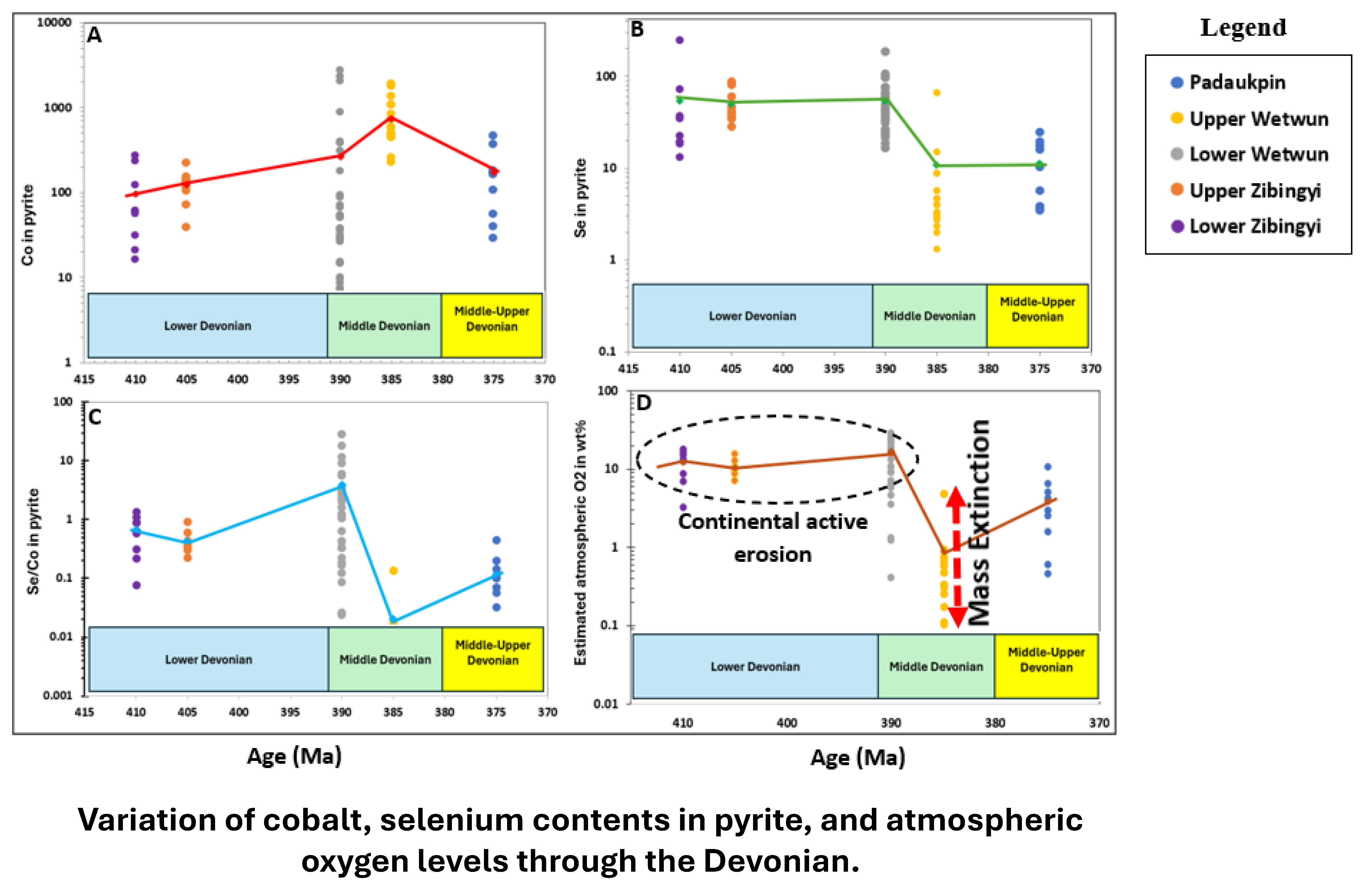
- Elevated gold content corresponds to a peak in oxygen content (up to 28.7 wt% O2).
- Zircon age peaks range between 400 Ma and 2500 Ma.
- Discernible connection with Gondwana is likely.
- Open Access
- Article
Geochemical and Age Constraints on Devonian Black Shales and Limestones in Myanmar: Insights into Gold Source Rocks
Author Information
Received: 23 Jun 2026 | Revised: 09 Aug 2026 | Accepted: 23 Sep 2026 | Published: 29 Sep 2026
Highlights
Abstract
Pyrite trace element chemistry, lithogeochemistry, and U–Pb dating of detrital zircon were carried out on the Devonian black shales and limestones, Northern Shan State, Myanmar. The findings indicate that the Upper to Middle Devonian Padaukpin Formation is enriched in CaO and show a similar content in SiO₂, TiO₂, Al₂O₃, Fe₂O₃, and K₂O compared to Post-Archean Australian Shale (PAAS). The Middle Devonian Wetwun Formation is depleted in SiO₂, TiO₂, Al₂O₃, Fe₂O₃, and K₂O but enriched in CaO relative to PAAS. The Lower Devonian Zebingyi Formation is enriched in CaO and strongly depleted in SiO₂, TiO₂, Al₂O₃, Fe₂O₃, and K₂O compared to PAAS. Total organic carbon (TOC) remains high in the Lower Devonian between 5% and 9.7% (mean = 8%) but drops in the Middle Devonian to value of 2.5% to 3.2% (mean = 2.9%), only to rise again in the Middle to Upper Devonian to 9.7%. Using trace element (TE) and TOC%, the contents of trace elements Mo, As, Zn, Cu, V, and Ni are inversely proportional to the TOC content in the Upper and Middle Devonian. Pyrite trace element chemistry shows that the beginning of the Middle Devonian, in the Lower Wetwun black shale, is marked by elevated levels of the gold (up to 1.1 ppm Au), which corresponding to a peak in oxygen content in the atmosphere (up to 28.7 wt% O₂) in oxic to anoxic redox conditions. The evidence suggests that the Wetwun shales are likely gold source rocks. The research outcome indicates a limited dataset of age dating pointing to three maximum depositional ages of 399, 480, and 537 Ma. There are a few zircon age peaks ranging from over 400 Ma up to 2500 Ma, suggesting a discernible connection with Gondwana; however, further work is required to confirm this relationship.
Graphical Abstract
References
- 1.
La Touche, T.H.D. Geology of the Northern Shan States; Part 2 of Memoirs of the Geological Survey of India; Office of the Geological Survey: Kolkata, India, 1913; Volume 39, 379p.
- 2.
Chhibber, H.L. The Geology of Burma; Macmillan & Co., Ltd: London, UK, 1934; p. 538.
- 3.
Khaing, K.S.; Ko, K.G. The Black Shale Unit in the Maymyo Formation, Pyin Oo Lwin Township. Universities Res. J. 2011, 4, 101–116.
- 4.
Aye, K.A. The Palaeozoic stratigraphy of Shan Plateau, Myanmar – An Updated Version. J. Myanmar Geosci. Soc. 2012, 5, 1–73.
- 5.
Khin, Z.; Meffre, S.; Lai, C.-K.; et al. Tectonics and metallogeny of mainland SE Asia – A review and contribution. Special Issue on Tectonics and Metallogeny of Mainland SE Asia. Gondwana Res. 2014, 26, 5–30. https://doi.org/10.1016/j.gr.2013.10.010
- 6.
Aye, K.A.; Cocks, L.R.M. Cambrian–Devonian stratigraphy of the Shan Plateau, Myanmar (Burma). In Myanmar: Geology, Resources and Tectonics; Barber, A.J., Khin, Z., Crow, M.J., Eds.; Memoirs, 48; Geological Society: London, UK, 2017; pp. 317–342. https://doi.org/10.1144/M48.14
- 7.
Khin, Z. Overview of mineralization styles, tectonic, and metallogenic setting in Myanmar. In Myanmar: Geology, Resources and Tectonics; Barber, A.J., Khin, Z., Crow, M.J., Eds.; Memoirs, 48; Geological Society: London, UK, 2017; pp. 531–556. https://doi.org/10.1144/M48.24
- 8.
Metcalfe, I. Paleozoic and Mesozoic tectonic evolution and palaeogeography of East Asian crustal fragments: The Korean Peninsula in context. Gondwana Res. 2006, 9, 24–26. https://doi.org/10.1016/J.GR.2005.04.002
- 9.
Burrett, C.; Khin, Z.; Meffre, S.; et al. The configuration of Greater Gondwana – Evidence from LA ICPMS, U‑Pb geochronology of detrital zircons from the Palaeozoic and Mesozoic of Southeast Asia and China. Gondwana Res. 2014, 26, 31–51. https://doi.org/10.1016/j.gr.2013.05.020
- 10.
Cromie, P.; Makoundi, C.; Khin, Z.; et al. Geochemistry of Au‑bearing pyrite from the sepon mineral district, Laos DPR, Southeast Asia: Implications for ore genesis. J. Asian Earth Sci. 2018, 164, 194–218. https://doi.org/10.1016/j.jseaes.2018.06.014
- 11.
Makoundi, C.; Endut, Z.; Large, R.R.; et al. Geochemistry of pyritic mudstones from the Singa Formation, Malaysia: Insights into gold potential, source of sulfur and organic matter. Geosciences 2021, 11, 279. https://doi.org/10.3390/geosciences11070279
- 12.
Khaing, K.S. Middle Devonian Rugose Corals of the Padaukpin Limestone, Pyin Oo Lwin Township, Mandalay Division. Unpublished Ph.D. Thesis, University of Mandalay, 2005; p. 282.
- 13.
Metcalfe, I. Stratigraphy, palaeontology, and palaeogeography of the Carboniferous of Southeast Asia. Mém. Soc. Géol. Fr. 1984, 147, 107–118.
- 14.
Metcalfe, I. Pre‑Cretaceous evolution of SE Asian terranes. Geol. Soc. Spec. Publ. 1996, 106, 97–122. https://doi.org/10.1144/GSL.SP.1996.106.01.09
- 15.
Ridd, M.F. Geological history of the Sibumasu Block in Peninsular Thailand: Report of a Geologists’ Association Field Meeting in 2007. Proc. Geol. Assoc. 2009, 120, 163–174. https://doi.org/10.1016/j.pgeola.2009.09.002
- 16.
Ridd, M.F. The Phuket Terrane: A Late Palaeozoic rift at the margin of Sibumasu. J. Asian Earth Sci. 2009, 36, 238–251. https://doi.org/10.1016/j.jseaes.2009.06.006
- 17.
Bunopas, S. Palaeogeographic History of Western Thailand and Adjacent Parts of Southeast Asia: A Plate Tectonic Interpretation; Geological Survey Special Paper, Issue, 5; Department of Mineral Resources: Bangkok, Thailand, 1982.
- 18.
Ferrari, O.M.; Hochard, C.; Stampfli, G.M. An alternative plate tectonic model for the Palaeozoic–Early Mesozoic Palaeotethyan evolution of Southeast Asia (Northern Thailand–Burma). Tectonophysics 2008, 451, 346–365. https://doi.org/10.1016/j.tecto.2007.11.065
- 19.
Ueno, K. The Permian fusulinoidean faunas of the Sibumasu and Baoshan blocks: Their implications for the palaeogeographic and palaeoclimatologic reconstruction of the Cimmerian Continent. Palaeogeogr. Palaeoclimatol. Palaeoecol. 2003, 193, 1–24. https://doi.org/10.1016/S0031‑0182(02)00708‑3
- 20.
Sevastjanova, I.; Clements, B.; Hall, R.; et al. Granitic magmatism, basement ages, and provenance indicators in the Malay Peninsula: Insights from detrital zircon U–Pb and Hf‑isotope data. Gondwana Res. 2011, 19, 1024–1039. https://doi.org/10.1016/j.gr.2010.10.010
- 21.
Hall, R.; Sevastjanova, I. Australian crust in Indonesia. Aust. J. Earth Sci. 2012, 59, 827–844. https://doi.org/10.1080/08120099.2012.692335
- 22.
Bender, F. Geology of Burma. In Beiträge zur Regionalen Geologie der Erde, Band 16; Bannert, D., Ed.; Gebr. Borntraeger: Berlin, Germany, 1983; Volume VIII, p. 293.
- 23.
Tin, A.M.; Mi, M.K. Origin of iron ore deposits in Maymyo Formation exposed around Baw village, Pyinoolwin Township, Mandalay Region, Myanmar. J. Myanmar Acad. Arts Sci. 2020, xviii, 137–148.
- 24.
Aye, K.A.; Kyaw, M. Stratigraphy of the Lower Devonian sediments in the northwestern Shan Plateau, Myanmar. Bull. Geol. Soc. Malays. 2011, 57, 55–67. https://doi.org/10.7186/bgsm57201108
- 25.
Sack, P.J.; Berry, R.F.; Meffre, S.; et al. In situ location and U‑Pb dating of small zircon grains in igneous rocks using laser ablation‑inductively coupled plasma‑quadrupole mass spectrometry. Geochem. Geophys. Geosyst. 2011, 12, Q0AA1.4. https://doi.org/10.1029/2010GC003405
- 26.
Satyabala, S.P. Subduction in the Indo‑Burman region: Is it still active? Geophys. Res. Lett. 1998, 16, 3189–3192. https://doi.org/10.1029/98GL02256
- 27.
Meffre, S.; Large, R.R.; Scott, R.; et al. Age and pyrite Pb‑isotopic composition of the giant Sukhoi Log sediment‑hosted gold deposit, Russia. Geochim. Cosmochim. Acta 2008, 72, 2377–2391. https://doi.org/10.1016/j.gca.2008.03.005
- 28.
Black, L.P.; Kamos, L.; Allen, C.M.; et al. TEMORA 1: A new zircon standard for Phanerozoic U–Pb geochronology. Chem. Geol. 2003, 200, 155–170. https://doi.org/10.1016/S0009‑2541(03)00165‑7
- 29.
Baker, J.; Peate, D.; Waight, T.; et al. Pb isotopic analysis of standards and samples using a Pb‑207‑Pb‑204 double spike and thallium to correct for mass bias with a double‑focusing MC‑ICP‑MS. Chem. Geol. 2004, 217, 275–303. https://doi.org/10.1016/j.chemgeo.2004.06.030
- 30.
Hatch, J.R.; Leventhal, J.S. Relationship between inferred redox potential of the deposition environment and geochemistry of the Upper Pennsylvanian (Missourian) Stank Shale Member of the Dennis Limestone, Wabaunsee County, Kansas, U.S.A. Chem. Geol. 1992, 99, 65–82. https://doi.org/10.1016/0009‑2541(92)90031‑Y
- 31.
Jones, B.; Manning, D.A.C. Comparison of geochemical indices used for the interpretation of palaeoredox conditions in ancient mudstones. Chem. Geol. 1994, 111, 111–129. https://doi.org/10.1016/0009‑2541(94)90085‑X
- 32.
Danyushevsky, L.V.; Robinson, P.; Gilbert, S.; et al. Routine quantitative multi‑element analysis of sulfide minerals by laser ablation ICP‑MS: Standard development and consideration of matrix effects. Geochem.: Explor. Environ. Anal. 2011, 11, 51–60. https://doi.org/10.1144/1467‑7873/09‑244
- 33.
Hoskin, P.W.O.; Schaltegger, U. The composition of zircon and igneous and metamorphic petrogenesis, In Zircon Review in Mineralogy and Geochemistry; Hanchar, J.M.; Hoskin, P.W.O., Eds.; Mineralogical Society of America: Chantilly, VA, 2003; Volume 53, pp. 27–62. https://doi.org/10.2113/0530027
- 34.
Rubatto, D. Zircon trace element geochemistry: Partitioning with garnet and the growth of metamorphic zircon overgrowths. Chem. Geol. 2002, 184, 123–138. https://doi.org/10.1016/S0009‑2541(01)00355‑2
- 35.
Taylor, S.R.; McLennan, S.M. The Continental Crust: Its Composition and Evolution; Blackwell: Oxford, UK, 1985; p. 312.
- 36.
Large, R.R.; Mukhin, P.; Gregory, D.; et al. Ocean and atmosphere geochemical proxies derived from trace elements in marine pyrite: Implications for ore genesis in sedimentary basins. Econ. Geol. 2017, 112, 423–450. https://doi.org/10.2113/econgeo.112.2.423
- 37.
Belousova, E.; Griffin, W.; O’Reilly, S.Y.; et al. Igneous zircon: Trace element composition as an indicator of source rock type. Contrib. Mineral. Petrol. 2002, 143, 602–622. https://doi.org/10.1007/s00410‑002‑0364‑7
- 38.
Yakymchuk, C.; Kirkland, C.L.; Clark, C. Th/U ratios in metamorphic zircon. J. Metamorph. Geol. 2018, 36, 715–737. https://doi.org/10.1111/jmg.12307
- 39.
Ridd, M.F. Should Sibumasu be renamed Sibuma? The case for a discrete Gondwana‑derived block embracing western Myanmar, upper Peninsular Thailand, and NE Sumatra. J. Geol. Soc. 2016, 173, 249–264. https://doi.org/10.1144/jgs2015‑065
- 40.
Wang, J.; Mi, Y.; Ma, X.; et al. Stratigraphic correlation of the Givetian (late Middle Devonian) deposits in Qujing, Yunnan, southwestern China and the paleogeographic implications. Turk. J. Earth Sci. 2022, 31, 3. https://journals.tubitak.gov.tr/earth/vol31/iss3/9/
- 41.
Rimmer, S.M. Geochemical paleoredox indicators in Devonian‑Mississippian black shale, Central Appalachian Basin (USA). Chem. Geol. 2004, 206, 373–391. https://doi.org/10.1016/j.chemgeo.2003.12.029
- 42.
Riquier, L.; Tribovillard, N.; Averbuch, O.; et al. Productivity and bottom water redox conditions at the Frasnian–Famennian boundary on both sides of the Eovariscan Belt constraints from trace element geochemistry. In Understanding Late Devonian and Permian–Triassic Biotic and Climatic Events: Towards an Integrated Approach: Developments in Palaeontology and Stratigraphy; Over, D.J., Morrow, J.R., Wignall, P.B., Eds.; Elsevier: Amsterdam, Netherlands, 2005; Volume 20, pp. 199–224. https://doi.org/10.1016/S0920‑5446(05)80008‑1
- 43.
Tribovillard, N.; Algeo, T.J.; Lyons, T.; et al. Trace metals as Paleoredox and paleoproductivity proxies: An update. Chem. Geol. 2006, 232, 12–32. https://doi.org/10.1016/j.chemgeo.2006.02.012
- 44.
Wilkin, R.T.; Barnes, H.L.; Brantley, S.L. The size distribution of framboidal pyrite in modern sediments: An indicator of redox conditions. Geochim. Cosmochim. Acta 1996, 60, 3897–3912. https://doi.org/10.1016/0016‑7037(96)00209‑8
- 45.
Cannell, A.; Blamey, N.; Brand, U.; et al. A revised sedimentary pyrite proxy for atmospheric oxygen in the Paleozoic: Evaluation for the Silurian‑Devonian‑Carboniferous period and the relationship of the results to the observed biosphere record. Earth‑Sci. Rev. 2022, 231, 104062. https://doi.org/10.1016/j.earscirev.2022.104062
- 46.
Large, R.R.; Halpin, J.A.; Lounejeva, E.; et al. Cycles of nutrient trace elements in Phanerozoic Ocean. Gondwana Res. 2015, 28, 1282–1293. https://doi.org/10.1016/j.gr.2015.06.004
- 47.
Steadman, J.A.; Large, R.R.; Blamey, N.J.; et al. Evidence for elevated and variable atmospheric oxygen in the Precambrian. Precambrian Res. 2020, 343, 105722. https://doi.org/10.1016/j.precamres.2020.105722
- 48.
McGhee, G.R.; Grzegorz, R. Extinction: Late Devonian mass extinction. In Encyclopedia of Life Sciences (eLS); Wiley: Chichester, UK, 2021; Volume 2, pp. 1–8. https://doi.org/10.1002/9780470015902.a0029301
- 49.
Pašava, J.; Sulovsky, P.; Kovalova, M. Geochemistry and mineralogy of Proterozoic metal‑rich black shales from the Bohemian massif Czech Republic with a description of possible new Molybdenum selenide and Telluride phases. Can. Mineral. 1993, 31, 745–754.
- 50.
Gregory, D.; Large, R.R.; Halpin, J.A.; et al. Trace elements content in sedimentary pyrite in black shales. Econ. Geol. 2015, 110, 1389–1410. https://doi.org/10.2113/econgeo.110.6.1389
How to Cite
Makoundi, C., Sheppard, J., Zaw, K., Myint, T. A., & Win, N. (2026). Geochemical and Age Constraints on Devonian Black Shales and Limestones in Myanmar: Insights into Gold Source Rocks. Habitable Planet, 2(2), 468–489. https://doi.org/10.63335/j.hp.2026.0049
RIS
BibTex
Copyright & License

Copyright (c) 2026 by the authors.
This work is licensed under a Creative Commons Attribution 4.0 International License.
Article Metrics
89
Article Views
0
Citations
Contents
References

 Suite 4002 Level 4, 447 Collins Street, Melbourne, Victoria 3000, Australia
 General Inquiries: info@sciltp.com