
- Plume–LIP dynamics can influence both proximal and distal mineral systems.
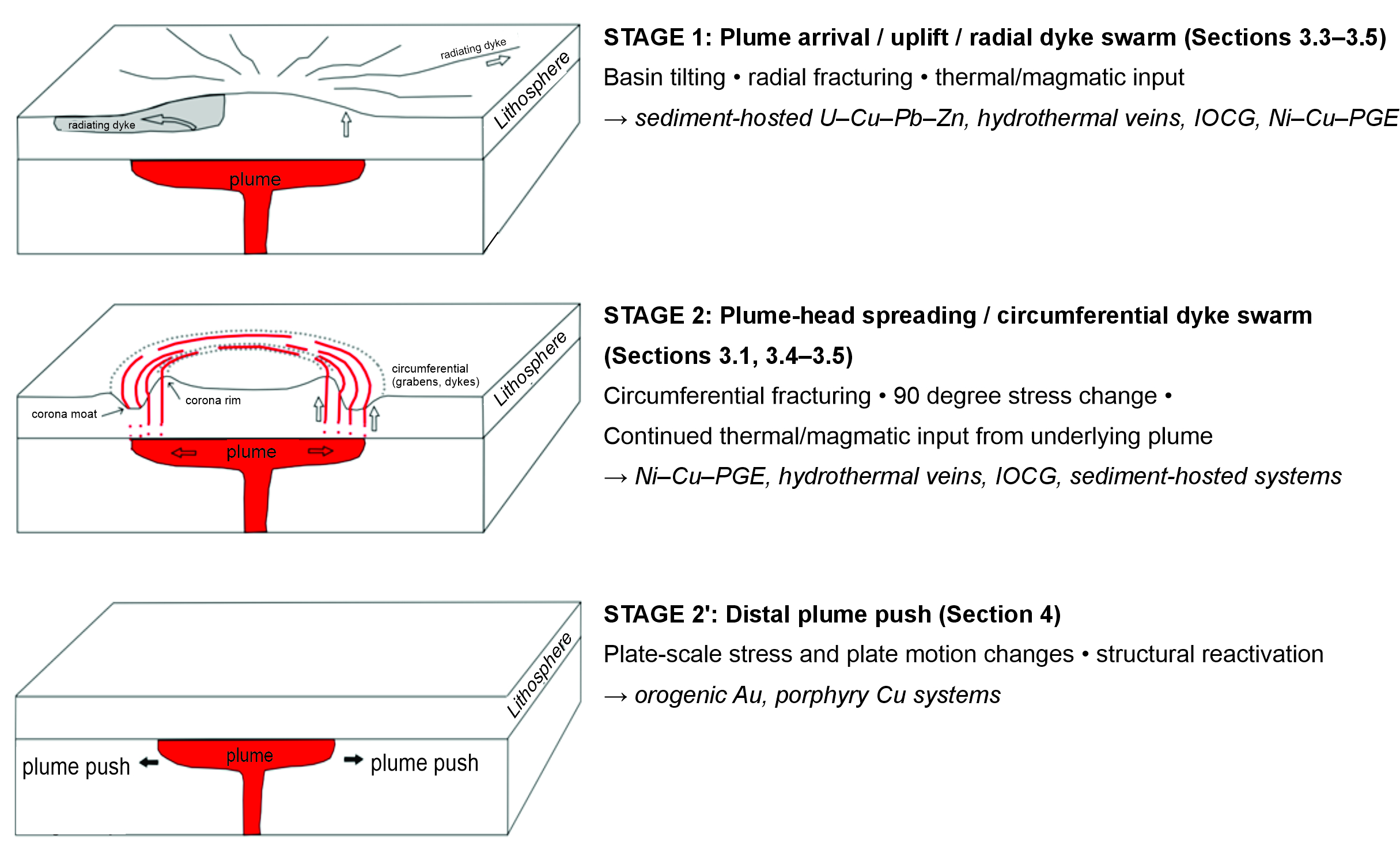
- Proximal effects include stress change, basin tilting, fracture (radial and circumferential) development and thermal–magmatic input.
- These processes may affect magmatic sulphides, IOCG, and uranium and other sediment-hosted systems.
- Distal plume push can change plate-scale stress and motion, influencing orogenic gold and porphyry systems.
- Plume geometry and timing provide new predictive criteria for regional mineral exploration.
- Open Access
- Article
Mantle Plume Dynamics: A Key Driver of Proximal and Distal Metallogeny
Author Information
Received: 12 August 2026 | Revised: 01 September 2026 | Accepted: 01 October 2026 | Published: 16 October 2026
Highlights
Abstract
Mantle plume-generated Large Igneous Provinces (LIPs) are well known for their genetic association with magmatic sulphide Ni–Cu–PGE deposits, exemplified by Norilsk in the Siberian Traps. Previous work has broadened genetic these links between LIP events and metallogeny to include other orthomagmatic and hydrothermal deposits, lateritic enrichment, fluid-flow barriers and reactive zones that enable the formation of mineral deposits, and distal mineral systems indirectly influenced through plate tectonics. Here, we further examine how plume-related stress and topographic changes affect metallogenesis. These drivers include those directly above plume heads where key processes include: (1) rapid ∼90° stress transitions from domal uplift to lateral spreading, facilitating emplacement of chonolith-hosted magmatic sulphide systems; (2) regional uplift influencing hydrothermal vein orientations; (3) basin tilting that redirects mineralized brines and promotes sedimenthosted mineralization; and (4) localized ascent of plume material through thick lithosphere, supplying heat and fluids for crustal mineralization. Distally, lateral plume-head spreading and pushing against adjacent cratonic roots may reorganize regional stresses, alter plate motions, and enhance convergence-related mineralization, including orogenic gold and porphyry systems along remote plate margins. These dynamic plume processes expand the metallogenic significance of LIPs and strengthen their use as predictive tools in regional mineral exploration, whereby a single plume-generated LIP event may generate or trigger diverse mineral systems.
Graphical Abstract
Keywords
Large Igneous Province | mantle plume | sediment-hosted ore deposits | magmatic sulphides | orogenic gold | porphyry systems
References
Coffin, M.F.; Eldholm, O. Large igneous provinces: Crustal structure, dimensions, and external consequences. Rev. Geophys. 1994, 32, 1–36. https://doi.org/10.1029/93RG02508
Coffin, M.F.; Eldholm, O. Large igneous provinces. In Encyclopedia of Geology; Selley, R.C., Cocks, R., Plimer, I.R., Eds.; Elsevier: Oxford, UK, 2005; pp. 315–323. https://doi.org/10.1016/b0-12-369396-9/00455-x
Bryan, S.E.; Ernst, R.E. Revised definition of Large Igneous Provinces (LIPs). Earth-Sci. Rev. 2008, 86, 175–202. https://doi.org/10.1016/j.earscirev.2007.08.008
Bryan, S.E.; Ferrari, L. Large igneous provinces and silicic large igneous provinces: Progress in our understanding over the last 25 years. Geol. Soc. Am. Bull. 2013, 125, 1053–1078. https://doi.org/10.1130/b30820.1
Ernst, R.E. Large Igneous Provinces; Cambridge University Press: Cambridge, UK, 2014; p. 653. https://doi.org/10.1017/CBO9781139025300
Ernst, R.E.; Liikane, D.A.; Jowitt, S.M.; et al. A new plumbing system framework for mantle plume-related continental large igneous provinces and their mafic-ultramafic intrusions. J. Volcanol. Geotherm. Res. 2019, 384, 75–84. https://doi.org/10.1016/j.jvolgeores.2019.07.007
Ernst, R.E.; Bond, D.P.G.; Zhang, S.-H.; et al. Large Igneous Province record through time and implications for secular environmental changes and geological time-scale boundaries. In Large Igneous Provinces: A Driver of Global Environmental and Biotic Changes; Ernst, R.E., Dickson, A.J., Bekker, A., Eds.; Geophysical Monograph 255; American Geophysical Union (AGU) / John Wiley & Sons, Inc.: Washington, DC, USA, 2021; pp. 3–26. https://doi.org/10.1002/9781119507444.ch1
Pandey, R.; Pandey, A.; Krmček, L.; et al. (Eds.) Alkaline Rocks: Economic and Geodynamic Significance through Geological Time; Geological Society, London; Special Publications, 551; The Geological Society of London: London, UK, 2021; p. 416.
Reis, N.J.; Teixeira, W.; D’Agrella-Filho, M.S.; et al. Large igneous provinces of the Amazonian Craton and their metallogenic potential in Proterozoic times. In Large Igneous Provinces and Their Plumbing Systems; Srivastava, R.K., Ernst, R.E., Buchan, K.L., et al., Eds.; Geological Society of London Special Publication, 518; The Geological Society of London: London, UK, 2021; pp. 493–529.
Ernst, R.E.; El Bilali, H.; Buchan, K.L.; et al. Record of Archean and earliest Proterozoic Large Igneous Provinces (LIPs) and their mafic dyke swarms (Chapter 3.7). In The Archean Earth, 2nd ed.; Homann, M., Lyons, T.W., Ernst, R.E., et al., Eds.; Elsevier: Amsterdam, The Netherlands, 2026; pp. 257–282.
Ernst, R.E.; Bleeker, W. Large igneous provinces (LIPs), giant dyke swarms, and mantle plumes: Significance for breakup events within Canada and adjacent regions from 2.5 Ga to present. Can. J. Earth Sci. 2010, 47, 695–739. https://doi.org/10.1139/e10-025
Ernst, R.E.; Jowitt, S.M. Large Igneous Provinces (LIPs) and metallogeny. In Tectonics, Metallogeny, and Discovery: The North American Cordillera and Similar Accretionary Settings; Colpron, M., Bissig, T., Rusk, B.G., et al., Eds.; Society of Economic Geologists; Special Publication 17; Society of Economic Geologists (SEG): Littleton, CO, USA, 2013; pp. 17–51.
Ernst, R.E.; Jowitt, S.M. Multi-commodity, multi-scale exploration targeting using the Large Igneous Province record. In TARGET 2017, Perth, Australia: Abstracts; Wyche, S., Witt, W.K., Eds.; Geological Survey of Western Australia Record 2017/6; Geological Survey of Western Australia: Perth, WA, Australia, 2017; pp. 41–44.
Eldrett, J.S.; Minisini, D.; Bergman, S.C. Decoupling of the carbon cycle during Ocean Anoxic Event 2. Geology 2014, 42, 567–570. https://doi.org/10.1130/G35520.1
Mark, N.J.; Schofield, N.; Pugliese, S.; et al. Igneous intrusions in the Faroe Shetland Basin and their implications for hydrocarbon exploration: New insights from well and seismic data. Mar. Pet. Geol. 2018, 92, 733–753. https://doi.org/10.1016/j.marpetgeo.2017.12.005
Ernst, R.E.; Youbi, N. How Large Igneous Provinces affect global climate, sometimes cause mass extinctions, and represent natural markers in the geological record. Palaeogeogr. Palaeoclimatol. Palaeoecol. 2017, 478, 30–52. https://doi.org/10.1016/j.palaeo.2017.03.014
Black, B.A.; Karlstrom, L.; Mather, T.A. The life cycle of large igneous provinces. Nat. Rev. Earth Environ. 2021, 2, 840–857. https://doi.org/10.1038/s43017-021-00221-4
Deegan, F.M.; Callegaro, S.; Davies, J.H.F.L.; et al. Driving global change one LIP at a time. Elements 2023, 19, 269–275. https://doi.org/10.2138/gselements.19.5.269
Pirajno, F.; Santosh, M. Mantle plumes, supercontinents, intracontinental rifting and mineral systems. Precambrian Res. 2015, 259, 243–261. https://doi.org/10.1016/j.precamres.2014.12.016
Liu, Z.; Wen, J.; Zhao, W.; et al. Research progress and prospect of Emeishan mantle plume metallogenic system. Front. Earth Sci. 2025, 13, 1511877. https://doi.org/10.3389/feart.2025.1511877
White, R.; McKenzie, D. Magmatism at rift zones: The generation of volcanic continental margins and flood basalts. J. Geophys. Res. 1989, 94, 7685–7729. https://doi.org/10.1029/JB094iB06p07685
Courtillot, V.; Davaille, A.; Besse, J.; et al. Three distinct types of hotspots in the Earth’s mantle. Earth Planet. Sci. Lett. 2003, 205, 295–308. https://doi.org/10.1016/s0012-821x(02)01048-8
Foulger, G.R. The “plate” model for the genesis of melting anomalies. In Plates, Plumes, and Planetary Processes; Foulger, G.R., Jurdy, D.M., Eds.; Geological Society of America Special Paper, 430; Geological Society of America: Boulder, CO, USA, 2007; pp. 1–28.
Foulger, G.R. Are “hot spots” hot spots? J. Geodyn. 2012, 58, 1–28. https://doi.org/10.1016/j.jog.2011.12.003
Koppers, A.A.P.; Becker, T.W.; Jackson, M.G.; et al. Mantle plumes and their role in Earth processes. Nat. Rev. Earth Environ. 2021, 2, 382–401. https://doi.org/10.1038/s43017-021-00168-6
Halls, H.C., Fahrig, W.F.; (Eds.) Mafic Dyke Swarms; Geological Association of Canada Special Paper, 34; Geological Association of Canada: St. John’s, NL, Canada, 1987; p. 503.
Buchan, K.L.; Ernst, R.E. Plumbing systems of large igneous provinces (LIPs) on Earth and Venus: Investigating the role of giant circumferential and radiating dyke swarms, coronae and novae, and mid-crustal intrusive complexes. Gondwana Res. 2021, 100, 25–43. https://doi.org/10.1016/j.gr.2021.02.014
El Bilali, H.; Ernst, R.E.; Buchan, K.L.; et al. Dyke swarms record the plume stage evolution of the Atla Regio superplume on Venus. Commun. Earth Environ. 2023, 4, 235. https://doi.org/10.1038/s43247-023-00901-7
Campbell, I.H. Large igneous provinces and the mantle plume hypothesis. Elements 2005, 1, 265–269. https://doi.org/10.2113/gselements.1.5.265
Wilson, M.; Patterson, R. Intraplate magmatism related to short wavelength convective instabilities in the upper mantle: Evidence from the Tertiary–Quaternary volcanic province of western and central Europe. In Mantle Plumes: Their Identification through Time; Ernst, R.E., Buchan, K.L., Eds.; Geological Society of America Special Paper, 352; Geological Society of America: Boulder, CO, USA, 2001; pp. 37–58.
Şengör, A.M.C. Elevation as indicator of mantle-plume activity. In Mantle Plumes: Their Identification Through Time; Ernst, R.E., Buchan, K.L., Eds.; Geological Society of America Special Paper, 352; Geological Society of America: Boulder, CO, USA, 2001; pp. 183–225.
Ebinger, C.J.; Sleep, N.H. Cenozoic magmatism throughout East Africa resulting from impact of a single plume. Nature 1998, 395, 788–791. https://doi.org/10.1038/27417
Moore, W.B.; Schubert, G.; Tackley, P.J. The role of rheology in lithospheric thinning by mantle plumes. Geophys. Res. Lett. 1999, 26, 1073–1076. https://doi.org/10.1029/1999GL900137
Campbell, I.H. Testing the plume theory. Chem. Geol. 2007, 241, 153–176. https://doi.org/10.1016/j.chemgeo.2007.01.024
Friedrich, A.M.; Bunge, H-P.; Rieger, S.M.; et al. Stratigraphic framework for the plume mode of mantle convection and the analysis of interregional unconformities on geological maps. Gondwana Res. 2018, 53, 159–188. https://doi.org/10.1016/j.gr.2017.06.003
Baragar, W.R.A.; Ernst, R.E.; Hulbert, L.; et al. Longitudinal petrochemical variation in the Mackenzie dyke swarm, Northwestern Canadian Shield. J. Petrol. 1996, 37, 317–359. https://doi.org/10.1093/petrology/37.2.317
Ernst, R.E.; Buchan, K.L. The use of mafic dike swarms in identifying and locating mantle plumes. In Mantle Plumes: Their Identification Through Time; Ernst, R.E., Buchan, K.L., Eds.; Geological Society of America Special Paper, 352; Geological Society of America: Boulder, CO, USA, 2001; pp. 247–265.
Ernst, R.E.; Buchan, K.L. Large mafic magmatic events through time and links to mantle plume heads. In Mantle Plumes: Their Identification through Time; Ernst, R.E., Buchan, K.L., Eds.; Geological Society of America Special Paper, 352; Geological Society of America: Boulder, CO, USA, 2001; pp. 483–575.
Ernst, R.E.; Buchan, K.L. Maximum size and distribution in time and space of mantle plumes: Evidence from large igneous provinces. J. Geodyn. 2002, 34, 309–342. https://doi.org/10.1016/S0264-3707(02)00025-X
Buchan, K.L.; Ernst, R.E. Giant circumferential dyke swarms: Catalogue and characteristics. In Dyke Swarms of the World—A Modern Perspective; Srivastava, R.K., Ernst, R.E., Peng, P., Eds.; Springer Nature Singapore Pte Ltd: Singapore, 2019; pp. 1–44. https://doi.org/10.1007/978-981-13-1666-1-1
Ernst, R.E. Mafic-ultramafic Large Igneous Provinces (LIPs): Importance of the pre-Mesozoic record. Episodes 2007, 30, 108–114. https://doi.org/10.18814/epiiugs/2007/v30i2/005
Tessier, A.D.; Ernst, R.E.; El Bilali, H. “Heng-o Corona, Venus: Dyke swarms record evolution of its underlying mantle plume”. Icarus 2024, 417, 116090. https://doi.org/10.1016/j.icarus.2024.116090
Pirajno, F. Ore Deposits and Mantle Plumes; Kluwer Academic: Dordrecht, The Netherlands, 2000.
Schissel, D.; Smail, R. Deep-mantle plumes and ore deposits. In Mantle Plumes: Their Identification Through Time; Ernst, R.E., Buchan, K.L., Eds.; Geological Society of America Special Paper, 352; Geological Society of America: Boulder, CO, USA, 2001; pp. 291–322.
Naldrett, A.J. Secular variation of magmatic sulfide deposits and their source magmas. Econ. Geol. 2010, 105, 669–688. https://doi.org/10.2113/gsecongeo.105.3.669
Mudd, G.M.; Jowitt, S.M. The new century for nickel resources, reserves, and mining: Reassessing the sustainability of the Devil’s metal. Econ. Geol. 2022, 117, 1961–1983. https://doi.org/10.5382/econgeo.4950
Goldfarb, R.J.; Hart, C.; Davis, G.; et al. East Asian gold: Deciphering the anomaly of Phanerozoic Gold in Precambrian cratons. Econ. Geol. 2007, 102, 341–345. https://doi.org/10.2113/gsecongeo.102.3.341
Bierlein, F.P.; Pisarevsky, S. Plume-related oceanic plateaus as a potential source of gold mineralization. Econ. Geol. 2008, 103, 425–430. https://doi.org/10.2113/gsecongeo.103.2.425
Goldfarb, R.J.; Bradley, D.; Leach, D.L. Secular variation in economic geology. Econ. Geol. 2010, 105, 459–465. https://doi.org/10.2113/gsecongeo.105.3.459
Jowitt, S.M.; Ernst, R.E. Large Igneous Provinces, their giant mafic dyke swarms, and links to metallogeny. Acta Geol. Sin. Engl. Ed. 2016, 90, 193–194. https://doi.org/10.1111/1755-6724.12968
Samal, A.K.; Srivastava, R.K.; Ernst, R.E. An appraisal of mineral systems associated with Precambrian Large Igneous Provinces of the Indian Shield. Ore Geol. Rev. 2021, 131, 104009. https://doi.org/10.1016/j.oregeorev.2021.104009
Naldrett, A.J. Magmatic Sulfide Deposits: Geology, Geochemistry and Exploration; Springer-Verlag: Berlin, Heidelberg, Germany, 2004; p. 728. https://doi.org/10.1007/978-3-662-08444-1
Barnes, S.-J.; Malitch, K.N.; Yudovskaya, M.A. Introduction to a special issue on the Norilsk–Talnakh Ni–Cu–platinum group element deposits. Econ. Geol. 2020, 115, 1157–1172. https://doi.org/10.5382/econgeo.4750
Torsvik, T.H.; Burke, K.; Steinberger, B.; et al. Diamonds sampled by plumes from the core–mantle boundary. Nature 2010, 466, 352–355. https://doi.org/10.1038/nature09216
Bekker, A.; Slack, J.F.; Planavsky, N.; et al. Iron formation: The sedimentary product of a complex interplay among mantle, tectonic, oceanic, and biospheric processes. Econ. Geol. 2010, 105, 467–508. https://doi.org/10.2113/gsecongeo.105.3.467
Woodruff, L.G.; Schulz, K.J.; Nicholson, S.W.; et al. Mineral deposits of the Mesoproterozoic Midcontinent Rift system in the Lake Superior region—A space and time classification. Ore Geol. Rev. 2020, 126, 103716. https://doi.org/10.1016/j.oregeorev.2020.103716
Pirajno, F.; Bagas, L. A review of Australia’s Proterozoic mineral systems and genetic models. Precambrian Res. 2008, 166, 54–80. https://doi.org/10.1016/j.precamres.2007.05.008
Reid, A. The Olympic Cu–Au Province, Gawler Craton: A review of the lithospheric architecture, geodynamic setting, alteration systems, cover successions and prospectivity. Minerals 2019, 9, 371. https://doi.org/10.3390/min9060371
Sydnes, M.; Fjeldskaar, W.; Løtveit, I.F.; et al. The importance of sill thickness and timing of sill emplacement on hydrocarbon maturation. Mar. Pet. Geol. 2018, 89, 500–514. https://doi.org/10.1016/j.marpetgeo.2017.10.017
Bárdossy, G.; Aleva, G.J.J. Lateritic Bauxites; Developments in Economic Geology, Vol. 27; Elsevier: Amsterdam, The Netherlands, 1990; p. 624.
Marsh, E.E.; Anderson, E.D. Ni–Co Laterite Deposits. U.S. Geological Survey Open-File Report 2011–1259; U.S. Geological Survey: Reston, VA, USA, 2011. https://doi.org/10.3133/ofr20111259
Siegfried, P.R.; Wall, F.; Verplanck, P.L. Carbonatite-hosted residual REE deposits. In Geology, Geochemistry and Formation of Supergene Mineral Deposits in Deeply Weathered Terrain; Bowell, R.J., Butt, C.R.M., Eds.; Springer: Cham, Switzerland, 2025; pp. 179–206. https://doi.org/10.1007/978-3-031-75733-4-7
Zhang, S.-H.; Ernst, R.E.; Munson, T.J.; et al. Comparisons of the Paleo-Mesoproterozoic large igneous provinces and black shales in the North China and North Australian cratons. Fundam. Res. 2022, 2, 84–100. https://doi.org/10.1016/j.fmre.2021.10.009
Goodfellow, W.D. Anoxic stratified oceans as a source of sulphur in sediment-hosted stratiform Zn–Pb deposits (Selwyn Basin, Yukon, Canada). Chem. Geol. 1987, 65, 359–382. https://doi.org/10.1016/0168-9622(87)90014-5
Goodfellow, W.D.; Lydon, J.W.; Turner, R.J.W. Geology and genesis of stratiform sediment-hosted (SEDEX) zinc–lead–silver sulphide deposits. In Mineral Deposit Modeling; Kirkham, R.V., Sinclair, W.D., Thorpe, R.I., et al., Eds.; Geological Association of Canada Special Paper, 40; Geological Association of Canada: St. John’s, NL, Canada, 1993; pp. 201–251.
Scott, C.; Kelley, K.D.; Slack, J.F. The geobiology of sediment-hosted mineral deposits. In Building Exploration Capability for the 21st Century; Kelley, K.D., Golden, H.C., Eds.; Society of Economic Geologists Special Publication, 18; Society of Economic Geologists: Littleton, CO, USA, 2014; pp. 17–35. https://doi.org/10.5382/SP.18.02
Goldfarb, R.J.; Santosh, M. The dilemma of the Jiaodong gold deposits: Are they unique? Geosci. Front. 2014, 5, 139–153. https://doi.org/10.1016/j.gsf.2013.11.001
Bleeker, W.; Ernst, R.E. Short-lived mantle-generated magmatic events and their dyke swarms: The key unlocking Earth’s paleogeographic record back to 2.6 Ga. In Dyke Swarms—Time Markers of Crustal Evolution; Hanski, E., Mertanen, S., Rämö, O.T., et al., Eds.; Taylor & Francis/Balkema: London, UK, 2006; pp. 3–26.
Ernst, R.E.; Bleeker, W.; Söderlund, U.; et al. Large Igneous Provinces and supercontinents: Toward completing the plate tectonic revolution. Lithos 2013, 174, 1–14. https://doi.org/10.1016/j.lithos.2013.02.017
Porter, T.M. The geology, structure and mineralisation of the Oyu Tolgoi porphyry copper-gold-molybdenum deposits, Mongolia: A review. Geosci. Front. 2016, 7, 375–407. https://doi.org/10.1016/j.gsf.2015.08.003
Begg, G.C.; Hronsky, J.M.A.; Griffin, W.L.; et al. Global- to deposit-scale controls on orthomagmatic Ni-Cu(-PGE) and PGE reef ore formation. In Processes and Ore Deposits of Ultramafic-Mafic Magmas through Space and Time; Mondal, S.K., Griffin, W.L., Eds.; Elsevier: Amsterdam, Netherlands, 2018; pp. 1–46.
Wilson, C.J.L.; Moore, D.H.; Vollgger, S.A.; et al. Structural evolution of the orogenic gold deposits in central Victoria, Australia: The role of regional stress change and the tectonic regime. Ore Geol. Rev. 2020, 120, 103390. https://doi.org/10.1016/j.oregeorev.2020.103390
Ernst, R.E.; El Bilali, H.; Buchan, K.L.; et al. Plume-generated 90° stress change linked to transition from radiating to circumferential dolerite dike swarms of Siberian Traps LIP and to emplacement of Norilsk-Talnakh ore deposits. Econ. Geol. 2024, 119, 243–249. https://doi.org/10.5382/econgeo.5065
Oriolo, S.; Gómez, A.L.R.; Maffini, M.N.; et al. Transtension, brittle-ductile shear zones and hydrothermal ore deposits: Towards quantitative structural and kinematic models. J. Struct. Geol. 2024, 185, 105173. https://doi.org/10.1016/j.jsg.2024.105173
Begg, G.C.; Hronsky, J.A.M.; Arndt, N.T.; et al. Lithospheric, cratonic, and geodynamic setting of Ni–Cu–PGE sulfide deposits. Econ. Geol. 2010, 105, 1057–1070. https://doi.org/10.2113/econgeo.105.6.1057
Davies, J.H.; von Blanckenburg, F. Slab breakoff: A model of lithosphere detachment and its test in the magmatism and deformation of collisional orogens. Earth Planet. Sci. Lett. 1995, 129, 85–102. https://doi.org/10.1016/0012-821X(94)00237-S
Schellart, W.P.; Lister, G.S.; Toy, V.G. A late Cretaceous and Cenozoic reconstruction of the southwest Pacific region: Tectonics controlled by subduction and slab rollback processes. Earth-Sci. Rev. 2006, 76, 191–233. https://doi.org/10.1016/j.earscirev.2006.01.002
Menant, A.; Jolivet, L.; Tuduri, J.; et al. 3D subduction dynamics: A first-order parameter of the transition from copper- to gold-rich deposits in the eastern Mediterranean region. Ore Geol. Rev. 2018, 94, 118–135. https://doi.org/10.1016/j.oregeorev.2018.01.023
Gianni, G.M.; Navarrete, C.; Spagnotto, S. Surface and mantle records reveal an ancient slab tear beneath Gondwana. Sci. Rep. 2019, 9, 19774. https://doi.org/10.1038/s41598-019-56335-9
Roberts, N.M.; Salminen, J.; Johansson, Å.; et al. On the enigmatic mid-Proterozoic: Single-lid versus plate tectonics. Earth Planet. Sci. Lett. 2022, 594, 117749. https://doi.org/10.1016/j.epsl.2022.117749
Mäkitie, H.; Data, G.; Isabirye, E.; et al. Petrology, geochronology and emplacement model of the giant 1.37 Ga arcuate Lake Victoria dyke swarm on the margin of a large igneous province in eastern Africa. J. Afr. Earth Sci. 2014, 97, 273–296. https://doi.org/10.1016/j.jafrearsci.2014.04.034
Tack, L.; Wingate, M.T.D.; DeWaele, B.; et al. The 1375 Ma Kibaran event in Central Africa: Prominent emplacement of bimodal magmatism under extensional regime. Precambrian Res. 2010, 180, 63–84. https://doi.org/10.1016/j.precamres.2010.02.022
Blanchard, J.A.; Ernst, R.E.; Samson, C. Gravity and magnetic modelling of layered mafic–ultramafic intrusions in large igneous province plume centre regions: Case studies from the 1.27 Ga Mackenzie, 1.38 Ga Kunene–Kibaran, 0.06 Ga Deccan, and 0.13–0.08 Ga High Arctic events. Can. J. Earth Sci. 2017, 54, 290–310. https://doi.org/10.1139/cjes-2016-0132
Burov, E.; Gerya, T. Asymmetric three-dimensional topography over mantle plumes. Nature 2014, 513, 85–89. https://doi.org/10.1038/nature13703
Negredo, A.M.; van Hunen, J.; Rodríguez-González, J.; et al. On the origin of the Canary Islands: Insights from mantle convection modelling. Earth Planet. Sci. Lett. 2022, 584, 117506. https://doi.org/10.1016/j.epsl.2022.117506
Li, H.; Zhang, Z.; Liu, R.; et al. Anatomy of the Emeishan mantle plume head: Insights from new geochronologic, geochemical, and geologic data. Geochem. Geophys. Geosyst. 2024, 25, e2024GC011635. https://doi.org/10.1029/2024GC011635
Qin, K.-Z.; Su, B.-X.; Pirajno, F.; et al. Escape of magma flow along the southern Central Asian Orogenic Belt prolonged the lifetime of the Tarim mantle plume. Geology 2025, 53, 722–726. https://doi.org/10.1130/g53464.1
Barnes, S.-J.; Lightfoot, P.C. Formation of magmatic nickel-sulfide ore deposits and processes affecting their copper and platinum-group element contents. In Economic Geology 100th Anniversary Volume; Hedenquist, J.W., Thompson, J.F.H., Goldfarb, R.J., et al., Eds.; Society of Economic Geologists: Littleton, CO, USA, 2005; pp. 179–213. https://doi.org/10.5382/AV100.08
Barnes, S.J.; Cruden, A.R.; Arndt, N.; et al. The mineral system approach applied to magmatic Ni-Cu-PGE sulphide deposits. Ore Geol. Rev. 2016, 76, 296–316. https://doi.org/10.1016/j.oregeorev.2015.06.012
Holwell, D.; Blanks, D.E.; Fiorentini, M.; et al. Geodynamic controls on magmatic Ni-Cu-Platinum group element sulfide mineral systems through time. Econ. Geol. 2026, 121, 673–699. https://doi.org/10.5382/econgeo.5240
Lightfoot, P.C.; Evans-Lamswood, D. Structural controls on the primary distribution of mafic-ultramafic intrusions containing Ni-Cu-Co-(PGE) sulfide mineralization in the roots of large igneous provinces. Ore Geol. Rev. 2015, 64, 354–386. https://doi.org/10.1016/j.oregeorev.2014.07.010
Bleeker, W.; Smith, J.; Hamilton, M.; et al. The Midcontinent Rift and its mineral systems: Overview and temporal constraints of Ni-Cu-PGE mineralized intrusions. In Targeted Geoscience Initiative 5: Advances in the Understanding of Canadian Ni-Cu-PGE and Cr Ore Systems; Bleeker, W., Houle, M.G., Eds.; Geological Survey of Canada Open File, 8722; Geological Survey of Canada: Ottawa, ON, Canada, 2020; pp. 7–35.
Barnes, S.J.; Mungall, J.E. Blade-shaped dikes and nickel sulfide deposits: A model for the emplacement of ore-bearing small intrusions. Econ. Geol. 2018, 113, 789–798. https://doi.org/10.5382/econgeo.2018.4571
Lesher, C.M. Up, down, or sideways: emplacement of magmatic Fe–Ni–Cu–PGE sulfide melts in large igneous provinces. Can. J. Earth Sci. 2019, 56, 756–773. https://doi.org/10.1139/cjes-2018-0177
Barnes, S.J.; Yudovskaya, M.A.; Iacono-Marziano, G.; et al. Role of volatiles in intrusion emplacement and sulfide deposition in the supergiant Norilsk-Talnakh Ni-Cu-PGE ore deposits. Geology 2023, 51, 1027–1032. https://doi.org/10.1130/G51359.1
Ernst, R.E.; El Bilali, H.; Buchan, K.L.; et al. Plume-generated stresses revealed by mafic dyke swarms of the Keweenawan LIP/Midcontinent Rift and implications for chonolith emplacement. Can. J. Earth Sci. 2026, in review.
Burgess, S.D.; Black, B.A. The anatomy and lethality of the Siberian Traps large igneous province. Annu. Rev. Earth Planet. Sci. 2025, 53, 567–594. https://doi.org/10.1146/annurev-earth-040722-105544
Yao, Z.; Mungall, J.E. Transport and deposition of immiscible sulfide liquid during lateral magma flow. Earth-Sci. Rev. 2022, 227, 103964. https://doi.org/10.1016/j.earscirev.2022.103964
Halls, H.C.; Pesonen, L.J. Paleomagnetism of Keweenawan rocks. In Geology and Tectonics of the Lake Superior Basin; Wold, R.J., Hinze, W.J., Eds.; Geological Society of America Memoir, 156; Geological Society of America: Boulder, CO, USA, 1982; pp. 173–201. https://doi.org/10.1130/MEM156-p173
Nicholson, S.W.; Shirey, S.B.; Schulz, K.J.; et al. Rift-wide correlation of 1.1 Ga Midcontinent rift system basalts: Implications for multiple mantle sources during rift development. Can. J. Earth Sci. 1997, 34, 504–520. https://doi.org/10.1139/e17-041
Maynard, J.B.; Okita, P.M. Bedded barite deposits in the United States, Canada, Germany, and China: Two major types based on tectonic setting. Econ. Geol. 1991, 86, 364–376. https://doi.org/10.2113/gsecongeo.86.2.364
Kissin, S.A. Five-element (Ni-Co-As-Ag-Bi) veins. Geosci. Can. 1992, 19, 113–124.
Glenn, C.R.; Föllmi, K.B.; Riggs, S.R.; et al. Phosphorus and phosphorites: Sedimentology and environments of formation. Eclogae Geol. Helv. 1994, 87, 747–788. https://doi.org/10.5169/seals-167476
Cox, D.P.; Lindsey, D.A.; Singer, D.A.; et al. Sediment-Hosted Copper Deposits of the World: Deposit Models and Database. U.S. Geological Survey Open-File Report 03-107, (Version 1.3, revised 2007); U.S. Geological Survey: Reston, VA, USA, 2003. http://doi.org/10.3133/ofr2003107
Leach, D.L.; Sangster, D.F.; Kelley, K.D.; et al. Sediment-hosted lead-zinc deposits: A global perspective. In Economic Geology One Hundredth Anniversary Volume, 1905–2005; Hedenquist, J.W., Thompson, J.F.H., Goldfarb, R.J., et al., Eds.; Society of Economic Geologists: Littleton, CO, USA, 2005; pp. 561–607. https://doi.org/10.5382/AV100.18
Leach, D.L.; Taylor, R.D.; Fey, D.L.; et al. A Deposit Model for Mississippi Valley-Type Lead-Zinc Ores. U.S. Geological Survey Scientific Investigations Report 2010–5070, viii; U.S. Geological Survey: Reston, VA, USA, 2010; p. 43. https://doi.org/10.3133/sir20105070A
Roy, S. Sedimentary manganese metallogenesis in response to the evolution of the Earth system. Earth-Sci. Rev. 2006, 77, 273–305. https://doi.org/10.1016/j.earscirev.2006.03.004
Hitzman, M.W.; Selley, D.; Bull, S. Formation of sedimentary rock-hosted stratiform copper deposits through Earth history. Econ. Geol. 2010, 105, 627–639. https://doi.org/10.2113/gsecongeo.105.3.627
Warren, J.K. Evaporites through time: Tectonic, climatic and eustatic controls in marine and nonmarine deposits. Earth-Sci. Rev. 2010, 98, 217–268. https://doi.org/10.1016/j.earscirev.2009.11.004
Emsbo, P.; Seal, R.R.; Breit, G.N.; et al. Sedimentary Exhalative (SEDEX) Zinc-Lead-Silver Deposit Model. U.S. Geological Survey Scientific Investigations Report 2010–5070–N; U.S. Geological Survey: Reston, VA, USA, 2016; p. 57.
Markl, G.; Burisch, M.; Neumann, U. Natural fracking and the genesis of five-element veins. Miner. Deposita 2016, 51, 703–712. https://doi.org/10.1007/s00126-016-0662-z
Hanley, J.; Trottier, C.; Burke, J.; et al. A revised model for high grade Ni-Co-As-Ag-U-Sb-Bi deposits: The product of heating and oxidation of marine evaporite brines and hydrocarbons from intracratonic basins. Geosci. Can. 2025, 52, 154.
Manning, A.H.; Emsbo, P. Testing the potential role of brine reflux in the formation of sedimentary exhalative (Sedex) ore deposits. Ore Geol. Rev. 2018, 102, 862–874. https://doi.org/10.1016/j.oregeorev.2018.10.003
Munk, L.A.; Boutt, D.; Butler, K.; et al. Lithium brines: Origin, characteristics, and global distribution. Econ. Geol. 2025, 120, 575–597. https://doi.org/10.5382/econgeo.5134
Poulet, T.; Sheldon, H.A.; Zuchuat, V.; et al. Small dip, big impact: How 1° strata inclination affects density-driven flow in anisotropic rocks. Geology 2025, 53, 1007–1011. https://doi.org/10.1130/G53888.1
Bethke, C.M.; Marshak, S. Brine migrations across North America — the plate tectonics of groundwater. Annu. Rev. Earth Planet. Sci. 1990, 18, 287–315. https://doi.org/10.1146/annurev.ea.18.050190.001443
Garven, G.; Ge, S.; Person, M.A.; et al. Genesis of stratabound ore deposits in the Midcontinent basins of North America. 1. The role of regional groundwater flow. Am. J. Sci. 1993, 293, 497–568. https://doi.org/10.2475/ajs.293.6.497
Chi, G.; Bosman, S.A.; Card, C. Numerical modeling of fluid pressure regime in the Athabasca basin and implications for fluid flow models related to the unconformity-type uranium mineralization. J. Geochem. Explor. 2013, 125, 8–19. https://doi.org/10.1016/j.gexplo.2012.10.017
Kearney, L.M.; MacMinn, C.W.; Katz, R.F.; et al. Episodic, compression-driven fluid venting in layered sedimentary basins. Proc. R. Soc. A 2023, 479, 20220654. https://doi.org/10.1098/rspa.2022.0654
Kearney, L.M.; Katz, R.F.; MacMinn, C.W.; et al. Episodic fluid venting from sedimentary basins fueled by pressurized mudstones. Proc. Natl. Acad. Sci. USA 2024, 121, e2312152121. https://doi.org/10.1073/pnas.2312152121
Sibson, R.H. Earthquake rupturing as a mineralizing agent in hydrothermal systems. Geology 1987, 15, 701–704. https://doi.org/10.1130/0091-7613(1987)15<701:ERAAMA>2.0.CO;2
Sibson, R.H. Implications of fault-valve behavior for rupture nucleation and recurrence. Tectonophysics 1992, 211, 283–293. https://doi.org/10.1016/0040-1951(92)90065-E
Sibson, R.H. Arterial faults and their role in mineralizing systems. Geosci. Front. 2019, 10, 2093–2100. https://doi.org/10.1016/j.gsf.2019.01.007
Cox, S.F. Coupling between deformation, fluid pressures, and fluid flow in ore-producing hydrothermal systems at depth in the crust. Econ. Geol. 2005, 100, 39–75. https://doi.org/10.5382/AV100.04
Scharrer, M.; Kreissl, S.; Markl, G. The mineralogical variability of hydrothermal native element-arsenide (five-element) associations and the role of physicochemical and kinetic factors concerning sulfur and arsenic. Ore Geol. Rev. 2019, 113, 103025. https://doi.org/10.1016/j.oregeorev.2019.103025
Stoffell, B.; Appold, M.S.; Wilkinson, J.J.; et al. Geochemistry and evolution of Mississippi Valley-Type mineralizing brines from the tristate and Northern Arkansas Districts determined by LA-ICP-MS microanalysis of fluid inclusions. Econ. Geol. 2008, 103, 1411–1435. https://doi.org/10.2113/gsecongeo.103.7.1411
Squire, R.J.; Keays, R.R. The role of supermountain belts and climatic controls on the genesis of copper deposits in the Kupferschiefer and the Central African Copperbelt. Miner. Deposita 2024, 59, 717–732. https://doi.org/10.1007/s00126-023-01227-2
Rogers, C.; Kamo, S.L.; Söderlund, U.; et al. Geochemistry and U-Pb geochronology of 1590 and 1550 Ma mafic dyke swarms of western Laurentia: Mantle plume magmatism shared with Australia. Lithos 2018, 314–315, 216–235. https://doi.org/10.1016/j.lithos.2018.06.002
Jefferson, C.W.; Thomas, D.J.; Gandhi, S.S.; et al. Unconformity-associated uranium deposits of the Athabasca Basin, Saskatchewan and Alberta. In EXTECH IV: Geology and Uranium Exploration Technology of the Proterozoic Athabasca Basin, Saskatchewan and Alberta; Jefferson, C.W., Delaney, G., Eds.; Geological Survey of Canada Bulletin, 588; Geological Survey of Canada: Ottawa, ON, Canada, 2007; pp. 23–67.
Renac, C.; Kyser, T.K.; Durocher, K.; et al. Comparison of diagenetic fluids in the Proterozoic Thelon and Athabasca Basins, Canada: Implications for protracted fluid histories in stable intracratonic basins. Can. J. Earth Sci. 2002, 39, 113–132. https://doi.org/10.1139/E01-077
Jefferson, C.W.; Pehrsson, S.J.; Tschirhart, V.L.; et al. Geology and metallogeny of the northeast Thelon Basin region, Nunavut, and comparison with the Athabasca Basin, Saskatchewan. In Canada’s Northern Shield: New Perspectives from the Geomapping for Energy and Minerals Program; Geological Survey of Canada Bulletin, 612; Geological Survey of Canada, Natural Resources Canada: Ottawa, ON, Canada, 2024; pp. 163–281. https://doi.org/10.4095/332499
Hoffman, P.F.; Myrow, P. Athabasca-type alluvial superfans and the aggregation of Nuna, Rodinia and Gondwana at cold spots on subduction girdles. Can. J. Earth Sci. 2026, in press.
Ledru, P.; Benedicto, A.; Chi, G.; et al. The Unconformity-related Uranium Mineral System of the Athabasca Basin (Canada). In: Metallic Resources 2: Geodynamic Framework and Remarkable Examples in the World; Decrée, S., Ed.; ISTE/Wiley: London, UK, 2023. https://doi.org/10.1002/9781394264841.ch3
Chi, G.; Li, Z.; Chu, H.; et al. Shallow-burial mineralization system driven by magmatic heat sources at depth: A new perspective on factors controlling unconformity-related uranium deposits associated with Proterozoic basins. Econ. Geol. 2018, 113, 1209–1217.
Alexandre, P.; Kyser, K.; Thomas, D.; et al. Geochronology of unconformity-related uranium deposits in the Athabasca Basin, Saskatchewan, Canada and their integration in the evolution of the basin. Miner. Deposita 2009, 44, 41–59. https://doi.org/10.1007/s00126-007-0153-3
Chamberlain, K.R.; Schmitt, A.K.; Swapp, S.M.; et al. In situ U–Pb SIMS (IN-SIMS) micro-baddeleyite dating of mafic rocks: Method with examples. Precambrian Res. 2010, 183, 379–387. https://doi.org/10.1016/j.precamres.2010.05.004
LeCheminant, A.N.; Heaman, L.M. Mackenzie igneous events, Canada: Middle Proterozoic hotspot magmatism associated with ocean opening. Earth Planet. Sci. Lett. 1989, 96, 38–48. https://doi.org/10.1016/0012-821X(89)90122-2
Bleeker, W.; Chamberlain, K. Robust U–Pb Age for the Douglas River Dyke, Athabasca Basin—Further Indications of a Significant Magmatic Event in Western Laurentia at 1165 Ma. Unpublished Report A203, 2015; p. 9. Available online: www.supercontinent.org (accessed on 1 July 2026)
French, J.E.; Heaman, L.M.; Chacko, T. Feasibility of chemical U-Th-total Pb baddeleyite dating by electron microprobe. Chem. Geol. 2002, 188, 85–104. https://doi.org/10.1016/S0009-2541(02)00074-8
Scoates, J.S.; Scoates, R.F.J. The Muskox intrusion: Overview of a major open-system layered intrusion and its role as a sub-volcanic magma reservoir in the Mackenzie large igneous province. Lithos 2024, 474–475, 107560. https://doi.org/10.1016/j.lithos.2024.107560
Fahrig, W.F. The Geology of the Athabasca Formation; Geological Survey of Canada Bulletin, 68; Geological Survey of Canada: Ottawa, ON, Canada, 1961; p. 41.
Sheahan, C.; Fayek, M.; Quirt, D.; et al. A combined ingress-egress model for the Kianna unconformity-related uranium deposit, Shea Creek project, Athabasca Basin, Canada. Econ. Geol. 2016, 111, 225–257. https://doi.org/10.2113/econgeo.111.1.225
Farnetani, C.G.; Richards, M.A. Numerical investigations of the mantle plume initiation model for flood basalt events. J. Geophys. Res. 1994, 99, 13813–13833. https://doi.org/10.1029/94JB00649
Saunders, A.D.; Jones, S.M.; Morgan, L.A.; et al. Regional uplift associated with continental large igneous provinces: The role of mantle plumes and the lithosphere. Chem. Geol. 2007, 241, 282–318. https://doi.org/10.1016/j.chemgeo.2007.01.017
Burov, E.; Guillou-Frottier, L. The plume head–continental lithosphere interaction using a tectonically realistic formulation for the lithosphere. Geophys. J. Int. 2005, 161, 469–490. https://doi.org/10.1111/j.1365-246X.2005.02588.x
Sleep, N.H. Mantle plumes from top to bottom. Earth-Sci. Rev. 2006, 77, 231–271. https://doi.org/10.1016/j.earscirev.2006.03.007
Cox, K.G. Continental magmatic underplating. Philos. Trans. R. Soc. Lond. A 1993, A342, 155–166. https://doi.org/10.1098/rsta.1993.0011
Kay, R.W.; Kay, S.M. Delamination and delamination magmatism. Tectonophysics 1993, 219, 177–189. https://doi.org/10.1016/0040-1951(93)90295-U
Jull, M.; Kelemen, P.B. On the conditions for lower crustal convective instability. J. Geophys. Res. Solid Earth 2001, 106, 6423–6446. https://doi.org/10.1029/2000JB900357
Krystopowicz, N.J.; Currie, C.A. Crustal eclogitization and lithosphere delamination in orogens. Earth Planet. Sci. Lett. 2013, 361, 195–207. https://doi.org/10.1016/j.epsl.2012.09.056
Cui, G.; Bao, Z.; Li, Q.; et al. Origin of hydrothermal dolomitization in the Huize Zn–Pb ore district, SW China: Insights from in situ U–Pb dating, fluid inclusion, and C–O–Sr–Mg isotope analyses. Ore Geol. Rev. 2024, 173, 106250. https://doi.org/10.1016/j.oregeorev.2024.106250
Zheng, H.; He, J.; Duan, X.; et al. Origins of the hydrothermal dolomites in Middle Permian, Sichuan Basin (SW China): Implication for the relationship with the Emeishan Large Igneous Province. PLOS One 2025, 20, e0336625. https://doi.org/10.1371/journal.pone.0336625
Pirajno, F. Mineral systems and their putative link with mantle plumes. In Large Igneous Provinces and their Plumbing Systems; Srivastava, R.K., Ernst, R.E., Buchan, K.L., et al., Eds.; Geological Society London Special Publications, 51; Geological Society of London: London, UK, 2022; pp. 467–492.
Thompson, R.N.; Gibson, S.A. Subcontinental mantle plumes, hotspots and pre-existing thinspots. J. Geol. Soc. London 1991, 148, 973–977. https://doi.org/10.1144/gsjgs.148.6.0973
Hayward, N. Improving multi-scale structural targeting precision for large Ni-Cu (±PGE, Co) sulfide discoveries from global case studies. Econ. Geol. 2024, 119, 1745–1767. https://doi.org/10.5382/econgeo.5117
Jagodzinski, E.A.; Reid, A.J.; Crowley, J.L.; et al. Precise zircon U-Pb dating of the Mesoproterozoic Gawler large igneous province, South Australia. Results Geochem. 2023, 10, 100020. https://doi.org/10.1016/j.ringeo.2022.100020
Cherry, A.R.; Ehrig, K.; Kamenetsky, V.S.; et al. Precise geochronological constraints on the origin, setting and incorporation of ca. 1.59 Ga surficial facies into the Olympic Dam Breccia Complex, South Australia. Precambrian Res. 2018, 315, 162–178. https://doi.org/10.1016/j.precamres.2018.07.012
de Morée van Lierde, K.E.; Ernst, R.E.; Blanchard, J.; et al. Geophysical modelling of the plume centre region of the 1270 Ma Mackenzie LIP of northern Canada. Int. Geol. Rev. 2026, 68, 1900–1916. https://doi.org/10.1080/00206814.2026.2662904
Camp, V.E.; Ross, M.E. Mantle dynamics and genesis of mafic magmatism in the intermontane Pacific Northwest. J. Geophys. Res. Solid Earth 2004, 109, B08204. https://doi.org/10.1029/2003JB002838
Reidel, S.P.; Camp, V.E.; Tolan, T.L.; et al. The Columbia River flood basalt province: Stratigraphy, areal extent, volume, and physical volcanology. In The Columbia River Flood Basalt Province; Reidel, S.P., Camp, V.E., Ross, M.E., et al., Eds.; Geological Society of Special Paper, 497; Geological Society of America: Boulder, CO, USA, 2013; pp. 1–43. https://doi.org/10.1130/2013.2497(01)
Kasbohm, J.; Schoene, B.; Mark, D.F.; et al. Eruption history of the Columbia River Basalt Group constrained by high-precision U-Pb and ⁴⁰Ar/³⁹Ar geochronology. Earth Planet. Sci. Lett. 2023, 617, 118269. https://doi.org/10.1016/j.epsl.2023.118269
Sears, J.W.; Hendrix, M.S.; Thomas, R.C.; et al. Stratigraphic record of the yellowstone hotspot track, Neogene Sixmile Creek Formation Grabens, Southwest Montana. J. Volcanol. Geotherm. Res. 2009, 188, 250–259. https://doi.org/10.1016/j.jvolgeores.2009.08.017
Verbeek, E.R.; Grout, M.A. Geometry and Structural Evolution of Gilsonite Dikes in the Eastern Uinta Basin, Utah. U.S. Geological Survey Bulletin 1787-HH; United States Government Printing Office (U.S. Government Printing Office): Washington, DC, USA, 1993.
Storey, B.C. The role of mantle plumes in continental breakup: Case histories from Gondwanaland. Nature 1995, 377, 301–308. https://doi.org/10.1038/377301a0
Storey, B.C.; Kyle, P.R. An active mantle mechanism for Gondwana breakup. S. Afr. J. Geol. 1997, 100, 283–290. https://hdl.handle.net/10520/EJC-929a29b77
Ponce, D.A.; Glen, J.M.G. Relationship of epithermal gold deposits to large-scale fractures in Northern Nevada. Econ. Geol. 2002, 97, 3–9. https://doi.org/10.2113/gsecongeo.97.1.3
Hames, W.; Unger, D.; Saunders, J.; et al. Early Yellowstone hotspot magmatism and gold metallogeny. J. Volcanol. Geotherm. Res. 2009, 188, 214–224. https://doi.org/10.1016/j.jvolgeores.2009.07.020
Faye, G.D.; Yamaji, A.; Yonezu, K.; et al. Paleostress and fluid-pressure regimes inferred from the orientations of Hishikari low sulfidation epithermal gold veins in southern Japan. J. Struct. Geol. 2018, 110, 131–141. https://doi.org/10.1016/j.jsg.2018.03.002
Davies, G.F. Dynamic Earth: Plates, Plumes and Mantle Convection; Cambridge University Press: Cambridge, UK, 1999.
Kuzmicz, B.; Ernst, R.E.; El Bilali, H.; et al. Continental large igneous provinces and global plate tectonics links to orogenic gold. Geosci. Can. 2023, 50, 167.
Kuzmicz, B. Continental Large Igneous Provinces and Global Plate Tectonics: Links to Orogenic Gold. Unpublished B.Sc. Thesis, Carleton University: Ottawa, ON, Canada, 2023.
Cox, S.F. The application of failure mode diagrams for exploring the roles of fluid pressure and stress states in controlling styles of fracture-controlled permeability enhancement in faults and shear zones. Geofluids 2010, 10, 217–233. https://doi.org/10.1111/j.1468-8123.2010.00281.x
Piquer, J.; Sanchez-Alfaro, P.; Pérez-Flores, P. A new model for the optimal structural context for giant porphyry copper deposit formation. Geology 2021, 49, 597–601. https://doi.org/10.1130/G48287.1
Bierlein, F.P.; Groves, D.I.; Cawood, P.A. Metallogeny of accretionary orogens—The connection between lithospheric processes and metal endowment. Ore Geol. Rev. 2009, 36, 282–292. https://doi.org/10.1016/j.oregeorev.2009.04.002
Ratcliff, J.T.; Bercovici, D.; Schubert, G.; et al. Mantle plume heads and the initiation of plate tectonic reorganizations. Earth Planet. Sci. Lett. 1998, 156, 195–207. https://doi.org/10.1016/S0012-821X(98)00016-8
Stotz, I.L.; Vilacís, B.; Hayek, J.N.; et al. Continental rift driven by asthenosphere flow and lithosphere weakening by flood basalts: South America and Africa Cenozoic rifting. Minerals, 2025, 15, 644. https://doi.org/10.3390/min15060644
van Hinsbergen, D.J.J.; Steinberger, B.; Guilmette, C.; et al. A record of plume-induced plate rotation triggering subduction initiation. Nat. Geosci., 2021, 14, 626–630. https://doi.org/10.1038/s41561-021-00780-7
van Hinsbergen, D.J.J.; Steinberger, B.; Doubrovine, P.V.; et al. Acceleration and deceleration of India-Asia Convergence since the Cretaceous: Roles of mantle plumes and continental collision. J. Geophys. Res. Solid Earth 2011, 116, B06101. https://doi.org/10.1029/2010JB008051
Stotz, I.L.; Vilacís, B.; Hayek, J.N.; et al. Yellowstone plume drives Neogene North American plate motion change. Geophys. Res. Lett. 2021, 48, e2021GL095079. https://doi.org/10.1029/2021GL095079
Zhang, N.; Dang, Z.; Huang, C.; et al. The dominant driving force for supercontinent breakup: Plume push or subduction retreat? Geosci. Front. 2018, 9, 997–1007. https://doi.org/10.1016/j.gsf.2018.01.010
Zoback, M.L. First- and second-order patterns of stress in the lithosphere: The World Stress Map Project. J. Geophys. Res. 1992, 97, 11703–11728. https://doi.org/10.1029/92JB00132
Richardson, R.M. Ridge forces, absolute plate motions, and the intraplate stress field. J. Geophys. Res. 1992, 97, 11739–11748. https://doi.org/10.1029/91JB00475
Lithgow-Bertelloni, C.; Guynn, J.H. Origin of the lithospheric stress field. J. Geophys. Res. Solid Earth 2004, 109, B01408. https://doi.org/10.1029/2003JB002467
Heidbach, O.; Rajabi, M.; Cui, X.; et al. The World Stress Map database release 2016: Crustal stress pattern across scales. Tectonophysics 2018, 744, 484–498. https://doi.org/10.1016/j.tecto.2018.07.007
Heidbach, O.; Rajabi, M. Patterns of contemporary horizontal stress orientation in the Earth’s crust derived from the World Stress Map Database 2025. Solid Earth 2026, 17, 735–745. https://doi.org/10.5194/se-17-735-2026
Wang, Z.R.; Stotz, I.L.; Bunge, H.-P.; et al. Cenozoic upper mantle flow history of the Atlantic realm based on Couette/Poiseuille models: Towards paleo-mantle-flowgraphy. Phys. Earth Planet. Inter. 2023, 340, 107045. https://doi.org/10.1016/j.pepi.2023.107045
Cande, S.C.; Stegman, D.R. Indian and African plate motions driven by the push force of the Réunion plume head. Nature 2011, 475, 47–52. https://doi.org/10.1038/nature10174
Cande, S.C.; Patriat, P. The anticorrelated velocities of Africa and India in the Late Cretaceous and early Cenozoic. Geophys. J. Int. 2015, 200, 227–243. https://doi.org/10.1093/gji/ggu392
Ribe, N.M.; Christensen, U.R. Three-dimensional modeling of plume–lithosphere interaction. J. Geophys. Res. 1994, 99, 669–682. https://doi.org/10.1029/93JB02386
Thoraval, C.; Tommasi, A.; Doin, M.-P. Plume–lithosphere interaction beneath a fast moving plate. Geophys. Res. Lett. 2006, 33, L01301. https://doi.org/10.1029/2005GL024047
Sleep, N.H. Lithospheric thinning by midplate mantle plumes and the thermal history of hot plume material ponded at sublithospheric depths. J. Geophys. Res. Solid Earth 1994, 99, 9327–9343. https://doi.org/10.1029/94JB00240
Stein, M.; Hofmann, A.W. Fossil plume head beneath the Arabian lithosphere? Earth Planet. Sci. Lett. 1992, 114, 193–209. https://doi.org/10.1016/0012-821X(92)90161-N
Condie, K.C. Mantle Plumes and their Record in Earth History; Cambridge University Press: Cambridge, UK, 2001; p. 306.
Stotz, I.L.; Iaffaldano, G.; Davies, D.R. Pressure-driven Poiseuille flow: A major component of the torque-balance governing Pacific Plate motion. Geophys. Res. Lett. 2018, 45, 117–125. https://doi.org/10.1002/2017GL075697
Bredow, E.; Steinberger, B.; Gassmöller, R.; et al. How plume-ridge interaction shapes the crustal thickness pattern of the Réunion hotspot track. Geochem. Geophys. Geosyst. 2017, 18, 2930–2948. https://doi.org/10.1002/2017GC006875
Barruol, G.; Sigloch, K.; Scholz, J.-R.; et al. Large-scale flow of Indian Ocean asthenosphere driven by Réunion plume. Nat. Geosci. 2019, 12, 1043–1049. https://doi.org/10.1038/s41561-019-0479-3
Giles, C.W. Petrogenesis of the proterozoic gawler range volcanics, South Australia. Precambrian Res. 1988, 40–41, 407–427. https://doi.org/10.1016/0301-9268(88)90078-2
Chapman, N.D.; Ferguson, M.; Meffre, S.J.; et al. Pb-isotopic constraints on the source of A-type Suites: Insights from the Hiltaba Suite–Gawler Range Volcanics Magmatic Event, Gawler Craton, South Australia. Lithos 2019, 346–347, 105156. https://doi.org/10.1016/j.lithos.2019.105156
Kontonikas-Charos, A.; Ehrig, K.; Cook, N.J.; et al. Mafic mineral clots and microgranular enclaves in A-type Hiltaba Suite granites from the Gawler Craton, South Australia: Origins and implications. Lithos 2023, 446–447, 107114. https://doi.org/10.1016/j.lithos.2023.107114
Groves, D.I.; Goldfarb, R.J.; Gebre-Mariam, M.; et al. Orogenic gold deposits: A proposed classification in the context of their crustal distribution and relationship to other gold deposit types. Ore Geol. Rev. 1998, 13, 7–27. https://doi.org/10.1016/S0169-1368(97)00012-7
Goldfarb, R.J.; Groves, D.I.; Gardoll, S. Orogenic gold and geologic time: A global synthesis. Ore Geol. Rev. 2001, 18, 1–75. https://doi.org/10.1016/S0169-1368(01)00016-6
Goldfarb, R.J.; Baker, T.; Dubé, B.; et al. Distribution, character, and genesis of gold deposits in metamorphic terranes. In Economic Geology One Hundredth Anniversary Volume; Hedenquist, J.W., Thompson, J.F.H., Goldfarb, R.J., et al., Eds.; Society of Economic Geologists: Littleton, CO, USA, 2005; pp. 407–450. https://doi.org/10.5382/AV100.14
Goldfarb, R.J.; Taylor, R.D.; Collins, G.S.; et al. Phanerozoic continental growth and gold metallogeny of Asia. Gondwana Res. 2014, 25, 48–102. https://doi.org/10.1016/j.gr.2013.03.002
Webber, A.P.; Roberts, S.; Taylor, R.N.; et al. Golden plumes: Substantial gold enrichment of oceanic crust during ridge-plume interaction. Geology 2013, 41, 87–90. https://doi.org/10.1130/G33301.1
Sillitoe, R.H.; Goldfarb, R.J.; Robert, F.; et al. (Eds.) Geology of the World’s Major Gold Deposits and Provinces; Special Publication No. 23; Society of Economic Geologists: Littleton, CO, USA, 2020.
Groves, D.I.; Santosh, M.; Deng, J.; et al. A holistic model for the origin of orogenic gold deposits and its implications for exploration. Miner. Deposita 2020, 55, 275–292. https://doi.org/10.1007/s00126-019-00877-5
Sun, W.; Li, S.; Yang, X.; et al. Large-scale gold mineralization in eastern China induced by an Early Cetaceous clockwise change in Pacific Plate motions. Int. Geol. Rev. 2013, 55, 311–321. https://doi.org/10.1080/00206814.2012.698920
Yang, K.; Liu, N.; Li, X.; et al. Structural control on gold mineralization in the northwestern Jiaodong terrane, China. Ore Geol. Rev. 2026, 196, 107486. https://doi.org/10.1016/j.oregeorev.2026.107486
Taylor, B. The single largest oceanic plateau: Ontong Java–Manihiki–Hikurangi. Earth Planet. Sci. Lett. 2006, 241, 372–380. https://doi.org/10.1016/j.epsl.2005.11.049
Chandler, M.T.; Wessel, P.; Taylor, B.; et al. Reconstructing Ontong Java Nui: Implications for Pacific absolute plate motion, hotspot drift and true polar wander. Earth Planet. Sci. Lett. 2012, 331–332, 140–151. https://doi.org/10.1016/j.epsl.2012.03.017
Tejada, M.L.G.; Sano, T.; Hanyu, T.; et al. New evidence for the Ontong Java Nui hypothesis. Sci. Rep. 2023, 13, 8486. https://doi.org/10.1038/s41598-023-33724-9
Matsumoto, H.; Shirai, K.; Ishikawa, A.; et al. Multidisciplinary evidence for synchroneity between Ontong Java Nui volcanism and early Aptian oceanic anoxic event 1a. Sci. Adv. 2025, 11, eadt0204. https://doi.org/10.1126/sciadv.adt0204
Davidson, P.C.; Koppers, A.A.P.; Sano, T.; et al. A younger and protracted emplacement of the Ontong Java Plateau. Science 2023, 380, 1185–1188. https://doi.org/10.1126/science.ade8666
Torsvik, T.H.; Steinberger, B.; Shephard, G.E.; et al. Pacific–Panthalassic reconstructions: Overview, errata and the way forward. Geochem. Geophys. Geosyst. 2019, 20, 3659–3689. https://doi.org/10.1029/2019GC008402
Wu, J.; Lin, Y.-A.; Flament, N.; et al. Northwest Pacific–Izanagi plate tectonics since Cretaceous times from western Pacific mantle structure. Earth Planet. Sci. Lett. 2022, 583, 117445. https://doi.org/10.1016/j.epsl.2022.117445
Tian, Z.; Ding, Z.; MacKenzie, D.; et al. Structural control of gold mineralization in the Jiaodong Peninsula, Eastern China. J. Struct. Geol. 2026, 206, 105654. https://doi.org/10.1016/j.jsg.2026.105654
Li, J.W.; Vasconcelos, P.M.; Zhang, J.; et al. 40Ar/39Ar constraints on a temporal link between gold mineralization, magmatism, and continental margin transtension in the Jiaodong gold province, eastern China. J. Geol. 2003, 111, 741–751. https://doi.org/10.1086/378486
Deng, J.; Yang, L.-Q.; Groves, D.I.; et al. An integrated mineral system model for the gold deposits of the giant Jiaodong province, eastern China. Earth-Sci. Rev. 2020, 208, 103274. https://doi.org/10.1016/j.earscirev.2020.103274
Wu, B.; Wang, Y.; Huang, J. Dynamics of the subducted Izanagi-Pacific plates since the Mesozoic and its implications for the formation of big mantle wedge beneath Eastern Asia. Front. Earth Sci. 2022, 10, 829163. https://doi.org/10.3389/feart.2022.829163
Dai, Z.; Xie, Y.; Cai, Z.; et al. Timing of magmatic–hydrothermal activity and gold mineralization in the Jiudian Gold Deposit, Jiaodong Peninsula, Eastern China: Constraints from integrated U–Pb and Rb–Sr geochronology. Ore Geol. Rev. 2026, 195, 107379. https://doi.org/10.1016/j.oregeorev.2026.107379
Cai, Z-X.; Yu, H-C.; Bao, H-Z.; et al. Geochronology constrains Early Cretaceous gold mineralization in the Baiyun gold deposit, Liaodong Peninsula. Ore Geol. Rev. 2026, 190, 107172. https://doi.org/10.1016/j.oregeorev.2026.107172
Müller, D.; Franz, L.; Herzig, P.M.; et al. Potassic igneous rocks from the vicinity of epithermal gold mineralization, Lihir Island, Papua New Guinea. Lithos 2001, 57, 163–186. https://doi.org/10.1016/S0024-4937(01)00035-4
Müller, D.; Kaminski, K.; Uhlig, S.; et al. The transition from porphyry- to epithermal-style gold mineralization at Ladolam, Lihir Island, Papua New Guinea: A reconnaissance study. Miner. Deposita 2002, 37, 61–74. https://doi.org/10.1007/s00126-001-0230-y
Holm, R.J.; Spandler, C.; Richards, S.W. Melanesian arc far-field response to collision of the Ontong Java Plateau: Geochronology and petrogenesis of the Simuku Igneous Complex, New Britain, Papua New Guinea. Tectonophysics 2013, 603, 189–212. https://doi.org/10.1016/j.tecto.2013.05.029
Lindley, I.D. Plate flexure and volcanism: Late Cenozoic tectonics of the Tabar–Lihir–Tanga–Feni alkalic province, New Ireland Basin, Papua New Guinea. Tectonophysics 2016, 677–678, 312–323. https://doi.org/10.1016/j.tecto.2016.04.015
Brandl, P.A.; Hannington, M.D.; Geersen, J.; et al. The submarine tectono-magmatic framework of Cu-Au endowment in the Tabar-to-Feni island chain, PNG. Ore Geol. Rev. 2020, 121, 103491. https://doi.org/10.1016/j.oregeorev.2020.103491
Ponyalou, O.L.; Petterson, M.G.; Espi, J.O. The geological and tectonic evolution of Feni, Papua New Guinea. Geosciences 2023, 13, 257. https://doi.org/10.3390/geosciences13090257
Cooke, D.R.; Hollings, P.; Walshe, J.L. Giant porphyry deposits: Characteristics, distribution, and tectonic controls. Econ. Geol. 2005, 100, 801–818. https://doi.org/10.2113/gsecongeo.100.5.801
Rosenbaum, G.; Giles D.; Saxon, M.; et al. Subduction of the Nazca Ridge and the Inca Plateau: Insights into the formation of ore deposits in Peru. Earth Planet. Sci. Lett. 2005, 239, 18–32. https://doi.org/10.1016/j.epsl.2005.08.003
Redwood, S.D. The mineral deposits of Panama: Arc metallogenesis on the trailing edge of the Caribbean large igneous province. Bol. Soc. Geol. Mex. 2020, 72, A130220. https://doi.org/10.18268/BSGM2020v72n3a130220
Li, Z.X.; Bogdanova, S.V.; Collins, A.S.; et al. Assembly, configuration, and break-up history of Rodinia: A synthesis. Precambrian Res. 2008, 160, 179–210. https://doi.org/10.1016/j.precamres.2007.04.021
Sillitoe, R.H. Porphyry copper systems. Econ. Geol. 2010, 105, 3–41. https://doi.org/10.2113/gsecongeo.105.1.3
Mudd, G.M.; Jowitt, S.M. Growing global copper resources, reserves and production: Discovery is not the only control on supply. Econ. Geol. 2018, 113, 1235–1267.
Seedorff, E.; Dilles, J.H.; Proffett, J.M., Jr.; et al. Porphyry deposits: Characteristics and origin of hypogene features. In Economic Geology 100th Anniversary Volume; Hedenquist, J.W., Thompson, J.F.H., Goldfarb, R.J., et al., Eds.; Society of Economic Geologists: Littleton, CO, USA, 2005; pp. 251–298. https://doi.org/10.5382/AV100.10
Loucks, R.R. Distinctive composition of copper-ore-forming arc magmas. Aust. J. Earth Sci. 2014, 61, 5–16. https://doi.org/10.1080/08120099.2013.865676
Loucks, R.R. Deep entrapment of buoyant magmas by orogenic tectonic stress: Its role in producing continental crust, adakites, and porphyry copper deposits. Earth-Sci. Rev. 2021, 220, 103744.
Cooke, D.R.; Hollings, P.; Wilkinson, J.J.; et al. Geochemistry of porphyry deposits. In Treatise on Geochemistry, 2nd ed.; Holland, H.D., Turekian, K.K., Eds.; Elsevier: Amsterdam, The Netherlands, 2014; Volume 13, pp. 357–381.
Piquer Romo, J.; Yáñez, G.; Rivera, O.; et al. Long-lived crustal damage zones associated with fault intersections in the high Andes of Central Chile. Andean Geol. 2019, 46, 223–239. https://dx.doi.org/10.5027/andgeoV46n2-3106
Farrar, A.D.; Cooke, D.R.; Hronsky, J.M.A.; et al. A model for the lithospheric architecture of the Central Andes and the localization of giant porphyry copper deposit clusters. Econ. Geol. 2023, 118, 1235–1259. https://doi.org/10.5382/econgeo.5010
Hayward, N.; Masurel, Q.; Thébaud, N.; et al. Translithospheric fault targeting for giant magmatic (-hydrothermal) ore deposit discoveries: recent advances and leading practices. Earth-Sci. Rev. 2026, 275, 105397. https://doi.org/10.1016/j.earscirev.2026.105397
Richards, J.P. Tectono-magmatic precursors for porphyry Cu-(Mo-Au) deposit formation. Econ. Geol. 2003, 98, 1515–1533. https://doi.org/10.2113/gsecongeo.98.8.1515
Chen, N.; Meng, X.; Mao, J.; et al. Genetic relationship between subduction of slab topographic anomalies and porphyry deposit formation: Insight from the source and evolution of Rio Blanco Magmas. J. Petrol. 2022, 63, egac045. https://doi.org/10.1093/petrology/egac045
Mather, B.R.; Müller, R.D.; Alfonso, C.P.; et al. Subducting seafloor anomalies promote porphyry copper formation. Int. Geol. Rev. 2025, 67, 2170–2186. https://doi.org/10.1080/00206814.2025.2508791
Windley, B.F.; Alexeiev, D.; Xiao, W.; et al. Tectonic models for accretion of the Central Asian Orogenic Belt. J. Geol. Soc. 2007, 164, 31–47. https://doi.org/10.1144/0016-76492006-022
Xiao, W-j.; Windley, B.F.; Sun, S.; et al. A tale of amalgamation of three Permo-Triassic collage systems in Central Asia: Oroclines, sutures, and terminal accretion. Annu. Rev. Earth Planet. Sci. 2015, 43, 477–507.
Xiao, W-j.; Song, D-f.; Windley, B.F.; et al. Accretionary processes and metallogenesis of the Central Asian Orogenic Belt: Advances and perspectives. Sci. China Earth Sci. 2020, 63, 329–361.
Perelló, J.; Cox, D.; Garamjav, D.; et al. Oyu Tolgoi, Mongolia: Siluro-Devonian porphyry Cu–Au–Mo and high-sulfidation Cu mineralization with a Cretaceous chalcocite blanket. Econ. Geol. 2001, 96, 1407–1428.
Wainwright, A.J.; Tosdal, R.M.; Forster, C.N.; et al. Devonian and carboniferous arcs of the Oyu Tolgoi porphyry Cu-Au district, South Gobi region, Mongolia. Geol. Soc. Am. Bull. 2011, 123, 306–328. https://doi.org/10.1130/B30137.1
Kiselev, A.I.; Ernst, R.E.; Yarmolyuk, V.V.; et al. Radiating rifts and dyke swarms of the middle Paleozoic Yakutsk plume of eastern Siberian craton. J. Asian Earth Sci. 2012, 45, 1–16. https://doi.org/10.1016/j.jseaes.2011.09.004
Polyansky, O.P.; Prokopiev, A.V.; Koroleva, O.V.; et al. Temporal correlation between dyke swarms and crustal extension in the Middle Palaeozoic Vilyui rift basin: Siberian Platform. Lithos 2017, 282–283, 45–64.
Ernst, R.E.; Rodygin, S.A.; Grinev, O.M. Age correlation of Large Igneous Provinces with Devonian biotic crises. Glob. Planet. Change 2020, 185, 103097.
Shen, P.; Pan, H-d.; Hattori, K.; et al. Large Paleozoic and Mesozoic porphyry deposits in the Central Asian Orogenic Belt: Geodynamic settings, magmatic sources, and genetic models. Gondwana Res. 2018, 58, 161–194.
Hou, W.R.; Nie, F.J.; Jiang, S.H.; et al. The geology and ore-forming mechanism of the Tsagaan Suvarga large-size Cu–Mo porphyry deposit in Mongolia. Acta Geosci. Sin. 2010, 31, 307–320.
Watanabe, Y.; Stein, H.J. Re–Os ages for the Erdenet and Tsagaan Suvarga porphyry Cu–Mo deposits, Mongolia, and tectonic implications. Econ. Geol. 2000, 95, 1537–1542. https://doi.org/10.2113/gsecongeo.95.7.1537
Masaitis, V.L. Devonian volcanism of the Patom–Vilyui aulacogen: Multiple melting of inhomogeneous mantle sources. Russ. J. Regional Geology and Metallogeny 2006, 29, 27–49. (In Russian).
Polyansky, O.P.; Prokopiev, A.V.; Koroleva, O.V.; et al. The Nature of the heat source of mafic magmatism during the formation of the Vilyui rift based on the ages of dike swarms and results of numerical modeling. Russ. Geol. Geophys. 2018, 59, 1217–1236.
Ricci, J.; Quidelleur, X.; Pavlov, V.; et al. New 40Ar/39Ar and K-Ar ages of the Viluy traps (Eastern Siberia): Further evidence for a relationship with the Frasnian-Famennian mass extinction. Palaeogeogr. Palaeoclimatol. Palaeoecol. 2013, 386, 531–540.
Powerman, V.; Shatsillo, A.; Coe, R.; et al. Palaeogeography of the Siberian platform during middle Palaeozoic times (∼450–400 Ma): New palaeomagnetic evidence from the Lena and Nyuya rivers. Geophys. J. Int. 2013, 194, 1412–1440. https://doi.org/10.1093/gji/ggt197
Koroleva, O.V.; Kamo, S.L.; Polyansky, O.P.; et al. U-Pb CA-IDTIMS age and geochemistry of the felsic rocks associated with the Late Devonian Yakutsk–Vilyui LIP, Siberian Craton. Int. Geol. Rev. 2025, 67, 2587–2611. https://doi.org/10.1080/00206814.2025.2555277
Polyansky, O.P.; Simonov, V.A.; Koroleva, O.V.; et al. Two-stage model of Devonian basic magmatism in the Vilyui paleorift (Siberian platform). Russ. Geol. Geophys. 2024, 65, 814–830. https://doi.org/10.2113/rgg20234666
Şengör, A.M.C.; Natal’in, B.A.; Burtman, V.S. Evolution of the Altaid tectonic collage and Palaeozoic crustal growth in Eurasia. Nature 1993, 364, 299–307. https://doi.org/10.1038/364299a0
Heumann, M.J.; Johnson, C.L.; Webb, L.E.; et al. Paleogeographic reconstruction of a Late Paleozoic arc collision zone, southern Mongolia. Geol. Soc. Am. Bull. 2012, 124, 1514–1534.
Domeier, M.; Torsvik, T.H. Plate tectonics in the Late Paleozoic. Geosci. Front. 2014, 5, 303–350. https://doi.org/10.1016/j.gsf.2014.01.002
Safonova, I. Juvenile versus recycled crust in the Central Asian Orogenic Belt: Implications from ocean plate stratigraphy, blueschist belts and intra-oceanic arcs. Gondwana Res. 2017, 47, 6–27. https://doi.org/10.1016/j.gr.2016.09.003
Li, P.; Sun, M.; Rosenbaum, G.; et al. Late Paleozoic closure of the Ob–Zaisan Ocean along the Irtysh shear zone, NW China: Implications for arc amalgamation and oroclinal bending in the Central Asian orogenic belt. Geol. Soc. Am. Bull. 2017, 129, 547–569. https://doi.org/10.1130/B31541.1
Priestley, K.; Debayle, E. Seismic evidence for a moderately thick lithosphere beneath the Siberian Platform. Geophys. Res. Lett. 2003, 30, 1118. https://doi.org/10.1029/2002GL015931

How to Cite
Ernst, R. E., El Bilali , H., & Jowitt, S. M. (2026). Mantle Plume Dynamics: A Key Driver of Proximal and Distal Metallogeny. Habitable Planet, 2(2), 490–527. https://doi.org/10.63335/j.hp.2026.0050
RIS
BibTex
Copyright & License

Copyright (c) 2026 by the authors.
This work is licensed under a Creative Commons Attribution 4.0 International License.
Article Metrics
139
Article Views
0
Citations
Contents
References
