
- It examines the relationship between environment-related technological innovation and ecological footprint components.
- Applies wavelet coherence to 1990Q1–2022Q4 data for India.
- Identifies strong, time-varying short- and medium-term coherence.
- Reveals heterogeneous relationships across ecological footprint components.
- Supports integrated technology, regulatory, and demand-side policies.
- Open Access
- Article
Environment-Related Technological Innovation and Ecological Footprint in India: Aggregate and Component-Wise Time–Frequency Analysis
Author Information
Received: 13 August 2026 | Revised: 16 October 2026 | Accepted: 28 October 2026 | Published: 02 November 2026
Highlights
Abstract
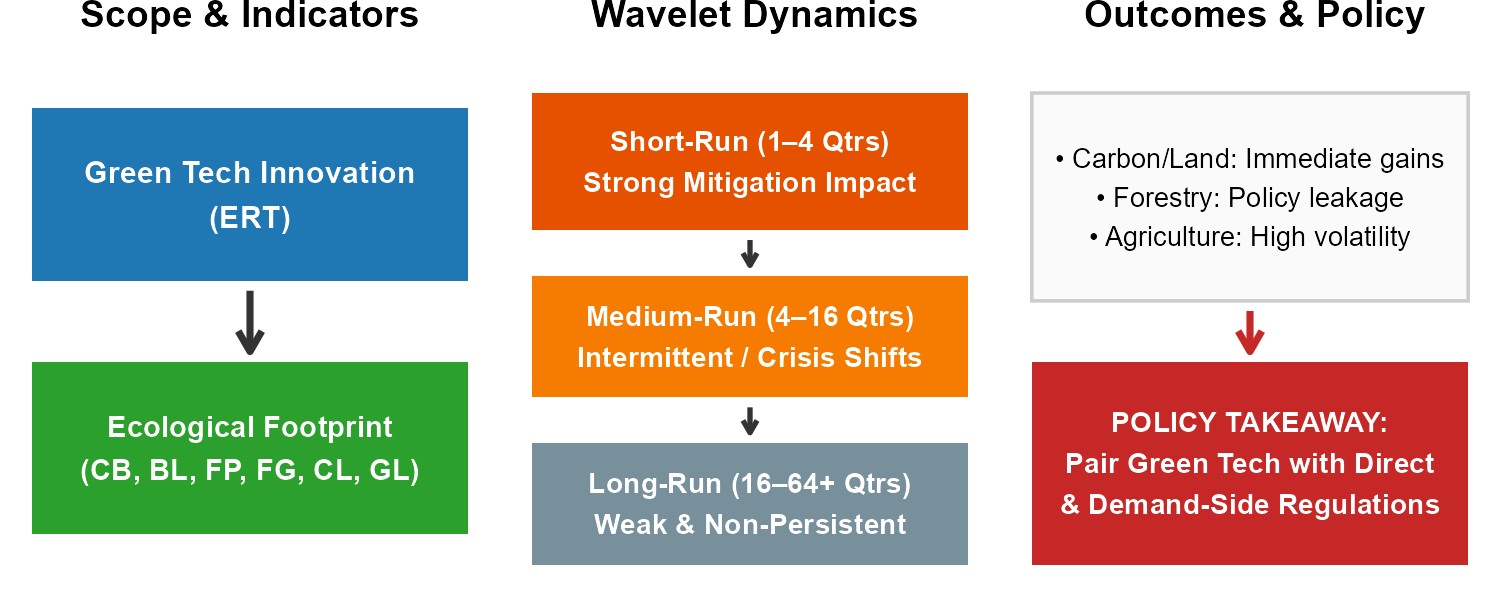
This study investigates the time-frequency dynamics between environment-related technological innovation and environmental quality using the ecological footprint as a comprehensive measure of environmental quality and its components for India. To capture time-varying and frequency-dependent relationships, the study adopts a wavelet coherence framework, which allows simultaneous analysis of short-, medium-, and long-run dynamics between environment-related technological innovation and environmental quality for the period between 1990Q1 to 2022Q4. The results indicate that the relationship between environment-related technological innovation and environmental quality is strongly time-varying and scale-dependent. In the aggregate ecological footprint, the significant coherence is concentrated on the short and medium horizons, while the long-run interactions are weak and non-persistent. The phase dynamics show that the rise in ecological footprint precedes the adoption of environment-related technological innovation. In components analysis, it shows a strong short-term coherence between technological innovation in the environmental field and single parts of the ecological footprint. At the same time, the medium-run effects are intermittent, and the long-run relationships are mostly insignificant or driven by boundary effects. The results suggest that the environmental benefits from environment-related technological innovation are gradual and uneven in ecological dimensions. Therefore, policymakers should complement technology-promotion strategies with regulatory and demand-side measures to avoid overreliance on long-term technological solutions and to better address short-term ecological footprint.
Graphical Abstract
Keywords
environment-related technological innovation | ecological footprint | wavelet coherence analysis | India
References
Chu, L.K. Determinants of ecological footprint in OCED countries: Do environmental-related technologies reduce environmental degradation? Environ. Sci. Pollut. Res. 2022, 29, 23779–23793. https://doi.org/10.1007/s11356-021-17261-4.
Kasioumi, M. The environmental kuznets curve in the 21st century: Future projections under socioeconomic and climate change scenarios. J. Clean. Prod. 2026, 541, 147522. https://doi.org/10.1016/j.jclepro.2026.147522.
Villanthenkodath, M.A.; Mahalik, M.K. Does overseas eco-friendly innovation collaboration matter for environmental quality sustainability in India? OPEC Energy Rev. 2022, 46, 250–284. https://doi.org/10.1111/opec.12232.
Ozkan, O.; Iormom, B.I.; Usman, O.; et al. Fossil fuel efficiency as a pathway to decarbonisation and the role of international trade: A perspective of the LCC hypothesis. Environ. Dev. Sustain. 2025. https://doi.org/10.1007/s10668-025-06351-9.
Khattak, S.I.; Ahmad, M.; Khan, Z.U.; et al. Exploring the impact of innovation, renewable energy consumption, and income on CO2 emissions: New evidence from the BRICS economies. Environ. Sci. Pollut. Res. 2020, 27, 13866–13881. https://doi.org/10.1007/s11356-020-07876-4.
Villanthenkodath, M.A.; Mahalik, M.K. Technological innovation and environmental quality nexus in India: Does inward remittance matter? J. Public. Aff. 2022, 22, e2291. https://doi.org/10.1002/pa.2291.
Rennings, K. Redefining innovation — Eco-innovation research and the contribution from ecological economics. Ecol. Econ. 2000, 32, 319–332. https://doi.org/10.1016/S0921-8009(99)00112-3.
Wang, Q.; Qu, J.; Wang, B.; et al. Green technology innovation development in China in 1990–2015. Sci. Total Environ. 2019, 696, 134008. https://doi.org/10.1016/j.scitotenv.2019.134008.
Johnstone, N.; Haščič, I.; Poirier, J.; et al. Environmental policy stringency and technological innovation: Evidence from survey data and patent counts. Appl. Econ. 2012, 44, 2157–2170. https://doi.org/10.1080/00036846.2011.560110.
Haščič, I.; Migotto, M. Measuring Environmental Innovation using Patent Data; OECD Environment Working Papers 89; OECD Publishing: Paris, France, 2015. https://doi.org/10.1787/5js009kf48xw-en.
OECD Environmental Policy. Technological Innovation and Patents. OECD Studies on Environmental Innovation; OECD Publishing: Paris, France, 2008. https://doi.org/10.1787/9789264046825-en.
Font Vivanco, D.; Freire-González, J.; Galvin, R.; et al. Rebound effect and sustainability science: A review. J. Ind. Ecol. 2022, 26, 1543–1563. https://doi.org/10.1111/jiec.13295.
Font Vivanco, D.; McDowall, W.; Freire-González, J.; et al. The foundations of the environmental rebound effect and its contribution towards a general framework. Ecol. Econ. 2016, 125, 60–69. https://doi.org/10.1016/j.ecolecon.2016.02.006.
Aydin, C.; Esen, Ö.; Çetintaş, Y. Nexus between environmental innovation and ecological footprint in OECD countries: Is there an environmental rebound effect? J. Environ. Stud. Sci. 2025, 15, 113–123. https://doi.org/10.1007/s13412-024-00901-9.
Ali, U.; Li, Y.; Yáñez Morales, V.P.; et al. Dynamics of international trade, technology innovation and environmental sustainability: Evidence from Asia by accounting for cross-sectional dependence. J. Environ. Plan. Manag. 2021, 64, 1864–1885. https://doi.org/10.1080/09640568.2020.1846507.
Wang, H.; Wei, W. Coordinating technological progress and environmental regulation in CO2 mitigation: The optimal levels for OECD countries & emerging economies. Energy Econ. 2020, 87, 104510. https://doi.org/10.1016/j.eneco.2019.104510.
Ahmed, K. Environmental policy stringency, related technological change and emissions inventory in 20 OECD countries. J. Environ. Manag. 2020, 274, 111209. https://doi.org/10.1016/j.jenvman.2020.111209.
Destek, M.A.; Pata, U.K. Carbon efficiency and sustainable environment in India: Impacts of structural change, renewable energy consumption, fossil fuel efficiency, urbanization, and technological innovation. Environ. Sci. Pollut. Res. 2023, 30, 92224–92237. https://doi.org/10.1007/s11356-023-28641-3.
Hussain, M.; Mir, G.M.; Usman, M.; et al. Analysing the role of environment-related technologies and carbon emissions in emerging economies: A step towards sustainable development. Environ. Technol. 2022, 43, 367–375. https://doi.org/10.1080/09593330.2020.1788171.
Zameer, H.; Yasmeen, H.; Zafar, M.W.; et al. Analyzing the association between innovation, economic growth, and environment: Divulging the importance of FDI and trade openness in India. Environ. Sci. Pollut. Res. 2020, 27, 29539–29553. https://doi.org/10.1007/s11356-020-09112-5.
Rahman, Z.U.; Ahmad, S.; Khan, A. Bridging the EPC and IPAT in the presence of natural resources in China: Considering asymmetries in environmental-related technologies and unemployment. Resour. Policy 2025, 103, 105523. https://doi.org/10.1016/j.resourpol.2025.105523.
Tang, N.; Arthur, N. Technological advancement, environmental regulations, and sustainable development: The role of energy efficiency and CO2 emissions. Sustain. Dev. 2026, 34, 5616–5631. https://doi.org/10.1002/sd.70654.
Espoir, D.K.; Sunge, R.; Alola, A.A. Exploring ecological footprint drivers in Africa: Fresh insights from advanced machine learning techniques. Comput. Econ. 2026. https://doi.org/10.1007/s10614-025-11210-w.
Rees, W.E. Ecological footprints and appropriated carrying capacity: What urban economics leaves out. Environ. Urban. 1992, 4, 121–130. https://doi.org/10.1177/095624789200400212.
Wackernagel, M.; Onisto, L.; Bello, P.; et al. National natural capital accounting with the ecological footprint concept. Ecol. Econ. 1999, 29, 375–390. https://doi.org/10.1016/S0921-8009(98)90063-5.
Galli, A.; Kitzes, J.; Wermer, P.; et al. An exploration of the mathematics behind the ecological footprint. Int. J. Ecodyn. 2007, 2, 250–257. https://doi.org/10.2495/ECO-V2-N4-250-257.
Wackernagel, M.; Schulz, N.B.; Deumling, D.; et al. Tracking the ecological overshoot of the human economy. Proc. Natl. Acad. Sci. USA 2002, 99, 9266–9271. https://doi.org/10.1073/pnas.142033699.
Borucke, M.; Moore, D.; Cranston, G.; et al. Accounting for demand and supply of the biosphere’s regenerative capacity: The national footprint accounts’ underlying methodology and framework. Ecol. Indic. 2013, 24, 518–533. https://doi.org/10.1016/j.ecolind.2012.08.005.
Wackernagel, M.; Rees, W. Ecological Footprint: Reducing Human Impact on the Earth; New Society: Gabriola Island, BC, Canada, 1996.
Galli, A. On the rationale and policy usefulness of ecological footprint accounting: The case of Morocco. Environ. Sci. Policy 2015, 48, 210–224. https://doi.org/10.1016/j.envsci.2015.01.008.
Rao, A.; Sharma, G.D.; Radulescu, M.; et al. Environmental apprehension under COP26 agreement: Examining the influence of environmental-related technologies and energy consumption on ecological footprint. Int. J. Environ. Sci. Technol. 2024, 21, 7999–8012. https://doi.org/10.1007/s13762-024-05526-7.
Sadiq, M.; Wen, F.; Dagestani, A.A. Environmental footprint impacts of nuclear energy consumption: The role of environmental technology and globalization in ten largest ecological footprint countries. Nucl. Eng. Technol. 2022, 54, 3672–3681. https://doi.org/10.1016/j.net.2022.05.016.
Nikou, V.; Sardianou, E. The determinants of ecological footprint of production: A spatial panel data estimation. Sustain. Futur. 2025, 9, 100508. https://doi.org/10.1016/j.sftr.2025.100508.
Obekpa, H.O.; Alola, A.A.; Adejo, A.M.; et al. Examining the drivers of ecological footprint components: Is pursuing food security environmentally costly for Nigeria? Ecol. Indic. 2025, 170, 113009. https://doi.org/10.1016/j.ecolind.2024.113009.
Zeb, A.; Shuhai, N.; Ullah, O. Socioeconomic determinants of ecological footprints: Bridging the gap between developed and developing nations. Environ. Dev. Sustain. 2025, 56, 1–30. https://doi.org/10.1007/s10668-025-06081-y.
Ahmed, S.; Ahmed, K.; Ismail, M. Predictive analysis of CO2 emissions and the role of environmental technology, energy use and economic output: Evidence from emerging economies. Air Qual. Atmos. Health 2020, 13, 1035–1044. https://doi.org/10.1007/s11869-020-00855-1.
Sharma, V.; Dhamija, A.; Haseeb, M.; et al. Transitioning towards a sustainable environment: The dynamic nexus between economic complexity index, technological development and human capital with environmental quality in India. Environ. Sci. Pollut. Res. 2023, 30, 87049–87070. https://doi.org/10.1007/s11356-023-28310-5.
Daubechies, I. The wavelet transform, time-frequency localization and signal analysis. IEEE Trans. Inf. Theory 1990, 36, 961–1005. https://doi.org/10.1109/18.57199.
Torrence, C.; Compo, G.P. A practical guide to wavelet analysis. Bull. Am. Meteorol. Soc. 1998, 79, 61–78. https://doi.org/10.1175/1520-0477(1998)0792.0.CO;2.
Grinsted, A.; Moore, J.C.; Jevrejeva, S. Application of the cross wavelet transform and wavelet coherence to geophysical time series. Nonlinear Process. Geophys. 2004, 11, 561–566. https://doi.org/10.5194/npg-11-561-2004.
Razi, U.; Afshan, S.; Cheong, C.W.H.; et al. Dynamic connection between energy prices, Malaysia’s economic growth, and ecological footprint: An evidence from morlet wavelet approach. Geol. J. 2024, 59, 1000–1017. https://doi.org/10.1002/gj.4906.
Adebayo, T.S.; Sevinç, H.; Sevinç, D.E.; et al. A wavelet-based model of trade openness with ecological footprint in the MINT economies. Energy Environ. 2024, 35, 2178–2197. https://doi.org/10.1177/0958305X221150489.
Ozcan, B.; Kılıç Depren, S.; Kartal, M.T. Impact of nuclear energy and hydro electricity consumption in achieving environmental quality: Evidence from load capacity factor by quantile based non-linear approaches. Gondwana Res. 2024, 129, 412–424. https://doi.org/10.1016/j.gr.2023.05.014.
Bilgili, F.; Önderol, S.; Kuşkaya, S.; et al. Renewable energy and technology adoption: Mitigating CO2 emissions through implementation strategies. Nat. Resour. Forum 2025, 49, 1478–1535. https://doi.org/10.1111/1477-8947.12441.
Dai, S. Understanding automation’s impact on ecological footprint: Theory and empirical evidence from Europe. Environ. Resour. Econ. 2025, 88, 503–532. https://doi.org/10.1007/s10640-024-00938-y.
Cetin, M.; Ozturk, I.; Sumerli Sarigul, S.; et al. Nexus between technological innovation and environmental pollution in selected OECD countries. Nat. Resour. Forum 2025, 49, 841–862. https://doi.org/10.1111/1477-8947.12458.
Adebayo, T.S. Achieving the targets of sustainable development goals 7 and 12 in Norway: An application of wavelet tools. Environ. Prog. Sustain. Energy 2025, 44, e14634. https://doi.org/10.1002/ep.14634.
Ahmad, Z.; Baig, I.A.; Husain, S.; et al. How technological innovation and electricity consumption affect environmental quality? A road map towards achieving environmental sustainability. Environ. Sci. Pollut. Res. Int. 2023. https://doi.org/10.1007/s11356-023-28055-1.
Chakraborty, P.; Chatterjee, C. Does environmental regulation indirectly induce upstream innovation? New evidence from India. Res. Policy 2017, 46, 939–955. https://doi.org/10.1016/j.respol.2017.03.004.
Cholette, P.-A. Adjusting Sub-Annual Series to Yearly Benchmarks; Statistics Canada, Working Paper No. 85-12; Statistics Canada: Ottawa, ON, Canada, 1983; pp. 1–14. Available online: https://publications.gc.ca/site/eng/9.837714/publication.html (accessed on 28 October 2026).
Denton, F.T. Adjustment of monthly or quarterly series to annual totals: An approach based on quadratic minimization. J. Am. Stat. Assoc. 1971, 66, 99–102. https://doi.org/10.1080/01621459.1971.10482227.
Adebayo, T.S. Response of sectoral CO2 emissions to climate and economic policy uncertainties: A multi-frequency quantile analysis. Appl. Econ. 2026, 58, 3922–3941. https://doi.org/10.1080/00036846.2025.2490857.
Sethi, S.R. Wavelet-based techniques to analyze the dynamics of petroleum consumption and CO2 emissions: Implications for environmental sustainability and policy. Technol. Sustain. 2026, 5, 78–93. https://doi.org/10.1108/TECHS-09-2025-0200.
World Bank. India’s Urban Infrastructure Needs to Cross $840 Billion Over Next 15 Years: New World Bank Report; World Bank: Washington, DC, USA, 2022. Available online: https://www.worldbank.org/en/news/press-release/2022/11/14/india-s-urban-infrastructure-needs-to-cross-840-billion-over-next-15-years-new-world-bank-report (accessed on 16 October 2026).
IEA. India Energy Outlook 2021; OECD Publishing: Paris, France, 2021. Available online: https://www.iea.org/reports/india-energy-outlook-2021 (accessed on 16 October 2026).
PIB. Balanced Use of Fertilizers: A Key Enabler of Sustainable Farming; Press Information Bureau, Government of India: New Delhi, India. Available online: https://www.pib.gov.in/PressReleasePage.aspx?PRID=2221117®=3&lang=2 (accessed on 16 October 2026).

How to Cite
Villanthenkodath, M. A. (2026). Environment-Related Technological Innovation and Ecological Footprint in India: Aggregate and Component-Wise Time–Frequency Analysis. Habitable Planet. https://doi.org/10.63335/j.hp.2027.0051
RIS
BibTex
Copyright & License

Copyright (c) 2026 by the authors.
This work is licensed under a Creative Commons Attribution 4.0 International License.
Article Metrics
40
Article Views
0
Citations
Contents
References
