
- Across 118 countries over 2000–2020, XGBoost shows the best reported test performance among six models.
- GDP per capita was the largest global XGBoost SHAP predictor with other factors including renewable energy showing differennce.
- Country and four-cluster profiles can guide further investigation, but incomplete explained variation and the observational design preclude causal policy conclusions.
- Future work should incorporate additional energy and policy inputs and evaluate proposed interventions with designs suited to causal questions.
- Open Access
- Article
Explainable Artificial Intelligence for Designing Country-Specific Climate Mitigation and Sustainable Development Pathways
Author Information
Received: 10 August 2026 | Revised: 21 September 2026 | Accepted: 03 November 2026 | Published: 09 November 2026
Highlights
Abstract
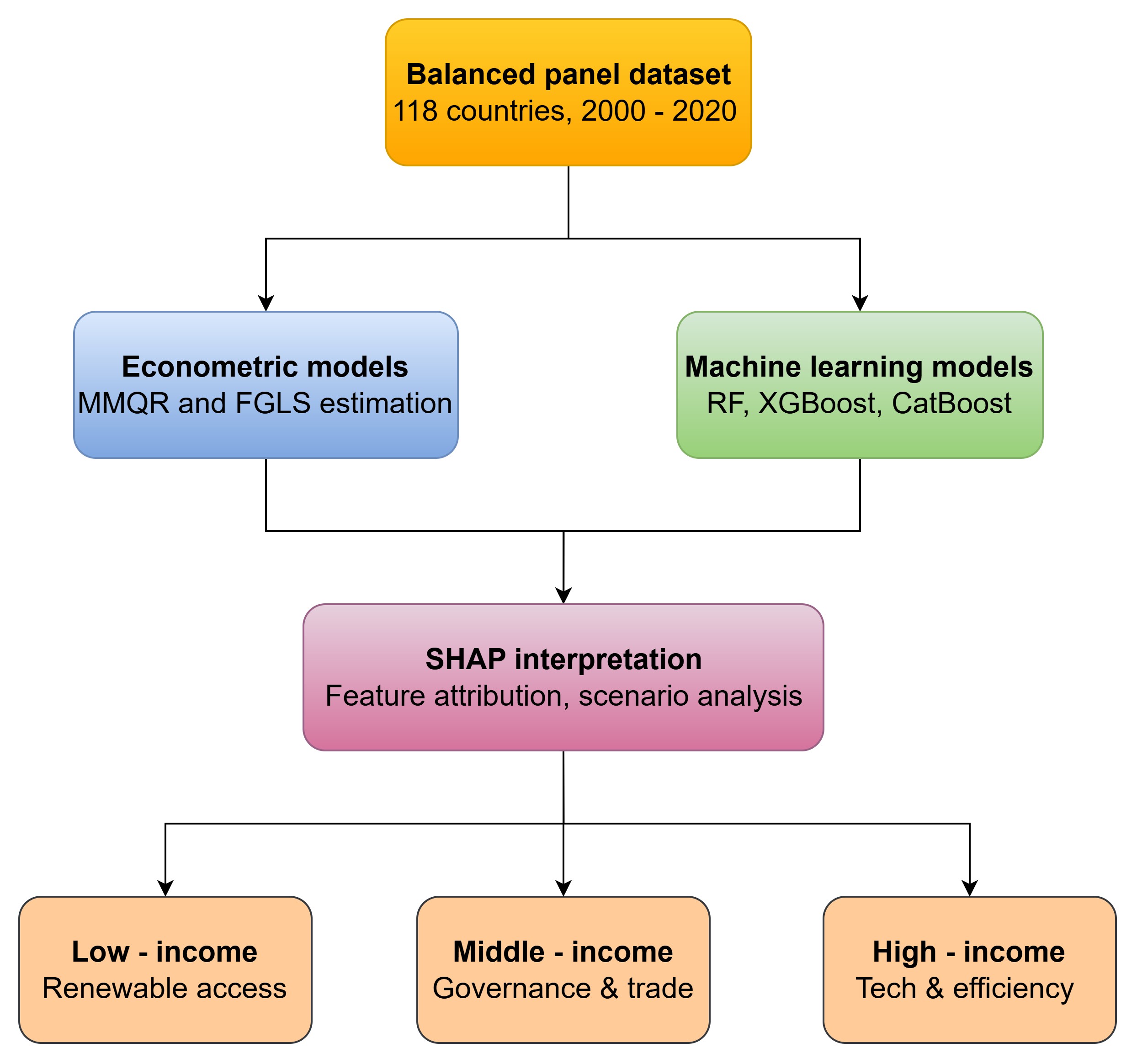
This study compares six machine-learning models for predicting per-capita CO2 emissions in a panel of 118 countries over 2000–2020 and uses SHAP to examine the fitted XGBoost model. The test sample comprises 2019–2020. XGBoost achieved the lowest test RMSE (0.475) and highest R2 (0.324), indicating limited to moderate predictive fit. GDP per capita had the largest means absolute SHAP value (0.2821), followed by the country effect (0.0361). Renewable-energy associations differed across observations and should not be interpreted as a uniform emissions reduction. Country profiles and four descriptive clusters illustrate possible areas for policy review; SHAP contributions are predictive associations, not causal effects or evaluated policy impacts.
Graphical Abstract
Keywords
climate action | explainable artificial intelligence | carbon mitigation | sustainable development | machine learning | environmental policy
References
Intergovernmental Panel on Climate Change (IPCC). Climate Change 2021: The Physical Science Basis. Contribution of Working Group I to the Sixth Assessment Report of the Intergovernmental Panel on Climate Change; Masson-Delmotte, V., Zhai, P., Pirani, A., et al., Eds.; Cambridge University Press: Cambridge, UK; New York, NY, USA, 2021; 2391 pp. https://doi.org/10.1017/9781009157896.
Intergovernmental Panel on Climate Change. Summary for Policymakers. In Climate Change 2023: Synthesis Report. Contribution of Working Groups I, II and III to the Sixth Assessment Report of the Intergovernmental Panel on Climate Change; Core Writing Team; Lee, H., Romero, J., Eds.; IPCC: Geneva, Switzerland, 2023; pp. 1–34. https://doi.org/10.59327/IPCC/AR6-9789291691647.001.
United Nations Environment Programme. Emissions Gap Report 2024: No More Hot Air . . . Please! With a Massive Gap between Rhetoric and Reality, Countries Draft New Climate Commitments; United Nations Environment Programme: Nairobi, Kenya, 2024. https://doi.org/10.59117/20.500.11822/46404.
International Energy Agency. CO₂ Emissions in 2023; IEA: Paris, France, 2024. Available online: https://www.iea.org/reports/co2-emissions-in-2023 (accessed on 5 November 2024).
Breiman, L. Random forests. Mach. Learn. 2001, 45, 5–32. https://doi.org/10.1023/A:1010933404324.
Chen, T.; Guestrin, C. XGBoost: A scalable tree boosting system. In Proceedings of the 22nd ACM SIGKDD International Conference on Knowledge Discovery and Data Mining; Association for Computing Machinery: New York, NY, USA, 2016; pp. 785–794. https://doi.org/10.1145/2939672.2939785.
Prokhorenkova, L.; Gusev, G.; Vorobev, A.; et al. CatBoost: Unbiased boosting with categorical features. In Advances in Neural Information Processing Systems 31; Bengio, S., Wallach, H., Larochelle, H., et al., Eds.; Curran Associates: Red Hook, NY, USA, 2018; pp. 6638–6648.
Lundberg, S.M.; Lee, S.-I. A unified approach to interpreting model predictions. In Advances in Neural Information Processing Systems 30; Guyon, I., von Luxburg, U., Bengio, S., et al., Eds.; Curran Associates: Red Hook, NY, USA, 2017; pp. 4765–4774.
Barredo Arrieta, A.; Díaz-Rodríguez, N.; Del Ser, J.; et al. Explainable Artificial Intelligence (XAI): Concepts, taxonomies, opportunities and challenges toward responsible AI. Inf. Fusion 2020, 58, 82–115. https://doi.org/10.1016/j.inffus.2019.12.012.
Dogan, E.; Turkekul, B. CO₂ emissions, real output, energy consumption, trade, urbanization and financial development: Testing the EKC hypothesis for the USA. Environ. Sci. Pollut. Res. 2016, 23, 1203–1213. https://doi.org/10.1007/s11356-015-5323-8.
Stern, D.I. The rise and fall of the environmental Kuznets curve. World Dev. 2004, 32, 1419–1439. https://doi.org/10.1016/j.worlddev.2004.03.004.
Costantini, L.; Laio, F.; Mariani, M.S.; et al. Forecasting national CO₂ emissions worldwide. Sci. Rep. 2024, 14, 22438. https://doi.org/10.1038/s41598-024-73060-0.
Butt, H.M.M.; Shehzadi, S.; Guo, J. Natural resource depletion, trade flows, and CO₂ emissions: A panel data econometrics and machine learning analysis of the top three economies. Environ. Qual. Manag. 2026, 36, e70396. https://doi.org/10.1002/tqem.70396.
Yang, Y.; Lo, K. China’s renewable energy and energy efficiency policies toward carbon neutrality: A systematic cross-sectoral review. Energy Environ. 2024, 35, 491–509. https://doi.org/10.1177/0958305X231167472.
Wang, Y.; Shinwari, R.; Payab, A.H.; et al. Harmonizing sustainability: Unveiling the nexus of public private investment, natural resources, and environmental dynamics by applying ARDL and machine learning approach. Ecol. Indic. 2024, 161, 111931. https://doi.org/10.1016/j.ecolind.2024.111931.
Li, B.; Wang, X.; Khurshid, A.; et al. Environmental governance, green finance, and mitigation technologies: Pathways to carbon neutrality in European industrial economies. Int. J. Environ. Sci. Technol. 2025, 22, 14899–14912. https://doi.org/10.1007/s13762-025-06608-w.
Zhou, N.; Fridley, D.; McNeil, M.A.; et al. China’s Energy and Carbon Emissions Outlook to 2050; Lawrence Berkeley National Laboratory: Berkeley, CA, USA, 2011. Available online: https://bies.lbl.gov/publications/china-s-energy-and-carbon-emissions (accessed on 28 October 2026).
Butt, H.M.M.; Khan, P.N.; Naseem, M.H.; et al. How do trade openness, energy intensity, technology innovation, and economic growth shape carbon emissions in Belt and Road Initiative countries? CLEAN–Soil Air Water 2025, 53, e70082. https://doi.org/10.1002/clen.70082.
Butt, H.M.M.; Khan, I.; Durrani, S.K.; et al. China’s environmental challenges: The role of energy supply and trade. Process Integr. Optim. Sustain. 2026, 10, 3461–3470. https://doi.org/10.1007/s41660-026-00715-y.
Gielen, D.; Boshell, F.; Saygin, D.; et al. The role of renewable energy in the global energy transformation. Energy Strategy Rev. 2019, 24, 38–50. https://doi.org/10.1016/j.esr.2019.01.006.
Intergovernmental Panel on Climate Change. Climate Change 2022: Mitigation of Climate Change. Contribution of Working Group III to the Sixth Assessment Report of the Intergovernmental Panel on Climate Change; Cambridge University Press: Cambridge, UK, and New York, NY, USA, 2022. https://doi.org/10.1017/9781009157926.
Friedman, J.H. Greedy function approximation: A gradient boosting machine. Ann. Stat. 2001, 29, 1189–1232. https://doi.org/10.1214/aos/1013203451.
Lundberg, S.M.; Erion, G.; Chen, H.; et al. From local explanations to global understanding with explainable AI for trees. Nat. Mach. Intell. 2020, 2, 56–67. https://doi.org/10.1038/s42256-019-0138-9.
Aas, K.; Jullum, M.; Løland, A. Explaining individual predictions when features are dependent: More accurate approximations to Shapley values. Artif. Intell. 2021, 298, 103502. https://doi.org/10.1016/j.artint.2021.103502.
Janzing, D.; Minorics, L.; Blöbaum, P. Feature relevance quantification in explainable AI: A causal problem. In Proceedings of the Twenty Third International Conference on Artificial Intelligence and Statistics; Chiappa, S., Calandra, R., Eds.; Proceedings of Machine Learning Research (PMLR): Cambridge, MA, USA, 2020; Volume 108, pp. 2907–2916. Available online: https://proceedings.mlr.press/v108/janzing20a.html.
Hamad, O.A.M.; Baysen, E.; Usman, A.G. Environmental education as a means of combating growing environmental pollution: An optimized-explainable artificial intelligence (XAI) approach. Sci. Rep. 2026, 16, 12647. https://doi.org/10.1038/s41598-026-42335-z.
Roberts, D.R.; Bahn, V.; Ciuti, S.; et al. Cross-validation strategies for data with temporal, spatial, hierarchical, or phylogenetic structure. Ecography 2017, 40, 913–929. https://doi.org/10.1111/ecog.02881.
Ke, G.; Meng, Q.; Finley, T.; et al. LightGBM: A highly efficient gradient boosting decision tree. In Advances in Neural Information Processing Systems 30; Guyon, I., von Luxburg, U., Bengio, S., et al., Eds.; Curran Associates: Red Hook, NY, USA, 2017; pp. 3146–3154.
Zou, H.; Hastie, T. Regularization and variable selection via the elastic net. J. R. Stat. Soc. Ser. B Stat. Methodol. 2005, 67, 301–320. https://doi.org/10.1111/j.1467-9868.2005.00503.x.
Bishop, C.M. Neural Networks for Pattern Recognition; Oxford University Press: Oxford, UK, 1995. https://doi.org/10.1093/oso/9780198538493.001.0001.
Bergmeir, C.; Hyndman, R.J.; Koo, B. A note on the validity of cross-validation for evaluating autoregressive time series prediction. Comput. Stat. Data Anal. 2018, 120, 70–83. https://doi.org/10.1016/j.csda.2017.11.003.
Hyndman, R.J.; Koehler, A.B. Another look at measures of forecast accuracy. Int. J. Forecast. 2006, 22, 679–688. https://doi.org/10.1016/j.ijforecast.2006.03.001.
Jolliffe, I.T.; Cadima, J. Principal component analysis: A review and recent developments. Philos. Trans. R. Soc. A 2016, 374, 20150202. https://doi.org/10.1098/rsta.20150202.
Rousseeuw, P.J. Silhouettes: A graphical aid to the interpretation and validation of cluster analysis. J. Comput. Appl. Math. 1987, 20, 53–65. https://doi.org/10.1016/0377-0427(87)90125-7.
Arthur, D.; Vassilvitskii, S. k-means++: The advantages of careful seeding. In Proceedings of the Eighteenth Annual ACM-SIAM Symposium on Discrete Algorithms, New Orleans, LA, USA, 7–9 January 2007; Society for Industrial and Applied Mathematics: Philadelphia, PA, USA, 2007; pp. 1027–1035.

How to Cite
Shehzadi, S., Butt, H. M. M., Durrani, S. K., & Guo, J. (2026). Explainable Artificial Intelligence for Designing Country-Specific Climate Mitigation and Sustainable Development Pathways. Habitable Planet. https://doi.org/10.63335/j.hp.2027.0052
RIS
BibTex
Copyright & License

Copyright (c) 2026 by the authors.
This work is licensed under a Creative Commons Attribution 4.0 International License.
Article Metrics
28
Article Views
0
Citations
Contents
References
