
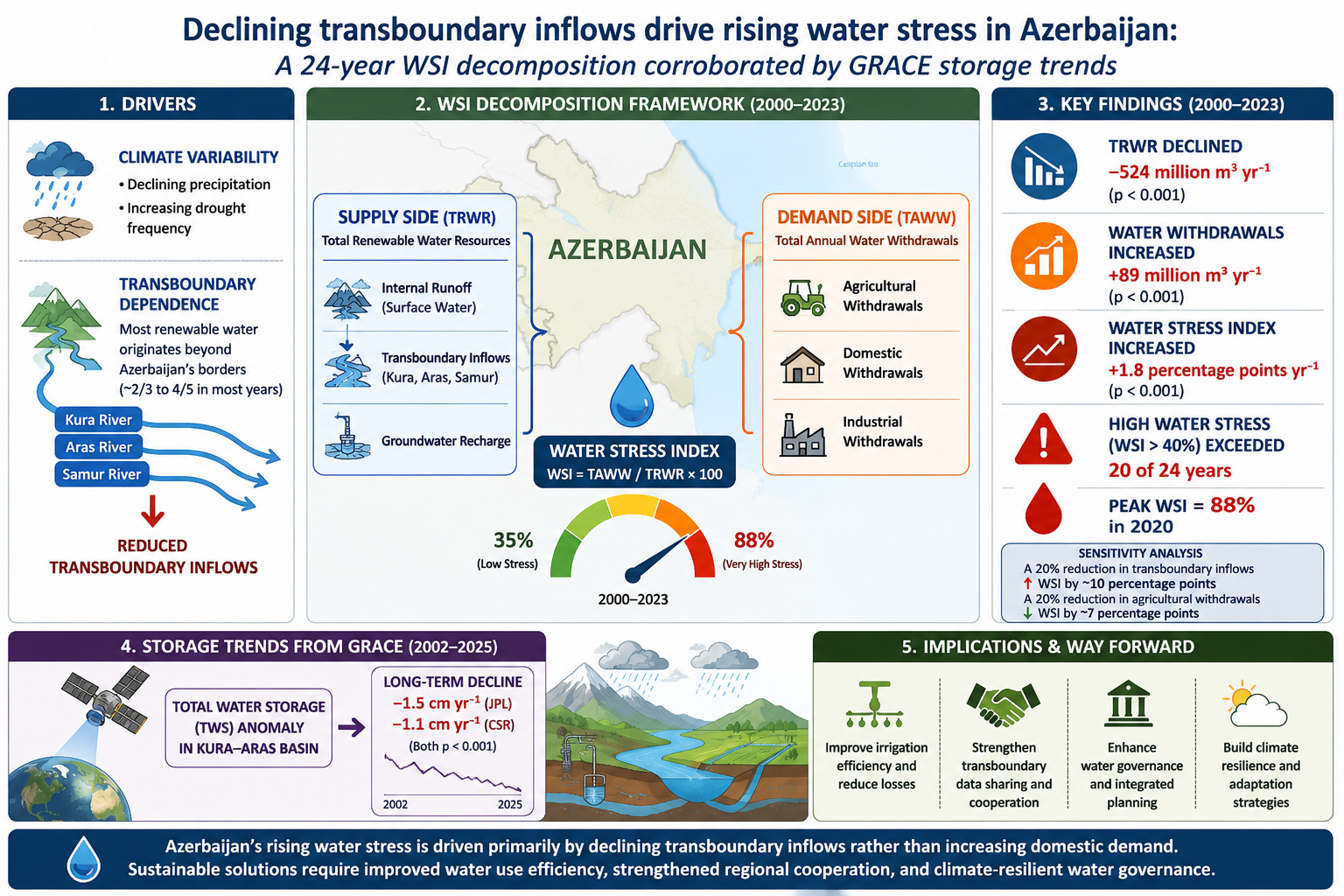
Azerbaijan faces escalating water stress driven by climate variability, socio-economic pressures, and pronounced transboundary dependence. This study presents a transparent, reproducible framework that decomposes the Water Stress Index (WSI = TAWW/TRWR × 100) into its hydrological (internal runoff, transboundary inflows, groundwater) and sectoral (agricultural, domestic, industrial) components, and integrates it with hydro-climatic drivers (P, ETₐ) and GRACE/GRACE-FO total water storage (TWS). Applied to Azerbaijan for 2000–2023, the framework yields mean TRWR of 21.8 km3 year−1, mean TAWW of 11.7 km3 year−1, and mean WSI of 56% (range 35–88%); the high-stress threshold (40%) was exceeded in 20 of 24 years, peaking at 88% in 2020. TRWR declined at −524 Mm3 year−1 (p < 0.001), driven almost entirely by falling transboundary inflows, while TAWW rose at +89 Mm3 year−1 and WSI at +1.8 percentage points year−1. GRACE mascons show a basin-scale TWS decline of −1.1 to −1.5 cm year−1 over 2002–2025 (p < 0.001). A key new result is a national water-balance closure test: a climate-only budget (ΔS = P − ETₐ − Q) is essentially flat (+0.10 cm year−1) and negatively correlated with GRACE (r = −0.61), whereas a full budget that includes the documented anthropogenic groundwater over-abstraction (which grew 4.3-fold between 2000 and 2020) matches GRACE with r = +0.96, RMSE = 2.5 cm, and trend agreement within 0.07 cm year−1. This provides an independent, budget-based attribution of the observed storage decline to unsustainable groundwater extraction rather than climatic variability. Sensitivity analysis reveals a supply-side dominance: a 20% reduction in Q, raises WSI by ≈10 percentage points, versus ≈ 7 for an equivalent demand reduction.
- Open Access
- Article
Declining Transboundary Inflows Drive Rising Water Stress in Azerbaijan: A 24-Year WSI Decomposition Corroborated by GRACE Storage Trends
Author Information
Received: 18 December 2025 | Revised: 13 July 2026 | Accepted: 17 July 2026 | Published: 14 August 2026
Abstract
Graphical Abstract
Keywords
water stress index | transboundary water resources | climate variability | Azerbaijan | GRACE | groundwater
References
- 1.
FAO AQUASTAT. Global Information System on Water and Agriculture; Food and Agriculture Organization of the United Nations: Rome, Italy, 2024.
- 2.
ECA; UNDESA; UNECE; et al. The United Nations World Water Development Report 2020: Water and Climate Change; UNESCO: Paris, France, 2020.
- 3.
Koncagül, E.; Tran, M.; Connor, R. The United Nations World Water Development Report 2020—Facts and Figures; UNESCO: Paris, France, 2020.
- 4.
Ismayilov, R.; Suleymanov, F. Water Resilience Under Climate Change in Azerbaijan. Geoj. Tour. Geosites 2024, 53, 677–686.
- 5.
Strosser, P.; Dworak, T.; Garzon Delvaux, P.A.; et al. Gap Analysis of the Water Scarcity and Droughts Policy in the EU; DG Environment, European Commission: Brussels, Belgium, 2017.
- 6.
Zeeb, B. Transboundary Water Management in the Kura–Aras Basin: UNDP/GEF Project Synthesis Report; UNDP: New York, NY, USA, 2010.
- 7.
De Stefano, L.; Edwards, P.; De Silva, L.; et al. Tracking cooperation and conflict in international basins: Historic and recent trends. Water Policy 2012, 12, 871–884.
- 8.
Wolf, A.T. Shared waters: Conflict and cooperation. Annu. Rev. Environ. Resour. 2007, 32, 241–269.
- 9.
Verdiyev, R. National Strategy for the Efficient Use of Water Resources in Azerbaijan. 2012. Available online: https://leap.unep.org/en/countries/az/national-legislation/national-strategy-efficient-use-water-resources (accessed on 15 December 2025).
- 10.
Arias, P.A.; Bellouin, N.; Coppola, E.; et al. Technical Summary. In Climate Change 2021: The Physical Science Basis; IPCC AR6 WG1; Cambridge University Press: Cambridge, UK, 2021.
- 11.
Giorgi, F.; Lionello, P. Climate change projections for the Mediterranean region. Glob. Planet. Chang. 2008, 63, 90–104.
- 12.
Ismailov, R.; Kreamer, D.K. The springs of the Republic of Azerbaijan and the evaluation of their hydrogeological and ecological security. Hydrogeol. Journal. 2026. https://doi.org/10.1007/s10040-026-03044-z.
- 13.
Ismailov, R.; Bayramov, E.; Neafie, J.; et al. Evaluating priorities for enhancing water security and sustainability in Azerbaijan in the context of climate change resilience. Geoj. Tour. Geosites 2026, 65, 1009–1019. https://doi.org/10.30892/gtg.65235-1740.
- 14.
Sidle, R.C.; Caiserman, A.; Jarihani, B.; et al. Sediment Sources, Erosion Processes, and Interactions with Climate Dynamics in the Vakhsh River Basin, Tajikistan. Water 2024, 16, 122. https://doi.org/10.3390/w16010122.
- 15.
Alcamo, J.; Henrichs, T.; Rösch, T. World Water in 2025: Global Modeling and Scenario Analysis for the World Commission on Water for the 21st Century; Kassel World Water Series 2; Center for Environmental Systems Research, University of Kassel: Kassel, Germany, 2000.
- 16.
Shiklomanov, I.A. Appraisal and assessment of world water resources. Water Int. 2000, 25, 11–32.
- 17.
Falkenmark, M. The massive water scarcity now threatening Africa: Why isn’t it being addressed? Ambio 1989, 18, 112–118.
- 18.
Baggio, G.; Qadir, M.; Smakhtin, V. Freshwater availability status across countries for human and ecosystem needs. Sci. Total Environ. 2021, 792, 148230.
- 19.
Rijsberman, F.R. Water scarcity: Fact or fiction? Agric. Water Manag. 2006, 80, 5–22.
- 20.
Srinivasan, V.; Konar, M.; Sivapalan, M. A dynamic framework for water security. Water Secur. 2017, 1, 12–20.
- 21.
Veettil, A.V.; Mishra, A.K. Potential influence of climate and anthropogenic variables on water security using blue and green water scarcity, Falkenmark index, and freshwater provision indicator. J. Environ. Manag. 2018, 228, 346–362.
- 22.
Prniyazova, A.; Turaeva, S.; Turgunov, D.; et al. Sustainable Transboundary Water Governance in Central Asia: Challenges, Conflicts, and Regional Cooperation. Sustainability 2025, 17, 4968. https://doi.org/10.3390/su17114968.
- 23.
Tulindinova, Z.; Pulatov, B.; Batykova, A.; et al. Sustainable Irrigation in Central Asia: A Review of Historical Development, Water Governance, Climate Change, and Digital Transformation. J. Sustain. Res. 2026, 8, e260069. https://doi.org/10.20900/jsr20260069.
- 24.
Jarihani, B.; Pulatov, B.; Sulaymonova, V.; et al. From Data Gaps to Decision Support: The Role of Hydrological Monitoring and Earth Observation in Central Asia. J. Cent. Asian Stud. 2026, 24, 4–18. https://doi.org/10.52536/3006-807X.2026-2.001.
- 25.
Grant, C. Integrated Water Resources Management: A K4D Helpdesk Report; Institute of Development Studies: Falmer, UK, 2017.
- 26.
Grafton, R.Q.; Williams, J.; Perry, C.J.; et al. The paradox of irrigation efficiency. Science 2018, 361, 748–750. https://doi.org/10.1126/science.aat9314.
- 27.
Imanov, F.A.; kyzy Aliyeva, I.S. Assessment of the Anthropogenic Factors’ Impact upon the Azerbaijan Rivers’ Annual Runoff. Водное Хозяйство России Проблемы Технологии Управление 2019, 10, 20–30.
- 28.
Israfilov, R.G.; Israfilov, Y.H. Impacts of Climate Change on Groundwater Resources: Review of a Case Study in Azerbaijan. In Climate Change and its Effects on Water Resources; Baba, A., Tayfur, G., Gündüz, O., et al., Eds; NATO Science for Peace and Security Series C: Environmental Security; Springer: Dordrecht, the Netherlands, 2011; Volume 3. https://doi.org/10.1007/978-94-007-1143-3_13.
- 29.
Abbasov, R.K.; Smakhtin, V.U. Introducing environmental thresholds into water withdrawal management of mountain streams in the Kura River basin, Azerbaijan. Hydrol. Sci. J. 2009, 54, 1068–1078. https://doi.org/10.1623/hysj.54.6.1068.42.
- 30.
Mátyás, C. Forecasts needed for retreating forests. Nature 2010, 464, 1271.
- 31.
Huseynov, N.; Huseynov, J.; Guliyev, Z. The conceptual model of climate change in the republic of Azerbaijan. Geoj. Tour. Geosites 2025, 61, 1875–1886.
- 32.
Rodell, M.; Famiglietti, J.S.; Wiese, D.N.; et al. Emerging trends in global freshwater availability. Nature 2018, 557, 651–659. https://doi.org/10.1038/s41586-018-0123-1.
- 33.
Abbasov, R.K.; Mahmudov, R.N. Analysis of non climatic origins of floods in the downstream part of the Kura River, Azerbaijan. Nat Hazards 2009, 50, 235–248. https://doi.org/10.1007/s11069-008-9335-2.
- 34.
Save, H.; Bettadpur, S.; Tapley, B. High resolution CSR GRACE RL05 mascons. J. Geophys. Res. Solid Earth 2016, 121, 7547–7569. https://doi.org/10.1002/2016JB013007.
- 35.
Watkins, M.; Wiese, D.; Yuan, D.N.; et al. Improved methods for observing Earth’s time variable mass distribution with GRACE using spherical cap mascons. J. Geophys. Res. Solid Earth 2015, 120, 2648–2671. https://doi.org/10.1002/
2014JB011547. - 36.
Santer, B.D.; Wigley, T.M.L.; Boyle, J.S.; et al. Statistical significance of trends and trend differences in layer-average atmospheric temperature time series. J. Geophys. Res. Atmos. 2000, 105, 7337–7356.
- 37.
Mann, H.B. Nonparametric tests against trend. Econometrica 1945, 13, 245–259.
- 38.
Kendall, M.G. Rank Correlation Methods, 4th ed.; Charles Griffin: London, UK, 1975.
- 39.
Sen, P.K. Estimates of the regression coefficient based on Kendall’s tau. J. Am. Stat. Assoc. 1968, 63, 1379–1389.
- 40.
Hamed, K.H.; Rao, A.R. A modified Mann–Kendall trend test for autocorrelated data. J. Hydrol. 1998, 204, 182–196.
- 41.
Yue, S.; Wang, C.Y. The Mann–Kendall test modified by effective sample size to detect trend in serially correlated hydrological series. Water Resour. Manag. 2004, 18, 201–218.
- 42.
State Committee on Statistics of the Republic of Azerbaijan. Water Statistics in the Republic of Azerbaijan; State Committee on Statistics of the Republic of Azerbaijan: Baku, Azerbaijan, 2014. Available online: https://unece.org/fileadmin/DAM/stats/documents/ece/ces/ge.57/2014/Session_2_Azerbaijan_Water_statistics_EN.pdf (accessed on 15 February 2026).
- 43.
Wiese Grace-Fo, D.N.; Yuan, D.N.; Boening, C.; et al. JPL GRACE and GRACE-FO Mascon Ocean, Ice, and Hydrology Equivalent Water Height JPL Release 06.3 Version 04; NASA Physical Oceanography Distributed Active Archive Center (DAAC): Pasadena, CA, USA, 2024.
- 44.
Gorelick, N.; Hancher, M.; Dixon, M.; et al. Google Earth Engine: Planetary-scale geospatial analysis for everyone, Remote Sens. Environ. 2017, 202, 18–27. https://doi.org/10.1016/j.rse.2017.06.031.


This work is licensed under a Creative Commons Attribution 4.0 International License.
