
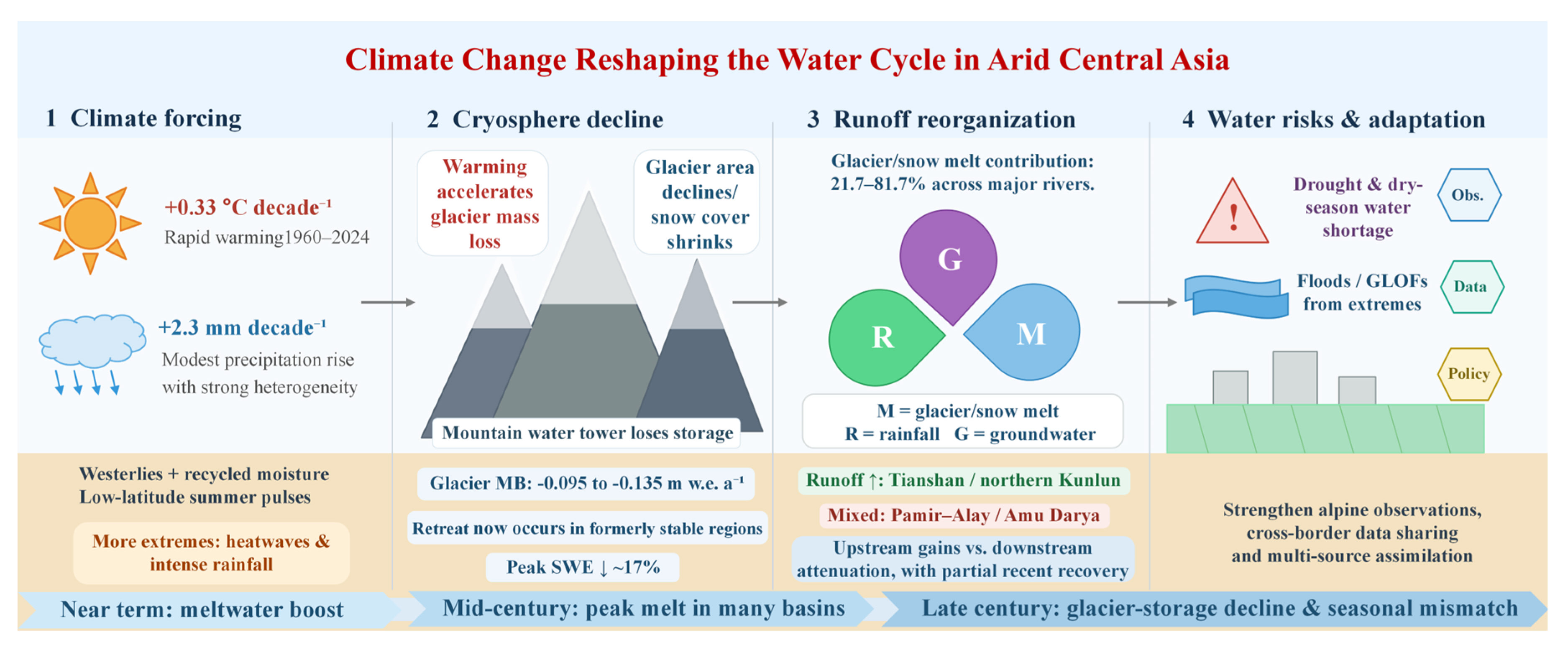
Global climate change is reshaping the hydrological regimes in arid Central Asia, where water resources depend heavily on glacier melt, snowmelt, and rainfall. Compared with well-studied high-mountain regions such as the Himalaya and the Alps, hydrological responses in Central Asia remain insufficiently synthesized. This review summarizes recent advances in climate change, moisture transport, glacier and snow dynamics, runoff changes, and related risks under continued warming. During 1960–2024, air temperature rose by ~0.33 °C per decade, while precipitation increased modestly by ~2.3 mm per decade. Westerly moisture dominates Central Asian precipitation but weakens southward, while recent low-latitude moisture contributions have increased in the southern part, especially the southern Tarim Basin. Persistent warming has driven widespread glacier retreat across Central Asia, with regional mass losses of −0.095 to −0.135 m w.e. a−1 during 2000–2016/2018/2019, and even the previously stable Kunlun and Pamir glaciers now showing signs of retreat. Snow-covered area and duration have generally declined, and in the Naryn River Basin, peak snow water equivalent during 2077–2096 is projected to decrease by ~17% relative to 1981–2000 under SSP5-8.5. Runoff has generally increased in the Tianshan (0.50–6.12 mm/a) and Kunlun Mountains (0.06–0.72 mm/a), whereas the Pamir–Alay region shows spatially heterogeneous changes (−5.02–1.78 mm/a), with both increasing and decreasing trends. Future runoff in Central Asia will likely increase in mountainous headwaters during the early to mid-21st century, but become increasingly heterogeneous and seasonally redistributed as glacier storage declines. Future research should strengthen high-mountain observations, cross-border data sharing and multi-source data assimilation to better constrain water availability and support climate change adaptation.
- Open Access
- Review
Climate Change Reshaping the Water Cycle in Arid Central Asia
- Ruoyan Li 1,2,
- Gonghuan Fang 1,2,3,*,
- Yaning Chen 1,3,*,
- Xiaolong Yan 1,2,
- Junqiang Yao 4,
- Zhi Li 1,
- Runze Guo 1,2,
- Qi Wu 1,2,
- Azamat Kaldybayev 5,
- Nekruz Gulahmadov 1,2,6,
- Nomvar Kurbon 6 and
- Farhod Nasrulloev 1,6,7
Author Information
Received: 30 June 2026 | Revised: 14 August 2026 | Accepted: 26 August 2026 | Published: 17 September 2026
Abstract
Graphical Abstract
Keywords
moisture source | glacier retreat | runoff change | water security | arid Central Asia
References
- 1.
Ravinandrasana, V.P.; Franzke, C.L.E. The first emergence of unprecedented global water scarcity in the Anthropocene. Nat. Commun. 2025, 16, 8281. https://doi.org/10.1038/s41467-025-63784-6.
- 2.
Zhang, W.; Furtado, K.; Wu, P.; et al. Increasing precipitation variability on daily-to-multiyear time scales in a warmer world. Sci. Adv. 2021, 7, eabf8021. https://doi.org/10.1126/sciadv.abf8021.
- 3.
IPCC. Climate Change 2023: Synthesis Report; Intergovernmental Panel on Climate Change: Geneva, Switzerland, 2023; pp. 35–115. https://doi.org/10.59327/ipcc/ar6-9789291691647.
- 4.
Zemp, M.; Jakob, L.; Dussaillant, I.; et al. Community estimate of global glacier mass changes from 2000 to 2023. Nature 2025, 639, 382–388. https://doi.org/10.1038/s41586-024-08545-z.
- 5.
Konapala, G.; Mishra, A.K.; Wada, Y.; et al. Climate change will affect global water availability through compounding changes in seasonal precipitation and evaporation. Nat. Commun. 2020, 11, 3044. https://doi.org/10.1038/s41467-020-16757-w.
- 6.
Ficklin, D.L.; Null, S.E.; Abatzoglou, J.T.; et al. Hydrological Intensification Will Increase the Complexity of Water Resource Management. Earth’s Future 2022, 10, e2021EF002487. https://doi.org/10.1029/2021ef002487.
- 7.
Thackeray, C.W.; Hall, A.; Norris, J.; et al. Constraining the increased frequency of global precipitation extremes under warming. Nat. Clim. Chang. 2022, 12, 441–448. https://doi.org/10.1038/s41558-022-01329-1.
- 8.
Lesk, C.S.; Mankin, J.S. More concentrated precipitation decreases terrestrial water storage. Nature 2026, 653, 425–432. https://doi.org/10.1038/s41586-026-10487-7.
- 9.
Zhang, Y.; Li, C.; Chiew, F.H.S.; et al. Southern Hemisphere dominates recent decline in global water availability. Science 2023, 382, 579–584. https://doi.org/10.1126/science.adh0716.
- 10.
Stringer, L.C.; Mirzabaev, A.; Benjaminsen, T.A.; et al. Climate change impacts on water security in global drylands. One Earth 2021, 4, 851–864. https://doi.org/10.1016/j.oneear.2021.05.010.
- 11.
Wang, X.; Chen, Y.; Fang, G.; et al. The growing water crisis in Central Asia and the driving forces behind it. J. Clean. Prod. 2022, 378, 134574. https://doi.org/10.1016/j.jclepro.2022.134574.
- 12.
Whateley, S.; Steinschneider, S.; Brown, C. A climate change range-based method for estimating robustness for water resources supply. Water Resour. Res. 2014, 50, 8944–8961. https://doi.org/10.1002/2014wr015956.
- 13.
Yang, Z.; Bai, P.; Tian, Y.; et al. Glacier Coverage Dominates the Response of Runoff and Its Components to Climate Change in the Tianshan Mountains. Water Resour. Res. 2025, 61, e2024WR037947. https://doi.org/10.1029/2024WR037947.
- 14.
Chen, Y.; Fang, G.; Li, Z.; et al. The Crisis in Oases: Research on Ecological Security and Sustainable Development in Arid Regions. Annu. Rev. Environ. Resour. 2024, 49, 1–20. https://doi.org/10.1146/annurev-environ-111522-105932.
- 15.
Li, C.; Fu, B.; Wang, S.; et al. Drivers and impacts of changes in China’s drylands. Nat. Rev. Earth Environ. 2021, 2, 858–873. https://doi.org/10.1038/s43017-021-00226-z.
- 16.
Lian, X.; Piao, S.; Chen, A.; et al. Multifaceted characteristics of dryland aridity changes in a warming world. Nat. Rev. Earth Environ. 2021, 2, 232–250. https://doi.org/10.1038/s43017-021-00144-0.
- 17.
Gafurov, A.; Selyuzhenok, V.; Latinovic, M.; et al. GRACE observes the natural and irrigation-induced regional redistribution of water storage in Central Asia. J. Hydrol. Reg. Stud. 2024, 56, 101994. https://doi.org/10.1016/j.ejrh.2024.101994.
- 18.
Barandun, M.; Fiddes, J.; Scherler, M.; et al. The state and future of the cryosphere in Central Asia. Water Secur. 2020, 11, 100072. https://doi.org/10.1016/j.wasec.2020.100072.
- 19.
Pohl, E.; Gloaguen, R.; Andermann, C.; et al. Glacier melt buffers river runoff in the Pamir Mountains. Water Resour. Res. 2017, 53, 2467–2489, https://doi.org/10.1002/2016wr019431.
- 20.
Saidaliyeva, Z.; Muccione, V.; Shahgedanova, M.; et al. Adaptation to climate change in the mountain regions of Central Asia: A systematic literature review. WIREs Clim. Chang. 2024, 15, e891. https://doi.org/10.1002/wcc.891.
- 21.
Central Asia Population. Available online: https://www.worldometers.info/world-population/central-asia-population/ (accessed on 2 September 2026).
- 22.
Ministry of Natural Resources of the People’s Republic of China. Bulletin of the Third National Land Survey; Ministry of Natural Resources of the People’s Republic of China: Beijing, China, 2021.
- 23.
Food and Agriculture Organization. FAOSTAT Database: Arable Land; Food and Agriculture Organization: Rome, Italy, 2021.
- 24.
Peng, J.; Liu, T.; Chen, J.; et al. The conflicts of agricultural water supply and demand under climate change in a typical arid land watershed of Central Asia. J. Hydrol. Reg. Stud. 2023, 47, 101384. https://doi.org/10.1016/j.ejrh.2023.101384.
- 25.
Li, Y.; Deng, M. Spatiotemporal variations of agricultural water footprint and its economic benefits in Xinjiang, northwestern China. Sci. Rep. 2021, 11, 23864. https://doi.org/10.1038/s41598-021-03240-9.
- 26.
United Nations Industrial Development Organization; International Center on Small Hydro Power. World Small Hydropower Development Report 2022: Central Asia; United Nations Industrial Development Organization: Vienna, Austria; International Center on Small Hydro Power: Hangzhou, China, 2022.
- 27.
Hu, Z.; Zhang, C.; Hu, Q.; et al. Temperature Changes in Central Asia from 1979 to 2011 Based on Multiple Datasets. J. Clim. 2014, 27, 1143–1167. https://doi.org/10.1175/jcli-d-13-00064.1.
- 28.
Zhang, M.; Chen, Y.; Shen, Y.; et al. Tracking climate change in Central Asia through temperature and precipitation extremes. J. Geogr. Sci. 2019, 29, 3–28. https://doi.org/10.1007/s11442-019-1581-6.
- 29.
Chen, F.; Huang, W.; Jin, L.; et al. Spatiotemporal precipitation variations in the arid Central Asia in the context of global warming. Sci. China Earth Sci. 2011, 54, 1812–1821. https://doi.org/10.1007/s11430-011-4333-8.
- 30.
Hu, Z.; Zhou, Q.; Chen, X.; et al. Variations and changes of annual precipitation in Central Asia over the last century. Int. J. Climatol. 2017, 37, 157–170. https://doi.org/10.1002/joc.4988.
- 31.
Farinotti, D.; Longuevergne, L.; Moholdt, G.; et al. Substantial glacier mass loss in the Tien Shan over the past 50 years. Nat. Geosci. 2015, 8, 716–722. https://doi.org/10.1038/ngeo2513.
- 32.
Zhuang, L.; Ke, C.; Cai, Y.; et al. Measuring glacier changes in the Tianshan Mountains over the past 20 years using Google Earth Engine and machine learning. J. Geogr. Sci. 2023, 33, 1939–1964. https://doi.org/10.1007/s11442-023-2160-4.
- 33.
Viviroli, D.; Archer, D.R.; Buytaert, W.; et al. Climate change and mountain water resources: overview and recommendations for research, management and policy. Hydrol. Earth Syst. Sci. 2011, 15, 471–504. https://doi.org/10.5194/hess-15-471-2011.
- 34.
Christian, J.E.; Whorton, E.; Carnahan, E.; et al. Differences in the transient responses of individual glaciers: a case study of the Cascade Mountains of Washington State, USA. J. Glaciol. 2022, 68, 751–763. https://doi.org/10.1017/jog.2021.133.
- 35.
Hodge, S.M.; Trabant, D.C.; Krimmel, R.M.; et al. Climate Variations and Changes in Mass of Three Glaciers in Western North America. J. Clim. 1998, 11, 2161–2179. https://doi.org/10.1175/1520-0442(1998)011<2161:cvacim>2.0.co;2.
- 36.
Bliss, A.; Hock, R.; Radić, V. Global response of glacier runoff to twenty-first century climate change. J. Geophys. Res. Earth Surf. 2014, 119, 717–730. https://doi.org/10.1002/2013jf002931.
- 37.
Zheng, Z.; Hong, S.; Deng, H.; et al. Impact of Elevation-Dependent Warming on Runoff Changes in the Headwater Region of Urumqi River Basin. Remote Sens. 2022, 14, 1780. https://doi.org/10.3390/rs14081780.
- 38.
Li, M.; Yao, J.; Zheng, J. Spatio-temporal changes in atmospheric aridity over the arid region of Central Asia during 1979–2019. Ecol. Indic. 2024, 169, 112814. https://doi.org/10.1016/j.ecolind.2024.112814.
- 39.
Wu, X.; Tang, W.; Chen, F.; et al. Attribution and Risk Projections of Hydrological Drought Over Water-Scarce Central Asia. Earth’s Future 2025, 13, e2024EF005243. https://doi.org/10.1029/2024ef005243.
- 40.
Bernauer, T.; Siegfried, T. Climate change and international water conflict in Central Asia. J. Peace Res. 2012, 49, 227–239. https://doi.org/10.1177/0022343311425843.
- 41.
Wegerich, K. Hydro-hegemony in the Amu Darya Basin. Water Policy 2008, 10, 71–88. https://doi.org/10.2166/wp.2008.208.
- 42.
World Bank. Central Asia Water & Energy Program; World Bank: Washington, DC, USA, 2026.
- 43.
Hu, W.; Yao, J.; He, Q.; et al. Changes in precipitation amounts and extremes across Xinjiang (Northwest China) and their connection to climate indices. PeerJ 2021, 9, e10792. https://doi.org/10.7717/peerj.10792.
- 44.
Li, S.; Lei, J.; Xu, X. Genetic Conditions of Sandstorms in the Hinterland of Taklimakan Desert. J. Appl. Meteorol. Sci. 2007, 18, 490–496.
- 45.
Mattea, E.; Bhattacharya, A.; Ghuffar, S.; et al. Multi-Sensor Analysis of Predicted and Observed Glacier Instabilities in the Hissar–Alay of Central Asia. Remote Sens. 2026, 18, 699. https://doi.org/10.3390/rs18050699.
- 46.
Sun, F.; Li, Y.; Chen, Y.; et al. The dominant warming season shifted from winter to spring in the arid region of Northwest China. npj Clim. Atmos. Sci. 2024, 7, 178. https://doi.org/10.1038/s41612-024-00724-z.
- 47.
Wang, G.; Yuan, X.; Jing, C.; et al. The Decreased Cloud Cover Dominated the Rapid Spring Temperature Rise in Arid Central Asia Over the Period 1980–2014. Geophys. Res. Lett. 2024, 51, e2023GL107523. https://doi.org/10.1029/2023gl107523.
- 48.
Li, B.; Chen, Y.; Shi, X. Does elevation dependent warming exist in high mountain Asia? Environ. Res. Lett. 2020, 15, 024012. https://doi.org/10.1088/1748-9326/ab6d7f.
- 49.
Zhang, Y.; An, C.B.; Liu, L.Y.; et al. High-elevation landforms are experiencing more remarkable wetting trends in arid Central Asia. Adv. Clim. Chang. Res. 2022, 13, 489–495. https://doi.org/10.1016/j.accre.2022.04.007.
- 50.
Haag, I.; Jones, P.D.; Samimi, C. Central Asia’s Changing Climate: How Temperature and Precipitation Have Changed across Time, Space, and Altitude. Climate 2019, 7, 123. https://doi.org/10.3390/cli7100123.
- 51.
Wu, L.; Zheng, H. Regional Climate Effects of Irrigation under Central Asia Warming by 2.0 °C. Remote Sens. 2023, 15, 3672. https://doi.org/10.3390/rs15143672.
- 52.
Li, Y.; Duan, W.; Zeng, Z.; et al. Asynchronous abrupt warming across Eurasia since the 1980s. npj Clim. Atmos. Sci. 2025, 8, 327. https://doi.org/10.1038/s41612-025-01209-3.
- 53.
Song, S.; Bai, J. Increasing Winter Precipitation over Arid Central Asia under Global Warming. Atmosphere 2016, 7, 139. https://doi.org/10.3390/atmos7100139.
- 54.
Ma, Q.; Zhang, J.; Game, A.T.; et al. Spatiotemporal variability of summer precipitation and precipitation extremes and associated large-scale mechanisms in Central Asia during 1979–2018. J. Hydrol. X 2020, 8, 100061. https://doi.org/10.1016/j.hydroa.2020.100061.
- 55.
Peng, D.; Zhou, T.; Zhang, L.; et al. Human Contribution to the Increasing Summer Precipitation in Central Asia from 1961 to 2013. J. Clim. 2018, 31, 8005–8021. https://doi.org/10.1175/jcli-d-17-0843.1.
- 56.
Guo, J.; Xie, X.; Myhre, G.; et al. Distinct drivers of recent seasonal precipitation increase over Central Asia: roles of anthropogenic aerosols and greenhouse gases. Atmos. Chem. Phys. 2026, 26, 5169–5184. https://doi.org/10.5194/acp-26-5169-2026.
- 57.
Yao, M.; Tang, H.; Huang, G. Roles of External Forcing and Internal Variability in Winter Precipitation Changes over Central Asia. Earth’s Future 2025, 13, e2025EF006064. https://doi.org/10.1029/2025ef006064.
- 58.
Zhou, G.; Chen, Y.; Yao, J. Variations in precipitation and temperature in Xinjiang (Northwest China) and their connection to atmospheric circulation. Front. Environ. Sci. 2023, 10, 1082713. https://doi.org/10.3389/fenvs.2022.1082713.
- 59.
Fallah, B.; Rostami, M. Exploring the impact of the recent global warming on extreme weather events in Central Asia using the counterfactual climate data ATTRICI v1.1. Clim. Chang. 2024, 177, 80. https://doi.org/10.1007/s10584-024-03743-0.
- 60.
Yu, S.; Yan, Z.; Freychet, N.; et al. Trends in summer heatwaves in central Asia from 1917 to 2016: Association with large-scale atmospheric circulation patterns. Int. J. Climatol. 2020, 40, 115–127. https://doi.org/10.1002/joc.6197.
- 61.
Wang, X.; Li, Y.; Chen, Y.; et al. Intensification of heatwaves in Central Asia from 1981 to 2020—Role of soil moisture reduction. J. Hydrol. 2023, 627, 130395. https://doi.org/10.1016/j.jhydrol.2023.130395.
- 62.
Li, L.; Yang, Y.; Zhang, X.; et al. Attribution of the 2021 record-breaking compound drought-heatwave extreme in Central Asia to anthropogenic warming, atmospheric circulation, and NAO. J. Hydrol. 2026, 679, 136282. https://doi.org/10.1016/j.jhydrol.2026.136282.
- 63.
Feldman, A.F.; Feng, X.; Felton, A.J.; et al. Widespread Co-Location of Less Frequent and More Intense Daily Precipitation Over Land. Geophys. Res. Lett. 2026, 53, e2025GL120745. https://doi.org/10.1029/2025gl120745.
- 64.
Zou, S.; Abuduwaili, J.; Duan, W.; et al. Attribution of changes in the trend and temporal non-uniformity of extreme precipitation events in Central Asia. Sci. Rep. 2021, 11, 15032. https://doi.org/10.1038/s41598-021-94486-w.
- 65.
Guan, J.; Yao, J.; Li, M.; et al. Historical changes and projected trends of extreme climate events in Xinjiang, China. Clim. Dyn. 2022, 59, 1753–1774. https://doi.org/10.1007/s00382-021-06067-2.
- 66.
Jin, C.; He, Q.; Huang, Q. Extreme Summer Precipitation Characteristics and Associated Water Vapor Transport in Southern Xinjiang. Water 2023, 15, 2361. https://doi.org/10.3390/w15132361.
- 67.
Li, M.; Yao, J. Precipitation extremes observed over and around the Taklimakan Desert, China. PeerJ 2023, 11, e15256. https://doi.org/10.7717/peerj.15256.
- 68.
Aihaiti, A.; Wang, Y.; Ali, M.; et al. Probability distribution characteristics of summer extreme precipitation in Xinjiang, China during 1970–2021. Theor. Appl. Climatol. 2023, 151, 753–766. https://doi.org/10.1007/s00704-022-04272-5.
- 69.
Hua, L.; Zhao, T.; Zhong, L. Future changes in drought over Central Asia under CMIP6 forcing scenarios. J. Hydrol. Reg. Stud. 2022, 43, 101191. https://doi.org/10.1016/j.ejrh.2022.101191.
- 70.
Li, T.; Song, F.; Bao, J.; et al. Historical and Projected Cropland Impacts of Heatwaves in Central Asia under Climate Change. Earth’s Future 2025, 13, e2024EF005595. https://doi.org/10.1029/2024ef005595.
- 71.
Xie, B.; Guo, H.; Meng, F.; et al. Historical Evolution and Future Trends of Precipitation Based on Integrated Datasets and Model Simulations of Arid Central Asia. Remote Sens. 2023, 15, 5460. https://doi.org/10.3390/rs15235460.
- 72.
Jiang, J.; Zhou, T.; Chen, X.; et al. Future changes in precipitation over Central Asia based on CMIP6 projections. Environ. Res. Lett. 2020, 15, 054009. https://doi.org/10.1088/1748-9326/ab7d03.
- 73.
Huang, A.; Zhou, Y.; Zhang, Y.; et al. Changes of the Annual Precipitation over Central Asia in the Twenty-First Century Projected by Multimodels of CMIP5. J. Clim. 2014, 27, 6627–6646. https://doi.org/10.1175/jcli-d-14-00070.1.
- 74.
Gutiérrez, J.M.; Jones, R.G.; Narisma, G.T.; et al. Atlas. In Climate Change 2021: The Physical Science Basis. Contribution of Working Group I to the Sixth Assessment Report of the Intergovernmental Panel on Climate Change; Cambridge University Press: Cambridge, UK; New York, NY, USA, 2023; pp. 1927–2058. https://doi.org/10.1017/9781009157896.021.
- 75.
Gummadi, S.; Samineni, S.; Lopez-Lavalle, L.A.B. Assessing high-resolution precipitation extremes in Central Asia: evaluation and future projections. Clim. Chang. 2025, 178, 29. https://doi.org/10.1007/s10584-025-03872-0.
- 76.
Zhang, X.; Chen, Y.; Fang, G.; et al. Increasing multiscale variability in extreme precipitation under global warming in the Tienshan Mountains, Central Asia. J. Hydrol. 2023, 626, 130158. https://doi.org/10.1016/j.jhydrol.2023.130158.
- 77.
Jiang, J.; Zhou, T.; Wang, H.; et al. Tracking moisture sources of precipitation over central Asia: A study based on the water-source-tagging method. J. Clim. 2020, 33, 10339–10355. https://doi.org/10.1175/jcli-d-20-0169.1.
- 78.
Zhong, L.; Hua, L.; Gong, Z.; et al. Quantifying the Spatial Characteristics of the Moisture Transport Affecting Precipitation Seasonality and Recycling Variability in Central Asia. Adv. Atmos. Sci. 2022, 39, 967–984. https://doi.org/10.1007/s00376-021-1383-5.
- 79.
Wang, W.; Li, H.; Wang, J.; et al. Water vapor from western Eurasia promotes precipitation during the snow season in northern Xinjiang, a typical arid region in central Asia. Water 2020, 12, 141. https://doi.org/10.3390/w12010141.
- 80.
Wang, S.; Zhang, M.; Che, Y.; et al. Contribution of recycled moisture to precipitation in oases of arid central Asia: A stable isotope approach. Water Resour. Res. 2016, 52, 3246–3257. https://doi.org/10.1002/2015wr018135.
- 81.
Wang, S.; Wang, L.; Zhang, M.; et al. Quantifying moisture recycling of a leeward oasis in arid central Asia using a Bayesian isotopic mixing model. J. Hydrol. 2022, 613, 128459. https://doi.org/10.1016/j.jhydrol.2022.128459.
- 82.
Zhang, J.; Wang, S.; He, Y.; et al. Contribution of the precipitation-recycling process to the wetting trend in Xinjiang, China. J. Geophys. Res. Atmos. 2022, 127, e2021JD036407. https://doi.org/10.1029/2021jd036407.
- 83.
Ren, Y.; Yu, H.; Liu, C.; et al. Attribution of Dry and Wet Climatic Changes over Central Asia. J. Clim. 2022, 35, 1399–1421. https://doi.org/10.1175/jcli-d-21-0329.1.
- 84.
Syed, F.S.; Giorgi, F.; Pal, J.S.; et al. Effect of remote forcings on the winter precipitation of central southwest Asia part 1: Observations. Theor. Appl. Climatol. 2006, 86, 147–160. https://doi.org/10.1007/s00704-005-0217-1.
- 85.
Yin, Z.Y.; Wang, H.; Liu, X. A Comparative Study on Precipitation Climatology and Interannual Variability in the Lower Midlatitude East Asia and Central Asia. J. Clim. 2014, 27, 7830–7848. https://doi.org/10.1175/jcli-d-14-00052.1.
- 86.
Yan, D.; Xu, H.; Lan, J.; et al. Solar activity and the westerlies dominate decadal hydroclimatic changes over arid Central Asia. Glob. Planet. Chang. 2019, 173, 53–60. https://doi.org/10.1016/j.gloplacha.2018.12.006.
- 87.
Chen, Y.; Li, Z.; Fang, G.; et al. Large hydrological processes changes in the transboundary rivers of Central Asia. J. Geophys. Res. Atmos. 2018, 123, 5059–5069. https://doi.org/10.1029/2017jd028184.
- 88.
Mariotti, A. How ENSO impacts precipitation in southwest central Asia. Geophys. Res. Lett. 2007, 34, L16706. https://doi.org/10.1029/2007gl030078.
- 89.
Rana, S.; McGregor, J.; Renwick, J. Dominant modes of winter precipitation variability over Central Southwest Asia and inter-decadal change in the ENSO teleconnection. Clim. Dyn. 2019, 53, 5689–5707. https://doi.org/10.1007/s00382-019-04889-9.
- 90.
Yang, H.; Xu, G.; Mao, H.; et al. Spatiotemporal Variation in Precipitation and Water Vapor Transport Over Central Asia in Winter and Summer under Global Warming. Front. Earth Sci. 2020, 8, 297. https://doi.org/10.3389/feart.2020.00297.
- 91.
Huang, W.; Feng, S.; Chen, J.; et al. Physical mechanisms of summer precipitation variations in the Tarim Basin in northwestern China. J. Clim. 2015, 28, 3579–3591. https://doi.org/10.1175/jcli-d-14-00395.1.
- 92.
Chen, C.; Zhang, X.; Lu, H.; et al. Increasing summer precipitation in arid Central Asia linked to the weakening of the East Asian summer monsoon in the recent decades. Int. J. Climatol. 2021, 41, 1024–1038. https://doi.org/10.1002/joc.6727.
- 93.
Hu, Q.; Zhao, Y.; Huang, A.; et al. Moisture Transport and Sources of the Extreme Precipitation Over Northern and Southern Xinjiang in the Summer Half-Year During 1979–2018. Front. Earth Sci. 2021. 9, 770877. https://doi.org/10.3389/feart.2021.770877.
- 94.
Randolph Glacier Inventory Consortium. Randolph Glacier Inventory—A Dataset of Global Glacier Outlines; Version 7; National Snow and Ice Data Center: Boulder, CO, USA, 2023. https://doi.org/10.5067/f6jmovy5navz.
- 95.
Shean, D.E.; Bhushan, S.; Montesano, P.; et al. A Systematic, Regional Assessment of High Mountain Asia Glacier Mass Balance. Front. Earth Sci. 2020, 7, 363. https://doi.org/10.3389/feart.2019.00363.
- 96.
Hugonnet, R.; McNabb, R.; Berthier, E.; et al. Accelerated global glacier mass loss in the early twenty-first century. Nature 2021, 592, 726–731. https://doi.org/10.1038/s41586-021-03436-z.
- 97.
Brun, F.; Berthier, E.; Wagnon, P.; et al. A spatially resolved estimate of High Mountain Asia glacier mass balances from 2000 to 2016. Nat. Geosci. 2017, 10, 668–673. https://doi.org/10.1038/ngeo2999; Corrected in Nat. Geosci. 2018, 11, 543.
- 98.
Li, H.; Wang, P.; Li, Z.; et al. Historical reconstruction and future projection of glacier mass balance and their meltwater runoff in Bogda region, Eastern Tianshan Mountains. CATENA 2026, 263, 109711. https://doi.org/10.1016/j.catena.2025.109711.
- 99.
Liu, X.; Li, L. Progress of research on climate change impact on water resources in Central Asia. Prog. Geogr. 2025, 44, 2008–2020. https://doi.org/10.18306/dlkxjz.2025.10.002.
- 100.
Kriegel, D.; Mayer, C.; Hagg, W.; et al. Changes in glacierisation, climate and runoff in the second half of the 20th century in the Naryn basin, Central Asia. Glob. Planet. Chang. 2013, 110, 51–61. https://doi.org/10.1016/j.gloplacha.2013.05.014.
- 101.
Bhattacharya, A.; Bolch, T.; Mukherjee, K.; et al. High Mountain Asian glacier response to climate revealed by multi-temporal satellite observations since the 1960s. Nat. Commun. 2021, 12, 4133. https://doi.org/10.1038/s41467-021-24180-y.
- 102.
Li, Y.; Li, Y. Topographic and geometric controls on glacier changes in the central Tien Shan, China, since the Little Ice Age. Ann. Glaciol. 2014, 55, 177–186. https://doi.org/10.3189/2014aog66a031.
- 103.
Fan, Y.; Ke, C.Q.; Zhou, X.; et al. Glacier mass-balance estimates over High Mountain Asia from 2000 to 2021 based on ICESat-2 and NASADEM. J. Glaciol. 2023, 69, 500–512. https://doi.org/10.1017/jog.2022.78.
- 104.
Barandun, M.; Pohl, E.; Naegeli, K.; et al. Hot Spots of Glacier Mass Balance Variability in Central Asia. Geophys. Res. Lett. 2021, 48, e2020GL092084. https://doi.org/10.1029/2020gl092084.
- 105.
Farinotti, D.; Immerzeel, W.W.; de Kok, R.J.; et al. Manifestations and mechanisms of the Karakoram glacier Anomaly. Nat. Geosci. 2020, 13, 8–16. https://doi.org/10.1038/s41561-019-0513-5.
- 106.
Bonekamp, P.N.J.; de Kok, R.J.; Collier, E.; et al. Contrasting Meteorological Drivers of the Glacier Mass Balance Between the Karakoram and Central Himalaya. Front. Earth Sci. 2019, 7, 107. https://doi.org/10.3389/feart.2019.00107.
- 107.
Lhakpa, D.; Fan, Y.; Cai, Y. Continuous Karakoram Glacier Anomaly and Its Response to Climate Change during 2000–2021. Remote Sens. 2022, 14, 6281. https://doi.org/10.3390/rs14246281.
- 108.
Zhu, M.; Yao, T.; Yang, W.; et al. Possible Causes of Anomalous Glacier Mass Balance in the Western Kunlun Mountains. J. Geophys. Res. Atmos. 2022, 127, e2021JD035705. https://doi.org/10.1029/2021jd035705.
- 109.
Van Tricht, L.; Kneib, M.; Huss, M.; et al. Record-breaking glacier mass loss in Central Asia in 2025. Environ. Res. Lett. 2026, 21, 104021. https://doi.org/10.1088/1748-9326/ae6712.
- 110.
Safarov, M.; Li, J.; Gulayozov, M.; et al. Surge-type glacier activity in the Tajik Pamirs from 2000 to 2024. Glob. Planet. Chang. 2026, 263, 105543. https://doi.org/10.1016/j.gloplacha.2026.105543.
- 111.
Bolch, T.; Shea, J.M.; Liu, S.; et al. Status and Change of the Cryosphere in the Extended Hindu Kush Himalaya Region. In The Hindu Kush Himalaya Assessment: Mountains, Climate Change, Sustainability and People; Springer International Publishing: Cham, Switzerland, 2019; pp. 209–255. https://doi.org/10.1007/978-3-319-92288-1_7.
- 112.
Aizen, V.B.; Aizen, E.M.; Melack, J.M. Precipitation, melt and runoff in the northern Tien Shan. J. Hydrol. 1996, 186, 229–251. https://doi.org/10.1016/s0022-1694(96)03022-3.
- 113.
Armstrong, R.L.; Rittger, K.; Brodzik, M.J.; et al. Runoff from glacier ice and seasonal snow in High Asia: separating melt water sources in river flow. Reg. Environ. Chang. 2019, 19, 1249–1261. https://doi.org/10.1007/s10113-018-1429-0.
- 114.
Pohl, B.; Kramer, A.; Hull, W.; et al. Rethinking Water in Central Asia: The Costs of Inaction and Benefits of Water Cooperation; Swiss Agency for Development and Cooperation: Bern/Zollikofen, Switzerland; adelphi: Berlin, Germany; CAREC: Tashkent, Uzbekistan, 2017.
- 115.
Chen, Y.; Li, W.; Fang, G.; et al. Review article: Hydrological modeling in glacierized catchments of central Asia—Status and challenges. Hydrol. Earth Syst. Sci. 2017, 21, 669–684. https://doi.org/10.5194/hess-21-669-2017.
- 116.
Wang, X.; Sun, L.; Zhang, Y.; et al. Runoff generation in the headwater of Amu Darya, Central Asia. Prog. Geogr. 2015, 34, 364–372. https://doi.org/10.11820/dlkxjz.2015.03.011.
- 117.
Chen, H.; Chen, Y.; Li, W.; et al. Quantifying the contributions of snow/glacier meltwater to river runoff in the Tianshan Mountains, Central Asia. Glob. Planet. Chang. 2019, 174, 47–57. https://doi.org/10.1016/j.gloplacha.2019.01.002.
- 118.
Kalashnikova, O.Y.; Usubaliev, R.A.; Alamanov, S.K. Changing the Volume of Components Flow on the Naryn River for Many Years Period (1964–2017 Years). Izvestiya VUZov Kyrgyzstana 2020, 8–13, https://doi.org/10.26104/IVK.2019.45.557.
- 119.
Shannon, S.; Payne, A.; Freer, J.; et al. A snow and glacier hydrological model for large catchments—Case study for the Naryn River, central Asia. Hydrol. Earth Syst. Sci. 2023, 27, 453–480. https://doi.org/10.5194/hess-27-453-2023.
- 120.
Van Tricht, L.; Zekollari, H.; Huss, M.; et al. Reduced Future Summer Water Availability in the Tien Shan Due to Glacier Wastage. Water Resour. Res. 2026, 62, e2025WR040877. https://doi.org/10.1029/2025wr040877.
- 121.
Lyu, H.; Fang, G.; Chen, Y.; et al. Hydrological response to glacier peak water in the largest inland river basin of China. J. Hydrol. 2026, 676, 135695. https://doi.org/10.1016/j.jhydrol.2026.135695.
- 122.
Huss, M.; Hock, R. Global-scale hydrological response to future glacier mass loss. Nat. Clim. Chang. 2018, 8, 135–140. https://doi.org/10.1038/s41558-017-0049-x.
- 123.
Marzeion, B.; Hock, R.; Anderson, B.; et al. Partitioning the Uncertainty of Ensemble Projections of Global Glacier Mass Change. Earth’s Future 2020, 8, e2019EF001470. https://doi.org/10.1029/2019ef001470.
- 124.
Rounce, D.R.; Hock, R.; Maussion, F.; et al. Global glacier change in the 21st century: Every increase in temperature matters. Science 2023, 379, 78–83. https://doi.org/10.1126/science.abo1324.
- 125.
Wimberly, F.; Ultee, L.; Schuster, L.; et al. Inter-model differences in 21st century glacier runoff for the world’s major river basins. Cryosphere 2025, 19, 1491–1511. https://doi.org/10.5194/tc-19-1491-2025.
- 126.
Liu, Y.; Fang, Y.; Margulis, S.A. Spatiotemporal distribution of seasonal snow water equivalent in High Mountain Asia from an 18-year Landsat–MODIS era snow reanalysis dataset. Cryosphere 2021, 15, 5261–5280. https://doi.org/10.5194/tc-15-5261-2021.
- 127.
Meredith, M.; Sommerkorn, M. IPCC Special Report on the Ocean and Cryosphere in a Changing Climate (SROCC); IPCC: Geneva, Switzerland, 2019.
- 128.
Smith, T.; Bookhagen, B. Changes in seasonal snow water equivalent distribution in High Mountain Asia (1987 to 2009). Sci. Adv. 2018, 4, e1701550. https://doi.org/10.1126/sciadv.1701550.
- 129.
Tang, Z.; Wang, X.; Wang, J.; et al. Spatiotemporal Variation of Snow Cover in Tianshan Mountains, Central Asia, Based on Cloud-Free MODIS Fractional Snow Cover Product, 2001–2015. Remote Sens. 2017, 9, 1045. https://doi.org/10.3390/rs9101045.
- 130.
Dietz, A.J.; Kuenzer, C.; Conrad, C. Snow-cover variability in central Asia between 2000 and 2011 derived from improved MODIS daily snow-cover products. Int. J. Remote Sens. 2013, 34, 3879–3902. https://doi.org/10.1080/01431161.2013.767480.
- 131.
Dietz, A.J.; Conrad, C.; Kuenzer, C.; et al. Identifying Changing Snow Cover Characteristics in Central Asia between 1986 and 2014 from Remote Sensing Data. Remote Sens. 2014, 6, 12752–12775. https://doi.org/10.3390/rs61212752.
- 132.
Savoskul, O.S.; Smakhtin, V. Glacier Systems and Seasonal Snow Cover in Six Major Asian River Basins: Hydrological Role under Changing Climate; International Water Management Institute (IWMI): Colombo, Sri Lanka, 2013. https://doi.org/10.5337/2013.204.
- 133.
Wang, X.; Yang, T.; Xu, C.-Y.; et al. Understanding the discharge regime of a glacierized alpine catchment in the Tianshan Mountains using an improved HBV-D hydrological model. Glob. Planet. Chang. 2019, 172, 211–222. https://doi.org/10.1016/j.gloplacha.2018.09.017.
- 134.
Sadyrov, S.; Isaev, E.; Tanaka, K.; et al. High-resolution assessment of climate change impacts on the surface energy and water balance in the glaciated Naryn River basin, Central Asia. J. Environ. Manag. 2025, 374, 124021. https://doi.org/10.1016/j.jenvman.2024.124021.
- 135.
Barnett, T.P.; Adam, J.C.; Lettenmaier, D.P. Potential impacts of a warming climate on water availability in snow-dominated regions. Nature 2005, 438, 303–309. https://doi.org/10.1038/nature04141.
- 136.
Hou, M.; Cuo, L.; Murodov, A.; et al. Streamflow Composition and the Contradicting Impacts of Anthropogenic Activities and Climatic Change on Streamflow in the Amu Darya Basin, Central Asia. J. Hydrometeorol. 2023, 24, 185–201. https://doi.org/10.1175/jhm-d-22-0040.1.
- 137.
Konovalov, V.G. Past and prospective changes in the state of Central Asian glaciers. Ice Snow 2011, 3, 60–68.
- 138.
Zuo, H.; Li, B.; Wang, Y. Characteristics of Streamflow Components in the Tarim River Basin Based on Hydrogen and Oxygen Isotopes. Acta Sci. Nat. Univ. Pekin. 2025, 61, 358–368. https://doi.org/10.13209/j.0479-8023.2024.104.
- 139.
Sun, C.; Chen, Y.; Li, X.; et al. Analysis on the streamflow components of the typical inland river, Northwest China. Hydrol. Sci. J. 2016, 61, 970–981. https://doi.org/10.1080/02626667.2014.1000914.
- 140.
Wang, H.; Chen, Z.; Chen, Y.; et al. Identification of the Space-Time Variability of Hydrological Drought in the Arid Region of Northwestern China. Water 2019, 11, 1051. https://doi.org/10.3390/w11051051.
- 141.
Wang, J.; Zhang, F.; Luo, G.; et al. Influence of natural and anthropogenic controls on runoff in the Keriya River, central Tarim Basin, China. PLoS ONE 2022, 17, e0269132. https://doi.org/10.1371/journal.pone.0269132.
- 142.
Gao, X.; Ye, B.; Zhang, S.; et al. Glacier runoff variation and its influence on river runoff during 1961–2006 in the Tarim River Basin, China. Sci. China Earth Sci. 2010, 53, 880–891. https://doi.org/10.1007/s11430-010-0073-4.
- 143.
Kogutenko, L.; Severskiy, I.; Shahgedanova, M.; et al. Change in the Extent of Glaciers and Glacier Runoff in the Chinese Sector of the Ile River Basin between 1962 and 2012. Water 2019, 11, 1668. https://doi.org/10.3390/w11081668.
- 144.
Sadyrov, S.; Tanaka, K.; Satylkanov, R.; et al. Modelling runoff components and hydrological processes in glaciated catchments of the inner Tien-Shan, Kyrgyzstan. Front. Earth Sci. 2024, 11, 1306476. https://doi.org/10.3389/feart.2023.1306476.
- 145.
Bissenbayeva, S.; Abuduwaili, J.; Saparova, A.; et al. Long-term variations in runoff of the Syr Darya River Basin under climate change and human activities. J. Arid Land 2021, 13, 56–70. https://doi.org/10.1007/s40333-021-0050-0.
- 146.
Kalashnikova, O.Y.; Niyazov, J.; Nurbatsina, A.; et al. Kyrgyz transboundary rivers’ runoff assessment (Syr-darya and Amu-darya river basins) in climate change scenarios. Cent. Asian J. Water Res. 2023, 9, 59–88. https://doi.org/10.29258/cajwr/2023-r1.v9-1/59-88.eng.
- 147.
Siegfried, T.; Mujahid, A.U.H.; Marti, B.; et al. Unveiling the future water pulse of central asia: a comprehensive 21st century hydrological forecast from stochastic water balance modeling. Clim. Chang. 2024, 177, 141. https://doi.org/10.1007/s10584-024-03799-y.
- 148.
Khanal, S.; Lutz, A.F.; Kraaijenbrink, P.D.A.; et al. Variable 21st Century Climate Change Response for Rivers in High Mountain Asia at Seasonal to Decadal Time Scales. Water Resour. Res. 2021, 57, e2020WR029266. https://doi.org/10.1029/2020wr029266.
- 149.
Reyer, C.P.O.; Otto, I.M.; Adams, S.; et al. Climate change impacts in Central Asia and their implications for development. Reg. Environ. Chang. 2017, 17, 1639–1650. https://doi.org/10.1007/s10113-015-0893-z.
- 150.
Su, F.; Pritchard, H.D.; Yao, T.; et al. Contrasting Fate of Western Third Pole’s Water Resources under 21st Century Climate Change. Earth’s Future 2022, 10, e2022EF002776. https://doi.org/10.1029/2022ef002776.
- 151.
Gulakhmadov, A.; Chen, X.; Gulahmadov, N.; et al. Simulation of the Potential Impacts of Projected Climate Change on Streamflow in the Vakhsh River Basin in Central Asia under CMIP5 RCP Scenarios. Water 2020, 12, 1426. https://doi.org/10.3390/w12051426.
- 152.
Xiang, Y.; Wang, Y.; Chen, Y.; et al. Impact of Climate Change on the Hydrological Regime of the Yarkant River Basin, China: An Assessment Using Three SSP Scenarios of CMIP6 GCMs. Remote Sens. 2022, 14, 115. https://doi.org/10.3390/rs14010115.
- 153.
Zheng, G.; Allen, S.K.; Bao, A.; et al. Increasing risk of glacial lake outburst floods from future Third Pole deglaciation. Nat. Clim. Chang. 2021, 11, 411–417. https://doi.org/10.1038/s41558-021-01028-3.
- 154.
Wu, J.S.; Li, Y.P.; Sun, J.; et al. Identifying the runoff variation in the Naryn River Basin under multiple climate and land-use change scenarios. J. Water Clim. Chang. 2022, 13, 574–592. https://doi.org/10.2166/wcc.2021.422.
- 155.
Yu, X.; Zeng, X.; Gui, D.; et al. Projection of Flash Droughts in the Headstream Area of Tarim River Basin Under Climate Change Through Bayesian Uncertainty Analysis. J. Geophys. Res. Atmos. 2023, 128, e2022JD037634. https://doi.org/10.1029/2022jd037634.
- 156.
de Boer, T.; Paltan, H.; Sternberg, T.; et al. Evaluating Vulnerability of Central Asian Water Resources under Uncertain Climate and Development Conditions: The Case of the Ili-Balkhash Basin. Water 2021, 13, 615. https://doi.org/10.3390/w13050615.
- 157.
Shahgedanova, M.; Saidaliyeva, Z.; Mussina, A.; et al. Debris flows in the northern Tien Shan, Central Asia: regional database, meteorological triggers, and trends. npj Nat. Hazards 2024, 1, 49. https://doi.org/10.1038/s44304-024-00050-7.
- 158.
Stoffel, M.; Huggel, C. Effects of climate change on mass movements in mountain environments. Prog. Phys. Geogr. Earth Environ. 2012, 36, 421–439. https://doi.org/10.1177/0309133312441010.
- 159.
Huggel, C.; Clague, J.J.; Korup, O. Is climate change responsible for changing landslide activity in high mountains? Earth Surf. Process. Landf. 2012, 37, 77–91. https://doi.org/10.1002/esp.2223.
- 160.
Haeberli, W.; Schaub, Y.; Huggel, C. Increasing risks related to landslides from degrading permafrost into new lakes in de-glaciating mountain ranges. Geomorphology 2017, 293, 405–417. https://doi.org/10.1016/j.geomorph.2016.02.009.
- 161.
World Bank. Turn Down the Heat: Confronting the New Climate Normal; World Bank: Washington, DC, USA, 2014. https://doi.org/10.1596/978-1-4648-0437-3.
- 162.
Ahunbaev, A.; Chuyev, S.; Adakhayev, A.; et al. Efficient Irrigation and Water Conservation in Central Asia; Eurasian Development Bank: Almaty, Kazakhstan, 2023.
- 163.
Siegfried, T.; Bernauer, T.; Guiennet, R.; et al. Will climate change exacerbate water stress in Central Asia? Clim. Chang. 2012, 112, 881–899. https://doi.org/10.1007/s10584-011-0253-z.
- 164.
Su, J.; Miao, C.; Zwiers, F.; et al. Precipitation observing network gaps limit climate change impact assessment. Nature 2026, 652, 119–125. https://doi.org/10.1038/s41586-026-10300-5.
- 165.
Sun, Q.; Miao, C.; Duan, Q.; et al. A Review of Global Precipitation Data Sets: Data Sources, Estimation, and Intercomparisons. Rev. Geophys. 2018, 56, 79–107. https://doi.org/10.1002/2017rg000574.
- 166.
Wortmann, M.; Duethmann, D.; Menz, C.; et al. Projected climate change and its impacts on glaciers and water resources in the headwaters of the Tarim River, NW China/Kyrgyzstan. Clim. Chang. 2022, 171, 30. https://doi.org/10.1007/s10584-022-03343-w.
- 167.
Emmer, A.; Allen, S.K.; Carey, M.; et al. Progress and challenges in glacial lake outburst flood research (2017–2021): A research community perspective. Nat. Hazards Earth Syst. Sci. 2022, 22, 3041–3061. https://doi.org/10.5194/nhess-22-3041-2022.
- 168.
Prniyazova, A.; Turaeva, S.; Turgunov, D.; et al. Sustainable Transboundary Water Governance in Central Asia: Challenges, Conflicts, and Regional Cooperation. Sustainability 2025, 17, 4968. https://doi.org/10.3390/su17114968.
- 169.
Kato, T. Strengthening the water-energy nexus for a climate resilient Central Asia. OECD Green Growth Pap. 2025. https://doi.org/10.1787/632162c2-en.
- 170.
Ziganshina, D. Water infrastructure in Central Asia: Legal and institutional frameworks. Front. Clim. 2023, 5, 1284400. https://doi.org/10.3389/fclim.2023.1284400.
- 171.
Chen, Y.; Chen, Y.; Zhu, C.; et al. Ecohydrological effects of water conveyance in a disconnected river in an arid inland river basin. Sci. Rep. 2022, 12, 9982. https://doi.org/10.1038/s41598-022-14524-z.
- 172.
Jiao, A.; Wang, W.; Ling, H.; et al. Effect evaluation of ecological water conveyance in Tarim River Basin, China. Front. Environ. Sci. 2022, 10, 1019695. https://doi.org/10.3389/fenvs.2022.1019695.
- 173.
Fu, A.; Li, W.; Chen, Y.; et al. The effects of ecological rehabilitation projects on the resilience of an extremely drought-prone desert riparian forest ecosystem in the Tarim River Basin, Xinjiang, China. Sci. Rep. 2021, 11, 18485. https://doi.org/10.1038/s41598-021-96742-5.
- 174.
UNECE. Reconciling Resource Uses in Transboundary Basins: Assessment of the Water-Food-Energy-Ecosystems Nexus in the Syr Darya River Basin; United Nations Economic Commission for Europe: Geneva, Switzerland, 2017.
- 175.
Hu, Y.; Duan, W.; Zou, S.; et al. Coupling coordination analysis of the water-food-energy-carbon nexus for crop production in Central Asia. Appl. Energy 2024, 369, 123584. https://doi.org/10.1016/j.apenergy.2024.123584.
- 176.
Chen, Y.; Fang, G.; Hao, H.; et al. Water use efficiency data from 2000 to 2019 in measuring progress towards SDGs in Central Asia. Big Earth Data 2022, 6, 90–102. https://doi.org/10.1080/20964471.2020.1851891.
- 177.
Kapitsa, V.; Shahgedanova, M.; Severskiy, I.; et al. Assessment of Changes in Mass Balance of the Tuyuksu Group of Glaciers, Northern Tien Shan, Between 1958 and 2016 Using Ground-Based Observations and Pléiades Satellite Imagery. Front. Earth Sci. 2020, 8, 259. https://doi.org/10.3389/feart.2020.00259.
- 178.
Zhao, G.; Zhang, Z.; Liu, L.; et al. Changes of glacier mass balance in Manas river basin based on multi-source remote sensing data. Acta Geogr. Sin. 2020, 75, 98–112. https://doi.org/10.11821/dlxb202001008.
- 179.
Che, Y.; Zhang, M.; Li, Z.; et al. Understanding the Mass Balance Characteristics of Qingbingtan Glacier No. 72 during the Period of 2008–2014. J. Glaciol. Geocryol. 2020, 42, 318–331. https://doi.org/10.7522/j.issn.1000-0240.2019.0035.
- 180.
Azisov, E.; Hoelzle, M.; Vorogushyn, S.; et al. Reconstructed Centennial Mass Balance Change for Golubin Glacier, Northern Tien Shan. Atmosphere 2022, 13, 954. https://doi.org/10.3390/atmos13060954.
- 181.
Pieczonka, T.; Bolch, T. Region-wide glacier mass budgets and area changes for the Central Tien Shan between ~1975 and 1999 using Hexagon KH-9 imagery. Glob. Planet. Chang. 2015, 128, 1–13. https://doi.org/10.1016/j.gloplacha.2014.11.014.
- 182.
Van Tricht, L.; Paice, C.M.; Rybak, O.; et al. Reconstruction of the Historical (1750–2020) Mass Balance of Bordu, Kara-Batkak and Sary-Tor Glaciers in the Inner Tien Shan, Kyrgyzstan. Front. Earth Sci. 2021, 9, 734802. https://doi.org/10.3389/feart.2021.734802.
- 183.
Wang, P.; Xu, M.; Han, H.; et al. Response of glacier mass balance and meltwater runoff to climate change in the Akesu River Basin, southern Tianshan. Earth Sci. Front. 2024, 31, 435–446. https://doi.org/10.13745/j.esf.sf.2023.2.50.
- 184.
Shangguan, D.H.; Bolch, T.; Ding, Y.J.; et al. Mass changes of Southern and Northern Inylchek Glacier, Central Tian Shan, Kyrgyzstan, during ∼1975 and 2007 derived from remote sensing data. Cryosphere 2015, 9, 703–717. https://doi.org/10.5194/tc-9-703-2015.
- 185.
Zhang, Y.; Liu, S.Y.; Ding, Y.J.; et al. Preliminary Study of Mass Balance on the Keqicar Baxi Glacier on the South Slopes of Tianshan Mountains. J. Glaciol. Geocryol. 2006, 28, 477–484. https://doi.org/10.7522/j.issn.1000-0240.2006.0069.
- 186.
Kenzhebaev, R.; Barandun, M.; Kronenberg, M.; et al. Mass balance observations and reconstruction for Batysh Sook Glacier, Tien Shan, from 2004 to 2016. Cold Reg. Sci. Technol. 2017, 135, 76–89. https://doi.org/10.1016/j.coldregions.2016.12.007.
- 187.
Fujita, K.; Takeuchi, N.; Nikitin, S.A.; et al. Favorable climatic regime for maintaining the present-day geometry of the Gregoriev Glacier, Inner Tien Shan. Cryosphere 2011, 5, 539–549. https://doi.org/10.5194/tc-5-539-2011.
- 188.
Kronenberg, M.; Barandun, M.; Hoelzle, M.; et al. Mass-balance reconstruction for Glacier No. 354, Tien Shan, from 2003 to 2014. Ann. Glaciol. 2016, 57, 92–102. https://doi.org/10.3189/2016aog71a032.
- 189.
Hoelzle, M.; Azisov, E.; Barandun, M.; et al. Re-establishing glacier monitoring in Kyrgyzstan and Uzbekistan, Central Asia. Geosci. Instrum. Methods Data Syst. 2017, 6, 397–418. https://doi.org/10.5194/gi-6-397-2017.
- 190.
Yang, X.; Zhao, J.; Han, H. Study on glacier mass balance in the Karlik Range, East Tianshan Mountains during 1972–2016. J. Glaciol. Geocryol. 2019, 41, 1–11. https://doi.org/10.7522/j.issn.1000-0240.2019.0004.
- 191.
Xu, C.; Li, Z.; Wang, F.; et al. Geodetic Mass Balance of Haxilegen Glacier No. 51, Eastern Tien Shan, from 1964 to 2018. Remote Sens. 2022, 14, 272. https://doi.org/10.3390/rs14020272.
- 192.
Fan, R.; Sun, M.; Wang, R.; et al. Modeling on glacier mass balance and glacier runoff in the Tianshan region of China from 1961 to 2020. J. Glaciol. Geocryol. 2025, 47, 239–254. https://doi.org/10.7522/j.issn.1000-0240.2025.0019.
- 193.
Zhou, Y.; Li, Z.; Li, J.; et al. Geodetic glacier mass balance (1975–1999) in the central Pamir using the SRTM DEM and KH-9 imagery. J. Glaciol. 2019, 65, 309–320. https://doi.org/10.1017/jog.2019.8.
- 194.
Lambrecht, A.; Mayer, C.; Wendt, A.; et al. Elevation change of Fedchenko Glacier, Pamir Mountains, from GNSS field measurements and TanDEM-X elevation models, with a focus on the upper glacier. J. Glaciol. 2018, 64, 637–648. https://doi.org/10.1017/jog.2018.52.
- 195.
Zhu, M.; Yao, T.; Yang, W.; et al. Reconstruction of the mass balance of Muztag Ata No. 15 glacier, eastern Pamir, and its climatic drivers. J. Glaciol. 2018, 64, 259–274. https://doi.org/10.1017/jog.2018.16.
- 196.
Lv, M.; Quincey, D.J.; Guo, H.; et al. Examining geodetic glacier mass balance in the eastern Pamir transition zone. J. Glaciol. 2020, 66, 927–937. https://doi.org/10.1017/jog.2020.54.
- 197.
Barandun, M.; Huss, M.; Sold, L.; et al. Re-analysis of seasonal mass balance at Abramov glacier 1968–2014. J. Glaciol. 2015, 61, 1103–1117. https://doi.org/10.3189/2015jog14j239.
- 198.
Zhou, Y.; Li, Z.; Li, J. Slight glacier mass loss in the Karakoram region during the 1970s to 2000 revealed by KH-9 images and SRTM DEM. J. Glaciol. 2017, 63, 331–342. https://doi.org/10.1017/jog.2016.142.
- 199.
Bhattacharjee, S.; Pandey, A.C.; Garg, R.D. Mapping spatial patterns of glacier elevation changes and mass balance between 2000–2023 across the Karakoram-Himalayan Range. Environ. Earth Sci. 2025, 84, 309. https://doi.org/10.1007/s12665-025-12307-z.
- 200.
Bhattacharjee, S.; Chandra Pandey, A. Contrasting behaviour of temporal glacier changes and long term estimation of glacier mass balance across Himalayan–Karakoram range. Geocarto Int. 2022, 37, 5807–5831. https://doi.org/10.1080/10106049.2021.1923832.
- 201.
Agarwal, V.; Bolch, T.; Syed, T.H.; et al. Area and mass changes of Siachen Glacier (East Karakoram). J. Glaciol. 2017, 63, 148–163. https://doi.org/10.1017/jog.2016.127.
- 202.
Wei, J.F.; Liu, S.Y.; Xu, J.L.; et al. Mass loss from glaciers in the Chinese Altai Mountains between 1959 and 2008 revealed based on historical maps, SRTM, and ASTER images. J. Mt. Sci. 2015, 12, 330–343. https://doi.org/10.1007/s11629-014-3175-1.
- 203.
Bai, C.; Wang, F.; Bi, Y.; et al. Increased Mass Loss of Glaciers in the Sawir Mountains of Central Asia between 1959 and 2021. Remote Sens. 2022, 14, 5406. https://doi.org/10.3390/rs14215406.
- 204.
World Meteorological Organization. State of the Climate in Asia 2024; 978-92-63-11374-0; World Meteorological Organization: Geneva, Switzerland, 2025.
- 205.
Zhao, X.E.; Li, L.; Zhang, H.; et al. Response of the Ishim River Streamflow in Northern Kazakhstan to Climate Change and Human Activities. Desert Oasis Meteorol. 2022, 16, 102–109.
- 206.
Didovets, I.; Krysanova, V.; Nurbatsina, A.; et al. Attribution of current trends in streamflow to climate change for 12 Central Asian catchments. Clim. Chang. 2024, 177, 16. https://doi.org/10.1007/s10584-023-03673-3.
- 207.
Kozykeyeva, A.; Mustafayev, Z.; Tastemirova, B. ВЛИЯНИЕ КЛИМАТИЧЕСКИХ ФАКТОРОВ НА ГИДРОЛОГИЧЕСКИЙ РЕЖИМ ВОДОСБОРА БАССЕЙНА РЕКИ ТОБОЛ. REPORTS 2021. 32–38. https://doi.org/10.32014/2021.2518-1483.45.
- 208.
Bai, X.; Zhao, W. Impacts of climate change and anthropogenic stressors on runoff variations in major river basins in China since 1950. Sci. Total Environ. 2023, 898, 165349. https://doi.org/10.1016/j.scitotenv.2023.165349.
- 209.
Qin, J.; Liu, Y.; Chang, Y.; et al. Regional runoff variation and its response to climate change and human activities in Northwest China. Environ. Earth Sci. 2016, 75, 1366. https://doi.org/10.1007/s12665-016-6187-z.
- 210.
Pu, Z.C.; Zhang, S.Q.; Li, J.L.; et al. Effect of Climate Change to Annual Runoff in Hutubi River Basin. Desert Oasis Meteorol. 2007, 1, 44–47.
- 211.
Ran, L.; Zhu, H.J.; Ziyabieke, A. Impact of Climate Change on Hydrological Regime in the Baiyanghe River Basin in Tacheng,Xinjiang during 1962–2007. J. Glaciol. Geocryol. 2010, 32, 921–926.
- 212.
Jiang, L. Analysis on the Trend of Climate and Runoff Changes of Manas River Basin Upstream. Environ. Prot. Xinjiang 2016, 38, 44–48.
- 213.
Tang, X.L.; Li, J.F.; Lv, X.; et al. Analysis of the Characteristics of Runoff in Manasi River Basin in the Past 50 Years. Procedia Environ. Sci. 2012, 13, 1354–1362. https://doi.org/10.1016/j.proenv.2012.01.128.
- 214.
Zhang, H.; Li, Z.; Mu, J.; et al. Impact of the Glacier Change on Water Resources in the Kuytun River Basin, Tianshan Mountains During Recent 50 Years. Sci. Geogr. Sin. 2017, 37, 1771–1777. https://doi.org/10.13249/j.cnki.sgs.2017.11.020.
- 215.
Li, Y.; Han, T.; Shen, Y.; et al. Characteristics of runoff variation and its response to climate change of Qingshuihe River and Alagou River watersheds in southern slopes of the Tianshan Mountains. J. Glaciol. Geocryol. 2018, 40, 127–135. https://doi.org/10.7522/j.issn.1000-0240.2017.0317.
- 216.
Bai, L. Climate Change and its Impacts on Runoff Process for Typical River Basin in the Southern Slopes of Tianshan Mountains—Cases in the Kaidu River and Aksu River Basins. Ph.D. Thesis, East China Normal University, Shanghai, China, 2016.
- 217.
Zhang, Q.; Chen, Y.; Li, Z.; et al. Recent Changes in Water Discharge in Snow and Glacier Melt-Dominated Rivers in the Tienshan Mountains, Central Asia. Remote Sens. 2020, 12, 2704. https://doi.org/10.3390/rs12172704.
- 218.
Mtalip, T.; Xu, H.L.; Liu, X.H. Trend analysis and forecast of the runoff change in Tarim River basin. J. Water Resour. Water Eng. 2012, 23, 77–82.
- 219.
Liu, J. Analysis on the evolution principle and trend of runoff in Kushan River Basin under the influence of climate for many years. Environ. Sustain. Dev. 2021, 46, 81–88. https://doi.org/10.19758/j.cnki.issn1673-288x.202105081.
- 220.
Aini, G. The Study of Climate Change in the Tiznap River Basin, Xinjiang, and Its Effects on Runoff. Master’s Thesis, Xinjiang Normal University, Urumqi, China, 2014.
- 221.
Hong, L.; Wang, L.; Sun, J.; et al. Analysis of Runoff Time Series Characteristics of the Qarqan River in Xinjiang from 1957 to 2021. Water Resour. Plan. Des. 2025. 62–66. https://doi.org/10.3969/j.issn.1672-2469.2025.05.011.
- 222.
Duan, J.J.; Wang, Y.G.; Wang, X.F.; et al. Impact of Climate Change and Human Activities on the Water Resources and Ecological Environments in the Tarim River Basin in 1957–2006. J. Glaciol. Geocryol. 2009, 31, 781–791. https://doi.org/10.7522/j.issn.1000-0240.2009.0108.
- 223.
Gan, G.; Wu, J.; Yang, R.; et al. Modeling Decadal Snow/Ice Dynamics and Their Hydrological Impacts with Remote Sensing Data Constraints in the Balkhash Lake Basin, Central Asia. SSRN 2025, 5238759. https://doi.org/10.2139/ssrn.5238759.
- 224.
Wang, X.; Luo, Y.; Sun, L.; et al. Attribution of Runoff Decline in the Amu Darya River in Central Asia during 1951–2007. J. Hydrometeorol. 2016, 17, 1543–1560. https://doi.org/10.1175/jhm-d-15-0114.1.
- 225.
Reyisha, J. Study on the Impacts of Climate Change and Human Activities on Runoff in the Amu Darya River, Central Asia. Ph.D. Thesis, Xinjiang Normal University, Urumqi, China, 2019.
- 226.
Normatov, I.; Normatov, P. Monitoring of Meteorological, Hydrological Conditions and Water Quality of the Main Tributaries of the Transboundary Amu Darya River. In Achievements and Challenges of Integrated River Basin Management; Komatina, D., Ed.; IntechOpen: London, UK, 2018.
- 227.
Wang, X.; Cui, B.; Chen, Y.; et al. Dynamic changes in water resources and comprehensive assessment of water resource utilization efficiency in the Aral Sea basin, Central Asia. J. Environ. Manag. 2024, 353, 120198, https://doi.org/10.1016/j.jenvman.2024.120198.
- 228.
Myktybekovna, S.N.; Chen, Y.N.; Salamat, A. Climate change and its impact on the hydrological processes of the Talas river in central Asia. Fresenius Environ. Bull. 2014, 23, 1423–1432.
- 229.
Liu, S.; Long, A.; Yan, D.; et al. Predicting Ili River streamflow change and identifying the major drivers with a novel hybrid model. J. Hydrol. Reg. Stud. 2024, 53, 101807. https://doi.org/10.1016/j.ejrh.2024.101807.
- 230.
Gan, R.; Luo, Y.; Zuo, Q.; et al. Effects of projected climate change on the glacier and runoff generation in the Naryn River Basin, Central Asia. J. Hydrol. 2015, 523, 240–251. https://doi.org/10.1016/j.jhydrol.2015.01.057.
- 231.
Hou, M.; Cuo, L.; Xu, H. Hydrological response to twenty-first century climate change in the Amu Darya Basin, Central Asia. J. Hydrol. Reg. Stud. 2025, 61, 102606. https://doi.org/10.1016/j.ejrh.2025.102606.
- 232.
Murodov, M.; Li, L.; Weili, D.; et al. Impacts of future climate change on runoff and its components for the Vanj river basin in the western Pamir. J. Hydrol. Reg. Stud. 2025, 62, 102916. https://doi.org/10.1016/j.ejrh.2025.102916.
- 233.
Didovets, I.; Lobanova, A.; Krysanova, V.; et al. Central Asian rivers under climate change: Impacts assessment in eight representative catchments. J. Hydrol. Reg. Stud. 2021, 34, 100779. https://doi.org/10.1016/j.ejrh.2021.100779.
- 234.
Fang, G.; Li, Z.; Chen, Y.; et al. Projecting the Impact of Climate Change on Runoff in the Tarim River Simulated by the Soil and Water Assessment Tool Glacier Model. Remote Sens. 2023, 15, 3922. https://doi.org/10.3390/rs15163922.
- 235.
Gao, X.; Fang, G.; Chen, Y.; et al. Analysis of runoff variations in an arid catchment based on multi-model ensemble- a case study in the Tarim River Basin in Central Asia. Front. Earth Sci. 2023, 11, 1249107. https://doi.org/10.3389/feart.2023.1249107.
- 236.
Liu, L.; Zhang, L.; Zhang, Q.; et al. A warming-induced glacier reduction causes lower streamflow in the upper Tarim River Basin. J. Hydrol. Reg. Stud. 2024, 53, 101802. https://doi.org/10.1016/j.ejrh.2024.101802.
- 237.
Cheng, Y.; Fang, G.; Zhou, H. Characteristics of Runoff in Huangshuigou River Basin and Its Future Change Trend. J. Water Resour. Res. 2022, 11, 42–49. https://doi.org/10.12677/jwrr.2022.111004.
- 238.
Semakova, E.; Floricioiu, D.; Bühler, Y.; et al. Satellite data synergy for analysis of the glacier daily lowering rate in the Pskem River basin, Uzbekistan. In Proceedings of the International Mountain Conference, Innsbruck, Austria, 14–18 September 2025.


This work is licensed under a Creative Commons Attribution 4.0 International License.
