
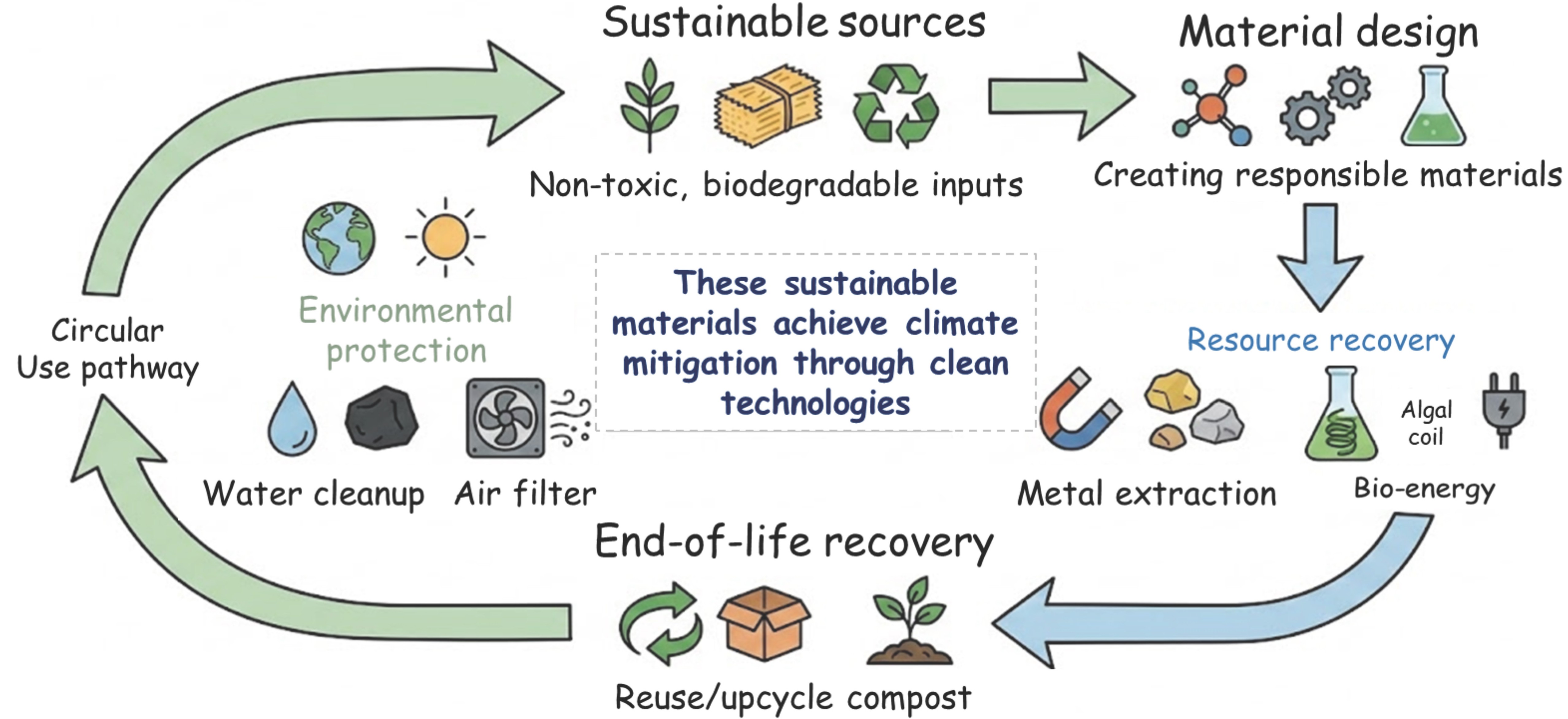
Growing concerns about resource depletion, pollution, climate change, and waste production have made sustainable and green materials an essential subject of study. Unlike traditional materials, which are often linked to energy-intensive manufacturing, hazardous chemicals, and poor end-of-life management, sustainable materials are designed to reduce environmental burdens while maintaining practical functionality. This narrative review examined literature published predominantly between 2014 and 2026 and evaluated 72 references related to bio-based, waste-derived, recycled, and hybrid materials for environmental applications. Recent studies have reported the development of these materials for water treatment, air pollution control, catalysis, carbon management, climate mitigation, and resource recovery. However, the sustainability of a material should not be assessed solely based on its renewable origin or green synthesis technique. The true environmental value must be evaluated based on functional performance, durability, reusability, scalability, and total environmental benefit. This overview encapsulates recent progress in sustainable and green materials from a function-centric viewpoint, emphasizing essential material classifications, design methodologies, and ecological applications. Emphasis is placed on the interconnections between material supply, structure, characteristics, and practical performance, alongside contemporary concerns of lifecycle impact, regeneration, and real-world applicability. This review presents a comprehensive framework integrating functional performance, life-cycle burden, durability, regeneration and reusability, scalability, and real-world applicability to facilitate the rational design and assessment of sustainable materials for environmental preservation, climate mitigation, and the advancement of the circular economy.
- Open Access
- Review
Beyond Green Synthesis: Materials for Environmental Preservation and Resource Recovery
- Ajcharapa Chuanchai 1,
- Wei-Hsin Chen 1,2,3,*
Author Information
Received: 10 May 2026 | Revised: 28 Jun 2026 | Accepted: 05 Jul 2026 | Published: 16 Jul 2026
Abstract
Graphical Abstract
Keywords
sustainable and green materials | environmental protection | pollution control | resource recovery | circular economy | climate mitigation
References
- 1.
Tabakh, M.; Attarzadeh, R.; Yarahmadi, R.; et al. From waste to functional materials: A review on innovations in waste Management for Environmental Remediation Applications. Coord. Chem. Rev. 2026, 549, 217379. https://doi.org/10.1016/j.ccr.2025.217379.
- 2.
Kader, S.; Gratchev, I.; Michael, R.N. Recycled waste substrates: A systematic review. Sci. Total Environ. 2024, 953, 176029. https://doi.org/10.1016/j.scitotenv.2024.176029.
- 3.
Hublikar, L.V.; Nivedhitha, K.S.; Chikkatti, B.S.; et al. Functionalized biochar–metal oxide nanocomposites for the catalytic degradation of recalcitrant pollutants in wastewater treatment. RSC Adv. 2026, 16, 12186–12214. https://doi.org/10.1039/d5ra07670f.
- 4.
Mukherjee, S.; Lombardo, S.; Edlund, U. Multifunctional lignin biocomposite for broad-spectrum water purification. Environ. Sci. Adv. 2026, 5, 485–498. https://doi.org/10.1039/d5va00282f.
- 5.
Ruiz-Caldas, M.-X.; Carlsson, J.; Sadiktsis, I.; et al. Cellulose Nanocrystals from Postconsumer Cotton and Blended Fabrics: A Study on Their Properties, Chemical Composition, and Process Efficiency. ACS Sustain. Chem. Eng. 2022, 10, 3787–3798. https://doi.org/10.1021/acssuschemeng.2c00797.
- 6.
Chen, X.-Q.; Pang, G.-X.; Shen, W.-H.; et al. Preparation and characterization of the ribbon-like cellulose nanocrystals by the cellulase enzymolysis of cotton pulp fibers. Carbohydr. Polym. 2019, 207, 713–719. https://doi.org/10.1016/j.carbpol.2018.12.042.
- 7.
Zhong, T.; Dhandapani, R.; Liang, D.; et al. Nanocellulose from recycled indigo-dyed denim fabric and its application in composite films. Carbohydr. Polym. 2020, 240, 116283. https://doi.org/10.1016/j.carbpol.2020.116283.
- 8.
Taher, T.; Rianjanu, A. Emerging trends and future perspectives in adsorption technologies for water and wastewater treatment: A sunrise or sunset horizon? Greensusmater 2024, 1, 1–8. https://doi.org/10.62755/greensusmater.2024.1.1.1-8.
- 9.
Atalie, D.; Abtew, M.A.; Zhao, L. Recent Advances in Bio-Based Nonwoven Materials: Sustainable Production, Applications, and Circular Economy. J. Nat. Fibers 2025, 22, 2565661. https://doi.org/10.1080/15440478.2025.2565661.
- 10.
Mamay Daget, T.; Birlie Kassie, B.; Tadesse Abate, M.; et al. Eco-friendly and bio-based approaches for flame-retardant functionalization of textile materials: A review. Polym. Plast. Technol. Mater. 2024, 63, 1887–1916. https://doi.org/10.1080/25740881.2024.2363260.
- 11.
Tazmeen, T.; Mir, F.Q. Sustainability through materials: A review of green options in construction. Results Surf. Interfaces 2024, 14, 100206. https://doi.org/10.1016/j.rsurfi.2024.100206.
- 12.
Ram, S.; Patil, Y.; Abdelrhman, F.; et al. Kinetics for Catalytic Pyrolysis of Organic Solid Wastes. Green Energy Fuel Res. 2025, 2, 328–359. https://doi.org/10.53941/gefr.2025.100023.
- 13.
Trivedi, Y.; Sharma, M.; Mishra, R.K.; et al. Biochar potential for pollutant removal during wastewater treatment: A comprehensive review of separation mechanisms, technological integration, and process analysis. Desalination 2025, 600, 118509. https://doi.org/10.1016/j.desal.2024.118509.
- 14.
Arfasa, G.F.; Tilahun, Z.A. Life-Cycle impacts of biochar, MOFs, and biomass adsorbents: A meta-analysis for wastewater and carbon management. Environ. Chall. 2025, 21, 101331. https://doi.org/10.1016/j.envc.2025.101331.
- 15.
Rosenboom, J.-G.; Langer, R.; Traverso, G. Bioplastics for a circular economy. Nat. Rev. Mater. 2022, 7, 117–137. https://doi.org/10.1038/s41578-021-00407-8.
- 16.
Chen, H. Biotechnology of Lignocellulose: Theory and Practice; Springer: Berlin/Heidelberg, Germany, 2014.
- 17.
Başarır, F.; Al Haj, Y.; Zou, F.; et al. Edible and Biodegradable Wearable Capacitive Pressure Sensors: A Paradigm Shift toward Sustainable Electronics with Bio‐Based Materials. Adv. Funct. Mater. 2024, 34, 2403268. https://doi.org/10.1002/adfm.202403268.
- 18.
McGuire, T.; Ning, D.; Buchard, A.; et al. The Science of Polymer Chemical Recycling Catalysis: Uncovering Kinetic and Thermodynamic Linear Free Energy Relationships. J. Am. Chem. Soc. 2025, 147, 22734–22746. https://doi.org/10.1021/jacs.5c04603.
- 19.
Wu, S.; Yan, Y.; Yin, J.; et al. Redox mediator-stabilized wide-bandgap perovskites for monolithic perovskite-organic tandem solar cells. Nat. Energy 2024, 9, 411–421. https://doi.org/10.1038/s41560-024-01451-8.
- 20.
RameshKumar, S.; Shaiju, P.; O’Connor, K.E.; et al. Bio-based and biodegradable polymers—State-of-the-art, challenges and emerging trends. Curr. Opin. Green Sustain. Chem. 2020, 21, 75–81. https://doi.org/10.1016/j.cogsc.2019.12.005.
- 21.
Kumbasaroglu, H.; Kumbasaroglu, A. Applicability of Agro-Waste Materials in Structural Systems for Building Construction: A Scoping Review. Appl. Sci. 2025, 15, 71. https://doi.org/10.3390/app15010071.
- 22.
Singh, J.; Ordoñez, I. Resource recovery from post-consumer waste: Important lessons for the upcoming circular economy. J. Clean. Prod. 2016, 134, 342–353. https://doi.org/10.1016/j.jclepro.2015.12.020.
- 23.
Yadav, G.; Yadav, N.; Sultana, M.; et al. A comprehensive review on low-cost waste-derived catalysts for environmental remediation. Mater. Res. Bull. 2023, 164, 112261. https://doi.org/10.1016/j.materresbull.2023.112261.
- 24.
Nadeem, A.; Tariq, M.; Safi, A.; et al. Life cycle assessment of a textile industry for environmental impacts under alternative operational scenarios. Water Sci. Technol. 2025, 92, 704–719. https://doi.org/10.2166/wst.2025.123.
- 25.
Breen, R.; Holmes, J.D.; Collins, G. Recent advances in chemical upcycling of plastic waste: Microwave-assisted heating and heterogeneous catalysis. EES Catal. 2026, 4, 249–269. https://doi.org/10.1039/d5ey00271k.
- 26.
Sharma, T.; Mary, K.; Singh, N.; et al. Review On Carbon Negative Innovations Including Biochar Hempcrete and the Next Generation of Sustainable Materials. EPJ Web Conf. 2026, 355, 05004. https://doi.org/10.1051/epjconf/202635505004.
- 27.
Palaniappan, M.; Palanisamy, S.; Louhichi, B.; et al. Environmentally Friendly Composites from Agricultural Residue Biomass for Lightweight Applications in New Generation Structures: A Review. BioResources 2025, 20, 11189–11226.
- 28.
Åhlén, M.; Afewerki, S.; Xu, C. A sustainable approach to biobased porous organic frameworks and their composites. Chem. Sci. 2026, 17, 712–724. https://doi.org/10.1039/d5sc08149a.
- 29.
Oliaei, E.; Olsén, P.; Lindström, T.; et al. Highly reinforced and degradable lignocellulose biocomposites by polymerization of new polyester oligomers. Nat. Commun. 2022, 13, 5666. https://doi.org/10.1038/s41467-022-33283-z.
- 30.
Hu, A.; Zhao, Y.; Hu, Q.; et al. Highly efficient solar steam evaporation via elastic polymer covalent organic frameworks monolith. Nat. Commun. 2024, 15, 9484. https://doi.org/10.1038/s41467-024-53902-1.
- 31.
Tian, X.; Cao, L.; Zhang, K.; et al. Molecular Weaving Towards Flexible Covalent Organic Framework Membranes for Efficient Gas Separations. Angew. Chem. Int. Ed. 2025, 64, e202416864. https://doi.org/10.1002/anie.202416864.
- 32.
Cerdan, K.; Thys, M.; Costa Cornellà, A.; et al. Sustainability of self-healing polymers: A holistic perspective towards circularity in polymer networks. Prog. Polym. Sci. 2024, 152, 101816. https://doi.org/10.1016/j.progpolymsci.2024.101816.
- 33.
Balcerak-Woźniak, A.; Dzwonkowska-Zarzycka, M.; Kabatc-Borcz, J. A Comprehensive Review of Stimuli-Responsive Smart Polymer Materials—Recent Advances and Future Perspectives. Materials 2024, 17, 4255. https://doi.org/10.3390/ma17174255.
- 34.
Liang, H.; Shi, X.; Li, Y. Technologies in Marine Antifouling and Anti-Corrosion Coatings: A Comprehensive Review. Coatings 2024, 14, 1487. https://doi.org/10.3390/coatings14121487.
- 35.
Visan, A.I.; Negut, I. Environmental and Wastewater Treatment Applications of Stimulus-Responsive Hydrogels. Gels 2025, 11, 72. https://doi.org/10.3390/gels11010072.
- 36.
Zeng, X. A Review on Design of Sustainable Advanced Materials by Using Artificial Intelligence. Adv. Mater. Sustain. Manuf. 2024, 1, 10006. https://doi.org/10.35534/amsm.2024.10006.
- 37.
Xian, Y.; Li, C.; Xu, Y.; et al. AI‐Driven Advances in Sustainable Materials for Green Energy: From Innovation to Lifecycle Management. SusMat 2025, 5, e70030. https://doi.org/10.1002/sus2.70030.
- 38.
Xue, X.; Dhumras, H.; Thakur, G.; et al. Integrating artificial intelligence and sustainable materials for smart eco innovation in production. Sci. Rep. 2025, 15, 36942. https://doi.org/10.1038/s41598-025-20803-2.
- 39.
Agaton, C.B. Nature-Based Solutions for Removal of Microplastics from Wastewater: Technologies, Challenges, and Prospects. Microplastics 2025, 4, 107. https://doi.org/10.3390/microplastics4040107.
- 40.
Wang, L.; Liang, L.; Li, N.; et al. A Mini-Review of Sludge-Derived Biochar (SDB) for Wastewater Treatment: Recent Advances in 2020–2025. Appl. Sci. 2025, 15, 6173.
- 41.
El Barkaoui, S.; Mandi, L.; Aziz, F.; et al. A critical review on using biochar as constructed wetland substrate: Characteristics, feedstock, design and pollutants removal mechanisms. Ecol. Eng. 2023, 190, 106927. https://doi.org/10.1016/j.ecoleng.2023.106927.
- 42.
Yang, R.; Yang, Q. A review of emerged constructed wetlands based on biochar filler: Wastewater purification and carbon sequestration/greenhouse gas reduction. Environ. Eng. Res. 2024, 29, 230105. https://doi.org/10.4491/eer.2023.105.
- 43.
Makoś-Chełstowska, P.; Słupek, E.; Gębicki, J. Agri-food waste biosorbents for volatile organic compounds removal from air and industrial gases—A review. Sci. Total Environ. 2024, 945, 173910. https://doi.org/10.1016/j.scitotenv.2024.173910.
- 44.
Alayaki, F.M.; Hajikarimi, P.; Meky, N.; et al. Global applications of biochar in sustainable cities of the future: A perspective. Biochar X 2025, 1, e010. https://doi.org/10.48130/bchax-0025-0009.
- 45.
Papchenko, K.; Ricci, E.; De Angelis, M.G. Modelling Across Multiple Scales to Design Biopolymer Membranes for Sustainable Gas Separations: 2-Multiscale Approach. Polymers 2024, 16, 2776.
- 46.
Budhathoki, S.; Ajayi, O.; Steckel, J.A.; et al. High-throughput computational prediction of the cost of carbon capture using mixed matrix membranes. Energy Environ. Sci. 2019, 12, 1255–1264. https://doi.org/10.1039/C8EE02582G.
- 47.
Mollahosseini, A.; Nikkhah Dafchahi, M.; Khoshhal Salestan, S.; et al. Polymeric membranes in carbon capture, utilization, and storage: Current trends and future directions in decarbonization of industrial flue gas and climate change mitigation. Energy Environ. Sci. 2025, 18, 5025–5092. https://doi.org/10.1039/D4EE05328A.
- 48.
Kurniawan, T.A.; Khan, S.; Mohyuddin, A.; et al. Technological solutions for air pollution control to mitigate climate change: An approach to facilitate global transition toward blue sky and net-zero emission. Chem. Pap. 2024, 78, 6843–6871. https://doi.org/10.1007/s11696-024-03594-0.
- 49.
Cordero-Lanzac, T.; Ramirez, A.; Navajas, A.; et al. A techno-economic and life cycle assessment for the production of green methanol from CO2: Catalyst and process bottlenecks. J. Energy Chem. 2022, 68, 255–266. https://doi.org/10.1016/j.jechem.2021.09.045.
- 50.
Banerjee, T.; Podjaski, F.; Kröger, J.; et al. Polymer photocatalysts for solar-to-chemical energy conversion. Nat. Rev. Mater. 2020, 6, 168–190. https://doi.org/10.1038/s41578-020-00254-z.
- 51.
Sherpa, K.; Nguyen, T.-B.; Goh, B.T.; et al. Engineering Ru-MOF–3D g-C3N4 interfaces for boosted photocatalytic H2 evolution. Sep. Purif. Technol. 2026, 394, 137676. https://doi.org/10.1016/j.seppur.2026.137676.
- 52.
Mani, P.; Shenoy, S.; Sagayaraj, P.J.J.; et al. Scaling up of photocatalytic systems for large-scale hydrogen generation. Appl. Phys. Rev. 2025, 12, 011303. https://doi.org/10.1063/5.0223598.
- 53.
Kehrein, P.; van Loosdrecht, M.; Osseweijer, P.; et al. A critical review of resource recovery from municipal wastewater treatment plants—market supply potentials, technologies and bottlenecks. Environ. Sci. Water Res. Technol. 2020, 6, 877–910. https://doi.org/10.1039/C9EW00905A.
- 54.
Soo, A.; Kim, J.; Shon, H.K. Technologies for the wastewater circular economy—A review. Desalination Water Treat. 2024, 317, 100205. https://doi.org/10.1016/j.dwt.2024.100205.
- 55.
Ye, Z.; Shen, Y.; Ye, X.; et al. Phosphorus recovery from wastewater by struvite crystallization: Property of aggregates. J. Environ. Sci. 2014, 26, 991–1000. https://doi.org/10.1016/S1001-0742(13)60536-7.
- 56.
Chen, L.; Zhang, G.; Liu, H.; et al. Efficient Metal Recovery from Industrial Wastewater: Potential Oscillation and Turbulence Mode for Electrochemical System. Engineering 2024, 38, 184–193. https://doi.org/10.1016/j.eng.2023.12.002.
- 57.
Maktabifard, M.; Zaborowska, E.; Makinia, J. Achieving energy neutrality in wastewater treatment plants through energy savings and enhancing renewable energy production. Rev. Environ. Sci. Bio/Technol. 2018, 17, 655–689. https://doi.org/10.1007/s11157-018-9478-x.
- 58.
Singh, J.; Verma, M. Waste derived modified biochar as promising functional material for enhanced water remediation potential. Environ. Res. 2024, 245, 117999. https://doi.org/10.1016/j.envres.2023.117999.
- 59.
Cardenas, I.C. Mitigation of climate change. Risk and uncertainty research gaps in the specification of mitigation actions. Environ. Sci. Policy 2024, 162, 103912. https://doi.org/10.1016/j.envsci.2024.103912.
- 60.
Shobanke, M.; Bhatt, M.; Shittu, E. Advancements and future outlook of Artificial Intelligence in energy and climate change modeling. Adv. Appl. Energy 2025, 17, 100211. https://doi.org/10.1016/j.adapen.2025.100211.
- 61.
Mesa, J.A.; Sierra-Fontalvo, L.; Ortegon, K.; et al. Advancing circular bioeconomy: A critical review and assessment of indicators. Sustain. Prod. Consum. 2024, 46, 324–342. https://doi.org/10.1016/j.spc.2024.03.006.
- 62.
Moraga, G.; Huysveld, S.; Mathieux, F.; et al. Circular economy indicators: What do they measure?Resour. Conserv. Recycl. 2019, 146, 452–461. https://doi.org/10.1016/j.resconrec.2019.03.045.
- 63.
Vakili, M.; Cagnetta, G.; Deng, S.; et al. Regeneration of exhausted adsorbents after PFAS adsorption: A critical review. J. Hazard. Mater. 2024, 471, 134429. https://doi.org/10.1016/j.jhazmat.2024.134429.
- 64.
Guinée, J.B.; Heijungs, R.; Huppes, G.; et al. Life Cycle Assessment: Past, Present, and Future. Environ. Sci. Technol. 2011, 45, 90–96. https://doi.org/10.1021/es101316v.
- 65.
Zimmermann, A.; Wunderlich, J.; Müller, L.; et al. Techno-Economic Assessment Guidelines for CO2 Utilization. Front. Energy Res. 2020, 8, 5. https://doi.org/10.3389/fenrg.2020.00005.
- 66.
Del Borghi, A. LCA and communication: Environmental Product Declaration. Int. J. Life Cycle Assess. 2013, 18, 293–295. https://doi.org/10.1007/s11367-012-0513-9.
- 67.
Guo, S.; Li, Y.; Wang, Y.; et al. Recent advances in biochar-based adsorbents for CO2 capture. Carbon Capture Sci. Technol. 2022, 4, 100059. https://doi.org/10.1016/j.ccst.2022.100059.
- 68.
Bagotia, N. Regeneration strategies for exhausted adsorbents used in water treatment—A critical review. J. Water Process Eng. 2025, 69, 106560. https://doi.org/10.1016/j.jwpe.2024.106560.
- 69.
Osman, A.I.; Farghali, M.; Dong, Y.; et al. Reducing the carbon footprint of buildings using biochar-based bricks and insulating materials: A review. Environ. Chem. Lett. 2024, 22, 71–104. https://doi.org/10.1007/s10311-023-01662-7.
- 70.
Nwagwu, C.C.; Ogorodnyk, O.; Sølvsberg, E.; et al. Integrating Artificial Intelligence into Life Cycle Assessment: A Framework for Balancing Automation and Human Expertise. J. Sustain. Metall. 2025, 11, 3590–3605. https://doi.org/10.1007/s40831-025-01305-x.
- 71.
Trienens, M.; Rasor, R.; Kharatyan, A.; et al. Digital twins to increase sustainability throughout the system life cycle: A systematic literature review. Proc. Des. Soc. 2024, 4, 2277–2286. https://doi.org/10.1017/pds.2024.230.
- 72.
McDonald, L.J.; Hernandez Galvan, J.L.; Emelue, C.; et al. Towards a unified carbon accounting landscape. Philos. Trans. A Math. Phys. Eng. Sci. 2024, 382, 20230260. https://doi.org/10.1098/rsta.2023.0260.


This work is licensed under a Creative Commons Attribution 4.0 International License.

 Suite 4002 Level 4, 447 Collins Street, Melbourne, Victoria 3000, Australia
 General Inquiries: info@sciltp.com