
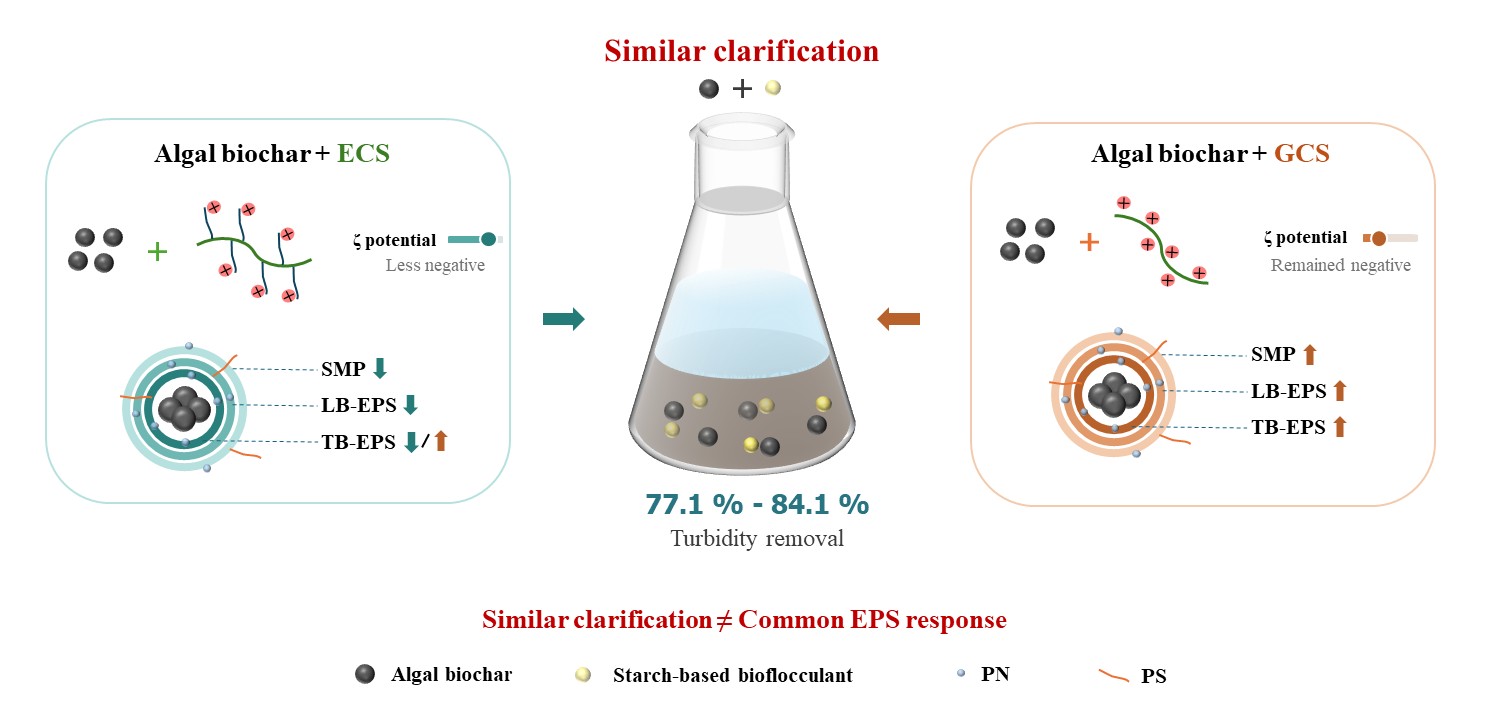
Anaerobically digested sludge (ADS) can be difficult to separate because fine particles and hydrated extracellular polymeric substances (EPS) contribute to sludge dispersion and water retention. Although particulate conditioners and bio-based flocculants have each been investigated, their combined effects on EPS distribution and sludge conditioning mechanisms are still poorly understood. This study evaluated algal biochar as an auxiliary conditioner in combination with grafted cationic starch (GCS) or etherified cationic starch (ECS), with particular attention to EPS fractions. The combined treatments achieved supernatant turbidity removals of 77.1% to 84.1%, exceeding that achieved with the corresponding starch-based flocculants alone. Although the two conditioning systems showed similar turbidity removal, they followed different zeta-potential and EPS responses. The algal biochar and ECS system shifted to less negative values and reduced soluble microbial products (SMP) and loosely bound EPS (LB-EPS). In contrast, the GCS combinations remained negatively charged and increased tightly bound EPS (TB-EPS) by 52% to 54% compared with GCS alone. These findings show that comparable supernatant clarification can be accompanied by contrasting electrokinetic and operationally extracted EPS profiles. The results highlight the value of examining EPS fractions alongside turbidity when comparing combined conditioning formulations. The implications of these profiles for sludge dewaterability and filterability remain to be established through direct performance measurements.
- Open Access
- Article
Combined Algal Biochar–Starch Bioflocculant Conditioning Reveals Distinct Responses of Extracellular Polymeric Substances in Anaerobically Digested Sludge
Author Information
Received: 20 Aug 2026 | Revised: 15 Sep 2026 | Accepted: 08 Oct 2026 | Published: 19 Oct 2026
Abstract
Graphical Abstract
Keywords
algal biochar | anaerobically digested sludge | cationic starch | extracellular polymeric substances | combined conditioning
References
- 1.
Zhang, Y.; Li, H.; Li, D. Maximize methane recovery from sludge anaerobic digestion by combining an optimal wet air oxidation process. Renew. Energy 2021, 179, 359–369. https://doi.org/10.1016/j.renene.2021.07.051.
- 2.
Cao, B.; Zhang, T.; Zhang, W.; et al. Enhanced technology based for sewage sludge deep dewatering: A critical review. Water Res. 2021, 189, 116650. https://doi.org/10.1016/j.watres.2020.116650.
- 3.
Zhang, J.; Li, N.; Dai, X.; et al. Enhanced dewaterability of sludge during anaerobic digestion with thermal hydrolysis pretreatment: New insights through structure evolution. Water Res. 2018, 131, 177–185. https://doi.org/10.1016/j.watres.2017.12.042.
- 4.
Luna Nino, S.; Meyer, T.; Edwards, E.A.; et al. Effects of anaerobic digestion on the dewaterability of sonicated biosludge. J. Environ. Manag. 2025, 388, 125981. https://doi.org/10.1016/j.jenvman.2025.125981.
- 5.
Lin, F.; Zhu, X.; Li, J.; et al. Effect of extracellular polymeric substances (EPS) conditioned by combined lysozyme and cationic polyacrylamide on the dewatering performance of activated sludge. Chemosphere 2019, 235, 679–689. https://doi.org/10.1016/j.chemosphere.2019.06.220.
- 6.
Liu, Z.; Luo, F.; He, L.; et al. Physical conditioning methods for sludge deep dewatering: A critical review. J. Environ. Manag. 2024, 360, 121207. https://doi.org/10.1016/j.jenvman.2024.121207.
- 7.
Wu, B.; Wang, H.; Dai, X.; et al. Influential mechanism of water occurrence states of waste-activated sludge: specifically focusing on the roles of EPS micro-spatial distribution and cation-dominated interfacial properties. Water Res. 2021, 202, 117461. https://doi.org/10.1016/j.watres.2021.117461.
- 8.
Sheng, G.P.; Yu, H.Q.; Li, X.Y. Extracellular polymeric substances (EPS) of microbial aggregates in biological wastewater treatment systems: A review. Biotechnol. Adv. 2010, 28, 882–894. https://doi.org/10.1016/j.biotechadv.2010.08.001.
- 9.
Ben Hamed, H.; Mainardis, M.; Moretti, A.; et al. Extracellular polymeric substances (EPS) in sewage sludge management: A call for methodological standardization. J. Environ. Manag. 2025, 376, 124407. https://doi.org/10.1016/j.jenvman.2025.124407.
- 10.
Yu, G.H.; He, P.J.; Shao, L.M.; et al. Stratification Structure of Sludge Flocs with Implications to Dewaterability. Environ. Sci. Technol. 2008, 42, 7944–7949. https://doi.org/10.1021/es8016717.
- 11.
Li, X.Y.; Yang, S.F. Influence of loosely bound extracellular polymeric substances (EPS) on the flocculation, sedimentation and dewaterability of activated sludge. Water Res. 2007, 41, 1022–1030. https://doi.org/10.1016/j.watres.2006.06.037.
- 12.
Basuvaraj, M.; Fein, J.; Liss, S.N. Protein and polysaccharide content of tightly and loosely bound extracellular polymeric substances and the development of a granular activated sludge floc. Water Res. 2015, 82, 104–117. https://doi.org/10.1016/j.watres.2015.05.014.
- 13.
Wei, H.; Gao, B.; Ren, J.; et al. Coagulation/flocculation in dewatering of sludge: A review. Water Res. 2018, 143, 608–631. https://doi.org/10.1016/j.watres.2018.07.029.
- 14.
Chang, N.; Cao, S.; Li, J.; et al. Preparation of Starch-Based Cationic Flocculants and Its Study on the Removal of Textile Dyes. Ind. Eng. Chem. Res. 2024, 63, 2483–2494. https://doi.org/10.1021/acs.iecr.3c03170.
- 15.
Zhang, J.; Li, P.; Yu, Y.; et al. A Review of Natural Polysaccharides-Based Flocculants Derived from Waste: Application Efficiency, Function Mechanism, and Development Prospects. Ind. Eng. Chem. Res. 2023, 62, 15774–15789. https://doi.org/10.1021/acs.iecr.3c02563.
- 16.
Hu, P.; Zhuang, S.; Shen, S.; et al. Dewaterability of sewage sludge conditioned with a graft cationic starch-based flocculant: Role of structural characteristics of flocculant. Water Res. 2021, 189, 116578. https://doi.org/10.1016/j.watres.2020.116578.
- 17.
Hu, P.; Shen, S.; Zhao, D.; et al. The influence of hydrophobicity on sludge dewatering associated with cationic starch-based flocculants. J. Environ. Manag. 2021, 296, 113218. https://doi.org/10.1016/j.jenvman.2021.113218.
- 18.
Qi, Y.; Thapa, K.B.; Hoadley, A.F.A. Application of filtration aids for improving sludge dewatering properties—A review. Chem. Eng. J. 2011, 171, 373–384. https://doi.org/10.1016/j.cej.2011.04.060.
- 19.
Wu, B.; Dai, X.; Chai, X. Critical review on dewatering of sewage sludge: Influential mechanism, conditioning technologies and implications to sludge re-utilizations. Water Res. 2020, 180, 115912. https://doi.org/10.1016/j.watres.2020.115912.
- 20.
Thapa, K.B.; Qi, Y.; Clayton, S.A.; et al. Lignite aided dewatering of digested sewage sludge. Water Res. 2009, 43, 623–634. https://doi.org/10.1016/j.watres.2008.11.005.
- 21.
Wu, Y.; Zhang, P.; Zeng, G.; et al. Enhancing Sewage Sludge Dewaterability by a Skeleton Builder: Biochar Produced from Sludge Cake Conditioned with Rice Husk Flour and FeCl3. ACS Sustain. Chem. Eng. 2016, 4, 5711–5717. https://doi.org/10.1021/acssuschemeng.6b01654.
- 22.
Xiong, Q.; Zhou, M.; Yang, H.; et al. Improving the Dewaterability of Sewage Sludge Using Rice Husk and Fe2+-Sodium Persulfate Oxidation. ACS Sustain. Chem. Eng. 2018, 6, 872–881. https://doi.org/10.1021/acssuschemeng.7b03227.
- 23.
Chen, K.; Sun, Y.; Fan, J.; et al. The dewatering performance and cracking-flocculation-skeleton mechanism of bioleaching-coal fly ash combined process for sewage sludge. Chemosphere 2022, 307, 135994. https://doi.org/10.1016/j.chemosphere.2022.135994.
- 24.
Zhang, X.; Kang, H.; Zhang, Q.; et al. The porous structure effects of skeleton builders in sustainable sludge dewatering process. J. Environ. Manag. 2019, 230, 14–20. https://doi.org/10.1016/j.jenvman.2018.09.049.
- 25.
Shen, S.; Wei, H.; Pan, Y.; et al. The enhanced dewaterability of sludge by a starch-based flocculant combined with attapulgite. Sci. Rep. 2023, 13, 402. https://doi.org/10.1038/s41598-023-27749-3.
- 26.
Sun, J.; Norouzi, O.; Mašek, O. A state-of-the-art review on algae pyrolysis for bioenergy and biochar production. Bioresour. Technol. 2022, 346, 126258. https://doi.org/10.1016/j.biortech.2021.126258.
- 27.
Bird, M.I.; Wurster, C.M.; de Paula Silva, P.H.; et al. Algal biochar—production and properties. Bioresour. Technol. 2011, 102, 1886–1891. https://doi.org/10.1016/j.biortech.2010.07.106.
- 28.
Leong, Y.K.; Chang, J.S. Microalgae-based biochar production and applications: A comprehensive review. Bioresour. Technol. 2023, 389, 129782. https://doi.org/10.1016/j.biortech.2023.129782.
- 29.
Wang, C.; Lin, X.; Zhang, X.; et al. Research advances on production and application of algal biochar in environmental remediation. Environ. Pollut. 2024, 348, 123860. https://doi.org/10.1016/j.envpol.2024.123860.
- 30.
Tan, L.; Zhang, J.; Du, J.; et al. Advanced oxidation using modified enteromorpha algae-derived biochar for marine sediment dehydration. Front. Chem. 2025, 13, 1546240. https://doi.org/10.3389/fchem.2025.1546240.
- 31.
Wang, Z.; Wu, Z.; Tang, S. Extracellular polymeric substances (EPS) properties and their effects on membrane fouling in a submerged membrane bioreactor. Water Res. 2009, 43, 2504–2512. https://doi.org/10.1016/j.watres.2009.02.026.
- 32.
Felz, S.; Vermeulen, P.; van Loosdrecht, M.C.M.; et al. Chemical characterization methods for the analysis of structural extracellular polymeric substances (EPS). Water Res. 2019, 157, 201–208. https://doi.org/10.1016/j.watres.2019.03.068.
- 33.
Deng, L.; Guo, W.; Ngo, H.H.; et al. A comparison study on membrane fouling in a sponge-submerged membrane bioreactor and a conventional membrane bioreactor. Bioresour. Technol. 2014, 165, 69–74. https://doi.org/10.1016/j.biortech.2014.02.111.
- 34.
Wang, L.L.; Wang, L.F.; Ren, X.M.; et al. pH Dependence of Structure and Surface Properties of Microbial EPS. Environ. Sci. Technol. 2012, 46, 737–744. https://doi.org/10.1021/es203540w.
- 35.
Bolto, B.; Gregory, J. Organic polyelectrolytes in water treatment. Water Res. 2007, 41, 2301–2324. https://doi.org/10.1016/j.watres.2007.03.012.
- 36.
Lee, C.H.; Liu, J.C. Enhanced sludge dewatering by dual polyelectrolytes conditioning. Water Res. 2000, 34, 4430–4436. https://doi.org/10.1016/s0043-1354(00)00209-8.
- 37.
Yu, J.; Xiao, K.; Xu, H.; et al. Spectroscopic fingerprints profiling the polysaccharide/protein/humic architecture of stratified extracellular polymeric substances (EPS) in activated sludge. Water Res. 2023, 235, 119866. https://doi.org/10.1016/j.watres.2023.119866.
- 38.
Guo, Z.; Ma, L.; Dai, Q.; et al. Role of extracellular polymeric substances in sludge dewatering under modified corn-core powder and sludge-based biochar pretreatments. Ecotoxicol. Environ. Saf. 2020, 202, 110882. https://doi.org/10.1016/j.ecoenv.2020.110882.
- 39.
Wei, H.; Hu, P.; Li, A.; et al. Evaluation of acidification and oxidation of sludge to improve the effect of a starch-based flocculant on the dewaterability of sewage sludge. J. Environ. Manag. 2019, 231, 405–412. https://doi.org/10.1016/j.jenvman.2018.10.058.
- 40.
Cao, X.; Yu, R.; Wang, X. Impact of Conditioning Agent Addition Sequence on Dewatering Performance of Advanced Anaerobic Digested Sludge. Water 2024, 16, 695. https://doi.org/10.3390/w16050695.
- 41.
Liu, X.M.; Sheng, G.P.; Luo, H.W.; et al. Contribution of Extracellular Polymeric Substances (EPS) to the Sludge Aggregation. Environ. Sci. Technol. 2010, 44, 4355–4360. https://doi.org/10.1021/es9016766.


This work is licensed under a Creative Commons Attribution 4.0 International License.

 Suite 4002 Level 4, 447 Collins Street, Melbourne, Victoria 3000, Australia
 General Inquiries: info@sciltp.com